Presented by:
Vaishnav
Kumar
Agenda
    Preamble
    Brief history
    Governors
    The key role of the RBI
    Monetary authority
    Regulator and supervisor of the financial system
    Manager of foreign exchange
    Issuer of currency
    Developmental role
    Instruments of credit control
    Objective and reasons for establishment of RBI
    Subsidiaries
Central Bank
 “It is a bank of banker”
                               -- Samuelson

 “Bank which has monopoly over note issue”
                       -- Vera Smith

 “Central bank is the government’s bank”
                           -- Sayers
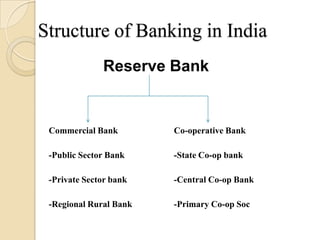
Structure of Banking in India
              Reserve Bank


 Commercial Bank        Co-operative Bank

 -Public Sector Bank    -State Co-op bank

 -Private Sector bank   -Central Co-op Bank

 -Regional Rural Bank   -Primary Co-op Soc
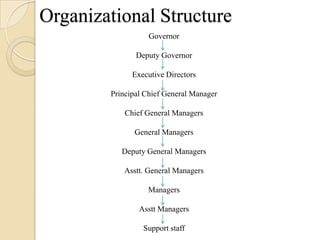
Organizational Structure
                   Governor

               Deputy Governor

              Executive Directors

        Principal Chief General Manager

            Chief General Managers

              General Managers

           Deputy General Managers

           Asstt. General Managers

                  Managers

                Asstt Managers

                 Support staff
PREAMBLE

   The preamble of the Reserve Bank of India describe the basic functions
    of the Reserve Bank as


          “…to regulate the issue of Bank Notes and keeping of reserve with
    a view to securing monetary stability in India and generally to operate
    the currency and credit system of the country to its advantage”
BRIEF HISTORY                          (1 OF 2)


    It was set up on the recommendations of the HILTON YOUNG
     COMMISSION
    It was started as Share-Holders Bank with a paid up capital of 5 Crs
    It was established on 1st of April 1935
    Initially it was located in Kolkata
    It moved to Mumbai in the year 1937
    Initially it was privately owned
    It was the 1st bank to be Nationalized in 1949
    It has 22 regional offices, most of them in state capitals
BRIEF HISTORY                          (2 OF 2)


   Since nationalization in 1949, the Reserve Bank is fully owned by
    the Government of India
   Its First governor was Sir Osborne A.Smith(1st April 1935 to 30th
    June 1937)
   The First Indian Governor was “Sir Chintaman D.Deshmukh”(11th
    August 1943 to 30th June 1949)
   On 27th June 2006, the Union Government of India reconstituted the
    Central Board of Directors of the Reserve Bank of India(RBI) with
    13 Members, including Azim Premji and Kumar Mangalam Birla
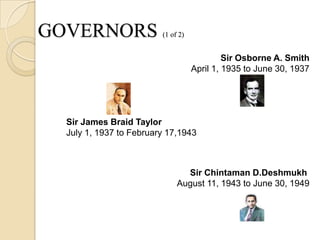
GOVERNORS                (1 of 2)


                                             Sir Osborne A. Smith
                                    April 1, 1935 to June 30, 1937


  Sir James Braid Taylor
  July 1, 1937 to February 17,1943


                                Sir Chintaman D.Deshmukh
                              August 11, 1943 to June 30, 1949
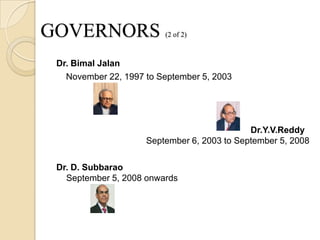
GOVERNORS                (2 of 2)


 Dr. Bimal Jalan
   November 22, 1997 to September 5, 2003


                                             Dr.Y.V.Reddy
                     September 6, 2003 to September 5, 2008

 Dr. D. Subbarao
   September 5, 2008 onwards
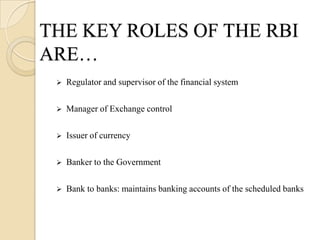
THE KEY ROLES OF THE RBI
ARE…
    Regulator and supervisor of the financial system

    Manager of Exchange control

    Issuer of currency

    Banker to the Government

    Bank to banks: maintains banking accounts of the scheduled banks
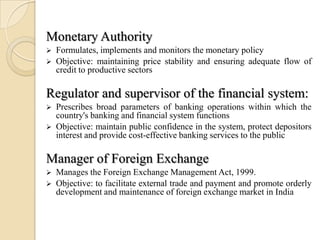
Monetary Authority
   Formulates, implements and monitors the monetary policy
   Objective: maintaining price stability and ensuring adequate flow of
    credit to productive sectors

Regulator and supervisor of the financial system:
   Prescribes broad parameters of banking operations within which the
    country's banking and financial system functions
   Objective: maintain public confidence in the system, protect depositors
    interest and provide cost-effective banking services to the public

Manager of Foreign Exchange
   Manages the Foreign Exchange Management Act, 1999.
   Objective: to facilitate external trade and payment and promote orderly
    development and maintenance of foreign exchange market in India
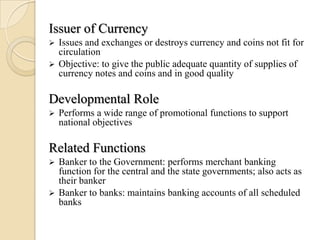
Issuer of Currency
 Issues and exchanges or destroys currency and coins not fit for
  circulation
 Objective: to give the public adequate quantity of supplies of
  currency notes and coins and in good quality

Developmental Role
   Performs a wide range of promotional functions to support
    national objectives

Related Functions
 Banker to the Government: performs merchant banking
  function for the central and the state governments; also acts as
  their banker
 Banker to banks: maintains banking accounts of all scheduled
  banks
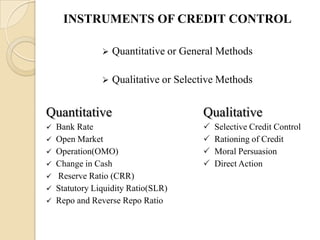
INSTRUMENTS OF CREDIT CONTROL

                   Quantitative or General Methods

                   Qualitative or Selective Methods


Quantitative                            Qualitative
   Bank Rate                              Selective Credit Control
   Open Market                            Rationing of Credit
   Operation(OMO)                         Moral Persuasion
   Change in Cash                         Direct Action
   Reserve Ratio (CRR)
   Statutory Liquidity Ratio(SLR)
   Repo and Reverse Repo Ratio
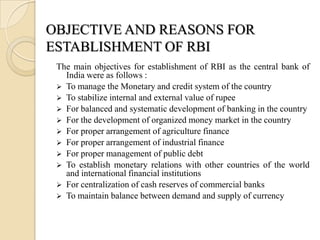
OBJECTIVE AND REASONS FOR
ESTABLISHMENT OF RBI
 The main objectives for establishment of RBI as the central bank of
   India were as follows :
  To manage the Monetary and credit system of the country
  To stabilize internal and external value of rupee
  For balanced and systematic development of banking in the country
  For the development of organized money market in the country
  For proper arrangement of agriculture finance
  For proper arrangement of industrial finance
  For proper management of public debt
  To establish monetary relations with other countries of the world
   and international financial institutions
  For centralization of cash reserves of commercial banks
  To maintain balance between demand and supply of currency
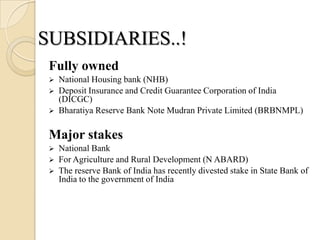
SUBSIDIARIES..!
 Fully owned
    National Housing bank (NHB)
    Deposit Insurance and Credit Guarantee Corporation of India
     (DICGC)
    Bharatiya Reserve Bank Note Mudran Private Limited (BRBNMPL)

 Major stakes
    National Bank
    For Agriculture and Rural Development (N ABARD)
    The reserve Bank of India has recently divested stake in State Bank of
     India to the government of India
Related Functions
   RBI also regulates the opening / installation of ATM
   RBI regulates the opening of branches by banks
   It ensures that all the N.B.F.C follow the KYC Guidelines
   Fresh currency notes for ATM are supplied by RBI
   Banker to the Government: Performs all banking function for the
    central and state governments and also act as their banker
   The reserve bank of India also regulates the trade of gold. Currently
    17 banks are involved in the trade of gold in India RBI has invited
    applications from more banks for direct import of gold to curb
    illegal trade in gold and increase competition in the market
   It issues guidelines and directions for the commercial banks
Conclusion
    Central bank plays important role in achieving economic growth of
     a developing country
    It promotes economic growth with stability
    It helps in attaining full employment balance of payment
     disequilibrium and in stabilizing exchange rate
    RBI is an autonomous body promoted by the government of India
     and is headquartered at Mumbai
    RBI is an autonomous body promoted by the government of India
     and is headquartered at Mumbai treasury foreign exchange
     movements and is also the primary regulator for banking and non-
     banking financial institutions
    The RBI operates a number of government mints that produce
     currency and coins
RBI Websites
   RBI Bulletin………………………………..www.bulletin.rbi.org.in
   RBI Annual Report……………………...….www.annualreport.rbi.org.in
   Weekly Statistical Supplement……………...www.wss.rbi.org.in
   Monetary and Credit Policy………………….www.cpolicy.rbi.org.in
   RBI Notifications…………………………….www.notifics.rbi.org.in
   RBI Press Release…………………………….www.pr.rbi.org.in
   RBI Speeches…………………………………www.speeches.rbi.org.in
   Monetary and credit Information Review……www.mcir.rbi.org.in
   Report on Trend and Progress of Banking…..www.bankreport.rbi.org.in
Sources

 www.rbi.org.in

 www.financialexpress.com
THANK YOU

RBI Presentation

  • 1.
  • 2.
    Agenda  Preamble  Brief history  Governors  The key role of the RBI  Monetary authority  Regulator and supervisor of the financial system  Manager of foreign exchange  Issuer of currency  Developmental role  Instruments of credit control  Objective and reasons for establishment of RBI  Subsidiaries
  • 3.
    Central Bank “Itis a bank of banker” -- Samuelson “Bank which has monopoly over note issue” -- Vera Smith “Central bank is the government’s bank” -- Sayers
  • 4.
    Structure of Bankingin India Reserve Bank Commercial Bank Co-operative Bank -Public Sector Bank -State Co-op bank -Private Sector bank -Central Co-op Bank -Regional Rural Bank -Primary Co-op Soc
  • 5.
    Organizational Structure Governor Deputy Governor Executive Directors Principal Chief General Manager Chief General Managers General Managers Deputy General Managers Asstt. General Managers Managers Asstt Managers Support staff
  • 6.
    PREAMBLE  The preamble of the Reserve Bank of India describe the basic functions of the Reserve Bank as “…to regulate the issue of Bank Notes and keeping of reserve with a view to securing monetary stability in India and generally to operate the currency and credit system of the country to its advantage”
  • 7.
    BRIEF HISTORY (1 OF 2)  It was set up on the recommendations of the HILTON YOUNG COMMISSION  It was started as Share-Holders Bank with a paid up capital of 5 Crs  It was established on 1st of April 1935  Initially it was located in Kolkata  It moved to Mumbai in the year 1937  Initially it was privately owned  It was the 1st bank to be Nationalized in 1949  It has 22 regional offices, most of them in state capitals
  • 8.
    BRIEF HISTORY (2 OF 2)  Since nationalization in 1949, the Reserve Bank is fully owned by the Government of India  Its First governor was Sir Osborne A.Smith(1st April 1935 to 30th June 1937)  The First Indian Governor was “Sir Chintaman D.Deshmukh”(11th August 1943 to 30th June 1949)  On 27th June 2006, the Union Government of India reconstituted the Central Board of Directors of the Reserve Bank of India(RBI) with 13 Members, including Azim Premji and Kumar Mangalam Birla
  • 9.
    GOVERNORS (1 of 2) Sir Osborne A. Smith April 1, 1935 to June 30, 1937 Sir James Braid Taylor July 1, 1937 to February 17,1943 Sir Chintaman D.Deshmukh August 11, 1943 to June 30, 1949
  • 10.
    GOVERNORS (2 of 2) Dr. Bimal Jalan November 22, 1997 to September 5, 2003 Dr.Y.V.Reddy September 6, 2003 to September 5, 2008 Dr. D. Subbarao September 5, 2008 onwards
  • 11.
    THE KEY ROLESOF THE RBI ARE…  Regulator and supervisor of the financial system  Manager of Exchange control  Issuer of currency  Banker to the Government  Bank to banks: maintains banking accounts of the scheduled banks
  • 12.
    Monetary Authority  Formulates, implements and monitors the monetary policy  Objective: maintaining price stability and ensuring adequate flow of credit to productive sectors Regulator and supervisor of the financial system:  Prescribes broad parameters of banking operations within which the country's banking and financial system functions  Objective: maintain public confidence in the system, protect depositors interest and provide cost-effective banking services to the public Manager of Foreign Exchange  Manages the Foreign Exchange Management Act, 1999.  Objective: to facilitate external trade and payment and promote orderly development and maintenance of foreign exchange market in India
  • 13.
    Issuer of Currency Issues and exchanges or destroys currency and coins not fit for circulation  Objective: to give the public adequate quantity of supplies of currency notes and coins and in good quality Developmental Role  Performs a wide range of promotional functions to support national objectives Related Functions  Banker to the Government: performs merchant banking function for the central and the state governments; also acts as their banker  Banker to banks: maintains banking accounts of all scheduled banks
  • 14.
    INSTRUMENTS OF CREDITCONTROL  Quantitative or General Methods  Qualitative or Selective Methods Quantitative Qualitative  Bank Rate  Selective Credit Control  Open Market  Rationing of Credit  Operation(OMO)  Moral Persuasion  Change in Cash  Direct Action  Reserve Ratio (CRR)  Statutory Liquidity Ratio(SLR)  Repo and Reverse Repo Ratio
  • 15.
    OBJECTIVE AND REASONSFOR ESTABLISHMENT OF RBI The main objectives for establishment of RBI as the central bank of India were as follows :  To manage the Monetary and credit system of the country  To stabilize internal and external value of rupee  For balanced and systematic development of banking in the country  For the development of organized money market in the country  For proper arrangement of agriculture finance  For proper arrangement of industrial finance  For proper management of public debt  To establish monetary relations with other countries of the world and international financial institutions  For centralization of cash reserves of commercial banks  To maintain balance between demand and supply of currency
  • 16.
    SUBSIDIARIES..! Fully owned  National Housing bank (NHB)  Deposit Insurance and Credit Guarantee Corporation of India (DICGC)  Bharatiya Reserve Bank Note Mudran Private Limited (BRBNMPL) Major stakes  National Bank  For Agriculture and Rural Development (N ABARD)  The reserve Bank of India has recently divested stake in State Bank of India to the government of India
  • 17.
    Related Functions  RBI also regulates the opening / installation of ATM  RBI regulates the opening of branches by banks  It ensures that all the N.B.F.C follow the KYC Guidelines  Fresh currency notes for ATM are supplied by RBI  Banker to the Government: Performs all banking function for the central and state governments and also act as their banker  The reserve bank of India also regulates the trade of gold. Currently 17 banks are involved in the trade of gold in India RBI has invited applications from more banks for direct import of gold to curb illegal trade in gold and increase competition in the market  It issues guidelines and directions for the commercial banks
  • 18.
    Conclusion  Central bank plays important role in achieving economic growth of a developing country  It promotes economic growth with stability  It helps in attaining full employment balance of payment disequilibrium and in stabilizing exchange rate  RBI is an autonomous body promoted by the government of India and is headquartered at Mumbai  RBI is an autonomous body promoted by the government of India and is headquartered at Mumbai treasury foreign exchange movements and is also the primary regulator for banking and non- banking financial institutions  The RBI operates a number of government mints that produce currency and coins
  • 19.
    RBI Websites  RBI Bulletin………………………………..www.bulletin.rbi.org.in  RBI Annual Report……………………...….www.annualreport.rbi.org.in  Weekly Statistical Supplement……………...www.wss.rbi.org.in  Monetary and Credit Policy………………….www.cpolicy.rbi.org.in  RBI Notifications…………………………….www.notifics.rbi.org.in  RBI Press Release…………………………….www.pr.rbi.org.in  RBI Speeches…………………………………www.speeches.rbi.org.in  Monetary and credit Information Review……www.mcir.rbi.org.in  Report on Trend and Progress of Banking…..www.bankreport.rbi.org.in
  • 20.
  • 21.