Research to Innovation:
Future Directions for Systems and
Control
Pramod P. Khargonekar
University of California, Irvine
2018 ACC Workshop
From Theory to Practice in Control:
Enhancing Innovation and Impact
June 26, 2018
Outline
Research to Innovation
Recent Trends in Innovation
Implications for Future Directions in Systems and
Control
Conclusions
Research to Innovation
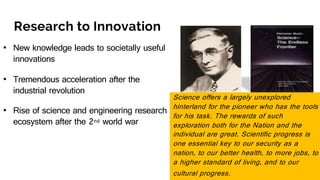
• New knowledge leads to societally useful
innovations
• Tremendous acceleration after the
industrial revolution
• Rise of science and engineering research
ecosystem after the 2nd world war
Science offers a largely unexplored
hinterland for the pioneer who has the tools
for his task. The rewards of such
exploration both for the Nation and the
individual are great. Scientific progress is
one essential key to our security as a
nation, to our better health, to more jobs, to
a higher standard of living, and to our
cultural progress.
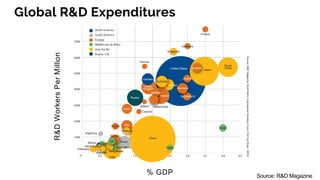
Global R&D Expenditures
% GDP
R&DWorkersPerMillion
Source: R&D Magazine
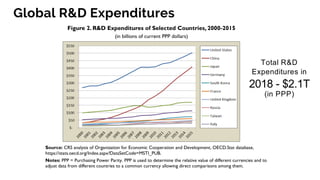
Global R&D Expenditures
Total R&D
Expenditures in
2018 - $2.1T
(in PPP)
How does Innovation Show up in Economic
Data?
Landmark article on economic growth theory by the Nobel prize winning
economist Robert Solow in 1956
Total Factor Productivity: Portion of output not explained by inputs into the
production process
Known as Solow residual
TFP – Attributed to technological innovation
Literature on endogenous growth theory in economics
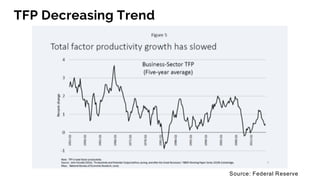
TFP Decreasing Trend
Source: Federal Reserve
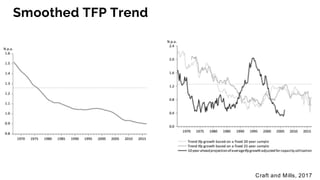
Smoothed TFP Trend
Craft and Mills, 2017
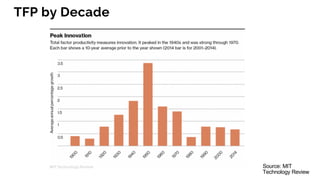
TFP by Decade
Source: MIT
Technology Review
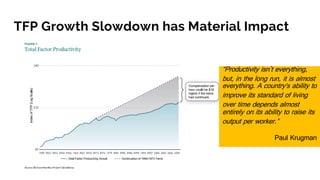
TFP Growth Slowdown has Material Impact
“Productivity isn't everything,
but, in the long run, it is almost
everything. A country’s ability to
improve its standard of living
over time depends almost
entirely on its ability to raise its
output per worker.”
Paul Krugman
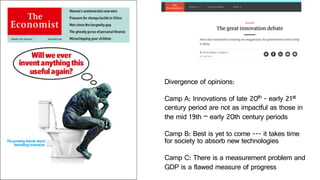
Divergence of opinions:
Camp A: Innovations of late 20th - early 21st
century period are not as impactful as those in
the mid 19th – early 20th century periods
Camp B: Best is yet to come --- it takes time
for society to absorb new technologies
Camp C: There is a measurement problem and
GDP is a flawed measure of progress
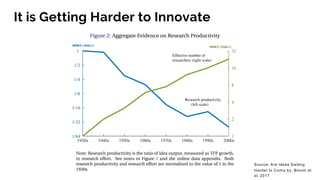
It is Getting Harder to Innovate
Source: Are Ideas G etting
Harder to Com e by, Bloom et
al, 2017
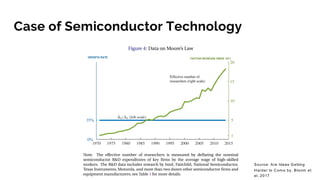
Case of Semiconductor Technology
Source: Are Ideas G etting
Harder to Com e by, Bloom et
al, 2017
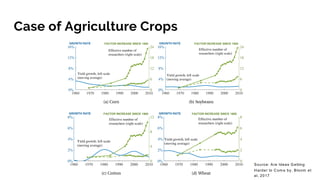
Case of Agriculture Crops
Source: Are Ideas G etting
Harder to Com e by, Bloom et
al, 2017
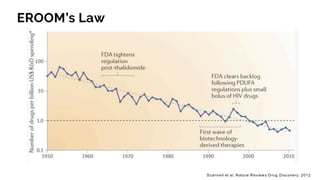
EROOM’s Law
Scannell et al, Nature Reviews Drug Discovery, 2012
Need for Innovation has Never Been Greater
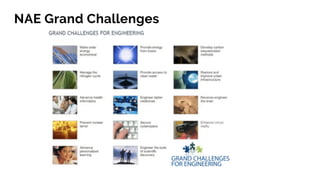
NAE Grand Challenges
UK Industrial Strategy: the Grand Challenges
● Growing the Artificial Intelligence and data driven
economy
● Clean growth
● Future of mobility
● Ageing society
https://www.gov.uk/government/publications/industrial-strategy-the-grand-challenges/industrial-strategy-the-grand-challenges
EU Horizon 2020 Grand Challenges
● Health, demographic change and wellbeing;
● Food security, sustainable agriculture and forestry, marine and
maritime and inland water research, and the Bioeconomy;
● Secure, clean and efficient energy;
● Smart, green and integrated transport;
● Climate action, environment, resource efficiency and raw materials;
● Europe in a changing world - inclusive, innovative and reflective
societies;
● Secure societies - protecting freedom and security of Europe and its
citizens.
https://ec.europa.eu/programmes/horizon2020/en/h2020-section/societal-challenges
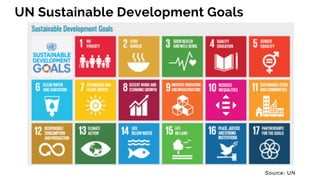
UN Sustainable Development Goals
Source: UN
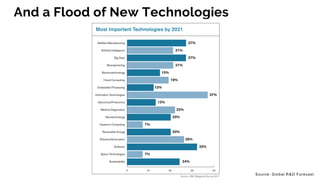
And a Flood of New Technologies
Source: G lobal R&D Forecast
Recent Trends in Research to Innovation
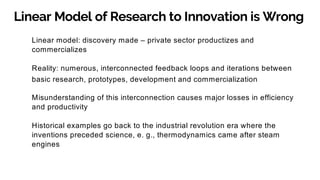
Linear Model of Research to Innovation is Wrong
Linear model: discovery made – private sector productizes and
commercializes
Reality: numerous, interconnected feedback loops and iterations between
basic research, prototypes, development and commercialization
Misunderstanding of this interconnection causes major losses in efficiency
and productivity
Historical examples go back to the industrial revolution era where the
inventions preceded science, e. g., thermodynamics came after steam
engines
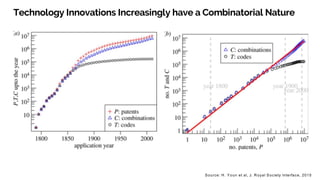
Technology Innovations Increasingly have a Combinatorial Nature
Source: H. Youn et al, J. Royal Society Interface, 2015
Examples of Recent Successes
Magnetic Resonance Imaging (MRI)
Internet technologies
Solar Photovoltaics
Laser surgery
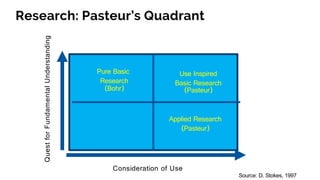
Research: Pasteur’s Quadrant
Source: D. Stokes, 1997
Consideration of Use
QuestforFundamentalUnderstanding
Pure Basic
Research
(Bohr)
Use Inspired
Basic Research
(Pasteur)
Applied Research
(Pasteur)
Can we systematically improve the
connection between research and
innovation?
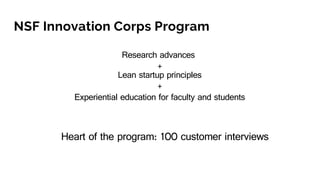
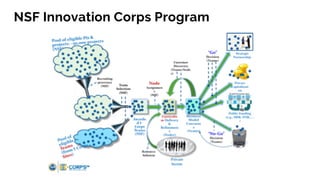
NSF Innovation Corps Program
Research advances
+
Lean startup principles
+
Experiential education for faculty and students
Heart of the program: 100 customer interviews
NSF Innovation Corps Program
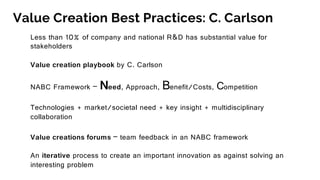
Value Creation Best Practices: C. Carlson
Less than 10% of company and national R&D has substantial value for
stakeholders
Value creation playbook by C. Carlson
NABC Framework – Need, Approach, Benefit/Costs, Competition
Technologies + market/societal need + key insight + multidisciplinary
collaboration
Value creations forums – team feedback in an NABC framework
An iterative process to create an important innovation as against solving an
interesting problem
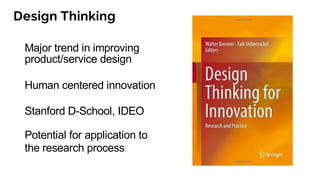
Design Thinking
Major trend in improving
product/service design
Human centered innovation
Stanford D-School, IDEO
Potential for application to
the research process
Implications for Future of Systems and
Controls Research
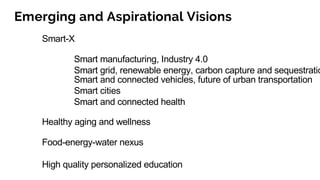
Emerging and Aspirational Visions
Smart-X
Smart manufacturing, Industry 4.0
Smart grid, renewable energy, carbon capture and sequestratio
Smart and connected vehicles, future of urban transportation
Smart cities
Smart and connected health
Healthy aging and wellness
Food-energy-water nexus
High quality personalized education
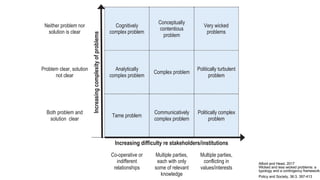
Grand Challenges are often Wicked
Problems
Wicked problems … there is no clear stopping rule …
working on it more … better solution … no single
right answer … every attempt can matter because it
affects the things people depend upon.
Horst and Rittel, 1973
Characteristics of Wicked Problems
● No definite formulation of a wicked problem.
● No stopping rules.
● Solutions are not true-or-false, but better or worse.
● No immediate and no ultimate test of a solution to a wicked
problem.
● Do not have an enumerable (or an exhaustively describable)
set of potential solutions
● Every wicked problem is essentially unique.
● Causes can be explained in numerous ways.
Alford and Head, 2017
Wicked and less wicked problems: a
typology and a contingency framework,
Policy and Society, 36:3, 397-413
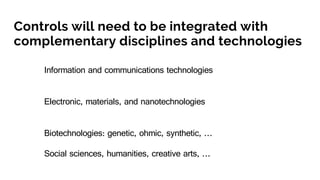
Controls will need to be integrated with
complementary disciplines and technologies
Information and communications technologies
Electronic, materials, and nanotechnologies
Biotechnologies: genetic, ohmic, synthetic, …
Social sciences, humanities, creative arts, …
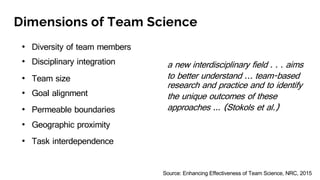
Dimensions of Team Science
• Diversity of team members
• Disciplinary integration
• Team size
• Goal alignment
• Permeable boundaries
• Geographic proximity
• Task interdependence
Source: Enhancing Effectiveness of Team Science, NRC, 2015
a new interdisciplinary field . . . aims
to better understand … team-based
research and practice and to identify
the unique outcomes of these
approaches ... (Stokols et al.)
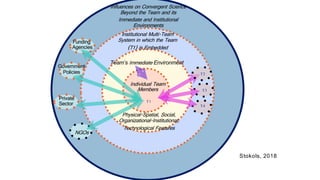
Stokols, 2018
Influences on Convergent Science
Beyond the Team and its
Immediate and Institutional
Environments
Institutional Multi-Team
System in which the Team
(T1) is Embedded
Team’s Immediate Environment
Individual Team
Members
Physical-Spatial, Social,
Organizational-Institutional,
Technological Features
T4
Private
Sector
T3
T2
T1
NGOs
Government
Policies
Funding
Agencies
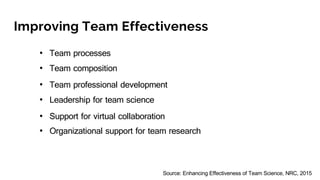
Improving Team Effectiveness
• Team processes
• Team composition
• Team professional development
• Leadership for team science
• Support for virtual collaboration
• Organizational support for team research
Source: Enhancing Effectiveness of Team Science, NRC, 2015
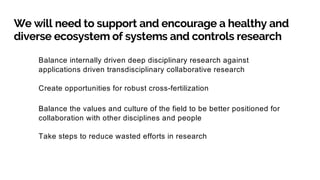
We will need to support and encourage a healthy and
diverse ecosystem of systems and controls research
Balance internally driven deep disciplinary research against
applications driven transdisciplinary collaborative research
Create opportunities for robust cross-fertilization
Balance the values and culture of the field to be better positioned for
collaboration with other disciplines and people
Take steps to reduce wasted efforts in research
Comments
Ideas
Questions?
pramod.Khargonekar@uci.edu
http://faculty.sites.uci.edu/khargonekar/

Research to Innovation

  • 1.
    Research to Innovation: FutureDirections for Systems and Control Pramod P. Khargonekar University of California, Irvine 2018 ACC Workshop From Theory to Practice in Control: Enhancing Innovation and Impact June 26, 2018
  • 2.
    Outline Research to Innovation RecentTrends in Innovation Implications for Future Directions in Systems and Control Conclusions
  • 3.
    Research to Innovation •New knowledge leads to societally useful innovations • Tremendous acceleration after the industrial revolution • Rise of science and engineering research ecosystem after the 2nd world war Science offers a largely unexplored hinterland for the pioneer who has the tools for his task. The rewards of such exploration both for the Nation and the individual are great. Scientific progress is one essential key to our security as a nation, to our better health, to more jobs, to a higher standard of living, and to our cultural progress.
  • 4.
    Global R&D Expenditures %GDP R&DWorkersPerMillion Source: R&D Magazine
  • 5.
    Global R&D Expenditures TotalR&D Expenditures in 2018 - $2.1T (in PPP)
  • 6.
    How does InnovationShow up in Economic Data? Landmark article on economic growth theory by the Nobel prize winning economist Robert Solow in 1956 Total Factor Productivity: Portion of output not explained by inputs into the production process Known as Solow residual TFP – Attributed to technological innovation Literature on endogenous growth theory in economics
  • 7.
  • 8.
    Smoothed TFP Trend Craftand Mills, 2017
  • 9.
    TFP by Decade Source:MIT Technology Review
  • 10.
    TFP Growth Slowdownhas Material Impact “Productivity isn't everything, but, in the long run, it is almost everything. A country’s ability to improve its standard of living over time depends almost entirely on its ability to raise its output per worker.” Paul Krugman
  • 11.
    Divergence of opinions: CampA: Innovations of late 20th - early 21st century period are not as impactful as those in the mid 19th – early 20th century periods Camp B: Best is yet to come --- it takes time for society to absorb new technologies Camp C: There is a measurement problem and GDP is a flawed measure of progress
  • 12.
    It is GettingHarder to Innovate Source: Are Ideas G etting Harder to Com e by, Bloom et al, 2017
  • 13.
    Case of SemiconductorTechnology Source: Are Ideas G etting Harder to Com e by, Bloom et al, 2017
  • 14.
    Case of AgricultureCrops Source: Are Ideas G etting Harder to Com e by, Bloom et al, 2017
  • 15.
    EROOM’s Law Scannell etal, Nature Reviews Drug Discovery, 2012
  • 16.
    Need for Innovationhas Never Been Greater
  • 17.
  • 18.
    UK Industrial Strategy:the Grand Challenges ● Growing the Artificial Intelligence and data driven economy ● Clean growth ● Future of mobility ● Ageing society https://www.gov.uk/government/publications/industrial-strategy-the-grand-challenges/industrial-strategy-the-grand-challenges
  • 19.
    EU Horizon 2020Grand Challenges ● Health, demographic change and wellbeing; ● Food security, sustainable agriculture and forestry, marine and maritime and inland water research, and the Bioeconomy; ● Secure, clean and efficient energy; ● Smart, green and integrated transport; ● Climate action, environment, resource efficiency and raw materials; ● Europe in a changing world - inclusive, innovative and reflective societies; ● Secure societies - protecting freedom and security of Europe and its citizens. https://ec.europa.eu/programmes/horizon2020/en/h2020-section/societal-challenges
  • 20.
  • 21.
    And a Floodof New Technologies Source: G lobal R&D Forecast
  • 22.
    Recent Trends inResearch to Innovation
  • 23.
    Linear Model ofResearch to Innovation is Wrong Linear model: discovery made – private sector productizes and commercializes Reality: numerous, interconnected feedback loops and iterations between basic research, prototypes, development and commercialization Misunderstanding of this interconnection causes major losses in efficiency and productivity Historical examples go back to the industrial revolution era where the inventions preceded science, e. g., thermodynamics came after steam engines
  • 24.
    Technology Innovations Increasinglyhave a Combinatorial Nature Source: H. Youn et al, J. Royal Society Interface, 2015
  • 25.
    Examples of RecentSuccesses Magnetic Resonance Imaging (MRI) Internet technologies Solar Photovoltaics Laser surgery
  • 26.
    Research: Pasteur’s Quadrant Source:D. Stokes, 1997 Consideration of Use QuestforFundamentalUnderstanding Pure Basic Research (Bohr) Use Inspired Basic Research (Pasteur) Applied Research (Pasteur)
  • 29.
    Can we systematicallyimprove the connection between research and innovation?
  • 30.
    NSF Innovation CorpsProgram Research advances + Lean startup principles + Experiential education for faculty and students Heart of the program: 100 customer interviews
  • 31.
  • 32.
    Value Creation BestPractices: C. Carlson Less than 10% of company and national R&D has substantial value for stakeholders Value creation playbook by C. Carlson NABC Framework – Need, Approach, Benefit/Costs, Competition Technologies + market/societal need + key insight + multidisciplinary collaboration Value creations forums – team feedback in an NABC framework An iterative process to create an important innovation as against solving an interesting problem
  • 33.
    Design Thinking Major trendin improving product/service design Human centered innovation Stanford D-School, IDEO Potential for application to the research process
  • 34.
    Implications for Futureof Systems and Controls Research
  • 35.
    Emerging and AspirationalVisions Smart-X Smart manufacturing, Industry 4.0 Smart grid, renewable energy, carbon capture and sequestratio Smart and connected vehicles, future of urban transportation Smart cities Smart and connected health Healthy aging and wellness Food-energy-water nexus High quality personalized education
  • 36.
    Grand Challenges areoften Wicked Problems Wicked problems … there is no clear stopping rule … working on it more … better solution … no single right answer … every attempt can matter because it affects the things people depend upon. Horst and Rittel, 1973
  • 37.
    Characteristics of WickedProblems ● No definite formulation of a wicked problem. ● No stopping rules. ● Solutions are not true-or-false, but better or worse. ● No immediate and no ultimate test of a solution to a wicked problem. ● Do not have an enumerable (or an exhaustively describable) set of potential solutions ● Every wicked problem is essentially unique. ● Causes can be explained in numerous ways.
  • 38.
    Alford and Head,2017 Wicked and less wicked problems: a typology and a contingency framework, Policy and Society, 36:3, 397-413
  • 39.
    Controls will needto be integrated with complementary disciplines and technologies Information and communications technologies Electronic, materials, and nanotechnologies Biotechnologies: genetic, ohmic, synthetic, … Social sciences, humanities, creative arts, …
  • 40.
    Dimensions of TeamScience • Diversity of team members • Disciplinary integration • Team size • Goal alignment • Permeable boundaries • Geographic proximity • Task interdependence Source: Enhancing Effectiveness of Team Science, NRC, 2015 a new interdisciplinary field . . . aims to better understand … team-based research and practice and to identify the unique outcomes of these approaches ... (Stokols et al.)
  • 41.
    Stokols, 2018 Influences onConvergent Science Beyond the Team and its Immediate and Institutional Environments Institutional Multi-Team System in which the Team (T1) is Embedded Team’s Immediate Environment Individual Team Members Physical-Spatial, Social, Organizational-Institutional, Technological Features T4 Private Sector T3 T2 T1 NGOs Government Policies Funding Agencies
  • 42.
    Improving Team Effectiveness •Team processes • Team composition • Team professional development • Leadership for team science • Support for virtual collaboration • Organizational support for team research Source: Enhancing Effectiveness of Team Science, NRC, 2015
  • 43.
    We will needto support and encourage a healthy and diverse ecosystem of systems and controls research Balance internally driven deep disciplinary research against applications driven transdisciplinary collaborative research Create opportunities for robust cross-fertilization Balance the values and culture of the field to be better positioned for collaboration with other disciplines and people Take steps to reduce wasted efforts in research
  • 44.