+
Research & Commercialization
Challenges
Dr. Mazlan Abbas
Research
Challenges
+
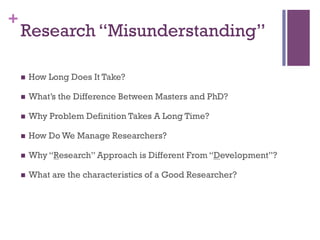
Research “Misunderstanding”
!  How Long Does It Take?
!  What’s the Difference Between Masters and PhD?
!  Why Problem Definition Takes A Long Time?
!  How Do We Manage Researchers?
!  Why “Research” Approach is Different From “Development”?
!  What are the characteristics of a Good Researcher?
+
Scientific Definition of “Research”
!  The strict definition of scientific research is performing a methodical
study in order to prove a hypothesis or answer a specific question.
!  Finding a definitive answer is the central goal of any experimental
process.
!  Research must be systematic and follow a series of steps and a rigid
standard protocol.These rules are broadly similar but may vary slightly
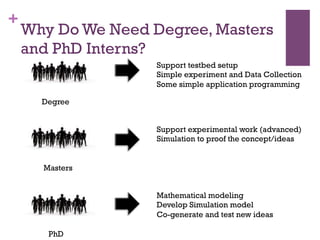
between the different fields of science.
!  Scientific research must be organized and undergo planning, including
performing literature reviews of past research and evaluating what
questions need to be answered.
!  Any type of ‘real’ research, whether scientific, economic or historical,
requires some kind of interpretation and an opinion from the researcher.
This opinion is the underlying principle, or question, that establishes the
nature and type of experiment.
+
Basic research also known as fundamental or pure research is
driven by a scientist’s curiosity or interest in a question. The main
motivation of this type of research is:-
•  To expand man’s knowledge of the world and not to invent or
create something new.
•  There is no obvious commercial value in research of this type.
Basic science research includes answers to such questions as:
•  How did the universe begin?
•  How has man evolved over time?
•  How does genetic code determine who we are?
•  What is the specific genetic code of an earth worm?
•  What are protons, neutrons and electrons made of?
What is BASIC Research?
+
Applied research is designed to the practical problems that exist
in the modern world, rather than to just acquire knowledge for
knowledge’s sake. One main goal of applied science is to
improve human conditions and make the world a better place.
Applied science may investigate ways to:
•  improve agricultural crop production
•  get better network throughput
•  find alternative routing solutions
•  treat or cure a specific disease
•  improve the energy efficiency of homes
What is APPLIED Research?
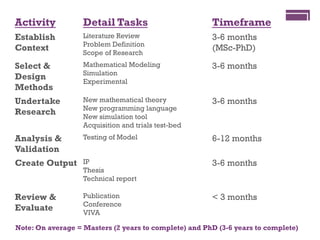
Activity Detail Tasks Timeframe
Establish
Context
Literature Review
Problem Definition
Scope of Research
3-6 months
(MSc-PhD)
Select &
Design
Methods
Mathematical Modeling
Simulation
Experimental
3-6 months
Undertake
Research
New mathematical theory
New programming language
New simulation tool
Acquisition and trials test-bed
3-6 months
Analysis &
Validation
Testing of Model 6-12 months
Create Output IP
Thesis
Technical report
3-6 months
Review &
Evaluate
Publication
Conference
VIVA
< 3 months
Note: On average = Masters (2 years to complete) and PhD (3-6 years to complete)
How To Choose a Good
Scientific Problem?
[Excerpts from the Article “How To Choose a Good Scientific Problem” by Uri Alon]
Choosing good problems is essential for
being a good researcher.
But what is a good problem, and how do
you choose one?
+
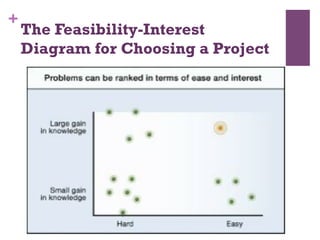
The Feasibility-Interest
Diagram for Choosing a Project
+
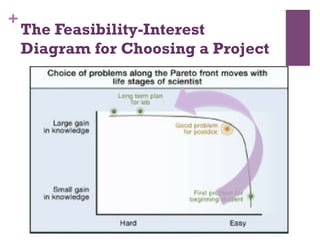
The Feasibility-Interest
Diagram for Choosing a Project
+
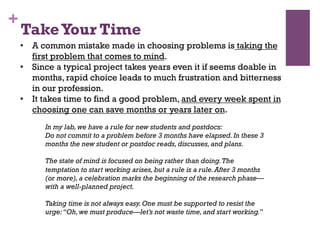
•  A common mistake made in choosing problems is taking the
first problem that comes to mind.
•  Since a typical project takes years even it if seems doable in
months, rapid choice leads to much frustration and bitterness
in our profession.
•  It takes time to find a good problem, and every week spent in
choosing one can save months or years later on.
In my lab,we have a rule for new students and postdocs:
Do not commit to a problem before 3 months have elapsed.In these 3
months the new student or postdoc reads,discusses,and plans.
The state of mind is focused on being rather than doing.The
temptation to start working arises,but a rule is a rule.After 3 months
(or more),a celebration marks the beginning of the research phase—
with a well-planned project.
Taking time is not always easy.One must be supported to resist the
urge:‘‘Oh,we must produce—let’s not waste time,and start working.’’
TakeYour Time
+
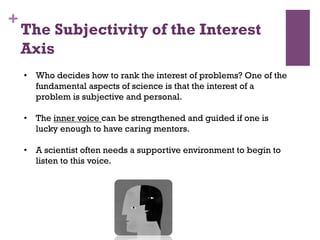
•  Who decides how to rank the interest of problems? One of the
fundamental aspects of science is that the interest of a
problem is subjective and personal.
•  The inner voice can be strengthened and guided if one is
lucky enough to have caring mentors.
•  A scientist often needs a supportive environment to begin to
listen to this voice.
The Subjectivity of the Interest
Axis
+
Good test:
One way to help listening to the inner voice is to ask:‘‘If I was the
only person on earth,which of these problems would I work on?’’
An honest answer can help minimize compromises.
Another good sign of the inner voice are ideas and questions
that come back again and again to your mind for months or
years.
Another good test:
When asked to describe our research to an acquaintance, how
does it feel to describe each project?
In science, the more you interest yourself, the larger the
probability that you will interest your audience.
The Subjectivity of the Interest
Axis
+
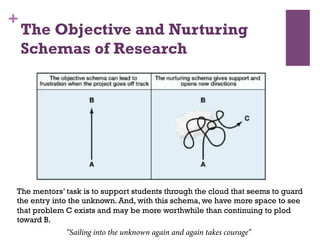
The mentors’ task is to support students through the cloud that seems to guard
the entry into the unknown. And, with this schema, we have more space to see
that problem C exists and may be more worthwhile than continuing to plod
toward B.
“Sailing into the unknown again and again takes courage”
The Objective and Nurturing
Schemas of Research
+
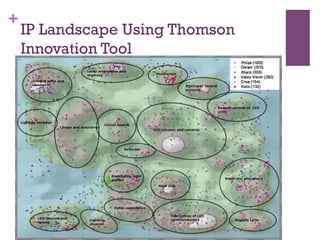
IP Landscape Using Thomson
Innovation Tool
Research Approaches
(1) Mathematical Modeling
(2) Simulation
(3) Experimental
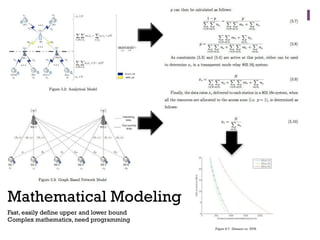
Mathematical Modeling
Fast, easily define upper and lower bound
Complex mathematics, need programming
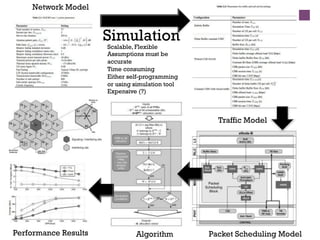
Network Model
Traffic Model
Packet Scheduling ModelAlgorithmPerformance Results
Simulation
Scalable, Flexible
Assumptions must be
accurate
Time consuming
Either self-programming
or using simulation tool
Expensive (?)
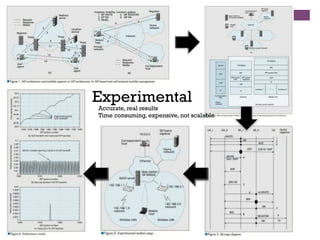
Experimental
Accurate, real results
Time consuming, expensive, not scalable
Architecture / Systems / Methods
Intellectual
Properties (IPs)
Masters or PhD
Is it Worth A
+
Degree
Masters
PhD
Support testbed setup
Simple experiment and Data Collection
Some simple application programming
Support experimental work (advanced)
Simulation to proof the concept/ideas
Mathematical modeling
Develop Simulation model
Co-generate and test new ideas
Why Do We Need Degree, Masters
and PhD Interns?
How Do We Manage
Researchers?
+
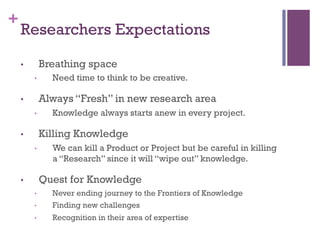
Researchers Expectations
•  Breathing space
•  Need time to think to be creative.
•  Always “Fresh” in new research area
•  Knowledge always starts anew in every project.
•  Killing Knowledge
•  We can kill a Product or Project but be careful in killing
a “Research” since it will “wipe out” knowledge.
•  Quest for Knowledge
•  Never ending journey to the Frontiers of Knowledge
•  Finding new challenges
•  Recognition in their area of expertise
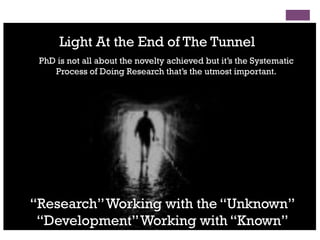
Light At the End of The Tunnel
“Research”Working with the “Unknown”
“Development”Working with “Known”
PhD is not all about the novelty achieved but it’s the Systematic
Process of Doing Research that’s the utmost important.
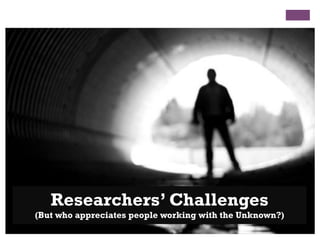
Researchers’ Challenges
(But who appreciates people working with the Unknown?)
+
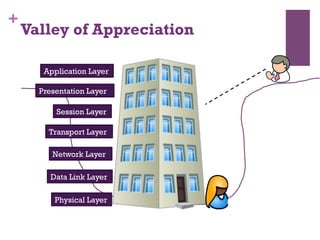
Viewing Angle
Application Layer
Physical Layer
Data Link Layer
Presentation Layer
Network Layer
Transport Layer
Session Layer
Valley of Appreciation
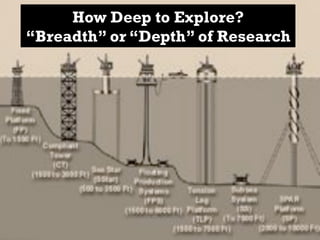
How Deep to Explore?
“Breadth” or “Depth” of Research
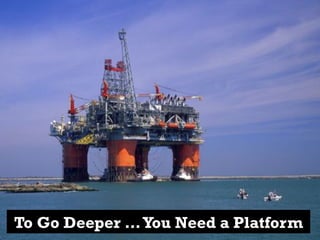
To Go Deeper …You Need a Platform
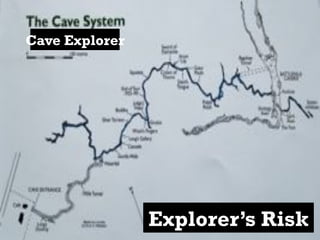
Explorer’s Risk
Cave Explorer
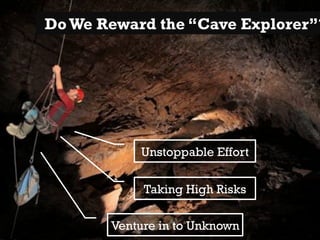
Do We Reward the “Cave Explorer”?
Unstoppable Effort
Taking High Risks
Venture in to Unknown
Commercialization
Challenges
+
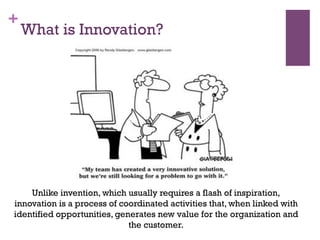
What is Innovation?
Unlike invention, which usually requires a flash of inspiration,
innovation is a process of coordinated activities that, when linked with
identified opportunities, generates new value for the organization and
the customer.
+
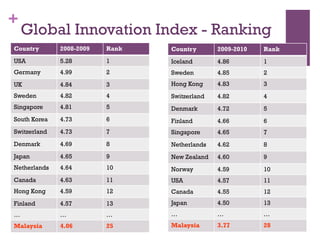
Global Innovation Index - Ranking
Country 2008-2009 Rank
USA 5.28 1
Germany 4.99 2
UK 4.84 3
Sweden 4.82 4
Singapore 4.81 5
South Korea 4.73 6
Switzerland 4.73 7
Denmark 4.69 8
Japan 4.65 9
Netherlands 4.64 10
Canada 4.63 11
Hong Kong 4.59 12
Finland 4.57 13
… … …
Malaysia 4.06 25
Country 2009-2010 Rank
Iceland 4.86 1
Sweden 4.85 2
Hong Kong 4.83 3
Switzerland 4.82 4
Denmark 4.72 5
Finland 4.66 6
Singapore 4.65 7
Netherlands 4.62 8
New Zealand 4.60 9
Norway 4.59 10
USA 4.57 11
Canada 4.55 12
Japan 4.50 13
… … …
Malaysia 3.77 28
+
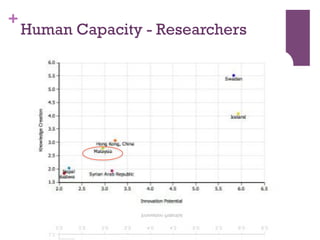
Human Capacity - Researchers
+
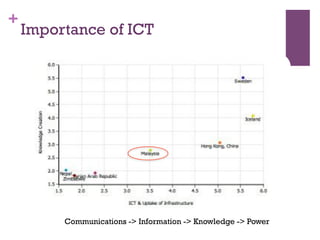
Importance of ICT
Communications -> Information -> Knowledge -> Power
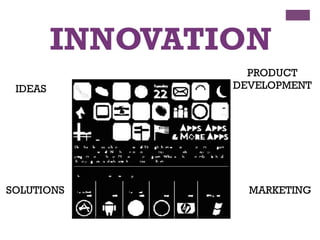
INNOVATION
IDEAS
PRODUCT
DEVELOPMENT
MARKETINGSOLUTIONS
+
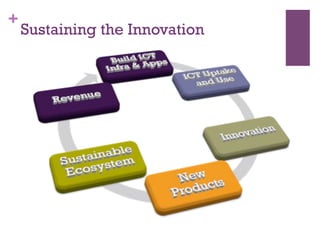
Sustaining the Innovation
+
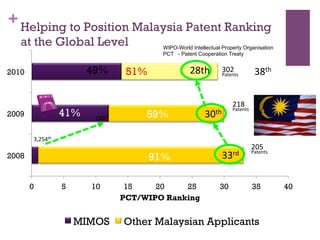
0 5 10 15 20 25 30 35 40
2008
2009
2010
PCT/WIPO Ranking
MIMOS Other Malaysian Applicants
51%
41% 59%
91%
3,254th(
33rd(
38th(
218(
Patents(
205(
Patents(
30th(
WIPO-World Intellectual Property Organisation
PCT - Patent Cooperation Treaty
302(
Patents(
(186th(!
28th(49%
Helping to Position Malaysia Patent Ranking
at the Global Level
+
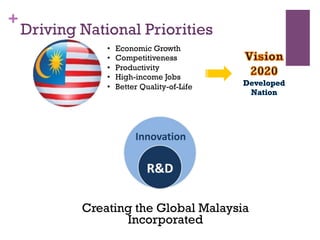
Driving National Priorities
•  Economic Growth
•  Competitiveness
•  Productivity
•  High-income Jobs
•  Better Quality-of-Life
Creating the Global Malaysia
Incorporated
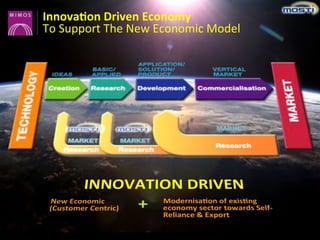
Innova&on'Driven'Economy''
To(Support(The(New(Economic(Model(
+
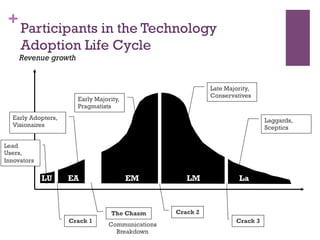
Time
Revenue growth
Lead
Users,
Innovators
Early Adopters,
Visionaires
Early Majority,
Pragmatists
Late Majority,
Conservatives
Laggards,
Sceptics
LU EA EM LM La
Crack 1
The Chasm Crack 2
Crack 3
Participants in the Technology
Adoption Life Cycle
Communications
Breakdown
+
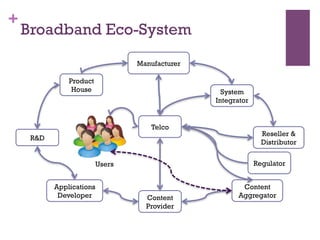
Broadband Eco-System
R&D
Product
House
Manufacturer
Telco
Content
Provider
Content
Aggregator
System
Integrator
Reseller &
Distributor
Applications
Developer
Users
App Stores
Regulator
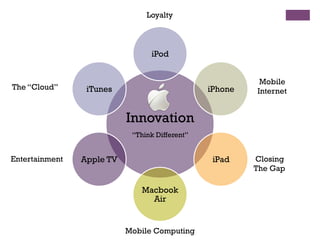
Innovation
“Think Different”
iPod
iPhone
iPad
Macbook
Air
Apple TV
iTunes
Loyalty
Mobile
Internet
Closing
The Gap
Mobile Computing
Entertainment
The “Cloud”
+
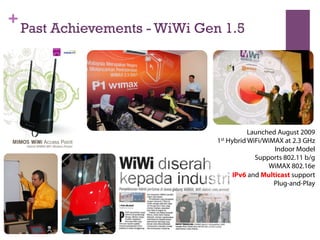
Past Achievements - WiWi Gen 1.5
Launched August 2009
1st Hybrid WiFi/WiMAX at 2.3 GHz
Indoor Model
Supports 802.11 b/g
WiMAX 802.16e
IPv6 and Multicast support
Plug-and-Play
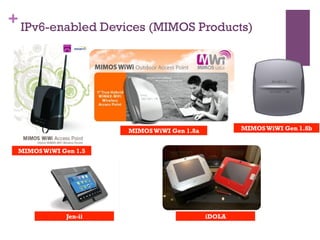
+IPv6-enabled Devices (MIMOS Products)
MIMOSWiWI Gen 1.5
MIMOSWiWI Gen 1.8a MIMOSWiWI Gen 1.8b
Jen-ii iDOLA
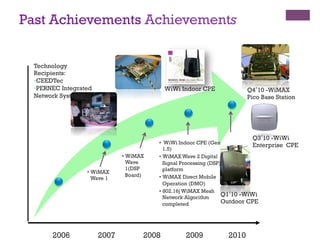
Past Achievements Achievements
2006 2007 2008 2009 2010
WiWi Indoor CPE
Q1 10 -WiWi
Outdoor CPE
Q3 10 -WiWi
Enterprise CPE
Q4 10 -WiMAX
Pico Base Station
•  WiWi Indoor CPE (Gen
1.5)
• WiMAX Wave 2 Digital
Signal Processing (DSP)
platform
• WiMAX Direct Mobile
Operation (DMO)
• 802.16j WiMAX Mesh
Network Algorithm
completed
• WiMAX
Wave 1
• WiMAX
Wave
1(DSP
Board)
Technology
Recipients:
• CEEDTec
• PERNEC Integrated
Network Systems
+
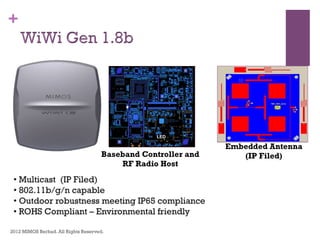
2012 MIMOS Berhad. All Rights Reserved.
LED
+
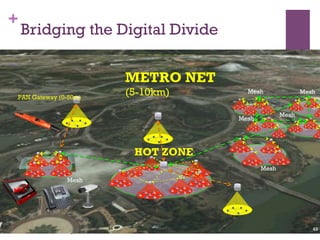
Bridging the Digital Divide
2012 MIMOS Berhad. All Rights Reserved.
Users
Access Point
Relay
HOT
SPOT
(50-200m)
HOT ZONE
(500m-1km)
Relay Hot Spot
DR-Mesh
METRO NET
(5-10km)
Mesh
Mesh
Mesh Mesh
Mesh
Mesh
PAN Gateway (0-50m)
HOT ZONE
49
+
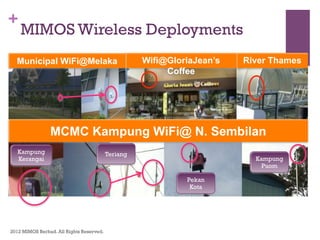
Municipal WiFi@Melaka
MCMC Kampung WiFi@ N. Sembilan
Wifi@GloriaJean’s
Coffee
River Thames
Pekan
Kota
Teriang
Kampung
Puom
Kampung
Kerangai
MIMOS Wireless Deployments
2012 MIMOS Berhad. All Rights Reserved.
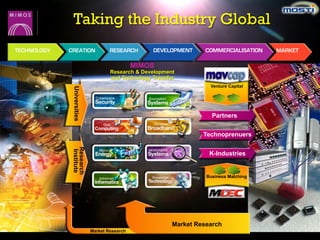
DEVELOPMENT COMMERCIALISATIONTECHNOLOGY CREATION RESEARCH MARKET
MIMOS
Research & Development
and Technology Transfer
Universities
Research
Institute
Technoprenuers
K-Industries
Partners
Venture Capital
Business Matching
Market Research
Market Research
Taking the Industry Global
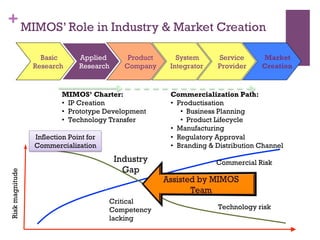
+MIMOS’ Role in Industry & Market Creation
52
Basic
Research
Applied
Research
Product
Company
System
Integrator
Service
Provider
Market
Creation
Commercial Risk
Technology risk
Riskmagnitude
Critical
Competency
lacking
MIMOS’ Charter:
•  IP Creation
•  Prototype Development
•  Technology Transfer
Commercialization Path:
•  Productisation
•  Business Planning
•  Product Lifecycle
•  Manufacturing
•  Regulatory Approval
•  Branding & Distribution Channel
Inflection Point for
Commercialization
Industry
Gap
+
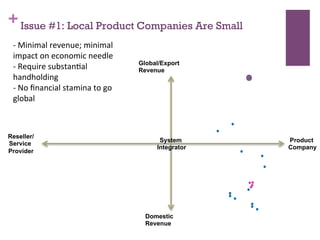
Product
Company
Reseller/
Service
Provider
Global/Export
Revenue
Domestic
Revenue
System
Integrator
A(Minimal(revenue;(minimal(
impact(on(economic(needle(
A (Require(substanGal(
handholding(
A (No(financial(stamina(to(go(
global(
!
Issue #1: Local Product Companies Are Small
+
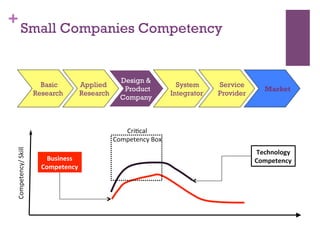
Basic
Research
Applied
Research
Design &
Product
Company
System
Integrator
Service
Provider
Market
Business''
Competency'
Technology''
Competency'
Competency/(Skill(
© 2010 MIMOS Berhad. All Rights Reserved.!
CriGcal(
Competency(Box(
Small Companies Competency
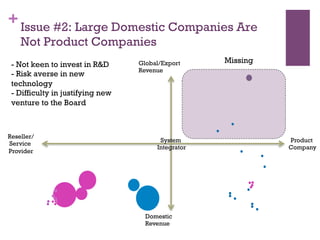
+Issue #2: Large Domestic Companies Are
Not Product Companies
Domestic
Revenue
Product
Company
Reseller/
Service
Provider
Global/Export
Revenue
System
Integrator
- Not keen to invest in R&D
- Risk averse in new
technology
- Difficulty in justifying new
venture to the Board
Missing
+
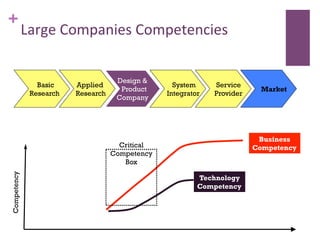
Large(Companies(Competencies(
Business
Competency
Technology
Competency
Competency
Critical
Competency
Box
Basic
Research
Applied
Research
Design &
Product
Company
System
Integrator
Service
Provider
Market
+Issue #3: Difficult for Small Local Product
Companies to Engage MNCs
•  MNC reluctant to work with non reputable local product
companies
•  Sustainability
•  Capability
•  Branding
•  Local product companies has problem to meet the stringent
requirement of MNC
•  CMMI
•  ISO
•  IP protection
+
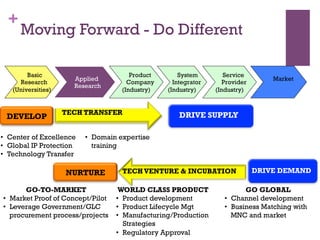
Moving Forward - Do Different
Basic
Research
(Universities)
Applied
Research
Product
Company
(Industry)
System
Integrator
(Industry)
Service
Provider
(Industry)
Market
DEVELOP
•  Center of Excellence
•  Global IP Protection
•  Technology Transfer
NURTURE
WORLD CLASS PRODUCT
•  Product development
•  Product Lifecycle Mgt
•  Manufacturing/Production
Strategies
•  Regulatory Approval
TECHVENTURE & INCUBATION
TECH TRANSFER
•  Domain expertise
training
GO-TO-MARKET
•  Market Proof of Concept/Pilot
•  Leverage Government/GLC
procurement process/projects
DRIVE SUPPLY
DRIVE DEMAND
GO GLOBAL
•  Channel development
•  Business Matching with
MNC and market
One More Thing
+
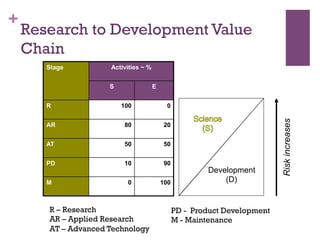
Development
(D)
Stage Activities ~ %
S E
R 100 0
AR 80 20
AT 50 50
PD 10 90
M 0 100
Riskincreases
R – Research
AR – Applied Research
AT – Advanced Technology
PD - Product Development
M - Maintenance
Research to Development Value
Chain
+
THANKYOU
EMAIL: mazlan@gmail.com
TWITTER: mazlan_abbas
FACEBOOK: www.facebook.com/drmazlanabbas
LINKEDIN: my.linkedin.com/in/mazlan/
SLIDESHARE: www.slideshare.net/mazlan1

Research and Commercialisation Challenges

  • 1.
  • 2.
  • 3.
    + Research “Misunderstanding” !  HowLong Does It Take? !  What’s the Difference Between Masters and PhD? !  Why Problem Definition Takes A Long Time? !  How Do We Manage Researchers? !  Why “Research” Approach is Different From “Development”? !  What are the characteristics of a Good Researcher?
  • 4.
    + Scientific Definition of“Research” !  The strict definition of scientific research is performing a methodical study in order to prove a hypothesis or answer a specific question. !  Finding a definitive answer is the central goal of any experimental process. !  Research must be systematic and follow a series of steps and a rigid standard protocol.These rules are broadly similar but may vary slightly between the different fields of science. !  Scientific research must be organized and undergo planning, including performing literature reviews of past research and evaluating what questions need to be answered. !  Any type of ‘real’ research, whether scientific, economic or historical, requires some kind of interpretation and an opinion from the researcher. This opinion is the underlying principle, or question, that establishes the nature and type of experiment.
  • 5.
    + Basic research alsoknown as fundamental or pure research is driven by a scientist’s curiosity or interest in a question. The main motivation of this type of research is:- •  To expand man’s knowledge of the world and not to invent or create something new. •  There is no obvious commercial value in research of this type. Basic science research includes answers to such questions as: •  How did the universe begin? •  How has man evolved over time? •  How does genetic code determine who we are? •  What is the specific genetic code of an earth worm? •  What are protons, neutrons and electrons made of? What is BASIC Research?
  • 6.
    + Applied research isdesigned to the practical problems that exist in the modern world, rather than to just acquire knowledge for knowledge’s sake. One main goal of applied science is to improve human conditions and make the world a better place. Applied science may investigate ways to: •  improve agricultural crop production •  get better network throughput •  find alternative routing solutions •  treat or cure a specific disease •  improve the energy efficiency of homes What is APPLIED Research?
  • 7.
    Activity Detail TasksTimeframe Establish Context Literature Review Problem Definition Scope of Research 3-6 months (MSc-PhD) Select & Design Methods Mathematical Modeling Simulation Experimental 3-6 months Undertake Research New mathematical theory New programming language New simulation tool Acquisition and trials test-bed 3-6 months Analysis & Validation Testing of Model 6-12 months Create Output IP Thesis Technical report 3-6 months Review & Evaluate Publication Conference VIVA < 3 months Note: On average = Masters (2 years to complete) and PhD (3-6 years to complete)
  • 8.
    How To Choosea Good Scientific Problem? [Excerpts from the Article “How To Choose a Good Scientific Problem” by Uri Alon]
  • 9.
    Choosing good problemsis essential for being a good researcher. But what is a good problem, and how do you choose one?
  • 10.
  • 11.
  • 12.
    + •  A commonmistake made in choosing problems is taking the first problem that comes to mind. •  Since a typical project takes years even it if seems doable in months, rapid choice leads to much frustration and bitterness in our profession. •  It takes time to find a good problem, and every week spent in choosing one can save months or years later on. In my lab,we have a rule for new students and postdocs: Do not commit to a problem before 3 months have elapsed.In these 3 months the new student or postdoc reads,discusses,and plans. The state of mind is focused on being rather than doing.The temptation to start working arises,but a rule is a rule.After 3 months (or more),a celebration marks the beginning of the research phase— with a well-planned project. Taking time is not always easy.One must be supported to resist the urge:‘‘Oh,we must produce—let’s not waste time,and start working.’’ TakeYour Time
  • 13.
    + •  Who decideshow to rank the interest of problems? One of the fundamental aspects of science is that the interest of a problem is subjective and personal. •  The inner voice can be strengthened and guided if one is lucky enough to have caring mentors. •  A scientist often needs a supportive environment to begin to listen to this voice. The Subjectivity of the Interest Axis
  • 14.
    + Good test: One wayto help listening to the inner voice is to ask:‘‘If I was the only person on earth,which of these problems would I work on?’’ An honest answer can help minimize compromises. Another good sign of the inner voice are ideas and questions that come back again and again to your mind for months or years. Another good test: When asked to describe our research to an acquaintance, how does it feel to describe each project? In science, the more you interest yourself, the larger the probability that you will interest your audience. The Subjectivity of the Interest Axis
  • 15.
    + The mentors’ taskis to support students through the cloud that seems to guard the entry into the unknown. And, with this schema, we have more space to see that problem C exists and may be more worthwhile than continuing to plod toward B. “Sailing into the unknown again and again takes courage” The Objective and Nurturing Schemas of Research
  • 16.
    + IP Landscape UsingThomson Innovation Tool
  • 17.
    Research Approaches (1) MathematicalModeling (2) Simulation (3) Experimental
  • 18.
    Mathematical Modeling Fast, easilydefine upper and lower bound Complex mathematics, need programming
  • 19.
    Network Model Traffic Model PacketScheduling ModelAlgorithmPerformance Results Simulation Scalable, Flexible Assumptions must be accurate Time consuming Either self-programming or using simulation tool Expensive (?)
  • 20.
    Experimental Accurate, real results Timeconsuming, expensive, not scalable
  • 21.
    Architecture / Systems/ Methods Intellectual Properties (IPs) Masters or PhD Is it Worth A
  • 22.
    + Degree Masters PhD Support testbed setup Simpleexperiment and Data Collection Some simple application programming Support experimental work (advanced) Simulation to proof the concept/ideas Mathematical modeling Develop Simulation model Co-generate and test new ideas Why Do We Need Degree, Masters and PhD Interns?
  • 23.
    How Do WeManage Researchers?
  • 24.
    + Researchers Expectations •  Breathingspace •  Need time to think to be creative. •  Always “Fresh” in new research area •  Knowledge always starts anew in every project. •  Killing Knowledge •  We can kill a Product or Project but be careful in killing a “Research” since it will “wipe out” knowledge. •  Quest for Knowledge •  Never ending journey to the Frontiers of Knowledge •  Finding new challenges •  Recognition in their area of expertise
  • 25.
    Light At theEnd of The Tunnel “Research”Working with the “Unknown” “Development”Working with “Known” PhD is not all about the novelty achieved but it’s the Systematic Process of Doing Research that’s the utmost important.
  • 26.
    Researchers’ Challenges (But whoappreciates people working with the Unknown?)
  • 27.
    + Viewing Angle Application Layer PhysicalLayer Data Link Layer Presentation Layer Network Layer Transport Layer Session Layer Valley of Appreciation
  • 28.
    How Deep toExplore? “Breadth” or “Depth” of Research
  • 29.
    To Go Deeper…You Need a Platform
  • 30.
  • 31.
    Do We Rewardthe “Cave Explorer”? Unstoppable Effort Taking High Risks Venture in to Unknown
  • 32.
  • 33.
    + What is Innovation? Unlikeinvention, which usually requires a flash of inspiration, innovation is a process of coordinated activities that, when linked with identified opportunities, generates new value for the organization and the customer.
  • 34.
    + Global Innovation Index- Ranking Country 2008-2009 Rank USA 5.28 1 Germany 4.99 2 UK 4.84 3 Sweden 4.82 4 Singapore 4.81 5 South Korea 4.73 6 Switzerland 4.73 7 Denmark 4.69 8 Japan 4.65 9 Netherlands 4.64 10 Canada 4.63 11 Hong Kong 4.59 12 Finland 4.57 13 … … … Malaysia 4.06 25 Country 2009-2010 Rank Iceland 4.86 1 Sweden 4.85 2 Hong Kong 4.83 3 Switzerland 4.82 4 Denmark 4.72 5 Finland 4.66 6 Singapore 4.65 7 Netherlands 4.62 8 New Zealand 4.60 9 Norway 4.59 10 USA 4.57 11 Canada 4.55 12 Japan 4.50 13 … … … Malaysia 3.77 28
  • 35.
    + Human Capacity -Researchers
  • 36.
    + Importance of ICT Communications-> Information -> Knowledge -> Power
  • 37.
  • 38.
  • 39.
    + 0 5 1015 20 25 30 35 40 2008 2009 2010 PCT/WIPO Ranking MIMOS Other Malaysian Applicants 51% 41% 59% 91% 3,254th( 33rd( 38th( 218( Patents( 205( Patents( 30th( WIPO-World Intellectual Property Organisation PCT - Patent Cooperation Treaty 302( Patents( (186th(! 28th(49% Helping to Position Malaysia Patent Ranking at the Global Level
  • 40.
    + Driving National Priorities • Economic Growth •  Competitiveness •  Productivity •  High-income Jobs •  Better Quality-of-Life Creating the Global Malaysia Incorporated
  • 41.
  • 42.
    + Time Revenue growth Lead Users, Innovators Early Adopters, Visionaires EarlyMajority, Pragmatists Late Majority, Conservatives Laggards, Sceptics LU EA EM LM La Crack 1 The Chasm Crack 2 Crack 3 Participants in the Technology Adoption Life Cycle Communications Breakdown
  • 43.
  • 44.
  • 45.
    + Past Achievements -WiWi Gen 1.5 Launched August 2009 1st Hybrid WiFi/WiMAX at 2.3 GHz Indoor Model Supports 802.11 b/g WiMAX 802.16e IPv6 and Multicast support Plug-and-Play
  • 46.
    +IPv6-enabled Devices (MIMOSProducts) MIMOSWiWI Gen 1.5 MIMOSWiWI Gen 1.8a MIMOSWiWI Gen 1.8b Jen-ii iDOLA
  • 47.
    Past Achievements Achievements 20062007 2008 2009 2010 WiWi Indoor CPE Q1 10 -WiWi Outdoor CPE Q3 10 -WiWi Enterprise CPE Q4 10 -WiMAX Pico Base Station •  WiWi Indoor CPE (Gen 1.5) • WiMAX Wave 2 Digital Signal Processing (DSP) platform • WiMAX Direct Mobile Operation (DMO) • 802.16j WiMAX Mesh Network Algorithm completed • WiMAX Wave 1 • WiMAX Wave 1(DSP Board) Technology Recipients: • CEEDTec • PERNEC Integrated Network Systems
  • 48.
    + 2012 MIMOS Berhad.All Rights Reserved. LED
  • 49.
    + Bridging the DigitalDivide 2012 MIMOS Berhad. All Rights Reserved. Users Access Point Relay HOT SPOT (50-200m) HOT ZONE (500m-1km) Relay Hot Spot DR-Mesh METRO NET (5-10km) Mesh Mesh Mesh Mesh Mesh Mesh PAN Gateway (0-50m) HOT ZONE 49
  • 50.
    + Municipal WiFi@Melaka MCMC KampungWiFi@ N. Sembilan Wifi@GloriaJean’s Coffee River Thames Pekan Kota Teriang Kampung Puom Kampung Kerangai MIMOS Wireless Deployments 2012 MIMOS Berhad. All Rights Reserved.
  • 51.
    DEVELOPMENT COMMERCIALISATIONTECHNOLOGY CREATIONRESEARCH MARKET MIMOS Research & Development and Technology Transfer Universities Research Institute Technoprenuers K-Industries Partners Venture Capital Business Matching Market Research Market Research Taking the Industry Global
  • 52.
    +MIMOS’ Role inIndustry & Market Creation 52 Basic Research Applied Research Product Company System Integrator Service Provider Market Creation Commercial Risk Technology risk Riskmagnitude Critical Competency lacking MIMOS’ Charter: •  IP Creation •  Prototype Development •  Technology Transfer Commercialization Path: •  Productisation •  Business Planning •  Product Lifecycle •  Manufacturing •  Regulatory Approval •  Branding & Distribution Channel Inflection Point for Commercialization Industry Gap
  • 53.
  • 54.
  • 55.
    +Issue #2: LargeDomestic Companies Are Not Product Companies Domestic Revenue Product Company Reseller/ Service Provider Global/Export Revenue System Integrator - Not keen to invest in R&D - Risk averse in new technology - Difficulty in justifying new venture to the Board Missing
  • 56.
  • 57.
    +Issue #3: Difficultfor Small Local Product Companies to Engage MNCs •  MNC reluctant to work with non reputable local product companies •  Sustainability •  Capability •  Branding •  Local product companies has problem to meet the stringent requirement of MNC •  CMMI •  ISO •  IP protection
  • 58.
    + Moving Forward -Do Different Basic Research (Universities) Applied Research Product Company (Industry) System Integrator (Industry) Service Provider (Industry) Market DEVELOP •  Center of Excellence •  Global IP Protection •  Technology Transfer NURTURE WORLD CLASS PRODUCT •  Product development •  Product Lifecycle Mgt •  Manufacturing/Production Strategies •  Regulatory Approval TECHVENTURE & INCUBATION TECH TRANSFER •  Domain expertise training GO-TO-MARKET •  Market Proof of Concept/Pilot •  Leverage Government/GLC procurement process/projects DRIVE SUPPLY DRIVE DEMAND GO GLOBAL •  Channel development •  Business Matching with MNC and market
  • 59.
  • 60.
    + Development (D) Stage Activities ~% S E R 100 0 AR 80 20 AT 50 50 PD 10 90 M 0 100 Riskincreases R – Research AR – Applied Research AT – Advanced Technology PD - Product Development M - Maintenance Research to Development Value Chain
  • 61.
    + THANKYOU EMAIL: mazlan@gmail.com TWITTER: mazlan_abbas FACEBOOK:www.facebook.com/drmazlanabbas LINKEDIN: my.linkedin.com/in/mazlan/ SLIDESHARE: www.slideshare.net/mazlan1