Research Tasks.
Front pageContents13245987610111513121918171622202123143324252627282930313534323837364140394746454443425453525150494855565758A different take on classical musicUp-coming solo artistsInterview with Escada Up-coming bandsA look at music from the past from favourite artistsInterview with band Current concerts playing around the world A look at award winning artistsFavourite scores from all time classicsBehind the musicThe50 greatest pianists everTop tips on where to buy the best instrumentsInterview with Sarah ChangThe life of a composerAudience’s favourites from MozartFestival previewsSecret behind composing a good songInterview with Paul PottsInterview with Paul Potts continued..How to get your music heardMusic Festival of LondonImage page full of bandsHistory of musicA British take on musicAn American take on musicInterview with Sarah wellingExclusive interview with..An editors farewell
Article – New bandFront PageArticle – New band Cont’dFeature About new MTV showAdvert – UpcomingGigMag’sfavartistsMag’sfavartistsProblem PageProblemPageAdvert – CosmeticsContentsCharts listCharts listAdvert – MTVArticle onNewPopular genre Of musicGenre ofMusicCont’dAdvert – SubscribeTo magForm to Post forsubscriptionOverflowContentsAdvert for UpcomingGigMTV show Cont’d	CommentsAnd emailsPage	CelebritynewsCelebritynewsArticle – UprisingArtistsArticle-UprisingArtistsTop tensOf monthFashion Article byBibaFree Poster – MuseFree Poster-MuseA few Words fromThe editorMobile AppsAdvertBack coverPerfumeAdvertArticle – New bandCont’dAdvert – RiverIslandInterviewWith Passion PitPassion Pit Cont’dPassion PitTour datesAnd InfoAdvert – New iPodCelebrity newsLatestStage-FashionpageAlbum ReviewpageReview PageCont’dInterviewJason MrazJason MrazCont’dCompe-Tition foriPodFree PosterAdvert – cosmeticsAdvert – AlbumAdvert –New ArtistInterviewAdele	InterviewAdele	Feature onArtists ex’sAnd love livesFeature onLove livescont’d1324598761011151312191817162220212314332425262728293031353432383736414039474645444342Advert –TopshopAdvert –TopshopAdvert –Ben and Jerry’sMostDesirable Albums of The month5453525150494855565758
The uses and gratifications theory illustrates how people consume the media and bring it into their lives actively. My magazine fits into this theory as it offers information to the reader and offers them more entertainment and knowledge of their selected subject. The magazine also offers other extras to try to engage and bring in the audience. For example, free gifts and competitions. The reader will also actively consume the media by entering the competitions and taking part in it. From my magazine, the reader can indulge in their particular interest and get a wider range of interests and be introduced to new aspects by the media/magazine.
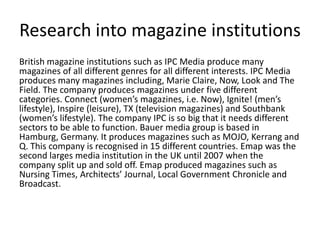
Research into magazine institutionsBritish magazine institutions such as IPC Media produce many magazines of all different genres for all different interests. IPC Media produces many magazines including, Marie Claire, Now, Look and The Field. The company produces magazines under five different categories. Connect (women’s magazines, i.e. Now), Ignite! (men’s lifestyle), Inspire (leisure), TX (television magazines) and Southbank (women’s lifestyle). The company IPC is so big that it needs different sectors to be able to function. Bauer media group is based in Hamburg, Germany. It produces magazines such as MOJO, Kerrang and Q. This company is recognised in 15 different countries. Emap was the second larges media institution in the UK until 2007 when the company split up and sold off. Emap produced magazines such as Nursing Times, Architects’ Journal, Local Government Chronicle and Broadcast.
QuestionnaireHow often do you buy music magazines?Weekly:Monthly:Occasionally:  6Never:  3If you were to buy a music magazine, which would you prefer?Q:Billboard:  3Rolling Stone:  3Spin:NME:  4Kerrang!:What would you like to see in a music magazine?Interviews and Images:   6Charts and Information:   3Celebrity News:  2How much would you pay for a magazine?£1 - £1.50:   3£2 - £3:   7£3 - £4:What is your favourite genre of music?Rock:                                          Pop:R&B:  3                                       Indie: 4Classical:                                    Dark Wave:  1                                Other: 2
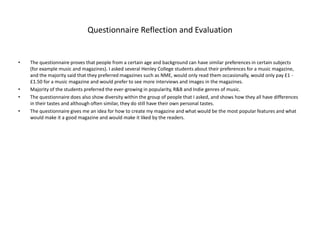
Questionnaire Reflection and EvaluationThe questionnaire proves that people from a certain age and background can have similar preferences in certain subjects (for example music and magazines). I asked several Henley College students about their preferences for a music magazine, and the majority said that they preferred magazines such as NME, would only read them occasionally, would only pay £1 -£1.50 for a music magazine and would prefer to see more interviews and images in the magazines. Majority of the students preferred the ever-growing in popularity, R&B and Indie genres of music. The questionnaire does also show diversity within the group of people that I asked, and shows how they all have differences in their tastes and although often similar, they do still have their own personal tastes. The questionnaire gives me an idea for how to create my magazine and what would be the most popular features and what would make it a good magazine and would make it liked by the readers.
This screenshot shows that different parts of the UK have different ratios of social groups or ‘tribes’. For example, the South East England features Townies, Indie Scenesters and Rahs as the three largest tribes in the area. Depending on environmental circumstances of where you live and the background you come from, it can alter the people within society that you may mix with. For example, in more Northern areas, it may prove that there are three completely different dominating tribes, due to the background and difference in area.
Personal Learning and Reflection ONE.My front cover analysis showed me that using certain images/colours/types of font can translate into different things in a metaphorical manner (for example, Curlz MT in pink is typically interpreted and gives off the impression of being feminine and girly.) This gives me ideas for how to portray my front cover for my magazine, and how I could use certain design techniques to make it appeal to my target audience and to make it stand out from other magazines in general or of that genre.  I have also noticed that a bolder font and a bigger text size for the title of the main article on the front cover will capture the audiences attention more easily and certain fonts are good for helping to identify certain bands – especially if they have a particular font featured in their band logo.
Personal Learning and Reflection TWO.My contents analysis helped for me to understand how a contents page may be designed and how to make it easier to use and function. To make page numbers more visible, many magazine contents pages appear to have a separate colour theme running through the page in smaller elements, part of which are used for the page numbers. These colour themes may also be used for subheadings and smaller titles across the page, which helps the reader to pick out certain details and information visually through the differentiation of the colourings. I also know that with a contents page, it can be easier and more helpful to the reader if you feature a small description of what each page contains, giving them a small synopsis of what to expect from a certain page/article.
Personal Learning and Reflection THREE.I analysed several double page spreads from different music genre magazines with different types of articles/features. I learnt that pictures should be located strategically on a page, so there is still plenty of space to include the text, and that titles and images should go together as they relate to each other and can be easier for the audience to make connections (for example, some people may know the name of the musician, but not the face, and would then be able to link them. Or the opposite way around – some people may know the face of the personality but not their name. Therefore the connection can be made much quicker, and this may help to draw the reader in.) The images for double page spreads should represent the band/celebrity in a typical or recognisable way for that subject. Or the images should represent the person being related to the magazines style or embracing the genre of magazine that an article is created for. On a double page spread,  the titles should be easily visible and should perhaps get the readers attention. For example, certain quotes of interest could be used which may interest people and leave them wondering what else the person may have stated, and whether the interview or article will be of interest.
Personal Learning and Reflection FOUR. Both of my audience research activities (‘Find your Tribe’ and the questionnaire) gave me ideas of how an audience may think and what they may wish to see in a magazine. They both made me understand what kind of people from the audience research would read the magazine that I am creating, and what kind of genre and style the magazine should be written in. For example, the magazine should have more unknown and controversial bands that would appeal to the kinds of people living in south east England and bands that would appeal to all kinds of classes and tribes and typical people. The audience research will also help me to write my magazine in a less biased manner, and to not just create the ideal magazine for me, that I would personally read, but little other people would find it of interest. I now understand that my magazine should be created in a little more of a general manner, so that it interesting to a wider audience and not just a select few that it could have been designed for.

Research Tasks

  • 1.
  • 2.
    Front pageContents13245987610111513121918171622202123143324252627282930313534323837364140394746454443425453525150494855565758A differenttake on classical musicUp-coming solo artistsInterview with Escada Up-coming bandsA look at music from the past from favourite artistsInterview with band Current concerts playing around the world A look at award winning artistsFavourite scores from all time classicsBehind the musicThe50 greatest pianists everTop tips on where to buy the best instrumentsInterview with Sarah ChangThe life of a composerAudience’s favourites from MozartFestival previewsSecret behind composing a good songInterview with Paul PottsInterview with Paul Potts continued..How to get your music heardMusic Festival of LondonImage page full of bandsHistory of musicA British take on musicAn American take on musicInterview with Sarah wellingExclusive interview with..An editors farewell
  • 3.
    Article – NewbandFront PageArticle – New band Cont’dFeature About new MTV showAdvert – UpcomingGigMag’sfavartistsMag’sfavartistsProblem PageProblemPageAdvert – CosmeticsContentsCharts listCharts listAdvert – MTVArticle onNewPopular genre Of musicGenre ofMusicCont’dAdvert – SubscribeTo magForm to Post forsubscriptionOverflowContentsAdvert for UpcomingGigMTV show Cont’d CommentsAnd emailsPage CelebritynewsCelebritynewsArticle – UprisingArtistsArticle-UprisingArtistsTop tensOf monthFashion Article byBibaFree Poster – MuseFree Poster-MuseA few Words fromThe editorMobile AppsAdvertBack coverPerfumeAdvertArticle – New bandCont’dAdvert – RiverIslandInterviewWith Passion PitPassion Pit Cont’dPassion PitTour datesAnd InfoAdvert – New iPodCelebrity newsLatestStage-FashionpageAlbum ReviewpageReview PageCont’dInterviewJason MrazJason MrazCont’dCompe-Tition foriPodFree PosterAdvert – cosmeticsAdvert – AlbumAdvert –New ArtistInterviewAdele InterviewAdele Feature onArtists ex’sAnd love livesFeature onLove livescont’d1324598761011151312191817162220212314332425262728293031353432383736414039474645444342Advert –TopshopAdvert –TopshopAdvert –Ben and Jerry’sMostDesirable Albums of The month5453525150494855565758
  • 4.
    The uses andgratifications theory illustrates how people consume the media and bring it into their lives actively. My magazine fits into this theory as it offers information to the reader and offers them more entertainment and knowledge of their selected subject. The magazine also offers other extras to try to engage and bring in the audience. For example, free gifts and competitions. The reader will also actively consume the media by entering the competitions and taking part in it. From my magazine, the reader can indulge in their particular interest and get a wider range of interests and be introduced to new aspects by the media/magazine.
  • 5.
    Research into magazineinstitutionsBritish magazine institutions such as IPC Media produce many magazines of all different genres for all different interests. IPC Media produces many magazines including, Marie Claire, Now, Look and The Field. The company produces magazines under five different categories. Connect (women’s magazines, i.e. Now), Ignite! (men’s lifestyle), Inspire (leisure), TX (television magazines) and Southbank (women’s lifestyle). The company IPC is so big that it needs different sectors to be able to function. Bauer media group is based in Hamburg, Germany. It produces magazines such as MOJO, Kerrang and Q. This company is recognised in 15 different countries. Emap was the second larges media institution in the UK until 2007 when the company split up and sold off. Emap produced magazines such as Nursing Times, Architects’ Journal, Local Government Chronicle and Broadcast.
  • 6.
    QuestionnaireHow often doyou buy music magazines?Weekly:Monthly:Occasionally: 6Never: 3If you were to buy a music magazine, which would you prefer?Q:Billboard: 3Rolling Stone: 3Spin:NME: 4Kerrang!:What would you like to see in a music magazine?Interviews and Images: 6Charts and Information: 3Celebrity News: 2How much would you pay for a magazine?£1 - £1.50: 3£2 - £3: 7£3 - £4:What is your favourite genre of music?Rock: Pop:R&B: 3 Indie: 4Classical: Dark Wave: 1 Other: 2
  • 7.
    Questionnaire Reflection andEvaluationThe questionnaire proves that people from a certain age and background can have similar preferences in certain subjects (for example music and magazines). I asked several Henley College students about their preferences for a music magazine, and the majority said that they preferred magazines such as NME, would only read them occasionally, would only pay £1 -£1.50 for a music magazine and would prefer to see more interviews and images in the magazines. Majority of the students preferred the ever-growing in popularity, R&B and Indie genres of music. The questionnaire does also show diversity within the group of people that I asked, and shows how they all have differences in their tastes and although often similar, they do still have their own personal tastes. The questionnaire gives me an idea for how to create my magazine and what would be the most popular features and what would make it a good magazine and would make it liked by the readers.
  • 8.
    This screenshot showsthat different parts of the UK have different ratios of social groups or ‘tribes’. For example, the South East England features Townies, Indie Scenesters and Rahs as the three largest tribes in the area. Depending on environmental circumstances of where you live and the background you come from, it can alter the people within society that you may mix with. For example, in more Northern areas, it may prove that there are three completely different dominating tribes, due to the background and difference in area.
  • 11.
    Personal Learning andReflection ONE.My front cover analysis showed me that using certain images/colours/types of font can translate into different things in a metaphorical manner (for example, Curlz MT in pink is typically interpreted and gives off the impression of being feminine and girly.) This gives me ideas for how to portray my front cover for my magazine, and how I could use certain design techniques to make it appeal to my target audience and to make it stand out from other magazines in general or of that genre. I have also noticed that a bolder font and a bigger text size for the title of the main article on the front cover will capture the audiences attention more easily and certain fonts are good for helping to identify certain bands – especially if they have a particular font featured in their band logo.
  • 12.
    Personal Learning andReflection TWO.My contents analysis helped for me to understand how a contents page may be designed and how to make it easier to use and function. To make page numbers more visible, many magazine contents pages appear to have a separate colour theme running through the page in smaller elements, part of which are used for the page numbers. These colour themes may also be used for subheadings and smaller titles across the page, which helps the reader to pick out certain details and information visually through the differentiation of the colourings. I also know that with a contents page, it can be easier and more helpful to the reader if you feature a small description of what each page contains, giving them a small synopsis of what to expect from a certain page/article.
  • 13.
    Personal Learning andReflection THREE.I analysed several double page spreads from different music genre magazines with different types of articles/features. I learnt that pictures should be located strategically on a page, so there is still plenty of space to include the text, and that titles and images should go together as they relate to each other and can be easier for the audience to make connections (for example, some people may know the name of the musician, but not the face, and would then be able to link them. Or the opposite way around – some people may know the face of the personality but not their name. Therefore the connection can be made much quicker, and this may help to draw the reader in.) The images for double page spreads should represent the band/celebrity in a typical or recognisable way for that subject. Or the images should represent the person being related to the magazines style or embracing the genre of magazine that an article is created for. On a double page spread, the titles should be easily visible and should perhaps get the readers attention. For example, certain quotes of interest could be used which may interest people and leave them wondering what else the person may have stated, and whether the interview or article will be of interest.
  • 14.
    Personal Learning andReflection FOUR. Both of my audience research activities (‘Find your Tribe’ and the questionnaire) gave me ideas of how an audience may think and what they may wish to see in a magazine. They both made me understand what kind of people from the audience research would read the magazine that I am creating, and what kind of genre and style the magazine should be written in. For example, the magazine should have more unknown and controversial bands that would appeal to the kinds of people living in south east England and bands that would appeal to all kinds of classes and tribes and typical people. The audience research will also help me to write my magazine in a less biased manner, and to not just create the ideal magazine for me, that I would personally read, but little other people would find it of interest. I now understand that my magazine should be created in a little more of a general manner, so that it interesting to a wider audience and not just a select few that it could have been designed for.