Preliminary Tasks.
Front Page ReflectionWhen researching other music magazine front covers I found that they each shared similarities in design, which I became accustomed to and could incorporate this in my own front cover. For example, many magazines use cover lines to advertise the content of the magazine, and usually place this on the left hand side of the page. So, I used this technique in the making of my front cover. In the research I also found that front covers use bright colours to capture an audiences attention, and usually with a colour that relates to or connotes with the genre/subject of the magazine. So, for the front cover of my ‘Indie’ music magazine, I highlighted my text in neon colours to make it stand out and be a little different from typical rock style magazines.
Contents Page ReflectionMy research of magazine contents pages showed that many magazine contents pages list the page number before the name of the article or subject. They also enhance either the page number or the title In a brighter colour or a different font. I used this and brightly coloured the article names and wrote the page numbers in capitals. Contents pages also have little features about articles in the magazine, encouraging the reader to look at them and engage the reader. Here I used this in featuring an advertisement for the holiday competition and an image and caption that the audience would be interested in.
Double Spread ReflectionWhen I researched the double page spreads, most of them were articles about particular artists with a large image, the title of the article, and then the text surrounding this. Looking at this, I could get a feel for how I should design my article. I decided to put my title and main image on one side of the page, to create more space for the text, and also, I created my double page spread on a competition my magazine would run, and I had some really good original photography on location.
These are two examples of school magazine front covers, they portray model students, and promote good things in the school/colleges. i.e. there is no typical magazine scandal articles. The magazines use very plain and serious colours, for example grey and green. The cover lines are informative and are calming, and do not jump out that the reader, for my college magazine, I think I will make my approach to my  readers more friendly and use colloquial language. I would probably make the magazine more of a student magazine, rather than just information about the establishment. The close up shot of a young student working, instantly indicates the subject of the magazineAdvertising relevant features on the cover, In a serious manner with formal language.
The HENLEY CollegeMagazineFilm STUDIES:The LA Trip.Get Student discount off of iTunes Purchases!The PERFORMING ARTS Dept:‘Antigone’ ReviewsCollege FASHION:What do we really wear?22nd Feb 2011£1.60Get £5free vouchers for Starbucks if you purchase a (RED) card, with at least £5 credit.
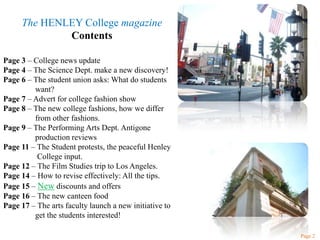
The HENLEY College magazineContentsPage 3 – College news updatePage 4 – The Science Dept. make a new discovery!Page 6 – The student union asks: What do students            	want?Page 7 – Advert for college fashion showPage 8 – The new college fashions, how we differ 	from other fashions.Page 9 – The Performing Arts Dept. Antigone 	production reviewsPage 11 – The Student protests, the peaceful Henley 	 College input. Page 12 – The Film Studies trip to Los Angeles. Page 14 – How to revise effectively: All the tips.Page 15 – New discounts and offersPage 16 – The new canteen foodPage 17 – The arts faculty launch a new initiative to 	get the students interested!Page 2
Preliminary EvaluationAudience Feedback:Would you buy this magazine?Yes: 6      No: 4If so, for how much?£1-1.50: 3         £2-£3: 1        £3+: 0Do you like the style of this magazine? Yes: 7     No: 3Making the college magazine helped me to understand how to address a specific audience in a magazine, and to help me to get an understanding of how to lay out a magazine. The audience research and feedback also showed me what the audience would be looking for in the magazine and what a general audience wants and then how I could incorporate specific elements into the magazine to make it more specialist with a general audience.  The college magazine was a good basis for my music magazine, as I could see how I could develop my music magazine and keep typical magazine elements and use them in my music magazine (like the layout of the contents page.)

Preliminary Tasks

  • 1.
  • 2.
    Front Page ReflectionWhenresearching other music magazine front covers I found that they each shared similarities in design, which I became accustomed to and could incorporate this in my own front cover. For example, many magazines use cover lines to advertise the content of the magazine, and usually place this on the left hand side of the page. So, I used this technique in the making of my front cover. In the research I also found that front covers use bright colours to capture an audiences attention, and usually with a colour that relates to or connotes with the genre/subject of the magazine. So, for the front cover of my ‘Indie’ music magazine, I highlighted my text in neon colours to make it stand out and be a little different from typical rock style magazines.
  • 3.
    Contents Page ReflectionMyresearch of magazine contents pages showed that many magazine contents pages list the page number before the name of the article or subject. They also enhance either the page number or the title In a brighter colour or a different font. I used this and brightly coloured the article names and wrote the page numbers in capitals. Contents pages also have little features about articles in the magazine, encouraging the reader to look at them and engage the reader. Here I used this in featuring an advertisement for the holiday competition and an image and caption that the audience would be interested in.
  • 4.
    Double Spread ReflectionWhenI researched the double page spreads, most of them were articles about particular artists with a large image, the title of the article, and then the text surrounding this. Looking at this, I could get a feel for how I should design my article. I decided to put my title and main image on one side of the page, to create more space for the text, and also, I created my double page spread on a competition my magazine would run, and I had some really good original photography on location.
  • 5.
    These are twoexamples of school magazine front covers, they portray model students, and promote good things in the school/colleges. i.e. there is no typical magazine scandal articles. The magazines use very plain and serious colours, for example grey and green. The cover lines are informative and are calming, and do not jump out that the reader, for my college magazine, I think I will make my approach to my readers more friendly and use colloquial language. I would probably make the magazine more of a student magazine, rather than just information about the establishment. The close up shot of a young student working, instantly indicates the subject of the magazineAdvertising relevant features on the cover, In a serious manner with formal language.
  • 6.
    The HENLEY CollegeMagazineFilmSTUDIES:The LA Trip.Get Student discount off of iTunes Purchases!The PERFORMING ARTS Dept:‘Antigone’ ReviewsCollege FASHION:What do we really wear?22nd Feb 2011£1.60Get £5free vouchers for Starbucks if you purchase a (RED) card, with at least £5 credit.
  • 7.
    The HENLEY CollegemagazineContentsPage 3 – College news updatePage 4 – The Science Dept. make a new discovery!Page 6 – The student union asks: What do students want?Page 7 – Advert for college fashion showPage 8 – The new college fashions, how we differ from other fashions.Page 9 – The Performing Arts Dept. Antigone production reviewsPage 11 – The Student protests, the peaceful Henley College input. Page 12 – The Film Studies trip to Los Angeles. Page 14 – How to revise effectively: All the tips.Page 15 – New discounts and offersPage 16 – The new canteen foodPage 17 – The arts faculty launch a new initiative to get the students interested!Page 2
  • 8.
    Preliminary EvaluationAudience Feedback:Wouldyou buy this magazine?Yes: 6 No: 4If so, for how much?£1-1.50: 3 £2-£3: 1 £3+: 0Do you like the style of this magazine? Yes: 7 No: 3Making the college magazine helped me to understand how to address a specific audience in a magazine, and to help me to get an understanding of how to lay out a magazine. The audience research and feedback also showed me what the audience would be looking for in the magazine and what a general audience wants and then how I could incorporate specific elements into the magazine to make it more specialist with a general audience. The college magazine was a good basis for my music magazine, as I could see how I could develop my music magazine and keep typical magazine elements and use them in my music magazine (like the layout of the contents page.)