National Education Policy
[NEP 2020 implementation in HEIs]
By
Mrs.P.Sravani Reddy
Assistant Professor in ECE
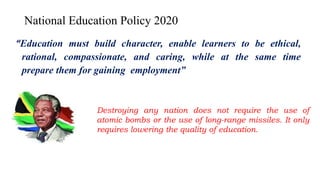
“Education must build character, enable learners to be ethical,
rational, compassionate, and caring, while at the same time
prepare them for gaining employment”
National Education Policy 2020
Destroying any nation does not require the use of
atomic bombs or the use of long-range missiles. It only
requires lowering the quality of education.
NEP 2020
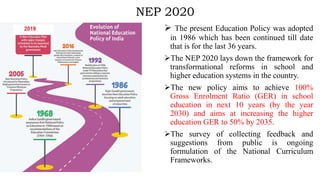
 The present Education Policy was adopted
in 1986 which has been continued till date
that is for the last 36 years.
The NEP 2020 lays down the framework for
transformational reforms in school and
higher education systems in the country.
The new policy aims to achieve 100%
Gross Enrolment Ratio (GER) in school
education in next 10 years (by the year
2030) and aims at increasing the higher
education GER to 50% by 2035.
The survey of collecting feedback and
suggestions from public is ongoing
formulation of the National Curriculum
Frameworks.
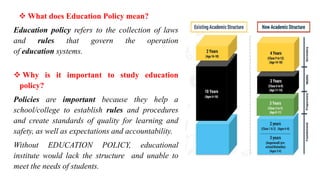
 What does Education Policy mean?
Education policy refers to the collection of laws
and rules that govern the operation
of education systems.
 Why is it important to study education
policy?
Policies are important because they help a
school/college to establish rules and procedures
and create standards of quality for learning and
safety, as well as expectations and accountability.
Without EDUCATION POLICY, educational
institute would lack the structure and unable to
meet the needs of students.
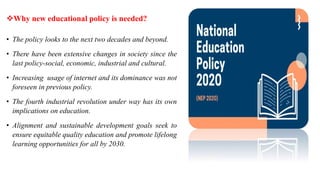
Why new educational policy is needed?
• The policy looks to the next two decades and beyond.
• There have been extensive changes in society since the
last policy-social, economic, industrial and cultural.
• Increasing usage of internet and its dominance was not
foreseen in previous policy.
• The fourth industrial revolution under way has its own
implications on education.
• Alignment and sustainable development goals seek to
ensure equitable quality education and promote lifelong
learning opportunities for all by 2030.
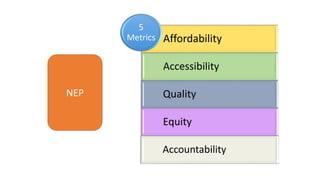
NEP
Affordability
Accessibility
Quality
Equity
Accountability
5
Metrics
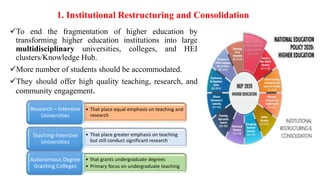
To end the fragmentation of higher education by
transforming higher education institutions into large
multidisciplinary universities, colleges, and HEI
clusters/Knowledge Hub.
More number of students should be accommodated.
They should offer high quality teaching, research, and
community engagement.
1. Institutional Restructuring and Consolidation
• That place equal emphasis on teaching and
research
Research – Intensive
Universities
• That place greater emphasis on teaching
but still conduct significant research
Teaching-Intensive
Universities
• that grants undergraduate degrees
• Primary focus on undergraduate teaching
Autonomous Degree
Granting Colleges
Institutions will have the option to run Open Distance Learning (ODL) and online
programmes, provided they are accredited .
Top institutions accredited for ODL will be encouraged and supported to develop
high-quality online courses.
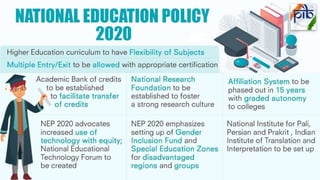
The new regulatory system envisioned by this Policy gradually phasing out the
system of ‘affiliated colleges’ over a period of 15 years through a system of graded
autonomy. [Conditional Monitoring by Affiliating University].
Present complex nomenclature of HEIs in the country such as ‘Deemed to be
university’, ‘Affiliating university’, ‘Affiliating technical university', ‘Unitary
university’ shall be replaced simply by ‘UNIVERSITY' on fulfilling the criteria as
per norms.
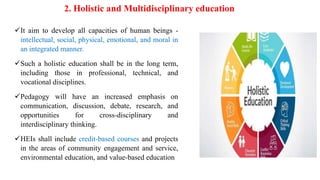
2. Holistic and Multidisciplinary education
It aim to develop all capacities of human beings -
intellectual, social, physical, emotional, and moral in
an integrated manner.
Such a holistic education shall be in the long term,
including those in professional, technical, and
vocational disciplines.
Pedagogy will have an increased emphasis on
communication, discussion, debate, research, and
opportunities for cross-disciplinary and
interdisciplinary thinking.
HEIs shall include credit-based courses and projects
in the areas of community engagement and service,
environmental education, and value-based education
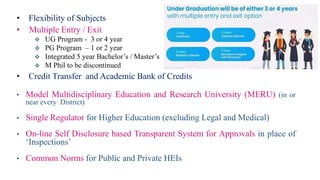
• Flexibility of Subjects
• Multiple Entry / Exit
 UG Program - 3 or 4 year
 PG Program – 1 or 2 year
 Integrated 5 year Bachelor’s / Master’s
 M Phil to be discontinued
• Credit Transfer and Academic Bank of Credits
• Model Multidisciplinary Education and Research University (MERU) (in or
near every District)
• Single Regulator for Higher Education (excluding Legal and Medical)
• On-line Self Disclosure based Transparent System for Approvals in place of
‘Inspections’
• Common Norms for Public and Private HEIs
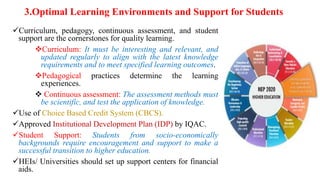
3.Optimal Learning Environments and Support for Students
Curriculum, pedagogy, continuous assessment, and student
support are the cornerstones for quality learning.
Curriculum: It must be interesting and relevant, and
updated regularly to align with the latest knowledge
requirements and to meet specified learning outcomes.
Pedagogical practices determine the learning
experiences.
 Continuous assessment: The assessment methods must
be scientific, and test the application of knowledge.
Use of Choice Based Credit System (CBCS).
Approved Institutional Development Plan (IDP) by IQAC.
Student Support: Students from socio-economically
backgrounds require encouragement and support to make a
successful transition to higher education.
HEIs/ Universities should set up support centers for financial
aids.
3.1. Internationalization
• Providing an opportunity and platform to foreign students with the goal of
“Internationalization at home”.
• Credit transfer with HEIs/ Universities and Aboard (Vice versa).
• An International Students Office at each HEI hosting foreign students will be set
up to coordinate all matters relating to welcoming and supporting students arriving
from abroad.
• Research/teaching collaborations and faculty/student exchanges with high-quality
foreign institutions will be facilitated.
• Relevant mutually beneficial MOUs with foreign countries will be signed.
• High performing Indian universities will be encouraged to set up campuses in
other countries.
• Top 100 Universities will be offered to will be facilitated to operate in India.
• A legislative framework will be developed for Internationalization.
Students are the prime stakeholders in the education system.
 HEIs should provide opportunities for participation in sports, culture/arts clubs, eco-clubs,
activity clubs, community service projects, etc.
 Mentoring system for handling stress and emotional adjustments.
 Requisite support to students from rural background.
 Hostel and medical facilities in campus.
 The National Scholarship Portal will be expanded to support, foster, and track the progress
of students receiving scholarships.
 Private HEIs will be encouraged to offer larger numbers of free ships and scholarships to
their students.
3.2. Student Activity and Participation
3.3. Financial support for students
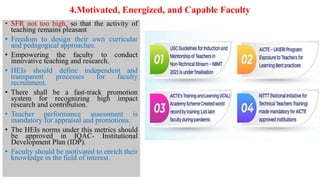
4.Motivated, Energized, and Capable Faculty
• SFR not too high, so that the activity of
teaching remains pleasant
• Freedom to design their own curricular
and pedagogical approaches.
• Empowering the faculty to conduct
innovative teaching and research.
• HEIs should define independent and
transparent processes for faculty
recruitment.
• There shall be a fast-track promotion
system for recognizing high impact
research and contribution.
• Teacher performance assessment is
mandatory for appraisal and promotions.
• The HEIs norms under this metrics should
be approved in IQAC- Institutional
Development Plan (IDP).
• Faculty should be motivated to enrich their
knowledge in the field of interest.
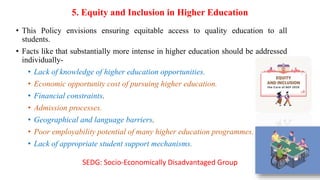
5. Equity and Inclusion in Higher Education
• This Policy envisions ensuring equitable access to quality education to all
students.
• Facts like that substantially more intense in higher education should be addressed
individually-
• Lack of knowledge of higher education opportunities.
• Economic opportunity cost of pursuing higher education.
• Financial constraints.
• Admission processes.
• Geographical and language barriers.
• Poor employability potential of many higher education programmes.
• Lack of appropriate student support mechanisms.
SEDG: Socio-Economically Disadvantaged Group
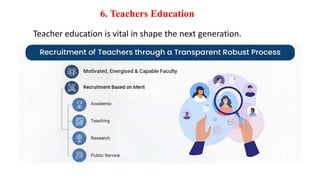
6. Teachers Education
Teacher education is vital in shape the next generation.
7. Reimagining Vocational Education
• Less than 5% vocational qualified workforce is available in
India, when compared to 52% in US, 75% in Germany and
96% in South Korea.
• This highlights the urgency to hasten the spread of
vocational Education.
• This policy aims in integration of vocational education
programmes into mainstream education in all education
institutions in a phased manner.
• Higher education institutions will offer vocational
education either on their own or in partnership with
industry and NGOs.
• B.Voc. degrees introduced in 2013 will continue to exist.
• HEIs will also be allowed to conduct short-term certificate
courses in various skills including soft skills.
8. Quality Academic Research through a new National Research Foundation [NRF]
• A robust ecosystem of research is perhaps more important with the rapid changes
occurring in the world today in technology and sustainability to the societal needs.
• The research and innovation investment in India is, at the current time, only 0.69% of
GDP.
• The societal challenges that India needs to address today, such as access for all its
citizens to clean drinking water and sanitation, quality education and healthcare,
improved transportation, air quality, energy, and infrastructure, will require high-quality
interdisciplinary research across fields.
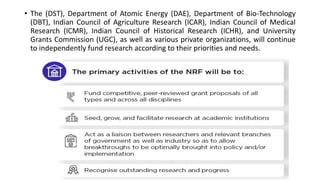
• This policy envisions the establishment of a National Research Foundation (NRF).
• The (DST), Department of Atomic Energy (DAE), Department of Bio-Technology
(DBT), Indian Council of Agriculture Research (ICAR), Indian Council of Medical
Research (ICMR), Indian Council of Historical Research (ICHR), and University
Grants Commission (UGC), as well as various private organizations, will continue
to independently fund research according to their priorities and needs.
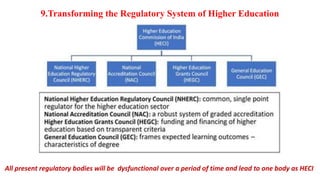
9.Transforming the Regulatory System of Higher Education
All present regulatory bodies will be dysfunctional over a period of time and lead to one body as HECI
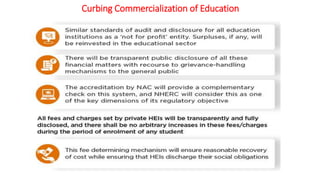
Curbing Commercialization of Education
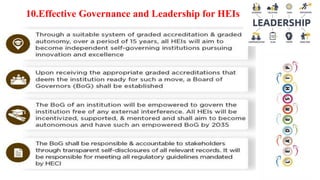
10.Effective Governance and Leadership for HEIs
To be Focus on…….
NEP 2020 for HEIs Highlights
2. Multiple Entry and Exit
3. Affiliation status will be faded out in 15 Years
4. Academic Bank of Credits
5. Flexibility in Subjects
6.Encouragement to Multidisciplinary HEIs
7. Institutional Development Plan
1. MHRD renamed as Ministry of Education [MOE]
10. Promoting Vocational Education
11. Research funding & monitoring through National Research Foundation [NRF]
12. One Regulatory System – Higher Educational Commission of India (HECI)
9. Internationalization
8. Promoting Open Distance Learning (ODL)
Thank you

NEP-S.pptx

  • 1.
    National Education Policy [NEP2020 implementation in HEIs] By Mrs.P.Sravani Reddy Assistant Professor in ECE
  • 2.
    “Education must buildcharacter, enable learners to be ethical, rational, compassionate, and caring, while at the same time prepare them for gaining employment” National Education Policy 2020 Destroying any nation does not require the use of atomic bombs or the use of long-range missiles. It only requires lowering the quality of education.
  • 3.
    NEP 2020  Thepresent Education Policy was adopted in 1986 which has been continued till date that is for the last 36 years. The NEP 2020 lays down the framework for transformational reforms in school and higher education systems in the country. The new policy aims to achieve 100% Gross Enrolment Ratio (GER) in school education in next 10 years (by the year 2030) and aims at increasing the higher education GER to 50% by 2035. The survey of collecting feedback and suggestions from public is ongoing formulation of the National Curriculum Frameworks.
  • 4.
     What doesEducation Policy mean? Education policy refers to the collection of laws and rules that govern the operation of education systems.  Why is it important to study education policy? Policies are important because they help a school/college to establish rules and procedures and create standards of quality for learning and safety, as well as expectations and accountability. Without EDUCATION POLICY, educational institute would lack the structure and unable to meet the needs of students.
  • 5.
    Why new educationalpolicy is needed? • The policy looks to the next two decades and beyond. • There have been extensive changes in society since the last policy-social, economic, industrial and cultural. • Increasing usage of internet and its dominance was not foreseen in previous policy. • The fourth industrial revolution under way has its own implications on education. • Alignment and sustainable development goals seek to ensure equitable quality education and promote lifelong learning opportunities for all by 2030.
  • 6.
  • 8.
    To end thefragmentation of higher education by transforming higher education institutions into large multidisciplinary universities, colleges, and HEI clusters/Knowledge Hub. More number of students should be accommodated. They should offer high quality teaching, research, and community engagement. 1. Institutional Restructuring and Consolidation • That place equal emphasis on teaching and research Research – Intensive Universities • That place greater emphasis on teaching but still conduct significant research Teaching-Intensive Universities • that grants undergraduate degrees • Primary focus on undergraduate teaching Autonomous Degree Granting Colleges
  • 9.
    Institutions will havethe option to run Open Distance Learning (ODL) and online programmes, provided they are accredited . Top institutions accredited for ODL will be encouraged and supported to develop high-quality online courses. The new regulatory system envisioned by this Policy gradually phasing out the system of ‘affiliated colleges’ over a period of 15 years through a system of graded autonomy. [Conditional Monitoring by Affiliating University]. Present complex nomenclature of HEIs in the country such as ‘Deemed to be university’, ‘Affiliating university’, ‘Affiliating technical university', ‘Unitary university’ shall be replaced simply by ‘UNIVERSITY' on fulfilling the criteria as per norms.
  • 10.
    2. Holistic andMultidisciplinary education It aim to develop all capacities of human beings - intellectual, social, physical, emotional, and moral in an integrated manner. Such a holistic education shall be in the long term, including those in professional, technical, and vocational disciplines. Pedagogy will have an increased emphasis on communication, discussion, debate, research, and opportunities for cross-disciplinary and interdisciplinary thinking. HEIs shall include credit-based courses and projects in the areas of community engagement and service, environmental education, and value-based education
  • 11.
    • Flexibility ofSubjects • Multiple Entry / Exit  UG Program - 3 or 4 year  PG Program – 1 or 2 year  Integrated 5 year Bachelor’s / Master’s  M Phil to be discontinued • Credit Transfer and Academic Bank of Credits • Model Multidisciplinary Education and Research University (MERU) (in or near every District) • Single Regulator for Higher Education (excluding Legal and Medical) • On-line Self Disclosure based Transparent System for Approvals in place of ‘Inspections’ • Common Norms for Public and Private HEIs
  • 12.
    3.Optimal Learning Environmentsand Support for Students Curriculum, pedagogy, continuous assessment, and student support are the cornerstones for quality learning. Curriculum: It must be interesting and relevant, and updated regularly to align with the latest knowledge requirements and to meet specified learning outcomes. Pedagogical practices determine the learning experiences.  Continuous assessment: The assessment methods must be scientific, and test the application of knowledge. Use of Choice Based Credit System (CBCS). Approved Institutional Development Plan (IDP) by IQAC. Student Support: Students from socio-economically backgrounds require encouragement and support to make a successful transition to higher education. HEIs/ Universities should set up support centers for financial aids.
  • 13.
    3.1. Internationalization • Providingan opportunity and platform to foreign students with the goal of “Internationalization at home”. • Credit transfer with HEIs/ Universities and Aboard (Vice versa). • An International Students Office at each HEI hosting foreign students will be set up to coordinate all matters relating to welcoming and supporting students arriving from abroad. • Research/teaching collaborations and faculty/student exchanges with high-quality foreign institutions will be facilitated. • Relevant mutually beneficial MOUs with foreign countries will be signed. • High performing Indian universities will be encouraged to set up campuses in other countries. • Top 100 Universities will be offered to will be facilitated to operate in India. • A legislative framework will be developed for Internationalization.
  • 14.
    Students are theprime stakeholders in the education system.  HEIs should provide opportunities for participation in sports, culture/arts clubs, eco-clubs, activity clubs, community service projects, etc.  Mentoring system for handling stress and emotional adjustments.  Requisite support to students from rural background.  Hostel and medical facilities in campus.  The National Scholarship Portal will be expanded to support, foster, and track the progress of students receiving scholarships.  Private HEIs will be encouraged to offer larger numbers of free ships and scholarships to their students. 3.2. Student Activity and Participation 3.3. Financial support for students
  • 15.
    4.Motivated, Energized, andCapable Faculty • SFR not too high, so that the activity of teaching remains pleasant • Freedom to design their own curricular and pedagogical approaches. • Empowering the faculty to conduct innovative teaching and research. • HEIs should define independent and transparent processes for faculty recruitment. • There shall be a fast-track promotion system for recognizing high impact research and contribution. • Teacher performance assessment is mandatory for appraisal and promotions. • The HEIs norms under this metrics should be approved in IQAC- Institutional Development Plan (IDP). • Faculty should be motivated to enrich their knowledge in the field of interest.
  • 16.
    5. Equity andInclusion in Higher Education • This Policy envisions ensuring equitable access to quality education to all students. • Facts like that substantially more intense in higher education should be addressed individually- • Lack of knowledge of higher education opportunities. • Economic opportunity cost of pursuing higher education. • Financial constraints. • Admission processes. • Geographical and language barriers. • Poor employability potential of many higher education programmes. • Lack of appropriate student support mechanisms. SEDG: Socio-Economically Disadvantaged Group
  • 17.
    6. Teachers Education Teachereducation is vital in shape the next generation.
  • 18.
    7. Reimagining VocationalEducation • Less than 5% vocational qualified workforce is available in India, when compared to 52% in US, 75% in Germany and 96% in South Korea. • This highlights the urgency to hasten the spread of vocational Education. • This policy aims in integration of vocational education programmes into mainstream education in all education institutions in a phased manner. • Higher education institutions will offer vocational education either on their own or in partnership with industry and NGOs. • B.Voc. degrees introduced in 2013 will continue to exist. • HEIs will also be allowed to conduct short-term certificate courses in various skills including soft skills.
  • 19.
    8. Quality AcademicResearch through a new National Research Foundation [NRF] • A robust ecosystem of research is perhaps more important with the rapid changes occurring in the world today in technology and sustainability to the societal needs. • The research and innovation investment in India is, at the current time, only 0.69% of GDP. • The societal challenges that India needs to address today, such as access for all its citizens to clean drinking water and sanitation, quality education and healthcare, improved transportation, air quality, energy, and infrastructure, will require high-quality interdisciplinary research across fields. • This policy envisions the establishment of a National Research Foundation (NRF).
  • 20.
    • The (DST),Department of Atomic Energy (DAE), Department of Bio-Technology (DBT), Indian Council of Agriculture Research (ICAR), Indian Council of Medical Research (ICMR), Indian Council of Historical Research (ICHR), and University Grants Commission (UGC), as well as various private organizations, will continue to independently fund research according to their priorities and needs.
  • 21.
    9.Transforming the RegulatorySystem of Higher Education All present regulatory bodies will be dysfunctional over a period of time and lead to one body as HECI
  • 22.
  • 23.
    10.Effective Governance andLeadership for HEIs
  • 24.
    To be Focuson…….
  • 28.
    NEP 2020 forHEIs Highlights 2. Multiple Entry and Exit 3. Affiliation status will be faded out in 15 Years 4. Academic Bank of Credits 5. Flexibility in Subjects 6.Encouragement to Multidisciplinary HEIs 7. Institutional Development Plan 1. MHRD renamed as Ministry of Education [MOE]
  • 29.
    10. Promoting VocationalEducation 11. Research funding & monitoring through National Research Foundation [NRF] 12. One Regulatory System – Higher Educational Commission of India (HECI) 9. Internationalization 8. Promoting Open Distance Learning (ODL)
  • 30.