Date
Research project
M2 ResearchVM341
M2 MEEF Anglais
Shona WHYTE 12 November 2015
Before we get going
✤ paperwork: absences, school/university conflict: Mme
Ceravolo (annuaire.unice.fr => personnel)
✤ updates: student reps PFSE and non PFSE
✤ tutor visits - paperwork/liaison
✤ tool of the week: Calendly
General requirements
✤ design a classroom
research project
✤ collect and analyse
classroom data
✤ write a research report
✤ defend your paper
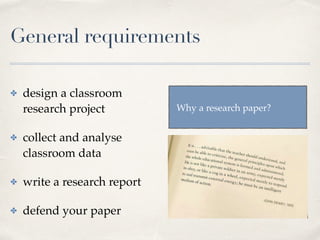
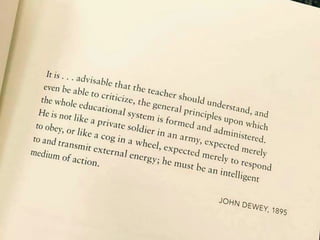
Why a research paper?
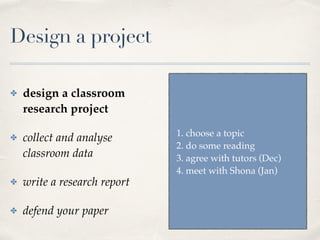
Design a project
✤ design a classroom
research project
✤ collect and analyse
classroom data
✤ write a research report
✤ defend your paper
1. choose a topic
2. do some reading
3. agree with tutors (Dec)
4. meet with Shona (Jan)
a) classroom research
A classroom action research project begins when a
teacher notices a question or problem in the classroom
and decides to investigate this with a view to making
improvements. The teacher collects data to confirm the
existence of the problem and reads up on the topic in
academic books and journals, and practitioner research
by other teachers. Then the teacher makes changes in
the class to tackle the problem, and collects more data
to find out whether the situation has improved.
b) replication
A replication study involves repeating research
conducted by someone else (perhaps another teacher)
to see whether the results are similar. The researcher
uses the same research design and the same research
instruments, perhaps with adaptations to suit the new
context. Data is collected and analysed as in the
original study, and the results compared.
c) CLIL
CLIL refers to content and language integrated
learning, where the objective is to teach content as
well as language. It often involves different curricular
areas (maths, geography) but can also mean teaching
literature or culture in the foreign language. In this
option students design a study to test a CLIL teaching
unit, collect and analyse classroom data, and draw
conclusions about this form of language education.
d) Materials design
Materials design refers to devising activities, teaching
units and curricula for learners. Teachers do it when
planning lessons, and textbook writers also do it when
preparing course books. For this option, you need to
prepare 10 hours' of teaching materials for a specific
teaching context.
e) videoconferencing (iTILT)
iTILT 2 is an EU-funded project on task-based
teaching with interactive technologies. At the
University of Nice we are working with interactive
whiteboards for videoconferencing, and with iPads. If
you join this project you will work online with
language teachers in other EU countries to produce
video examples of technology-mediated classroom
practice.
2 trainees, 2 tutors
f) telecollaboration FR-NL
Our programme has a telecollaborative exchange with
an English teacher preparation programme at Fontys
University of Applied Sciences in the Netherlands.
Students with annual teaching placements will work
with a Dutch student teacher to develop common
teaching activities and implement class exchanges
(online collaboration). This work is conducted in the
digital technologies course VMAN422 but may be
extended to form the basis of this research project.
PFSE: Meeting 2 December
Design a project
✤ design a classroom
research project
✤ collect and analyse
classroom data
✤ write a research report
✤ defend your paper
1. What kind of papers have
you written in the past?
2. Where did the content come
from?
3. What were the expectations
concerning format, length,
topic and type of paper?
Collect and analyse data
✤ design a classroom
research project
✤ collect and analyse
classroom data
✤ write a research report
✤ defend your paper
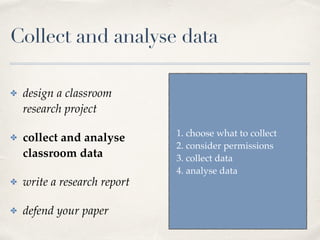
1. choose what to collect
2. consider permissions
3. collect data
4. analyse data
Timeline
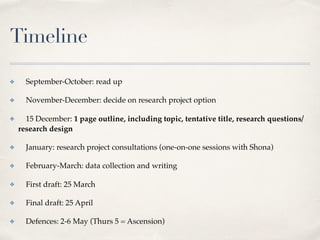
✤ September-October: read up
✤ November-December: decide on research project option
✤ 15 December: 1 page outline, including topic, tentative title, research questions/
research design
✤ January: research project consultations (one-on-one sessions with Shona)
✤ February-March: data collection and writing
✤ First draft: 25 March
✤ Final draft: 25 April
✤ Defences: 2-6 May (Thurs 5 = Ascension)
Write the paper
✤ design a classroom
research project
✤ collect and analyse
classroom data
✤ write a research report
✤ defend your paper
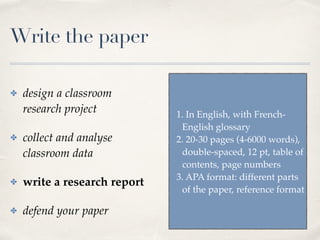
1. In English, with French-
English glossary
2. 20-30 pages (4-6000 words),
double-spaced, 12 pt, table of
contents, page numbers
3. APA format: different parts
of the paper, reference format
References
✤ APA (American Psychological Association)
✤ Google scholar
✤ bibliotheque.unice.fr
Defend your paper
✤ design a classroom
research project
✤ collect and analyse
classroom data
✤ write a research report
✤ defend your paper
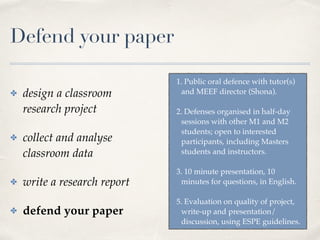
1. Public oral defence with tutor(s)
and MEEF director (Shona).

2. Defenses organised in half-day
sessions with other M1 and M2
students; open to interested
participants, including Masters
students and instructors.

3. 10 minute presentation, 10
minutes for questions, in English.
5. Evaluation on quality of project,
write-up and presentation/
discussion, using ESPE guidelines.
For 19 November
✤ decide on topic, question, and work on bibliography
✤ bring articles, ideas, questions to class
✤ be ready to discuss your ideas/plans and give
feedback to others

Research project: possibilities and requirements

  • 1.
    Date Research project M2 ResearchVM341 M2MEEF Anglais Shona WHYTE 12 November 2015
  • 2.
    Before we getgoing ✤ paperwork: absences, school/university conflict: Mme Ceravolo (annuaire.unice.fr => personnel) ✤ updates: student reps PFSE and non PFSE ✤ tutor visits - paperwork/liaison ✤ tool of the week: Calendly
  • 3.
    General requirements ✤ designa classroom research project ✤ collect and analyse classroom data ✤ write a research report ✤ defend your paper Why a research paper?
  • 5.
    Design a project ✤design a classroom research project ✤ collect and analyse classroom data ✤ write a research report ✤ defend your paper 1. choose a topic 2. do some reading 3. agree with tutors (Dec) 4. meet with Shona (Jan)
  • 6.
    a) classroom research Aclassroom action research project begins when a teacher notices a question or problem in the classroom and decides to investigate this with a view to making improvements. The teacher collects data to confirm the existence of the problem and reads up on the topic in academic books and journals, and practitioner research by other teachers. Then the teacher makes changes in the class to tackle the problem, and collects more data to find out whether the situation has improved.
  • 7.
    b) replication A replicationstudy involves repeating research conducted by someone else (perhaps another teacher) to see whether the results are similar. The researcher uses the same research design and the same research instruments, perhaps with adaptations to suit the new context. Data is collected and analysed as in the original study, and the results compared.
  • 8.
    c) CLIL CLIL refersto content and language integrated learning, where the objective is to teach content as well as language. It often involves different curricular areas (maths, geography) but can also mean teaching literature or culture in the foreign language. In this option students design a study to test a CLIL teaching unit, collect and analyse classroom data, and draw conclusions about this form of language education.
  • 9.
    d) Materials design Materialsdesign refers to devising activities, teaching units and curricula for learners. Teachers do it when planning lessons, and textbook writers also do it when preparing course books. For this option, you need to prepare 10 hours' of teaching materials for a specific teaching context.
  • 10.
    e) videoconferencing (iTILT) iTILT2 is an EU-funded project on task-based teaching with interactive technologies. At the University of Nice we are working with interactive whiteboards for videoconferencing, and with iPads. If you join this project you will work online with language teachers in other EU countries to produce video examples of technology-mediated classroom practice. 2 trainees, 2 tutors
  • 11.
    f) telecollaboration FR-NL Ourprogramme has a telecollaborative exchange with an English teacher preparation programme at Fontys University of Applied Sciences in the Netherlands. Students with annual teaching placements will work with a Dutch student teacher to develop common teaching activities and implement class exchanges (online collaboration). This work is conducted in the digital technologies course VMAN422 but may be extended to form the basis of this research project. PFSE: Meeting 2 December
  • 12.
    Design a project ✤design a classroom research project ✤ collect and analyse classroom data ✤ write a research report ✤ defend your paper 1. What kind of papers have you written in the past? 2. Where did the content come from? 3. What were the expectations concerning format, length, topic and type of paper?
  • 14.
    Collect and analysedata ✤ design a classroom research project ✤ collect and analyse classroom data ✤ write a research report ✤ defend your paper 1. choose what to collect 2. consider permissions 3. collect data 4. analyse data
  • 15.
    Timeline ✤ September-October: readup ✤ November-December: decide on research project option ✤ 15 December: 1 page outline, including topic, tentative title, research questions/ research design ✤ January: research project consultations (one-on-one sessions with Shona) ✤ February-March: data collection and writing ✤ First draft: 25 March ✤ Final draft: 25 April ✤ Defences: 2-6 May (Thurs 5 = Ascension)
  • 16.
    Write the paper ✤design a classroom research project ✤ collect and analyse classroom data ✤ write a research report ✤ defend your paper 1. In English, with French- English glossary 2. 20-30 pages (4-6000 words), double-spaced, 12 pt, table of contents, page numbers 3. APA format: different parts of the paper, reference format
  • 17.
    References ✤ APA (AmericanPsychological Association) ✤ Google scholar ✤ bibliotheque.unice.fr
  • 18.
    Defend your paper ✤design a classroom research project ✤ collect and analyse classroom data ✤ write a research report ✤ defend your paper 1. Public oral defence with tutor(s) and MEEF director (Shona).
 2. Defenses organised in half-day sessions with other M1 and M2 students; open to interested participants, including Masters students and instructors.
 3. 10 minute presentation, 10 minutes for questions, in English. 5. Evaluation on quality of project, write-up and presentation/ discussion, using ESPE guidelines.
  • 19.
    For 19 November ✤decide on topic, question, and work on bibliography ✤ bring articles, ideas, questions to class ✤ be ready to discuss your ideas/plans and give feedback to others