Getting started in pedagogical research and writing: beyond the first steps David Boud
Overview First steps Outlets for publication Positioning one’s work Is teaching and learning writing different? Pre-writing Building capacity to write effectively Becoming productive Commenting on drafts Getting published
Scholarship of teaching and learning To be called scholarship “ an activity has to manifest three essential features, it should:  be public,  subject to peer review and evaluation, and  accessible for exchange and use by members of one’s disciplinary community”.  Lee Shulman
1. First steps Understanding and being thoughtful about student learning It isn’t about teaching but the consequences for learning Don’t expect anyone to be interested in what you are doing, if you are not interested in what they do Know what is going on elsewhere, keep in touch Become a connoisseur Appreciating pedagogy requires knowing the concepts and the language and using it well
What am I doing? Am I doing something interesting that is different from what others are doing elsewhere?  What is different about it? How do I know that it is different? How will I know if it is worthwhile? What will others be interested in knowing about? What might convince them of the worth of this practice?
Key questions What is the problematic? What is the focus of your study? What is your research question? How can it be approached (methodology/methods, research design)? What evidence can I assemble to illuminate it? What kinds of analysis will I need to do? What is enough?
2. Outlets for different purposes Teaching and learning meetings and conferences First exposure Newsletters/magazines Internal and external: quick dissemination Academic journals Discipline education and general teaching and learning in higher education Work won’t really be valued, except locally, until it appears in a journal or equivalent
3. Positioning one’s work We can’t communicate with others without knowing what other work is going on Researching the topic Ephemeral and substantial sources
4. Is teaching and learning writing different? Essentially no!  It needs to exhibit all the qualities you would expect to see in any academic writing Shows knowledge of literature and current ideas Has interesting ideas/practices to communicate Uses evidence well to make a compelling argument
5. Preparation—pre-writing Specifically, which outlet am I ultimately writing for (not just intermediate ones)? Do I have an idea/form of practice that will interest others? What will others need to know about it? Do I know enough about what others are doing/thinking? What evidence will they find compelling?
6. Building capacity to write effectively? Read, read, read Don’t expect others to read you if you don’t read them! Write, write, write Find out whether you need to change your normal disciplinary style Use intermediate steps Write with others Show drafts to others Which others?
7. What do I need to know to be productive? Identify early the outlet that I will ultimately end up writing for Understand how it is positioned, what it publishes, what approaches it accepts Identify literature in relation to which I am going to position my work Conceptually and practically Identify if I have enough evidence or if additional investigation/reading is needed Find some good peers to comment on the writing
Commenting on drafts Your expertise is as a reader—does the writing communicate to you and to those it is planned to influence? You are not the writer, don’t tell them what to write Share your personal responses in the role of the kind of reader it is aimed at Listen carefully to the kind of comments they want at this particular stage
Commenting on drafts—checklist What is the outlet for this? (specific journal—now and later?) What stage of writing is this? (comment accordingly) Is it positioned vis a vis other ideas/literature? Is this work adequately referenced? What specifically is being argued? Is it completely clear to me? What evidence is there to support the argument? Is it compelling? Am I being persuaded by what I am reading? What is missing that I might reasonably expect to see? What would I expect to see in the next draft that is different from this?
Receiving comments on drafts Listen carefully, don’t respond or defend Make detailed notes or even record comments If readers have picked up the wrong idea, don’t justify what you wrote, but work out why this interpretation could have been made—was there something in the paper that prompted it?  End by thanking the givers and  briefly  say how you are thinking of proceeding from here (saying you will scrap it is not an option!)
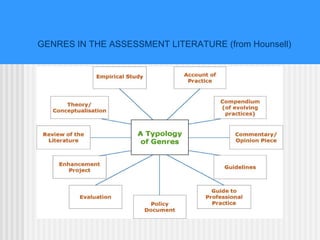
GENRES IN THE ASSESSMENT LITERATURE (from Hounsell)
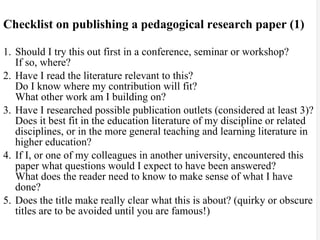
Checklist on publishing a pedagogical research paper (1) 1. Should I try this out first in a conference, seminar or workshop?  If so, where? 2. Have I read the literature relevant to this?  Do I know where my contribution will fit?  What other work am I building on? 3. Have I researched possible publication outlets (considered at least 3)?  Does it best fit in the education literature of my discipline or related disciplines, or in the more general teaching and learning literature in higher education? 4. If I, or one of my colleagues in another university, encountered this paper what questions would I expect to have been answered?  What does the reader need to know to make sense of what I have done? 5. Does the title make really clear what this is about? (quirky or obscure titles are to be avoided until you are famous!)
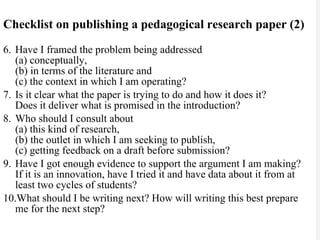
Checklist on publishing a pedagogical research paper (2) 6. Have I framed the problem being addressed  (a) conceptually,  (b) in terms of the literature and  (c) the context in which I am operating? 7. Is it clear what the paper is trying to do and how it does it?  Does it deliver what is promised in the introduction? 8. Who should I consult about  (a) this kind of research,  (b) the outlet in which I am seeking to publish,  (c) getting feedback on a draft before submission? 9. Have I got enough evidence to support the argument I am making?  If it is an innovation, have I tried it and have data about it from at least two cycles of students? 10.What should I be writing next? How will writing this best prepare me for the next step?
Producing the paper for a journal Think about this before you write the very first version!
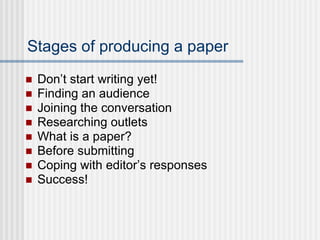
Stages of producing a paper  Don’t start writing yet! Finding an audience Joining the conversation Researching outlets What is a paper? Before submitting Coping with editor’s responses Success!
What comes first? “ Joining the conversation” Who do I want to speak to? Who is available to be spoken to? Finding an opening
Researching outlets If I don’t know the journal, why would it want to know me? Where is my work positioned? Where do I want it to be positioned? What business (field) am I actually in?
What is a paper? Not a conference presentation Not a chapter in a book Certainly not a book or a thesis! A discrete communication located in a specific area which argues a case based on evidence Playing with the genre is for experts
Before submitting If it is written for this particular journal exactly what does it need to satisfy? What would any reasonable reader of my paper in this journal expect of it? Don’t forget the abstract (and make it  an abstract!) Follow referencing conventions, avoid referencing ephemera Understand the submission process
Editor’s responses When is a rejection not a rejection? Reading referees’ reports—what to take seriously? What is a sufficient revision? Another cycle? Dealing with proofs
What to expect after publication Nothing for a long time! The conversation is a very slow one

David boud uu pedagogic research and writing

  • 1.
    Getting started inpedagogical research and writing: beyond the first steps David Boud
  • 2.
    Overview First stepsOutlets for publication Positioning one’s work Is teaching and learning writing different? Pre-writing Building capacity to write effectively Becoming productive Commenting on drafts Getting published
  • 3.
    Scholarship of teachingand learning To be called scholarship “ an activity has to manifest three essential features, it should: be public, subject to peer review and evaluation, and accessible for exchange and use by members of one’s disciplinary community”. Lee Shulman
  • 4.
    1. First stepsUnderstanding and being thoughtful about student learning It isn’t about teaching but the consequences for learning Don’t expect anyone to be interested in what you are doing, if you are not interested in what they do Know what is going on elsewhere, keep in touch Become a connoisseur Appreciating pedagogy requires knowing the concepts and the language and using it well
  • 5.
    What am Idoing? Am I doing something interesting that is different from what others are doing elsewhere? What is different about it? How do I know that it is different? How will I know if it is worthwhile? What will others be interested in knowing about? What might convince them of the worth of this practice?
  • 6.
    Key questions Whatis the problematic? What is the focus of your study? What is your research question? How can it be approached (methodology/methods, research design)? What evidence can I assemble to illuminate it? What kinds of analysis will I need to do? What is enough?
  • 7.
    2. Outlets fordifferent purposes Teaching and learning meetings and conferences First exposure Newsletters/magazines Internal and external: quick dissemination Academic journals Discipline education and general teaching and learning in higher education Work won’t really be valued, except locally, until it appears in a journal or equivalent
  • 8.
    3. Positioning one’swork We can’t communicate with others without knowing what other work is going on Researching the topic Ephemeral and substantial sources
  • 9.
    4. Is teachingand learning writing different? Essentially no! It needs to exhibit all the qualities you would expect to see in any academic writing Shows knowledge of literature and current ideas Has interesting ideas/practices to communicate Uses evidence well to make a compelling argument
  • 10.
    5. Preparation—pre-writing Specifically,which outlet am I ultimately writing for (not just intermediate ones)? Do I have an idea/form of practice that will interest others? What will others need to know about it? Do I know enough about what others are doing/thinking? What evidence will they find compelling?
  • 11.
    6. Building capacityto write effectively? Read, read, read Don’t expect others to read you if you don’t read them! Write, write, write Find out whether you need to change your normal disciplinary style Use intermediate steps Write with others Show drafts to others Which others?
  • 12.
    7. What doI need to know to be productive? Identify early the outlet that I will ultimately end up writing for Understand how it is positioned, what it publishes, what approaches it accepts Identify literature in relation to which I am going to position my work Conceptually and practically Identify if I have enough evidence or if additional investigation/reading is needed Find some good peers to comment on the writing
  • 13.
    Commenting on draftsYour expertise is as a reader—does the writing communicate to you and to those it is planned to influence? You are not the writer, don’t tell them what to write Share your personal responses in the role of the kind of reader it is aimed at Listen carefully to the kind of comments they want at this particular stage
  • 14.
    Commenting on drafts—checklistWhat is the outlet for this? (specific journal—now and later?) What stage of writing is this? (comment accordingly) Is it positioned vis a vis other ideas/literature? Is this work adequately referenced? What specifically is being argued? Is it completely clear to me? What evidence is there to support the argument? Is it compelling? Am I being persuaded by what I am reading? What is missing that I might reasonably expect to see? What would I expect to see in the next draft that is different from this?
  • 15.
    Receiving comments ondrafts Listen carefully, don’t respond or defend Make detailed notes or even record comments If readers have picked up the wrong idea, don’t justify what you wrote, but work out why this interpretation could have been made—was there something in the paper that prompted it? End by thanking the givers and briefly say how you are thinking of proceeding from here (saying you will scrap it is not an option!)
  • 16.
    GENRES IN THEASSESSMENT LITERATURE (from Hounsell)
  • 17.
    Checklist on publishinga pedagogical research paper (1) 1. Should I try this out first in a conference, seminar or workshop? If so, where? 2. Have I read the literature relevant to this? Do I know where my contribution will fit? What other work am I building on? 3. Have I researched possible publication outlets (considered at least 3)? Does it best fit in the education literature of my discipline or related disciplines, or in the more general teaching and learning literature in higher education? 4. If I, or one of my colleagues in another university, encountered this paper what questions would I expect to have been answered? What does the reader need to know to make sense of what I have done? 5. Does the title make really clear what this is about? (quirky or obscure titles are to be avoided until you are famous!)
  • 18.
    Checklist on publishinga pedagogical research paper (2) 6. Have I framed the problem being addressed (a) conceptually, (b) in terms of the literature and (c) the context in which I am operating? 7. Is it clear what the paper is trying to do and how it does it? Does it deliver what is promised in the introduction? 8. Who should I consult about (a) this kind of research, (b) the outlet in which I am seeking to publish, (c) getting feedback on a draft before submission? 9. Have I got enough evidence to support the argument I am making? If it is an innovation, have I tried it and have data about it from at least two cycles of students? 10.What should I be writing next? How will writing this best prepare me for the next step?
  • 19.
    Producing the paperfor a journal Think about this before you write the very first version!
  • 20.
    Stages of producinga paper Don’t start writing yet! Finding an audience Joining the conversation Researching outlets What is a paper? Before submitting Coping with editor’s responses Success!
  • 21.
    What comes first?“ Joining the conversation” Who do I want to speak to? Who is available to be spoken to? Finding an opening
  • 22.
    Researching outlets IfI don’t know the journal, why would it want to know me? Where is my work positioned? Where do I want it to be positioned? What business (field) am I actually in?
  • 23.
    What is apaper? Not a conference presentation Not a chapter in a book Certainly not a book or a thesis! A discrete communication located in a specific area which argues a case based on evidence Playing with the genre is for experts
  • 24.
    Before submitting Ifit is written for this particular journal exactly what does it need to satisfy? What would any reasonable reader of my paper in this journal expect of it? Don’t forget the abstract (and make it an abstract!) Follow referencing conventions, avoid referencing ephemera Understand the submission process
  • 25.
    Editor’s responses Whenis a rejection not a rejection? Reading referees’ reports—what to take seriously? What is a sufficient revision? Another cycle? Dealing with proofs
  • 26.
    What to expectafter publication Nothing for a long time! The conversation is a very slow one

Editor's Notes

  • #2 Learning in context: the role of experience, reflection and work itself While there has been considerable emphasis on structured and accredited learning and development, and educators of course believe that this is the most important, it still accounts for a small part of the learning that occurs in and for work. This session will focus on how we learn in work settings and locate structured learning in a wider context. It will discuss how ideas about learning from experience and the role of reflection in learning have been changing. It will also draw upon recent research conducted by the speaker on everyday learning at work. About myself How the session will unfold Invitation to contribute, interrupt