How to Explicate a
Poem

    Source: http://www.unc.edu/depts/wcweb/handouts/poetry-explication.html
Aim: How do we
Explicate a Poem?
• A poetry explication is a relatively
  short analysis which describes the
  possible meanings and relationships
  of the words, images, and other
  small units that make up a poem.
• Writing an explication is an effective
  way for a reader to connect a poem's
  plot and conflicts with its structural
  features.
Aim: How do we
Explicate a Poem?
• Preparing to write an
  explication
  • Read the poem silently, then read it
    aloud (if not in a testing situation).
    Repeat as necessary.
  • Consider the poem as a dramatic
    situation in which a speaker addresses
    an audience or another character. In this
    way, begin your analysis by identifying
    and describing the speaking voice or
    voices, the conflicts or ideas, and the
    language used in the poem.
Aim: How do we
Explicate a Poem?
       The Large Issues:
• Determine the basic design of
  the poem by considering the
  who, what, when, where, and
  why of the dramatic situation.
Aim: How do we
Explicate a Poem?
• What is being dramatized?
  What conflicts or themes
  does the poem present,
  address, or question?
• Who is the speaker? Define
  and describe the speaker
  and his/her voice. What does
  the speaker say? Who is the
  audience? Are other
  characters involved?
Aim: How do we
Explicate a Poem?
• What happens in the poem?
  Consider the plot or basic
  design of the action. How are
  the dramatized conflicts or
  themes introduced, sustained,
  resolved, etc.?
• When does the action occur?
  What is the date and/or time of
  day?
Aim: How do we
Explicate a Poem?
• Where is the speaker? Describe
  the physical location of the
  dramatic moment.
• Why does the speaker feel
  compelled to speak at this
  moment? What is his/her
  motivation?
Aim: How do we
Explicate a Poem?
            The Design:

• To analyze the design of the poem,
  we must focus on the poem's parts,
  namely how the poem dramatizes
  conflicts or ideas in language.
• By concentrating on the parts, we
  develop our understanding of the
  poem's structure, and we gather
  support and evidence for our
  interpretations.
Aim: How do we
Explicate a Poem?
• Form: Does the poem represent a
  particular form (sonnet, sestina,
  etc.)? Does the poem present any
  unique variations from the traditional
  structure of that form?
• Rhetoric: How does the speaker
  make particular statements? Does
  the rhetoric seem odd in any way?
  Why? Consider the predicates and
  what they reveal about the speaker.
Aim: How do we
Explicate a Poem?
• Syntax: Consider the subjects, verbs,
  and objects of each statement and
  what these elements reveal about
  the speaker. Do any statements have
  convoluted or vague syntax?
• Diction: Why does the poet choose
  one word over another in each line?
  Do any of the words have multiple or
  archaic meanings that add other
  meanings to the line?
Aim: How do we
Explicate a Poem?
          The Patterns :

• As you analyze the design line
  by line, look for certain patterns
  to develop which provide insight
  into the dramatic situation, the
  speaker's state of mind, or the
  poet's use of details. Some of
  the most common patterns
  include the following:
Aim: How do we
Explicate a Poem?
• Rhetorical Patterns: Look for
  statements that follow the
  same format.
• Rhyme: Consider the
  significance of the end words
  joined by sound; in a poem
  with no rhymes, consider the
  importance of the end words.
Aim: How do we
Explicate a Poem?
• Patterns of Sound: Alliteration
  and assonance create sound
  effects and often cluster
  significant words.
• Visual Patterns: How does the
  poem look on the page?
• Rhythm and Meter: Consider how
  rhythm and meter influence our
  perception of the speaker and
  his/her language
Aim: How do we
Explicate a Poem?
    Basic terms for talking about meter
• Meter (from the Greek metron,
  meaning measure) refers
  principally to the recurrence of
  regular beats in a poetic line. In
  this way, meter pertains to the
  structure of the poem as it is
  written.
Aim: How do we
Explicate a Poem?
• The most common form of meter
  in English verse since the 14th
  century is accentual-syllabic
  meter, in which the basic unit is
  the foot.
• A foot is a combination of two or
  three stressed and/or unstressed
  syllables. The following are the
  four most common metrical feet
  in English poetry:
Aim: How do we
Explicate a Poem?

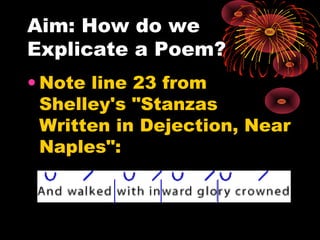
• IAMBIC (the noun is "iamb"): an
  unstressed syllable followed by a
  stressed syllable, a pattern which
  comes closest to approximating
  the natural rhythm of speech.
Aim: How do we
Explicate a Poem?
• Note line 23 from
  Shelley's "Stanzas
  Written in Dejection, Near
  Naples":
Aim: How do we
Explicate a Poem?

• TROCHAIC (the noun is
  "trochee"): a stressed followed
  by an unstressed syllable.
Aim: How do we
Explicate a Poem?
• Note the first line of Blake's
  "Introduction" to Songs of
  Innocence:
Aim: How do we
Explicate a Poem?

• ANAPESTIC (the noun is
  "anapest"): two unstressed
  syllables followed by a stressed
  syllable
Aim: How do we
Explicate a Poem?
• Note the opening to Byron's
  "The Destruction of
  Sennacherib":
Aim: How do we
Explicate a Poem?

• DACTYLIC (the noun is
  "dactyl"): a stressed syllable
  followed by two unstressed
  syllables
Aim: How do we
Explicate a Poem?
• Note Thomas Hardy's "The
  Voice":
Aim: How do we
Explicate a Poem?
• Meter also refers to the
  number of feet in a line:

     Monomete          One
          r            Two
      Dimeter         Three
      Trimeter         Four
     Tetramete         Five
          r             Six
     Pentamet
Aim: How do we
Explicate a Poem?
      Writing An Explication
• The explication should follow
  the same format as the
  preparation: begin with the
  large issues and basic design of
  the poem and work through
  each line to the more specific
  details and patterns.
Aim: How do we
Explicate a Poem?
         The First Paragraph
• The first paragraph should present
  the large issues; it should inform the
  reader which conflicts are
  dramatized and should describe the
  dramatic situation of the speaker.
  The explication does not require a
  formal introductory paragraph; the
  writer should simply start
  explicating immediately.
Aim: How do we
Explicate a Poem?
• A foolproof way to begin any
  explication is with the following
  sentence:


• "This poem dramatizes the
  conflict between …"
Aim: How do we
Explicate a Poem?
• Such a beginning ensures that
  you will introduce the major
  conflict or theme in the poem
  and organize your explication
  accordingly
Aim: How do we
Explicate a Poem?
                     Here is an example.
•   A student's explication of Wordsworth's "Composed upon
    Westminster Bridge" might begin in the following way:
•   This poem dramatizes the conflict between appearance and reality,
    particularly as this conflict relates to what the speaker seems to say and
    what he really says. From Westminster Bridge, the speaker looks at
    London at sunrise, and he explains that all people should be struck by
    such a beautiful scene. The speaker notes that the city is silent, and he
    points to several specific objects, naming them only in general terms:
    "Ships, towers, domes, theatres, and temples" (6). After describing the
    "glittering" aspect of these objects, he asserts that these city places are
    just as beautiful in the morning as country places like "valley, rock, or hill"
    (8,10). Finally, after describing his deep feeling of calmness, the speaker
    notes how the "houses seem asleep" and that "all that mighty heart is
    lying still" (13, 14). In this way, the speaker seems to say simply that
    London looks beautiful in the morning.
Aim: How do we
Explicate a Poem?
        The next paragraphs
• The next paragraphs should expand
  the discussion of the conflict by
  focusing on details of form, rhetoric,
                         form rhetoric
  syntax, and vocabulary.
  syntax       vocabulary
• In these paragraphs, the writer
  should explain the poem line by line
  in terms of these details, and he or
  she should incorporate important
  elements of rhyme, rhythm, and
               rhyme rhythm
  meter during this discussion.
Aim: How do we
Explicate a Poem?
•   The student's explication continues with a topic
    sentence that directs the discussion of the first five
    lines:
•   However, the poem begins with several oddities that
    suggest the speaker is saying more than what he seems
    to say initially. For example, the poem is an Italian
    sonnet and follows the abbaabbacdcdcd rhyme scheme.
    The fact that the poet chooses to write a sonnet about
    London in an Italian form suggests that what he says may
    not be actually praising the city. Also, the rhetoric of the
    first two lines seems awkward compared to a normal
    speaking voice: "Earth has not anything to show more
    fair. / Dull would he be of soul who could pass by" (1-2).
    The odd syntax continues when the poet personifies the
    city: "This City now doth, like a garment, wear / The
    beauty of the morning" (4-5). Here, the city wears the
    morning's beauty, so it is not the city but the morning
    that is beautiful ...
Aim: How do we
Explicate a Poem?
          The conclusion??
• The explication has no formal
  concluding paragraph; do not simply
  restate the main points of the
  introduction!
• The end of the explication should
  focus on sound effects or visual
  patterns as the final element of
  asserting an explanation
Aim: How do we
Explicate a Poem?
• Or, as does the student here, the writer
  may choose simply to stop writing when he
  or she reaches the end of the poem:
• The poem ends with a vague statement:
  "And all that mighty heart is lying still!" In
  this line, the city's heart could be dead, or
  it could be simply deceiving the one
  observing the scene. In this way, the poet
  reinforces the conflict between the
  appearance of the city in the morning and
  what such a scene and his words actually
  reveal.
Aim: How do we
Explicate a Poem?
        Tips to keep in mind
1. Refer to the speaking voice in the
  poem as “the speaker" or "the poet."
For example, do not write, "In this
  poem, Wordsworth says that London
  is beautiful in the morning."
However, you can write, "In this poem,
  Wordsworth presents a speaker
  who…"
Aim: How do we
Explicate a Poem?

• We cannot absolutely identify
  Wordsworth with the speaker of
  the poem, so it is more accurate
  to talk about "the speaker" or
  "the poet" in an explication.
Aim: How do we
Explicate a Poem?

2. Use the present tense when
  writing the explication. The
  poem, as a work of literature,
  continues to exist!
Aim: How do we
Explicate a Poem?
3. To avoid unnecessary uses of
  the verb "to be" in your
  compositions, the following list
  suggests some verbs you can
  use when writing the
  explication:
Aim: How do we
  Explicate a Poem?

dramatize     underline   portrays    shows
s             s asserts   contrasts   addresses
presents      posits      juxtapose   emphasiz
illustrate    enacts      s           es
s             connects    suggests    stresses
characteriz               implies     accentuate
es
                                      s enables
Aim: How do we
Explicate a Poem?
                  The Fountain
Fountain, fountain, what do you say
     Singing at night alone?
  "It is enough to rise and fall
     Here in my basin of stone."
But are you content as you seem to be
  So near the freedom and rush of the sea?
     "I have listened all night to its laboring
  sound,
     It heaves and sags, as the moon runs
  round;
  Ocean and fountain, shadow and tree,
  Nothing escapes, nothing is free."

AP Poetry Explication

  • 1.
    How to Explicatea Poem Source: http://www.unc.edu/depts/wcweb/handouts/poetry-explication.html
  • 2.
    Aim: How dowe Explicate a Poem? • A poetry explication is a relatively short analysis which describes the possible meanings and relationships of the words, images, and other small units that make up a poem. • Writing an explication is an effective way for a reader to connect a poem's plot and conflicts with its structural features.
  • 3.
    Aim: How dowe Explicate a Poem? • Preparing to write an explication • Read the poem silently, then read it aloud (if not in a testing situation). Repeat as necessary. • Consider the poem as a dramatic situation in which a speaker addresses an audience or another character. In this way, begin your analysis by identifying and describing the speaking voice or voices, the conflicts or ideas, and the language used in the poem.
  • 4.
    Aim: How dowe Explicate a Poem? The Large Issues: • Determine the basic design of the poem by considering the who, what, when, where, and why of the dramatic situation.
  • 5.
    Aim: How dowe Explicate a Poem? • What is being dramatized? What conflicts or themes does the poem present, address, or question? • Who is the speaker? Define and describe the speaker and his/her voice. What does the speaker say? Who is the audience? Are other characters involved?
  • 6.
    Aim: How dowe Explicate a Poem? • What happens in the poem? Consider the plot or basic design of the action. How are the dramatized conflicts or themes introduced, sustained, resolved, etc.? • When does the action occur? What is the date and/or time of day?
  • 7.
    Aim: How dowe Explicate a Poem? • Where is the speaker? Describe the physical location of the dramatic moment. • Why does the speaker feel compelled to speak at this moment? What is his/her motivation?
  • 8.
    Aim: How dowe Explicate a Poem? The Design: • To analyze the design of the poem, we must focus on the poem's parts, namely how the poem dramatizes conflicts or ideas in language. • By concentrating on the parts, we develop our understanding of the poem's structure, and we gather support and evidence for our interpretations.
  • 9.
    Aim: How dowe Explicate a Poem? • Form: Does the poem represent a particular form (sonnet, sestina, etc.)? Does the poem present any unique variations from the traditional structure of that form? • Rhetoric: How does the speaker make particular statements? Does the rhetoric seem odd in any way? Why? Consider the predicates and what they reveal about the speaker.
  • 10.
    Aim: How dowe Explicate a Poem? • Syntax: Consider the subjects, verbs, and objects of each statement and what these elements reveal about the speaker. Do any statements have convoluted or vague syntax? • Diction: Why does the poet choose one word over another in each line? Do any of the words have multiple or archaic meanings that add other meanings to the line?
  • 11.
    Aim: How dowe Explicate a Poem? The Patterns : • As you analyze the design line by line, look for certain patterns to develop which provide insight into the dramatic situation, the speaker's state of mind, or the poet's use of details. Some of the most common patterns include the following:
  • 12.
    Aim: How dowe Explicate a Poem? • Rhetorical Patterns: Look for statements that follow the same format. • Rhyme: Consider the significance of the end words joined by sound; in a poem with no rhymes, consider the importance of the end words.
  • 13.
    Aim: How dowe Explicate a Poem? • Patterns of Sound: Alliteration and assonance create sound effects and often cluster significant words. • Visual Patterns: How does the poem look on the page? • Rhythm and Meter: Consider how rhythm and meter influence our perception of the speaker and his/her language
  • 14.
    Aim: How dowe Explicate a Poem? Basic terms for talking about meter • Meter (from the Greek metron, meaning measure) refers principally to the recurrence of regular beats in a poetic line. In this way, meter pertains to the structure of the poem as it is written.
  • 15.
    Aim: How dowe Explicate a Poem? • The most common form of meter in English verse since the 14th century is accentual-syllabic meter, in which the basic unit is the foot. • A foot is a combination of two or three stressed and/or unstressed syllables. The following are the four most common metrical feet in English poetry:
  • 16.
    Aim: How dowe Explicate a Poem? • IAMBIC (the noun is "iamb"): an unstressed syllable followed by a stressed syllable, a pattern which comes closest to approximating the natural rhythm of speech.
  • 17.
    Aim: How dowe Explicate a Poem? • Note line 23 from Shelley's "Stanzas Written in Dejection, Near Naples":
  • 18.
    Aim: How dowe Explicate a Poem? • TROCHAIC (the noun is "trochee"): a stressed followed by an unstressed syllable.
  • 19.
    Aim: How dowe Explicate a Poem? • Note the first line of Blake's "Introduction" to Songs of Innocence:
  • 20.
    Aim: How dowe Explicate a Poem? • ANAPESTIC (the noun is "anapest"): two unstressed syllables followed by a stressed syllable
  • 21.
    Aim: How dowe Explicate a Poem? • Note the opening to Byron's "The Destruction of Sennacherib":
  • 22.
    Aim: How dowe Explicate a Poem? • DACTYLIC (the noun is "dactyl"): a stressed syllable followed by two unstressed syllables
  • 23.
    Aim: How dowe Explicate a Poem? • Note Thomas Hardy's "The Voice":
  • 24.
    Aim: How dowe Explicate a Poem? • Meter also refers to the number of feet in a line: Monomete One r Two Dimeter Three Trimeter Four Tetramete Five r Six Pentamet
  • 25.
    Aim: How dowe Explicate a Poem? Writing An Explication • The explication should follow the same format as the preparation: begin with the large issues and basic design of the poem and work through each line to the more specific details and patterns.
  • 26.
    Aim: How dowe Explicate a Poem? The First Paragraph • The first paragraph should present the large issues; it should inform the reader which conflicts are dramatized and should describe the dramatic situation of the speaker. The explication does not require a formal introductory paragraph; the writer should simply start explicating immediately.
  • 27.
    Aim: How dowe Explicate a Poem? • A foolproof way to begin any explication is with the following sentence: • "This poem dramatizes the conflict between …"
  • 28.
    Aim: How dowe Explicate a Poem? • Such a beginning ensures that you will introduce the major conflict or theme in the poem and organize your explication accordingly
  • 29.
    Aim: How dowe Explicate a Poem? Here is an example. • A student's explication of Wordsworth's "Composed upon Westminster Bridge" might begin in the following way: • This poem dramatizes the conflict between appearance and reality, particularly as this conflict relates to what the speaker seems to say and what he really says. From Westminster Bridge, the speaker looks at London at sunrise, and he explains that all people should be struck by such a beautiful scene. The speaker notes that the city is silent, and he points to several specific objects, naming them only in general terms: "Ships, towers, domes, theatres, and temples" (6). After describing the "glittering" aspect of these objects, he asserts that these city places are just as beautiful in the morning as country places like "valley, rock, or hill" (8,10). Finally, after describing his deep feeling of calmness, the speaker notes how the "houses seem asleep" and that "all that mighty heart is lying still" (13, 14). In this way, the speaker seems to say simply that London looks beautiful in the morning.
  • 30.
    Aim: How dowe Explicate a Poem? The next paragraphs • The next paragraphs should expand the discussion of the conflict by focusing on details of form, rhetoric, form rhetoric syntax, and vocabulary. syntax vocabulary • In these paragraphs, the writer should explain the poem line by line in terms of these details, and he or she should incorporate important elements of rhyme, rhythm, and rhyme rhythm meter during this discussion.
  • 31.
    Aim: How dowe Explicate a Poem? • The student's explication continues with a topic sentence that directs the discussion of the first five lines: • However, the poem begins with several oddities that suggest the speaker is saying more than what he seems to say initially. For example, the poem is an Italian sonnet and follows the abbaabbacdcdcd rhyme scheme. The fact that the poet chooses to write a sonnet about London in an Italian form suggests that what he says may not be actually praising the city. Also, the rhetoric of the first two lines seems awkward compared to a normal speaking voice: "Earth has not anything to show more fair. / Dull would he be of soul who could pass by" (1-2). The odd syntax continues when the poet personifies the city: "This City now doth, like a garment, wear / The beauty of the morning" (4-5). Here, the city wears the morning's beauty, so it is not the city but the morning that is beautiful ...
  • 32.
    Aim: How dowe Explicate a Poem? The conclusion?? • The explication has no formal concluding paragraph; do not simply restate the main points of the introduction! • The end of the explication should focus on sound effects or visual patterns as the final element of asserting an explanation
  • 33.
    Aim: How dowe Explicate a Poem? • Or, as does the student here, the writer may choose simply to stop writing when he or she reaches the end of the poem: • The poem ends with a vague statement: "And all that mighty heart is lying still!" In this line, the city's heart could be dead, or it could be simply deceiving the one observing the scene. In this way, the poet reinforces the conflict between the appearance of the city in the morning and what such a scene and his words actually reveal.
  • 34.
    Aim: How dowe Explicate a Poem? Tips to keep in mind 1. Refer to the speaking voice in the poem as “the speaker" or "the poet." For example, do not write, "In this poem, Wordsworth says that London is beautiful in the morning." However, you can write, "In this poem, Wordsworth presents a speaker who…"
  • 35.
    Aim: How dowe Explicate a Poem? • We cannot absolutely identify Wordsworth with the speaker of the poem, so it is more accurate to talk about "the speaker" or "the poet" in an explication.
  • 36.
    Aim: How dowe Explicate a Poem? 2. Use the present tense when writing the explication. The poem, as a work of literature, continues to exist!
  • 37.
    Aim: How dowe Explicate a Poem? 3. To avoid unnecessary uses of the verb "to be" in your compositions, the following list suggests some verbs you can use when writing the explication:
  • 38.
    Aim: How dowe Explicate a Poem? dramatize underline portrays shows s s asserts contrasts addresses presents posits juxtapose emphasiz illustrate enacts s es s connects suggests stresses characteriz implies accentuate es s enables
  • 39.
    Aim: How dowe Explicate a Poem? The Fountain Fountain, fountain, what do you say    Singing at night alone? "It is enough to rise and fall    Here in my basin of stone." But are you content as you seem to be So near the freedom and rush of the sea?    "I have listened all night to its laboring sound,    It heaves and sags, as the moon runs round; Ocean and fountain, shadow and tree, Nothing escapes, nothing is free."