How to Developa Research
Paper
A Step-by-Step Guide for Students & Early-Career Researchers
by Jagirdar Lubna Batool
2.
What is aResearch Paper?
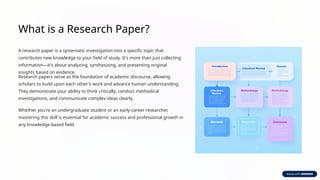
A research paper is a systematic investigation into a specific topic that
contributes new knowledge to your field of study. It's more than just collecting
information—it's about analyzing, synthesizing, and presenting original
insights based on evidence.
Research papers serve as the foundation of academic discourse, allowing
scholars to build upon each other's work and advance human understanding.
They demonstrate your ability to think critically, conduct methodical
investigations, and communicate complex ideas clearly.
Whether you're an undergraduate student or an early-career researcher,
mastering this skill is essential for academic success and professional growth in
any knowledge-based field.
3.
Choosing Your ResearchTopic
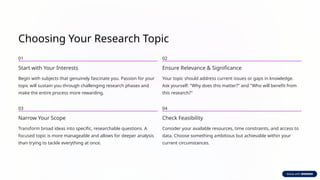
01
Start with Your Interests
Begin with subjects that genuinely fascinate you. Passion for your
topic will sustain you through challenging research phases and
make the entire process more rewarding.
02
Ensure Relevance & Significance
Your topic should address current issues or gaps in knowledge.
Ask yourself: "Why does this matter?" and "Who will benefit from
this research?"
03
Narrow Your Scope
Transform broad ideas into specific, researchable questions. A
focused topic is more manageable and allows for deeper analysis
than trying to tackle everything at once.
04
Check Feasibility
Consider your available resources, time constraints, and access to
data. Choose something ambitious but achievable within your
current circumstances.
4.
Conducting Your Literature
Review
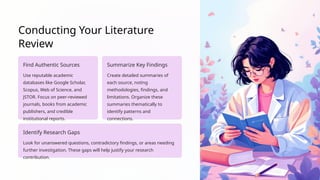
FindAuthentic Sources
Use reputable academic
databases like Google Scholar,
Scopus, Web of Science, and
JSTOR. Focus on peer-reviewed
journals, books from academic
publishers, and credible
institutional reports.
Summarize Key Findings
Create detailed summaries of
each source, noting
methodologies, findings, and
limitations. Organize these
summaries thematically to
identify patterns and
connections.
Identify Research Gaps
Look for unanswered questions, contradictory findings, or areas needing
further investigation. These gaps will help justify your research
contribution.
5.
Defining Your ResearchProblem
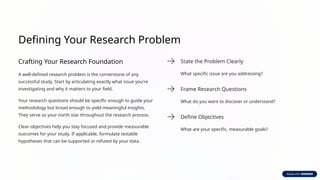
Crafting Your Research Foundation
A well-defined research problem is the cornerstone of any
successful study. Start by articulating exactly what issue you're
investigating and why it matters to your field.
Your research questions should be specific enough to guide your
methodology but broad enough to yield meaningful insights.
They serve as your north star throughout the research process.
Clear objectives help you stay focused and provide measurable
outcomes for your study. If applicable, formulate testable
hypotheses that can be supported or refuted by your data.
State the Problem Clearly
What specific issue are you addressing?
Frame Research Questions
What do you want to discover or understand?
Define Objectives
What are your specific, measurable goals?
6.
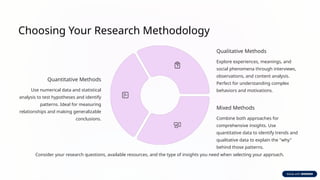
Choosing Your ResearchMethodology
Quantitative Methods
Use numerical data and statistical
analysis to test hypotheses and identify
patterns. Ideal for measuring
relationships and making generalizable
conclusions.
Qualitative Methods
Explore experiences, meanings, and
social phenomena through interviews,
observations, and content analysis.
Perfect for understanding complex
behaviors and motivations.
Mixed Methods
Combine both approaches for
comprehensive insights. Use
quantitative data to identify trends and
qualitative data to explain the "why"
behind those patterns.
Consider your research questions, available resources, and the type of insights you need when selecting your approach.
7.
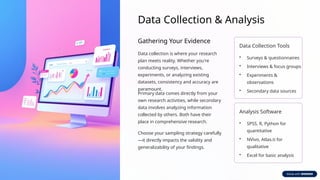
Data Collection &Analysis
Gathering Your Evidence
Data collection is where your research
plan meets reality. Whether you're
conducting surveys, interviews,
experiments, or analyzing existing
datasets, consistency and accuracy are
paramount.
Primary data comes directly from your
own research activities, while secondary
data involves analyzing information
collected by others. Both have their
place in comprehensive research.
Choose your sampling strategy carefully
—it directly impacts the validity and
generalizability of your findings.
Data Collection Tools
• Surveys & questionnaires
• Interviews & focus groups
• Experiments &
observations
• Secondary data sources
Analysis Software
• SPSS, R, Python for
quantitative
• NVivo, Atlas.ti for
qualitative
• Excel for basic analysis
8.
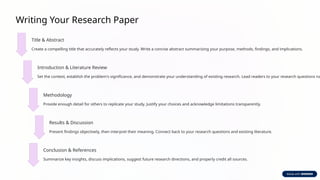
Writing Your ResearchPaper
Title & Abstract
Create a compelling title that accurately reflects your study. Write a concise abstract summarizing your purpose, methods, findings, and implications.
Introduction & Literature Review
Set the context, establish the problem's significance, and demonstrate your understanding of existing research. Lead readers to your research questions na
Methodology
Provide enough detail for others to replicate your study. Justify your choices and acknowledge limitations transparently.
Results & Discussion
Present findings objectively, then interpret their meaning. Connect back to your research questions and existing literature.
Conclusion & References
Summarize key insights, discuss implications, suggest future research directions, and properly credit all sources.
9.
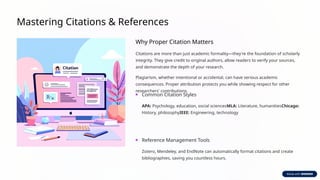
Mastering Citations &References
Why Proper Citation Matters
Citations are more than just academic formality—they're the foundation of scholarly
integrity. They give credit to original authors, allow readers to verify your sources,
and demonstrate the depth of your research.
Plagiarism, whether intentional or accidental, can have serious academic
consequences. Proper attribution protects you while showing respect for other
researchers' contributions.
Common Citation Styles
APA: Psychology, education, social sciencesMLA: Literature, humanitiesChicago:
History, philosophyIEEE: Engineering, technology
Reference Management Tools
Zotero, Mendeley, and EndNote can automatically format citations and create
bibliographies, saving you countless hours.
10.
Your Research JourneyStarts Now
Maintain Originality
Always cite your sources and use
plagiarism-checking tools. Your unique
perspective and analysis are what make
your research valuable.
Revise & Proofread
Great writing is rewriting. Take breaks
between drafts, read aloud, and consider
having others review your work for clarity
and errors.
Follow Guidelines
Each journal or conference has specific formatting requirements. Adhering to these
guidelines shows professionalism and attention to detail.
Remember: Research is not about having all the answers—it's about asking the right
questions and pursuing them with rigor, curiosity, and integrity.
Be clear, be concise, be critical. Your research has the power to change the world—one discovery at a time.