About the Course
 Course: Advanced Research
Methods
 Credit hours: 3
 Instructor: Adem I (PhD)
1
Course Content
• Introduction to Research
1
• Title Identification and
Research Problem
2
• Literature Review
3
• Research Design
4 2
Course Content
• Data Analysis and
Interpretation – Theoretical
and Practical perspectives
5
• How to write Conclusion
and Recommendation
6
• Formatting thesis
7
3
Course evaluation methods
 Mini Research 20%
 Research proposal 20%
 Article Review 20%
 Final exam 40%
4
Chapter 1: Introduction to Research
 Definition of Research
 Why conduct research?
 Purpose of Research
 Types of Researches
5
When Should We Trust What We Know?
 How do you know?
 If I asked you how you know the world is round, you’d probably
say, “Everybody knows that.” There are a lot of things
everybody knows. Of course, at one time, everyone “knew” the
world was flat.
 Most of what you know is a matter of agreement and belief;
Little of it is based on personal experience and discovery
 That’s simply the way human societies are structured; the basis
of knowledge is agreement.
 Because you can’t learn through personal experience and
discovery alone all you need to know, things are set up so you
can simply believe what others tell you.
 You know some things through tradition, others from “experts.
 . In contrast to knowing things through agreement, you can
know them through direct experience—through observation
 We live in an information-dominated society. Every day, like it or not, we are
bombarded by facts, figures, news, and opinions; we are connected to
countless information sources about our local community, our society, and
our world.
 Tradition, authoritative knowledge, common sense and intuition
 With traditional knowledge the mere passing of time is seen as the basis for
making knowledgeable assertions about the world.
 The mere passing of time does NOT in itself establish something as true;
Consider the fact that for thousands of years "everyone knew" that the earth
was flat.
 Similarly, until the fifteenth century, astronomers held that the earth was the
center of the universe; It was unthinkable to challenge this fact.
 Most recently, the genetic mapping evidence of the genome project challenged
the traditional view of race as a biologically determined category.
 Despite age-old arguments to the contrary, human races are not genetically
distinct. Humans share 99.9 percent of their DNA.
 Racial similarities, not differences, are in our genes
 While many of our most familiar and comfortable ways of knowing may be
fast and easy, they can also be risky, error-prone ways of knowing.
 Traditional and authoritative knowledge, common sense and intuition are all
alike in that they encourage an uncritical acceptance of information.
 Common errors we make in our casual inquiries.
 InaccurateObservation
 Overgeneralization
 SelectiveObservation
 IllogicalReasoning
 Science as a Trustworthy Way of Knowing
 Science as a method of inquiry—a way of learning and knowing things about
the world around us.
 We are well advised to engage scientific ways of knowing.
 Understanding research methods allows us to assess the wealth of information
we receive each day in light of some very discerning standards.
 Science is distinctive in that it employs set methodical procedures that aim to
reduce or control the amount of error that creeps into the process of knowing.
 For instance, the scientific approach demands empirical evidence; systematic
and replication, methodical "rules" for gathering our empirical evidence
 Reality is a tricky business. You’ve probably long suspected that
some of the things you “know” may not be true, but how can you
really know what’s real?
 One answer that has arisen out of that grappling is science,
which offers an approach to both agreement reality and
experiential reality.
 Scientists have certain criteria that must be met before they’ll
accept the reality of something they haven’t personally
experienced.
 An assertion must have both logical and empirical support: It
must make sense, and it must not contradict actual observation.
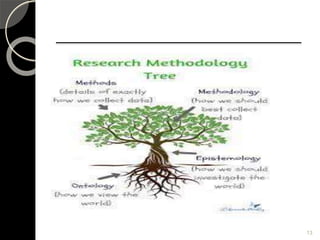
 Research philosophy can be discussed in terms of ontology and epistemology.
 Epistemology explains how researchers acquire the truth or knowledge
(Crotty, 1998). “An epistemology is a theory of knowledge of what can be
known and what criteria it uses to justify it being knowledge” (Petty et al.,
2012).
 The way we look at our world is called a worldview, paradigm, or epistemology
(Creswell, 2014; Mertens, 2009).
 However, there is a clear difference between ontology and epistemology.
 Ontology reflects the philosophy or nature of reality, while epistemology
reflects the nature of knowledge or the ways used to acquire knowledge of this
reality
 k
13
 u
14
 What’sReallyReal?
Philosophers sometimes use the phrase naive realism to describe the way most of
us operate in our daily lives.
 When you sit at a table to write, you probably don’t spend a lot of time thinking
about whether the table is really made up of atoms, which in turn are mostly
empty space.
 Premodern, Modern, and Postmodern views of reality (W. Anderson 1990).
 ThePremodernViewThis view of reality has guided most of human history. Our
early ancestors assumed that they saw things as they really were
 The Modern View What philosophers call the modern view
accepts such diversity as legitimate, a philosophical “different
strokes for different folks.”
 As a modern thinker you would say, “I regard the spirits in the
tree as evil, but I know others regard them as good. Neither of
us is right or wrong.
 There are simply spirits in the tree; They are neither good nor
evil, but different people have different ideas about them.
16
 To the premoderns, a dandelion has to be either one or the other. If you think it is
a weed, it is really a weed, even though some people have a warped sense of
beauty.
 In the modern view, a dandelion is simply a dandelion; The concepts “beautiful
flower” and “annoying weed” are subjective points of view imposed on the plant.
 Neither is a quality of the plant itself, just as “good” and “evil” were concepts
imposed on the spirits in the tree.
 The Postmodern View Philosophers also speak of a postmodern view of reality. In
this view, neither the spirits nor the dandelion exists.
 All that’s “real” are the images we get through our points of view.; Put differently,
there’s nothing out there—it’s all in here.
 As Gertrude Stein said of Oakland, “There’s no there, there.
 As this example illustrates, there is no answer to the question, “What does the
book really look like?”
 All we can offer is the different ways it looks from different points of view.
 Thus, according to the postmodern view, there is no “book,” only various images
of it from different points of view. And all the different images are equally “true.
Research defined
 Scholars define research in different ways.
 Research is defined as
◦ A systematized effort to gain new knowledge
◦ A search for knowledge through objective and
systemic method of finding solutions to a
problem or systematic approach concerning
generalization and formulation of a theory
19
 Research is a logical and systematic search for new and useful
information on a particular topic.
 It is an investigation of finding solutions to scientific and social
problems through objective and systematic analysis.
 It is a search for knowledge, that is, a discovery of hidden
truths.
 The word research is composed of two syllabuses, re and
search.
 RE=Is a prefix meaning again, anew or over again
 SEARCH =Is a verb meaning to examine closely and
carefully, to test and try or to probe.
 Together they form a noun describing a careful,
20
 Research is a systematic, controlled empirical and critical
method consisting of enumerating the problem,
formulating a hypothesis, collecting the facts or data,
analyzing the facts and reaching certain conclusions
either in the form of solutions toward the concerned
problem or in certain generalizations for some theoretical
formulation.
21
Why conduct research?
◦ To discover answers to questions through
the application of scientific procedures
◦ To find out the truth which is hidden and
which has not been discovered yet.
◦ To gain familiarity with a phenomenon or
achieve new insights into it
◦ To test a hypothesis of a causal relationship
between variables
◦ To predict the future effects of a
phenomenon or action
22
Nature of business research
It deals with business phenomena
It aims at discovering of new
facts/solving business problems
It is a scientific undertaking
Does not involve experimentation
It is dynamic in nature
It is inter-disciplinary
23
Characteristics of Research
 From the above definitions it is clear that research
is a process of collecting, analyzing and
interpreting information to answer questions.
 But to qualify as a research, a process must have
certain characteristics as listed below:
1. Systematic
 It means that research is structured with specified
steps to be taken in a specified sequence in
accordance with the well defined set of rules.
24
.
2. Rigorous (relevant)
 One must be very careful (scrupulous) in ensuring that the
procedures followed to find answers to questions are
relevant, appropriate and justified.
3. Valid and verifiable
 This concept implies that whatever you conclude on the
basis of your findings, it should be correct and can be
verified by you and others.
4. Empirical
 This means that any conclusions drawn are based upon
hard evidence gathered from information collected from
real life experiences or observations.
 It implies that research is related basically to one or more
aspects of a real situation and deals with concrete data that
provides a basis for external validity to research results
25
.
5. Critical
 The methods employed and procedures used should be
critically scrutinized. The process of investigation must be
foolproof and free from any drawbacks. The process adopted
and the procedures used must be able to withstand critical
scrutiny.
6. Controlled
 In exploring the causality relation b/n two variables, the
study must be set in a way that minimizes the effects of other
factors affecting relationship.
 In social science research, however, since controlling is
almost impossible, the effect of the other variable must be
quantified rather.
26
.
7. Replicable
 This characteristic allows research results to be
verified by replicating the study and thereby
building a sound basis for decisions. This is
related to verifiability and validity.
8. Logical
 This implies that research is guided by the rules
of logical reasoning and the logical process of
induction and deduction.
27
Purposes of Research
 In the business arena, research is required
because of the following reasons:
To identify and find solutions to the problems
To help in making decisions
To develop new concepts
To find alternate business strategies
To gain a competitive advantage.
 To test new products and services.
To reduce operational costs.
To enhance profitability.
28
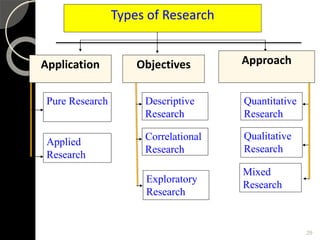
Pure Research
Applied
Research
Descriptive
Research
Correlational
Research
Exploratory
Research
Quantitative
Research
Qualitative
Research
Types of Research
Application Objectives Approach
Mixed
Research
29
Basic/Pure Research
 Involves developing and testing theories and hypothesis
that are intellectually challenging to the researcher but
may or may not have practical application at the present
time or in the future.
 It aims to solve problem of a theoretical nature that have
little direct impact on action, performance, or policy
decisions.
 is directed towards finding information that has a broad
base of application and thus, add to the already existing
organized body of scientific knowledge.
30
Applied Research
 It is fundamentally based on a need for specific facts and
findings with policy implications
 It has a practical or problem-solving emphasis
 It is conducted to reveal answers to specific questions
related to action, performance, or policy needs.
 Applied research is a research that discovers a solution
for some pressing practical problem, facing a society,
business organization or country
31
Based on Objective
◦ A. Descriptive Research: Its major purpose is description of
the state of affairs as it exists at present.
◦ is used to describe characteristics of a population or
phenomenon being studied.
◦ It does not answer questions about how/when/why the
characteristics occurred.
◦ Researcher has no control over the variables, he can only
report what has happened or what is happening.
32
Cont….d
 B. Correlational Research: Its main emphasis is to discover
or establish the existence of statistical
relationship/association/interdependence between two or
more aspects of a situation with no influence from any
extraneous variable.
 Example: What is the relationship between stressful living
and the incidence of heart attacks?
 What is the relationship between technology and
employment?
33
C. Exploratory Research
ER
34
It is usually carried out when a
researcher wants to explore areas
about which s/he has little or no
knowledge.
Exploratory studies are also
conducted to develop, refine and/or
test measurement tools and
procedures.
.
Factors Exploratory
research
Descriptive
research
Explanatory
research
Degree of Problem
Definition
Key variables not
defined
Key variables are
defined
Key variables and
key relationships
are
defined
Amount of
Uncertainty
Highly ambiguous Partially defined Clearly defined
Key Research
Statement
Research
questions
Research
questions
Research
hypothesis
Possible
Situations
“Quality of service
is
declining and we
don’t know why.”
“Would people be
interested in our
new
product idea?”
“How important is
business process
“What have been
the
trends in
organisational
downsizing over
the
past ten years?”
“Did last year’s
product recall have
an impact on our
company’s share
price?”
“Which of two
training programs is
more effective for
reducing labour
turnover?”
“Can I predict the
value of energy
stocks if I know the
current dividends
and growth rates of
dividends?”
“Do buyers prefer
Business Research Methods in
Management 35
Research Approach
 A. Quantitative approach of research involves the
generation of data in quantitative form which can be
subjected to rigorous quantitative analysis in a formal and
rigid fashion.
 B. Qualitative approach is concerned with subjective
assessment of attitudes, opinions and behavior. Research in
such a situation is a function of researchers’ insights and
impression.
 C. A mixture of methods may be used.
 Researchers may seek to increase reliability and validity by
using both quantitative and qualitative approaches. This is
called triangulation!
36
.
 Difference between quantitative and
qualitative
Quantitative research Qualitative research
Objective is to test hypotheses that the
researcher generates.
Objective is to discover and
encapsulate
meanings once the researcher
becomes
immersed in the data.
Concepts are in the form of distinct
variables
Concepts tend to be in the form of
themes,
motifs, generalizations, and
taxonomies.
However, the objective is still to
generate
concepts.
Measures are systematically created
before data collection and are
standardized as far as possible; e.g.
measures of job satisfaction
Measures are more specific and may
be
specific to the individual setting or
researcher; e.g. a specific scheme of
values.
Data are in the form of numbers from
precise measurement.
Data are in the form of words from
documents, observations, and
37
38
Based on Time
 Research can be classified into
◦ Cross-sectional where research will be done at
one time in period. Most of the empirical
studies in descriptive studies are part of cross-
sectional researches.
◦ Longitudinal, where study will be done at more
than one in time.
◦ Example of longitudinal researches:
 Time series study
 Panel data study
38
Inductive and Deductive research
1) Inductive research
 In inductive research, the goal of a
researcher is to infer theoretical concepts
and patterns from observed data.
 Hence, inductive research is often loosely
called theory-building research
39
.
2) Deductive research
 In deductive research, the goal of the researcher is
to test concepts and patterns known from theory
using new empirical data.
 Hence, deductive research is often loosely called
theory-testing research.
 Note here that the goal of theory-testing is not just
to test a theory, but also to refine, improve, and
possibly extend it.
40
.
 Note that inductive and deductive research are two halves
of the research cycle that constantly iterates between
theory and observations.
 You cannot do inductive or deductive research if you are
not familiar with both the theory and data components of
research.
 Naturally, a complete researcher is one who is able to
handle both inductive and deductive research.
 It is important to understand that theory-building
(inductive research) and theory testing (deductive
41
.
 Cycle of the research
42
43
RP
Define
Research
problem
Review
concepts
and
theories
Review
previous
research
findings
Formulate
hypothes
is
Design
Research
Collect
data
(Execution)
Analyze
data (test
hypothesis
if any)
Interpr
et and
report
Research
Process
Cont….d
 The research process includes the following
issues:
◦ Problem definition and topic identification
◦ Literature review (it is done in every step of the
research parts)
◦ Research Design
◦ Data Collection
◦ Data Analysis
◦ Research report
 Each of the research process will be
described in the following chapters
44
Chapter Two: Title
Identification and
Research Problem
45
21/12/2021 Assefa T. T (Dr.)
Research problem defined
 Research problem refers to some difficulty which
a researcher experiences in the context of either
a theoretical or practical situation and wants to
obtain a solution for the same.
 Example
◦ Current problems in organizations
◦ Identified areas for further improvement and to attain
objectives at organizational/country level
◦ Researchers aspiration to verify the theoretical aspects
or basic questions through empirical studies
46
When does a research problem exist?
 Research problem exists if the following conditions
are met.
 Some difficulty problem facing by an individual or
group or institution etc.
 Need to attain objectives
 Availability of alternative means (or courses of action)
for obtaining the objectives one wishes to attain.
 Some doubt in the mind of a researcher with regard
to the selection of alternatives.
47
Sources of a research
problem
Individuals,
organizations, groups,
communities etc
Issues, situations,
needs, profiles, etc
Contents, structure,
outcomes, satisfaction, etc
Program
Problem
People
48
Selecting the problem
 As a researcher, note that
◦ Topic which is overdone should not be normally
chosen, for it will be a difficult task to throw any
new light in such a case.
◦ The topic selected for research needs familiarity
and feasibility so that the related research material
or sources of research are within one’s reach.
49
Cont'…
◦ Controversial subject should not become the choice
of an average researcher.
◦ Too narrow or too vague problems should be
avoided.
◦ Take into account the importance of the subject, the
qualifications and the training of a researcher, the
costs involved, time factor
50
Cont'…
1. Identify the problem in a general way.
2. Identify and select a narrow problem within the
broad topic.
3. Raise questions to be asked.
4. Formulate objectives
51
Cont'…
1. Identify a broad field/area that faces problem
52
Human
Resource
Management
Human Resource
Management
Cont'…
21/12/2021 53
Recruitmen
t
Placement
and
induction
Selectio
n Motivation
Promotion
Performance
appraisal
Training and
Development
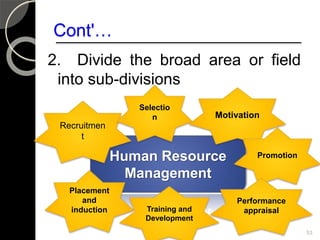
2. Divide the broad area or field
into sub-divisions
Human Resource
Management
Cont'…
21/12/2021 54
Recruitmen
t
Placement
and
induction
Selectio
n Motivation
Promotion
Performance
appraisal
Training and
Development
3. Select the one that interests you the
most
Cont'…
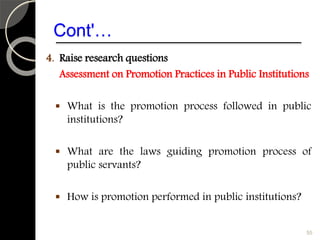
4. Raise research questions
Assessment on Promotion Practices in Public Institutions
 What is the promotion process followed in public
institutions?
 What are the laws guiding promotion process of
public servants?
 How is promotion performed in public institutions?
55
Exercise 1
 Sit in groups and choose a topic of your interest?
 Write the title of the research
56
Research objectives
 Research objectives determines your destination
 Have a path to walk on throughout your thesis work.
 It is split into two
◦ General objectives – statement that tells the overall aim
of undertaking a given topic.
◦ Specific objectives – provides sub-ways of attaining the
above mentioned general objectives. These should be
very SMART
 If research objectives are devised with the thesis, no need
to have research questions. 57
Cont'…
5. Set research objectives
General objective:
 To assess promotion practices in public institutions
Specific objectives:
 To point out procedures followed to promote public
servants
 To evaluate laws guiding promotion in public
institutions
 To examine how promotion is done practically
58
Cont'…
6. Check & double check your research objectives
 How much work is involved?
 Do I have time?
 Do I have the resources?
 Do I have the technical expertise?
 Am I really interested?
 Do I agree with the objectives?
59
Title Selection
 Research topic must be;
 Interesting – keeps the researcher interested in it
throughout the research process
 Researchable – can be investigated through the
collection and analysis of data
 Significant-contributes to the improvement and
understanding of educational theory and practice
 Manageable – fits the level of researcher’s level of
research skills, needed resources, and time restrictions
 Ethical – does not embarrass or harm participants
60
What Can Be Researched ?
The right topic to be researched often depends
on a number of factors.
 It is not advisable to select the following topics:
1. Common/over-used topics
2. Controversial Politics/ religion related
topics
3. General/ broad topics
4. Topics that are Too Narrow
61
62
Good Research topic must:
1. Be original;
2. Be of interest to both the researcher and the supervisor;
3. Be timely and relevant;
4. It must make a contribution to existing knowledge or
respond to a research gap;
5. Be specific and distinct, not too broad;
6. Incorporate the main purpose of the research;
7. Be clever, captivating and unforgettable; and
8. The research questions that flow from it must be
possible to address through a research design.
Exercise 2
 Reframe your topic based on the title selection
criteria.
 Compare these topics with the title requirements
63
Problem Statement
 Clear statement of what the situation looks like,
and what problems you perceive in the area,
and to conduct the research.
64
Cont'…
“The formulation of the
problem is often more
essential than its solution.”
Albert Einstein
65
Cont'…
 Ideally, it must address problems that induced a
researcher to select and take topic for his/her thesis.
 Of course, it is effortless to outline problems burning a
researcher, but what makes it unique is the extent to
which it carries facts and figures from credible
sources.
 Good problem statements may contain three concepts
spread over between 3 to 5 paragraphs
66
Objectives of the Study
 General objectives
◦ What is the general reason for carrying out this
research? This should be at the level of the aim of the
study. In most of the cases, it is your topic written in
the form of an objective
 Specific objectives
◦ These emanate from the general objectives. Specific
objective must be SMART. By using action verbs, the
researcher must list at least three specific objectives to
achieve the general objective
67
Exercise 4
 Based on your research topic, write at least three to
five specific objectives
68
Significance of the study
 Significance of the study is also called justification or
importance of the study.
 State why you feel the study is important. This is usually
stated in terms of identifying people or institution that
will benefit from it and how they will benefit.
 This is where you convince scholars that their research is
worth undertaking or studying.
69
Scope of the study
 Specifies the boundaries of their research.
 It covers
◦ Geographical scope which defines the location of the
study;
◦ Theoretical scope by defining issues to be covered; and
◦ Time scope stating the period coverage of the research
70
Description of the study area
 Brief description of the study area or study
organizations or sampling unit.
 It provides information about the characteristics of
the study areas as population, location, climate,
socioeconomic activities etc.
 In case you are studying about institutions,
information concerning target institutions is
inevitable.
 Such information may include organizational
structure, mandates of respective institutions,
71
Limitation
 Limitation, by definition, are factors affecting research
findings substantially and lies beyond the control of the
researcher.
 It could be concerned to chosen research method,
research technique, sampling method, sampling size, etc
21/12/2021 Assefa T. T (Dr.) 72
73
Exercise
 Specify your research interest and
◦ Write a research title
◦ Specify at least three to five objectives
◦ Formulate the research problem
◦ Specify the scope of the study and
◦ Mention some of the limitation of the study
Research hypothesis
Business research methods in
Management
 Hypothesis is an assumption about a phenomena,
relationship or situation, the reality or truth of
which you do not know.
 A hypothesis is a proposition, condition, or
principle which is assumed perhaps without belief,
in order to draw out its logical consequences and
this method to test its accord with facts which are
known or may be determined.
 Hypothesis is a proposition that is stated in a testable
form and that predicts a particular relationship
between two or more variables.
 Hypothesis is a tentative statement about something,
the validity of which is usually unknown.
74
Importance of hypothesis
Business research methods in
Management
1. It places clear and specific goals before the study.
2. It provides direction to research
3. It sensitizes the individual facts and conditions
that might otherwise be overlooked.
4. It is a guide to the thinking process and the
process of discovery.
5. It help to focuses on research.
6. It may enable you to add to the formulation of
theory and help you to bridge the gaps in the
body of knowledge.
7. It serves as a framework for drawing conclusions.
8. It prevents from doing a blind research.
75
Characteristics of Good hypothesis
Business research methods in
Management
1. A hypothesis should be simple, specific, and
conceptually clear. A good hypothesis is the one
which is based on the operationally defined
concepts.
 It should be uni-dimensional, that it should test
only one relationship at a time.
2. It should not be framed as a question- i.e. it
should be framed as a descriptive statement.
76
Con’t
Business research methods in
Management
3. A hypothesis should be capable of verification: Methods and
techniques must be available for data collection and analysis. It
should be formulated in a way that it can be tested directly and
found to be probably true or probably false.
4. A hypothesis should be related to the body of knowledge: It is
important that your hypothesis emerges from the existing body
of knowledge, and that it adds to it, as this is an important
function of research. This can only be achieved if the
hypothesis has its roots in the existing body of knowledge.
5. A hypothesis should be operationalizable: That is, it can be
expressed in terms that can be measured. If it can not be
measured, it can not be tested and hence no conclusions can
be drawn.
77
Types of Hypotheses
Business research methods in
Management
 As explained, any assumption that you seek to validate
through an inquiry is called hypothesis. Hence, theoretically
there should be only one type of hypothesis, that is the
research hypotheses-the basis for your investigation.
 However, because of the convention in scientific inquiries and
because of the wording used in the construction of a
hypothesis, hypothesis can be classified in to several types.
 Broadly, there are two categories of hypothesis:
1. Null/Research Hypothesis (Ho)
2. Alternate Hypothesis (H1)
 An alternate hypothesis is an opposite of the null
hypothesis.
78
Con’t
Business research methods in
Management
 Based on the following example we can differentiate the
types of hypotheses
 Suppose you want to study the employment pattern in a
private sector in relation to gender differentials. The
following hypotheses could be constructed.
1. There is no significant difference in the proportion of
male and female employees in private sector (null
hypothesis).
2. A greater proportion of males than females are
employed in private sector (hypothesis of difference).
3. Sixty percent of males and thirty percent of females are
employed in private sector (hypothesis of point –
prevalence).
4. There are twice as many male employees as female
employees in private sector (hypothesis of association).
79
Con’t
Business research methods in
Management
 The first hypothesis formulated indicates that there
is no difference in the proportion female and male
employees in private sector. When you construct
such hypothesis, it is called null hypothesis and
usually written as HO.
 The second hypothesis implies that there is a
difference in the proportion of male and female
employees among the study population, though the
extent of the difference is not specified.
 A hypothesis in which a researcher stipulates that
there will be a difference but does not specify its
magnitude is called a hypothesis of difference. 80
Procedures for Hypotheses
Testing
Business research methods in
Management
 To test hypothesis means to tell (on the basis of the data
that the researcher has collected) whether or not the
hypothesis seems to be valid.
Example: private banks are more profitable than public
banks
How can we test this hypothesis? What are the
indicators to test this hypothesis?
 Procedures in hypothesis testing refers to all those steps
that we undertake for making a choice between the two
actions i.e., rejection and acceptance of a null
hypothesis.
81
Limitations of the tests of
Hypotheses
Business research methods in
Management
 The tests do not explain the reasons as to why do the
difference exist, say between the means of the two
samples.
• They simply indicate whether the difference is due to
fluctuations in the sampling or because of other
reasons but the test do not tell us as to which is /are
the other reason(s) causing the difference.
Example: private banks are more profitable than
public banks. Assume this hypothesis is tested and
found to be true. But the test fails to justify as to why
the difference existed between private and public
banks. 82
Errors in Hypothesis Testing
Business research methods in
Management
 When a hypothesis is tested, there are four possible
outcomes:
1. The hypothesis is true but our test may lead to
rejection.
2. The hypothesis is false but our test may lead to
acceptance
3. The hypothesis is true and our test may lead to
acceptance.
4. The hypothesis is false and our test may lead to
rejection.
 Of these four possibilities, the first two lead to an
erroneous decision. The first possibility leads to a Type I
error (rejection of a true hypothesis is called type-I error.
83
Con’t
Business research methods in
Management
Decision State of nature
Ho is true Ho is false
Accept Ho
Correct Decision Type II error
Reject Ho
Type I error Correct Decision
84
Chapter-3: The Research Proposal
 Introduction
 Types of Research Proposal
 Sections of a Research Proposal
 Sources of Research Funding
 Evaluating the Research Proposal
85
The Research Proposal
What is research proposal?
 A written statement of the research design that
includes a statement explaining the purpose of
the study.
 Detailed outline of procedures associated
with a particular research methodology.
 It includes information on cost and deadlines.
 The proposal must communicate exactly what
information, how and where it will be obtained
through the study.
 Questionnaires and other supporting
documents should be attached for reference.
86
Business Research Methods in Management
The Research Proposal
• A research proposal is intended to convince
others that you have a worthwhile research project
and that you have the competence and the work-
plan to complete it.
• Generally, a research proposal should contain all
the key elements involved in the research process
and include sufficient information for the readers to
evaluate the proposed study.
• Regardless of your research area and the
methodology you choose, all research proposals
must address the following questions: What you
plan to accomplish, why you want to do it and how
you are going to do it.
87
Business Research Methods in Management
The Structure of Business Research
Proposal:
 A specific structure of the business research
proposal depends on the institutional and
organizational requirements and may vary
from institutions to institutions.
 However, the variability does not usually
affect the basic structural model, which
includes 4 major components:
88
Business Research Methods
Basic Components of a Research Proposal
a. Prefatory Parts
b. Chapter One-Introduction/the
Problem and its Background
c. Chapter Two-Literature Review
d. Chapter Three-Methodology
e. Annex
7/28/2022
Components… cont’d
a. Prefatory parts
1. Title Page
 On separate lines and centered, the
title page has the title of the study, the
author’s name, the institutional
affiliation, and date.
 Particularly, put your name, the name
of your department/faculty/college, the
name of your advisor(s) and date of
delivery under the title.
7/28/2022
Ch1… cont’d
 The title should not be too lengthy or
too short. It should provide sufficient
information about the nature of the
study.
 The title should not be burdened by
pompous words. The language in the
title should be professional in nature
but pedantic.
 A title ought to be well studied, and to
give, so far as its limits permit, a
definite and concise indication of what
is to come. 7/28/2022
Cont’d
 All words in the title should be chosen with great care,
and association with one another must be carefully
managed.
 A good title is defined as the fewest possible words
that adequately describe the contents of the study.
 Title is a label: it is not a sentence. Titles should
almost never contain abbreviations.
 The title page has no page number and it is not
counted in any page numbering.
7/28/2022
Components…cont’d
2. Abstract
 At the top of the page, centered, you should have the
word “Abstract.”
 It is a concise summary of the entire paper, including
the problem, major hypotheses, sample and
population, a brief description of the measures, and
the name of the design or a short description
 Fits to one page, sometimes 250 words.
 It should be placed before table of content.
7/28/2022
Cont’d
 Do not put information in the abstract
that is not in the main text of your
research proposal.
 Do not put references, figures, or
tables in the abstract.
7/28/2022
Issues to remember:
 The abstract is a concise summary of
the material presented in the proposal.
 Though it appears at the front of the
proposal, it is written last. A well-
prepared summary enables the reader to
1. Identify the basic content of a document
quickly and accurately,
2. Determine its relevance to their
interests, and
3. Decide whether they need to read the
document in its entirely
7/28/2022
The Structure of Business Research
Proposal:
Though the exact format of the proposal is
variable, most research proposals contain the
following.
A. Background to the study
B. Statement of the problem
C. Objectives of the study
D. Hypothesis/research questions
E. Significance of the study
F. Limitations of the study
G. Scope of the study
H. Literature review/Theoretical framework
I. Methodology
J. References
K. A budget break down
L. Plan of action or work plan
96
Business Research Methods
• The background of study/Introduction:
A research proposal should provide relevant
background for the proposed study. Specifically,
the proposal should precisely define the problem at
hand.
 This section should be used to put the work into
context, what has been done before, and how will
the proposed work adds to it.
 The introduction situates the research subject within a
larger business context.
 The introduction section identifies the problem that
needs to be resolved as a result of the research and
outlines the proposed activities and describes the
expected outcomes.
97
The Structure of Business Research
Proposal:
Statement of the problem:
 A clear, concise statement of the problem to be
solved by the proposed research, usually in few
sentences.
 The problem provides the context for the research
study and typically generates questions which the
research hopes to answer.
 The problem statement should “hook” the reader
and establish a persuasive context for what follows.
The problem statement should close with
question. 98
Objectives of the study:
 Statement(s) identifying the purpose of the
research.
 The objective(s) should be phrased in
positive terms (e.g., to develop, to determine,
to measure, rather than broad generalities,
such as, to investigate, to study)
99
The Structure of Business Research Proposal:
Hypothesis:
• is proposed explanation on observable
phenomenon. A hypothesis is a logical supposition,
a reasonable guess and educated conjecture.
• It provides a tentative explanation for a
phenomenon under investigation.
• A useful hypothesis is testable statement which may
include a prediction.
• States on expected relationships or difference
between two variables.
• A good hypothesis is stated clearly and concisely,
express the relationship between two variables and
defines those variables in measurable form.
100
Significance of the study:
• It briefly includes the findings of the literature
search (also known as literature review) related to
the research to be conducted.
• There should be well justification for conducting
and choosing your topic and research problem in
such a way that either there has been no other
research on the problem with the same approach
or that the proposed research project will extend,
modify or refine prior research.
• Thus the proposed research should be related to
past research accomplishments and how it builds
upon rather than duplicating any previous
research. 101
Literature Review
• The review of related literature should provide
an overview of the topic and present references
related to what is known about the topic.
• The literature sets a context for the topic and
identifies prior research that can support the
significance of the study. The literature review
also provides a basis of identifying hypothesis.
• Literature review provides justification for the
future research as well as for the effort that the
writer has already contributed to studying the
subject area
102
The Structure of Business Research Proposal:
• The goal of the Literature review is to demonstrate that the
researcher has extensive knowledge of the field and of the
specific problem; and that s/he has studied both the works
of recognized authorities and the new trends in the theory.
• Moreover, the writer should be an experienced practician
capable of applying theory to real-life contexts.
• However, more importantly, the Literature review has to
prove that there is a gap in either theory or business
practice; the proposed research will eliminate this gap.
• Sometimes the literature review is incorporated into the
introduction section. However, most of the time a separate
section is preferred, which allows a more thorough review
of the literature.
103
The Structure of Business Research
Proposal:
Importance of Literature Review
• Gives credits to those who have laid the groundwork for your
research.
• Demonstrates your knowledge of the research problem.
• Demonstrates your understanding of the theoretical and research
issues related to your research question.
• Shows your ability to critically evaluate relevant literature
information.
• Indicates your ability to integrate and synthesize the existing
literature.
• Provides new theoretical insights or develops a new model as the
conceptual framework for your research.
• Convinces your reader that your proposed research will make a
significant and substantial contribution to the literature (i.e.,
resolving an important theoretical issue or filling a major gap in
the literature).
104
The Structure of Business Research
Proposal:
Most of the time literature reviews
suffer from the following problems:
• Lacking organization and structure
• Lacking focus, unity and coherence
• Being repetitive and verbose
• Failing to cite influential papers
• Failing to keep up with recent
developments
• Failing to critically evaluate cited papers
• Citing irrelevant or trivial references
• Depending too much on secondary 105
Research Methods
• The methods section is an outline of all the activities that the
researcher is planning to perform in the pursuit of his/her research
goals.
• The methods section includes a descriptions of the research participants,
measuring instruments, procedures and data analysis.
• The key to a successful research is to identify appropriate data
collection techniques, to gather relevant and usable data.
• Surveys, face-to-face interviews, focus groups are the three
methods of collecting primary data.
• Secondary data can be gathered from annual and market reports,
financial and legal documentation, organizational structure-charts,
executive publications and speeches, and so on.
• The focus of this section is on the details: the timeframe for each
activity, the list of participants, the scripts for the interviews, the
materials, and so on. The more detailed is the description of the
methods of the data collection and analysis the more thoughtful the
research sounds to the reader 106
The Structure of Business Research
Proposal:
The method section typically consists of the following
sections:
• Design -Is it a questionnaire study or a laboratory
experiment? What kinds of design do you choose?
• Subjects or participants - Who will take part in
your study? What kind of sampling procedure do you
use?
• Instruments - What kind of measuring instruments
or questionnaires do you use? Why do you choose
them? Are they valid and reliable?
• Procedure - How do you plan to carry out your
study? What activities are involved? How long does
it take? 107
In short the methods section should clearly outlines-
• What will be the research methodology e.g. survey or
secondary data analysis or observation?
• Who are the population for the study?
• What would be sample size?
• How this sample would be selected – applying probability
or non-probability method?
• What instrument would be used to collect data or how the
data would be collected from the sample?
• How the data would be analyzed? What statistical tool
would be used to analyze and interpret data? (Proposed
method of data analysis).
• Research Period Provide detail work plan mentioning the
activities and time schedule in a bar chart. For example:
Gantt Chart
108
The Structure of Business Research Proposal:
 References
 Research Period or Work Plan:
Provide detail work plan mentioning
the activities and time schedule.
Preferably in Gantt Chart
 Budget
109
The Structure of Business Research
Proposal:
S.N
o
Phase name Period
1 Topic identification Sept 01– October 01/2010
2 Literature review October 05—December 05/2010
3 Development of instruments December 10– January 10/2011
4 Data Collection January 15– May 15/2011
5 Data Analysis May 20– July 20/2011
6 Report writing July 22– September 01/2011
110
The Structure of Business Research Proposal:
Financial plan/Cost of Research
 Remuneration / fees for employed research
associates / assistants (where applicable).
 Cost for support services (field workers, laborers,
conveyance etc.).
 Cost of consumable materials with break up.
 Construction of pilot study with break up (if
necessary).
 Cost of experimental work (if necessary).
 Cost of report preparation, binding etc.
 Others
Bibliography: Bibliography will contain all research
materials including books, magazines, Periodicals,
websites, and scientific papers which you have
referred. 111
The Structure of Business Research Proposal:
Common Mistakes in Proposal Writing
• Failure to provide the proper context to frame
the research question.
• Failure to delimit the boundary conditions for
your research.
• Failure to cite landmark studies.
• Failure to accurately present the theoretical and
empirical contributions by other researchers.
• Failure to stay focused on the research question.
• Failure to develop a coherent and persuasive
argument for the proposed research.
112
Con’t
• Too much detail on minor issues, but not
enough detail on major issues.
• Too much rambling — going "all over the map"
without a clear sense of direction. (The best
proposals move forward with ease and grace
like a seamless river.)
• Too many citation lapses and incorrect
references.
• Too long or too short.
• Failing to follow the appropriate referencing
style (APA or Harvard style.
21/12/2021 Assefa T. T (Dr.) 113
The Structure of Business Research
Proposal:
Guideline for Technical evaluation of Research
proposal
 Appropriateness and clarity of conceptual/theoretical
framework
 Logical relationship between the conceptual/theoretical
framework and the problem of the study.
 clarity and adequacy of research method
 Realistic work Plan/Activities
 itemized financial breakdown of the total project cost.
114
Chapter Three:
Literature review
The pen
is the
tongue
of the
mind.
Miguel de
Cervantes
115
21/12/2021 Assefa T. T (Dr.)
Session outline
 Literature review
 Goals of literature review
 Components of Literature Review
 Where to find the research literature?
 Referencing
21/12/2021 Assefa T. T (Dr.) 116
Reviewing the literature
 This involves to
review existing
literature and
prepare a summary
of the topic and
submit for approval.
 It is an effective
evaluation of these
documents in relation
to the research being
proposed. 21/12/2021 117
Assefa T. T (Dr.)
Goals of a literature review
 To demonstrate a familiarity with a body of
knowledge and establish credibility.
 To know the path of prior research and how a
current research project is linked to it.
 To integrate and summarize what is known in an
area.
 To learn from others and stimulate new ideas.
 To identify variables.
 To help developing theoretical framework.
21/12/2021 Assefa T. T (Dr.) 118
Components of Literature
Review
 The literature Review part
includes;
◦ Introduction
◦ Theoretical review
◦ Empirical review
◦ Conceptual model/framework
◦ Hypothesis development
21/12/2021 Assefa T. T (Dr.) 119
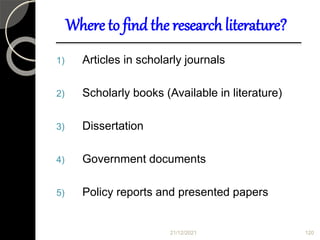
Where to find the research literature?
1) Articles in scholarly journals
2) Scholarly books (Available in literature)
3) Dissertation
4) Government documents
5) Policy reports and presented papers
21/12/2021 120
The issue of Referencing
 Referencing, or citing, means acknowledging the sources of
information and ideas you have used in an assignment, thesis or any
other academic paper. There are three types of referencing:
1. APA/Harvard Referencing Style:
2. Chicago referencing style
3. Vancouver referencing style
 The referencing in your assignment, thesis or academic paper shows
two things:
◦ Range of ideas and approaches to a topic that you have found and
thought about
◦ Your acknowledgement of where these ideas came from
21/12/2021 121
Rules of referencing
1. A reference must be included every time you
use someone else’s ideas or information.
2. A reference must be included when you
paraphrase, quota, summarize or copy the work
of others.
3. Each reference must appear in two places:
◦ in the text (i.e Body)
◦ in the reference list at the end of the
assignment, academic work or thesis.
21/12/2021 122
Notices the difference
- Paraphrase (express someone else’s idea in
your own words)
- Summarize (express someone else’s idea in
a reduced form in your own words)
- Quote (express someone else’s idea in their
exact words)
- Copy (reproduce a diagram, graph or table
from someone else’s work).
21/12/2021 Assefa T. T (Dr.) 123
Rules of referencing & citation
(APA/Harvard System)
1.Book(Single Author)
Title: Human Resource Management in Somaliland
Author: Ahmed Hassan
Publisher: National Printing Press
Year: 2011 City: Hargeisa Edition: 3rd
21/12/2021 Assefa T. T (Dr.) 124
In-text citation Reference list
Beginning of
sentence---Ahmed
(2011). End of
sentence
(Ahmed,2011)
Ahmed Hassan(2011),Human
Resource Management in
Somaliland,3rd ed. National
Printing Press, Hargeisa
Cont’…
2. Book (Two Authors)
Title: Performance Appraisal
Author: Ahmed Hassan and Yasin Omer
Publisher: National Printing Press
Year: 2011 City: Hargeisa Edition: 3rd
21/12/2021 Assefa T. T (Dr.) 125
In-text citation Reference list
Beginning of sentence-
--Ahmed & Yasin
(2011). End of
sentence (Ahmed &
Yasin, 2011)
Ahmed Hassan and Yasin Omer
(2011), Performance Appraisal, 3rd
ed. National Printing Press,
Hargeisa
Cont’…
3. Book(Four Authors)
Title: Conflict Analysis and Resolution
Author: Ahmed Hassan , Yasin Omer, Hodan Nour & Asma
Hussein
Publisher: National Printing Press
Year: 2011 City: Hargeisa Edition: 3rd
21/12/2021 Assefa T. T (Dr.) 126
In-text citation Reference list
Beginning of
sentence--- Ahmed
et al(2011). End of
sentence (Ahmed et
al ,2011)
Ahmed Hassan, Yasin Omer,
Hodan Nour & Asma Hussein
(2011), Conflict Analysis and
Resolution, 3rd ed. National Printing
Press, Hargeisa
Cont’…
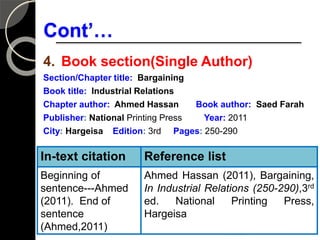
4. Book section(Single Author)
Section/Chapter title: Bargaining
Book title: Industrial Relations
Chapter author: Ahmed Hassan Book author: Saed Farah
Publisher: National Printing Press Year: 2011
City: Hargeisa Edition: 3rd Pages: 250-290
21/12/2021 Assefa T. T (Dr.) 127
In-text citation Reference list
Beginning of
sentence---Ahmed
(2011). End of
sentence
(Ahmed,2011)
Ahmed Hassan (2011), Bargaining,
In Industrial Relations (250-290),3rd
ed. National Printing Press,
Hargeisa
Cont’…
5. Journal article(Single Author)
Article title: Factors affecting employees performance of service
organization in Somaliland
Journal Name: Journal of Human Resource Management
Author: Abdirahman Jama Year: 2011 Pages: 5-10
Volume: 4 Issue: 16
21/12/2021 Assefa T. T (Dr.) 128
In-text citation Reference list
Beginning of
sentence---
Abdirahman (2011).
End of sentence
(Abdirahman,2011)
Abdirahman Jama (2011),
Factors affecting employees
performance of service
organizations in Somaliland,
Journal of Human Resource
Management, 4(16), 5-10
Cont’…
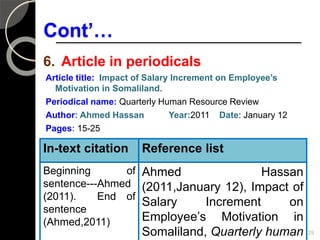
6. Article in periodicals
Article title: Impact of Salary Increment on Employee’s
Motivation in Somaliland.
Periodical name: Quarterly Human Resource Review
Author: Ahmed Hassan Year:2011 Date: January 12
Pages: 15-25
21/12/2021 Assefa T. T (Dr.) 129
In-text citation Reference list
Beginning of
sentence---Ahmed
(2011). End of
sentence
(Ahmed,2011)
Ahmed Hassan
(2011,January 12), Impact of
Salary Increment on
Employee’s Motivation in
Somaliland, Quarterly human
Cont’…
7. Conference Proceedings
Article title: Causes of employees’ turnover in Private
Businesses in Hargeisa
Conference publication name: Proceedings of the 10th annual
conference on the Small Business Development
Author: Ahmed Hassan Year: 2011 Pages: 42-65
City: Hargeisa Publisher: Chamber of Commerce
21/12/2021 Assefa T. T (Dr.) 130
In-text citation Reference list
Beginning of
sentence---
Ahmed(2011). End
of sentence
(Ahmed,2011)
Ahmed Hassan . (2011). Causes of
employees’ turnover in Private
Businesses in Hargeisa City,
Proceedings of 10th annual
conference on Small Business
Development (pp. 42-65).
Hargeisa, Chamber of Commerce
Cont’…
8. Report
Title: Status of Public Sector Employees, annual report .
Author: Civil Service Commission Year: 2011
Publisher: Civil Service Commission
City: Hargeisa
21/12/2021 Assefa T. T (Dr.) 131
In-text citation Reference list
Beginning of
sentence---CSC
(2011). End of
sentence
(CSC,2011)
CSC (2011). Status of
Public Sector Employees,
Annual report. Hargeisa;
CSC
Cont’…
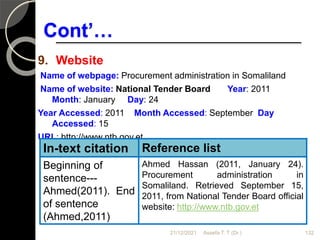
9. Website
Name of webpage: Procurement administration in Somaliland
Name of website: National Tender Board Year: 2011
Month: January Day: 24
Year Accessed: 2011 Month Accessed: September Day
Accessed: 15
URL: http://www.ntb.gov.et
21/12/2021 Assefa T. T (Dr.) 132
In-text citation Reference list
Beginning of
sentence---
Ahmed(2011). End
of sentence
(Ahmed,2011)
Ahmed Hassan (2011, January 24).
Procurement administration in
Somaliland. Retrieved September 15,
2011, from National Tender Board official
website: http://www.ntb.gov.et
When must we provide citation?
 Quote directly
 Paraphrase
 Summarise
 Use ideas, theories, facts, experiments, case
studies, from a source
 Adopt another person’s research method,
survey or experiment design
 Use statistics, tables, diagrams etc.
21/12/2021 133
Assefa T. T (Dr.)
APA Style
◦ In the case of one and two authors- Surname of
the author(s) followed by year of publication and
page number if it is direct quote
 Cormack (2014) work supports … view
(paraphrasing)
 Cormack (2014, p.32-33) states that 'when
writing….’ (quote)
 Writing for a professional audience (Cormack
and Jacky, 1994).
21/12/2021 134
Cont'…
◦ In case of three to five authors-Write the
surnames of all of the authors the first time the
text is cited, then after the surname of the first
author followed by et al. meaning and others
 Further research (Green, Harris and Dunne,
2009) showed that …
 The research (Green, et al., 2009) has also
found that the majority of
 In the case of six and more authors- the
surname of the first author followed by et al. every
time the work is cited
21/12/2021 135
.
Cont'…
 Several works by one author in the same year
will be identified by an alphabet
◦ Earlier research by Dunn (2013a) found
that…but later research suggested again by
Dunn (2013b) that ….
 When you cite a chapter from an edited book,
you cite the author of the chapter not the editor of
the book
 In case you want to cite a work that has no
author
◦ Development is defined as (Anon., 2009)
21/12/2021 136
.
Cont'…
 In case you want to cite a work that has no
date
◦ Earlier research (Smith, n.d.) demonstrated
that …
 Second hand references
◦ Deforestation is described as ….(Brown,
2006 cited in Bassett, 2013, p.142)
21/12/2021 137
Assefa T. T (Dr.)
Chapter Four:
Research Design
138
21/12/2021 Assefa T. T (Dr.)
Contenets
 Variable Definition/Operationalization of Variables
 Research Types
 Research Approach
 Sample Design
◦ Population
◦ Sample size
◦ Sampling techniques
 Sources of Data
 Data Collection Instruments
 Data Presentation Tools
 Data Analysis and Interpretation
 Ethical Consideration 21/12/2021 Assefa T. T (Dr.) 139
21/12/2021 Assefa T. T (Dr.) 140
Session outline
 Census and sample survey
 Definition of sample
 Why sample?
 Sampling process
21/12/2021 Assefa T. T (Dr.) 141
Variable defined
 Variable is a concept that varies. It is a concept that can take different
quantitative values as a weight, height, income
 Types of Variables
◦ Dependent Variable: is a variable that depends upon or is consequences
of other variables.
◦ It is effects of a change variable, the outcome of the changes brought
about by changes in an independent variable.
◦ It is the main variable under investigation.
◦ Independent Variable: the antecedents to the dependent variable. It
responsible for bringing about change in a phenomenon, situation.
21/12/2021 142
Assefa T. T (Dr.)
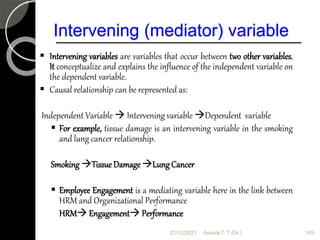
Intervening (mediator) variable
 Intervening variables are variables that occur between two other variables.
It conceptualize and explains the influence of the independent variable on
the dependent variable.
 Causal relationship can be represented as:
Independent Variable  Intervening variable Dependent variable
 For example, tissue damage is an intervening variable in the smoking
and lung cancer relationship.
Smoking Tissue Damage LungCancer
 Employee Engagement is a mediating variable here in the link between
HRM and Organizational Performance
HRM Engagement Performance
21/12/2021 143
Assefa T. T (Dr.)
144
21/12/2021
Cont'…
 Moderating variable is a form of extraneous variable that
has a contingent effect on the link between IV and DV.
 The presence of a third variable modifies the original
relationship between the independent and dependent
variable
 Example: Trust in Supervisor is a moderating variable
between Employee Engagement and Organizational
Performance.
21/12/2021 Assefa T. T (Dr.) 145
146
NUMBER OF
BOOKS
READING
ABILITIES
PARENTS’
LITERACY
Independent
Variable
Dependent
Variable
Extraneous
Variable
Example: Reading Abilities
21/12/2021 Assefa T. T (Dr.)
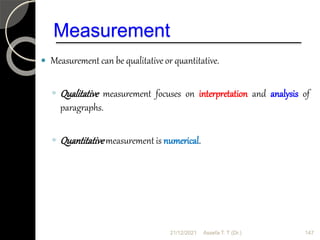
Measurement
 Measurement can be qualitative or quantitative.
◦ Qualitative measurement focuses on interpretation and analysis of
paragraphs.
◦ Quantitativemeasurement is numerical.
21/12/2021 147
Assefa T. T (Dr.)
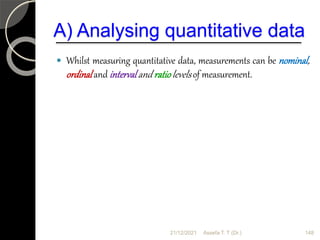
A) Analysing quantitative data
 Whilst measuring quantitative data, measurements can be nominal,
ordinal and intervaland ratiolevels of measurement.
21/12/2021 148
Assefa T. T (Dr.)
A) Nominal scales
 Nominal scales classifies elements into two or more categories.
 It indicates that the elements are different-not according to order or
magnitude.
 In simple terms, it is a type of data which reflects classification
characteristics, but do not indicate any mathematical or qualitative
differences.
 When the data is nominal, it is meaningless to find mean, standard
deviations,correlationcoefficients,etc.
 Example: Gender, Political Party, Nationality, Department, e.t.c
21/12/2021 149
Assefa T. T (Dr.)
Example
 Grouping into categories based upon political party preference
(EZEMA, PP, Others) or upon sex (Male or Female) or upon religion
(Muslim, Orthodox, Protestant, Catholic, etc).
 In the political party preference system EZEMA, might be assigned the
number "1", PP "2", and Others "3", while in the latter females might be
assigned the number "1" and males "2".
21/12/2021 150
Assefa T. T (Dr.)
Cont'…
21/12/2021 Assefa T. T (Dr.) 151
b) Ordinal Scales
 Ordinal scale possesses the property of magnitude.
 It classifies scores in the algebra of inequalities (a < b < c) (I.e a is
not equal to “b” and b is not equal to “a” etc)
 Ordering, ranking, or rank ordering is involved. Examples: the
ranking of people for height, weight, education, job category, etc.
 In ordinal scales, the numbers attached to values might indicate a
rankingor orderingof the values.
 Canapplythe median, rank order, correlations and percentile.
21/12/2021 152
Assefa T. T (Dr.)
c) Interval Scales
 Establishes an equal unit in the scale. The difference between any
two scores is equal.
 Suitable to calculate arithmeticmeanand standarddeviations.
 The classic example of an interval scale is Celsius temperature
because the difference between each value is the same. For example,
the difference between 60 and 50 degrees is a measurable 10 degrees,
as is the difference between 80 and 70 degrees.
 Other examples: five liker scale, exam results, attitudinal results and
most behavioral concepts
21/12/2021 153
Assefa T. T (Dr.)
Examples
21/12/2021 154
D. Ratio Scales
 The highest level of measurement scales; It has an absolute
zero point
 It is the most powerful of the other measurement scales
 Example
◦ Salary, financial performance, annual budget,
21/12/2021 Assefa T. T (Dr.) 155
Census and sampling survey
 A complete enumeration of all items in the ‘population’ is known as a Census.
 All items in any field of inquiry is a populationor universe.
 Under census, the assumption is that no element is left and highest accuracy is
obtained.
 Alternatively, sample respondents can be selected fromthe population.
 The respondents selected should be as representative of the total population as
possible.
 The selected respondents constitute what is technically called a ‘sample’ and the
selection process is called ‘samplingtechnique.’
 The survey so conducted is known as ‘sample survey’.
21/12/2021 Assefa T. T (Dr.) 156
Sample defined
 A sample is a subset, or some part, of a larger population.
 A larger population could be anything out which sample is
taken.
 A complete group of entities sharing some common set of
characteristics is population.
21/12/2021 157
Assefa T. T (Dr.)
Why sample?
 Saves Cost, Labor, and Time
 Quality Management/supervision
 Accurate and Reliable Results
 Sampling may be the Only Way
◦ For example, consider the case of electric bulbs. In testing the life of
bulbs, if we were to burn every bulb produced, there would be none
left to sell. This is destructivesampling.
21/12/2021 158
Sampling terminologies
 Population(Universe)
◦ A population is the theoretically specified aggregation of study elements.
◦ It is translating the abstractconcept into workableconcept.
 For example, let us look at the study of “University students”.
Fundamental question coming into ones’ mind is who are the
University students?
 Public or Private, level of students, faculties/departments
21/12/2021 159
Cont'…
 Universe is the set of objects to be studied.
 Universe can be finite or infinite
 Finite universe – items to be studied are certain. For example,
population of a city, number of workers in a factory etc.
 Infinite universe – items to be studied are infinite. For example,
listeners of specific radio program
21/12/2021 Assefa T. T (Dr.) 160
Cont'…
 Target population
◦ Target population is the complete group of specific population elements
relevant to the research project.
◦ Target population may also be called survey population i.e. that aggregation
of elements from which the survey sample is actually selected.
 In the example of ‘University students”, finally one may decide to study
the University students from government institutions located in Gondar,
who are studying Development Management, who are aged older than 24
years of age.
21/12/2021 Assefa T. T (Dr.) 161
Cont'…
 Sampling
◦ Sampling is the process of selecting a small number of items or
parts from a larger population to make conclusions about the
whole population.
21/12/2021 162
Sampling frame
 A sampling frame is the list of elements from which the sample may be
drawn.
 A simple example could be listing of all University students meeting the
criteria of target population.
 Example; Registrar in a university, payroll in organizations, telephone
directory,
 Sampling frame is useful in providing a listing of each elements in the
population
 A sampling frame is also called the working population because it
provides the list that can be worked with operationally.
 This is possibleonly for finitepopulation.
21/12/2021 163
Sampling unit
 A sampling unit is that element or set of elements considered for
selectionin some stage of sampling.
 Sampling may be done in single stage or in multiple stages.
◦ Single-stage sample, the sampling units are the same as the
elements.
◦ In more complex samples, however, different levels of sampling units
may be employed – the case of clustering or stratified techniques
21/12/2021 164
Cont.
 For example, a researcher may select a sample of Villages in a city, and then
select a sample of households from the selected villages, and finally may select a
sample of adults from the selected households.
 The sampling units of these three stages of sampling are respectively Villages,
households, and adults, of which the last of these are the elements.
 More specifically, the terms “primary sampling units,” “secondary sampling
units,” and “final sampling units” would be used to designate the successive
stages.
21/12/2021 Assefa T. T (Dr.) 165
Parameter
 A parameter is the summary description of a given variable in a
population.
◦ The mean income of all families in a city and the age distribution
of the city’s population are parameters.
 More precisely, parameters is the characteristics of a POPULATION
21/12/2021 166
Statistic
 A statistic is the summary description of a given variable in a survey
sample.
◦ Thus the mean income computed from the survey sample and the
age distribution of that sample are statistics.
 Like the parameters, statistic stands for characteristics of a SAMPLE.
21/12/2021 Assefa T. T (Dr.) 167
Sample size
 Sample size is the determination of the number of elements to be selected
from a population to serve as representatives
 It can be done in two ways
◦ Rule of Thumb
◦ Using Formula
21/12/2021 Assefa T. T (Dr.) 168
SamplingTheory
 Sampling theory is a study of relationships existing between a population
and samples drawn from the population.
 The main concern of sampling theory is the relationship between a
parameter and a statistic.
 Sampling theory is applicable only to (probability) random samples.
21/12/2021 Assefa T. T (Dr.) 169
 The sampling theory is concerned with estimating the properties of
the population from those of the sample.
 This sort of movement from particulars (samples) towards general
(population) is known as statistical inductionor statistical inference.
21/12/2021 Assefa T. T (Dr.) 170
Sampling Design
 A sample design is a definite plan for obtaining a sample
from a given population.
 It refers to the technique or the procedure the researcher
would adopt in selecting items for the sample.
7/28/2022
Design…cont’d…
5.3.1. Steps in sample Designing
 While developing a sampling design, the researcher
must pay attention to the following points:
a. Defining clearly the population/ universe to be
studied.
7/28/2022
Steps…Cont’d
b. Determination of the sampling unit.( Sampling unit
may be a geographical one such as state, district, village,
etc., or a construction unit such as house, flat, etc., or it
may be a social unit such as family, club, school, etc., or it
may be an individual.
c. Identifying the sampling frame or source list.
(Sampling frame contains the names of all items of
universe).
7/28/2022
Steps…cont’d
d. Determining the sample size. (This refers to determining
the number of items to be selected from the population to
constitute a sample.)
e. Identifying the parameters of interest (what type of
population characteristic the researcher wants to study i.e.,
proportion, mean, variation…)
7/28/2022
Steps…
f. Determining the Budgetary Constraints (cost consideration
has effect not only the size of the sample but also on overall
sample design to be pursued).
g. Determining the Sampling Procedure (what type of sample
is to be used that can minimize the sampling error).
7/28/2022
Cont’d…
Errors in Sampling
 There are two types of errors in sample studies or in
inference making: sampling error and non-sample
errors.
1. Non –sampling errors, called systematic bias, results
from errors in the sampling procedures, it can not be
reduced or eliminated by increasing the sample size.
7/28/2022
Error…cont’d
 Usually a systematic bias is the result of one or more of the
following factors:
a) Inappropriate sampling frame
b) Defective measurement device (questionnaire or interview
guide)
c) Non respondents
d) Indeterminacy principle( individuals may act differently
when put under observation)
e) Natural bias in the reporting of data basically by the
respondents.
7/28/2022
Error…cont’d
 Usually a systematic bias is the result of one or more of the
following factors:
a) Inappropriate sampling frame
b) Defective measurement device (questionnaire or interview
guide)
c) Non respondents
d) Indeterminacy principle( individuals may act differently
when put under observation)
e) Natural bias in the reporting of data basically by the
respondents.
7/28/2022
Errors…Cont’d…
2. Sampling errors are the random variation in the sample estimates.
• Sampling error decreases with the increase in the size of the sample.
• It happens to be of a smaller magnitude in case of homogeneous population.
• It is measured for each sample size and design.
• Doing so is called measuring the precision of the sampling plan.
7/28/2022
Cont’d…
Characteristicsof GoodSample Design
 The characteristics of good sample design are
 Representativeness.
 Small sampling error.
 Systematic bias can be controlled in a better way.
Viability in the context of funds available for the research study.
The sample study can be applied for the population with a reasonable
confidence=External validity
7/28/2022
Sampling Techniques
 Probability sampling
 Non-probability sampling
21/12/2021 Assefa T. T (Dr.) 181
182
Probability
Sampling
Non-probability
Sampling
Sampling Techniques
Simple
Random
Sampling
Systemati
c Random
Sampling
Stratified
Random
Sampling
Cluster
Sampling
Convenience
sampling
Snowball
sampling
Quota
sampling
21/12/2021
1) Probability Sampling
 Probability (Random) sampling is sampling method whereby all
items (i.e., each element) in the population have a chance of being
chosen in the sample and the probability of each element of the
population included in the sample is known.
 Whento use?
◦ Probability sampling designs are used when the
representativeness of the sample is of importance in the interest
of wider generalizability.
21/12/2021 183
Assefa T. T (Dr.)
2) Non-probability sampling
 Non-probability (Non-random/Judgment) sampling is a sampling method
where personal knowledge and opinion play major role in identifying
which elements of the population are to be included in the sample, and the
probability of an element from the population to be included in the
sample is not known.
 When to use?
 When time or other factors, RATHER THAN generalizability become
critical, non-probability sampling is generally used.
21/12/2021 184
Assefa T. T (Dr.)
Cont'…
 With view of non-probability sampling techniques, probability
samples that rely on random processes require more work than
nonrandomones.
 A researcher must identify specific sampling elements (e.g.
persons) to include in the sample.
21/12/2021 Assefa T. T (Dr.) 185
1.1) Simple Random Sample
 This method is also known as chance sampling or probability
sampling
 In this method, each and every item in the population has an equal
chance of inclusionin the sample.
 This is performed through lottery.
21/12/2021 186
Assefa T. T (Dr.)
2) Systematic sampling
 In this sampling, an element of randomness is usually introduced by
using randomnumbers to pick up theunit with which to start.
 This procedure is useful when sampling frame (source listing) is
available in the form of list.
 Is suitable for market survey, customer attitudinal survey
21/12/2021 187
Assefa T. T (Dr.)
Cont'…
 Systematic sampling is method of selecting sample in which an element in
the sample is obtained by taking every Kth element on a list of all elements
in the population.
 The formula is N/n
 To determine which of the first K elements is chosen, a number from 1 to
K is chosenat random.
21/12/2021 188
Example
 Suppose that there are 1000 resident or households in one village
with different income levels.
 If the researcher has the list of all households randomly listed and
wants to study the income disparity in that village by taking 50
samples?
21/12/2021 189
Assefa T. T (Dr.)
Con’t
Procedure for selectinga systematic sample
Step 1: prepare a list of all elements in the study population (N).
Step 2: Decide on the sample size (n).
Step 3: Determine the width of the interval (k) =total population Sample size
Step 4: Using the SRS, select an element from the first interval (nth order).
Step 5: Select the same order element from each subsequent interval.
(See Kumar Chap.12 pp181 fig. 12.9)
21/12/2021 Assefa T. T (Dr.) 190
3) Stratified sampling
 If the population from which a sample is to be drawn does not
constitute homogenous group, then stratified sampling technique is
applied so as to obtain a representative sample
 By definition, stratified sampling is sampling in which the population is
divided into strata and random sample is taken from the elements in
eachstratum.
21/12/2021 191
Assefa T. T (Dr.)
Because…
 When the population is heterogeneous, the use of simple random sample
may not producerepresentative sample.
 Some of the bigger strata may get over representation while some of the
small ones may entirely be eliminated.
 Whystrata?
 In order to sub-divide heterogonous population into a relatively
homogenousgroups within the strata
21/12/2021 192
Example
 A sample of 100 students has to be selected out of 1000 students
of a University. Of these students, 600 are boys and the rest are
girls whereby the college requires 60 from the boys and 40 from
the girls?
21/12/2021 193
Assefa T. T (Dr.)
5) Cluster sampling
 Cluster sampling involves grouping the population and then selecting the
groups or clusters RATHER THAN individual elements for inclusion in
the sample.
 Cluster Sampling is sampling method in which one divides the elements
in the population into a number of clusters or groups.
 Sometimes, this is referred as two stageclustersampling.
 Is not common in organizational researches
21/12/2021 Assefa T. T (Dr.) 194
Example
 Still taking the study of the income disparity condition in Gondar,
the city will be classified by districts (i.e., Ahmed dhagax, 26th June…
etc). Once the city is classified into various clusters (i.e Districts),
randomly, some of the clusters (i.e., districts in our case) will be
chosen and the researcher randomly select elements from the chosen
cluster.
21/12/2021 195
A) Quota sampling
 Quota sampling is a sampling procedure which ensures that certain
characteristics of a population sample will be represented to the exact
extent that the researcher desires.
 Given characteristics may be male and female, under age 30, ages 30 to
60, over 60 etc thendecideshowmanytogetineachcategory.
 Thus, the number of people in various categories of sample is fixed.
21/12/2021 196
Assefa T. T (Dr.)
For example,
 The researcher decides to select 5 males and 5 females under age 30,
10 males and 10 females aged 30 to 60, and 5 males and 5 females
over age 60 for a 40 person sample.
 This is quota sampling
21/12/2021 Assefa T. T (Dr.) 197
Cont'…
 Advantages
◦ Inexpensive way of selecting a sample
◦ Sampling frame is not needed
◦ Guarantees inclusion of target groups
21/12/2021 Assefa T. T (Dr.) 198
Cont'…
 Disadvantages
◦ Sample is not a probability one (no
generalization)
◦ Accessible respondents might have unique
characteristics
◦ In some cases selection cannot be guided
by visible characteristics. Despite setting
characteristics for selection, target
population may fail to match the criteria.
21/12/2021 Assefa T. T (Dr.) 199
B) Convenience/ Accidental Sampling
 Convenience/Accidental sampling involves choosing the nearest and
mostconvenientpersonsfor the researcher
 The main consideration is ease of access to population and not
selectionof respondents.
 Selection continues until required number of respondents is
contacted.
21/12/2021 200
C) Purposive sampling
 In this sampling technique, a researcher purposively selects people who
she/he believes have the requiredcharacteristics needed for the study.
◦ For example, a researcher is conducting a study on factors
contributing to poor performance in Mathematics might lead him to
select teachers who teach Mathematics.
◦ Another example, if you want to study a research that is based on the
reconciliation process will take place in Ethiopia, it is better a
researcher to search data and target elders, politicians, religious
leaders, CSOs…..
21/12/2021 201
D) Snowball sampling
 Snowball sampling (network, chain referral, or reputational
sampling) is a method for identifying and sampling (or selecting)
cases in the network.
 It is based on an analogy to a snowball.
◦ It begins with one or a few people or cases and spreads out on the
basis of links to the initial cases.
21/12/2021 202
Cont'…
 This group is then used to locate others who possess similar
characteristics and who, in turn, identify others.
◦ For example, if a researcher wants to get information about people
who are HIV positive then the researcher can use this kind of
sampling.
21/12/2021 Assefa T. T (Dr.) 203
Cont'…
 Advantages
◦ Useful if you do only knowlittle of the group you wish to study
◦ Good for studying e.g. communication patterns, decision-making, or
diffusion of information
 Disadvantages
◦ Difficult for larger samples
◦ Choice of entire sample rests on choice of first individuals (bias)
21/12/2021 Assefa T. T (Dr.) 204
Data sources
 There are two datasources; primary data and secondary data.
◦ Primary data are those which are collected afresh and for the first
time.
◦ Secondary data, on the other hand, are those which have already
been collected by someone else and which have already been
passedthroughthe statistical process.
21/12/2021 205
Assefa T. T (Dr.)
Cont'…
 The methods of collecting primary and secondary data differ since
primary data are to be originally collected, while in case of secondary
data the nature of data collection work is merely that of compilation.
 If the data at hand is inadequate, appropriate data has to be collected
(i.e primary data) in either through survey or experiment.
21/12/2021 Assefa T. T (Dr.) 206
Cont'…
 Experiment – refers to an investigation in which a factor or variable
under test is isolatedand its effects measured.
 In an experiment, the investigator measures the effects of an
experiment which he conducts intentionally.
21/12/2021 207
Cont'…
 Survey – refers to the method of securing/collecting information
concerning phenomena under study from all or a selected number of
respondents of the concerned universe/ population
21/12/2021 208
Questionnaire
Observation Interviewing
Data Sources
Secondary Data
Documents
Govt.
publications
Earlier
Researches
Census
Personal Records
Primary Data
Participant
Non-Participant
Structured
Un-structured
Mailed
Collective
or
Direct
Semi-Structured
Data
Collection
Instruments
21/12/2021 Assefa T. T (Dr.) 209
1) Observation
 Observation involves the collection of
information by a way of investigators’ own
observation, without interviewing the
respondents.
 Sometimes, observation is divided into two types
◦ Participant observation and
◦ Non-participant observation
 Observation also can be of two types
◦ Structured observation
◦ Unstructured observation
21/12/2021 210
Assefa T. T (Dr.)
Structured and unstructured
 Structured observation is a type of observation in which the researcher decided
in advance issues pertaining to
◦ What should be observed?
◦ How the observations should be recorded?
◦ How the accuracy of observation can be ensured?
 Unstructured observation takes place when the abovementioned issues are not
thought in advance.
 Structured observation is considered appropriate in descriptive studies,
whereas in an exploratory study the observational procedure is most likely to
be relatively unstructured.
21/12/2021 211
Participant and non-participant
 This distinction depends upon the observer’s sharing or not sharing the life of
the group he is observing.
 An observation is participant observation if the observer observes by making
himself a member of the group he is observing so that he can experience what
the members of the group experience.
 An observation is non-participant if the observer observes as a detached
emissary without any attempt on his part to experience through participation
what others feel.
 But, if the observer is observing in such a manner that his presence may be
unknown to the people he is observing, such an observation is described as
disguisedobservation.
21/12/2021 212
Cont'…
 Advantages of observation
◦ Overcomes language barrier.
◦ Can be carried out any time.
◦ Helps researcher to get in touch with the information directly.
◦ More reliable technique.
21/12/2021 213
Cont'…
 Disadvantages of Observation
◦ Misinterpretation of what is observed.
◦ More expensive way of collecting information than the questionnaires.
◦ Time consuming.
◦ Cannot be applied to many aspects of social life. For instance, one
cannot observe attitude and beliefs.
◦ Tells what happens but not why it happened.
21/12/2021 214
2) Interview Method
 Interview involves presentation of oral-verbal stimuli and reply in terms of
oral-verbal responses.
 An interview is a conversation between two people (the interviewer and the
interviewee) where questions are asked by the interviewer to obtain
information from the interviewee.
 This method can be used through personal interviews and, if possible,
through telephoneinterviews.
21/12/2021 215
2.1. Personal interview
 Personal interview method is a type of interview which requires a person
known as the interviewer asking questions generally in a face-to-face
contact to the other person or persons.
 This sort of interview may be in the form of direct personal investigation
or it may be indirect oral investigation.
 In the case of direct personal investigation, the interviewer has to collect
the information personallyfrom the sources concerned.
21/12/2021 216
Cont'…
 But in certain cases it may not be possible or worthwhile to contact
directly the persons concerned or on account of the extensive scope of
enquiry, the direct personal investigation technique may not be used.
 In such cases, an indirect oral examination can be conducted under
which the interviewer has to cross-examine other persons who are
supposed to have knowledge about the problem under investigation and
the information obtained is recorded.
21/12/2021 217
Types of personal interviews
 Structured interview is the one in which there is a set of predetermined
questions.
 The interviewer in a structured interview follows a rigid procedure laid down,
asking questions in a form and order prescribed.
 Unstructured interview is a method of interview where there is flexibility in
the approach to questioning. It does not follow a system of
pre-determined questions and standardized techniques of recording
information.
21/12/2021 218
Cont'…
 In a non-structured interview, the interviewer is allowed much greater
freedom to ask, in case of need, supplementary questions or at times he may
omit certain questions if the situation so requires.
21/12/2021 219
3) Telephone interview
 Telephoneinterviewinvolves contacting the respondents on telephone.
 It plays an important role when the survey has to be accomplished in a very
limitedtime.
21/12/2021 220
Assefa T. T (Dr.)
Cont'…
 Advantages of Interview
◦ Interview is quite flexible.
◦ Adaptable and can be used in many people.
◦ Information can be obtained in a detail and well-explained.
21/12/2021 221
Cont'…
 Disadvantages of Interview
◦ Interviewees may feel shy or become discomfort about the question.
◦ Sometimes questions may be wrong and may take a lot of time from
the respondent to give respond.
◦ Untrained interviewers may be one of the major weaknesses or
demerits of the interview.
21/12/2021 Assefa T. T (Dr.) 222
4) Mailing questionnaire
 The researcher and the respondents do come in contact with each
other.
 Questionnaires are mailed to the respondents with a request to
return after completing the same
21/12/2021 223
Assefa T. T (Dr.)
The concept of Validity
7/28/2022
Scale Construction
 The development of a summated rating scale is a multistep process.
7/28/2022
Theory of Summated Rating Scales
 Classical test theory distinguishes true score from observed score. A true score is the
theoretical value that each subject has on the construct or variable of interest.
 An observed score is the score actually derived from the measurement
process. It is assumed that each subject has a true score on the construct of interest.
 These true scores, however, cannot be directly observed. Rather, they are inferred from
the observed scores.
 If one had perfectly reliable and valid measurement, the observed score would equal the
true score.
 According to classical test theory, each observed score is comprised of two components,
the true score and random error. That is,
O = T + E,
7/28/2022
 where O is the observed score, T is the true score, and E is random error. Errors, by
being random, are assumed to be from a population with a mean of zero.
 This implies that with multiple observations, errors will tend to average zero.
 With a summated rating scale, each individual item is designed to be an observation
of the intended trait. Each item represents an individual assessment of the true score.
 If the average (or sum) of individual items is calculated, the errors of measurement
are assumed to average approximately zero, resulting in an estimate of the true score.
 Errors of measurement are inversely related to reliability.
 With multiple items combined into an estimate of the true score, errors will tend to
average out, leaving a more accurate and consistent (reliable) measurement from
time to time.
7/28/2022
 Classical test theory is an oversimplification and does not take into account other
known
influences on people's responses to such scales.
 The basic formula of classical test theory can be extended to include an additional
component:
O = T + E + B,
where B is bias. Bias is comprised of systematic influences on observed scores that do
not reflect the true score.
 Systematic influences are not random and do not come from distributions with means
of zero.
 Thus they cannot be averaged out with multiple items. Bias represents an alternative
trait or traits that influence observed score measurements.
7/28/2022
 Defining the Construct
One of the most vital steps in the development of a scale is the conceptual task of
defining the construct.
 It almost goes without saying that a scale cannot be developed to measure a construct
unless the nature of that construct is clearly delineated
7/28/2022
 One of the difficulties in social science research is that many constructs are theoretical
abstractions, with no known objective reality. Such theoretical constructs may be
unobservable cognitive states, either individual (e.g., attitudes) or shared (e.g., cultural
values).
 These constructs may exist more in the minds of social scientists than in the minds of
their subjects, whether their subjects are individual people or larger social entities.
7/28/2022
 Homogeneity and Dimensionality of Constructs
 Constructs can vary from being highly specific and narrowly defined to being
multidimensional.
 Some constructs are quite simple and their content can be covered adequately with a single
item.
 Others are so complex that they may be broken down into several subconstructs.
 The content of complex constructs can only be adequately covered by a scale with multiple
subscales.
7/28/2022
 Designing the Scale
Construct definition, if properly done, leads easily into the next step of scale design.
There are three parts to be completed.
 First, there are the number and nature of the response choices or anchors. Second, there
are the item stems themselves. Finally, there are any special instructions that are to be
given to the respondents.
 Common are agreement, evaluation, and frequency. Agreement asks subjects to indicate
the extent to which they agree with items.
 Evaluation asks for an evaluative rating for each item. Frequency asks for a judgment of
how often each item has, should, or will occur.
 Although it is not necessary, many scale developers will include a neutral point, such as
"neither agree nor disagree."
7/28/2022
 What Makes a Good Scale?
A good summated rating scale is both reliable and valid.
 Reliability will be considered
 First, test-retest reliability means that a scale yields consistent measurement over time.
Assuming that the construct of interest does not change, each subject should get about
the same score upon repeated testings.
 Second, internal-consistency reliability means that multiple items, designed to measure
the same construct, will intercorrelate with one another.
 Reliability assures that a scale can consistently measure something, but it does not
assure that it will measure what it is designed to measure.
7/28/2022
 There are things to look for in a good scale.
 First, items should be clear, well written, and contain a single idea.
 Many scales run into difficulty because items are ambiguous or contain multiple ideas.
 Unless absolutely necessary, jargon should be avoided.
 Colloquial expressions limit the use of the scale in terms of populations and time.
 Another aspect of a good scale is that it is appropriate to the population of people who
use it.
 Reading level, for example, must be considered with these scales.
 To make a scale broadly applicable, keep the items short and the language simple and
straightforward. Concrete ideas produce the best items.
 Respondents should not have to guess what the intended meaning of an item might be.
 They should not miss the meaning of an item because they do not understand a word.
7/28/2022
 .
7/28/2022
 .
7/28/2022
 .
7/28/2022
 .
7/28/2022
7/28/2022
 .
7/28/2022
 Validity The accuracy of the measure in reflecting the concept it is supposed to measure.
 Reliability Stability and consistency of the measuring instrument.
 A measure can be reliable without being valid, but it cannot be valid without being reliable.
 Validity The extent to which, and how well, a measure measures a concept
7/28/2022
 In our pursuit of valid knowledge, we are typically concerned with
three "trust" issues.
 First, we want to know whether or not we can trust statements or claims of
measurement.
 This concern raises the issue of measurement validity and requires us to take a long,
hard look at the steps we take to empirically document reality.
 Second, we want to know
whether or not we can trust causal statements about the world. This concern raises the
issue of internal validity and requires us to take a long, hard look at research design.
 Last, we want to know whether we can trust our findings to apply beyond the study that
produced them.
 This raises the issue of external validity and forces us to take a long, hard look at issues
of sampling and replication.
7/28/2022
6.1 Introduction
• Validity is an important term in research that refers to the
conceptual and scientific soundness of a research
study.
• The primary purpose of all forms of research is to
produce valid conclusions.
• Researchers are interested in explanations for the effects
and interactions of variables as they occur across a wide
variety of different settings.
Contd.
 Validity is, therefore, a very important and useful concept
in all forms of research methodology
 Its primary purpose is to increase the accuracy and
usefulness of findings by eliminating or controlling
as many confounding variables as possible, which
allows for greater confidence in the findings of a given
study.
6.2 Types of Validity
 There are four distinct types of validity:
internal validity
external validity
construct validity, and
statistical conclusion validity
21/12/2021 Assefa T. T (Dr.) 246
ACTIVITY
Group Assignment
◦Develop a research proposal in group and
Submit it after three Weeks. And then you
will present it
Individual Assignment
◦Article Review
◦Time Series Analysis and Panel Data
CH 5: Data Analysis & Interpretation
 Introduction: One of the aspects of data
analysis is consideration of the data that is
going to be analyzed.
How accurate is it?
How complete is it?
How representative is it?
 These are some of the questions that should
be asked about any set of data, preferably
before starting to try and understand the data
21/12/2021 Assefa T. T (Dr.) 247
Cont…..d
 The analysis of data requires a number of closely
related operations such as:
a) Coding, Entering in to Excel or SPSS or STATA
b) Presentation of Data via Tabulation and the like
c) Descriptive analysis
d) Drawing statistical inferences.
 Demographic Profile of Respondents
 Research Objective (Major Issues of Analysis)
 Present your data using tables, graphs, texts… then
interpret and analyze – show the implication,
support with additional data from interview… and
evidences in the literature
21/12/2021 Assefa T. T (Dr.) 248
21/12/2021 Assefa T. T (Dr.) 249
Steps for hypothesis testing
1) State Research Hypothesis
2) State type of data for explanatory and
outcome variable
3) Determine appropriate statistical test
4) State summary statistics
5) Calculate p-value (t-value, Z-score)
6) Decide whether to reject or not reject the
research hypothesis
7) Write conclusion
21/12/2021 Assefa T. T (Dr.) 250
Correlation
 It is the degree to which two continuous
variables are linearly related
◦ Positive correlation- As one variable goes up, the
other goes up (positive slope)
◦ Negative correlation- As one variable goes up, the
other goes down (negative slope)
 Correlation (r) ranges from -1 (perfect
negative correlation) to 1 (perfect positive
correlation)
 A correlation of 0 means that there is no linear
relationship between the two variables
 The most common estimator of the correlation
is the Pearson’s correlation coefficient
21/12/2021 Assefa T. T (Dr.) 251
Linear/Multiple regression
 Regression is used to predict the value of
dependent variable based on the value of
independent variable.
 Linear regression tries to find the best line to fit
the data. It deals with only one DV and IV.
 A multiple regression equation the extension of
linear regression. It deals with more than two
independent variables.
 B0 and Bi are regression coefficient
e
x
x
x
Y n
n 




 


 ...
2
2
1
1
0
Multivariate Assumptions
 Multivariate Assumptions:
◦ Missing Data
◦ Normality
◦ Outlier
◦ Multicollinearity
21/12/2021 Assefa T. T (Dr.) 252
Practical Ilustration
 Discussion of findings by relating to the
theoretical discussions made in the literature
◦ Differences and similarities with the other
authors findings
◦ Coherence and cohesiveness of Arguments
 Practical Example on descriptive
statistics and hypothesis testing using
SPSS
21/12/2021 Assefa T. T (Dr.) 253
21/12/2021 Assefa T. T (Dr.) 254
Chapter 6
Report Writing
254
21/12/2021 Assefa T. T (Dr.) 255
Points of Focus
 Introduction
 Part of Research
Reports
 Referencing and
Annexes
 Summary of the
Course
21/12/2021 Assefa T. T (Dr.) 256
Introduction
 Report writing is very important part of your
research
 Academic report writing is different from
your job related report writing
 In this case, you have to familiar with the
academic writing style which is really
important to achieve your academic objective
 From chapter one to chapter five we have
covered the major components of a research.
 Following the standard, we will discuss report
writing to communicate to your audience
21/12/2021 Assefa T. T (Dr.) 257
Research Report Components...
 Abstract
 Introduction
 Literature
 Methodology
 Data analysis and Interpretation
 Summary of findings, conclusions
and recommendations
 Reference
 Appendix
21/12/2021 Assefa T. T (Dr.) 258
Abstract: Summary in one paragraph that
consists of:
◦ Background of the issue under study
◦ Major Objective/Purpose
◦ Methodologies used in the research
◦ Major findings and major conclusions
◦ major general suggestions
Abstract/executive Summary
21/12/2021 Assefa T. T (Dr.) 259
1.1. General background of the concept and
the study area
 Provide general information on the discipline
 Provide historical, geographical, societal facts
1.2. Statement of the problem
 Elaborates about the problem and motives
 Develop key research questions
Chapter one:Introduction…..
21/12/2021 Assefa T. T (Dr.) 260
Chapter one:Introduction …
1.3. Objectives of the study
◦ General and Specific Objectives
1.4. Significance of the study
 Justify the importance of the study as to
how the results of your study will be useful to
the beneficiaries
 The contribution it makes in augmenting
knowledge
21/12/2021 Assefa T. T (Dr.) 261
1.6. Delimitation (scope) of the Study: Present geographical,
conceptual and time scope of the research.
1.7. Limitations of the study
 Specify the limiting factors that hindered the attainment of
the research objectives such as:
◦ Practical weaknesses in the methodologies the researcher adapted
◦ Lack of access to the right data
◦ Lack of up-to-date literature in the areas
◦ Time and resource constraints
1.8. Organization of the Paper: Shows what each chapter
deals within the paper.
Chapter one:Introduction…..
21/12/2021 Assefa T. T (Dr.) 262
 2.1. Introduction
 2.2. Definitions and Concepts
 2.3. Theoretical and Empirical Reviews
 2.4 Conceptual Model/Frameworks
 2.4.Hypothesis Development
◦ Discussing what other authors have done in the
area, includes findings and your hypothesis
◦ Use Appropriate citations in all of your papers
◦ Conclusion that reflects the main themes,
concepts, variables that are going to be used in
your research
Chapter Two: Review of Related Literature
21/12/2021 Assefa T. T (Dr.) 263
3.1. Introduction:
3.2.Type of research:
3.3. Types of data:
3.4 Population and Sampling
3.5. Data gathering Tools/Instruments
3.6 Method of Data Collection
3.6. Method of data Analysis
◦ Data handling and processing
◦ Mathematical or descriptive, pictorial model for data analysis
◦ Computer programs, and the rationale for selecting a particular data
analysis method
Chapter 3: Research Methodology
21/12/2021 Assefa T. T (Dr.) 264
 4.1. Introduction
 4.2. Demographic Profile of Respondents
 4.3. Research Questions (Major Issues of
Analysis)
◦ Present your data using tables, graphs, texts…
then interpret and analyze – show the implication,
support with additional data from interview… and
evidences in the literature
Chapter 4: Data Analysis and Interpretation
21/12/2021 Assefa T. T (Dr.) 265
Chapter Four: Data Analysis .......
 4.4: Discussion of findings by relating to the
theoretical discussions made in the literature
◦ Differences and similarities with the other
authors findings
◦ Coherence and cohesiveness of arguments
21/12/2021 Assefa T. T (Dr.) 266
 5.1. Summary of findings: Should answer research
questions and meet the objective of the study
 5.2. Conclusions
◦ Drawn from the findings
◦ Findings state facts while conclusions represent
inferences drawn from the findings
◦ A process of making judgement than reporting fact
◦ Should explain the implications of your findings for the
current state of knowledge of the topic
Chapter Five: Summary of Findings,
Conclusions and Recommendations
21/12/2021 Assefa T. T (Dr.) 267
5.3. Recommendations
 Suggests way forwards
 Suggest policy directions
 suggests corrective actions
 Suggests further study
 Always give possible recommendations
as they are related to your research
Cont….d
21/12/2021 Assefa T. T (Dr.) 268
References
 Lists of books, journals, internet sources,
etc
 Apply consistent style and proper citation
 Don’t forget listing all materials that you
have cited in your text
 Start your referencing section at the
beginning of the writing process and add to
it as you go along
References and Appendices
21/12/2021 Assefa T. T (Dr.) 269
References and Appendices
Appendices
 Place for complex table, statistical
tests supporting documents, copies of
forms and questionnaires
 keep it to the minimum
 put materials that are ‘interesting to
know’ rather than ‘essential to know’
21/12/2021 Assefa T. T (Dr.) 270
1. APA Referencing Style: This style of
referencing is the most applicable and
acceptable in business studies such
as Management, Accounting and
Finance, and other marketing fields
2. Chicago referencing style
3. Vancouver referencing style
Important chapter to read on citations
and references
21/12/2021 Assefa T. T (Dr.) 271
Dissemination of Research Works
Publications include;
 Journal articles
 Book/Book Chapter
 Newspapers
 Radio/TV
 Conference
 Public Lecture
21/12/2021 Assefa T. T (Dr.) 272
End
of
Course

Advanced reserach method.pptx

  • 1.
    About the Course Course: Advanced Research Methods  Credit hours: 3  Instructor: Adem I (PhD) 1
  • 2.
    Course Content • Introductionto Research 1 • Title Identification and Research Problem 2 • Literature Review 3 • Research Design 4 2
  • 3.
    Course Content • DataAnalysis and Interpretation – Theoretical and Practical perspectives 5 • How to write Conclusion and Recommendation 6 • Formatting thesis 7 3
  • 4.
    Course evaluation methods Mini Research 20%  Research proposal 20%  Article Review 20%  Final exam 40% 4
  • 5.
    Chapter 1: Introductionto Research  Definition of Research  Why conduct research?  Purpose of Research  Types of Researches 5
  • 6.
    When Should WeTrust What We Know?  How do you know?  If I asked you how you know the world is round, you’d probably say, “Everybody knows that.” There are a lot of things everybody knows. Of course, at one time, everyone “knew” the world was flat.  Most of what you know is a matter of agreement and belief; Little of it is based on personal experience and discovery  That’s simply the way human societies are structured; the basis of knowledge is agreement.  Because you can’t learn through personal experience and discovery alone all you need to know, things are set up so you can simply believe what others tell you.  You know some things through tradition, others from “experts.  . In contrast to knowing things through agreement, you can know them through direct experience—through observation
  • 7.
     We livein an information-dominated society. Every day, like it or not, we are bombarded by facts, figures, news, and opinions; we are connected to countless information sources about our local community, our society, and our world.  Tradition, authoritative knowledge, common sense and intuition  With traditional knowledge the mere passing of time is seen as the basis for making knowledgeable assertions about the world.  The mere passing of time does NOT in itself establish something as true; Consider the fact that for thousands of years "everyone knew" that the earth was flat.  Similarly, until the fifteenth century, astronomers held that the earth was the center of the universe; It was unthinkable to challenge this fact.
  • 8.
     Most recently,the genetic mapping evidence of the genome project challenged the traditional view of race as a biologically determined category.  Despite age-old arguments to the contrary, human races are not genetically distinct. Humans share 99.9 percent of their DNA.  Racial similarities, not differences, are in our genes  While many of our most familiar and comfortable ways of knowing may be fast and easy, they can also be risky, error-prone ways of knowing.  Traditional and authoritative knowledge, common sense and intuition are all alike in that they encourage an uncritical acceptance of information.
  • 9.
     Common errorswe make in our casual inquiries.  InaccurateObservation  Overgeneralization  SelectiveObservation  IllogicalReasoning
  • 10.
     Science asa Trustworthy Way of Knowing  Science as a method of inquiry—a way of learning and knowing things about the world around us.  We are well advised to engage scientific ways of knowing.  Understanding research methods allows us to assess the wealth of information we receive each day in light of some very discerning standards.  Science is distinctive in that it employs set methodical procedures that aim to reduce or control the amount of error that creeps into the process of knowing.  For instance, the scientific approach demands empirical evidence; systematic and replication, methodical "rules" for gathering our empirical evidence
  • 11.
     Reality isa tricky business. You’ve probably long suspected that some of the things you “know” may not be true, but how can you really know what’s real?  One answer that has arisen out of that grappling is science, which offers an approach to both agreement reality and experiential reality.  Scientists have certain criteria that must be met before they’ll accept the reality of something they haven’t personally experienced.  An assertion must have both logical and empirical support: It must make sense, and it must not contradict actual observation.
  • 12.
     Research philosophycan be discussed in terms of ontology and epistemology.  Epistemology explains how researchers acquire the truth or knowledge (Crotty, 1998). “An epistemology is a theory of knowledge of what can be known and what criteria it uses to justify it being knowledge” (Petty et al., 2012).  The way we look at our world is called a worldview, paradigm, or epistemology (Creswell, 2014; Mertens, 2009).  However, there is a clear difference between ontology and epistemology.  Ontology reflects the philosophy or nature of reality, while epistemology reflects the nature of knowledge or the ways used to acquire knowledge of this reality
  • 13.
  • 14.
  • 15.
     What’sReallyReal? Philosophers sometimesuse the phrase naive realism to describe the way most of us operate in our daily lives.  When you sit at a table to write, you probably don’t spend a lot of time thinking about whether the table is really made up of atoms, which in turn are mostly empty space.  Premodern, Modern, and Postmodern views of reality (W. Anderson 1990).  ThePremodernViewThis view of reality has guided most of human history. Our early ancestors assumed that they saw things as they really were
  • 16.
     The ModernView What philosophers call the modern view accepts such diversity as legitimate, a philosophical “different strokes for different folks.”  As a modern thinker you would say, “I regard the spirits in the tree as evil, but I know others regard them as good. Neither of us is right or wrong.  There are simply spirits in the tree; They are neither good nor evil, but different people have different ideas about them. 16
  • 17.
     To thepremoderns, a dandelion has to be either one or the other. If you think it is a weed, it is really a weed, even though some people have a warped sense of beauty.  In the modern view, a dandelion is simply a dandelion; The concepts “beautiful flower” and “annoying weed” are subjective points of view imposed on the plant.  Neither is a quality of the plant itself, just as “good” and “evil” were concepts imposed on the spirits in the tree.  The Postmodern View Philosophers also speak of a postmodern view of reality. In this view, neither the spirits nor the dandelion exists.  All that’s “real” are the images we get through our points of view.; Put differently, there’s nothing out there—it’s all in here.  As Gertrude Stein said of Oakland, “There’s no there, there.
  • 18.
     As thisexample illustrates, there is no answer to the question, “What does the book really look like?”  All we can offer is the different ways it looks from different points of view.  Thus, according to the postmodern view, there is no “book,” only various images of it from different points of view. And all the different images are equally “true.
  • 19.
    Research defined  Scholarsdefine research in different ways.  Research is defined as ◦ A systematized effort to gain new knowledge ◦ A search for knowledge through objective and systemic method of finding solutions to a problem or systematic approach concerning generalization and formulation of a theory 19
  • 20.
     Research isa logical and systematic search for new and useful information on a particular topic.  It is an investigation of finding solutions to scientific and social problems through objective and systematic analysis.  It is a search for knowledge, that is, a discovery of hidden truths.  The word research is composed of two syllabuses, re and search.  RE=Is a prefix meaning again, anew or over again  SEARCH =Is a verb meaning to examine closely and carefully, to test and try or to probe.  Together they form a noun describing a careful, 20
  • 21.
     Research isa systematic, controlled empirical and critical method consisting of enumerating the problem, formulating a hypothesis, collecting the facts or data, analyzing the facts and reaching certain conclusions either in the form of solutions toward the concerned problem or in certain generalizations for some theoretical formulation. 21
  • 22.
    Why conduct research? ◦To discover answers to questions through the application of scientific procedures ◦ To find out the truth which is hidden and which has not been discovered yet. ◦ To gain familiarity with a phenomenon or achieve new insights into it ◦ To test a hypothesis of a causal relationship between variables ◦ To predict the future effects of a phenomenon or action 22
  • 23.
    Nature of businessresearch It deals with business phenomena It aims at discovering of new facts/solving business problems It is a scientific undertaking Does not involve experimentation It is dynamic in nature It is inter-disciplinary 23
  • 24.
    Characteristics of Research From the above definitions it is clear that research is a process of collecting, analyzing and interpreting information to answer questions.  But to qualify as a research, a process must have certain characteristics as listed below: 1. Systematic  It means that research is structured with specified steps to be taken in a specified sequence in accordance with the well defined set of rules. 24
  • 25.
    . 2. Rigorous (relevant) One must be very careful (scrupulous) in ensuring that the procedures followed to find answers to questions are relevant, appropriate and justified. 3. Valid and verifiable  This concept implies that whatever you conclude on the basis of your findings, it should be correct and can be verified by you and others. 4. Empirical  This means that any conclusions drawn are based upon hard evidence gathered from information collected from real life experiences or observations.  It implies that research is related basically to one or more aspects of a real situation and deals with concrete data that provides a basis for external validity to research results 25
  • 26.
    . 5. Critical  Themethods employed and procedures used should be critically scrutinized. The process of investigation must be foolproof and free from any drawbacks. The process adopted and the procedures used must be able to withstand critical scrutiny. 6. Controlled  In exploring the causality relation b/n two variables, the study must be set in a way that minimizes the effects of other factors affecting relationship.  In social science research, however, since controlling is almost impossible, the effect of the other variable must be quantified rather. 26
  • 27.
    . 7. Replicable  Thischaracteristic allows research results to be verified by replicating the study and thereby building a sound basis for decisions. This is related to verifiability and validity. 8. Logical  This implies that research is guided by the rules of logical reasoning and the logical process of induction and deduction. 27
  • 28.
    Purposes of Research In the business arena, research is required because of the following reasons: To identify and find solutions to the problems To help in making decisions To develop new concepts To find alternate business strategies To gain a competitive advantage.  To test new products and services. To reduce operational costs. To enhance profitability. 28
  • 29.
  • 30.
    Basic/Pure Research  Involvesdeveloping and testing theories and hypothesis that are intellectually challenging to the researcher but may or may not have practical application at the present time or in the future.  It aims to solve problem of a theoretical nature that have little direct impact on action, performance, or policy decisions.  is directed towards finding information that has a broad base of application and thus, add to the already existing organized body of scientific knowledge. 30
  • 31.
    Applied Research  Itis fundamentally based on a need for specific facts and findings with policy implications  It has a practical or problem-solving emphasis  It is conducted to reveal answers to specific questions related to action, performance, or policy needs.  Applied research is a research that discovers a solution for some pressing practical problem, facing a society, business organization or country 31
  • 32.
    Based on Objective ◦A. Descriptive Research: Its major purpose is description of the state of affairs as it exists at present. ◦ is used to describe characteristics of a population or phenomenon being studied. ◦ It does not answer questions about how/when/why the characteristics occurred. ◦ Researcher has no control over the variables, he can only report what has happened or what is happening. 32
  • 33.
    Cont….d  B. CorrelationalResearch: Its main emphasis is to discover or establish the existence of statistical relationship/association/interdependence between two or more aspects of a situation with no influence from any extraneous variable.  Example: What is the relationship between stressful living and the incidence of heart attacks?  What is the relationship between technology and employment? 33
  • 34.
    C. Exploratory Research ER 34 Itis usually carried out when a researcher wants to explore areas about which s/he has little or no knowledge. Exploratory studies are also conducted to develop, refine and/or test measurement tools and procedures.
  • 35.
    . Factors Exploratory research Descriptive research Explanatory research Degree ofProblem Definition Key variables not defined Key variables are defined Key variables and key relationships are defined Amount of Uncertainty Highly ambiguous Partially defined Clearly defined Key Research Statement Research questions Research questions Research hypothesis Possible Situations “Quality of service is declining and we don’t know why.” “Would people be interested in our new product idea?” “How important is business process “What have been the trends in organisational downsizing over the past ten years?” “Did last year’s product recall have an impact on our company’s share price?” “Which of two training programs is more effective for reducing labour turnover?” “Can I predict the value of energy stocks if I know the current dividends and growth rates of dividends?” “Do buyers prefer Business Research Methods in Management 35
  • 36.
    Research Approach  A.Quantitative approach of research involves the generation of data in quantitative form which can be subjected to rigorous quantitative analysis in a formal and rigid fashion.  B. Qualitative approach is concerned with subjective assessment of attitudes, opinions and behavior. Research in such a situation is a function of researchers’ insights and impression.  C. A mixture of methods may be used.  Researchers may seek to increase reliability and validity by using both quantitative and qualitative approaches. This is called triangulation! 36
  • 37.
    .  Difference betweenquantitative and qualitative Quantitative research Qualitative research Objective is to test hypotheses that the researcher generates. Objective is to discover and encapsulate meanings once the researcher becomes immersed in the data. Concepts are in the form of distinct variables Concepts tend to be in the form of themes, motifs, generalizations, and taxonomies. However, the objective is still to generate concepts. Measures are systematically created before data collection and are standardized as far as possible; e.g. measures of job satisfaction Measures are more specific and may be specific to the individual setting or researcher; e.g. a specific scheme of values. Data are in the form of numbers from precise measurement. Data are in the form of words from documents, observations, and 37
  • 38.
    38 Based on Time Research can be classified into ◦ Cross-sectional where research will be done at one time in period. Most of the empirical studies in descriptive studies are part of cross- sectional researches. ◦ Longitudinal, where study will be done at more than one in time. ◦ Example of longitudinal researches:  Time series study  Panel data study 38
  • 39.
    Inductive and Deductiveresearch 1) Inductive research  In inductive research, the goal of a researcher is to infer theoretical concepts and patterns from observed data.  Hence, inductive research is often loosely called theory-building research 39
  • 40.
    . 2) Deductive research In deductive research, the goal of the researcher is to test concepts and patterns known from theory using new empirical data.  Hence, deductive research is often loosely called theory-testing research.  Note here that the goal of theory-testing is not just to test a theory, but also to refine, improve, and possibly extend it. 40
  • 41.
    .  Note thatinductive and deductive research are two halves of the research cycle that constantly iterates between theory and observations.  You cannot do inductive or deductive research if you are not familiar with both the theory and data components of research.  Naturally, a complete researcher is one who is able to handle both inductive and deductive research.  It is important to understand that theory-building (inductive research) and theory testing (deductive 41
  • 42.
    .  Cycle ofthe research 42
  • 43.
  • 44.
    Cont….d  The researchprocess includes the following issues: ◦ Problem definition and topic identification ◦ Literature review (it is done in every step of the research parts) ◦ Research Design ◦ Data Collection ◦ Data Analysis ◦ Research report  Each of the research process will be described in the following chapters 44
  • 45.
    Chapter Two: Title Identificationand Research Problem 45 21/12/2021 Assefa T. T (Dr.)
  • 46.
    Research problem defined Research problem refers to some difficulty which a researcher experiences in the context of either a theoretical or practical situation and wants to obtain a solution for the same.  Example ◦ Current problems in organizations ◦ Identified areas for further improvement and to attain objectives at organizational/country level ◦ Researchers aspiration to verify the theoretical aspects or basic questions through empirical studies 46
  • 47.
    When does aresearch problem exist?  Research problem exists if the following conditions are met.  Some difficulty problem facing by an individual or group or institution etc.  Need to attain objectives  Availability of alternative means (or courses of action) for obtaining the objectives one wishes to attain.  Some doubt in the mind of a researcher with regard to the selection of alternatives. 47
  • 48.
    Sources of aresearch problem Individuals, organizations, groups, communities etc Issues, situations, needs, profiles, etc Contents, structure, outcomes, satisfaction, etc Program Problem People 48
  • 49.
    Selecting the problem As a researcher, note that ◦ Topic which is overdone should not be normally chosen, for it will be a difficult task to throw any new light in such a case. ◦ The topic selected for research needs familiarity and feasibility so that the related research material or sources of research are within one’s reach. 49
  • 50.
    Cont'… ◦ Controversial subjectshould not become the choice of an average researcher. ◦ Too narrow or too vague problems should be avoided. ◦ Take into account the importance of the subject, the qualifications and the training of a researcher, the costs involved, time factor 50
  • 51.
    Cont'… 1. Identify theproblem in a general way. 2. Identify and select a narrow problem within the broad topic. 3. Raise questions to be asked. 4. Formulate objectives 51
  • 52.
    Cont'… 1. Identify abroad field/area that faces problem 52 Human Resource Management
  • 53.
    Human Resource Management Cont'… 21/12/2021 53 Recruitmen t Placement and induction Selectio nMotivation Promotion Performance appraisal Training and Development 2. Divide the broad area or field into sub-divisions
  • 54.
    Human Resource Management Cont'… 21/12/2021 54 Recruitmen t Placement and induction Selectio nMotivation Promotion Performance appraisal Training and Development 3. Select the one that interests you the most
  • 55.
    Cont'… 4. Raise researchquestions Assessment on Promotion Practices in Public Institutions  What is the promotion process followed in public institutions?  What are the laws guiding promotion process of public servants?  How is promotion performed in public institutions? 55
  • 56.
    Exercise 1  Sitin groups and choose a topic of your interest?  Write the title of the research 56
  • 57.
    Research objectives  Researchobjectives determines your destination  Have a path to walk on throughout your thesis work.  It is split into two ◦ General objectives – statement that tells the overall aim of undertaking a given topic. ◦ Specific objectives – provides sub-ways of attaining the above mentioned general objectives. These should be very SMART  If research objectives are devised with the thesis, no need to have research questions. 57
  • 58.
    Cont'… 5. Set researchobjectives General objective:  To assess promotion practices in public institutions Specific objectives:  To point out procedures followed to promote public servants  To evaluate laws guiding promotion in public institutions  To examine how promotion is done practically 58
  • 59.
    Cont'… 6. Check &double check your research objectives  How much work is involved?  Do I have time?  Do I have the resources?  Do I have the technical expertise?  Am I really interested?  Do I agree with the objectives? 59
  • 60.
    Title Selection  Researchtopic must be;  Interesting – keeps the researcher interested in it throughout the research process  Researchable – can be investigated through the collection and analysis of data  Significant-contributes to the improvement and understanding of educational theory and practice  Manageable – fits the level of researcher’s level of research skills, needed resources, and time restrictions  Ethical – does not embarrass or harm participants 60
  • 61.
    What Can BeResearched ? The right topic to be researched often depends on a number of factors.  It is not advisable to select the following topics: 1. Common/over-used topics 2. Controversial Politics/ religion related topics 3. General/ broad topics 4. Topics that are Too Narrow 61
  • 62.
    62 Good Research topicmust: 1. Be original; 2. Be of interest to both the researcher and the supervisor; 3. Be timely and relevant; 4. It must make a contribution to existing knowledge or respond to a research gap; 5. Be specific and distinct, not too broad; 6. Incorporate the main purpose of the research; 7. Be clever, captivating and unforgettable; and 8. The research questions that flow from it must be possible to address through a research design.
  • 63.
    Exercise 2  Reframeyour topic based on the title selection criteria.  Compare these topics with the title requirements 63
  • 64.
    Problem Statement  Clearstatement of what the situation looks like, and what problems you perceive in the area, and to conduct the research. 64
  • 65.
    Cont'… “The formulation ofthe problem is often more essential than its solution.” Albert Einstein 65
  • 66.
    Cont'…  Ideally, itmust address problems that induced a researcher to select and take topic for his/her thesis.  Of course, it is effortless to outline problems burning a researcher, but what makes it unique is the extent to which it carries facts and figures from credible sources.  Good problem statements may contain three concepts spread over between 3 to 5 paragraphs 66
  • 67.
    Objectives of theStudy  General objectives ◦ What is the general reason for carrying out this research? This should be at the level of the aim of the study. In most of the cases, it is your topic written in the form of an objective  Specific objectives ◦ These emanate from the general objectives. Specific objective must be SMART. By using action verbs, the researcher must list at least three specific objectives to achieve the general objective 67
  • 68.
    Exercise 4  Basedon your research topic, write at least three to five specific objectives 68
  • 69.
    Significance of thestudy  Significance of the study is also called justification or importance of the study.  State why you feel the study is important. This is usually stated in terms of identifying people or institution that will benefit from it and how they will benefit.  This is where you convince scholars that their research is worth undertaking or studying. 69
  • 70.
    Scope of thestudy  Specifies the boundaries of their research.  It covers ◦ Geographical scope which defines the location of the study; ◦ Theoretical scope by defining issues to be covered; and ◦ Time scope stating the period coverage of the research 70
  • 71.
    Description of thestudy area  Brief description of the study area or study organizations or sampling unit.  It provides information about the characteristics of the study areas as population, location, climate, socioeconomic activities etc.  In case you are studying about institutions, information concerning target institutions is inevitable.  Such information may include organizational structure, mandates of respective institutions, 71
  • 72.
    Limitation  Limitation, bydefinition, are factors affecting research findings substantially and lies beyond the control of the researcher.  It could be concerned to chosen research method, research technique, sampling method, sampling size, etc 21/12/2021 Assefa T. T (Dr.) 72
  • 73.
    73 Exercise  Specify yourresearch interest and ◦ Write a research title ◦ Specify at least three to five objectives ◦ Formulate the research problem ◦ Specify the scope of the study and ◦ Mention some of the limitation of the study
  • 74.
    Research hypothesis Business researchmethods in Management  Hypothesis is an assumption about a phenomena, relationship or situation, the reality or truth of which you do not know.  A hypothesis is a proposition, condition, or principle which is assumed perhaps without belief, in order to draw out its logical consequences and this method to test its accord with facts which are known or may be determined.  Hypothesis is a proposition that is stated in a testable form and that predicts a particular relationship between two or more variables.  Hypothesis is a tentative statement about something, the validity of which is usually unknown. 74
  • 75.
    Importance of hypothesis Businessresearch methods in Management 1. It places clear and specific goals before the study. 2. It provides direction to research 3. It sensitizes the individual facts and conditions that might otherwise be overlooked. 4. It is a guide to the thinking process and the process of discovery. 5. It help to focuses on research. 6. It may enable you to add to the formulation of theory and help you to bridge the gaps in the body of knowledge. 7. It serves as a framework for drawing conclusions. 8. It prevents from doing a blind research. 75
  • 76.
    Characteristics of Goodhypothesis Business research methods in Management 1. A hypothesis should be simple, specific, and conceptually clear. A good hypothesis is the one which is based on the operationally defined concepts.  It should be uni-dimensional, that it should test only one relationship at a time. 2. It should not be framed as a question- i.e. it should be framed as a descriptive statement. 76
  • 77.
    Con’t Business research methodsin Management 3. A hypothesis should be capable of verification: Methods and techniques must be available for data collection and analysis. It should be formulated in a way that it can be tested directly and found to be probably true or probably false. 4. A hypothesis should be related to the body of knowledge: It is important that your hypothesis emerges from the existing body of knowledge, and that it adds to it, as this is an important function of research. This can only be achieved if the hypothesis has its roots in the existing body of knowledge. 5. A hypothesis should be operationalizable: That is, it can be expressed in terms that can be measured. If it can not be measured, it can not be tested and hence no conclusions can be drawn. 77
  • 78.
    Types of Hypotheses Businessresearch methods in Management  As explained, any assumption that you seek to validate through an inquiry is called hypothesis. Hence, theoretically there should be only one type of hypothesis, that is the research hypotheses-the basis for your investigation.  However, because of the convention in scientific inquiries and because of the wording used in the construction of a hypothesis, hypothesis can be classified in to several types.  Broadly, there are two categories of hypothesis: 1. Null/Research Hypothesis (Ho) 2. Alternate Hypothesis (H1)  An alternate hypothesis is an opposite of the null hypothesis. 78
  • 79.
    Con’t Business research methodsin Management  Based on the following example we can differentiate the types of hypotheses  Suppose you want to study the employment pattern in a private sector in relation to gender differentials. The following hypotheses could be constructed. 1. There is no significant difference in the proportion of male and female employees in private sector (null hypothesis). 2. A greater proportion of males than females are employed in private sector (hypothesis of difference). 3. Sixty percent of males and thirty percent of females are employed in private sector (hypothesis of point – prevalence). 4. There are twice as many male employees as female employees in private sector (hypothesis of association). 79
  • 80.
    Con’t Business research methodsin Management  The first hypothesis formulated indicates that there is no difference in the proportion female and male employees in private sector. When you construct such hypothesis, it is called null hypothesis and usually written as HO.  The second hypothesis implies that there is a difference in the proportion of male and female employees among the study population, though the extent of the difference is not specified.  A hypothesis in which a researcher stipulates that there will be a difference but does not specify its magnitude is called a hypothesis of difference. 80
  • 81.
    Procedures for Hypotheses Testing Businessresearch methods in Management  To test hypothesis means to tell (on the basis of the data that the researcher has collected) whether or not the hypothesis seems to be valid. Example: private banks are more profitable than public banks How can we test this hypothesis? What are the indicators to test this hypothesis?  Procedures in hypothesis testing refers to all those steps that we undertake for making a choice between the two actions i.e., rejection and acceptance of a null hypothesis. 81
  • 82.
    Limitations of thetests of Hypotheses Business research methods in Management  The tests do not explain the reasons as to why do the difference exist, say between the means of the two samples. • They simply indicate whether the difference is due to fluctuations in the sampling or because of other reasons but the test do not tell us as to which is /are the other reason(s) causing the difference. Example: private banks are more profitable than public banks. Assume this hypothesis is tested and found to be true. But the test fails to justify as to why the difference existed between private and public banks. 82
  • 83.
    Errors in HypothesisTesting Business research methods in Management  When a hypothesis is tested, there are four possible outcomes: 1. The hypothesis is true but our test may lead to rejection. 2. The hypothesis is false but our test may lead to acceptance 3. The hypothesis is true and our test may lead to acceptance. 4. The hypothesis is false and our test may lead to rejection.  Of these four possibilities, the first two lead to an erroneous decision. The first possibility leads to a Type I error (rejection of a true hypothesis is called type-I error. 83
  • 84.
    Con’t Business research methodsin Management Decision State of nature Ho is true Ho is false Accept Ho Correct Decision Type II error Reject Ho Type I error Correct Decision 84
  • 85.
    Chapter-3: The ResearchProposal  Introduction  Types of Research Proposal  Sections of a Research Proposal  Sources of Research Funding  Evaluating the Research Proposal 85
  • 86.
    The Research Proposal Whatis research proposal?  A written statement of the research design that includes a statement explaining the purpose of the study.  Detailed outline of procedures associated with a particular research methodology.  It includes information on cost and deadlines.  The proposal must communicate exactly what information, how and where it will be obtained through the study.  Questionnaires and other supporting documents should be attached for reference. 86 Business Research Methods in Management
  • 87.
    The Research Proposal •A research proposal is intended to convince others that you have a worthwhile research project and that you have the competence and the work- plan to complete it. • Generally, a research proposal should contain all the key elements involved in the research process and include sufficient information for the readers to evaluate the proposed study. • Regardless of your research area and the methodology you choose, all research proposals must address the following questions: What you plan to accomplish, why you want to do it and how you are going to do it. 87 Business Research Methods in Management
  • 88.
    The Structure ofBusiness Research Proposal:  A specific structure of the business research proposal depends on the institutional and organizational requirements and may vary from institutions to institutions.  However, the variability does not usually affect the basic structural model, which includes 4 major components: 88 Business Research Methods
  • 89.
    Basic Components ofa Research Proposal a. Prefatory Parts b. Chapter One-Introduction/the Problem and its Background c. Chapter Two-Literature Review d. Chapter Three-Methodology e. Annex 7/28/2022
  • 90.
    Components… cont’d a. Prefatoryparts 1. Title Page  On separate lines and centered, the title page has the title of the study, the author’s name, the institutional affiliation, and date.  Particularly, put your name, the name of your department/faculty/college, the name of your advisor(s) and date of delivery under the title. 7/28/2022
  • 91.
    Ch1… cont’d  Thetitle should not be too lengthy or too short. It should provide sufficient information about the nature of the study.  The title should not be burdened by pompous words. The language in the title should be professional in nature but pedantic.  A title ought to be well studied, and to give, so far as its limits permit, a definite and concise indication of what is to come. 7/28/2022
  • 92.
    Cont’d  All wordsin the title should be chosen with great care, and association with one another must be carefully managed.  A good title is defined as the fewest possible words that adequately describe the contents of the study.  Title is a label: it is not a sentence. Titles should almost never contain abbreviations.  The title page has no page number and it is not counted in any page numbering. 7/28/2022
  • 93.
    Components…cont’d 2. Abstract  Atthe top of the page, centered, you should have the word “Abstract.”  It is a concise summary of the entire paper, including the problem, major hypotheses, sample and population, a brief description of the measures, and the name of the design or a short description  Fits to one page, sometimes 250 words.  It should be placed before table of content. 7/28/2022
  • 94.
    Cont’d  Do notput information in the abstract that is not in the main text of your research proposal.  Do not put references, figures, or tables in the abstract. 7/28/2022
  • 95.
    Issues to remember: The abstract is a concise summary of the material presented in the proposal.  Though it appears at the front of the proposal, it is written last. A well- prepared summary enables the reader to 1. Identify the basic content of a document quickly and accurately, 2. Determine its relevance to their interests, and 3. Decide whether they need to read the document in its entirely 7/28/2022
  • 96.
    The Structure ofBusiness Research Proposal: Though the exact format of the proposal is variable, most research proposals contain the following. A. Background to the study B. Statement of the problem C. Objectives of the study D. Hypothesis/research questions E. Significance of the study F. Limitations of the study G. Scope of the study H. Literature review/Theoretical framework I. Methodology J. References K. A budget break down L. Plan of action or work plan 96 Business Research Methods
  • 97.
    • The backgroundof study/Introduction: A research proposal should provide relevant background for the proposed study. Specifically, the proposal should precisely define the problem at hand.  This section should be used to put the work into context, what has been done before, and how will the proposed work adds to it.  The introduction situates the research subject within a larger business context.  The introduction section identifies the problem that needs to be resolved as a result of the research and outlines the proposed activities and describes the expected outcomes. 97
  • 98.
    The Structure ofBusiness Research Proposal: Statement of the problem:  A clear, concise statement of the problem to be solved by the proposed research, usually in few sentences.  The problem provides the context for the research study and typically generates questions which the research hopes to answer.  The problem statement should “hook” the reader and establish a persuasive context for what follows. The problem statement should close with question. 98
  • 99.
    Objectives of thestudy:  Statement(s) identifying the purpose of the research.  The objective(s) should be phrased in positive terms (e.g., to develop, to determine, to measure, rather than broad generalities, such as, to investigate, to study) 99
  • 100.
    The Structure ofBusiness Research Proposal: Hypothesis: • is proposed explanation on observable phenomenon. A hypothesis is a logical supposition, a reasonable guess and educated conjecture. • It provides a tentative explanation for a phenomenon under investigation. • A useful hypothesis is testable statement which may include a prediction. • States on expected relationships or difference between two variables. • A good hypothesis is stated clearly and concisely, express the relationship between two variables and defines those variables in measurable form. 100
  • 101.
    Significance of thestudy: • It briefly includes the findings of the literature search (also known as literature review) related to the research to be conducted. • There should be well justification for conducting and choosing your topic and research problem in such a way that either there has been no other research on the problem with the same approach or that the proposed research project will extend, modify or refine prior research. • Thus the proposed research should be related to past research accomplishments and how it builds upon rather than duplicating any previous research. 101
  • 102.
    Literature Review • Thereview of related literature should provide an overview of the topic and present references related to what is known about the topic. • The literature sets a context for the topic and identifies prior research that can support the significance of the study. The literature review also provides a basis of identifying hypothesis. • Literature review provides justification for the future research as well as for the effort that the writer has already contributed to studying the subject area 102
  • 103.
    The Structure ofBusiness Research Proposal: • The goal of the Literature review is to demonstrate that the researcher has extensive knowledge of the field and of the specific problem; and that s/he has studied both the works of recognized authorities and the new trends in the theory. • Moreover, the writer should be an experienced practician capable of applying theory to real-life contexts. • However, more importantly, the Literature review has to prove that there is a gap in either theory or business practice; the proposed research will eliminate this gap. • Sometimes the literature review is incorporated into the introduction section. However, most of the time a separate section is preferred, which allows a more thorough review of the literature. 103
  • 104.
    The Structure ofBusiness Research Proposal: Importance of Literature Review • Gives credits to those who have laid the groundwork for your research. • Demonstrates your knowledge of the research problem. • Demonstrates your understanding of the theoretical and research issues related to your research question. • Shows your ability to critically evaluate relevant literature information. • Indicates your ability to integrate and synthesize the existing literature. • Provides new theoretical insights or develops a new model as the conceptual framework for your research. • Convinces your reader that your proposed research will make a significant and substantial contribution to the literature (i.e., resolving an important theoretical issue or filling a major gap in the literature). 104
  • 105.
    The Structure ofBusiness Research Proposal: Most of the time literature reviews suffer from the following problems: • Lacking organization and structure • Lacking focus, unity and coherence • Being repetitive and verbose • Failing to cite influential papers • Failing to keep up with recent developments • Failing to critically evaluate cited papers • Citing irrelevant or trivial references • Depending too much on secondary 105
  • 106.
    Research Methods • Themethods section is an outline of all the activities that the researcher is planning to perform in the pursuit of his/her research goals. • The methods section includes a descriptions of the research participants, measuring instruments, procedures and data analysis. • The key to a successful research is to identify appropriate data collection techniques, to gather relevant and usable data. • Surveys, face-to-face interviews, focus groups are the three methods of collecting primary data. • Secondary data can be gathered from annual and market reports, financial and legal documentation, organizational structure-charts, executive publications and speeches, and so on. • The focus of this section is on the details: the timeframe for each activity, the list of participants, the scripts for the interviews, the materials, and so on. The more detailed is the description of the methods of the data collection and analysis the more thoughtful the research sounds to the reader 106
  • 107.
    The Structure ofBusiness Research Proposal: The method section typically consists of the following sections: • Design -Is it a questionnaire study or a laboratory experiment? What kinds of design do you choose? • Subjects or participants - Who will take part in your study? What kind of sampling procedure do you use? • Instruments - What kind of measuring instruments or questionnaires do you use? Why do you choose them? Are they valid and reliable? • Procedure - How do you plan to carry out your study? What activities are involved? How long does it take? 107
  • 108.
    In short themethods section should clearly outlines- • What will be the research methodology e.g. survey or secondary data analysis or observation? • Who are the population for the study? • What would be sample size? • How this sample would be selected – applying probability or non-probability method? • What instrument would be used to collect data or how the data would be collected from the sample? • How the data would be analyzed? What statistical tool would be used to analyze and interpret data? (Proposed method of data analysis). • Research Period Provide detail work plan mentioning the activities and time schedule in a bar chart. For example: Gantt Chart 108
  • 109.
    The Structure ofBusiness Research Proposal:  References  Research Period or Work Plan: Provide detail work plan mentioning the activities and time schedule. Preferably in Gantt Chart  Budget 109
  • 110.
    The Structure ofBusiness Research Proposal: S.N o Phase name Period 1 Topic identification Sept 01– October 01/2010 2 Literature review October 05—December 05/2010 3 Development of instruments December 10– January 10/2011 4 Data Collection January 15– May 15/2011 5 Data Analysis May 20– July 20/2011 6 Report writing July 22– September 01/2011 110
  • 111.
    The Structure ofBusiness Research Proposal: Financial plan/Cost of Research  Remuneration / fees for employed research associates / assistants (where applicable).  Cost for support services (field workers, laborers, conveyance etc.).  Cost of consumable materials with break up.  Construction of pilot study with break up (if necessary).  Cost of experimental work (if necessary).  Cost of report preparation, binding etc.  Others Bibliography: Bibliography will contain all research materials including books, magazines, Periodicals, websites, and scientific papers which you have referred. 111
  • 112.
    The Structure ofBusiness Research Proposal: Common Mistakes in Proposal Writing • Failure to provide the proper context to frame the research question. • Failure to delimit the boundary conditions for your research. • Failure to cite landmark studies. • Failure to accurately present the theoretical and empirical contributions by other researchers. • Failure to stay focused on the research question. • Failure to develop a coherent and persuasive argument for the proposed research. 112
  • 113.
    Con’t • Too muchdetail on minor issues, but not enough detail on major issues. • Too much rambling — going "all over the map" without a clear sense of direction. (The best proposals move forward with ease and grace like a seamless river.) • Too many citation lapses and incorrect references. • Too long or too short. • Failing to follow the appropriate referencing style (APA or Harvard style. 21/12/2021 Assefa T. T (Dr.) 113
  • 114.
    The Structure ofBusiness Research Proposal: Guideline for Technical evaluation of Research proposal  Appropriateness and clarity of conceptual/theoretical framework  Logical relationship between the conceptual/theoretical framework and the problem of the study.  clarity and adequacy of research method  Realistic work Plan/Activities  itemized financial breakdown of the total project cost. 114
  • 115.
    Chapter Three: Literature review Thepen is the tongue of the mind. Miguel de Cervantes 115 21/12/2021 Assefa T. T (Dr.)
  • 116.
    Session outline  Literaturereview  Goals of literature review  Components of Literature Review  Where to find the research literature?  Referencing 21/12/2021 Assefa T. T (Dr.) 116
  • 117.
    Reviewing the literature This involves to review existing literature and prepare a summary of the topic and submit for approval.  It is an effective evaluation of these documents in relation to the research being proposed. 21/12/2021 117 Assefa T. T (Dr.)
  • 118.
    Goals of aliterature review  To demonstrate a familiarity with a body of knowledge and establish credibility.  To know the path of prior research and how a current research project is linked to it.  To integrate and summarize what is known in an area.  To learn from others and stimulate new ideas.  To identify variables.  To help developing theoretical framework. 21/12/2021 Assefa T. T (Dr.) 118
  • 119.
    Components of Literature Review The literature Review part includes; ◦ Introduction ◦ Theoretical review ◦ Empirical review ◦ Conceptual model/framework ◦ Hypothesis development 21/12/2021 Assefa T. T (Dr.) 119
  • 120.
    Where to findthe research literature? 1) Articles in scholarly journals 2) Scholarly books (Available in literature) 3) Dissertation 4) Government documents 5) Policy reports and presented papers 21/12/2021 120
  • 121.
    The issue ofReferencing  Referencing, or citing, means acknowledging the sources of information and ideas you have used in an assignment, thesis or any other academic paper. There are three types of referencing: 1. APA/Harvard Referencing Style: 2. Chicago referencing style 3. Vancouver referencing style  The referencing in your assignment, thesis or academic paper shows two things: ◦ Range of ideas and approaches to a topic that you have found and thought about ◦ Your acknowledgement of where these ideas came from 21/12/2021 121
  • 122.
    Rules of referencing 1.A reference must be included every time you use someone else’s ideas or information. 2. A reference must be included when you paraphrase, quota, summarize or copy the work of others. 3. Each reference must appear in two places: ◦ in the text (i.e Body) ◦ in the reference list at the end of the assignment, academic work or thesis. 21/12/2021 122
  • 123.
    Notices the difference -Paraphrase (express someone else’s idea in your own words) - Summarize (express someone else’s idea in a reduced form in your own words) - Quote (express someone else’s idea in their exact words) - Copy (reproduce a diagram, graph or table from someone else’s work). 21/12/2021 Assefa T. T (Dr.) 123
  • 124.
    Rules of referencing& citation (APA/Harvard System) 1.Book(Single Author) Title: Human Resource Management in Somaliland Author: Ahmed Hassan Publisher: National Printing Press Year: 2011 City: Hargeisa Edition: 3rd 21/12/2021 Assefa T. T (Dr.) 124 In-text citation Reference list Beginning of sentence---Ahmed (2011). End of sentence (Ahmed,2011) Ahmed Hassan(2011),Human Resource Management in Somaliland,3rd ed. National Printing Press, Hargeisa
  • 125.
    Cont’… 2. Book (TwoAuthors) Title: Performance Appraisal Author: Ahmed Hassan and Yasin Omer Publisher: National Printing Press Year: 2011 City: Hargeisa Edition: 3rd 21/12/2021 Assefa T. T (Dr.) 125 In-text citation Reference list Beginning of sentence- --Ahmed & Yasin (2011). End of sentence (Ahmed & Yasin, 2011) Ahmed Hassan and Yasin Omer (2011), Performance Appraisal, 3rd ed. National Printing Press, Hargeisa
  • 126.
    Cont’… 3. Book(Four Authors) Title:Conflict Analysis and Resolution Author: Ahmed Hassan , Yasin Omer, Hodan Nour & Asma Hussein Publisher: National Printing Press Year: 2011 City: Hargeisa Edition: 3rd 21/12/2021 Assefa T. T (Dr.) 126 In-text citation Reference list Beginning of sentence--- Ahmed et al(2011). End of sentence (Ahmed et al ,2011) Ahmed Hassan, Yasin Omer, Hodan Nour & Asma Hussein (2011), Conflict Analysis and Resolution, 3rd ed. National Printing Press, Hargeisa
  • 127.
    Cont’… 4. Book section(SingleAuthor) Section/Chapter title: Bargaining Book title: Industrial Relations Chapter author: Ahmed Hassan Book author: Saed Farah Publisher: National Printing Press Year: 2011 City: Hargeisa Edition: 3rd Pages: 250-290 21/12/2021 Assefa T. T (Dr.) 127 In-text citation Reference list Beginning of sentence---Ahmed (2011). End of sentence (Ahmed,2011) Ahmed Hassan (2011), Bargaining, In Industrial Relations (250-290),3rd ed. National Printing Press, Hargeisa
  • 128.
    Cont’… 5. Journal article(SingleAuthor) Article title: Factors affecting employees performance of service organization in Somaliland Journal Name: Journal of Human Resource Management Author: Abdirahman Jama Year: 2011 Pages: 5-10 Volume: 4 Issue: 16 21/12/2021 Assefa T. T (Dr.) 128 In-text citation Reference list Beginning of sentence--- Abdirahman (2011). End of sentence (Abdirahman,2011) Abdirahman Jama (2011), Factors affecting employees performance of service organizations in Somaliland, Journal of Human Resource Management, 4(16), 5-10
  • 129.
    Cont’… 6. Article inperiodicals Article title: Impact of Salary Increment on Employee’s Motivation in Somaliland. Periodical name: Quarterly Human Resource Review Author: Ahmed Hassan Year:2011 Date: January 12 Pages: 15-25 21/12/2021 Assefa T. T (Dr.) 129 In-text citation Reference list Beginning of sentence---Ahmed (2011). End of sentence (Ahmed,2011) Ahmed Hassan (2011,January 12), Impact of Salary Increment on Employee’s Motivation in Somaliland, Quarterly human
  • 130.
    Cont’… 7. Conference Proceedings Articletitle: Causes of employees’ turnover in Private Businesses in Hargeisa Conference publication name: Proceedings of the 10th annual conference on the Small Business Development Author: Ahmed Hassan Year: 2011 Pages: 42-65 City: Hargeisa Publisher: Chamber of Commerce 21/12/2021 Assefa T. T (Dr.) 130 In-text citation Reference list Beginning of sentence--- Ahmed(2011). End of sentence (Ahmed,2011) Ahmed Hassan . (2011). Causes of employees’ turnover in Private Businesses in Hargeisa City, Proceedings of 10th annual conference on Small Business Development (pp. 42-65). Hargeisa, Chamber of Commerce
  • 131.
    Cont’… 8. Report Title: Statusof Public Sector Employees, annual report . Author: Civil Service Commission Year: 2011 Publisher: Civil Service Commission City: Hargeisa 21/12/2021 Assefa T. T (Dr.) 131 In-text citation Reference list Beginning of sentence---CSC (2011). End of sentence (CSC,2011) CSC (2011). Status of Public Sector Employees, Annual report. Hargeisa; CSC
  • 132.
    Cont’… 9. Website Name ofwebpage: Procurement administration in Somaliland Name of website: National Tender Board Year: 2011 Month: January Day: 24 Year Accessed: 2011 Month Accessed: September Day Accessed: 15 URL: http://www.ntb.gov.et 21/12/2021 Assefa T. T (Dr.) 132 In-text citation Reference list Beginning of sentence--- Ahmed(2011). End of sentence (Ahmed,2011) Ahmed Hassan (2011, January 24). Procurement administration in Somaliland. Retrieved September 15, 2011, from National Tender Board official website: http://www.ntb.gov.et
  • 133.
    When must weprovide citation?  Quote directly  Paraphrase  Summarise  Use ideas, theories, facts, experiments, case studies, from a source  Adopt another person’s research method, survey or experiment design  Use statistics, tables, diagrams etc. 21/12/2021 133 Assefa T. T (Dr.)
  • 134.
    APA Style ◦ Inthe case of one and two authors- Surname of the author(s) followed by year of publication and page number if it is direct quote  Cormack (2014) work supports … view (paraphrasing)  Cormack (2014, p.32-33) states that 'when writing….’ (quote)  Writing for a professional audience (Cormack and Jacky, 1994). 21/12/2021 134
  • 135.
    Cont'… ◦ In caseof three to five authors-Write the surnames of all of the authors the first time the text is cited, then after the surname of the first author followed by et al. meaning and others  Further research (Green, Harris and Dunne, 2009) showed that …  The research (Green, et al., 2009) has also found that the majority of  In the case of six and more authors- the surname of the first author followed by et al. every time the work is cited 21/12/2021 135 .
  • 136.
    Cont'…  Several worksby one author in the same year will be identified by an alphabet ◦ Earlier research by Dunn (2013a) found that…but later research suggested again by Dunn (2013b) that ….  When you cite a chapter from an edited book, you cite the author of the chapter not the editor of the book  In case you want to cite a work that has no author ◦ Development is defined as (Anon., 2009) 21/12/2021 136 .
  • 137.
    Cont'…  In caseyou want to cite a work that has no date ◦ Earlier research (Smith, n.d.) demonstrated that …  Second hand references ◦ Deforestation is described as ….(Brown, 2006 cited in Bassett, 2013, p.142) 21/12/2021 137 Assefa T. T (Dr.)
  • 138.
  • 139.
    Contenets  Variable Definition/Operationalizationof Variables  Research Types  Research Approach  Sample Design ◦ Population ◦ Sample size ◦ Sampling techniques  Sources of Data  Data Collection Instruments  Data Presentation Tools  Data Analysis and Interpretation  Ethical Consideration 21/12/2021 Assefa T. T (Dr.) 139
  • 140.
  • 141.
    Session outline  Censusand sample survey  Definition of sample  Why sample?  Sampling process 21/12/2021 Assefa T. T (Dr.) 141
  • 142.
    Variable defined  Variableis a concept that varies. It is a concept that can take different quantitative values as a weight, height, income  Types of Variables ◦ Dependent Variable: is a variable that depends upon or is consequences of other variables. ◦ It is effects of a change variable, the outcome of the changes brought about by changes in an independent variable. ◦ It is the main variable under investigation. ◦ Independent Variable: the antecedents to the dependent variable. It responsible for bringing about change in a phenomenon, situation. 21/12/2021 142 Assefa T. T (Dr.)
  • 143.
    Intervening (mediator) variable Intervening variables are variables that occur between two other variables. It conceptualize and explains the influence of the independent variable on the dependent variable.  Causal relationship can be represented as: Independent Variable  Intervening variable Dependent variable  For example, tissue damage is an intervening variable in the smoking and lung cancer relationship. Smoking Tissue Damage LungCancer  Employee Engagement is a mediating variable here in the link between HRM and Organizational Performance HRM Engagement Performance 21/12/2021 143 Assefa T. T (Dr.)
  • 144.
  • 145.
    Cont'…  Moderating variableis a form of extraneous variable that has a contingent effect on the link between IV and DV.  The presence of a third variable modifies the original relationship between the independent and dependent variable  Example: Trust in Supervisor is a moderating variable between Employee Engagement and Organizational Performance. 21/12/2021 Assefa T. T (Dr.) 145
  • 146.
  • 147.
    Measurement  Measurement canbe qualitative or quantitative. ◦ Qualitative measurement focuses on interpretation and analysis of paragraphs. ◦ Quantitativemeasurement is numerical. 21/12/2021 147 Assefa T. T (Dr.)
  • 148.
    A) Analysing quantitativedata  Whilst measuring quantitative data, measurements can be nominal, ordinal and intervaland ratiolevels of measurement. 21/12/2021 148 Assefa T. T (Dr.)
  • 149.
    A) Nominal scales Nominal scales classifies elements into two or more categories.  It indicates that the elements are different-not according to order or magnitude.  In simple terms, it is a type of data which reflects classification characteristics, but do not indicate any mathematical or qualitative differences.  When the data is nominal, it is meaningless to find mean, standard deviations,correlationcoefficients,etc.  Example: Gender, Political Party, Nationality, Department, e.t.c 21/12/2021 149 Assefa T. T (Dr.)
  • 150.
    Example  Grouping intocategories based upon political party preference (EZEMA, PP, Others) or upon sex (Male or Female) or upon religion (Muslim, Orthodox, Protestant, Catholic, etc).  In the political party preference system EZEMA, might be assigned the number "1", PP "2", and Others "3", while in the latter females might be assigned the number "1" and males "2". 21/12/2021 150 Assefa T. T (Dr.)
  • 151.
  • 152.
    b) Ordinal Scales Ordinal scale possesses the property of magnitude.  It classifies scores in the algebra of inequalities (a < b < c) (I.e a is not equal to “b” and b is not equal to “a” etc)  Ordering, ranking, or rank ordering is involved. Examples: the ranking of people for height, weight, education, job category, etc.  In ordinal scales, the numbers attached to values might indicate a rankingor orderingof the values.  Canapplythe median, rank order, correlations and percentile. 21/12/2021 152 Assefa T. T (Dr.)
  • 153.
    c) Interval Scales Establishes an equal unit in the scale. The difference between any two scores is equal.  Suitable to calculate arithmeticmeanand standarddeviations.  The classic example of an interval scale is Celsius temperature because the difference between each value is the same. For example, the difference between 60 and 50 degrees is a measurable 10 degrees, as is the difference between 80 and 70 degrees.  Other examples: five liker scale, exam results, attitudinal results and most behavioral concepts 21/12/2021 153 Assefa T. T (Dr.)
  • 154.
  • 155.
    D. Ratio Scales The highest level of measurement scales; It has an absolute zero point  It is the most powerful of the other measurement scales  Example ◦ Salary, financial performance, annual budget, 21/12/2021 Assefa T. T (Dr.) 155
  • 156.
    Census and samplingsurvey  A complete enumeration of all items in the ‘population’ is known as a Census.  All items in any field of inquiry is a populationor universe.  Under census, the assumption is that no element is left and highest accuracy is obtained.  Alternatively, sample respondents can be selected fromthe population.  The respondents selected should be as representative of the total population as possible.  The selected respondents constitute what is technically called a ‘sample’ and the selection process is called ‘samplingtechnique.’  The survey so conducted is known as ‘sample survey’. 21/12/2021 Assefa T. T (Dr.) 156
  • 157.
    Sample defined  Asample is a subset, or some part, of a larger population.  A larger population could be anything out which sample is taken.  A complete group of entities sharing some common set of characteristics is population. 21/12/2021 157 Assefa T. T (Dr.)
  • 158.
    Why sample?  SavesCost, Labor, and Time  Quality Management/supervision  Accurate and Reliable Results  Sampling may be the Only Way ◦ For example, consider the case of electric bulbs. In testing the life of bulbs, if we were to burn every bulb produced, there would be none left to sell. This is destructivesampling. 21/12/2021 158
  • 159.
    Sampling terminologies  Population(Universe) ◦A population is the theoretically specified aggregation of study elements. ◦ It is translating the abstractconcept into workableconcept.  For example, let us look at the study of “University students”. Fundamental question coming into ones’ mind is who are the University students?  Public or Private, level of students, faculties/departments 21/12/2021 159
  • 160.
    Cont'…  Universe isthe set of objects to be studied.  Universe can be finite or infinite  Finite universe – items to be studied are certain. For example, population of a city, number of workers in a factory etc.  Infinite universe – items to be studied are infinite. For example, listeners of specific radio program 21/12/2021 Assefa T. T (Dr.) 160
  • 161.
    Cont'…  Target population ◦Target population is the complete group of specific population elements relevant to the research project. ◦ Target population may also be called survey population i.e. that aggregation of elements from which the survey sample is actually selected.  In the example of ‘University students”, finally one may decide to study the University students from government institutions located in Gondar, who are studying Development Management, who are aged older than 24 years of age. 21/12/2021 Assefa T. T (Dr.) 161
  • 162.
    Cont'…  Sampling ◦ Samplingis the process of selecting a small number of items or parts from a larger population to make conclusions about the whole population. 21/12/2021 162
  • 163.
    Sampling frame  Asampling frame is the list of elements from which the sample may be drawn.  A simple example could be listing of all University students meeting the criteria of target population.  Example; Registrar in a university, payroll in organizations, telephone directory,  Sampling frame is useful in providing a listing of each elements in the population  A sampling frame is also called the working population because it provides the list that can be worked with operationally.  This is possibleonly for finitepopulation. 21/12/2021 163
  • 164.
    Sampling unit  Asampling unit is that element or set of elements considered for selectionin some stage of sampling.  Sampling may be done in single stage or in multiple stages. ◦ Single-stage sample, the sampling units are the same as the elements. ◦ In more complex samples, however, different levels of sampling units may be employed – the case of clustering or stratified techniques 21/12/2021 164
  • 165.
    Cont.  For example,a researcher may select a sample of Villages in a city, and then select a sample of households from the selected villages, and finally may select a sample of adults from the selected households.  The sampling units of these three stages of sampling are respectively Villages, households, and adults, of which the last of these are the elements.  More specifically, the terms “primary sampling units,” “secondary sampling units,” and “final sampling units” would be used to designate the successive stages. 21/12/2021 Assefa T. T (Dr.) 165
  • 166.
    Parameter  A parameteris the summary description of a given variable in a population. ◦ The mean income of all families in a city and the age distribution of the city’s population are parameters.  More precisely, parameters is the characteristics of a POPULATION 21/12/2021 166
  • 167.
    Statistic  A statisticis the summary description of a given variable in a survey sample. ◦ Thus the mean income computed from the survey sample and the age distribution of that sample are statistics.  Like the parameters, statistic stands for characteristics of a SAMPLE. 21/12/2021 Assefa T. T (Dr.) 167
  • 168.
    Sample size  Samplesize is the determination of the number of elements to be selected from a population to serve as representatives  It can be done in two ways ◦ Rule of Thumb ◦ Using Formula 21/12/2021 Assefa T. T (Dr.) 168
  • 169.
    SamplingTheory  Sampling theoryis a study of relationships existing between a population and samples drawn from the population.  The main concern of sampling theory is the relationship between a parameter and a statistic.  Sampling theory is applicable only to (probability) random samples. 21/12/2021 Assefa T. T (Dr.) 169
  • 170.
     The samplingtheory is concerned with estimating the properties of the population from those of the sample.  This sort of movement from particulars (samples) towards general (population) is known as statistical inductionor statistical inference. 21/12/2021 Assefa T. T (Dr.) 170
  • 171.
    Sampling Design  Asample design is a definite plan for obtaining a sample from a given population.  It refers to the technique or the procedure the researcher would adopt in selecting items for the sample. 7/28/2022
  • 172.
    Design…cont’d… 5.3.1. Steps insample Designing  While developing a sampling design, the researcher must pay attention to the following points: a. Defining clearly the population/ universe to be studied. 7/28/2022
  • 173.
    Steps…Cont’d b. Determination ofthe sampling unit.( Sampling unit may be a geographical one such as state, district, village, etc., or a construction unit such as house, flat, etc., or it may be a social unit such as family, club, school, etc., or it may be an individual. c. Identifying the sampling frame or source list. (Sampling frame contains the names of all items of universe). 7/28/2022
  • 174.
    Steps…cont’d d. Determining thesample size. (This refers to determining the number of items to be selected from the population to constitute a sample.) e. Identifying the parameters of interest (what type of population characteristic the researcher wants to study i.e., proportion, mean, variation…) 7/28/2022
  • 175.
    Steps… f. Determining theBudgetary Constraints (cost consideration has effect not only the size of the sample but also on overall sample design to be pursued). g. Determining the Sampling Procedure (what type of sample is to be used that can minimize the sampling error). 7/28/2022
  • 176.
    Cont’d… Errors in Sampling There are two types of errors in sample studies or in inference making: sampling error and non-sample errors. 1. Non –sampling errors, called systematic bias, results from errors in the sampling procedures, it can not be reduced or eliminated by increasing the sample size. 7/28/2022
  • 177.
    Error…cont’d  Usually asystematic bias is the result of one or more of the following factors: a) Inappropriate sampling frame b) Defective measurement device (questionnaire or interview guide) c) Non respondents d) Indeterminacy principle( individuals may act differently when put under observation) e) Natural bias in the reporting of data basically by the respondents. 7/28/2022
  • 178.
    Error…cont’d  Usually asystematic bias is the result of one or more of the following factors: a) Inappropriate sampling frame b) Defective measurement device (questionnaire or interview guide) c) Non respondents d) Indeterminacy principle( individuals may act differently when put under observation) e) Natural bias in the reporting of data basically by the respondents. 7/28/2022
  • 179.
    Errors…Cont’d… 2. Sampling errorsare the random variation in the sample estimates. • Sampling error decreases with the increase in the size of the sample. • It happens to be of a smaller magnitude in case of homogeneous population. • It is measured for each sample size and design. • Doing so is called measuring the precision of the sampling plan. 7/28/2022
  • 180.
    Cont’d… Characteristicsof GoodSample Design The characteristics of good sample design are  Representativeness.  Small sampling error.  Systematic bias can be controlled in a better way. Viability in the context of funds available for the research study. The sample study can be applied for the population with a reasonable confidence=External validity 7/28/2022
  • 181.
    Sampling Techniques  Probabilitysampling  Non-probability sampling 21/12/2021 Assefa T. T (Dr.) 181
  • 182.
  • 183.
    1) Probability Sampling Probability (Random) sampling is sampling method whereby all items (i.e., each element) in the population have a chance of being chosen in the sample and the probability of each element of the population included in the sample is known.  Whento use? ◦ Probability sampling designs are used when the representativeness of the sample is of importance in the interest of wider generalizability. 21/12/2021 183 Assefa T. T (Dr.)
  • 184.
    2) Non-probability sampling Non-probability (Non-random/Judgment) sampling is a sampling method where personal knowledge and opinion play major role in identifying which elements of the population are to be included in the sample, and the probability of an element from the population to be included in the sample is not known.  When to use?  When time or other factors, RATHER THAN generalizability become critical, non-probability sampling is generally used. 21/12/2021 184 Assefa T. T (Dr.)
  • 185.
    Cont'…  With viewof non-probability sampling techniques, probability samples that rely on random processes require more work than nonrandomones.  A researcher must identify specific sampling elements (e.g. persons) to include in the sample. 21/12/2021 Assefa T. T (Dr.) 185
  • 186.
    1.1) Simple RandomSample  This method is also known as chance sampling or probability sampling  In this method, each and every item in the population has an equal chance of inclusionin the sample.  This is performed through lottery. 21/12/2021 186 Assefa T. T (Dr.)
  • 187.
    2) Systematic sampling In this sampling, an element of randomness is usually introduced by using randomnumbers to pick up theunit with which to start.  This procedure is useful when sampling frame (source listing) is available in the form of list.  Is suitable for market survey, customer attitudinal survey 21/12/2021 187 Assefa T. T (Dr.)
  • 188.
    Cont'…  Systematic samplingis method of selecting sample in which an element in the sample is obtained by taking every Kth element on a list of all elements in the population.  The formula is N/n  To determine which of the first K elements is chosen, a number from 1 to K is chosenat random. 21/12/2021 188
  • 189.
    Example  Suppose thatthere are 1000 resident or households in one village with different income levels.  If the researcher has the list of all households randomly listed and wants to study the income disparity in that village by taking 50 samples? 21/12/2021 189 Assefa T. T (Dr.)
  • 190.
    Con’t Procedure for selectingasystematic sample Step 1: prepare a list of all elements in the study population (N). Step 2: Decide on the sample size (n). Step 3: Determine the width of the interval (k) =total population Sample size Step 4: Using the SRS, select an element from the first interval (nth order). Step 5: Select the same order element from each subsequent interval. (See Kumar Chap.12 pp181 fig. 12.9) 21/12/2021 Assefa T. T (Dr.) 190
  • 191.
    3) Stratified sampling If the population from which a sample is to be drawn does not constitute homogenous group, then stratified sampling technique is applied so as to obtain a representative sample  By definition, stratified sampling is sampling in which the population is divided into strata and random sample is taken from the elements in eachstratum. 21/12/2021 191 Assefa T. T (Dr.)
  • 192.
    Because…  When thepopulation is heterogeneous, the use of simple random sample may not producerepresentative sample.  Some of the bigger strata may get over representation while some of the small ones may entirely be eliminated.  Whystrata?  In order to sub-divide heterogonous population into a relatively homogenousgroups within the strata 21/12/2021 192
  • 193.
    Example  A sampleof 100 students has to be selected out of 1000 students of a University. Of these students, 600 are boys and the rest are girls whereby the college requires 60 from the boys and 40 from the girls? 21/12/2021 193 Assefa T. T (Dr.)
  • 194.
    5) Cluster sampling Cluster sampling involves grouping the population and then selecting the groups or clusters RATHER THAN individual elements for inclusion in the sample.  Cluster Sampling is sampling method in which one divides the elements in the population into a number of clusters or groups.  Sometimes, this is referred as two stageclustersampling.  Is not common in organizational researches 21/12/2021 Assefa T. T (Dr.) 194
  • 195.
    Example  Still takingthe study of the income disparity condition in Gondar, the city will be classified by districts (i.e., Ahmed dhagax, 26th June… etc). Once the city is classified into various clusters (i.e Districts), randomly, some of the clusters (i.e., districts in our case) will be chosen and the researcher randomly select elements from the chosen cluster. 21/12/2021 195
  • 196.
    A) Quota sampling Quota sampling is a sampling procedure which ensures that certain characteristics of a population sample will be represented to the exact extent that the researcher desires.  Given characteristics may be male and female, under age 30, ages 30 to 60, over 60 etc thendecideshowmanytogetineachcategory.  Thus, the number of people in various categories of sample is fixed. 21/12/2021 196 Assefa T. T (Dr.)
  • 197.
    For example,  Theresearcher decides to select 5 males and 5 females under age 30, 10 males and 10 females aged 30 to 60, and 5 males and 5 females over age 60 for a 40 person sample.  This is quota sampling 21/12/2021 Assefa T. T (Dr.) 197
  • 198.
    Cont'…  Advantages ◦ Inexpensiveway of selecting a sample ◦ Sampling frame is not needed ◦ Guarantees inclusion of target groups 21/12/2021 Assefa T. T (Dr.) 198
  • 199.
    Cont'…  Disadvantages ◦ Sampleis not a probability one (no generalization) ◦ Accessible respondents might have unique characteristics ◦ In some cases selection cannot be guided by visible characteristics. Despite setting characteristics for selection, target population may fail to match the criteria. 21/12/2021 Assefa T. T (Dr.) 199
  • 200.
    B) Convenience/ AccidentalSampling  Convenience/Accidental sampling involves choosing the nearest and mostconvenientpersonsfor the researcher  The main consideration is ease of access to population and not selectionof respondents.  Selection continues until required number of respondents is contacted. 21/12/2021 200
  • 201.
    C) Purposive sampling In this sampling technique, a researcher purposively selects people who she/he believes have the requiredcharacteristics needed for the study. ◦ For example, a researcher is conducting a study on factors contributing to poor performance in Mathematics might lead him to select teachers who teach Mathematics. ◦ Another example, if you want to study a research that is based on the reconciliation process will take place in Ethiopia, it is better a researcher to search data and target elders, politicians, religious leaders, CSOs….. 21/12/2021 201
  • 202.
    D) Snowball sampling Snowball sampling (network, chain referral, or reputational sampling) is a method for identifying and sampling (or selecting) cases in the network.  It is based on an analogy to a snowball. ◦ It begins with one or a few people or cases and spreads out on the basis of links to the initial cases. 21/12/2021 202
  • 203.
    Cont'…  This groupis then used to locate others who possess similar characteristics and who, in turn, identify others. ◦ For example, if a researcher wants to get information about people who are HIV positive then the researcher can use this kind of sampling. 21/12/2021 Assefa T. T (Dr.) 203
  • 204.
    Cont'…  Advantages ◦ Usefulif you do only knowlittle of the group you wish to study ◦ Good for studying e.g. communication patterns, decision-making, or diffusion of information  Disadvantages ◦ Difficult for larger samples ◦ Choice of entire sample rests on choice of first individuals (bias) 21/12/2021 Assefa T. T (Dr.) 204
  • 205.
    Data sources  Thereare two datasources; primary data and secondary data. ◦ Primary data are those which are collected afresh and for the first time. ◦ Secondary data, on the other hand, are those which have already been collected by someone else and which have already been passedthroughthe statistical process. 21/12/2021 205 Assefa T. T (Dr.)
  • 206.
    Cont'…  The methodsof collecting primary and secondary data differ since primary data are to be originally collected, while in case of secondary data the nature of data collection work is merely that of compilation.  If the data at hand is inadequate, appropriate data has to be collected (i.e primary data) in either through survey or experiment. 21/12/2021 Assefa T. T (Dr.) 206
  • 207.
    Cont'…  Experiment –refers to an investigation in which a factor or variable under test is isolatedand its effects measured.  In an experiment, the investigator measures the effects of an experiment which he conducts intentionally. 21/12/2021 207
  • 208.
    Cont'…  Survey –refers to the method of securing/collecting information concerning phenomena under study from all or a selected number of respondents of the concerned universe/ population 21/12/2021 208
  • 209.
    Questionnaire Observation Interviewing Data Sources SecondaryData Documents Govt. publications Earlier Researches Census Personal Records Primary Data Participant Non-Participant Structured Un-structured Mailed Collective or Direct Semi-Structured Data Collection Instruments 21/12/2021 Assefa T. T (Dr.) 209
  • 210.
    1) Observation  Observationinvolves the collection of information by a way of investigators’ own observation, without interviewing the respondents.  Sometimes, observation is divided into two types ◦ Participant observation and ◦ Non-participant observation  Observation also can be of two types ◦ Structured observation ◦ Unstructured observation 21/12/2021 210 Assefa T. T (Dr.)
  • 211.
    Structured and unstructured Structured observation is a type of observation in which the researcher decided in advance issues pertaining to ◦ What should be observed? ◦ How the observations should be recorded? ◦ How the accuracy of observation can be ensured?  Unstructured observation takes place when the abovementioned issues are not thought in advance.  Structured observation is considered appropriate in descriptive studies, whereas in an exploratory study the observational procedure is most likely to be relatively unstructured. 21/12/2021 211
  • 212.
    Participant and non-participant This distinction depends upon the observer’s sharing or not sharing the life of the group he is observing.  An observation is participant observation if the observer observes by making himself a member of the group he is observing so that he can experience what the members of the group experience.  An observation is non-participant if the observer observes as a detached emissary without any attempt on his part to experience through participation what others feel.  But, if the observer is observing in such a manner that his presence may be unknown to the people he is observing, such an observation is described as disguisedobservation. 21/12/2021 212
  • 213.
    Cont'…  Advantages ofobservation ◦ Overcomes language barrier. ◦ Can be carried out any time. ◦ Helps researcher to get in touch with the information directly. ◦ More reliable technique. 21/12/2021 213
  • 214.
    Cont'…  Disadvantages ofObservation ◦ Misinterpretation of what is observed. ◦ More expensive way of collecting information than the questionnaires. ◦ Time consuming. ◦ Cannot be applied to many aspects of social life. For instance, one cannot observe attitude and beliefs. ◦ Tells what happens but not why it happened. 21/12/2021 214
  • 215.
    2) Interview Method Interview involves presentation of oral-verbal stimuli and reply in terms of oral-verbal responses.  An interview is a conversation between two people (the interviewer and the interviewee) where questions are asked by the interviewer to obtain information from the interviewee.  This method can be used through personal interviews and, if possible, through telephoneinterviews. 21/12/2021 215
  • 216.
    2.1. Personal interview Personal interview method is a type of interview which requires a person known as the interviewer asking questions generally in a face-to-face contact to the other person or persons.  This sort of interview may be in the form of direct personal investigation or it may be indirect oral investigation.  In the case of direct personal investigation, the interviewer has to collect the information personallyfrom the sources concerned. 21/12/2021 216
  • 217.
    Cont'…  But incertain cases it may not be possible or worthwhile to contact directly the persons concerned or on account of the extensive scope of enquiry, the direct personal investigation technique may not be used.  In such cases, an indirect oral examination can be conducted under which the interviewer has to cross-examine other persons who are supposed to have knowledge about the problem under investigation and the information obtained is recorded. 21/12/2021 217
  • 218.
    Types of personalinterviews  Structured interview is the one in which there is a set of predetermined questions.  The interviewer in a structured interview follows a rigid procedure laid down, asking questions in a form and order prescribed.  Unstructured interview is a method of interview where there is flexibility in the approach to questioning. It does not follow a system of pre-determined questions and standardized techniques of recording information. 21/12/2021 218
  • 219.
    Cont'…  In anon-structured interview, the interviewer is allowed much greater freedom to ask, in case of need, supplementary questions or at times he may omit certain questions if the situation so requires. 21/12/2021 219
  • 220.
    3) Telephone interview Telephoneinterviewinvolves contacting the respondents on telephone.  It plays an important role when the survey has to be accomplished in a very limitedtime. 21/12/2021 220 Assefa T. T (Dr.)
  • 221.
    Cont'…  Advantages ofInterview ◦ Interview is quite flexible. ◦ Adaptable and can be used in many people. ◦ Information can be obtained in a detail and well-explained. 21/12/2021 221
  • 222.
    Cont'…  Disadvantages ofInterview ◦ Interviewees may feel shy or become discomfort about the question. ◦ Sometimes questions may be wrong and may take a lot of time from the respondent to give respond. ◦ Untrained interviewers may be one of the major weaknesses or demerits of the interview. 21/12/2021 Assefa T. T (Dr.) 222
  • 223.
    4) Mailing questionnaire The researcher and the respondents do come in contact with each other.  Questionnaires are mailed to the respondents with a request to return after completing the same 21/12/2021 223 Assefa T. T (Dr.)
  • 224.
    The concept ofValidity 7/28/2022
  • 225.
    Scale Construction  Thedevelopment of a summated rating scale is a multistep process. 7/28/2022
  • 226.
    Theory of SummatedRating Scales  Classical test theory distinguishes true score from observed score. A true score is the theoretical value that each subject has on the construct or variable of interest.  An observed score is the score actually derived from the measurement process. It is assumed that each subject has a true score on the construct of interest.  These true scores, however, cannot be directly observed. Rather, they are inferred from the observed scores.  If one had perfectly reliable and valid measurement, the observed score would equal the true score.  According to classical test theory, each observed score is comprised of two components, the true score and random error. That is, O = T + E, 7/28/2022
  • 227.
     where Ois the observed score, T is the true score, and E is random error. Errors, by being random, are assumed to be from a population with a mean of zero.  This implies that with multiple observations, errors will tend to average zero.  With a summated rating scale, each individual item is designed to be an observation of the intended trait. Each item represents an individual assessment of the true score.  If the average (or sum) of individual items is calculated, the errors of measurement are assumed to average approximately zero, resulting in an estimate of the true score.  Errors of measurement are inversely related to reliability.  With multiple items combined into an estimate of the true score, errors will tend to average out, leaving a more accurate and consistent (reliable) measurement from time to time. 7/28/2022
  • 228.
     Classical testtheory is an oversimplification and does not take into account other known influences on people's responses to such scales.  The basic formula of classical test theory can be extended to include an additional component: O = T + E + B, where B is bias. Bias is comprised of systematic influences on observed scores that do not reflect the true score.  Systematic influences are not random and do not come from distributions with means of zero.  Thus they cannot be averaged out with multiple items. Bias represents an alternative trait or traits that influence observed score measurements. 7/28/2022
  • 229.
     Defining theConstruct One of the most vital steps in the development of a scale is the conceptual task of defining the construct.  It almost goes without saying that a scale cannot be developed to measure a construct unless the nature of that construct is clearly delineated 7/28/2022
  • 230.
     One ofthe difficulties in social science research is that many constructs are theoretical abstractions, with no known objective reality. Such theoretical constructs may be unobservable cognitive states, either individual (e.g., attitudes) or shared (e.g., cultural values).  These constructs may exist more in the minds of social scientists than in the minds of their subjects, whether their subjects are individual people or larger social entities. 7/28/2022
  • 231.
     Homogeneity andDimensionality of Constructs  Constructs can vary from being highly specific and narrowly defined to being multidimensional.  Some constructs are quite simple and their content can be covered adequately with a single item.  Others are so complex that they may be broken down into several subconstructs.  The content of complex constructs can only be adequately covered by a scale with multiple subscales. 7/28/2022
  • 232.
     Designing theScale Construct definition, if properly done, leads easily into the next step of scale design. There are three parts to be completed.  First, there are the number and nature of the response choices or anchors. Second, there are the item stems themselves. Finally, there are any special instructions that are to be given to the respondents.  Common are agreement, evaluation, and frequency. Agreement asks subjects to indicate the extent to which they agree with items.  Evaluation asks for an evaluative rating for each item. Frequency asks for a judgment of how often each item has, should, or will occur.  Although it is not necessary, many scale developers will include a neutral point, such as "neither agree nor disagree." 7/28/2022
  • 233.
     What Makesa Good Scale? A good summated rating scale is both reliable and valid.  Reliability will be considered  First, test-retest reliability means that a scale yields consistent measurement over time. Assuming that the construct of interest does not change, each subject should get about the same score upon repeated testings.  Second, internal-consistency reliability means that multiple items, designed to measure the same construct, will intercorrelate with one another.  Reliability assures that a scale can consistently measure something, but it does not assure that it will measure what it is designed to measure. 7/28/2022
  • 234.
     There arethings to look for in a good scale.  First, items should be clear, well written, and contain a single idea.  Many scales run into difficulty because items are ambiguous or contain multiple ideas.  Unless absolutely necessary, jargon should be avoided.  Colloquial expressions limit the use of the scale in terms of populations and time.  Another aspect of a good scale is that it is appropriate to the population of people who use it.  Reading level, for example, must be considered with these scales.  To make a scale broadly applicable, keep the items short and the language simple and straightforward. Concrete ideas produce the best items.  Respondents should not have to guess what the intended meaning of an item might be.  They should not miss the meaning of an item because they do not understand a word. 7/28/2022
  • 235.
  • 236.
  • 237.
  • 238.
  • 239.
  • 240.
  • 241.
     Validity Theaccuracy of the measure in reflecting the concept it is supposed to measure.  Reliability Stability and consistency of the measuring instrument.  A measure can be reliable without being valid, but it cannot be valid without being reliable.  Validity The extent to which, and how well, a measure measures a concept 7/28/2022
  • 242.
     In ourpursuit of valid knowledge, we are typically concerned with three "trust" issues.  First, we want to know whether or not we can trust statements or claims of measurement.  This concern raises the issue of measurement validity and requires us to take a long, hard look at the steps we take to empirically document reality.  Second, we want to know whether or not we can trust causal statements about the world. This concern raises the issue of internal validity and requires us to take a long, hard look at research design.  Last, we want to know whether we can trust our findings to apply beyond the study that produced them.  This raises the issue of external validity and forces us to take a long, hard look at issues of sampling and replication. 7/28/2022
  • 243.
    6.1 Introduction • Validityis an important term in research that refers to the conceptual and scientific soundness of a research study. • The primary purpose of all forms of research is to produce valid conclusions. • Researchers are interested in explanations for the effects and interactions of variables as they occur across a wide variety of different settings.
  • 244.
    Contd.  Validity is,therefore, a very important and useful concept in all forms of research methodology  Its primary purpose is to increase the accuracy and usefulness of findings by eliminating or controlling as many confounding variables as possible, which allows for greater confidence in the findings of a given study.
  • 245.
    6.2 Types ofValidity  There are four distinct types of validity: internal validity external validity construct validity, and statistical conclusion validity
  • 246.
    21/12/2021 Assefa T.T (Dr.) 246 ACTIVITY Group Assignment ◦Develop a research proposal in group and Submit it after three Weeks. And then you will present it Individual Assignment ◦Article Review ◦Time Series Analysis and Panel Data
  • 247.
    CH 5: DataAnalysis & Interpretation  Introduction: One of the aspects of data analysis is consideration of the data that is going to be analyzed. How accurate is it? How complete is it? How representative is it?  These are some of the questions that should be asked about any set of data, preferably before starting to try and understand the data 21/12/2021 Assefa T. T (Dr.) 247
  • 248.
    Cont…..d  The analysisof data requires a number of closely related operations such as: a) Coding, Entering in to Excel or SPSS or STATA b) Presentation of Data via Tabulation and the like c) Descriptive analysis d) Drawing statistical inferences.  Demographic Profile of Respondents  Research Objective (Major Issues of Analysis)  Present your data using tables, graphs, texts… then interpret and analyze – show the implication, support with additional data from interview… and evidences in the literature 21/12/2021 Assefa T. T (Dr.) 248
  • 249.
    21/12/2021 Assefa T.T (Dr.) 249 Steps for hypothesis testing 1) State Research Hypothesis 2) State type of data for explanatory and outcome variable 3) Determine appropriate statistical test 4) State summary statistics 5) Calculate p-value (t-value, Z-score) 6) Decide whether to reject or not reject the research hypothesis 7) Write conclusion
  • 250.
    21/12/2021 Assefa T.T (Dr.) 250 Correlation  It is the degree to which two continuous variables are linearly related ◦ Positive correlation- As one variable goes up, the other goes up (positive slope) ◦ Negative correlation- As one variable goes up, the other goes down (negative slope)  Correlation (r) ranges from -1 (perfect negative correlation) to 1 (perfect positive correlation)  A correlation of 0 means that there is no linear relationship between the two variables  The most common estimator of the correlation is the Pearson’s correlation coefficient
  • 251.
    21/12/2021 Assefa T.T (Dr.) 251 Linear/Multiple regression  Regression is used to predict the value of dependent variable based on the value of independent variable.  Linear regression tries to find the best line to fit the data. It deals with only one DV and IV.  A multiple regression equation the extension of linear regression. It deals with more than two independent variables.  B0 and Bi are regression coefficient e x x x Y n n           ... 2 2 1 1 0
  • 252.
    Multivariate Assumptions  MultivariateAssumptions: ◦ Missing Data ◦ Normality ◦ Outlier ◦ Multicollinearity 21/12/2021 Assefa T. T (Dr.) 252
  • 253.
    Practical Ilustration  Discussionof findings by relating to the theoretical discussions made in the literature ◦ Differences and similarities with the other authors findings ◦ Coherence and cohesiveness of Arguments  Practical Example on descriptive statistics and hypothesis testing using SPSS 21/12/2021 Assefa T. T (Dr.) 253
  • 254.
    21/12/2021 Assefa T.T (Dr.) 254 Chapter 6 Report Writing 254
  • 255.
    21/12/2021 Assefa T.T (Dr.) 255 Points of Focus  Introduction  Part of Research Reports  Referencing and Annexes  Summary of the Course
  • 256.
    21/12/2021 Assefa T.T (Dr.) 256 Introduction  Report writing is very important part of your research  Academic report writing is different from your job related report writing  In this case, you have to familiar with the academic writing style which is really important to achieve your academic objective  From chapter one to chapter five we have covered the major components of a research.  Following the standard, we will discuss report writing to communicate to your audience
  • 257.
    21/12/2021 Assefa T.T (Dr.) 257 Research Report Components...  Abstract  Introduction  Literature  Methodology  Data analysis and Interpretation  Summary of findings, conclusions and recommendations  Reference  Appendix
  • 258.
    21/12/2021 Assefa T.T (Dr.) 258 Abstract: Summary in one paragraph that consists of: ◦ Background of the issue under study ◦ Major Objective/Purpose ◦ Methodologies used in the research ◦ Major findings and major conclusions ◦ major general suggestions Abstract/executive Summary
  • 259.
    21/12/2021 Assefa T.T (Dr.) 259 1.1. General background of the concept and the study area  Provide general information on the discipline  Provide historical, geographical, societal facts 1.2. Statement of the problem  Elaborates about the problem and motives  Develop key research questions Chapter one:Introduction…..
  • 260.
    21/12/2021 Assefa T.T (Dr.) 260 Chapter one:Introduction … 1.3. Objectives of the study ◦ General and Specific Objectives 1.4. Significance of the study  Justify the importance of the study as to how the results of your study will be useful to the beneficiaries  The contribution it makes in augmenting knowledge
  • 261.
    21/12/2021 Assefa T.T (Dr.) 261 1.6. Delimitation (scope) of the Study: Present geographical, conceptual and time scope of the research. 1.7. Limitations of the study  Specify the limiting factors that hindered the attainment of the research objectives such as: ◦ Practical weaknesses in the methodologies the researcher adapted ◦ Lack of access to the right data ◦ Lack of up-to-date literature in the areas ◦ Time and resource constraints 1.8. Organization of the Paper: Shows what each chapter deals within the paper. Chapter one:Introduction…..
  • 262.
    21/12/2021 Assefa T.T (Dr.) 262  2.1. Introduction  2.2. Definitions and Concepts  2.3. Theoretical and Empirical Reviews  2.4 Conceptual Model/Frameworks  2.4.Hypothesis Development ◦ Discussing what other authors have done in the area, includes findings and your hypothesis ◦ Use Appropriate citations in all of your papers ◦ Conclusion that reflects the main themes, concepts, variables that are going to be used in your research Chapter Two: Review of Related Literature
  • 263.
    21/12/2021 Assefa T.T (Dr.) 263 3.1. Introduction: 3.2.Type of research: 3.3. Types of data: 3.4 Population and Sampling 3.5. Data gathering Tools/Instruments 3.6 Method of Data Collection 3.6. Method of data Analysis ◦ Data handling and processing ◦ Mathematical or descriptive, pictorial model for data analysis ◦ Computer programs, and the rationale for selecting a particular data analysis method Chapter 3: Research Methodology
  • 264.
    21/12/2021 Assefa T.T (Dr.) 264  4.1. Introduction  4.2. Demographic Profile of Respondents  4.3. Research Questions (Major Issues of Analysis) ◦ Present your data using tables, graphs, texts… then interpret and analyze – show the implication, support with additional data from interview… and evidences in the literature Chapter 4: Data Analysis and Interpretation
  • 265.
    21/12/2021 Assefa T.T (Dr.) 265 Chapter Four: Data Analysis .......  4.4: Discussion of findings by relating to the theoretical discussions made in the literature ◦ Differences and similarities with the other authors findings ◦ Coherence and cohesiveness of arguments
  • 266.
    21/12/2021 Assefa T.T (Dr.) 266  5.1. Summary of findings: Should answer research questions and meet the objective of the study  5.2. Conclusions ◦ Drawn from the findings ◦ Findings state facts while conclusions represent inferences drawn from the findings ◦ A process of making judgement than reporting fact ◦ Should explain the implications of your findings for the current state of knowledge of the topic Chapter Five: Summary of Findings, Conclusions and Recommendations
  • 267.
    21/12/2021 Assefa T.T (Dr.) 267 5.3. Recommendations  Suggests way forwards  Suggest policy directions  suggests corrective actions  Suggests further study  Always give possible recommendations as they are related to your research Cont….d
  • 268.
    21/12/2021 Assefa T.T (Dr.) 268 References  Lists of books, journals, internet sources, etc  Apply consistent style and proper citation  Don’t forget listing all materials that you have cited in your text  Start your referencing section at the beginning of the writing process and add to it as you go along References and Appendices
  • 269.
    21/12/2021 Assefa T.T (Dr.) 269 References and Appendices Appendices  Place for complex table, statistical tests supporting documents, copies of forms and questionnaires  keep it to the minimum  put materials that are ‘interesting to know’ rather than ‘essential to know’
  • 270.
    21/12/2021 Assefa T.T (Dr.) 270 1. APA Referencing Style: This style of referencing is the most applicable and acceptable in business studies such as Management, Accounting and Finance, and other marketing fields 2. Chicago referencing style 3. Vancouver referencing style Important chapter to read on citations and references
  • 271.
    21/12/2021 Assefa T.T (Dr.) 271 Dissemination of Research Works Publications include;  Journal articles  Book/Book Chapter  Newspapers  Radio/TV  Conference  Public Lecture
  • 272.
    21/12/2021 Assefa T.T (Dr.) 272 End of Course