Introduction to research
Methodology
Dr Mahbub Hussain
MS (OMFS) BDS
Lecturer
Dhaka Dental College
Research
• Research is a scientific, systematic,
organized & ethical investigation into
a phenomenon to discover new facts
about the unknown in an attempt to
find answer to a question & its
solution.
Scientific Method
• Scientific methods are systematic and
well controlled body of procedures
and techniques rooted in objective
realities which are applied in carrying
out investigation targeted at obtaining
new knowledge or correcting previous
knowledge about natural phenomena.
Research methodology
• It is the way to deal with the various
steps adopted by a researcher to
study the research problem
systematically along with the logic,
assumption and rationale behind
them.
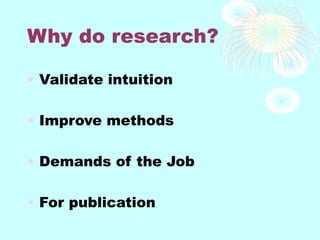
Why do research?
• Validate intuition
• Improve methods
• Demands of the Job
• For publication
Steps of Research
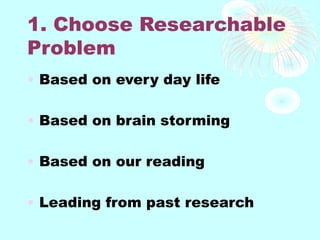
1. Choose Researchable
Problem
• Based on every day life
• Based on brain storming
• Based on our reading
• Leading from past research
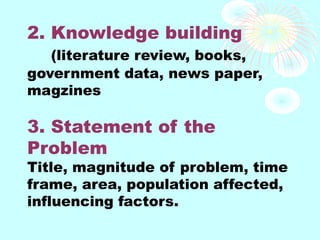
2. Knowledge building
(literature review, books,
government data, news paper,
magzines
3. Statement of the
Problem
Title, magnitude of problem, time
frame, area, population affected,
influencing factors.
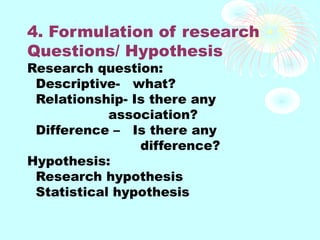
4. Formulation of research
Questions/ Hypothesis
Research question:
Descriptive- what?
Relationship- Is there any
association?
Difference – Is there any
difference?
Hypothesis:
Research hypothesis
Statistical hypothesis
5. Define objectives
• It should be, specific, measurable,
actionable, achievable, reliable and
time bound.
• Needs to be realistic.
• Closely related to research
questions/ hypothesis.
• The more variables the more
difficult.
• Ethical issues needed to be
considered.
6. Study design
• 1. Qualitative:
• eg; case study, phenomenological
study
• 2. Qantitative:
• i) Observational
• A) Descriptive
• a) Case Report
• b)Case Series
• c) longitudinal
• d) Cross sectional
Study design
• B) Analytical Study
• a) Cohort
• b) Case Control
• c) Cross Sectional
• ii) Interventional Study
• A) True Experimental
• a) RCT
• b)Community Trial
• c) Field Trial
• B) Quasi experimental Study
A Case report
• Description of one interesting
and unusual case
• This is anecdotal and may form
the basis for further study
• This may be the only way to
report on something very rare
Case series
• Description of several cases in
which no attempt is made to
answer specific hypotheses or
compare results with another
group of cases.
Cross sectional study
• A survey of the frequency of
disease, risk factors or other
characteristics in a defined
population at one particular
point in time.
Cohort study
• An observational study of a
group of people with a specific
characteristic or disease who
are followed over a period of
time to detect change
• Comparison with control group
is allowed
Case control study
• An observational study where
characteristics of people with a
disease (cases) are compared
with selected people without
the disease (controls)
Controlled Trials
• An experimental study in which
an intervention is applied to one
group and the outcome
compared with that in a similar
group (controls) not receiving
the intervention.
7. Determining Sample
Design
• Sampling: it is the subset of
population among which
information is actually derived
in order to study the population.
• Probability sampling
• Non probality sampling
8.Development of Data
Collection Instrument
Questionnaire
Schedule
9.Data Collection
• By observation
• Through personal interview
• Through telephone interview
• By mailing of Questionnaires
• Through schedules
9. Execution of the project
• Time line
• Quality check
10. Analysis of data
Data editing, presentation,
tabulation, analysis and
drawing statistical
inferences.
11. Hypothesis testing
• t-test
• z-test
• Chi square test
12. Research report writing
13. Preparation of report for
presentation of the result,
i.e. formal write up of
conclusion.
14. Dissemination of
research report through
publication and
presentation.
Authorship
Author Should be directly
involved at the
• Idea stage
• Protocol development
• Actual performance of the study
• Interpretation of results
• Writing up
Authorship
• All authors must take full
responsibility for the study.
• That is why it is important to be
involved fully.
Thank
you

Introduction to research_methodology

  • 1.
    Introduction to research Methodology DrMahbub Hussain MS (OMFS) BDS Lecturer Dhaka Dental College
  • 2.
    Research • Research isa scientific, systematic, organized & ethical investigation into a phenomenon to discover new facts about the unknown in an attempt to find answer to a question & its solution.
  • 3.
    Scientific Method • Scientificmethods are systematic and well controlled body of procedures and techniques rooted in objective realities which are applied in carrying out investigation targeted at obtaining new knowledge or correcting previous knowledge about natural phenomena.
  • 4.
    Research methodology • Itis the way to deal with the various steps adopted by a researcher to study the research problem systematically along with the logic, assumption and rationale behind them.
  • 5.
    Why do research? •Validate intuition • Improve methods • Demands of the Job • For publication
  • 6.
  • 7.
    1. Choose Researchable Problem •Based on every day life • Based on brain storming • Based on our reading • Leading from past research
  • 8.
    2. Knowledge building (literaturereview, books, government data, news paper, magzines 3. Statement of the Problem Title, magnitude of problem, time frame, area, population affected, influencing factors.
  • 9.
    4. Formulation ofresearch Questions/ Hypothesis Research question: Descriptive- what? Relationship- Is there any association? Difference – Is there any difference? Hypothesis: Research hypothesis Statistical hypothesis
  • 10.
    5. Define objectives •It should be, specific, measurable, actionable, achievable, reliable and time bound. • Needs to be realistic. • Closely related to research questions/ hypothesis. • The more variables the more difficult. • Ethical issues needed to be considered.
  • 11.
    6. Study design •1. Qualitative: • eg; case study, phenomenological study • 2. Qantitative: • i) Observational • A) Descriptive • a) Case Report • b)Case Series • c) longitudinal • d) Cross sectional
  • 12.
    Study design • B)Analytical Study • a) Cohort • b) Case Control • c) Cross Sectional • ii) Interventional Study • A) True Experimental • a) RCT • b)Community Trial • c) Field Trial • B) Quasi experimental Study
  • 13.
    A Case report •Description of one interesting and unusual case • This is anecdotal and may form the basis for further study • This may be the only way to report on something very rare
  • 14.
    Case series • Descriptionof several cases in which no attempt is made to answer specific hypotheses or compare results with another group of cases.
  • 15.
    Cross sectional study •A survey of the frequency of disease, risk factors or other characteristics in a defined population at one particular point in time.
  • 16.
    Cohort study • Anobservational study of a group of people with a specific characteristic or disease who are followed over a period of time to detect change • Comparison with control group is allowed
  • 17.
    Case control study •An observational study where characteristics of people with a disease (cases) are compared with selected people without the disease (controls)
  • 18.
    Controlled Trials • Anexperimental study in which an intervention is applied to one group and the outcome compared with that in a similar group (controls) not receiving the intervention.
  • 19.
    7. Determining Sample Design •Sampling: it is the subset of population among which information is actually derived in order to study the population. • Probability sampling • Non probality sampling
  • 20.
    8.Development of Data CollectionInstrument Questionnaire Schedule 9.Data Collection • By observation • Through personal interview • Through telephone interview • By mailing of Questionnaires • Through schedules
  • 21.
    9. Execution ofthe project • Time line • Quality check 10. Analysis of data Data editing, presentation, tabulation, analysis and drawing statistical inferences.
  • 22.
    11. Hypothesis testing •t-test • z-test • Chi square test
  • 23.
    12. Research reportwriting 13. Preparation of report for presentation of the result, i.e. formal write up of conclusion.
  • 24.
    14. Dissemination of researchreport through publication and presentation.
  • 25.
    Authorship Author Should bedirectly involved at the • Idea stage • Protocol development • Actual performance of the study • Interpretation of results • Writing up
  • 26.
    Authorship • All authorsmust take full responsibility for the study. • That is why it is important to be involved fully.
  • 27.