Research for Competitive
Effectiveness: Vanguard,
Johnson & Johnson or
Reckitt Benckiser
Linda Hauck, Spring 2016
Objectives
 Nature of quality secondary research including source
variety, evaluation criteria
 Familiarity with industry reports, company profiles,
consumer surveys, trade associations and news
 Provide attribution for sources using APA Style
APA Citations
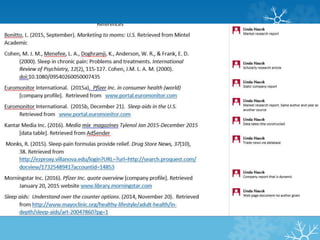
 How do you make your reference list?
 Easybib (APA behind pay wall), Bibme (mistakes
introduced), Citationmachine (doesn’t support many
publication types), Noodletools express (works well),
refworks (learning curve), Zotero (learning curve), Word
Reference tab (Use show all bibliographic fields and
some errors), Google docs ad ons buggy, database
utilities (don’t cover all resources used and some
errors.)
 What you still need to know: APA style and what you
are trying to cite
 APA Style Guide to Electronic References or APA Style or
Purdue OWL APA Style
APA Basics
Reference:
Author, A. (publication date). Title. Retrieved from URL or
database name..
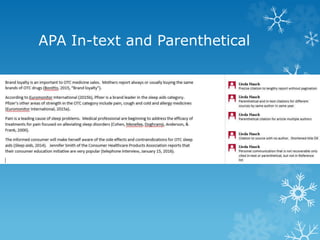
In Text: authors (date, page)
Parenthetical: (authors, date, page)
NEED TO CREATE REFERENCE BEFORE IN-TEXT OR
PARENTHETICAL CITATION
ALWAYS NEED TO KNOW TYPE OF RESOURCE BEFORE
CREATING REFERENCE
APA In-text and Parenthetical
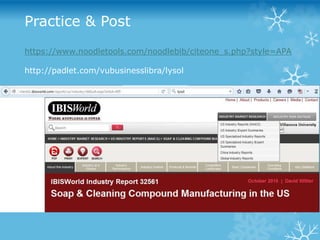
Practice & Post
https://www.noodletools.com/noodlebib/citeone_s.php?style=APA
http://padlet.com/vubusinesslibra/lysol
Indicators Good Research
 Source Variety : Different kinds of source materials are
used. There is not excessive reliance on only one or two
types of resources. Types of resources include market
or industry research reports, trade news, general &
business news, trade associations, company web sites,
company profiles, academic studies, & data sets.
 Source Quality: The sources used are written by
qualified authors, are timely, are relevant, employ
rigerous methods, and are appropriate to the task.
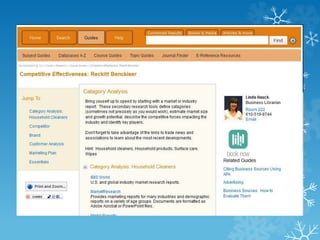
Business Sources How to Evaluate Them
 References: The reference list conforms to the APA style
in organization and form, attribution is provided as
needed and parenthetical or in-text citations conform to
APA style.
Getting Started
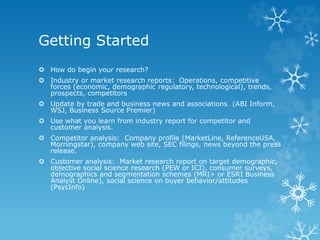
 How do begin your research?
 Industry or market research reports: Operations, competitive
forces (economic, demographic regulatory, technological), trends,
prospects, competitors
 Update by trade and business news and associations. (ABI Inform,
WSJ, Business Source Premier)
 Use what you learn from industry report for competitor and
customer analysis.
 Competitor analysis: Company profile (MarketLine, ReferenceUSA,
Morningstar), company web site, SEC filings, news beyond the press
release.
 Customer analysis: Market research report on target demographic,
objective social science research (PEW or ICI), consumer surveys,
demographics and segmentation schemes (MRI+ or ESRI Business
Analyst Online), social science on buyer behavior/attitudes
(PsycInfo)
Evaluating Sources
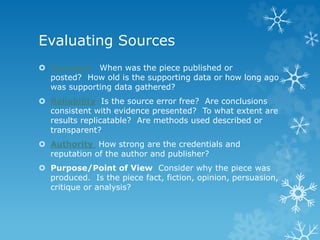
 Currency When was the piece published or
posted? How old is the supporting data or how long ago
was supporting data gathered?
 Reliability Is the source error free? Are conclusions
consistent with evidence presented? To what extent are
results replicatable? Are methods used described or
transparent?
 Authority How strong are the credentials and
reputation of the author and publisher?
 Purpose/Point of View Consider why the piece was
produced. Is the piece fact, fiction, opinion, persuasion,
critique or analysis?
Getting Help
 BookMe scheduler
https://vubusinesslibrarian.youcanbook.me/
 Virtual meetings available outside scheduled times too
 Email linda.hauck@villanova.edu
 Drop in, Falvey 222

Research for competitive effectiveness spring 2016

  • 1.
    Research for Competitive Effectiveness:Vanguard, Johnson & Johnson or Reckitt Benckiser Linda Hauck, Spring 2016
  • 2.
    Objectives  Nature ofquality secondary research including source variety, evaluation criteria  Familiarity with industry reports, company profiles, consumer surveys, trade associations and news  Provide attribution for sources using APA Style
  • 3.
    APA Citations  Howdo you make your reference list?  Easybib (APA behind pay wall), Bibme (mistakes introduced), Citationmachine (doesn’t support many publication types), Noodletools express (works well), refworks (learning curve), Zotero (learning curve), Word Reference tab (Use show all bibliographic fields and some errors), Google docs ad ons buggy, database utilities (don’t cover all resources used and some errors.)  What you still need to know: APA style and what you are trying to cite  APA Style Guide to Electronic References or APA Style or Purdue OWL APA Style
  • 4.
    APA Basics Reference: Author, A.(publication date). Title. Retrieved from URL or database name.. In Text: authors (date, page) Parenthetical: (authors, date, page) NEED TO CREATE REFERENCE BEFORE IN-TEXT OR PARENTHETICAL CITATION ALWAYS NEED TO KNOW TYPE OF RESOURCE BEFORE CREATING REFERENCE
  • 6.
    APA In-text andParenthetical
  • 7.
  • 8.
    Indicators Good Research Source Variety : Different kinds of source materials are used. There is not excessive reliance on only one or two types of resources. Types of resources include market or industry research reports, trade news, general & business news, trade associations, company web sites, company profiles, academic studies, & data sets.  Source Quality: The sources used are written by qualified authors, are timely, are relevant, employ rigerous methods, and are appropriate to the task. Business Sources How to Evaluate Them  References: The reference list conforms to the APA style in organization and form, attribution is provided as needed and parenthetical or in-text citations conform to APA style.
  • 9.
    Getting Started  Howdo begin your research?  Industry or market research reports: Operations, competitive forces (economic, demographic regulatory, technological), trends, prospects, competitors  Update by trade and business news and associations. (ABI Inform, WSJ, Business Source Premier)  Use what you learn from industry report for competitor and customer analysis.  Competitor analysis: Company profile (MarketLine, ReferenceUSA, Morningstar), company web site, SEC filings, news beyond the press release.  Customer analysis: Market research report on target demographic, objective social science research (PEW or ICI), consumer surveys, demographics and segmentation schemes (MRI+ or ESRI Business Analyst Online), social science on buyer behavior/attitudes (PsycInfo)
  • 10.
    Evaluating Sources  CurrencyWhen was the piece published or posted? How old is the supporting data or how long ago was supporting data gathered?  Reliability Is the source error free? Are conclusions consistent with evidence presented? To what extent are results replicatable? Are methods used described or transparent?  Authority How strong are the credentials and reputation of the author and publisher?  Purpose/Point of View Consider why the piece was produced. Is the piece fact, fiction, opinion, persuasion, critique or analysis?
  • 12.
    Getting Help  BookMescheduler https://vubusinesslibrarian.youcanbook.me/  Virtual meetings available outside scheduled times too  Email linda.hauck@villanova.edu  Drop in, Falvey 222