Data Management Plans
Services Needed?
What is a DMP?
A data management plan is a formal
document describing how a researcher
intends to handle data throughout the
lifecycle of a particular project.
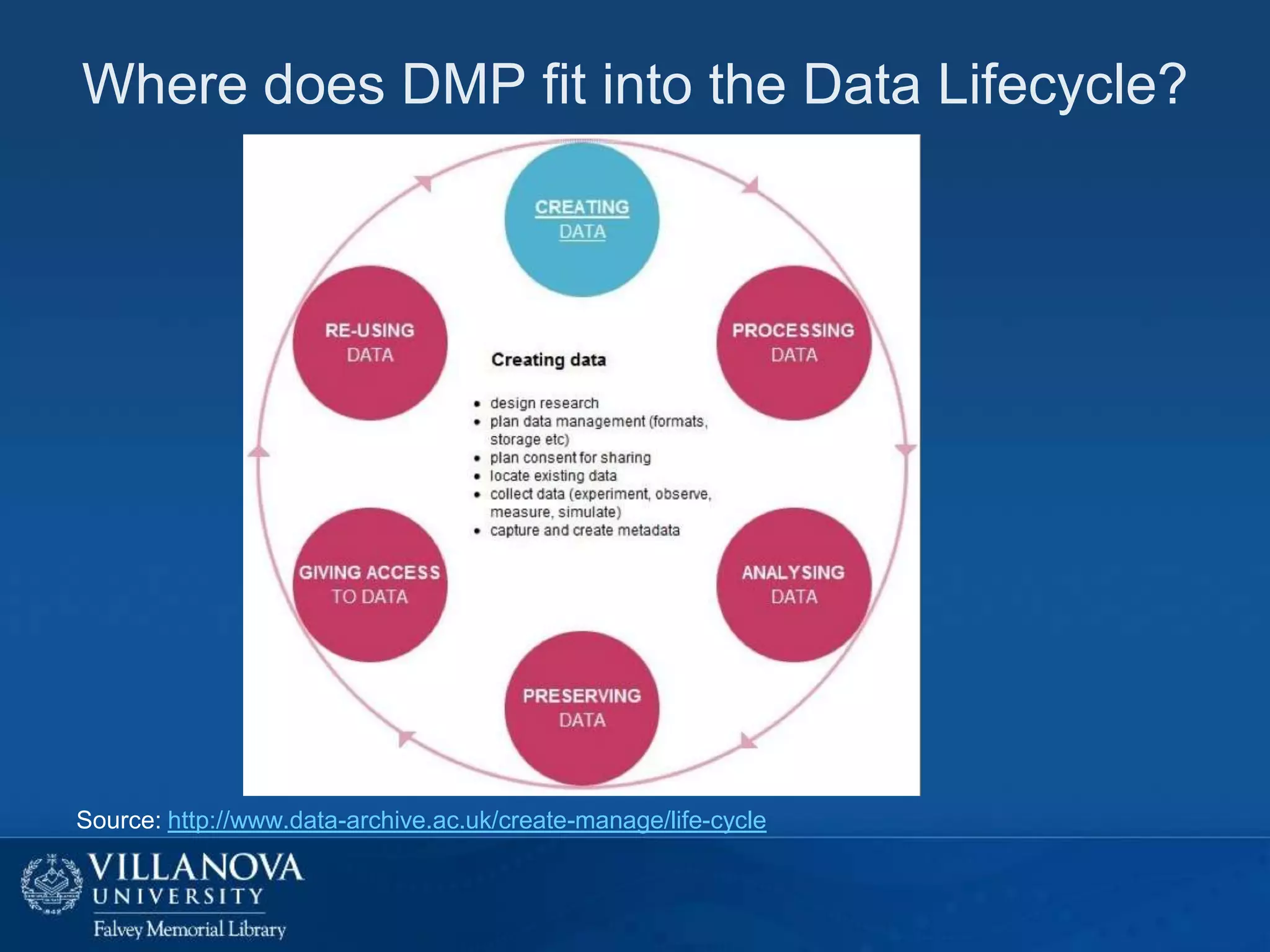
Where does DMP fit into the Data Lifecycle?

Source: http://www.data-archive.ac.uk/create-manage/life-cycle
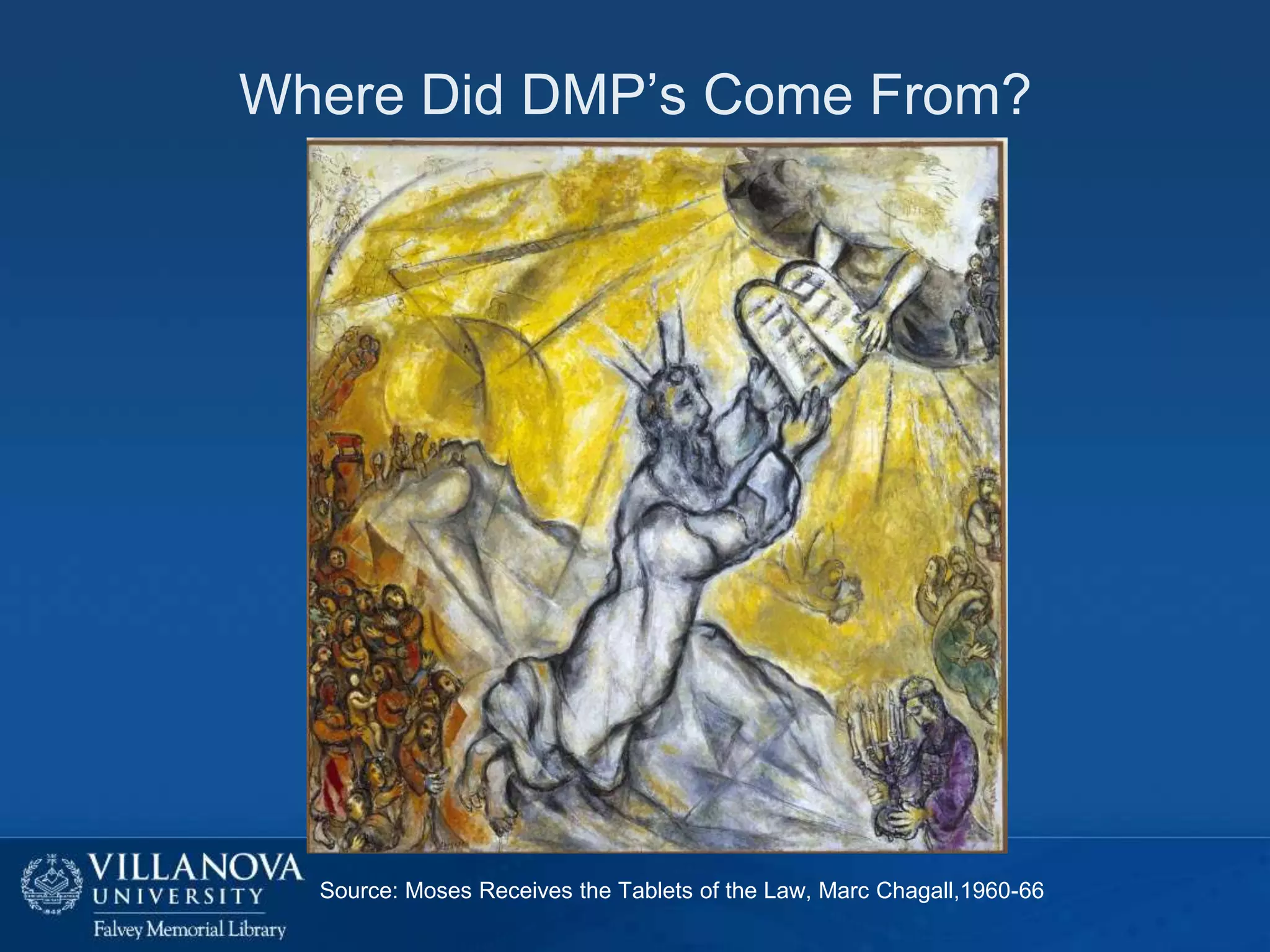
Where Did DMP’s Come From?

Source: Moses Receives the Tablets of the Law, Marc Chagall,1960-66
Funding Providers in the US
• National Institute of Health (2003)
• National Science Foundation (2011)
• National Oceanic & Atmospheric Administration
(2011)
• National Endowment for the Humanities (2013)
• Institute of Education Sciences (2012)
• Federal Agencies >$100M in R&D (2013)
• Wellcome Trust in the UK…
• US private funders to follow?
Why are DMP’s Needed?
•
•
•
•
•

Ensure integrity
Accelerate scientific advances
Government accountability
Economic development
Replicate results
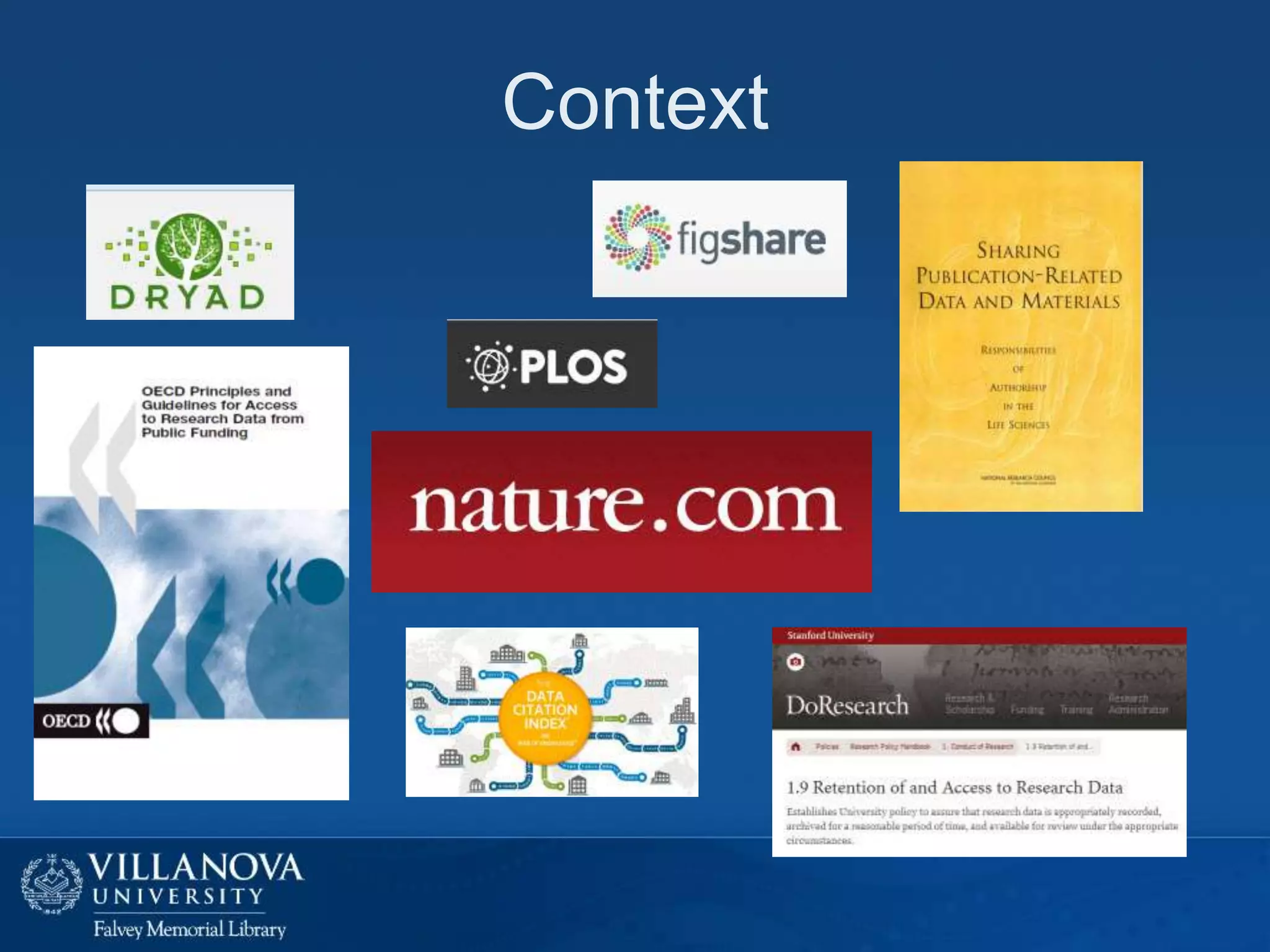
Context
Researcher attitudes toward data management &
plans
“Data sharing is a bit like going to
the dentist. We can all agree that
it is a good thing to do and
intrinsic to good scientific practice.
In reality, however, researchers
tend to view data sharing with a
mix of fear, contempt, and dread.”
LeClere, F. (2010, Aug. 3). Too many
researchers are reluctant to share their data.
Chronicle of Higher Education. Retrieved from
http://chronicle.com/article/Too-ManyResearchers-Are/123749/

•
•
•
•
•
•

Fear of data misuse
Competitive advantage loss
Lack of time, too much work
No place to put the data
Contribution to Open Access
Facilitate knowledge creation
via mashups, diversity of
analysis
• Enhance research profile &
prominence
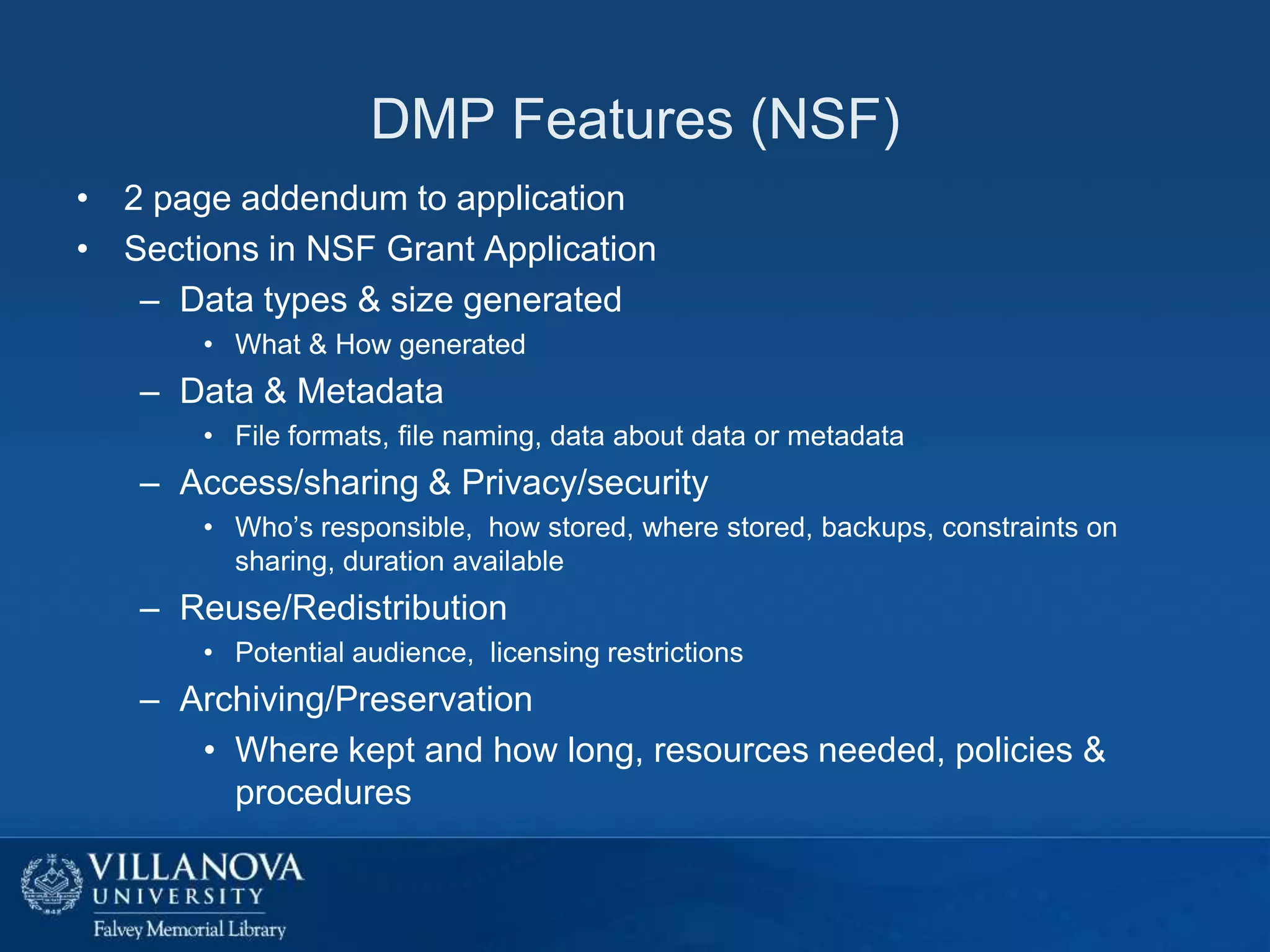
DMP Features (NSF)
• 2 page addendum to application
• Sections in NSF Grant Application
– Data types & size generated
• What & How generated

– Data & Metadata
• File formats, file naming, data about data or metadata

– Access/sharing & Privacy/security
• Who’s responsible, how stored, where stored, backups, constraints on
sharing, duration available

– Reuse/Redistribution
• Potential audience, licensing restrictions

– Archiving/Preservation
• Where kept and how long, resources needed, policies &
procedures
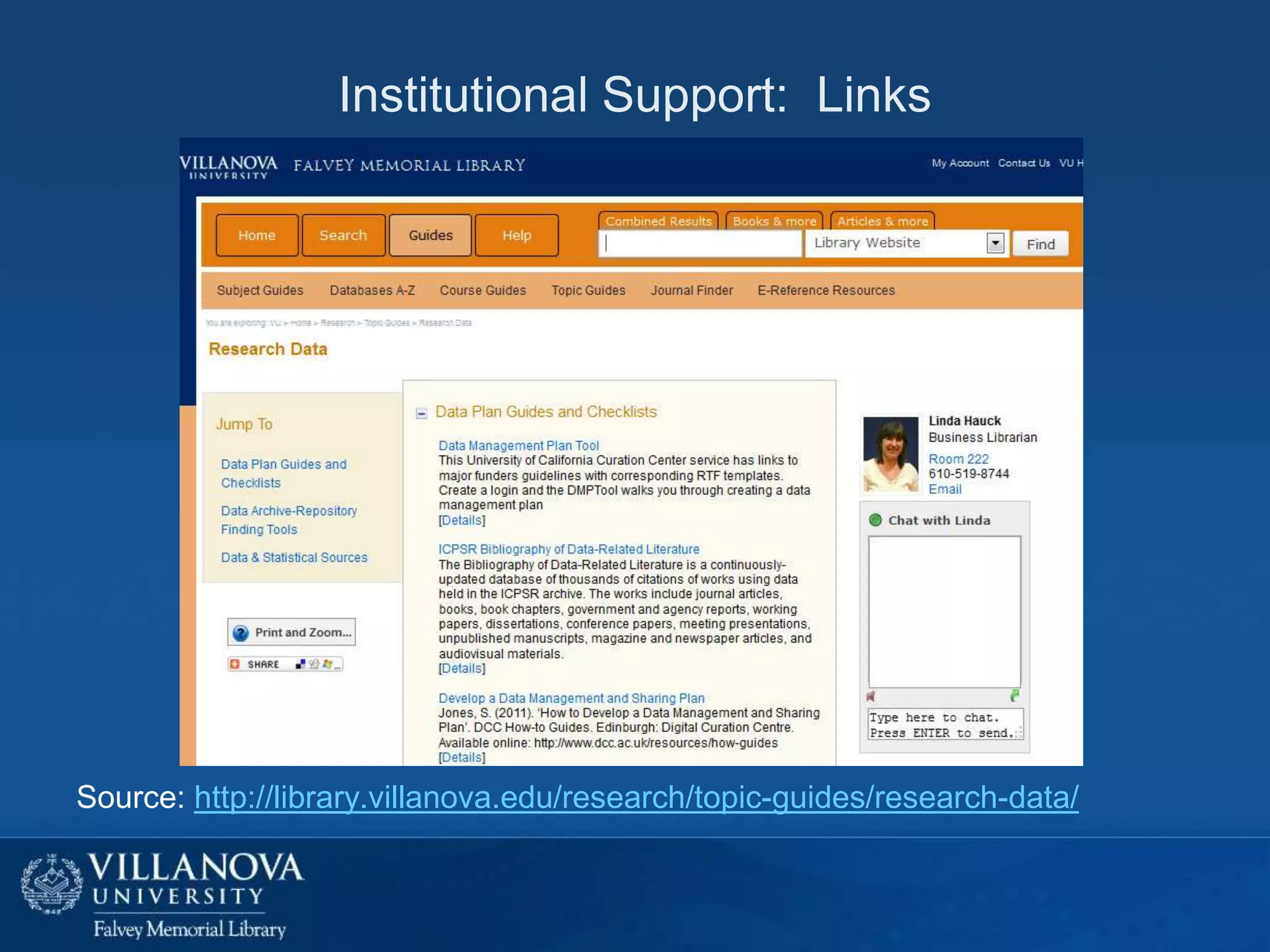
Institutional Support: Links

Source: http://library.villanova.edu/research/topic-guides/research-data/
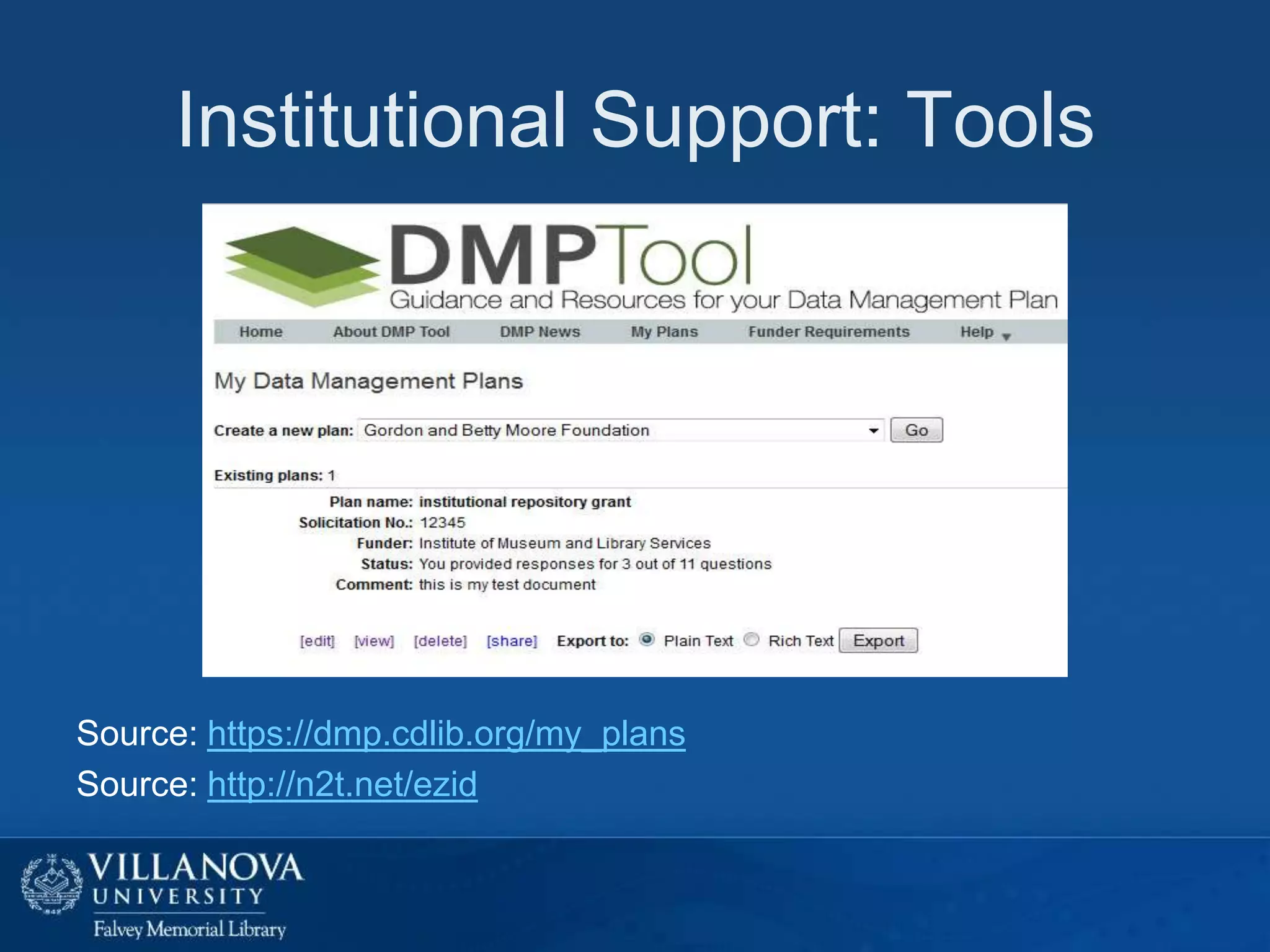
Institutional Support: Tools

Source: https://dmp.cdlib.org/my_plans
Source: http://n2t.net/ezid
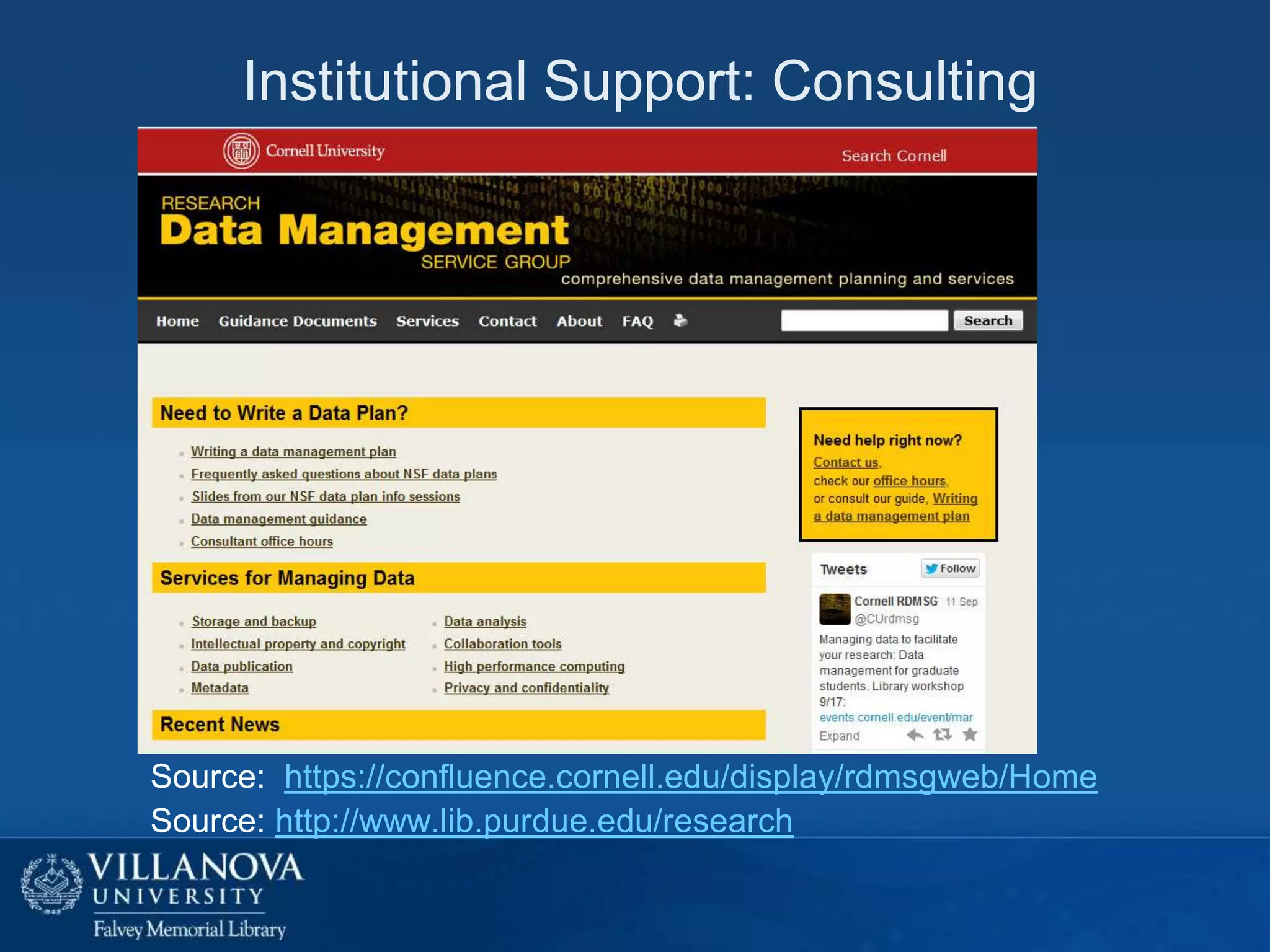
Institutional Support: Consulting

Source: https://confluence.cornell.edu/display/rdmsgweb/Home
Source: http://www.lib.purdue.edu/research
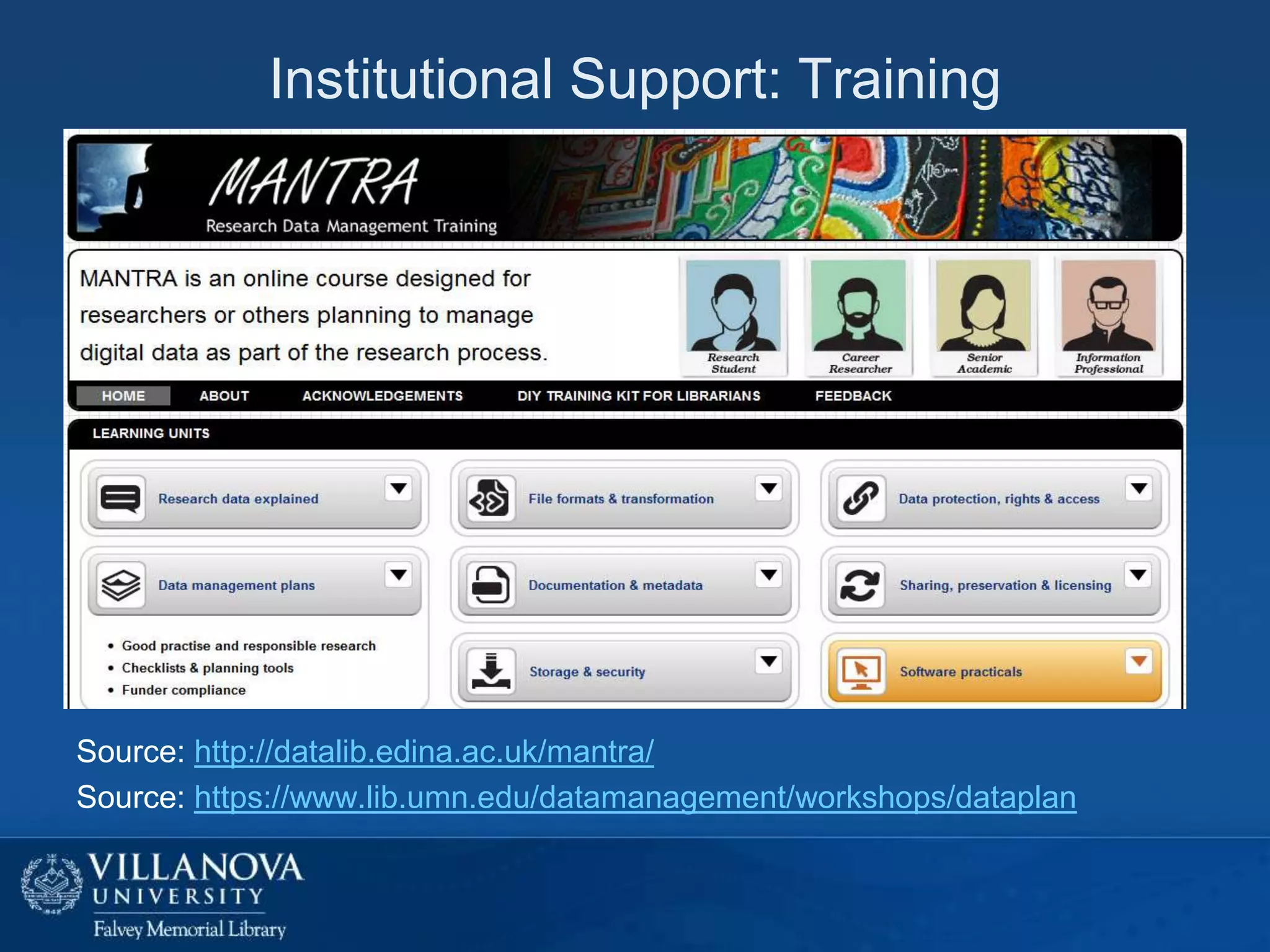
Institutional Support: Training

Source: http://datalib.edina.ac.uk/mantra/
Source: https://www.lib.umn.edu/datamanagement/workshops/dataplan
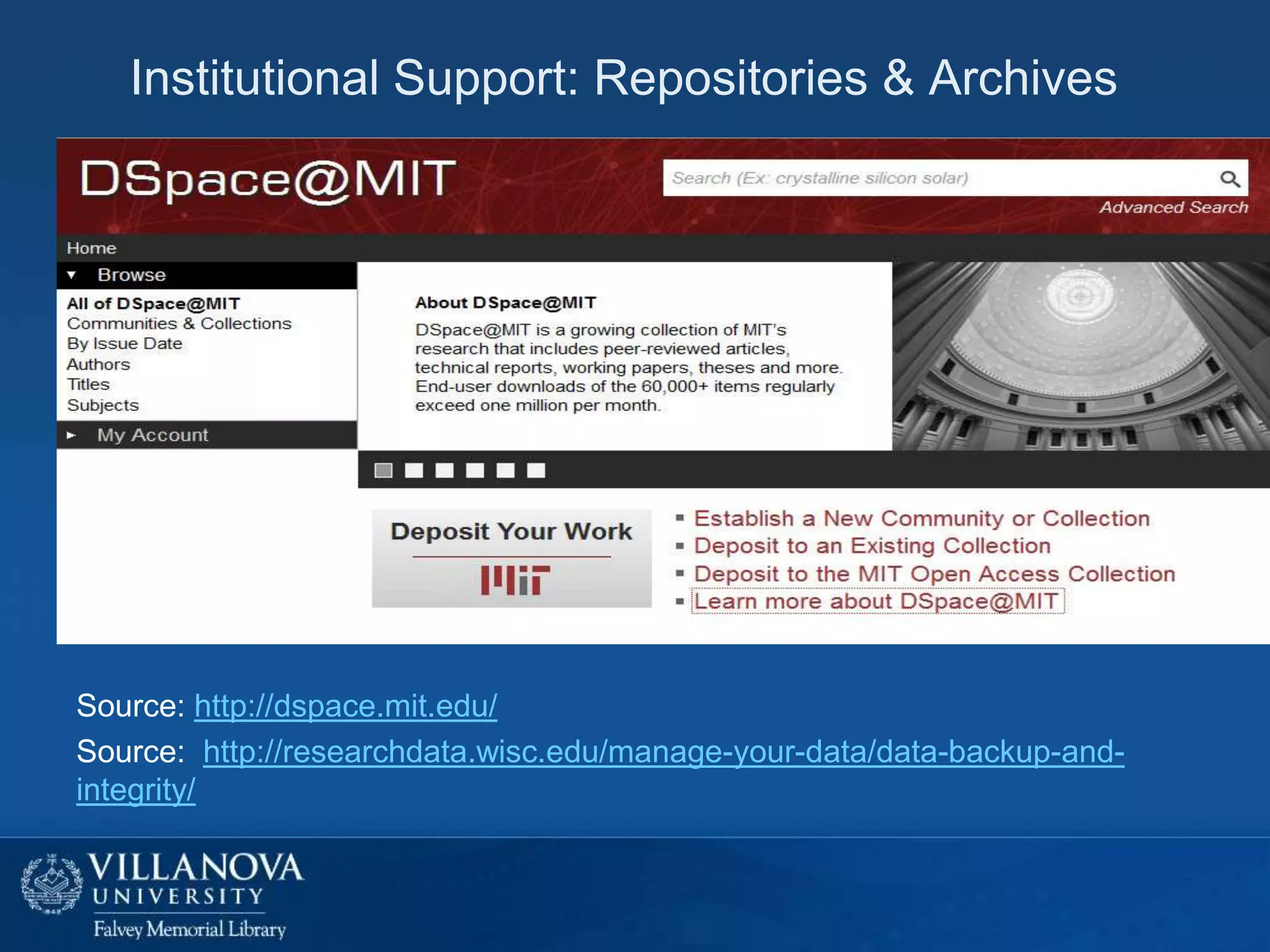
Institutional Support: Repositories & Archives

Source: http://dspace.mit.edu/
Source: http://researchdata.wisc.edu/manage-your-data/data-backup-andintegrity/
Research Data at Villanova
• What will research data management services look like
at Villanova?
• Who are the key stakeholders at Villanova and who can
best champion the effort?
• How shall University leadership, support services and
researchers come together to plan and implement
services?
Additional Resources
Jones, S. Pryor, G. & Whyte, A. (2013). How to develop research data
management services: A guide for HEIs’ Retrieved from
http://www.dcc.ac.uk/resources/how-guides/how-develop-rdm-services
Pryor, G. (Ed.) (2012). Managing research Data. London: Facet Publishing.
Steinhart, G. Chen, E. Arguillas, F. Dietrich, D. & Kramer, S. (2012). Prepared
to plan? A snapshot of researcher readiness to address data management
planning requirement. Journal of eScience Librarianship 1(2) 63-78.
Scaramozzino, J.M., Ramirez, M.L. & McGaughey, K.J. (2012). A study of
faculty data curation behaviors and attitudes at a teaching-centered university.
College & Research Libraries 73 (7) 349-365.

Data management profiles workshop

  • 1.
  • 2.
    What is aDMP? A data management plan is a formal document describing how a researcher intends to handle data throughout the lifecycle of a particular project.
  • 3.
    Where does DMPfit into the Data Lifecycle? Source: http://www.data-archive.ac.uk/create-manage/life-cycle
  • 4.
    Where Did DMP’sCome From? Source: Moses Receives the Tablets of the Law, Marc Chagall,1960-66
  • 5.
    Funding Providers inthe US • National Institute of Health (2003) • National Science Foundation (2011) • National Oceanic & Atmospheric Administration (2011) • National Endowment for the Humanities (2013) • Institute of Education Sciences (2012) • Federal Agencies >$100M in R&D (2013) • Wellcome Trust in the UK… • US private funders to follow?
  • 6.
    Why are DMP’sNeeded? • • • • • Ensure integrity Accelerate scientific advances Government accountability Economic development Replicate results
  • 7.
  • 8.
    Researcher attitudes towarddata management & plans “Data sharing is a bit like going to the dentist. We can all agree that it is a good thing to do and intrinsic to good scientific practice. In reality, however, researchers tend to view data sharing with a mix of fear, contempt, and dread.” LeClere, F. (2010, Aug. 3). Too many researchers are reluctant to share their data. Chronicle of Higher Education. Retrieved from http://chronicle.com/article/Too-ManyResearchers-Are/123749/ • • • • • • Fear of data misuse Competitive advantage loss Lack of time, too much work No place to put the data Contribution to Open Access Facilitate knowledge creation via mashups, diversity of analysis • Enhance research profile & prominence
  • 9.
    DMP Features (NSF) •2 page addendum to application • Sections in NSF Grant Application – Data types & size generated • What & How generated – Data & Metadata • File formats, file naming, data about data or metadata – Access/sharing & Privacy/security • Who’s responsible, how stored, where stored, backups, constraints on sharing, duration available – Reuse/Redistribution • Potential audience, licensing restrictions – Archiving/Preservation • Where kept and how long, resources needed, policies & procedures
  • 10.
    Institutional Support: Links Source:http://library.villanova.edu/research/topic-guides/research-data/
  • 11.
    Institutional Support: Tools Source:https://dmp.cdlib.org/my_plans Source: http://n2t.net/ezid
  • 12.
    Institutional Support: Consulting Source:https://confluence.cornell.edu/display/rdmsgweb/Home Source: http://www.lib.purdue.edu/research
  • 13.
    Institutional Support: Training Source:http://datalib.edina.ac.uk/mantra/ Source: https://www.lib.umn.edu/datamanagement/workshops/dataplan
  • 14.
    Institutional Support: Repositories& Archives Source: http://dspace.mit.edu/ Source: http://researchdata.wisc.edu/manage-your-data/data-backup-andintegrity/
  • 15.
    Research Data atVillanova • What will research data management services look like at Villanova? • Who are the key stakeholders at Villanova and who can best champion the effort? • How shall University leadership, support services and researchers come together to plan and implement services?
  • 16.
    Additional Resources Jones, S.Pryor, G. & Whyte, A. (2013). How to develop research data management services: A guide for HEIs’ Retrieved from http://www.dcc.ac.uk/resources/how-guides/how-develop-rdm-services Pryor, G. (Ed.) (2012). Managing research Data. London: Facet Publishing. Steinhart, G. Chen, E. Arguillas, F. Dietrich, D. & Kramer, S. (2012). Prepared to plan? A snapshot of researcher readiness to address data management planning requirement. Journal of eScience Librarianship 1(2) 63-78. Scaramozzino, J.M., Ramirez, M.L. & McGaughey, K.J. (2012). A study of faculty data curation behaviors and attitudes at a teaching-centered university. College & Research Libraries 73 (7) 349-365.