MACROECONOMIC
INDICATORS
Linda Hauck
Librarian to VSB & Economics
Spring 2012
Defined
 economic indicators A collection of statistical
 information about the economy. The most commonly
 used country economic indicators include the gross
 domestic product , output by sectors, private
 consumption, retail sales
 volume, employment, unemployment, average
 earnings, investment, productivity, inflation, producer
 input and output prices, current account, volume of trade
 in goods and services, exports, imports, public debt, and
 interest rates.

 “Economic indicators" A Dictionary of Economics. John Black, Nigar Hashimzade, and Gareth
 Myles. Oxford University Press, 2009. Oxford Reference Online. Oxford University
 Press. Villanova University. 6 February 2012 <http://www.oxfordreference.com
Leading, Lagging, Coincident
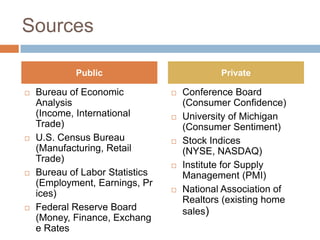
Sources

            Public                           Private

   Bureau of Economic              Conference Board
    Analysis                         (Consumer Confidence)
    (Income, International          University of Michigan
    Trade)                           (Consumer Sentiment)
   U.S. Census Bureau              Stock Indices
    (Manufacturing, Retail           (NYSE, NASDAQ)
    Trade)
                                    Institute for Supply
   Bureau of Labor Statistics       Management (PMI)
    (Employment, Earnings, Pr
    ices)                           National Association of
                                     Realtors (existing home
   Federal Reserve Board            sales)
    (Money, Finance, Exchang
    e Rates
In the news…


Appelbaum, B. (2012, January 27). The quiet driver of economic growth: Exports [web log post].
   Retrieved from http://economix.blogs.nytimes.com/2012/01/27/the-quiet-driver-of-economic-
   growth-exports/?ref=economy
What’s the point?
A.   “The only function of economic forecasting is to make
     astrology look respectable.”
     John Kenneth Galbraith

B.   “God is in the details”


C.   "There are three kinds of lies: lies, damned
     lies, and statistics."

Macroeconomic indicators

  • 1.
  • 2.
    Defined economic indicatorsA collection of statistical information about the economy. The most commonly used country economic indicators include the gross domestic product , output by sectors, private consumption, retail sales volume, employment, unemployment, average earnings, investment, productivity, inflation, producer input and output prices, current account, volume of trade in goods and services, exports, imports, public debt, and interest rates. “Economic indicators" A Dictionary of Economics. John Black, Nigar Hashimzade, and Gareth Myles. Oxford University Press, 2009. Oxford Reference Online. Oxford University Press. Villanova University. 6 February 2012 <http://www.oxfordreference.com
  • 3.
  • 4.
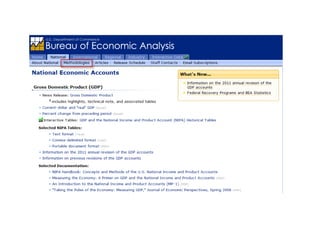
    Sources Public Private  Bureau of Economic  Conference Board Analysis (Consumer Confidence) (Income, International  University of Michigan Trade) (Consumer Sentiment)  U.S. Census Bureau  Stock Indices (Manufacturing, Retail (NYSE, NASDAQ) Trade)  Institute for Supply  Bureau of Labor Statistics Management (PMI) (Employment, Earnings, Pr ices)  National Association of Realtors (existing home  Federal Reserve Board sales) (Money, Finance, Exchang e Rates
  • 6.
    In the news… Appelbaum,B. (2012, January 27). The quiet driver of economic growth: Exports [web log post]. Retrieved from http://economix.blogs.nytimes.com/2012/01/27/the-quiet-driver-of-economic- growth-exports/?ref=economy
  • 8.
    What’s the point? A. “The only function of economic forecasting is to make astrology look respectable.” John Kenneth Galbraith B. “God is in the details” C. "There are three kinds of lies: lies, damned lies, and statistics."