Week 2: External Environmental Analysis
1. What economic factors have to be considered in identifying
an industry analysis?
2. What competitive forces do companies face in an industry?
3. What factors are driving industry change and what impacts
will they have?
4. What market positions do rivals occupy – who is strongly
positioned and who is not?
5. What strategic moves are rivals likely to make next?
6. What are the key factors for future competitive success?
7. Does the outlook for the industry present the company with
an attractive opportunity?
Project 1: Starting an External Environmental Analysis
· Topps Tiles Plc (NBB:TPT)
Previous Next
Instructions
BMGT 495 - Project 1: Starting an External Environmental
Analysis (Week 2)
NOTE: All submitted work is to be your original work (only
your work). You may not use any work from another student,
the Internet or an online clearinghouse. You are expected to
understand the Academic Dishonesty and Plagiarism Policy, and
know that it is your responsibility to learn about instructor and
general academic expectations with regard to proper citation of
sources as specified in the APA Publication Manual, 6th Ed.
(You are held accountable for in-text citations and an associated
reference list only).
Project 1 is due Sunday at 11:59 p.m. eastern time of week 2
unless otherwise changed by the instructor.
Purpose:
This project is the first of four projects. This project provides
the first steps in completing an external environmental analysis
of your focal company’s strategic management plan. You will
use tools and apply concepts learned in this and previous
business courses to demonstrate an understanding of how
organizations develop and manage strategies to establish,
safeguard and sustain its competitive position in the
21st century’s (rapidly evolving/shifting/changing), uncertain
hyper-competitive business environment.
Completing a company overview and assessing the general
environment is a key aspect of performing an external
environment analysis. This project provides you with the
opportunity to evaluate the competitive position of one of the
organizations listed below and integrate that information in the
beginnings of a external environmental analysis.
The company you will be analyzing operates within the global
market. You will assess the company in terms of the global
industry. Industries differ widely in their economic
characteristics, competitive situation and future profit potential.
In this project, you are presenting a report document. The
expectation is that the report provides the level of details to
help the audience grasp the main topics and to understand the
General Environment.
Analysis is the operative word. In analyzing the external
environment, you are expected to thoroughly research and take
that research and break it into small parts to gain a better
understanding of what is happening in the external environment
of the business. In researching an industry, it is important to
understand that every company within an industry is different so
gathering information on one company does not mean that the
collected information is relevant to other companies within that
industry. When researching, parsing the material is critical to
an accurate analysis. Avoid presenting just any information as
that may lead to using irrelevant information.
You will then write the report in your own words to share the
external analysis. You are expected to present information and
support the ideas and reasoning using the course material and
your research. You will not lift any information from source
documents without properly citing and referencing. For the
technical analysis aspect of the project, you are required to
create the technique on your own and may not use from any
source material that you happen to find. No work from a
clearinghouse or similar website may be used or cited as a
credible source.
Outcomes Met With This Project:
· utilize a set of useful analytical skills, tools, and techniques
for analyzing a company strategically;
· integrate ideas, concepts, and theories from previously taken
functional courses including accounting, finance, market,
business and human resource management;
Instructions:
In completing the report, you will use the chapters in the eBook
and other course material, and perform research on the company
and industry in which the company operates and answer
the required elements below in narrative form following the
steps provided.
Step 1: Specific Company for All Four Projects
In this project, you will complete a Company Overview, an
Evaluation of the General Environment and a conclusion.
You will be assigned by your instructor one focal company to
complete the analysis. The assigned company must be used for
all four projects in this course. You are not allowed to write the
report on any other company different from the company
specifically assigned by your instructor. If a company other
than that assigned to you is used, a zero will be assigned.
The instructor will assign you a company from the list below.
(Students may not select the company). All companies can be
found on Mergent Online.
·
· Topps Tiles Plc (NBB:TPT)
· Students must complete the project using the assigned
company. Deviating from the assigned company will result in a
zero for the project. You will look for the company assigned to
you in the Announcement area of the classroom.
Step 2: Course Materials and Research
· You are required to research information about the focal
company and the internal environment for this project, You are
accountable for using the course materials to support the ideas,
reasoning and conclusions made. Course materials use goes
beyond defining terms but is used to explain the 'why and how'
of a situation. Using one or two in-text citations from the
course materials and then relying on Internet source material
will not earn many points on the assignment. A variety of
source material is expected and what is presented must be
relevant and applicable to the topic being discussed. Avoid
merely making statements but close the loop of the discussion
by explaining how something happens or why something
happens, which focuses on importance and impact. In closing
the loop, you will demonstrate the ability to think clearly and
rationally showing an understanding of the logical connections
between the ideas presented from the research, the course
material and the question(s) being asked.
· Note: Your report is based on the results of the research
performed and not on any prepared documentation. What this
means is that you will research and draw your own conclusions
that are supported by the research and the course material rather
than the use any source material that puts together any of the
tools or techniques whether from the Internet, for-pay websites
or any pre-prepared document, video or source material. A zero
will be earned for not doing your own analysis.
· Success: The analysis is based on research and not opinion.
You are not making recommendations and you will not attempt
to position the focal company in a better or worse light than
other companies within the industry merely because you are
completing an analysis on this particular company. The
analysis must be based on factual information. Any conclusions
drawn have to be based on factual information rather than leaps
of faith. To ensure success, as stated above, you are expected
to use the course materials and research on the focal company's
global industry and the focal company. Opinion does not earn
credit nor does using external sources when course materials
can be used. It is necessary to provide explanations (the why
and how) rather than making statements. Avoid stringing one
citation after another as doing so does not show detailed
explanations.
Library Resources
· On the main navigation bar in the classroom select, Resources
and then select Library. Select Databases by Title (A - Z).
Select M from the alphabet list, and then select Mergent
Online. You may also use Market Line and should be looking
at the focal company's Annual Report or 10K report. You are
not depending on any one resource to complete the analysis. It
is impossible to complete a Porter’s Five Forces, competitive
analysis or OT by using only course material.
· You should not be using obscure articles, GlassDoor, or Chron
or similar types of articles.
· Research for Financial Analysis: Financial Research
· Research for Industry Analysis CSI Market
· UMGC library is available for providing resources and
services. Seek library support for excellence in your academic
pursuit.
Library Support
· Extensive library resources and services are available online,
24 hours a day, seven days a week
at https://www.umgc.edu/library/index.cfm to support you in
your studies. The UMGC Library provides research assistance
in creating search strategies, selecting relevant databases, and
evaluating and citing resources in a variety of formats via its
Ask a Librarian service
at https://www.umgc.edu/library/libask/index.cfm.
· Scholarly Research in OneSearch is allowed.
· To search for only scholarly resources, you are expected to
place a check mark in the space for "Scholarly journals only"
before clicking search.
Step 3: How to Set Up the Report:
· The document has to be written in Word or rtf. No other
format is acceptable. Pdf files will not be graded. Use 12-point
font for a double-spaced report. The final product cannot be
longer than 8 pages in length, which includes all tables and
matrices but excludes the title page and reference page. Do no
use an Appendix.
· Create a title page with title, your name, the course number,
the instructor's name.
Step 4: Company Overview
· Provide a company overview, which is an essential component
to the strategic management process. The company overview
includes the purpose(s) for the founding of the company, i.e,
what problems was it formed to solve and/or opportunities it
was formed to exploit, who are the founders, home country or
state, current management, employee headcount, last year’s
revenue, etc.).
Step 5: Evaluate the General Environment
· Identify the global industry in which the company operates.
This will come from Mergent Online.
· Discuss the company's general environment by developing a
PESTEL analysis. First, use the course material to identify the
elements of the PESTEL and what components make up each
element. Then, complete the analysis using research on the
industry and the focal company. Be sure to thoroughly present
and support the reasoning for what is presented. You may not
use a PESTEL analysis that is already completed and available
on the Internet. A zero will result if used as the analysis has to
be the result of your research and your own
development. NOTE: A PESTEL analysis is not a table and it
is not a bulleted assessment.
· Identify and discuss one key trend for each letter of the
PESTEL for the industry. Key trends are separate from the
PESTEL analysis.
· Select one of the six trends identified in the previous
requirement and discuss how the focal company could be
affected by the selected trends.
· Discuss key areas of uncertainty related to the identified trend
for the focal company that could potentially impact the
company's strategy.
· Perform a strategic analysis of the company's mission, vision
and objectives.
Step 6:Conclusion
· Create a concluding paragraph. The Conclusion is intended to
emphasize the purpose/significance of the analysis, emphasize
the significance/consequence of findings, and indicate the wider
applications that are derived from the main points of the
project’s requirements. You will draw conclusions about the
findings of the external environment analysis.
Step 7: Review the Paper
Read the paper to ensure all required elements are present.
The following are specific requirements that you will follow.
Use the checklist to mark off that you have followed each
specific requirement.
Checklist
Specific Project Requirements
Proofread your paper
Read and use the grading rubric while completing the paper to
ensure all requirements are met that will lead to the highest
possible grade.
Third person writing is required. Third person means that there
are no words such as “I, me, my, we, or us” (first person
writing), nor is there use of “you or your” (second person
writing). If uncertain how to write in the third person, view this
link: http://www.quickanddirtytips.com/education/grammar/firs
t-second-and-third-person.
Contractions are not used in business writing, so do not use
them.
Paraphrase and do not use direct quotations. Paraphrase means
you do not use more than four consecutive words from a source
document. Removing quotation marks and citing is
inappropriate. Instead put a passage from a source document
into your own words and attribute the passage to the source
document. There should be no passages with quotation marks.
Using more than four consecutive words from a source
document would require direct quotation marks. Changing
words from a passage does not exclude the passage from having
quotation marks. If more than four consecutive words are used
from source documents, this material will not be included in the
grade.
You are expected to use the research and weekly course
materials to develop the analysis and support the reasoning.
There should be a robust use of the course material. Material
used from a source document must be cited and referenced. A
reference within a reference list cannot exist without an
associated in-text citation and vice versa. Changing words from
a passage does not exclude the passage from having quotation
marks.
Use in-text citations and provide a reference list that contains
the reference associated with each in-text citation.
You may not use books in completing this problem set unless
part of the course material. Also, do not use a dictionary,
Wikipedia or Investopedia or similar sources. You may not use
Fern Fort University, Ibis World or any other for-fee website.
Provide the page or paragraph number in every in-text citation
presented. Since the eBook does not have page numbers,
include the chapter title and topic heading. If using a video,
provide the minutes and second of the cited material.
Step 8: Submit the paper in the Assignment Folder (The
assignment submitted to the Assignment Folder will be
considered the student's final product and therefore ready for
grading by the instructor. It is incumbent upon the student to
verify the assignment is the correct submission. No exceptions
will be considered by the instructor).
Self-Plagiarism: Self-plagiarism is the act of reusing
significant, identical or nearly identical portions of one's own
work. You cannot re-use any portion of a paper or other graded
work that was submitted to another class even if you are
retaking this course. You also will not reuse any portion of
previously submitted work in this class. A zero will be
assigned to the assignment if self-plagiarized.
Faculty do nothave the discretion to accept self-plagiarized
work.
NOTE:All submitted work is to be your original work. You may
not use any work from another student, the Internet or an online
clearinghouse. You are expected to understand the Academic
Dishonesty and Plagiarism Policy, and know that it is your
responsibility to learn about instructor and general academic
expectations with regard to proper citation of sources as
specified in the APA Publication Manual, 6th Ed. (Students are
held accountable for in-text citations and an associated
reference list only).
Week 2: Mar 23 - 29
Print
Theme: The External Environment Assessment
To successfully craft a strategy that fits with a company’s
situation, builds competitive advantage and improves
performance, managers have to have insight into a company’s
external and internal environment. The internal environment
will be discussed in week 3. The external environment
comprises all of the entities that exists outside of an
organization’s boundaries that affect its growth and survival.
An organization has little to no control over the external
environment so there is a need to constantly monitor, prepare
and adapt to the changes that occur. Understanding the
information that comes from the external environment is crucial
to an organization’s long-term planning and in identifying its
competitor’s actions. Completing an external environmental
analysis helps an organization update or adapt its internal core
competencies, structure, culture or other internal environmental
factors.
To identify and analyze the key drivers of change in an
organization’s general business environment, a PESTEL
analysis is completed. A Porter’s Five Forces is a framework
that helps an organization analyze the level of competition
within a specific industry and a partial SWOT (OT) helps
identify the threats and opportunities that exist in the
environment.
At this point, it is necessary to clarify a few points. An
industry consists of a group of companies that are related based
on their primary business activities. When you hear industry,
this refers to the global industry and not to a specific country or
region of the world. Individual companies are classified into an
industry based on the largest source of revenue. Industries are
grouped into larger categories called sectors. When you
research using Mergent Online, both industry and sector are
provided.
When completing either an external or internal environmental
analysis, you should note patterns, trends and relationships as
techniques that help with completing an analysis and that
uncertainty reduces an organization’s ability to predict with
confidence the future of its environment. A pattern is a series
of data that repeats in a recognizable manner whereas a trend
has to do with the general movement or change in a situation
over time. Relationships have to do with how concepts,
information, organizations, people are connected.
Read/View:
Mastering Strategic Management:
· Chapter 3:Evaluating the External Environment (Scroll down
to see chapter readings)
· Hard Ball: Five Killer Strategies for Trouncing the
Competition. (HBR)
· Porter's (1980) Generic Strategies as Determinants of Strategic
Group Membership and Organizational Performance
· Rumelt, R. (2011, June) The perils of bad strategy, McKinsey
Quarterly.
· Bradley, C., Hirt, M. & Smit, S. (2011, January). Have you
tested your strategy lately? McKinsey Quarterly.
· How to Stress-Test Your Strategy (10:15 minutes; transcript
available)
Tools and Techniques:
You will be using the following tools/techniques in the
projects. These tools are also part of the quizzes that you will
complete so make sure you understand their use and how to do
the calculations.
· External Factor Evaluation (EFE) Matrix
· PESTEL Analysis
· Porter's Five Forces
· Using Porter's Five Force Model
· The Five Competitive Forces That Shape Strategy (13:11
minutes)
· SWOT Analysis: How to perform one for your organization
Rubric Name: Project #1 15%
This table lists criteria and criteria group name in the first
column. The first row lists level names and includes scores if
the rubric uses a numeric scoring method.Criteria
Equivalent to an A
Equivalent to a B
Equivalent to a C
Equivalent to a D
Equivalent to an F
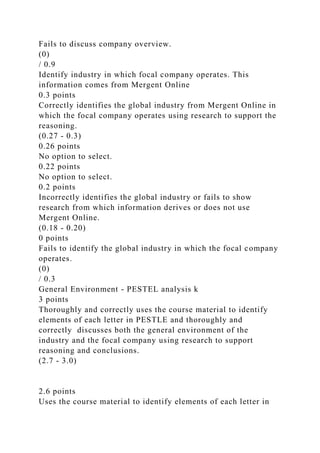
Company Overview
0.9 points
Thoroughly and correctly presents company overview
describing the purpose of the founding of company, why
company was formed, opportunities, founding father's names,
home country or state, current management, employee
headcount, last year's revenue, etc. all clearly and strongly
supported by thorough research to explain the reasoning.
(0.81 - 0.9)
0.765 points
Missing one identified element of company overview; uses
research that supports the reasoning and conclusions; needs
some development.
(0.72 - 0.80)
0.675 points
Missing two identified element of company overview; uses
research that supports the reasoning and conclusions; needs
sigificant development.
(0.63 - 0.71)
0.585 points
Information presented but is missing at least three elements,
superficial, vague, or incorrect; little to no evidence of
research and course material; needs major development.
(0.54 - 0.62)
0 points
Fails to discuss company overview.
(0)
/ 0.9
Identify industry in which focal company operates. This
information comes from Mergent Online
0.3 points
Correctly identifies the global industry from Mergent Online in
which the focal company operates using research to support the
reasoning.
(0.27 - 0.3)
0.26 points
No option to select.
0.22 points
No option to select.
0.2 points
Incorrectly identifies the global industry or fails to show
research from which information derives or does not use
Mergent Online.
(0.18 - 0.20)
0 points
Fails to identify the global industry in which the focal company
operates.
(0)
/ 0.3
General Environment - PESTEL analysis k
3 points
Thoroughly and correctly uses the course material to identify
elements of each letter in PESTLE and thoroughly and
correctly discusses both the general environment of the
industry and the focal company using research to support
reasoning and conclusions.
(2.7 - 3.0)
2.6 points
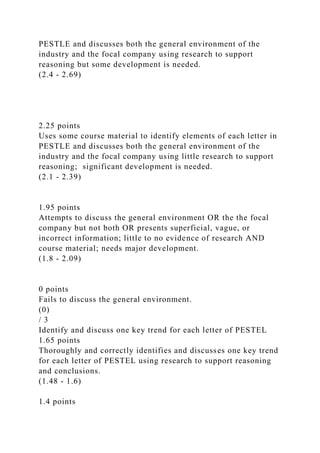
Uses the course material to identify elements of each letter in
PESTLE and discusses both the general environment of the
industry and the focal company using research to support
reasoning but some development is needed.
(2.4 - 2.69)
2.25 points
Uses some course material to identify elements of each letter in
PESTLE and discusses both the general environment of the
industry and the focal company using little research to support
reasoning; significant development is needed.
(2.1 - 2.39)
1.95 points
Attempts to discuss the general environment OR the the focal
company but not both OR presents superficial, vague, or
incorrect information; little to no evidence of research AND
course material; needs major development.
(1.8 - 2.09)
0 points
Fails to discuss the general environment.
(0)
/ 3
Identify and discuss one key trend for each letter of PESTEL
1.65 points
Thoroughly and correctly identifies and discusses one key trend
for each letter of PESTEL using research to support reasoning
and conclusions.
(1.48 - 1.6)
1.4 points
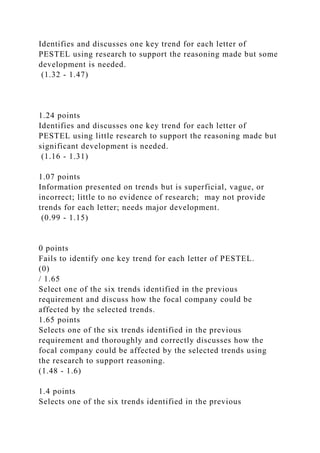
Identifies and discusses one key trend for each letter of
PESTEL using research to support the reasoning made but some
development is needed.
(1.32 - 1.47)
1.24 points
Identifies and discusses one key trend for each letter of
PESTEL using little research to support the reasoning made but
significant development is needed.
(1.16 - 1.31)
1.07 points
Information presented on trends but is superficial, vague, or
incorrect; little to no evidence of research; may not provide
trends for each letter; needs major development.
(0.99 - 1.15)
0 points
Fails to identify one key trend for each letter of PESTEL.
(0)
/ 1.65
Select one of the six trends identified in the previous
requirement and discuss how the focal company could be
affected by the selected trends.
1.65 points
Selects one of the six trends identified in the previous
requirement and thoroughly and correctly discusses how the
focal company could be affected by the selected trends using
the research to support reasoning.
(1.48 - 1.6)
1.4 points
Selects one of the six trends identified in the previous
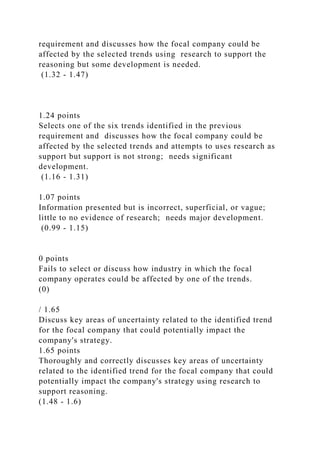
requirement and discusses how the focal company could be
affected by the selected trends using research to support the
reasoning but some development is needed.
(1.32 - 1.47)
1.24 points
Selects one of the six trends identified in the previous
requirement and discusses how the focal company could be
affected by the selected trends and attempts to uses research as
support but support is not strong; needs significant
development.
(1.16 - 1.31)
1.07 points
Information presented but is incorrect, superficial, or vague;
little to no evidence of research; needs major development.
(0.99 - 1.15)
0 points
Fails to select or discuss how industry in which the focal
company operates could be affected by one of the trends.
(0)
/ 1.65
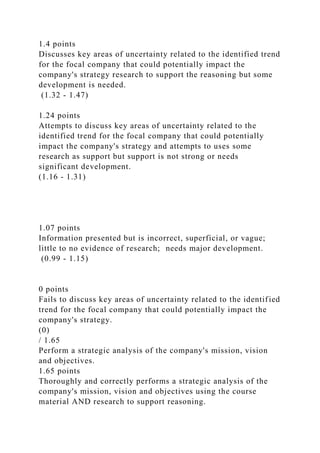
Discuss key areas of uncertainty related to the identified trend
for the focal company that could potentially impact the
company's strategy.
1.65 points
Thoroughly and correctly discusses key areas of uncertainty
related to the identified trend for the focal company that could
potentially impact the company's strategy using research to
support reasoning.
(1.48 - 1.6)
1.4 points
Discusses key areas of uncertainty related to the identified trend
for the focal company that could potentially impact the
company's strategy research to support the reasoning but some
development is needed.
(1.32 - 1.47)
1.24 points
Attempts to discuss key areas of uncertainty related to the
identified trend for the focal company that could potentially
impact the company's strategy and attempts to uses some
research as support but support is not strong or needs
significant development.
(1.16 - 1.31)
1.07 points
Information presented but is incorrect, superficial, or vague;
little to no evidence of research; needs major development.
(0.99 - 1.15)
0 points
Fails to discuss key areas of uncertainty related to the identified
trend for the focal company that could potentially impact the
company's strategy.
(0)
/ 1.65
Perform a strategic analysis of the company's mission, vision
and objectives.
1.65 points
Thoroughly and correctly performs a strategic analysis of the
company's mission, vision and objectives using the course
material AND research to support reasoning.
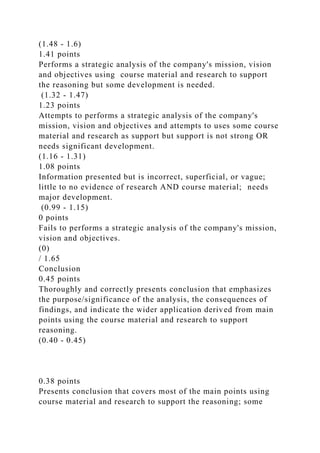
(1.48 - 1.6)
1.41 points
Performs a strategic analysis of the company's mission, vision
and objectives using course material and research to support
the reasoning but some development is needed.
(1.32 - 1.47)
1.23 points
Attempts to performs a strategic analysis of the company's
mission, vision and objectives and attempts to uses some course
material and research as support but support is not strong OR
needs significant development.
(1.16 - 1.31)
1.08 points
Information presented but is incorrect, superficial, or vague;
little to no evidence of research AND course material; needs
major development.
(0.99 - 1.15)
0 points
Fails to performs a strategic analysis of the company's mission,
vision and objectives.
(0)
/ 1.65
Conclusion
0.45 points
Thoroughly and correctly presents conclusion that emphasizes
the purpose/significance of the analysis, the consequences of
findings, and indicate the wider application derived from main
points using the course material and research to support
reasoning.
(0.40 - 0.45)
0.38 points
Presents conclusion that covers most of the main points using
course material and research to support the reasoning; some
development is needed.
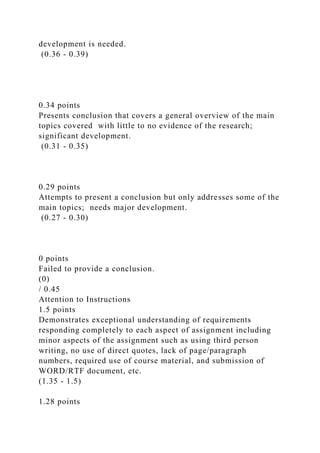
(0.36 - 0.39)
0.34 points
Presents conclusion that covers a general overview of the main
topics covered with little to no evidence of the research;
significant development.
(0.31 - 0.35)
0.29 points
Attempts to present a conclusion but only addresses some of the
main topics; needs major development.
(0.27 - 0.30)
0 points
Failed to provide a conclusion.
(0)
/ 0.45
Attention to Instructions
1.5 points
Demonstrates exceptional understanding of requirements
responding completely to each aspect of assignment including
minor aspects of the assignment such as using third person
writing, no use of direct quotes, lack of page/paragraph
numbers, required use of course material, and submission of
WORD/RTF document, etc.
(1.35 - 1.5)
1.28 points
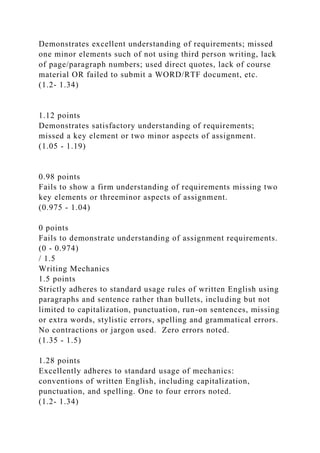
Demonstrates excellent understanding of requirements; missed
one minor elements such of not using third person writing, lack
of page/paragraph numbers; used direct quotes, lack of course
material OR failed to submit a WORD/RTF document, etc.
(1.2- 1.34)
1.12 points
Demonstrates satisfactory understanding of requirements;
missed a key element or two minor aspects of assignment.
(1.05 - 1.19)
0.98 points
Fails to show a firm understanding of requirements missing two
key elements or threeminor aspects of assignment.
(0.975 - 1.04)
0 points
Fails to demonstrate understanding of assignment requirements.
(0 - 0.974)
/ 1.5
Writing Mechanics
1.5 points
Strictly adheres to standard usage rules of written English using
paragraphs and sentence rather than bullets, including but not
limited to capitalization, punctuation, run-on sentences, missing
or extra words, stylistic errors, spelling and grammatical errors.
No contractions or jargon used. Zero errors noted.
(1.35 - 1.5)
1.28 points
Excellently adheres to standard usage of mechanics:
conventions of written English, including capitalization,
punctuation, and spelling. One to four errors noted.
(1.2- 1.34)
1.12 points
Satisfactorily adheres to standard usage rules of mechanics:
conventions of English, including capitalization, punctuation,
and spelling. Five to 10 errors noted.
(1.05 - 1.19)
0.98 points
Minimally adheres to standard usage rules of mechanics:
conventions of written English, including capitalization,
punctuation, and spelling. More than 10 errors found.
(0.975 - 1.04)
0 points
Does not adhere to standard usage rules of mechanics:
conventions of written English largely incomprehensible, or
errors are too plentiful to count.
(0 - 0.974)
/ 1.5
APA Style (6th ed.)
0.75 points
No APA style or usage errors; Proper citation of source material
is used throughout; Provices citation every time with use of
source material. Reference titles follow APA with only the first
word, the first word after a colon and proper nouns capitalized.
(0.675 - 0.75)
0.64 points
Attempts in-text citations and reference list but one or two APA
style errors noted or fails to use APA citations when citations
are required 1-2 times.
(0.6 - 0.674)
0.56 points
Attempts in-text citations and reference lists; APA style errors
are noted throughout; Fails to use APA citations 3 times in
document.
(0.525 - 0.59)
0.49 points
Attempts in-text citations and reference lists; Fails to use APA
citation 4-5 times; or presents only a few in-text citations
throughout document, and reference list that requires APA
citations throughout the document.
(0.45 - 0.524)
0 points
No attempt at APA style; or attempts either in-text citations or
reference list but omits the other; Use book or obscure articles
not related to subject.
(0 – 0.44)
/ 0.75
Rubric Total ScoreTotal
/ 15
Overall Score
Overall ScoreEquivalent to an A13.5 points minimum
Equivalent to a B12 points minimum
Equivalent to a C10.5 points minimum
Equivalent to a D9 points minimum
Equivalent to an F0 points minimum
Bottom of Form

Week 2  External Environmental Analysis1. What economic factors.docx

  • 1.
    Week 2: ExternalEnvironmental Analysis 1. What economic factors have to be considered in identifying an industry analysis? 2. What competitive forces do companies face in an industry? 3. What factors are driving industry change and what impacts will they have? 4. What market positions do rivals occupy – who is strongly positioned and who is not? 5. What strategic moves are rivals likely to make next? 6. What are the key factors for future competitive success? 7. Does the outlook for the industry present the company with an attractive opportunity? Project 1: Starting an External Environmental Analysis · Topps Tiles Plc (NBB:TPT) Previous Next Instructions BMGT 495 - Project 1: Starting an External Environmental Analysis (Week 2) NOTE: All submitted work is to be your original work (only your work). You may not use any work from another student, the Internet or an online clearinghouse. You are expected to understand the Academic Dishonesty and Plagiarism Policy, and know that it is your responsibility to learn about instructor and general academic expectations with regard to proper citation of sources as specified in the APA Publication Manual, 6th Ed. (You are held accountable for in-text citations and an associated reference list only). Project 1 is due Sunday at 11:59 p.m. eastern time of week 2 unless otherwise changed by the instructor. Purpose: This project is the first of four projects. This project provides the first steps in completing an external environmental analysis
  • 2.
    of your focalcompany’s strategic management plan. You will use tools and apply concepts learned in this and previous business courses to demonstrate an understanding of how organizations develop and manage strategies to establish, safeguard and sustain its competitive position in the 21st century’s (rapidly evolving/shifting/changing), uncertain hyper-competitive business environment. Completing a company overview and assessing the general environment is a key aspect of performing an external environment analysis. This project provides you with the opportunity to evaluate the competitive position of one of the organizations listed below and integrate that information in the beginnings of a external environmental analysis. The company you will be analyzing operates within the global market. You will assess the company in terms of the global industry. Industries differ widely in their economic characteristics, competitive situation and future profit potential. In this project, you are presenting a report document. The expectation is that the report provides the level of details to help the audience grasp the main topics and to understand the General Environment. Analysis is the operative word. In analyzing the external environment, you are expected to thoroughly research and take that research and break it into small parts to gain a better understanding of what is happening in the external environment of the business. In researching an industry, it is important to understand that every company within an industry is different so gathering information on one company does not mean that the collected information is relevant to other companies within that industry. When researching, parsing the material is critical to an accurate analysis. Avoid presenting just any information as that may lead to using irrelevant information. You will then write the report in your own words to share the external analysis. You are expected to present information and support the ideas and reasoning using the course material and your research. You will not lift any information from source
  • 3.
    documents without properlyciting and referencing. For the technical analysis aspect of the project, you are required to create the technique on your own and may not use from any source material that you happen to find. No work from a clearinghouse or similar website may be used or cited as a credible source. Outcomes Met With This Project: · utilize a set of useful analytical skills, tools, and techniques for analyzing a company strategically; · integrate ideas, concepts, and theories from previously taken functional courses including accounting, finance, market, business and human resource management; Instructions: In completing the report, you will use the chapters in the eBook and other course material, and perform research on the company and industry in which the company operates and answer the required elements below in narrative form following the steps provided. Step 1: Specific Company for All Four Projects In this project, you will complete a Company Overview, an Evaluation of the General Environment and a conclusion. You will be assigned by your instructor one focal company to complete the analysis. The assigned company must be used for all four projects in this course. You are not allowed to write the report on any other company different from the company specifically assigned by your instructor. If a company other than that assigned to you is used, a zero will be assigned. The instructor will assign you a company from the list below. (Students may not select the company). All companies can be found on Mergent Online. · · Topps Tiles Plc (NBB:TPT) · Students must complete the project using the assigned company. Deviating from the assigned company will result in a zero for the project. You will look for the company assigned to
  • 4.
    you in theAnnouncement area of the classroom. Step 2: Course Materials and Research · You are required to research information about the focal company and the internal environment for this project, You are accountable for using the course materials to support the ideas, reasoning and conclusions made. Course materials use goes beyond defining terms but is used to explain the 'why and how' of a situation. Using one or two in-text citations from the course materials and then relying on Internet source material will not earn many points on the assignment. A variety of source material is expected and what is presented must be relevant and applicable to the topic being discussed. Avoid merely making statements but close the loop of the discussion by explaining how something happens or why something happens, which focuses on importance and impact. In closing the loop, you will demonstrate the ability to think clearly and rationally showing an understanding of the logical connections between the ideas presented from the research, the course material and the question(s) being asked. · Note: Your report is based on the results of the research performed and not on any prepared documentation. What this means is that you will research and draw your own conclusions that are supported by the research and the course material rather than the use any source material that puts together any of the tools or techniques whether from the Internet, for-pay websites or any pre-prepared document, video or source material. A zero will be earned for not doing your own analysis. · Success: The analysis is based on research and not opinion. You are not making recommendations and you will not attempt to position the focal company in a better or worse light than other companies within the industry merely because you are completing an analysis on this particular company. The analysis must be based on factual information. Any conclusions drawn have to be based on factual information rather than leaps of faith. To ensure success, as stated above, you are expected to use the course materials and research on the focal company's
  • 5.
    global industry andthe focal company. Opinion does not earn credit nor does using external sources when course materials can be used. It is necessary to provide explanations (the why and how) rather than making statements. Avoid stringing one citation after another as doing so does not show detailed explanations. Library Resources · On the main navigation bar in the classroom select, Resources and then select Library. Select Databases by Title (A - Z). Select M from the alphabet list, and then select Mergent Online. You may also use Market Line and should be looking at the focal company's Annual Report or 10K report. You are not depending on any one resource to complete the analysis. It is impossible to complete a Porter’s Five Forces, competitive analysis or OT by using only course material. · You should not be using obscure articles, GlassDoor, or Chron or similar types of articles. · Research for Financial Analysis: Financial Research · Research for Industry Analysis CSI Market · UMGC library is available for providing resources and services. Seek library support for excellence in your academic pursuit. Library Support · Extensive library resources and services are available online, 24 hours a day, seven days a week at https://www.umgc.edu/library/index.cfm to support you in your studies. The UMGC Library provides research assistance in creating search strategies, selecting relevant databases, and evaluating and citing resources in a variety of formats via its Ask a Librarian service at https://www.umgc.edu/library/libask/index.cfm. · Scholarly Research in OneSearch is allowed. · To search for only scholarly resources, you are expected to place a check mark in the space for "Scholarly journals only" before clicking search. Step 3: How to Set Up the Report:
  • 6.
    · The documenthas to be written in Word or rtf. No other format is acceptable. Pdf files will not be graded. Use 12-point font for a double-spaced report. The final product cannot be longer than 8 pages in length, which includes all tables and matrices but excludes the title page and reference page. Do no use an Appendix. · Create a title page with title, your name, the course number, the instructor's name. Step 4: Company Overview · Provide a company overview, which is an essential component to the strategic management process. The company overview includes the purpose(s) for the founding of the company, i.e, what problems was it formed to solve and/or opportunities it was formed to exploit, who are the founders, home country or state, current management, employee headcount, last year’s revenue, etc.). Step 5: Evaluate the General Environment · Identify the global industry in which the company operates. This will come from Mergent Online. · Discuss the company's general environment by developing a PESTEL analysis. First, use the course material to identify the elements of the PESTEL and what components make up each element. Then, complete the analysis using research on the industry and the focal company. Be sure to thoroughly present and support the reasoning for what is presented. You may not use a PESTEL analysis that is already completed and available on the Internet. A zero will result if used as the analysis has to be the result of your research and your own development. NOTE: A PESTEL analysis is not a table and it is not a bulleted assessment. · Identify and discuss one key trend for each letter of the PESTEL for the industry. Key trends are separate from the PESTEL analysis. · Select one of the six trends identified in the previous
  • 7.
    requirement and discusshow the focal company could be affected by the selected trends. · Discuss key areas of uncertainty related to the identified trend for the focal company that could potentially impact the company's strategy. · Perform a strategic analysis of the company's mission, vision and objectives. Step 6:Conclusion · Create a concluding paragraph. The Conclusion is intended to emphasize the purpose/significance of the analysis, emphasize the significance/consequence of findings, and indicate the wider applications that are derived from the main points of the project’s requirements. You will draw conclusions about the findings of the external environment analysis. Step 7: Review the Paper Read the paper to ensure all required elements are present. The following are specific requirements that you will follow. Use the checklist to mark off that you have followed each specific requirement. Checklist Specific Project Requirements Proofread your paper Read and use the grading rubric while completing the paper to ensure all requirements are met that will lead to the highest possible grade. Third person writing is required. Third person means that there are no words such as “I, me, my, we, or us” (first person writing), nor is there use of “you or your” (second person writing). If uncertain how to write in the third person, view this link: http://www.quickanddirtytips.com/education/grammar/firs t-second-and-third-person. Contractions are not used in business writing, so do not use
  • 8.
    them. Paraphrase and donot use direct quotations. Paraphrase means you do not use more than four consecutive words from a source document. Removing quotation marks and citing is inappropriate. Instead put a passage from a source document into your own words and attribute the passage to the source document. There should be no passages with quotation marks. Using more than four consecutive words from a source document would require direct quotation marks. Changing words from a passage does not exclude the passage from having quotation marks. If more than four consecutive words are used from source documents, this material will not be included in the grade. You are expected to use the research and weekly course materials to develop the analysis and support the reasoning. There should be a robust use of the course material. Material used from a source document must be cited and referenced. A reference within a reference list cannot exist without an associated in-text citation and vice versa. Changing words from a passage does not exclude the passage from having quotation marks. Use in-text citations and provide a reference list that contains the reference associated with each in-text citation. You may not use books in completing this problem set unless part of the course material. Also, do not use a dictionary, Wikipedia or Investopedia or similar sources. You may not use Fern Fort University, Ibis World or any other for-fee website. Provide the page or paragraph number in every in-text citation presented. Since the eBook does not have page numbers, include the chapter title and topic heading. If using a video, provide the minutes and second of the cited material.
  • 9.
    Step 8: Submitthe paper in the Assignment Folder (The assignment submitted to the Assignment Folder will be considered the student's final product and therefore ready for grading by the instructor. It is incumbent upon the student to verify the assignment is the correct submission. No exceptions will be considered by the instructor). Self-Plagiarism: Self-plagiarism is the act of reusing significant, identical or nearly identical portions of one's own work. You cannot re-use any portion of a paper or other graded work that was submitted to another class even if you are retaking this course. You also will not reuse any portion of previously submitted work in this class. A zero will be assigned to the assignment if self-plagiarized. Faculty do nothave the discretion to accept self-plagiarized work. NOTE:All submitted work is to be your original work. You may not use any work from another student, the Internet or an online clearinghouse. You are expected to understand the Academic Dishonesty and Plagiarism Policy, and know that it is your responsibility to learn about instructor and general academic expectations with regard to proper citation of sources as specified in the APA Publication Manual, 6th Ed. (Students are held accountable for in-text citations and an associated reference list only). Week 2: Mar 23 - 29 Print Theme: The External Environment Assessment To successfully craft a strategy that fits with a company’s situation, builds competitive advantage and improves
  • 10.
    performance, managers haveto have insight into a company’s external and internal environment. The internal environment will be discussed in week 3. The external environment comprises all of the entities that exists outside of an organization’s boundaries that affect its growth and survival. An organization has little to no control over the external environment so there is a need to constantly monitor, prepare and adapt to the changes that occur. Understanding the information that comes from the external environment is crucial to an organization’s long-term planning and in identifying its competitor’s actions. Completing an external environmental analysis helps an organization update or adapt its internal core competencies, structure, culture or other internal environmental factors. To identify and analyze the key drivers of change in an organization’s general business environment, a PESTEL analysis is completed. A Porter’s Five Forces is a framework that helps an organization analyze the level of competition within a specific industry and a partial SWOT (OT) helps identify the threats and opportunities that exist in the environment. At this point, it is necessary to clarify a few points. An industry consists of a group of companies that are related based on their primary business activities. When you hear industry, this refers to the global industry and not to a specific country or region of the world. Individual companies are classified into an industry based on the largest source of revenue. Industries are grouped into larger categories called sectors. When you research using Mergent Online, both industry and sector are provided. When completing either an external or internal environmental analysis, you should note patterns, trends and relationships as techniques that help with completing an analysis and that uncertainty reduces an organization’s ability to predict with confidence the future of its environment. A pattern is a series of data that repeats in a recognizable manner whereas a trend
  • 11.
    has to dowith the general movement or change in a situation over time. Relationships have to do with how concepts, information, organizations, people are connected. Read/View: Mastering Strategic Management: · Chapter 3:Evaluating the External Environment (Scroll down to see chapter readings) · Hard Ball: Five Killer Strategies for Trouncing the Competition. (HBR) · Porter's (1980) Generic Strategies as Determinants of Strategic Group Membership and Organizational Performance · Rumelt, R. (2011, June) The perils of bad strategy, McKinsey Quarterly. · Bradley, C., Hirt, M. & Smit, S. (2011, January). Have you tested your strategy lately? McKinsey Quarterly. · How to Stress-Test Your Strategy (10:15 minutes; transcript available) Tools and Techniques: You will be using the following tools/techniques in the projects. These tools are also part of the quizzes that you will complete so make sure you understand their use and how to do the calculations. · External Factor Evaluation (EFE) Matrix · PESTEL Analysis · Porter's Five Forces · Using Porter's Five Force Model · The Five Competitive Forces That Shape Strategy (13:11 minutes) · SWOT Analysis: How to perform one for your organization Rubric Name: Project #1 15% This table lists criteria and criteria group name in the first column. The first row lists level names and includes scores if the rubric uses a numeric scoring method.Criteria Equivalent to an A Equivalent to a B
  • 12.
    Equivalent to aC Equivalent to a D Equivalent to an F Company Overview 0.9 points Thoroughly and correctly presents company overview describing the purpose of the founding of company, why company was formed, opportunities, founding father's names, home country or state, current management, employee headcount, last year's revenue, etc. all clearly and strongly supported by thorough research to explain the reasoning. (0.81 - 0.9) 0.765 points Missing one identified element of company overview; uses research that supports the reasoning and conclusions; needs some development. (0.72 - 0.80) 0.675 points Missing two identified element of company overview; uses research that supports the reasoning and conclusions; needs sigificant development. (0.63 - 0.71) 0.585 points Information presented but is missing at least three elements, superficial, vague, or incorrect; little to no evidence of research and course material; needs major development. (0.54 - 0.62) 0 points
  • 13.
    Fails to discusscompany overview. (0) / 0.9 Identify industry in which focal company operates. This information comes from Mergent Online 0.3 points Correctly identifies the global industry from Mergent Online in which the focal company operates using research to support the reasoning. (0.27 - 0.3) 0.26 points No option to select. 0.22 points No option to select. 0.2 points Incorrectly identifies the global industry or fails to show research from which information derives or does not use Mergent Online. (0.18 - 0.20) 0 points Fails to identify the global industry in which the focal company operates. (0) / 0.3 General Environment - PESTEL analysis k 3 points Thoroughly and correctly uses the course material to identify elements of each letter in PESTLE and thoroughly and correctly discusses both the general environment of the industry and the focal company using research to support reasoning and conclusions. (2.7 - 3.0) 2.6 points Uses the course material to identify elements of each letter in
  • 14.
    PESTLE and discussesboth the general environment of the industry and the focal company using research to support reasoning but some development is needed. (2.4 - 2.69) 2.25 points Uses some course material to identify elements of each letter in PESTLE and discusses both the general environment of the industry and the focal company using little research to support reasoning; significant development is needed. (2.1 - 2.39) 1.95 points Attempts to discuss the general environment OR the the focal company but not both OR presents superficial, vague, or incorrect information; little to no evidence of research AND course material; needs major development. (1.8 - 2.09) 0 points Fails to discuss the general environment. (0) / 3 Identify and discuss one key trend for each letter of PESTEL 1.65 points Thoroughly and correctly identifies and discusses one key trend for each letter of PESTEL using research to support reasoning and conclusions. (1.48 - 1.6) 1.4 points
  • 15.
    Identifies and discussesone key trend for each letter of PESTEL using research to support the reasoning made but some development is needed. (1.32 - 1.47) 1.24 points Identifies and discusses one key trend for each letter of PESTEL using little research to support the reasoning made but significant development is needed. (1.16 - 1.31) 1.07 points Information presented on trends but is superficial, vague, or incorrect; little to no evidence of research; may not provide trends for each letter; needs major development. (0.99 - 1.15) 0 points Fails to identify one key trend for each letter of PESTEL. (0) / 1.65 Select one of the six trends identified in the previous requirement and discuss how the focal company could be affected by the selected trends. 1.65 points Selects one of the six trends identified in the previous requirement and thoroughly and correctly discusses how the focal company could be affected by the selected trends using the research to support reasoning. (1.48 - 1.6) 1.4 points Selects one of the six trends identified in the previous
  • 16.
    requirement and discusseshow the focal company could be affected by the selected trends using research to support the reasoning but some development is needed. (1.32 - 1.47) 1.24 points Selects one of the six trends identified in the previous requirement and discusses how the focal company could be affected by the selected trends and attempts to uses research as support but support is not strong; needs significant development. (1.16 - 1.31) 1.07 points Information presented but is incorrect, superficial, or vague; little to no evidence of research; needs major development. (0.99 - 1.15) 0 points Fails to select or discuss how industry in which the focal company operates could be affected by one of the trends. (0) / 1.65 Discuss key areas of uncertainty related to the identified trend for the focal company that could potentially impact the company's strategy. 1.65 points Thoroughly and correctly discusses key areas of uncertainty related to the identified trend for the focal company that could potentially impact the company's strategy using research to support reasoning. (1.48 - 1.6)
  • 17.
    1.4 points Discusses keyareas of uncertainty related to the identified trend for the focal company that could potentially impact the company's strategy research to support the reasoning but some development is needed. (1.32 - 1.47) 1.24 points Attempts to discuss key areas of uncertainty related to the identified trend for the focal company that could potentially impact the company's strategy and attempts to uses some research as support but support is not strong or needs significant development. (1.16 - 1.31) 1.07 points Information presented but is incorrect, superficial, or vague; little to no evidence of research; needs major development. (0.99 - 1.15) 0 points Fails to discuss key areas of uncertainty related to the identified trend for the focal company that could potentially impact the company's strategy. (0) / 1.65 Perform a strategic analysis of the company's mission, vision and objectives. 1.65 points Thoroughly and correctly performs a strategic analysis of the company's mission, vision and objectives using the course material AND research to support reasoning.
  • 18.
    (1.48 - 1.6) 1.41points Performs a strategic analysis of the company's mission, vision and objectives using course material and research to support the reasoning but some development is needed. (1.32 - 1.47) 1.23 points Attempts to performs a strategic analysis of the company's mission, vision and objectives and attempts to uses some course material and research as support but support is not strong OR needs significant development. (1.16 - 1.31) 1.08 points Information presented but is incorrect, superficial, or vague; little to no evidence of research AND course material; needs major development. (0.99 - 1.15) 0 points Fails to performs a strategic analysis of the company's mission, vision and objectives. (0) / 1.65 Conclusion 0.45 points Thoroughly and correctly presents conclusion that emphasizes the purpose/significance of the analysis, the consequences of findings, and indicate the wider application derived from main points using the course material and research to support reasoning. (0.40 - 0.45) 0.38 points Presents conclusion that covers most of the main points using course material and research to support the reasoning; some
  • 19.
    development is needed. (0.36- 0.39) 0.34 points Presents conclusion that covers a general overview of the main topics covered with little to no evidence of the research; significant development. (0.31 - 0.35) 0.29 points Attempts to present a conclusion but only addresses some of the main topics; needs major development. (0.27 - 0.30) 0 points Failed to provide a conclusion. (0) / 0.45 Attention to Instructions 1.5 points Demonstrates exceptional understanding of requirements responding completely to each aspect of assignment including minor aspects of the assignment such as using third person writing, no use of direct quotes, lack of page/paragraph numbers, required use of course material, and submission of WORD/RTF document, etc. (1.35 - 1.5) 1.28 points
  • 20.
    Demonstrates excellent understandingof requirements; missed one minor elements such of not using third person writing, lack of page/paragraph numbers; used direct quotes, lack of course material OR failed to submit a WORD/RTF document, etc. (1.2- 1.34) 1.12 points Demonstrates satisfactory understanding of requirements; missed a key element or two minor aspects of assignment. (1.05 - 1.19) 0.98 points Fails to show a firm understanding of requirements missing two key elements or threeminor aspects of assignment. (0.975 - 1.04) 0 points Fails to demonstrate understanding of assignment requirements. (0 - 0.974) / 1.5 Writing Mechanics 1.5 points Strictly adheres to standard usage rules of written English using paragraphs and sentence rather than bullets, including but not limited to capitalization, punctuation, run-on sentences, missing or extra words, stylistic errors, spelling and grammatical errors. No contractions or jargon used. Zero errors noted. (1.35 - 1.5) 1.28 points Excellently adheres to standard usage of mechanics: conventions of written English, including capitalization, punctuation, and spelling. One to four errors noted. (1.2- 1.34)
  • 21.
    1.12 points Satisfactorily adheresto standard usage rules of mechanics: conventions of English, including capitalization, punctuation, and spelling. Five to 10 errors noted. (1.05 - 1.19) 0.98 points Minimally adheres to standard usage rules of mechanics: conventions of written English, including capitalization, punctuation, and spelling. More than 10 errors found. (0.975 - 1.04) 0 points Does not adhere to standard usage rules of mechanics: conventions of written English largely incomprehensible, or errors are too plentiful to count. (0 - 0.974) / 1.5 APA Style (6th ed.) 0.75 points No APA style or usage errors; Proper citation of source material is used throughout; Provices citation every time with use of source material. Reference titles follow APA with only the first word, the first word after a colon and proper nouns capitalized. (0.675 - 0.75) 0.64 points Attempts in-text citations and reference list but one or two APA style errors noted or fails to use APA citations when citations are required 1-2 times. (0.6 - 0.674) 0.56 points Attempts in-text citations and reference lists; APA style errors are noted throughout; Fails to use APA citations 3 times in document. (0.525 - 0.59)
  • 22.
    0.49 points Attempts in-textcitations and reference lists; Fails to use APA citation 4-5 times; or presents only a few in-text citations throughout document, and reference list that requires APA citations throughout the document. (0.45 - 0.524) 0 points No attempt at APA style; or attempts either in-text citations or reference list but omits the other; Use book or obscure articles not related to subject. (0 – 0.44) / 0.75 Rubric Total ScoreTotal / 15 Overall Score Overall ScoreEquivalent to an A13.5 points minimum Equivalent to a B12 points minimum Equivalent to a C10.5 points minimum Equivalent to a D9 points minimum Equivalent to an F0 points minimum Bottom of Form