Detection of Early Stage Alzheimer’s Disease
using EEG Relative Power with Deep Neural
Network
- IEEE EMBC 2018 -
2018.06.19.
Donghyeon Kim
(dhkim518@gist.ac.kr)
IEEE EMBC 2018
Detection of Early Stage Alzheimer’s Disease using EEG Relative Power with Deep
Neural Network
Donghyeon Kim and Kiseon Kim
• Introduction
• Related Works
• Motivation & Objective
• Methods
• Results
• Conclusive Remarks
List of Contents
2
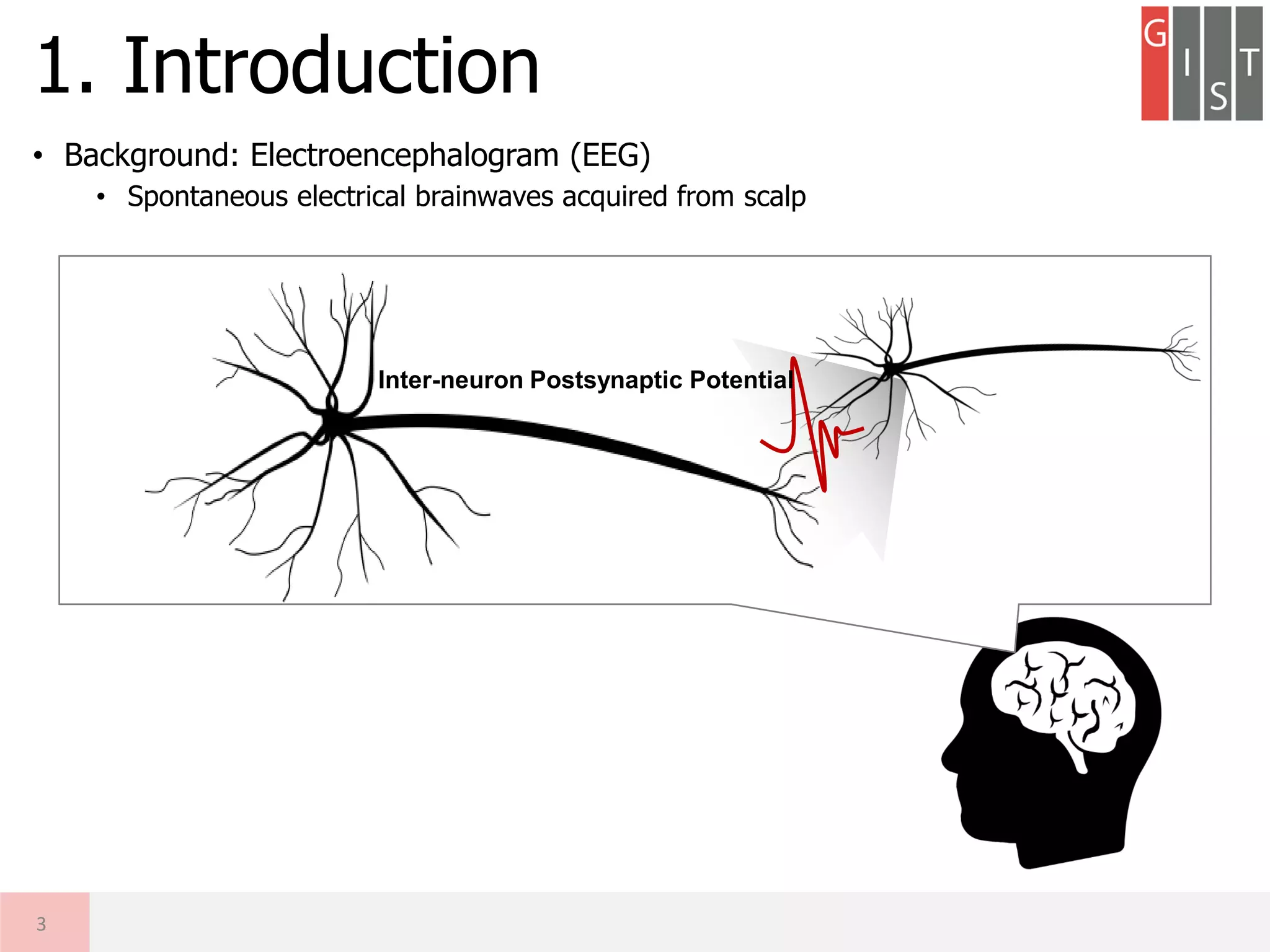
• Background: Electroencephalogram (EEG)
• Spontaneous electrical brainwaves acquired from scalp
1. Introduction
3
Inter-neuron Postsynaptic Potential
• Background: Alzheimer’s Disease (AD)
• AD Pathology [R. J. Perrin, ’09]
1. Introduction
4
Senile Plaques
Amyloid-beta (Aβ)
Amyloid Plaques
Tau-protein (τ)
Neurofibrillary
Tangles (NFTs)
Accumulation
Accumulation
Brain/ Body/
Behavioral
Problems
Cognitive
decline
A decrease of
neuronal activation
& synaptic coupling
Aβ
τ
Synaptic loss,
neuronal deaths
Plaques
NFTs
Accumulation Interference
Toxicity
• Background: Alzheimer’s Disease (AD)
• Clinical AD diagnosis criteria [R. J. Perrin,’09][B. Dubois, ’10]
1. Introduction
5
Old classification 1. Healthy Control (HC)
2. Mild Cognitive
Impairments (MCI)
3. Alzheimer’s disease (AD)
New classification
1. Normal
Aging
2. Preclinical AD
(Presymptomatic AD)
3. Prodromal AD
4. Mild
AD
5. Mod.
AD
6. Sev.
AD
Cognitively
normal O O △ X XX XXX
Biomarkers
(Aβ, τ) X △ O OO OOO OOO
Neuronal integrity
Amyloid plaques
Neurofibrillary tangles
Max.
Min.
• Background: Alzheimer’s Disease (AD)
• Clinical AD diagnosis criteria [R. J. Perrin,’09][B. Dubois, ’10]
1. Introduction
6
Neuronal integrity
Amyloid plaques
Neurofibrillary tangles
Max.
Min.
Old classification 1. Healthy Control (HC)
2. Mild Cognitive
Impairments (MCI)
3. Alzheimer’s disease (AD)
New classification
1. Normal
Aging
2. Preclinical AD
(Pre-symptomatic AD)
3. Prodromal AD
4. Mild
AD
5. Mod.
AD
6. Sev.
AD
Cognitively
normal O O △ X XX XXX
Biomarkers
(Aβ, τ) X △ O OO OOO OOO
Detection of
Preclinical AD or
Prodromal AD (MCI)
is most important
issues for early
diagnosis of AD
• Background: Alzheimer’s Disease (AD)
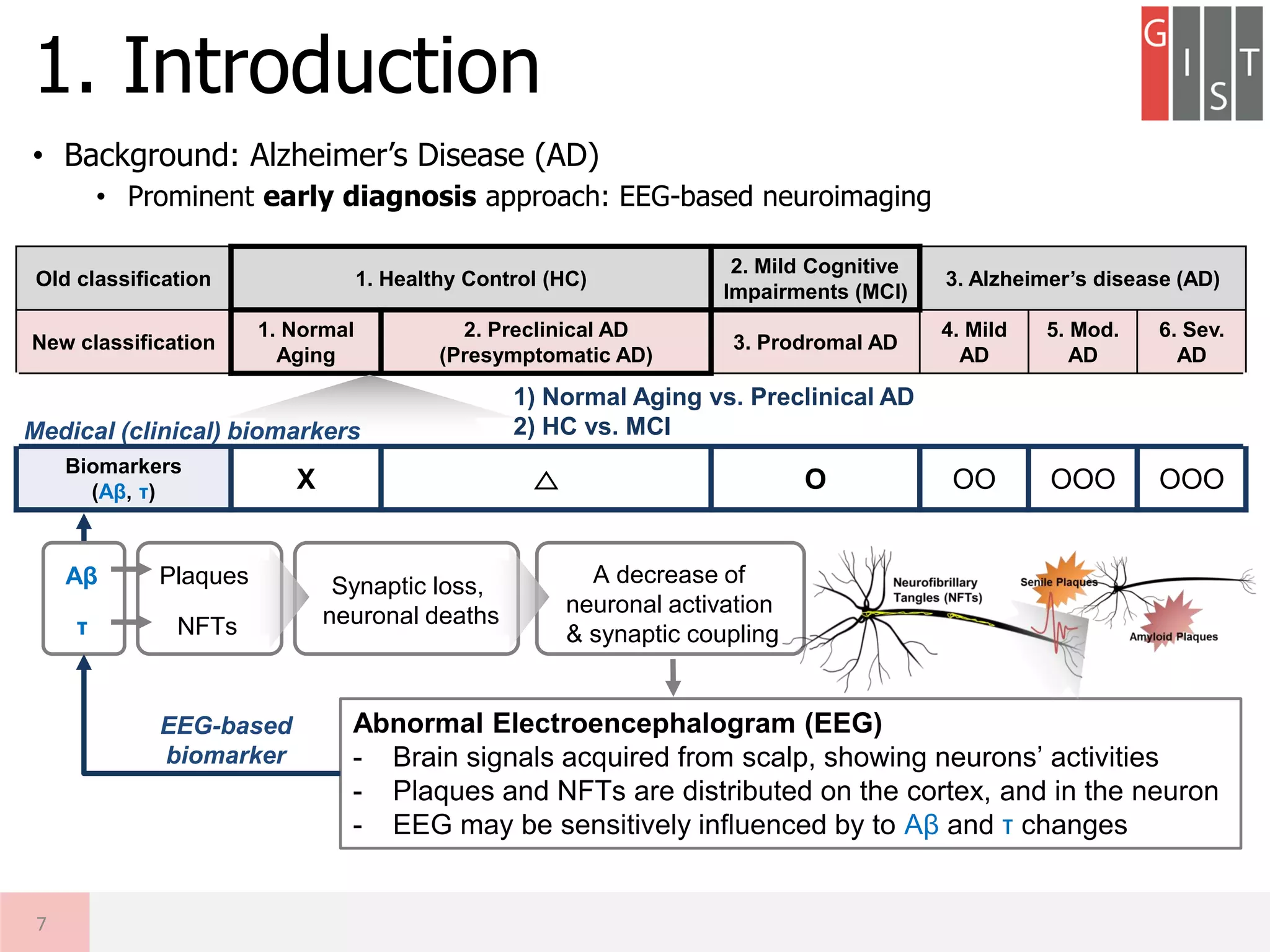
• Prominent early diagnosis approach: EEG-based neuroimaging
1. Introduction
7
Old classification 1. Healthy Control (HC)
2. Mild Cognitive
Impairments (MCI)
3. Alzheimer’s disease (AD)
New classification
1. Normal
Aging
2. Preclinical AD
(Presymptomatic AD)
3. Prodromal AD
4. Mild
AD
5. Mod.
AD
6. Sev.
AD
Biomarkers
(Aβ, τ) X △ O OO OOO OOO
Abnormal Electroencephalogram (EEG)
- Brain signals acquired from scalp, showing neurons’ activities
- Plaques and NFTs are distributed on the cortex, and in the neuron
- EEG may be sensitively influenced by to Aβ and τ changes
A decrease of
neuronal activation
& synaptic coupling
Aβ
τ
Synaptic loss,
neuronal deaths
Plaques
NFTs
1) Normal Aging vs. Preclinical AD
2) HC vs. MCIMedical (clinical) biomarkers
EEG-based
biomarker
• Abnormal EEG Patterns as the AD biomarker [J. Jeong ‘04]
• Remarks
• Most related studies have focused on AD vs. HC
• No previous literature for Normal vs. Preclinical AD using EEG slowing
• Important issue: (1) Which frequency bands? (2) Which region?
2. Related Works
8
Slowing: Slow brain waves of EEG
# Subjects # Channels Features (Spectral bands for RP)
[C. Besthorn ’97] 50 AD / 42 HC 17 δ, θ, α1, α2, β1, β2
[V. Jelic ’00] 15 AD / 27 MCI/ 16 HC 8 δ, θ, α, β
[K. Bennys, ‘01] 35 AD / 35 HC 6
δ, θ, α, β1, β2,
Ratio: θ/(α+β1) & (δ+θ)/(α+β1+β2)
[V. Knott ‘01] 35 AD / 30 HC 21 δ, θ, α, β
[PM. Rossini ‘08]
115 MCI /
171 HC
19 δ, θ, α1, α2, β1, β2, γ
[DV. Moretti ‘12] 79 MCI 19 δ, θ, α1, α2, α3, β1, β2, γ
[N.Benz ‘14] 20 AD / 20 HC 256 δ, θ, α, β, γ
[JC. Mcbride ‘14] 17 AD / 16 MCI/ 15 HC 32 θ, α1, α2, β1, β2, γ
[M. Dauwan ‘16] 66 AD / 66 HC 21 δ, θ, α1, α2, β, γ, Ratio: θ/(θ+α1+α2)
[J. Wang ‘17] 8 AD / 12 HC 32 δ, θ, α, β, γ
• Motivation
• Objective
① To implement the shallow neural network classifier (1-hidden layer)
exploiting conventional EEG relative powers (RPs) for MCI detection
② To design deep neural network (DNN) based system exploiting RPs and
to compare the performance with the SNN-based method
3. Motivation & Objective
9
Key Challenges
(1) Which Spatial Feature?
(2) Which Spectral Feature?
Deep Neural Network using multi-channel EEG RPs
- Potential of DNN classifier exploiting domain knowledge
- Interpretable DNN-based classifier for AD detection
SlowingAβ
τ
Abnormal
EEG
Plaques
NFTs
Spatial Feature
Spectral Feature
Multi-channel
Relative Power
Absolute Power
Power Ratio
Necessity of Early Diagnosis on
Normal Aging vs. Preclinical AD
(Conventional Works: HC vs. MCI)
[R.J. Perrin, ’09]
[B. Dubois, ’10] [J. Jeong ‘04]
[N.Benz ‘14],[JC. Mcbride ‘14]
[M. Dauwan ‘16], [J. Wang ‘17]
[W. Zheng ‘15]
[NS. Kwak ‘17]
[L. Vareka ‘17]
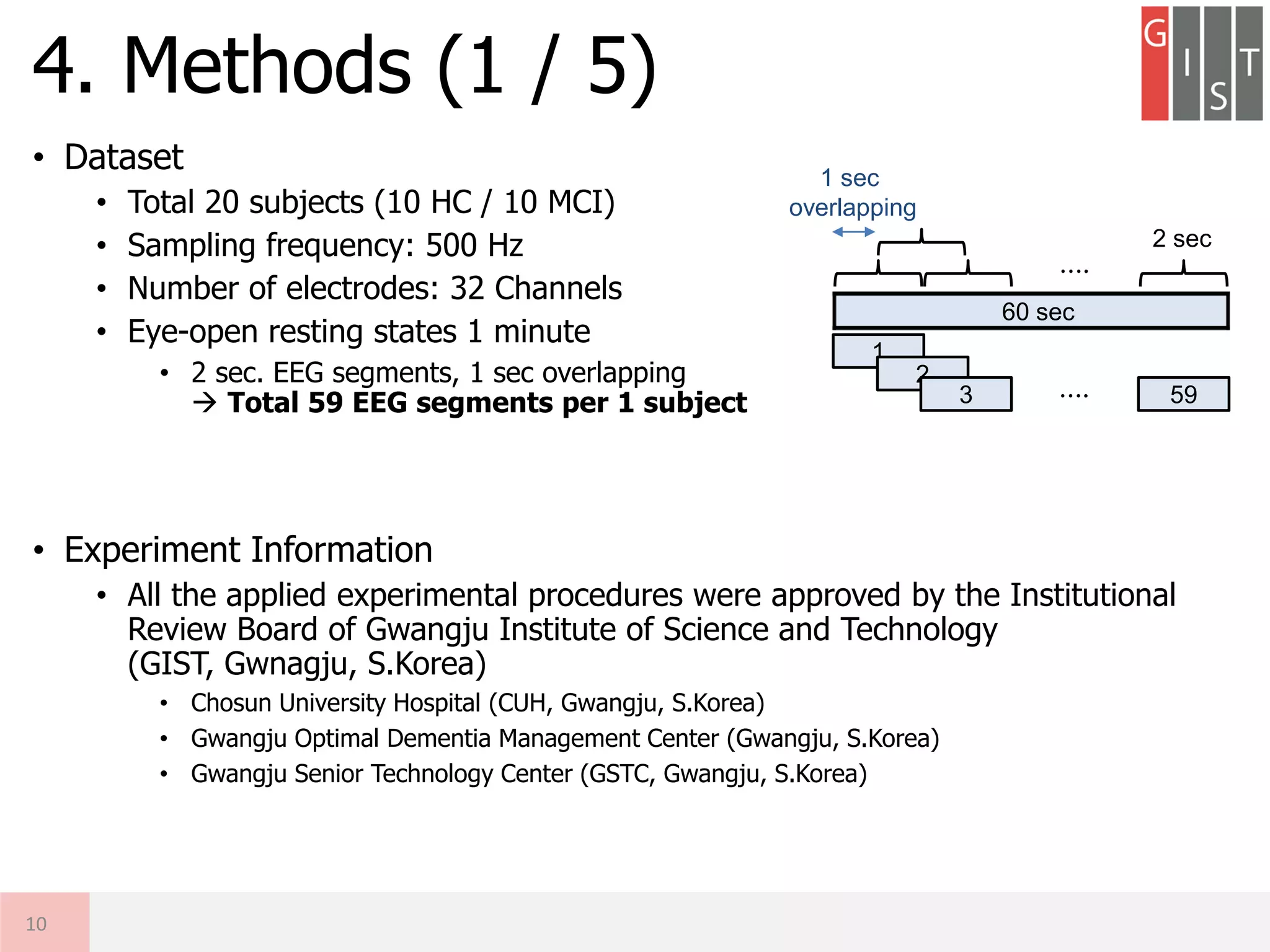
• Dataset
• Total 20 subjects (10 HC / 10 MCI)
• Sampling frequency: 500 Hz
• Number of electrodes: 32 Channels
• Eye-open resting states 1 minute
• 2 sec. EEG segments, 1 sec overlapping
 Total 59 EEG segments per 1 subject
• Experiment Information
• All the applied experimental procedures were approved by the Institutional
Review Board of Gwangju Institute of Science and Technology
(GIST, Gwnagju, S.Korea)
• Chosun University Hospital (CUH, Gwangju, S.Korea)
• Gwangju Optimal Dementia Management Center (Gwangju, S.Korea)
• Gwangju Senior Technology Center (GSTC, Gwangju, S.Korea)
4. Methods (1 / 5)
10
2 sec
….
1 sec
overlapping
60 sec
1
2
3 59….
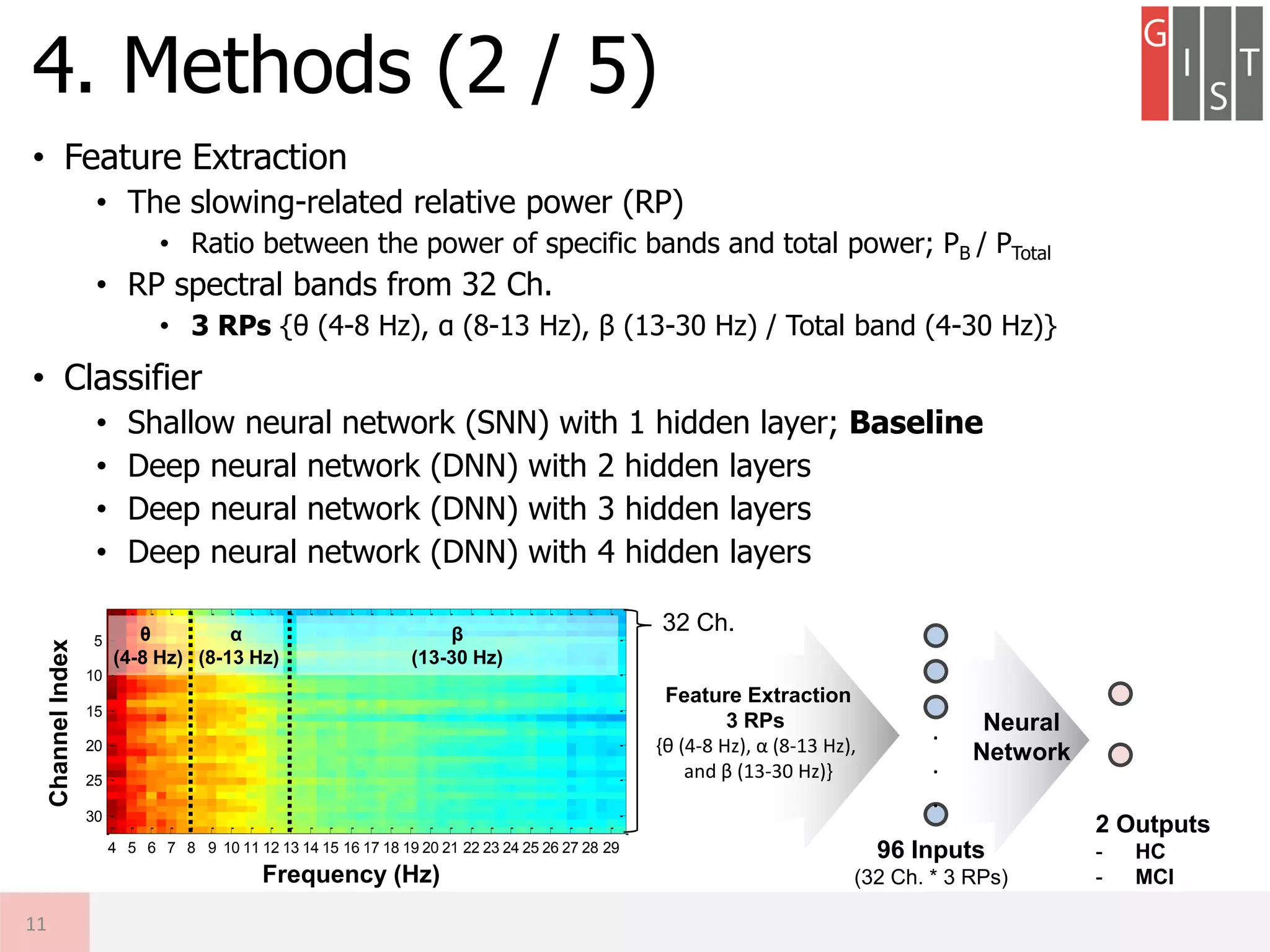
• Feature Extraction
• The slowing-related relative power (RP)
• Ratio between the power of specific bands and total power; PB / PTotal
• RP spectral bands from 32 Ch.
• 3 RPs {θ (4-8 Hz), α (8-13 Hz), β (13-30 Hz) / Total band (4-30 Hz)}
• Classifier
• Shallow neural network (SNN) with 1 hidden layer; Baseline
• Deep neural network (DNN) with 2 hidden layers
• Deep neural network (DNN) with 3 hidden layers
• Deep neural network (DNN) with 4 hidden layers
4. Methods (2 / 5)
11
Frequency (Hz)
4 5 6 7 8 9 10 11 12 13 14 15 16 17 18 19 20 21 22 23 24 25 26 27 28 29
5
10
15
20
25
30
32 Ch.
ChannelIndex
.
.
.
Feature Extraction
3 RPs
{θ (4-8 Hz), α (8-13 Hz),
and β (13-30 Hz)}
Neural
Network
2 Outputs
- HC
- MCI
θ
(4-8 Hz)
α
(8-13 Hz)
β
(13-30 Hz)
96 Inputs
(32 Ch. * 3 RPs)
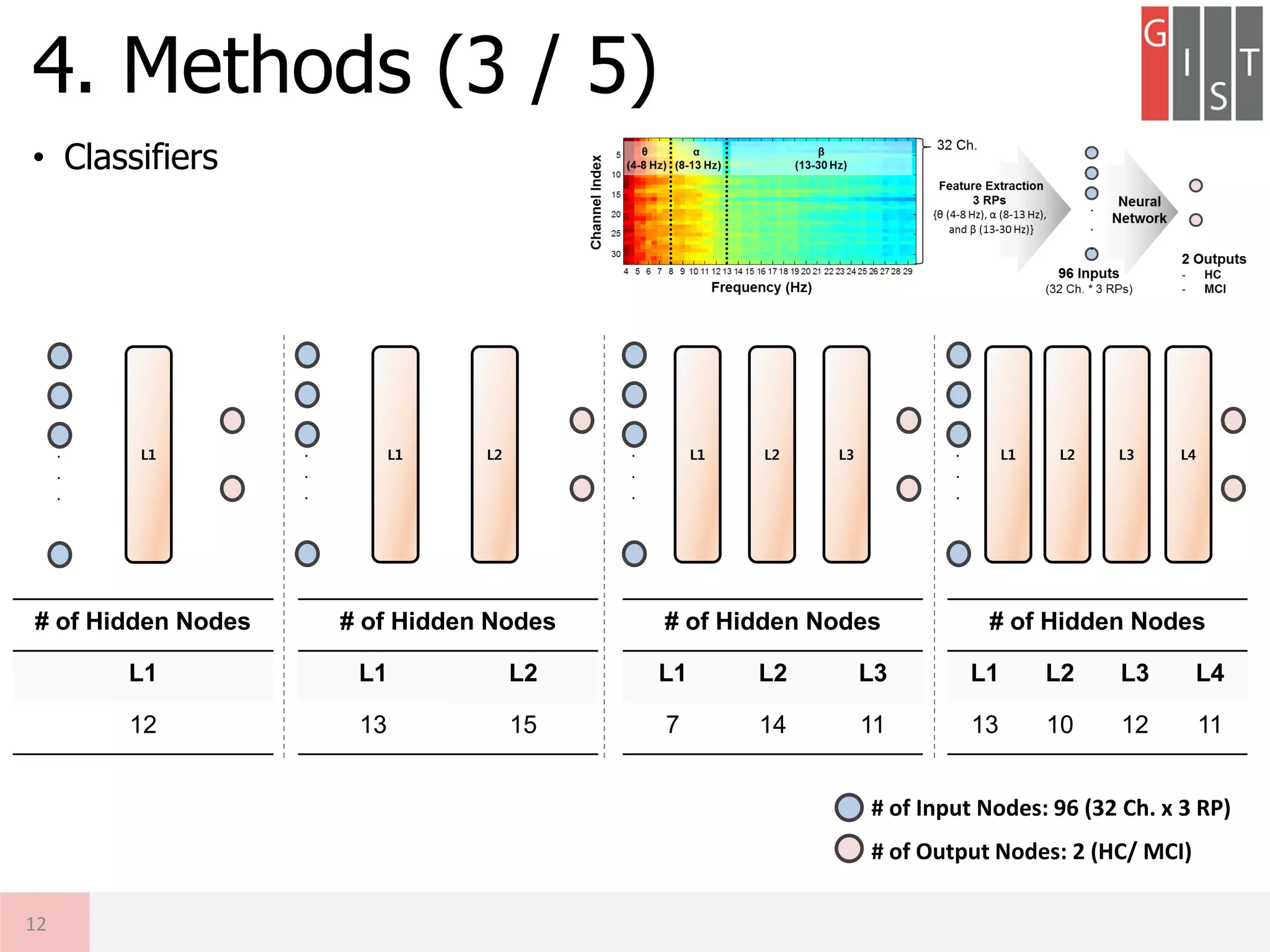
• Classifiers
4. Methods (3 / 5)
12
# of Input Nodes: 96 (32 Ch. x 3 RP)
# of Output Nodes: 2 (HC/ MCI)
.
.
.
L1 L2 L3 L4
# of Hidden Nodes
L1 L2 L3 L4
13 10 12 11
.
.
.
L1 L2 L3
# of Hidden Nodes
L1 L2 L3
7 14 11
.
.
.
L1 L2
# of Hidden Nodes
L1 L2
13 15
.
.
.
L1
# of Hidden Nodes
L1
12
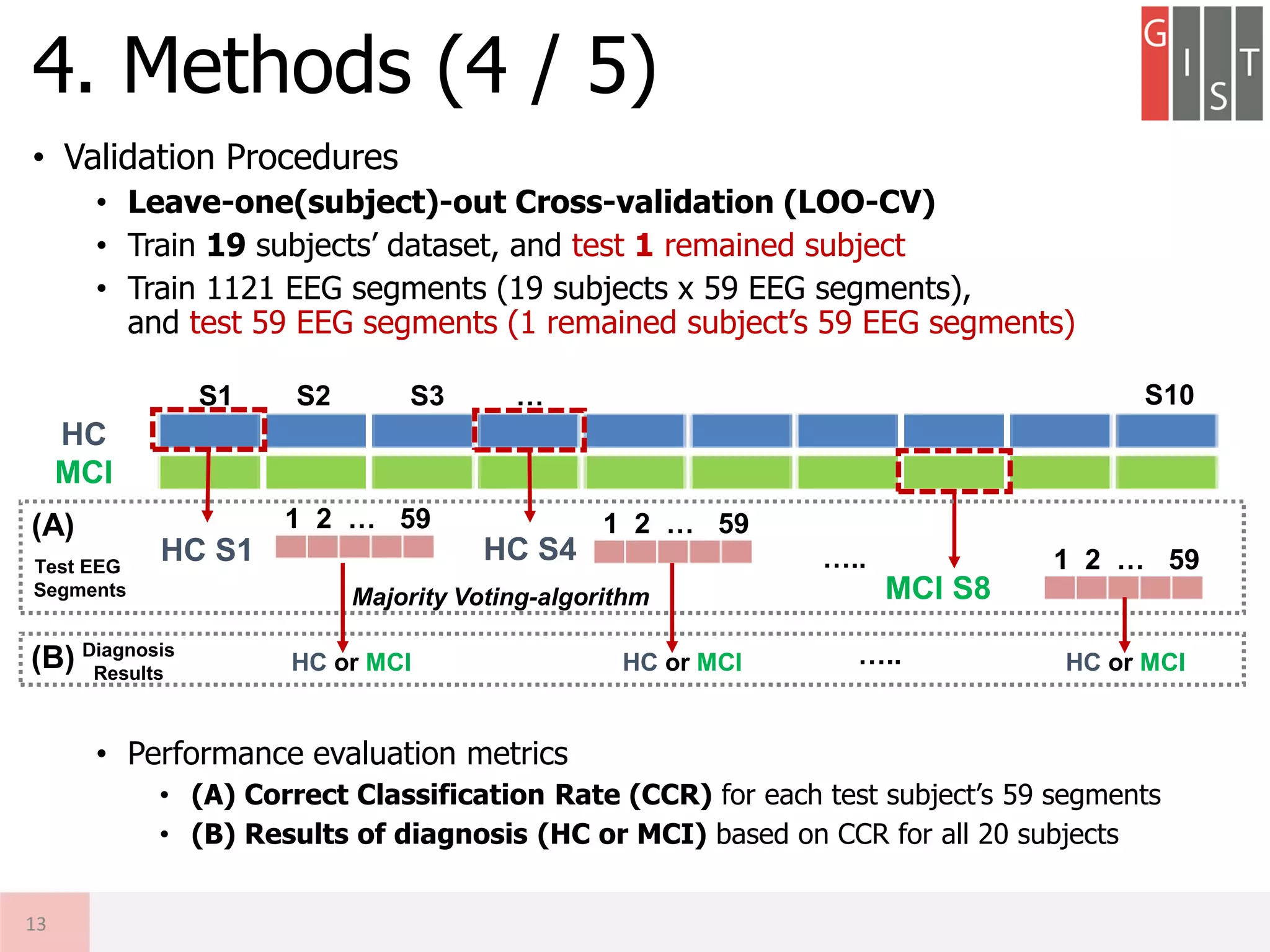
• Validation Procedures
• Leave-one(subject)-out Cross-validation (LOO-CV)
• Train 19 subjects’ dataset, and test 1 remained subject
• Train 1121 EEG segments (19 subjects x 59 EEG segments),
and test 59 EEG segments (1 remained subject’s 59 EEG segments)
• Performance evaluation metrics
• (A) Correct Classification Rate (CCR) for each test subject’s 59 segments
• (B) Results of diagnosis (HC or MCI) based on CCR for all 20 subjects
4. Methods (4 / 5)
13
HC
MCI
S1 S2 S3 … S10
Test EEG
Segments
1 2 … 59
HC S1 HC S4
1 2 … 59
MCI S8
1 2 … 59
(A)
(B) Diagnosis
Results
…..
HC or MCI HC or MCI HC or MCI…..
Majority Voting-algorithm
• Summary of LOO-CV Procedures
4. Methods (5 / 5)
14
HC
MCI
Train EEG
[Ns x Nc x Nt]
x (Nsubj-1)
Nsubj = 20 (10 HC, 10 MCI)
Ns = 1,000 Samples (2 s. x 500 Hz)
Nc = 32 Channels
Nt = 59 Trials
Relative Power
[Nb x Nc x Nt]
x (Nsubj-1)
Nb = 3 spectral bands
Features
[Nf x Ntrain]
Nf = (Nb x Nc) features
Ntrain = Nt x (Nsubj-1)
Ntest = Nt x 1
Learn
Neural Network
[Nf x Ntrain]
Dataset Feature Extraction Classification Result (A)
Test EEG
[Ns x Nc x Nt] x 1
Relative Power
[Nb x Nc x Nt] x 1
Features
[Nf x Ntest]
Test
Neural Network
[Nf x Ntest]
Classification
Diagnosis
Result
[Ntest x 1] [HC or MCI]
(A) CCR = Ncc / Ntest
Correct Classification Rate
Ncc: # Correct Classification
(B) Diagnosis = N or Prec.
Based on major votes
Result (B)
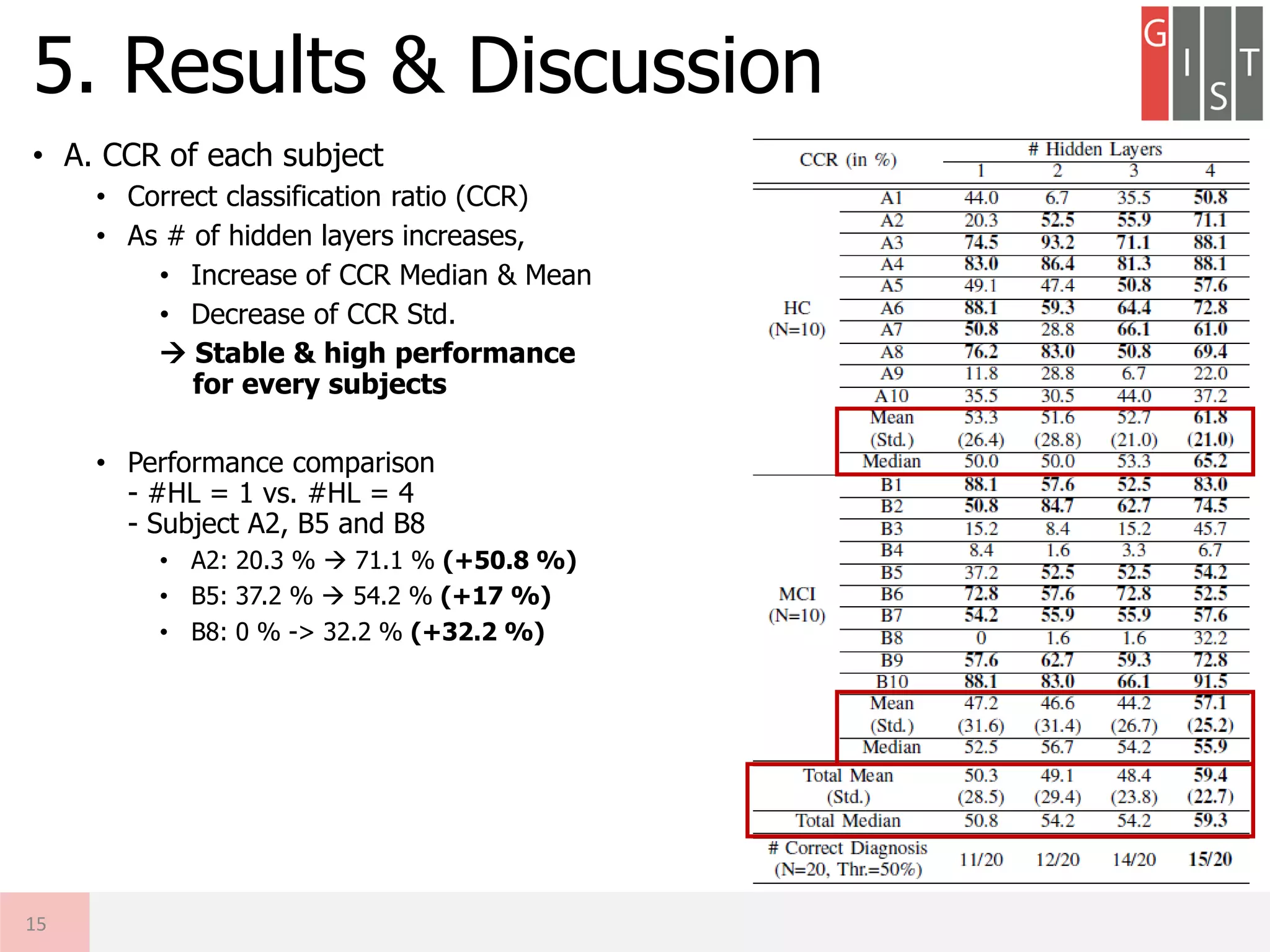
• A. CCR of each subject
• Correct classification ratio (CCR)
• As # of hidden layers increases,
• Increase of CCR Median & Mean
• Decrease of CCR Std.
 Stable & high performance
for every subjects
• Performance comparison
- #HL = 1 vs. #HL = 4
- Subject A2, B5 and B8
• A2: 20.3 %  71.1 % (+50.8 %)
• B5: 37.2 %  54.2 % (+17 %)
• B8: 0 % -> 32.2 % (+32.2 %)
5. Results & Discussion
15
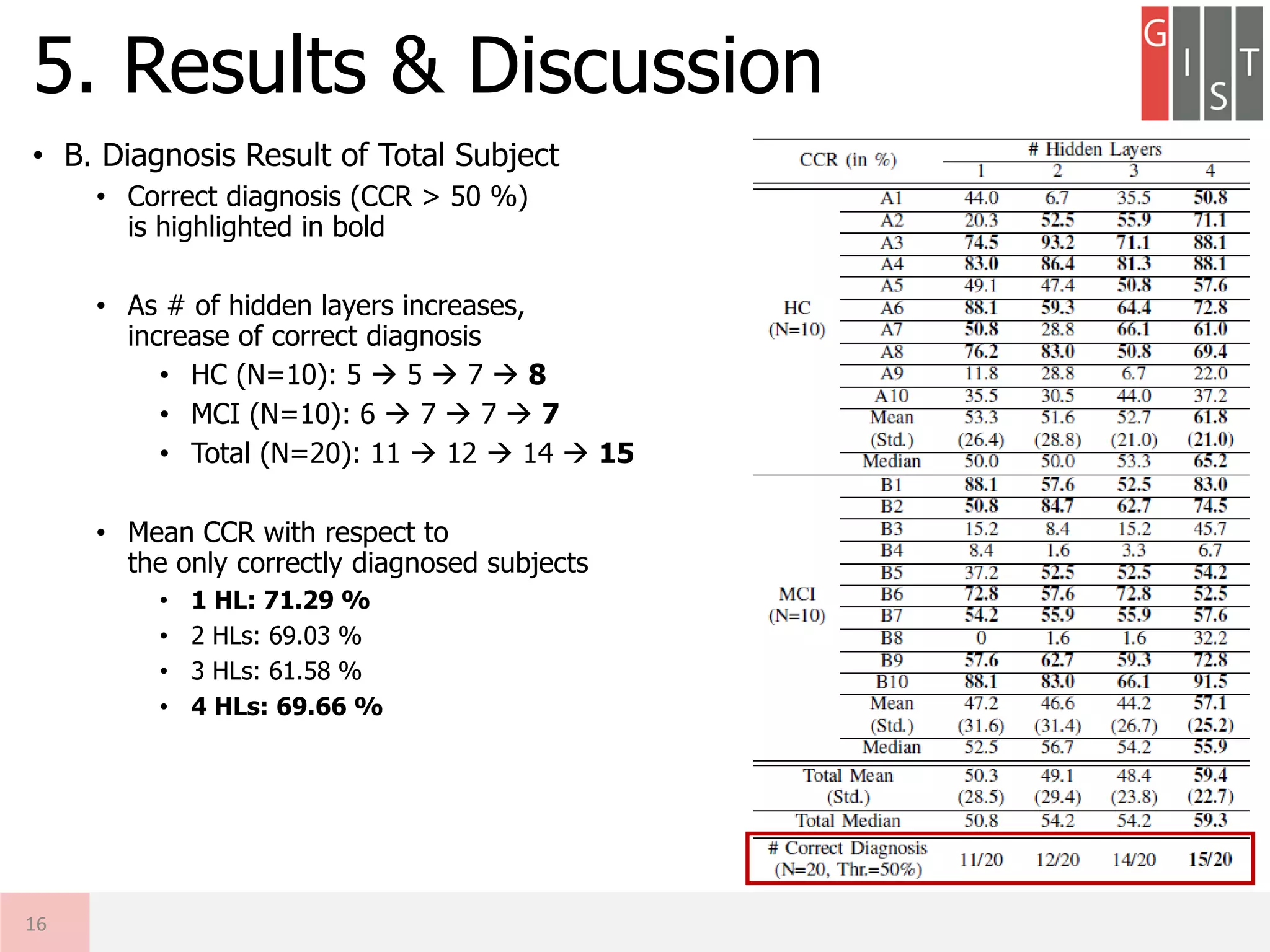
• B. Diagnosis Result of Total Subject
• Correct diagnosis (CCR > 50 %)
is highlighted in bold
• As # of hidden layers increases,
increase of correct diagnosis
• HC (N=10): 5  5  7  8
• MCI (N=10): 6  7  7  7
• Total (N=20): 11  12  14  15
• Mean CCR with respect to
the only correctly diagnosed subjects
• 1 HL: 71.29 %
• 2 HLs: 69.03 %
• 3 HLs: 61.58 %
• 4 HLs: 69.66 %
5. Results & Discussion
16
• Summary of Contributions
• Potentials of the DNN-based classifier exploiting EEG RP features
• LOO-CV correct diagnosis results: 75 % (correct diagnosis: 15 out of 20 subjects)
• Note that only 3 RPs of 32 Ch. (96 features) were used as the features
• Interpretable results with slowing-related aspects (domain knowledge)
• Further Works
• Recent deep learning based EEG signal processing
• To extract and select critical temporal, spectral, or spatial features using deep learning
• Next step
• To apply deep learning method to extract distinct features to discriminate Normal Aging
and different AD stages
• Acknowledgement
• This research was supported by the Brain Research Program through the National Research
Foundation (NRF) of Korea funded by the Ministry of Science, ICT & Future Planning
(NRF-2016M3C7A1905477)
• Acknowledge efforts of Prof. Sung Chan Jun and Sehyeon Jang in experimental preparation
6. Conclusive Remarks
17
Thank you
18

[Research] Detection of MCI using EEG Relative Power + DNN

  • 1.
    Detection of EarlyStage Alzheimer’s Disease using EEG Relative Power with Deep Neural Network - IEEE EMBC 2018 - 2018.06.19. Donghyeon Kim (dhkim518@gist.ac.kr)
  • 2.
    IEEE EMBC 2018 Detectionof Early Stage Alzheimer’s Disease using EEG Relative Power with Deep Neural Network Donghyeon Kim and Kiseon Kim • Introduction • Related Works • Motivation & Objective • Methods • Results • Conclusive Remarks List of Contents 2
  • 3.
    • Background: Electroencephalogram(EEG) • Spontaneous electrical brainwaves acquired from scalp 1. Introduction 3 Inter-neuron Postsynaptic Potential
  • 4.
    • Background: Alzheimer’sDisease (AD) • AD Pathology [R. J. Perrin, ’09] 1. Introduction 4 Senile Plaques Amyloid-beta (Aβ) Amyloid Plaques Tau-protein (τ) Neurofibrillary Tangles (NFTs) Accumulation Accumulation Brain/ Body/ Behavioral Problems Cognitive decline A decrease of neuronal activation & synaptic coupling Aβ τ Synaptic loss, neuronal deaths Plaques NFTs Accumulation Interference Toxicity
  • 5.
    • Background: Alzheimer’sDisease (AD) • Clinical AD diagnosis criteria [R. J. Perrin,’09][B. Dubois, ’10] 1. Introduction 5 Old classification 1. Healthy Control (HC) 2. Mild Cognitive Impairments (MCI) 3. Alzheimer’s disease (AD) New classification 1. Normal Aging 2. Preclinical AD (Presymptomatic AD) 3. Prodromal AD 4. Mild AD 5. Mod. AD 6. Sev. AD Cognitively normal O O △ X XX XXX Biomarkers (Aβ, τ) X △ O OO OOO OOO Neuronal integrity Amyloid plaques Neurofibrillary tangles Max. Min.
  • 6.
    • Background: Alzheimer’sDisease (AD) • Clinical AD diagnosis criteria [R. J. Perrin,’09][B. Dubois, ’10] 1. Introduction 6 Neuronal integrity Amyloid plaques Neurofibrillary tangles Max. Min. Old classification 1. Healthy Control (HC) 2. Mild Cognitive Impairments (MCI) 3. Alzheimer’s disease (AD) New classification 1. Normal Aging 2. Preclinical AD (Pre-symptomatic AD) 3. Prodromal AD 4. Mild AD 5. Mod. AD 6. Sev. AD Cognitively normal O O △ X XX XXX Biomarkers (Aβ, τ) X △ O OO OOO OOO Detection of Preclinical AD or Prodromal AD (MCI) is most important issues for early diagnosis of AD
  • 7.
    • Background: Alzheimer’sDisease (AD) • Prominent early diagnosis approach: EEG-based neuroimaging 1. Introduction 7 Old classification 1. Healthy Control (HC) 2. Mild Cognitive Impairments (MCI) 3. Alzheimer’s disease (AD) New classification 1. Normal Aging 2. Preclinical AD (Presymptomatic AD) 3. Prodromal AD 4. Mild AD 5. Mod. AD 6. Sev. AD Biomarkers (Aβ, τ) X △ O OO OOO OOO Abnormal Electroencephalogram (EEG) - Brain signals acquired from scalp, showing neurons’ activities - Plaques and NFTs are distributed on the cortex, and in the neuron - EEG may be sensitively influenced by to Aβ and τ changes A decrease of neuronal activation & synaptic coupling Aβ τ Synaptic loss, neuronal deaths Plaques NFTs 1) Normal Aging vs. Preclinical AD 2) HC vs. MCIMedical (clinical) biomarkers EEG-based biomarker
  • 8.
    • Abnormal EEGPatterns as the AD biomarker [J. Jeong ‘04] • Remarks • Most related studies have focused on AD vs. HC • No previous literature for Normal vs. Preclinical AD using EEG slowing • Important issue: (1) Which frequency bands? (2) Which region? 2. Related Works 8 Slowing: Slow brain waves of EEG # Subjects # Channels Features (Spectral bands for RP) [C. Besthorn ’97] 50 AD / 42 HC 17 δ, θ, α1, α2, β1, β2 [V. Jelic ’00] 15 AD / 27 MCI/ 16 HC 8 δ, θ, α, β [K. Bennys, ‘01] 35 AD / 35 HC 6 δ, θ, α, β1, β2, Ratio: θ/(α+β1) & (δ+θ)/(α+β1+β2) [V. Knott ‘01] 35 AD / 30 HC 21 δ, θ, α, β [PM. Rossini ‘08] 115 MCI / 171 HC 19 δ, θ, α1, α2, β1, β2, γ [DV. Moretti ‘12] 79 MCI 19 δ, θ, α1, α2, α3, β1, β2, γ [N.Benz ‘14] 20 AD / 20 HC 256 δ, θ, α, β, γ [JC. Mcbride ‘14] 17 AD / 16 MCI/ 15 HC 32 θ, α1, α2, β1, β2, γ [M. Dauwan ‘16] 66 AD / 66 HC 21 δ, θ, α1, α2, β, γ, Ratio: θ/(θ+α1+α2) [J. Wang ‘17] 8 AD / 12 HC 32 δ, θ, α, β, γ
  • 9.
    • Motivation • Objective ①To implement the shallow neural network classifier (1-hidden layer) exploiting conventional EEG relative powers (RPs) for MCI detection ② To design deep neural network (DNN) based system exploiting RPs and to compare the performance with the SNN-based method 3. Motivation & Objective 9 Key Challenges (1) Which Spatial Feature? (2) Which Spectral Feature? Deep Neural Network using multi-channel EEG RPs - Potential of DNN classifier exploiting domain knowledge - Interpretable DNN-based classifier for AD detection SlowingAβ τ Abnormal EEG Plaques NFTs Spatial Feature Spectral Feature Multi-channel Relative Power Absolute Power Power Ratio Necessity of Early Diagnosis on Normal Aging vs. Preclinical AD (Conventional Works: HC vs. MCI) [R.J. Perrin, ’09] [B. Dubois, ’10] [J. Jeong ‘04] [N.Benz ‘14],[JC. Mcbride ‘14] [M. Dauwan ‘16], [J. Wang ‘17] [W. Zheng ‘15] [NS. Kwak ‘17] [L. Vareka ‘17]
  • 10.
    • Dataset • Total20 subjects (10 HC / 10 MCI) • Sampling frequency: 500 Hz • Number of electrodes: 32 Channels • Eye-open resting states 1 minute • 2 sec. EEG segments, 1 sec overlapping  Total 59 EEG segments per 1 subject • Experiment Information • All the applied experimental procedures were approved by the Institutional Review Board of Gwangju Institute of Science and Technology (GIST, Gwnagju, S.Korea) • Chosun University Hospital (CUH, Gwangju, S.Korea) • Gwangju Optimal Dementia Management Center (Gwangju, S.Korea) • Gwangju Senior Technology Center (GSTC, Gwangju, S.Korea) 4. Methods (1 / 5) 10 2 sec …. 1 sec overlapping 60 sec 1 2 3 59….
  • 11.
    • Feature Extraction •The slowing-related relative power (RP) • Ratio between the power of specific bands and total power; PB / PTotal • RP spectral bands from 32 Ch. • 3 RPs {θ (4-8 Hz), α (8-13 Hz), β (13-30 Hz) / Total band (4-30 Hz)} • Classifier • Shallow neural network (SNN) with 1 hidden layer; Baseline • Deep neural network (DNN) with 2 hidden layers • Deep neural network (DNN) with 3 hidden layers • Deep neural network (DNN) with 4 hidden layers 4. Methods (2 / 5) 11 Frequency (Hz) 4 5 6 7 8 9 10 11 12 13 14 15 16 17 18 19 20 21 22 23 24 25 26 27 28 29 5 10 15 20 25 30 32 Ch. ChannelIndex . . . Feature Extraction 3 RPs {θ (4-8 Hz), α (8-13 Hz), and β (13-30 Hz)} Neural Network 2 Outputs - HC - MCI θ (4-8 Hz) α (8-13 Hz) β (13-30 Hz) 96 Inputs (32 Ch. * 3 RPs)
  • 12.
    • Classifiers 4. Methods(3 / 5) 12 # of Input Nodes: 96 (32 Ch. x 3 RP) # of Output Nodes: 2 (HC/ MCI) . . . L1 L2 L3 L4 # of Hidden Nodes L1 L2 L3 L4 13 10 12 11 . . . L1 L2 L3 # of Hidden Nodes L1 L2 L3 7 14 11 . . . L1 L2 # of Hidden Nodes L1 L2 13 15 . . . L1 # of Hidden Nodes L1 12
  • 13.
    • Validation Procedures •Leave-one(subject)-out Cross-validation (LOO-CV) • Train 19 subjects’ dataset, and test 1 remained subject • Train 1121 EEG segments (19 subjects x 59 EEG segments), and test 59 EEG segments (1 remained subject’s 59 EEG segments) • Performance evaluation metrics • (A) Correct Classification Rate (CCR) for each test subject’s 59 segments • (B) Results of diagnosis (HC or MCI) based on CCR for all 20 subjects 4. Methods (4 / 5) 13 HC MCI S1 S2 S3 … S10 Test EEG Segments 1 2 … 59 HC S1 HC S4 1 2 … 59 MCI S8 1 2 … 59 (A) (B) Diagnosis Results ….. HC or MCI HC or MCI HC or MCI….. Majority Voting-algorithm
  • 14.
    • Summary ofLOO-CV Procedures 4. Methods (5 / 5) 14 HC MCI Train EEG [Ns x Nc x Nt] x (Nsubj-1) Nsubj = 20 (10 HC, 10 MCI) Ns = 1,000 Samples (2 s. x 500 Hz) Nc = 32 Channels Nt = 59 Trials Relative Power [Nb x Nc x Nt] x (Nsubj-1) Nb = 3 spectral bands Features [Nf x Ntrain] Nf = (Nb x Nc) features Ntrain = Nt x (Nsubj-1) Ntest = Nt x 1 Learn Neural Network [Nf x Ntrain] Dataset Feature Extraction Classification Result (A) Test EEG [Ns x Nc x Nt] x 1 Relative Power [Nb x Nc x Nt] x 1 Features [Nf x Ntest] Test Neural Network [Nf x Ntest] Classification Diagnosis Result [Ntest x 1] [HC or MCI] (A) CCR = Ncc / Ntest Correct Classification Rate Ncc: # Correct Classification (B) Diagnosis = N or Prec. Based on major votes Result (B)
  • 15.
    • A. CCRof each subject • Correct classification ratio (CCR) • As # of hidden layers increases, • Increase of CCR Median & Mean • Decrease of CCR Std.  Stable & high performance for every subjects • Performance comparison - #HL = 1 vs. #HL = 4 - Subject A2, B5 and B8 • A2: 20.3 %  71.1 % (+50.8 %) • B5: 37.2 %  54.2 % (+17 %) • B8: 0 % -> 32.2 % (+32.2 %) 5. Results & Discussion 15
  • 16.
    • B. DiagnosisResult of Total Subject • Correct diagnosis (CCR > 50 %) is highlighted in bold • As # of hidden layers increases, increase of correct diagnosis • HC (N=10): 5  5  7  8 • MCI (N=10): 6  7  7  7 • Total (N=20): 11  12  14  15 • Mean CCR with respect to the only correctly diagnosed subjects • 1 HL: 71.29 % • 2 HLs: 69.03 % • 3 HLs: 61.58 % • 4 HLs: 69.66 % 5. Results & Discussion 16
  • 17.
    • Summary ofContributions • Potentials of the DNN-based classifier exploiting EEG RP features • LOO-CV correct diagnosis results: 75 % (correct diagnosis: 15 out of 20 subjects) • Note that only 3 RPs of 32 Ch. (96 features) were used as the features • Interpretable results with slowing-related aspects (domain knowledge) • Further Works • Recent deep learning based EEG signal processing • To extract and select critical temporal, spectral, or spatial features using deep learning • Next step • To apply deep learning method to extract distinct features to discriminate Normal Aging and different AD stages • Acknowledgement • This research was supported by the Brain Research Program through the National Research Foundation (NRF) of Korea funded by the Ministry of Science, ICT & Future Planning (NRF-2016M3C7A1905477) • Acknowledge efforts of Prof. Sung Chan Jun and Sehyeon Jang in experimental preparation 6. Conclusive Remarks 17
  • 18.