CRITICAL APPRAISAL OF
RESEARCHSTUDIES
INTRODUCTION
• The nursing profession continually strives for
evidence-based practice, which includes
critiquing studies, synthesizing the findings
and applying the scientific evidence in practice
• Thus, critiquing research is an essential step
toward basing your practice on empirical
evidence.
DEFINITION
• Critique is a careful judgment in which you
give your opinion about the good and bad
parts of something (such as a piece of writing
or a work of art).
Merriam- Webster Learner's Dictionary
• A research critique is a systematic, unbiased, careful
examination of all aspects of a study to judge the merits,
limitations, meaning and significance based on previous
research experience and knowledge of the topic.
Burns N. and Grove S, 2005
• A research critique is a critical appraisal of a research study
that has been systematically reviewed based on some known
criteria.
Cherly T Beck
PROBLEM
STATEMENT AND
PURPOSE
• What is the problem and/ or purpose of the research study?
• Is the problem statement clearly and concisely articulated? Is it
appropriately stated?
• Does the problem statement clearly depict the variables,
population and place of the study?
• Does the title indicate the type of study conducted- descriptive,
corelational, quasi-experimental/ experimental?
• Does the problem or purpose statement express a relationship
between two or more variables, e.g., between an independent
and a dependant variable? If so, what is/ are the relationship?
Are they testable?
• Does the problem statement and/ or purpose specify the nature
of the population being studied? What is it?
• Is the research problem within the professional domain?
• What significance of the problem has been identified, if any,
by the investigator?
• Is the problem not complex to study and appropriately
delimited in its scope?
• Is the research problem feasible to study in reference to time,
resources, researcher's ability and availability of respondents,
facility and equipment; ethical considerations?
• Is the research problem directed to develop or test the nursing
theories?
• Are the objectives in accordance with the
research problem?
• Are the objectives stated in clear and concise
form?
• Are the objectives stated using accepted action
verbs in logical manner?
HYPOTHESES
• Are the hypotheses stated? If not, does the researcher provide
sufficient information for not stating the hypothesis?
• Are hypotheses logically related with the research problem and
objectives?
• If stated, are the hypotheses clear? Specific? Testable?
• Whether hypotheses is stated in measurable terms by stating
the level of significance (P=0.05) to accept or reject the
hypotheses?
• Are hypotheses stated in a way that they express a predicted
relationship between two or more variables?
• Are hypotheses based on conceptual framework used in
research study?
• Is the conceptual framework appropriate and in
accordance with the research problem?
• Is conceptual framework based on a nursing theory or
a theory from other related disciplines?
• Are all the concepts in conceptual framework clearly,
adequately and logically defines and articulated in a
way that they help either in the testing or generation
of a theory?
• What concepts are included in the review?
• Does the literature reviews make explicit the relationships
among the variable or place?
• Is the literature completely in accordance with research
problem and covers majority of available studies on the topic
under study?
• Is the literature review thorough and detailed?
• Is the literature reviewed from the current and primary
sources- that is, has the literature been published within the
last 5 years?
• Are the majority of sources primary or secondary?
• Is the literature review well organized under subheadings in a
chronological order according to the year of the study?
• Is the literature review presented in an analytical way to draw
meaningful inferences?
• Does the literature review provide a solid basis for the new
study?
• Are there benchmark publications?
• Is the design specified correctly? What was the
design used?
• Is the design appropriate to answer the research
questions?
• Did the researcher attempt to control for threats to
internal and external validity?
• Is the sample size adequate?
• Is the sampling method adequate to produce a representative
sample?
• What are the potential biases in the sampling method?
• Are the criteria for including and/ or excluding people or items
from the sample clear and appropriate? Are any subjects
excluded from the study because of age, socioeconomic status/
ethnicity without sound rationale?
• Is an appropriate sampling technique used to draw a sample
from the population?
• Was sample attrition a problem?
• Are the instruments or other means for data collection
described sufficiently?
• Are the reliability and validity of the instruments addressed?
Are these adequate?
• Are data collection methods described clearly?
• Are the data collection methods appropriate? Could the
researcher mentioned the specific benefits and problems faced
by the research with particular methods of data collection?
• Is the data collection process conducted in a consistent
manner?
• Are the instruments clearly described?
• Are techniques to complete and score the
instruments provided?
• Are validity and reliability of the instruments
described?
• Did the researcher reexamine the validity and
reliability of instruments for the present
sample?
• If the instrument was developed for the study, is
the instrument development process described?
Scales and Questionnaires
• Is what to be observed clearly identified and defined?
• Is interrater reliability described?
• Are the techniques for recording observations described?
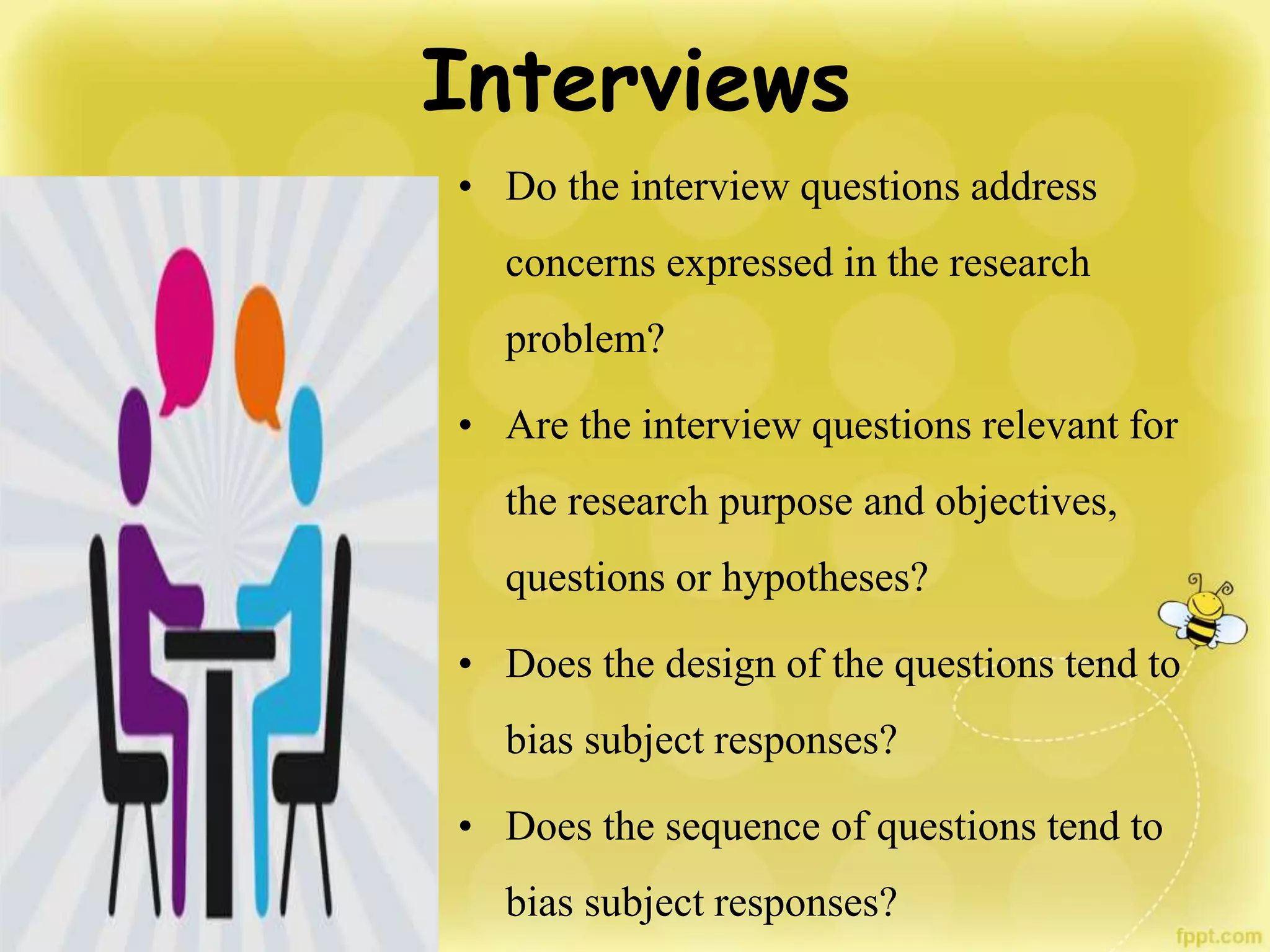
Interviews
• Do the interview questions address
concerns expressed in the research
problem?
• Are the interview questions relevant for
the research purpose and objectives,
questions or hypotheses?
• Does the design of the questions tend to
bias subject responses?
• Does the sequence of questions tend to
bias subject responses?
Physiological Measures
• Are the physiological measures/ instruments clearly described?
• Are the accuracy, precision and error of the physiological
instruments discussed?
• Are the physiological measures appropriate for the research
purpose and objectives, questions/ hypotheses?
• Are the methods for recording data from the physiological
measures clearly described? Is the recording of the data
consistent?
• Are the participants safe from any physical harms, risks,
psychological and social distress and discomfort?
• Was the study designed to minimize risks and maximize
benefits to participants?
• Is confidentiality of information and anonymity of the
information maintained?
• Was an appropriate written or verbal consent taken from the
study participants?
• Was a written permission obtained from the competent
authority to conduct the research study?
Statement of the
phenomenon of
interest
• Is the phenomenon of interest clearly identified?
• Were the clinical problem and research problem explicitly
stated?
• Has the researcher identified why the phenomenon requires
qualitative design for study?
• Are the philosophical underpinnings of the study described?
• Does the problem have a significance for nursing?
PURPOSE AND
RESEARCH
QUESTIONS
• Is the purpose of conducting the research made explicit?
• Were the research questions related to the problem and
purpose?
• Were qualitative methods appropriate to answer the research
questions?
REVIEWOF
LITERATURE &
THEORITICAL
FRAMEWORK
• Did the author cite quantitative and qualitative studies relevant
to the focus of the study? What other types of literature did the
author include?
• Are the references current?
• Did the author valuate or indicate the weaknesses of the
available studies?
• Did the literature reviews include adequate synthesized
information to build a logical argument?
PROTECTION OF
PARTICIPANTS RIGHTS
• Were appropriate procedures used to safeguard the rights of
the study participants?
• Were the study designed to minimize risks and maximize
benefited to participants?
RESEARCH DESIGN
• Is the method used to collect data compatible with the purpose
of the research?
• Is the method adequate to address the phenomenon of interest?
• If a particular approach is used to guide the inquiry, does the
researcher complete the study according to the processes
described?
• Was an adequate amount of time spent in the field or with the
study participants?
SAMPLING
• Does the researcher describe the selection of participants? Is
the particular method appropriately given?
• Are the informants who were chosen appropriate to inform the
research?
• Was the sample size adequate? Was saturation achieved?
DATA COLLECTION
• Were the methods of gathering the data appropriate? Were data gathered
through two or more methods to achieve triangulation?
• Is data collection focused on human experiences?
• Does the researcher describe the data collection strategies (i.e. interview,
Observation, field notes)?
• Did the researcher ask the right questions or make the right observations
and were they recorded in an appropriate fashion?
• Was a sufficient amount of data gathered? was the data of sufficient depth
and richness?
• Grove, S., Burns, N., Gray, J. (2013). The Practice of Nursing Research.
(7th ed). Missouri: Elsevier.
• Polit, D., Beck, C. (2010). Essentials of Nursing Research. (7th ed).
Philadelphia: Lippincott Williams & Wilkins.
• Wood, G., Haber, J. (2010). Nursing Research. (7th ed). Missouri: Mosby
Elsevier.
• Burns, N., & Grove, S. K. (2008). Understanding Nursing Research (4 ed.).
Missouri: Saunders.
• Parahoo, K. (2006).Nursing research. (2nd ed). S.l.: Palgrave Macmillan.
• Sharma, S. (2012). Nursing Research and Statistics. Haryana: Elsevier.
• Brockopp, D., Hastings-Tolsma, M..(2003). Fundamentals of Nursing
Research.( 3rd ed). Boston: Jones & Bartlett.
• Kaplan, L. (2012). Reading and critiquing a research article. American
Nurse Today, 7(10).
Critical appraisal of research studies

Critical appraisal of research studies

  • 1.
  • 2.
    INTRODUCTION • The nursingprofession continually strives for evidence-based practice, which includes critiquing studies, synthesizing the findings and applying the scientific evidence in practice • Thus, critiquing research is an essential step toward basing your practice on empirical evidence.
  • 3.
    DEFINITION • Critique isa careful judgment in which you give your opinion about the good and bad parts of something (such as a piece of writing or a work of art). Merriam- Webster Learner's Dictionary
  • 4.
    • A researchcritique is a systematic, unbiased, careful examination of all aspects of a study to judge the merits, limitations, meaning and significance based on previous research experience and knowledge of the topic. Burns N. and Grove S, 2005 • A research critique is a critical appraisal of a research study that has been systematically reviewed based on some known criteria. Cherly T Beck
  • 7.
  • 8.
    • What isthe problem and/ or purpose of the research study? • Is the problem statement clearly and concisely articulated? Is it appropriately stated? • Does the problem statement clearly depict the variables, population and place of the study? • Does the title indicate the type of study conducted- descriptive, corelational, quasi-experimental/ experimental? • Does the problem or purpose statement express a relationship between two or more variables, e.g., between an independent and a dependant variable? If so, what is/ are the relationship? Are they testable?
  • 9.
    • Does theproblem statement and/ or purpose specify the nature of the population being studied? What is it? • Is the research problem within the professional domain? • What significance of the problem has been identified, if any, by the investigator? • Is the problem not complex to study and appropriately delimited in its scope? • Is the research problem feasible to study in reference to time, resources, researcher's ability and availability of respondents, facility and equipment; ethical considerations? • Is the research problem directed to develop or test the nursing theories?
  • 11.
    • Are theobjectives in accordance with the research problem? • Are the objectives stated in clear and concise form? • Are the objectives stated using accepted action verbs in logical manner?
  • 12.
  • 13.
    • Are thehypotheses stated? If not, does the researcher provide sufficient information for not stating the hypothesis? • Are hypotheses logically related with the research problem and objectives? • If stated, are the hypotheses clear? Specific? Testable? • Whether hypotheses is stated in measurable terms by stating the level of significance (P=0.05) to accept or reject the hypotheses? • Are hypotheses stated in a way that they express a predicted relationship between two or more variables? • Are hypotheses based on conceptual framework used in research study?
  • 15.
    • Is theconceptual framework appropriate and in accordance with the research problem? • Is conceptual framework based on a nursing theory or a theory from other related disciplines? • Are all the concepts in conceptual framework clearly, adequately and logically defines and articulated in a way that they help either in the testing or generation of a theory?
  • 17.
    • What conceptsare included in the review? • Does the literature reviews make explicit the relationships among the variable or place? • Is the literature completely in accordance with research problem and covers majority of available studies on the topic under study? • Is the literature review thorough and detailed? • Is the literature reviewed from the current and primary sources- that is, has the literature been published within the last 5 years?
  • 18.
    • Are themajority of sources primary or secondary? • Is the literature review well organized under subheadings in a chronological order according to the year of the study? • Is the literature review presented in an analytical way to draw meaningful inferences? • Does the literature review provide a solid basis for the new study? • Are there benchmark publications?
  • 20.
    • Is thedesign specified correctly? What was the design used? • Is the design appropriate to answer the research questions? • Did the researcher attempt to control for threats to internal and external validity?
  • 22.
    • Is thesample size adequate? • Is the sampling method adequate to produce a representative sample? • What are the potential biases in the sampling method? • Are the criteria for including and/ or excluding people or items from the sample clear and appropriate? Are any subjects excluded from the study because of age, socioeconomic status/ ethnicity without sound rationale? • Is an appropriate sampling technique used to draw a sample from the population? • Was sample attrition a problem?
  • 24.
    • Are theinstruments or other means for data collection described sufficiently? • Are the reliability and validity of the instruments addressed? Are these adequate? • Are data collection methods described clearly? • Are the data collection methods appropriate? Could the researcher mentioned the specific benefits and problems faced by the research with particular methods of data collection? • Is the data collection process conducted in a consistent manner?
  • 25.
    • Are theinstruments clearly described? • Are techniques to complete and score the instruments provided? • Are validity and reliability of the instruments described? • Did the researcher reexamine the validity and reliability of instruments for the present sample? • If the instrument was developed for the study, is the instrument development process described? Scales and Questionnaires
  • 26.
    • Is whatto be observed clearly identified and defined? • Is interrater reliability described? • Are the techniques for recording observations described?
  • 27.
    Interviews • Do theinterview questions address concerns expressed in the research problem? • Are the interview questions relevant for the research purpose and objectives, questions or hypotheses? • Does the design of the questions tend to bias subject responses? • Does the sequence of questions tend to bias subject responses?
  • 28.
    Physiological Measures • Arethe physiological measures/ instruments clearly described? • Are the accuracy, precision and error of the physiological instruments discussed? • Are the physiological measures appropriate for the research purpose and objectives, questions/ hypotheses? • Are the methods for recording data from the physiological measures clearly described? Is the recording of the data consistent?
  • 30.
    • Are theparticipants safe from any physical harms, risks, psychological and social distress and discomfort? • Was the study designed to minimize risks and maximize benefits to participants? • Is confidentiality of information and anonymity of the information maintained? • Was an appropriate written or verbal consent taken from the study participants? • Was a written permission obtained from the competent authority to conduct the research study?
  • 32.
  • 33.
    • Is thephenomenon of interest clearly identified? • Were the clinical problem and research problem explicitly stated? • Has the researcher identified why the phenomenon requires qualitative design for study? • Are the philosophical underpinnings of the study described? • Does the problem have a significance for nursing?
  • 34.
  • 35.
    • Is thepurpose of conducting the research made explicit? • Were the research questions related to the problem and purpose? • Were qualitative methods appropriate to answer the research questions?
  • 36.
  • 37.
    • Did theauthor cite quantitative and qualitative studies relevant to the focus of the study? What other types of literature did the author include? • Are the references current? • Did the author valuate or indicate the weaknesses of the available studies? • Did the literature reviews include adequate synthesized information to build a logical argument?
  • 39.
    PROTECTION OF PARTICIPANTS RIGHTS •Were appropriate procedures used to safeguard the rights of the study participants? • Were the study designed to minimize risks and maximize benefited to participants?
  • 40.
    RESEARCH DESIGN • Isthe method used to collect data compatible with the purpose of the research? • Is the method adequate to address the phenomenon of interest? • If a particular approach is used to guide the inquiry, does the researcher complete the study according to the processes described? • Was an adequate amount of time spent in the field or with the study participants?
  • 41.
    SAMPLING • Does theresearcher describe the selection of participants? Is the particular method appropriately given? • Are the informants who were chosen appropriate to inform the research? • Was the sample size adequate? Was saturation achieved?
  • 42.
    DATA COLLECTION • Werethe methods of gathering the data appropriate? Were data gathered through two or more methods to achieve triangulation? • Is data collection focused on human experiences? • Does the researcher describe the data collection strategies (i.e. interview, Observation, field notes)? • Did the researcher ask the right questions or make the right observations and were they recorded in an appropriate fashion? • Was a sufficient amount of data gathered? was the data of sufficient depth and richness?
  • 44.
    • Grove, S.,Burns, N., Gray, J. (2013). The Practice of Nursing Research. (7th ed). Missouri: Elsevier. • Polit, D., Beck, C. (2010). Essentials of Nursing Research. (7th ed). Philadelphia: Lippincott Williams & Wilkins. • Wood, G., Haber, J. (2010). Nursing Research. (7th ed). Missouri: Mosby Elsevier. • Burns, N., & Grove, S. K. (2008). Understanding Nursing Research (4 ed.). Missouri: Saunders.
  • 45.
    • Parahoo, K.(2006).Nursing research. (2nd ed). S.l.: Palgrave Macmillan. • Sharma, S. (2012). Nursing Research and Statistics. Haryana: Elsevier. • Brockopp, D., Hastings-Tolsma, M..(2003). Fundamentals of Nursing Research.( 3rd ed). Boston: Jones & Bartlett. • Kaplan, L. (2012). Reading and critiquing a research article. American Nurse Today, 7(10).