Research Conceptualization
Arvin Kim Arnilla, PhD
Assistant Professor 4
College of Teacher Education
Aklan State University
Outline
• Disclosure
• References
• Objectives
• Digital Approaches in Research
• Researcher Driven• Data and Theory Driven
• Summary
• Key Sources of Inspiration
Disclosure
I am not a PE major
Research interests: inclusive
education, disability studies and
Philippine culture
No conflict of interest
Objectives
• Identify the key sources of inspiration for research topics.
• Recognize the impact of technology-based innovations in doing
literature search, data gathering and data analysis.
TOPIC 1: Digital Approaches in Research
 Literature Review
• Open Access vs. “Get Access”
• Online Surveys
• Online Interviews
 Data Gathering
 Data Analysis
• jamovi (for quantitative analysis)
• ATLAS.ti (for qualitative analysis)
FREE
comes with a FEE (pricey)
Transcend the “FEE” and download the article for FREE
• Online Surveys
 Data Gathering
• Google Forms
• Online Interviews
• Facebook Messenger (security issue)
• Windows Skype
• WhatsApp (security issue)
jamovi (for quantitative analysis)
ATLAS.ti (for qualitative analysis)
Workshop 1
• What are advantages and disadvantages of technology-based innovations
in doing literature search, data gathering and data analysis?
Innovations in … Advantage/s Disadvantage/s
Literature Search
Data Gathering
Data Analysis
TOPIC 2: Key Sources of Inspiration
Conceptualization, the art and practiceof discovery,
is the first and some may argue the most difficult part of
research.
- Aurini, Heath & Howells (2016)
RESEARCH TOPIC
Research
PROBLEM
determine what
you want to
study
problem/s your project
hopes to solve,
including filling in a
gap or extending the
literature in a new and
exciting direction
- Aurini, Heath & Howells (2016)
can be anything that a
person finds unsatisfactory
or unsettling, a difficulty of
some sort, a state of affairs
that needs to be changed,
anything that is not working
as well as it might
- Fraenkel & Wallen, 2000
RESEARCH
QUESTION/S
Specific and focused
inquires that derive from
the research problem
- Aurini, Heath & Howells (2016)
(Aurini, Heath & Howells, 2016)
Sources of Inspiration
Data and Theory driven
1) Secondary Sources
• Journal Articles
• Academic or professional books
• Research Reports
continued ….
What is my TOPIC?
2) Primary Sources
• Online materials (e.g. blogs)
• Websites
• Archival materials
• Brochures, reports, posters
• Diaries, letters
• Media (online, newspapers, mags & TV)
• Government documents or public records
… continued
continued ….
3) Primary, Preliminary raw data that you collect or produce
• Pilot project
• Pictures or videos
• Furniture, statues, clothing
• Music, poetry, art
• Maps
• Transcripts
• Academic and professional articles and reports that used as
primary sources of data
… continued
… continued
Researcher driven
Mapping Exercises
• Mind Map
• Concept Map
• Literature Map
Abbott’s (2004) “Lists”
• Aristotle’s four causes
… continued
Your own interest!
We should not forget . . .
“pre-competition anxiety” “pre-performance anxiety”
“pre-game anxiety”“athlete anxiety”
“competitive anxiety” “sports anxiety”
Keywords
 to “strike gold” requires experiment with
different terms and combination
How to search for academic journal articles
Workshop 2
Fill out the Research Grid with the pertinent information based on the
assigned research article/s.
Research
Question/s
Data Collection
Procedures
Instruments Data Analysis Conclusions Recommendations
1.
2.
3.
Research Grid
Bibliographic Entry: ______________________________________________
- Aurini, Heath & Howells (2016)
What is my INTENTION?
1. Identify your target audience. Your initial target audience will determine the
range of early problem formulation strategies.
2. Based on our review of relevant literature and other resources, identify a
research problem based on what your audience already knows and wants to
know.
3. Articulate your specific intention in a way that aligns your target audience and
research problem formulation. Ask yourself: Does my research problem
formulation and potential contribution make sense given my target audience?
Possible audience (s) Possible research problem formation Possible contributions
• Academic
• Professionals
Are interested in building …
• Theoretical frameworks
• Concepts
• Empirical Data
• Evaluation
That contributes to …
• Scholarly or professional literature
• Program evaluation
• Policy reform
• Social reform
• Providing a new factual information
• Solving a practical problem
• Professionals
• Policy makers
• Group under study
• Community group
Are interested in building …
• Concepts
• Empirical data
• Evaluation
That contributes to …
Policy reform
Social reform
Providing new factual information
Solving a practical problem
• General public
• Popular media
Are interested in building …
• Concepts
• Empirical data
• Evaluation
That contributes to …
Policy reforms
Social reforms
Providing new factual information
Solving practical problems
Popular discourse (e.g. entertainment)
- Aurini, Heath & Howells (2016)
Characteristics of Good Research Questions (Fraenkel and Wallen, 2000)
1. Feasible – can be investigated w/out an undue amount of time,
energy or money
2. Clear – most people would agree as to what the key words in the
question mean
3. Significant – worth investigating because it will contribute
important knowledge about the human condition
4. Ethical – it will not involve physical or psychological harm or
damage to human beings or to the natural or social environment of
which they are a part
“Funded Research” vs. “Self-funded”
Issue:
Discuss:
Which do you prefer?
Literature Map of the Study (Creswell, 2014)
• a visual summary of the research that has been conducted
by others, and typically represented in a figure
• could be hierarchical structure with a top-down
presentation of the literature, ending at the bottom with the
proposed study
• might be similar to a flowchart in which the reader understands
the literature as unfolding from left to right with the farthest right-
hand section advancing a proposed study
• might be a series of circles; each circle represents a body of
literature and the intersection of the circles as the place in which the
future research is indicated
• areas of AGREEMENT between different authors.
• areas of DISAGREEMENT between authors.
• REASONS for the different views held by various authors.
Literature review map determines:
https://www.literaturereviewwritingservice.com/how-to-make-a-literature-review-map/
Abstracting Studies
Abstract is a brief review of the literature (typically a short
paragraph) that summarizes major elements to enable a
reader to understand the basic features of the article.
A GOOD summary of research study: (Creswell, 2014)
• Mention the problem being addressed
• State briefly the central purpose or focus of the study
• Briefly state information about the sample, population, or
subjects
• Review key results that relate to the proposed study
• If it is a critique or methods review, point out technical and
methodological flaws in the study
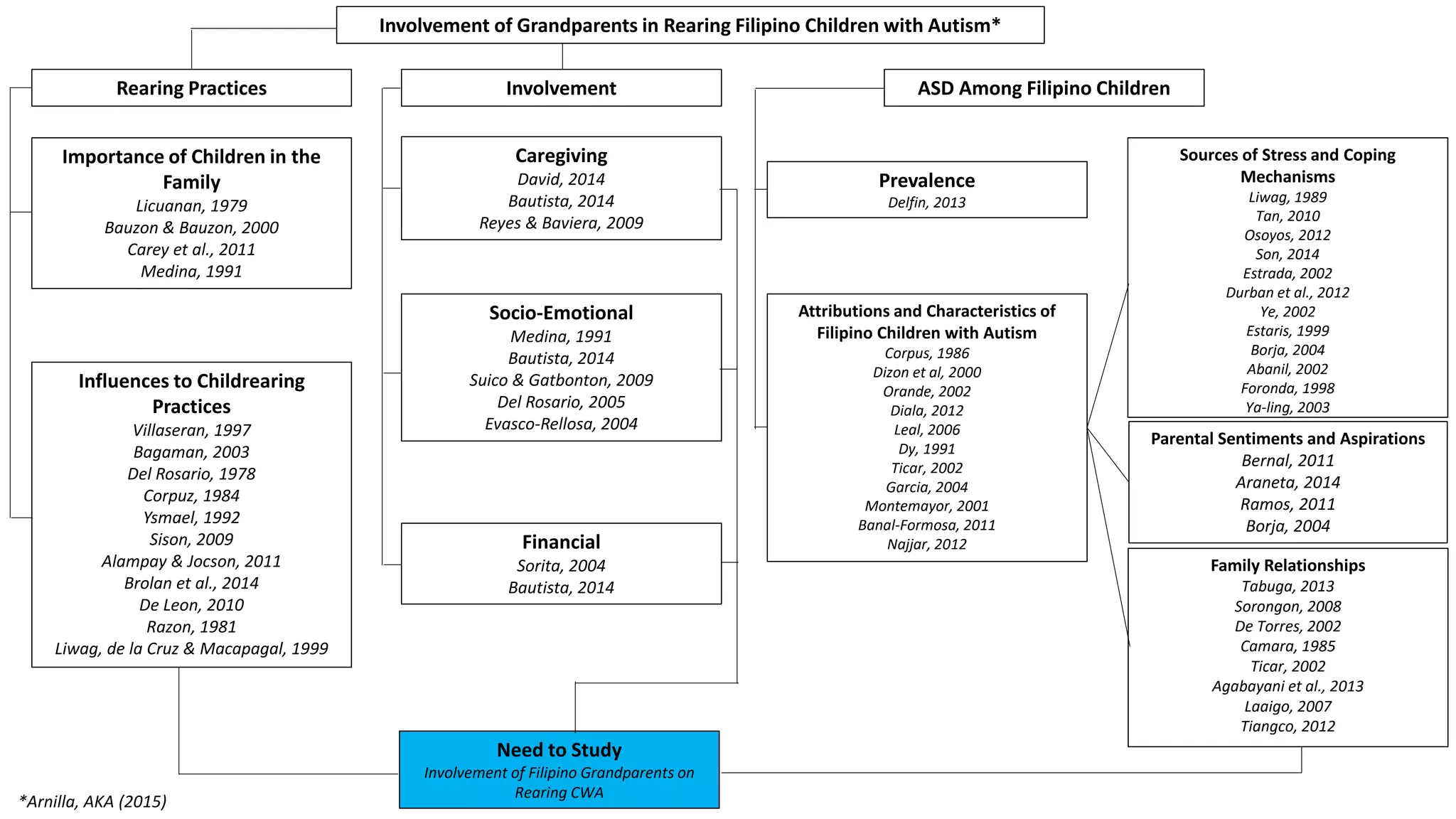
Involvement of Grandparents in Rearing Filipino Children with Autism*
*Arnilla, AKA (2015)
Caregiving
David, 2014
Bautista, 2014
Reyes & Baviera, 2009
Socio-Emotional
Medina, 1991
Bautista, 2014
Suico & Gatbonton, 2009
Del Rosario, 2005
Evasco-Rellosa, 2004
Financial
Sorita, 2004
Bautista, 2014
Rearing Practices
Importance of Children in the
Family
Licuanan, 1979
Bauzon & Bauzon, 2000
Carey et al., 2011
Medina, 1991
Influences to Childrearing
Practices
Villaseran, 1997
Bagaman, 2003
Del Rosario, 1978
Corpuz, 1984
Ysmael, 1992
Sison, 2009
Alampay & Jocson, 2011
Brolan et al., 2014
De Leon, 2010
Razon, 1981
Liwag, de la Cruz & Macapagal, 1999
Prevalence
Delfin, 2013
Attributions and Characteristics of
Filipino Children with Autism
Corpus, 1986
Dizon et al, 2000
Orande, 2002
Diala, 2012
Leal, 2006
Dy, 1991
Ticar, 2002
Garcia, 2004
Montemayor, 2001
Banal-Formosa, 2011
Najjar, 2012
Sources of Stress and Coping
Mechanisms
Liwag, 1989
Tan, 2010
Osoyos, 2012
Son, 2014
Estrada, 2002
Durban et al., 2012
Ye, 2002
Estaris, 1999
Borja, 2004
Abanil, 2002
Foronda, 1998
Ya-ling, 2003
Parental Sentiments and Aspirations
Bernal, 2011
Araneta, 2014
Ramos, 2011
Borja, 2004
Family Relationships
Tabuga, 2013
Sorongon, 2008
De Torres, 2002
Camara, 1985
Ticar, 2002
Agabayani et al., 2013
Laaigo, 2007
Tiangco, 2012
Involvement ASD Among Filipino Children
Need to Study
Involvement of Filipino Grandparents on
Rearing CWA
Workshop 3
 What are the problems unique to data-theory and researcher driven
conceptualization of research? How can these problems be
addressed?
 What are the implications of technology-based innovations in
research?
Summary
Aurini, , Janice D., Melanie Heath & Stephanie Howells. (2016). The How To of Qualitative Research. SAGE Publications
Ltd. Avalable in https://uk.sagepub.com/sites/default/files/upmbinaries/86946_02_Aurini_et_al_Ch_02.pdf
References
Creswell, J.W. (2014). Research design: qualitative, quantitative and mixed methods approaches. SAGE Publications
Fraenkel, J.R. and N.E. Wallen. (2000). How to design and evaluate research in education. McGraw-Hill
Arvin Kim Arnilla, PhD
Assistant Professor 4
College of Teacher Education
Aklan State University
arnilla_kim@asu.edu.ph

Research conceptualization new

  • 1.
    Research Conceptualization Arvin KimArnilla, PhD Assistant Professor 4 College of Teacher Education Aklan State University
  • 2.
    Outline • Disclosure • References •Objectives • Digital Approaches in Research • Researcher Driven• Data and Theory Driven • Summary • Key Sources of Inspiration
  • 3.
    Disclosure I am nota PE major Research interests: inclusive education, disability studies and Philippine culture No conflict of interest
  • 4.
    Objectives • Identify thekey sources of inspiration for research topics. • Recognize the impact of technology-based innovations in doing literature search, data gathering and data analysis.
  • 5.
    TOPIC 1: DigitalApproaches in Research
  • 6.
     Literature Review •Open Access vs. “Get Access” • Online Surveys • Online Interviews  Data Gathering  Data Analysis • jamovi (for quantitative analysis) • ATLAS.ti (for qualitative analysis)
  • 7.
  • 8.
    comes with aFEE (pricey)
  • 9.
    Transcend the “FEE”and download the article for FREE
  • 10.
    Transcend the “FEE”and download the article for FREE
  • 11.
    • Online Surveys Data Gathering • Google Forms
  • 12.
    • Online Interviews •Facebook Messenger (security issue) • Windows Skype • WhatsApp (security issue)
  • 13.
  • 14.
  • 15.
    Workshop 1 • Whatare advantages and disadvantages of technology-based innovations in doing literature search, data gathering and data analysis? Innovations in … Advantage/s Disadvantage/s Literature Search Data Gathering Data Analysis
  • 16.
    TOPIC 2: KeySources of Inspiration
  • 17.
    Conceptualization, the artand practiceof discovery, is the first and some may argue the most difficult part of research. - Aurini, Heath & Howells (2016)
  • 18.
    RESEARCH TOPIC Research PROBLEM determine what youwant to study problem/s your project hopes to solve, including filling in a gap or extending the literature in a new and exciting direction - Aurini, Heath & Howells (2016) - Aurini, Heath & Howells (2016) can be anything that a person finds unsatisfactory or unsettling, a difficulty of some sort, a state of affairs that needs to be changed, anything that is not working as well as it might - Fraenkel & Wallen, 2000 RESEARCH QUESTION/S Specific and focused inquires that derive from the research problem - Aurini, Heath & Howells (2016)
  • 19.
    (Aurini, Heath &Howells, 2016) Sources of Inspiration Data and Theory driven 1) Secondary Sources • Journal Articles • Academic or professional books • Research Reports continued …. What is my TOPIC?
  • 20.
    2) Primary Sources •Online materials (e.g. blogs) • Websites • Archival materials • Brochures, reports, posters • Diaries, letters • Media (online, newspapers, mags & TV) • Government documents or public records … continued continued ….
  • 21.
    3) Primary, Preliminaryraw data that you collect or produce • Pilot project • Pictures or videos • Furniture, statues, clothing • Music, poetry, art • Maps • Transcripts • Academic and professional articles and reports that used as primary sources of data … continued … continued
  • 22.
    Researcher driven Mapping Exercises •Mind Map • Concept Map • Literature Map Abbott’s (2004) “Lists” • Aristotle’s four causes … continued
  • 23.
    Your own interest! Weshould not forget . . .
  • 24.
    “pre-competition anxiety” “pre-performanceanxiety” “pre-game anxiety”“athlete anxiety” “competitive anxiety” “sports anxiety” Keywords  to “strike gold” requires experiment with different terms and combination How to search for academic journal articles
  • 27.
    Workshop 2 Fill outthe Research Grid with the pertinent information based on the assigned research article/s. Research Question/s Data Collection Procedures Instruments Data Analysis Conclusions Recommendations 1. 2. 3. Research Grid Bibliographic Entry: ______________________________________________
  • 29.
    - Aurini, Heath& Howells (2016) What is my INTENTION? 1. Identify your target audience. Your initial target audience will determine the range of early problem formulation strategies. 2. Based on our review of relevant literature and other resources, identify a research problem based on what your audience already knows and wants to know. 3. Articulate your specific intention in a way that aligns your target audience and research problem formulation. Ask yourself: Does my research problem formulation and potential contribution make sense given my target audience?
  • 30.
    Possible audience (s)Possible research problem formation Possible contributions • Academic • Professionals Are interested in building … • Theoretical frameworks • Concepts • Empirical Data • Evaluation That contributes to … • Scholarly or professional literature • Program evaluation • Policy reform • Social reform • Providing a new factual information • Solving a practical problem • Professionals • Policy makers • Group under study • Community group Are interested in building … • Concepts • Empirical data • Evaluation That contributes to … Policy reform Social reform Providing new factual information Solving a practical problem • General public • Popular media Are interested in building … • Concepts • Empirical data • Evaluation That contributes to … Policy reforms Social reforms Providing new factual information Solving practical problems Popular discourse (e.g. entertainment) - Aurini, Heath & Howells (2016)
  • 31.
    Characteristics of GoodResearch Questions (Fraenkel and Wallen, 2000) 1. Feasible – can be investigated w/out an undue amount of time, energy or money 2. Clear – most people would agree as to what the key words in the question mean 3. Significant – worth investigating because it will contribute important knowledge about the human condition 4. Ethical – it will not involve physical or psychological harm or damage to human beings or to the natural or social environment of which they are a part
  • 32.
    “Funded Research” vs.“Self-funded” Issue: Discuss: Which do you prefer?
  • 33.
    Literature Map ofthe Study (Creswell, 2014) • a visual summary of the research that has been conducted by others, and typically represented in a figure • could be hierarchical structure with a top-down presentation of the literature, ending at the bottom with the proposed study
  • 34.
    • might besimilar to a flowchart in which the reader understands the literature as unfolding from left to right with the farthest right- hand section advancing a proposed study • might be a series of circles; each circle represents a body of literature and the intersection of the circles as the place in which the future research is indicated
  • 35.
    • areas ofAGREEMENT between different authors. • areas of DISAGREEMENT between authors. • REASONS for the different views held by various authors. Literature review map determines: https://www.literaturereviewwritingservice.com/how-to-make-a-literature-review-map/
  • 36.
    Abstracting Studies Abstract isa brief review of the literature (typically a short paragraph) that summarizes major elements to enable a reader to understand the basic features of the article.
  • 37.
    A GOOD summaryof research study: (Creswell, 2014) • Mention the problem being addressed • State briefly the central purpose or focus of the study • Briefly state information about the sample, population, or subjects • Review key results that relate to the proposed study • If it is a critique or methods review, point out technical and methodological flaws in the study
  • 38.
    Involvement of Grandparentsin Rearing Filipino Children with Autism* *Arnilla, AKA (2015) Caregiving David, 2014 Bautista, 2014 Reyes & Baviera, 2009 Socio-Emotional Medina, 1991 Bautista, 2014 Suico & Gatbonton, 2009 Del Rosario, 2005 Evasco-Rellosa, 2004 Financial Sorita, 2004 Bautista, 2014 Rearing Practices Importance of Children in the Family Licuanan, 1979 Bauzon & Bauzon, 2000 Carey et al., 2011 Medina, 1991 Influences to Childrearing Practices Villaseran, 1997 Bagaman, 2003 Del Rosario, 1978 Corpuz, 1984 Ysmael, 1992 Sison, 2009 Alampay & Jocson, 2011 Brolan et al., 2014 De Leon, 2010 Razon, 1981 Liwag, de la Cruz & Macapagal, 1999 Prevalence Delfin, 2013 Attributions and Characteristics of Filipino Children with Autism Corpus, 1986 Dizon et al, 2000 Orande, 2002 Diala, 2012 Leal, 2006 Dy, 1991 Ticar, 2002 Garcia, 2004 Montemayor, 2001 Banal-Formosa, 2011 Najjar, 2012 Sources of Stress and Coping Mechanisms Liwag, 1989 Tan, 2010 Osoyos, 2012 Son, 2014 Estrada, 2002 Durban et al., 2012 Ye, 2002 Estaris, 1999 Borja, 2004 Abanil, 2002 Foronda, 1998 Ya-ling, 2003 Parental Sentiments and Aspirations Bernal, 2011 Araneta, 2014 Ramos, 2011 Borja, 2004 Family Relationships Tabuga, 2013 Sorongon, 2008 De Torres, 2002 Camara, 1985 Ticar, 2002 Agabayani et al., 2013 Laaigo, 2007 Tiangco, 2012 Involvement ASD Among Filipino Children Need to Study Involvement of Filipino Grandparents on Rearing CWA
  • 39.
    Workshop 3  Whatare the problems unique to data-theory and researcher driven conceptualization of research? How can these problems be addressed?  What are the implications of technology-based innovations in research?
  • 40.
  • 41.
    Aurini, , JaniceD., Melanie Heath & Stephanie Howells. (2016). The How To of Qualitative Research. SAGE Publications Ltd. Avalable in https://uk.sagepub.com/sites/default/files/upmbinaries/86946_02_Aurini_et_al_Ch_02.pdf References Creswell, J.W. (2014). Research design: qualitative, quantitative and mixed methods approaches. SAGE Publications Fraenkel, J.R. and N.E. Wallen. (2000). How to design and evaluate research in education. McGraw-Hill
  • 42.
    Arvin Kim Arnilla,PhD Assistant Professor 4 College of Teacher Education Aklan State University arnilla_kim@asu.edu.ph