Mr Safir Kassim.B
Kassim.safir@univ-mascara.dz
Avril 2020
Definitions
 Definition 1
 A research problem is a specific issue, difficulty,
contradiction, or gap in knowledge that you will aim to
address in your research. You might look for practical
problems aimed at contributing to change, or
theoretical problems aimed at expanding knowledge.
(Mc Combs, 2020)
 Definition 2
 A research problem is a statement about an area of
concern, a condition to be improved, a difficulty to be
eliminated, or a troubling question that exists in
scholarly literature, in theory, or in practice that points
to the need for meaningful understanding and
deliberate investigation.28 janv. 2020
(https://library.sacredheart.edu/c.php?g=29803&p=185918)
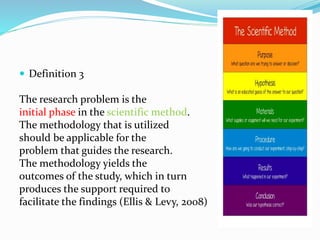
 Definition 3
The research problem is the
initial phase in the scientific method.
The methodology that is utilized
should be applicable for the
problem that guides the research.
The methodology yields the
outcomes of the study, which in turn
produces the support required to
facilitate the findings (Ellis & Levy, 2008)
 Definition 4
The statement of a social research problem is a
comprehensive argument with clarity, direction, logic,
rationale, sequence, structure, substance and power to
establish, relate and justify the aspects of the problem
to pursue the solution. (Avdhesh S Jha, 2014)
Characteristics
 1 . The problem can be stated clearly and concisely.
2. The problem generates research questions.
3. It is grounded in theory.
4. It relates to one or more academic fields of study.
5. It has a base in the research literature.
6. It has potential significance/importance.
7. It is do-able within the time frame, budget.
8. Sufficient data are available or can be obtained.
9. The researcher’s methodological strengths can be
applied to the problem.
10. The problem is new; it is not already answered
sufficiently.
(https://readingcraze.com/index.php/characteristics-good-research-problem/)
SMART
 Specific
 Measurable
 Attainable
 Realistic
 Time-bound
(https://www.youtube.com/watch?v=cfWf4M3D3TU)
NIPIC
Novel
Interesting
Practical
Innovative
Cost-effective
(https://www.youtube.com/watch?v=cfWf4M3D3TU)
How to formulate it (SREDA)
Specify your research objectives;
Review its context or environment;
Explore its nature;
Determine variable relationships;
Anticipate the possible consequences of
alternative approaches.
(https://prothesiswriter.com/blog/how-to-formulate-research-problem)
Examples
 What effect does daily use of Twitter have on the attention
span of under-16s?
 What impact have university internationalisation policies
had on the availability and affordability of housing in the
Netherlands?
 How do the US and the UK compare in health outcomes
and patient satisfaction among low-income people with
chronic illnesses?
 What are the most effective communication strategies for
increasing voter turnout among under-30s in region X?
(https://www.scribbr.com/research-process/research-question-examples/)
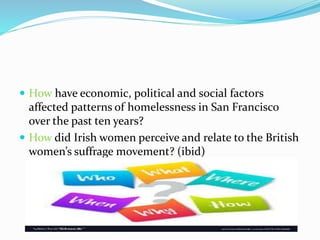
 How have economic, political and social factors
affected patterns of homelessness in San Francisco
over the past ten years?
 How did Irish women perceive and relate to the British
women’s suffrage movement? (ibid)
 What are the similarities and differences in the
experiences of recent Turkish, Polish and Syrian
immigrants in Berlin?
 How have modern adaptations of
Shakespeare’s Othello dealt with the theme of racism
through casting, staging and allusion to contemporary
events?
 What effect do different legal approaches have on the
number of people who drive after drinking in
European countries? (ibid)
Statements
 The problem was to investigate the effects of exercice on
blood lipidsamong college –age females.
 This study was designed to determine the relationship
between stability performance and physical growth
characteristics of preschool children.
 The problem of the study was to determine if there is a
relationship between self-efficacy and self-reported alcohol
usage among middle-aged adult females.
(http://wishbonegroup.com.au/?77-research-problem-statement-examples)
Structure
 Remember: It can be a statement or a troubling question:
Statement:
The problem was to investigate
the effects of…on … .
This study was designed to
determine the relationship
between… and … .
Question
What effect does …have on …of …?
What impact have … had on … of
…in …?
How do …and … compare in …
among … (with …)?
Activities
 1. Analyse the research problem examples (lexis,
structure etc (in slides 9-12).Use a table.
 2. Write 10 research problems (statements and
troubling questions). Then send them to my email.
Useful bibiography
 Research Methodology: Methods and Techniques - C.
R. Kothari - 2004
 Research Methodology - Upagade Vijay & Shende
Arvind - 2010
 Social Research Methods.JHA.McGraw Hill
Education (India) Pvt Ltd, 2014
An introduction to the problem statement

An introduction to the problem statement

  • 1.
  • 2.
    Definitions  Definition 1 A research problem is a specific issue, difficulty, contradiction, or gap in knowledge that you will aim to address in your research. You might look for practical problems aimed at contributing to change, or theoretical problems aimed at expanding knowledge. (Mc Combs, 2020)
  • 3.
     Definition 2 A research problem is a statement about an area of concern, a condition to be improved, a difficulty to be eliminated, or a troubling question that exists in scholarly literature, in theory, or in practice that points to the need for meaningful understanding and deliberate investigation.28 janv. 2020 (https://library.sacredheart.edu/c.php?g=29803&p=185918)
  • 4.
     Definition 3 Theresearch problem is the initial phase in the scientific method. The methodology that is utilized should be applicable for the problem that guides the research. The methodology yields the outcomes of the study, which in turn produces the support required to facilitate the findings (Ellis & Levy, 2008)
  • 5.
     Definition 4 Thestatement of a social research problem is a comprehensive argument with clarity, direction, logic, rationale, sequence, structure, substance and power to establish, relate and justify the aspects of the problem to pursue the solution. (Avdhesh S Jha, 2014)
  • 6.
    Characteristics  1 .The problem can be stated clearly and concisely. 2. The problem generates research questions. 3. It is grounded in theory. 4. It relates to one or more academic fields of study. 5. It has a base in the research literature. 6. It has potential significance/importance. 7. It is do-able within the time frame, budget. 8. Sufficient data are available or can be obtained. 9. The researcher’s methodological strengths can be applied to the problem. 10. The problem is new; it is not already answered sufficiently. (https://readingcraze.com/index.php/characteristics-good-research-problem/)
  • 7.
    SMART  Specific  Measurable Attainable  Realistic  Time-bound (https://www.youtube.com/watch?v=cfWf4M3D3TU)
  • 8.
  • 9.
    How to formulateit (SREDA) Specify your research objectives; Review its context or environment; Explore its nature; Determine variable relationships; Anticipate the possible consequences of alternative approaches. (https://prothesiswriter.com/blog/how-to-formulate-research-problem)
  • 10.
    Examples  What effectdoes daily use of Twitter have on the attention span of under-16s?  What impact have university internationalisation policies had on the availability and affordability of housing in the Netherlands?  How do the US and the UK compare in health outcomes and patient satisfaction among low-income people with chronic illnesses?  What are the most effective communication strategies for increasing voter turnout among under-30s in region X? (https://www.scribbr.com/research-process/research-question-examples/)
  • 11.
     How haveeconomic, political and social factors affected patterns of homelessness in San Francisco over the past ten years?  How did Irish women perceive and relate to the British women’s suffrage movement? (ibid)
  • 12.
     What arethe similarities and differences in the experiences of recent Turkish, Polish and Syrian immigrants in Berlin?  How have modern adaptations of Shakespeare’s Othello dealt with the theme of racism through casting, staging and allusion to contemporary events?  What effect do different legal approaches have on the number of people who drive after drinking in European countries? (ibid)
  • 13.
    Statements  The problemwas to investigate the effects of exercice on blood lipidsamong college –age females.  This study was designed to determine the relationship between stability performance and physical growth characteristics of preschool children.  The problem of the study was to determine if there is a relationship between self-efficacy and self-reported alcohol usage among middle-aged adult females. (http://wishbonegroup.com.au/?77-research-problem-statement-examples)
  • 14.
    Structure  Remember: Itcan be a statement or a troubling question: Statement: The problem was to investigate the effects of…on … .
  • 15.
    This study wasdesigned to determine the relationship between… and … .
  • 16.
    Question What effect does…have on …of …? What impact have … had on … of …in …? How do …and … compare in … among … (with …)?
  • 17.
    Activities  1. Analysethe research problem examples (lexis, structure etc (in slides 9-12).Use a table.  2. Write 10 research problems (statements and troubling questions). Then send them to my email.
  • 18.
    Useful bibiography  ResearchMethodology: Methods and Techniques - C. R. Kothari - 2004  Research Methodology - Upagade Vijay & Shende Arvind - 2010  Social Research Methods.JHA.McGraw Hill Education (India) Pvt Ltd, 2014