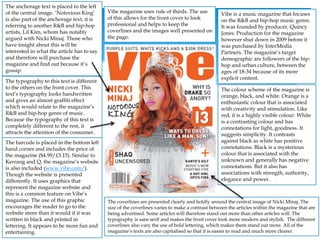
Vibe is a music magazine that focuses
on the R&B and hip-hop music genre.
It was founded by producer, Quincy
Jones. Production for the magazine
however shut down in 2009 before it
was purchased by InterMedia
Partners. The magazine’s target
demographic are followers of the hip-
hop and urban culture, between the
ages of 18-34 because of its more
explicit content.
Vibe magazine uses rule of thirds. The use
of this allows for the front cover to look
professional and helps to keep the
coverlines and the images well presented on
the page.
The colour scheme of the magazine is
orange, black, and white. Orange is a
enthusiastic colour that is associated
with creativity and stimulation. Like
red, it is a highly visible colour. White
is a contrasting colour and has
connotations for light, goodness. It
suggests simplicity. It contrasts
against black as white has positive
connotations. Black is a mysterious
colour that is associated with the
unknown and generally has negative
connotations. But it also has
associations with strength, authority,
elegance and power.
The anchorage text is placed to the left
of the central image. ‘Notorious King’
is also part of the anchorage text, it is
referring to another R&B and hip-hop
artists, Lil Kim, whom has notably
argued with Nicki Minaj. Those who
have insight about this will be
interested in what the article has to say
and therefore will purchase the
magazine and find out because it’s
gossip.
The typography to this text is different
to the others on the front cover. This
text’s typography looks handwritten
and gives an almost graffiti effect
which would relate to the magazine’s
R&B and hip-hop genre of music.
Because the typography of this text is
completely different to the rest, it
attracts the attention of the consumer.
The barcode is placed in the bottom left
hand corner and includes the price of
the magazine ($4.99/£3.15). Similar to
Kerrang and Q, the magazine’s website
is also included (www.vibe.com/).
Though the website is presented
differently. It uses graphics that
represent the magazine website and
this is a common feature on Vibe’s
magazine. The use of this graphic
encourages the reader to go to the
website more than it would if it was
written in black and printed in
lettering. It appears to be more fun and
entertaining.
The coverlines are presented clearly and boldly around the central image of Nicki Minaj. The
size of the coverlines varies to make a contrast between the articles within the magazine that are
being advertised. Some articles will therefore stand out more than other articles will. The
typography is sans serif and makes the front cover look more modern and stylish. The different
coverlines also vary the use of bold lettering, which makes them stand out more. All of the
magazine’s texts are also capitalised so that it is easier to read and much more clearer.
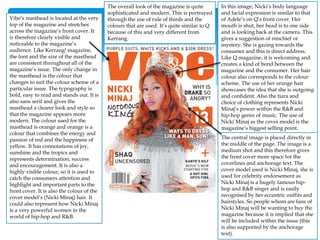
In this image, Nicki’s body language
and facial expression is similar to that
of Adele’s on Q’s front cover. Her
mouth is shut, her head is to one side
and is looking back at the camera. This
gives a suggestion of mischief or
mystery. She is gazing towards the
consumer and this is direct address.
Like Q magazine, it is welcoming and
creates a kind of bond between the
magazine and the consumer. Her hair
colour also corresponds to the colour
scheme. The use of her orange hair
showcases the idea that she is outgoing
and confident. Also the tiara and
choice of clothing represents Nicki
Minaj’s power within the R&B and
hip-hop genre of music. The use of
Nicki Minaj as the cover model is the
magazine’s biggest selling point.
The overall look of the magazine is quite
sophisticated and modern. This is portrayed
through the use of rule of thirds and the
colours that are used. It’s quite similar to Q
because of this and very different from
Kerrang.
Vibe’s masthead is located at the very
top of the magazine and stretches
across the magazine’s front cover. It
is therefore clearly visible and
noticeable to the magazine’s
audience. Like Kerrang! magazine,
the font and the size of the masthead
are consistent throughout all of the
magazine’s issue. The only change in
the masthead is the colour that
changes to suit the colour scheme of a
particular issue. The typography is
bold, easy to read and stands out. It is
also sans serif and gives the
masthead a clearer look and style so
that the magazine appears more
modern. The colour used for the
masthead is orange and orange is a
colour that combines the energy and
passion of red and the happiness of
yellow. It has connotations of joy,
sunshine and the tropics and
represents determination, success
and encouragement. It is also a
highly visible colour, so it is used to
catch the consumers attention and
highlight and important parts to the
front cover. It is also the colour of the
cover model’s (Nicki Minaj) hair. It
could also represent how Nicki Minaj
is a very powerful women in the
world of hip-hop and R&B.
The central image is placed directly in
the middle of the page. The image is a
medium shot and this therefore gives
the front cover more space for the
coverlines and anchorage text. The
cover model used is Nicki Minaj, she is
used for celebrity endorsement as
Nicki Minaj is a hugely famous hip-
hop and R&B singer and is easily
recognised by her eccentric outfits and
hairstyles. So people whom are fans of
Nicki Minaj will be wanting to buy the
magazine because it is implied that she
will be included within the issue (this
is also supported by the anchorage
text).
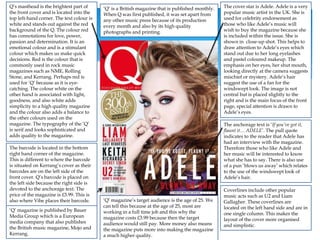
‘Q’ is a British magazine that is published monthly.
When Q was first published, it was set apart from
any other music press because of its production
every month and also by its high quality
photographs and printing.
Q’s masthead is the brightest part of
the front cover and is located into the
top left-hand corner. The text colour is
white and stands out against the red
background of the Q. The colour red
has connotations for love, power,
passion and determination. It is an
emotional colour and is a stimulant
colour which makes us make quick
decisions. Red is the colour that is
commonly used in rock music
magazines such as NME, Rolling
Stone, and Kerrang. Perhaps red is
used for ‘Q’ because as it is eye-
catching. The colour white on the
other hand is associated with light,
goodness, and also white adds
simplicity to a high quality magazine
and the colour also adds a balance to
the other colours used on the
magazine. The typography of the ‘Q’
is serif and looks sophisticated and
adds quality to the magazine.
The cover star is Adele. Adele is a very
popular music artist in the UK. She is
used for celebrity endorsement as
those who like Adele’s music will
wish to buy the magazine because she
is included within the issue. She is
shown in close-up shot. This helps to
draw attention to Adele’s eyes which
stand out due to her long eyelashes
and pastel coloured makeup. The
emphasis on her eyes, her shut mouth,
looking directly at the camera suggests
mischief or mystery. Adele’s hair
suggest the use of a fan for the
windswept look. The image is not
central but is placed slightly to the
right and is the main focus of the front
page, special attention is drawn to
Adele’s eyes.
‘Q’ magazine is published by Bauer
Media Group which is a European
media company that also publishes
the British music magazine, Mojo and
Kerrang.
The anchorage text is ‘If you’ve got it,
flaunt it… ADELE’. The pull quote
indicates to the reader that Adele has
had an interview with the magazine.
Therefore those who like Adele and
her music will be interested to know
what she has to say. There is also use
of a pun ‘blows us away’ which relates
to the use of the windswept look of
Adele’s hair.
Coverlines include other popular
music acts such as U2 and Liam
Gallagher. These coverlines are
located on the left hand side and are in
one single column. This makes the
layout of the cover more organised
and simplistic.
‘Q’ magazine’s target audience is the age of 25. We
can tell this because at the age of 25, most are
working in a full time job and this why the
magazine costs £3.99 because then the target
audience would still pay. More money also means
the magazine puts more into making the magazine
a much higher quality.
The barcode is located in the bottom
right hand corner of the magazine.
This is different to where the barcode
is situated on Kerrang’s cover as their
barcodes are on the left side of the
front cover. Q’s barcode is placed on
the left side because the right side is
devoted to the anchorage text. The
price of the magazine is £3.99. This is
also where Vibe places their barcode.
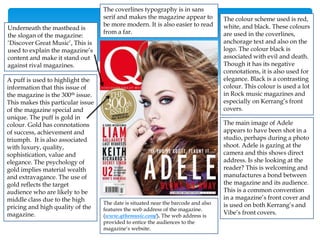
The colour scheme used is red,
white, and black. These colours
are used in the coverlines,
anchorage text and also on the
logo. The colour black is
associated with evil and death.
Though it has its negative
connotations, it is also used for
elegance. Black is a contrasting
colour. This colour is used a lot
in Rock music magazines and
especially on Kerrang’s front
covers.
A puff is used to highlight the
information that this issue of
the magazine is the 300th issue.
This makes this particular issue
of the magazine special and
unique. The puff is gold in
colour. Gold has connotations
of success, achievement and
triumph. It is also associated
with luxury, quality,
sophistication, value and
elegance. The psychology of
gold implies material wealth
and extravagance. The use of
gold reflects the target
audience who are likely to be
middle class due to the high
pricing and high quality of the
magazine.
Underneath the masthead is
the slogan of the magazine:
‘Discover Great Music’, This is
used to explain the magazine’s
content and make it stand out
against rival magazines.
The coverlines typography is in sans
serif and makes the magazine appear to
be more modern. It is also easier to read
from a far.
The main image of Adele
appears to have been shot in a
studio, perhaps during a photo
shoot. Adele is gazing at the
camera and this shows direct
address. Is she looking at the
reader? This is welcoming and
manufactures a bond between
the magazine and its audience.
This is a common convention
in a magazine’s front cover and
is used on both Kerrang’s and
Vibe’s front covers.
The date is situated near the barcode and also
features the web address of the magazine.
(www.qthemusic.com/). The web address is
provided to entice the audiences to the
magazine’s website.
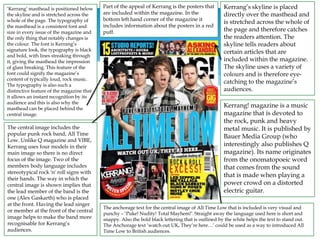
‘Kerrang’ masthead is positioned below
the skyline and is stretched across the
whole of the page. The typography of
the masthead is a consistent font and
size in every issue of the magazine and
the only thing that notably changes is
the colour. The font is Kerrang’s
signature look, the typography is black
and bold, with lines streaking through
it, giving the masthead the impression
of glass breaking. This feature of the
font could signify the magazine’s
content of typically loud, rock music.
The typography is also such a
distinctive feature of the magazine that
it allows an instant recognition by its
audience and this is also why the
masthead can be placed behind the
central image.
Kerrang! magazine is a music
magazine that is devoted to
the rock, punk and heavy
metal music. It is published by
Bauer Media Group (who
interestingly also publishes Q
magazine). Its name originates
from the onomatopoeic word
that comes from the sound
that is made when playing a
power crowd on a distorted
electric guitar.
Kerrang’s skyline is placed
directly over the masthead and
is stretched across the whole of
the page and therefore catches
the readers attention. The
skyline tells readers about
certain articles that are
included within the magazine.
The skyline uses a variety of
colours and is therefore eye-
catching to the magazine’s
audiences.
The anchorage text for the central image of All Time Low that is included is very visual and
punchy – ‘Puke! Nudity! Total Mayhem!’. Straight away the language used here is short and
snappy. Also the bold black lettering that is outlined by the white helps the text to stand out.
The Anchorage text ‘watch out UK, They’re here…’ could be used as a way to introduced All
Time Low to British audiences.
The central image includes the
popular punk rock band, All Time
Low. Unlike Q magazine and VIBE,
Kerrang uses four models in their
main image so there is no direct
focus of the image. Two of the
members body language includes
stereotypical rock 'n' roll signs with
their hands. The way in which the
central image is shown implies that
the lead member of the band is the
one (Alex Gaskarth) who is placed
at the front. Having the lead singer
or member at the front of the central
image helps to make the band more
recognisable for Kerrang’s
audiences.
Part of the appeal of Kerrang is the posters that
are included within the magazine. In the
bottom left hand corner of the magazine it
includes information about the posters in a red
puff.
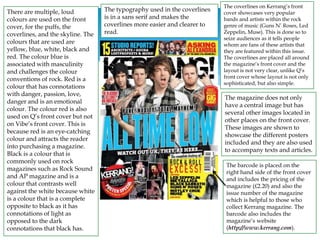
The barcode is placed on the
right hand side of the front cover
and includes the pricing of the
magazine (£2.20) and also the
issue number of the magazine
which is helpful to those who
collect Kerrang magazine. The
barcode also includes the
magazine’s website
(http://www.kerrang.com).
There are multiple, loud
colours are used on the front
cover, for the puffs, the
coverlines, and the skyline. The
colours that are used are
yellow, blue, white, black and
red. The colour blue is
associated with masculinity
and challenges the colour
conventions of rock. Red is a
colour that has connotations
with danger, passion, love,
danger and is an emotional
colour. The colour red is also
used on Q’s front cover but not
on Vibe’s front cover. This is
because red is an eye-catching
colour and attracts the reader
into purchasing a magazine.
Black is a colour that is
commonly used on rock
magazines such as Rock Sound
and AP magazine and is a
colour that contrasts well
against the white because white
is a colour that is a complete
opposite to black as it has
connotations of light as
opposed to the dark
connotations that black has.
The typography used in the coverlines
is in a sans serif and makes the
coverlines more easier and clearer to
read.
The magazine does not only
have a central image but has
several other images located in
other places on the front cover.
These images are shown to
showcase the different posters
included and they are also used
to accompany texts and articles.
The coverlines on Kerrang’s front
cover showcases very popular
bands and artists within the rock
genre of music (Guns N’ Roses, Led
Zeppelin, Muse). This is done so to
seize audiences as it tells people
whom are fans of these artists that
they are featured within this issue.
The coverlines are placed all around
the magazine’s front cover and the
layout is not very clear, unlike Q’s
front cover whose layout is not only
sophisticated, but also simple.

Front Cover Analysis of 3 Music Magazines

  • 3.
    Vibe is amusic magazine that focuses on the R&B and hip-hop music genre. It was founded by producer, Quincy Jones. Production for the magazine however shut down in 2009 before it was purchased by InterMedia Partners. The magazine’s target demographic are followers of the hip- hop and urban culture, between the ages of 18-34 because of its more explicit content. Vibe magazine uses rule of thirds. The use of this allows for the front cover to look professional and helps to keep the coverlines and the images well presented on the page. The colour scheme of the magazine is orange, black, and white. Orange is a enthusiastic colour that is associated with creativity and stimulation. Like red, it is a highly visible colour. White is a contrasting colour and has connotations for light, goodness. It suggests simplicity. It contrasts against black as white has positive connotations. Black is a mysterious colour that is associated with the unknown and generally has negative connotations. But it also has associations with strength, authority, elegance and power. The anchorage text is placed to the left of the central image. ‘Notorious King’ is also part of the anchorage text, it is referring to another R&B and hip-hop artists, Lil Kim, whom has notably argued with Nicki Minaj. Those who have insight about this will be interested in what the article has to say and therefore will purchase the magazine and find out because it’s gossip. The typography to this text is different to the others on the front cover. This text’s typography looks handwritten and gives an almost graffiti effect which would relate to the magazine’s R&B and hip-hop genre of music. Because the typography of this text is completely different to the rest, it attracts the attention of the consumer. The barcode is placed in the bottom left hand corner and includes the price of the magazine ($4.99/£3.15). Similar to Kerrang and Q, the magazine’s website is also included (www.vibe.com/). Though the website is presented differently. It uses graphics that represent the magazine website and this is a common feature on Vibe’s magazine. The use of this graphic encourages the reader to go to the website more than it would if it was written in black and printed in lettering. It appears to be more fun and entertaining. The coverlines are presented clearly and boldly around the central image of Nicki Minaj. The size of the coverlines varies to make a contrast between the articles within the magazine that are being advertised. Some articles will therefore stand out more than other articles will. The typography is sans serif and makes the front cover look more modern and stylish. The different coverlines also vary the use of bold lettering, which makes them stand out more. All of the magazine’s texts are also capitalised so that it is easier to read and much more clearer.
  • 4.
    In this image,Nicki’s body language and facial expression is similar to that of Adele’s on Q’s front cover. Her mouth is shut, her head is to one side and is looking back at the camera. This gives a suggestion of mischief or mystery. She is gazing towards the consumer and this is direct address. Like Q magazine, it is welcoming and creates a kind of bond between the magazine and the consumer. Her hair colour also corresponds to the colour scheme. The use of her orange hair showcases the idea that she is outgoing and confident. Also the tiara and choice of clothing represents Nicki Minaj’s power within the R&B and hip-hop genre of music. The use of Nicki Minaj as the cover model is the magazine’s biggest selling point. The overall look of the magazine is quite sophisticated and modern. This is portrayed through the use of rule of thirds and the colours that are used. It’s quite similar to Q because of this and very different from Kerrang. Vibe’s masthead is located at the very top of the magazine and stretches across the magazine’s front cover. It is therefore clearly visible and noticeable to the magazine’s audience. Like Kerrang! magazine, the font and the size of the masthead are consistent throughout all of the magazine’s issue. The only change in the masthead is the colour that changes to suit the colour scheme of a particular issue. The typography is bold, easy to read and stands out. It is also sans serif and gives the masthead a clearer look and style so that the magazine appears more modern. The colour used for the masthead is orange and orange is a colour that combines the energy and passion of red and the happiness of yellow. It has connotations of joy, sunshine and the tropics and represents determination, success and encouragement. It is also a highly visible colour, so it is used to catch the consumers attention and highlight and important parts to the front cover. It is also the colour of the cover model’s (Nicki Minaj) hair. It could also represent how Nicki Minaj is a very powerful women in the world of hip-hop and R&B. The central image is placed directly in the middle of the page. The image is a medium shot and this therefore gives the front cover more space for the coverlines and anchorage text. The cover model used is Nicki Minaj, she is used for celebrity endorsement as Nicki Minaj is a hugely famous hip- hop and R&B singer and is easily recognised by her eccentric outfits and hairstyles. So people whom are fans of Nicki Minaj will be wanting to buy the magazine because it is implied that she will be included within the issue (this is also supported by the anchorage text).
  • 6.
    ‘Q’ is aBritish magazine that is published monthly. When Q was first published, it was set apart from any other music press because of its production every month and also by its high quality photographs and printing. Q’s masthead is the brightest part of the front cover and is located into the top left-hand corner. The text colour is white and stands out against the red background of the Q. The colour red has connotations for love, power, passion and determination. It is an emotional colour and is a stimulant colour which makes us make quick decisions. Red is the colour that is commonly used in rock music magazines such as NME, Rolling Stone, and Kerrang. Perhaps red is used for ‘Q’ because as it is eye- catching. The colour white on the other hand is associated with light, goodness, and also white adds simplicity to a high quality magazine and the colour also adds a balance to the other colours used on the magazine. The typography of the ‘Q’ is serif and looks sophisticated and adds quality to the magazine. The cover star is Adele. Adele is a very popular music artist in the UK. She is used for celebrity endorsement as those who like Adele’s music will wish to buy the magazine because she is included within the issue. She is shown in close-up shot. This helps to draw attention to Adele’s eyes which stand out due to her long eyelashes and pastel coloured makeup. The emphasis on her eyes, her shut mouth, looking directly at the camera suggests mischief or mystery. Adele’s hair suggest the use of a fan for the windswept look. The image is not central but is placed slightly to the right and is the main focus of the front page, special attention is drawn to Adele’s eyes. ‘Q’ magazine is published by Bauer Media Group which is a European media company that also publishes the British music magazine, Mojo and Kerrang. The anchorage text is ‘If you’ve got it, flaunt it… ADELE’. The pull quote indicates to the reader that Adele has had an interview with the magazine. Therefore those who like Adele and her music will be interested to know what she has to say. There is also use of a pun ‘blows us away’ which relates to the use of the windswept look of Adele’s hair. Coverlines include other popular music acts such as U2 and Liam Gallagher. These coverlines are located on the left hand side and are in one single column. This makes the layout of the cover more organised and simplistic. ‘Q’ magazine’s target audience is the age of 25. We can tell this because at the age of 25, most are working in a full time job and this why the magazine costs £3.99 because then the target audience would still pay. More money also means the magazine puts more into making the magazine a much higher quality. The barcode is located in the bottom right hand corner of the magazine. This is different to where the barcode is situated on Kerrang’s cover as their barcodes are on the left side of the front cover. Q’s barcode is placed on the left side because the right side is devoted to the anchorage text. The price of the magazine is £3.99. This is also where Vibe places their barcode.
  • 7.
    The colour schemeused is red, white, and black. These colours are used in the coverlines, anchorage text and also on the logo. The colour black is associated with evil and death. Though it has its negative connotations, it is also used for elegance. Black is a contrasting colour. This colour is used a lot in Rock music magazines and especially on Kerrang’s front covers. A puff is used to highlight the information that this issue of the magazine is the 300th issue. This makes this particular issue of the magazine special and unique. The puff is gold in colour. Gold has connotations of success, achievement and triumph. It is also associated with luxury, quality, sophistication, value and elegance. The psychology of gold implies material wealth and extravagance. The use of gold reflects the target audience who are likely to be middle class due to the high pricing and high quality of the magazine. Underneath the masthead is the slogan of the magazine: ‘Discover Great Music’, This is used to explain the magazine’s content and make it stand out against rival magazines. The coverlines typography is in sans serif and makes the magazine appear to be more modern. It is also easier to read from a far. The main image of Adele appears to have been shot in a studio, perhaps during a photo shoot. Adele is gazing at the camera and this shows direct address. Is she looking at the reader? This is welcoming and manufactures a bond between the magazine and its audience. This is a common convention in a magazine’s front cover and is used on both Kerrang’s and Vibe’s front covers. The date is situated near the barcode and also features the web address of the magazine. (www.qthemusic.com/). The web address is provided to entice the audiences to the magazine’s website.
  • 9.
    ‘Kerrang’ masthead ispositioned below the skyline and is stretched across the whole of the page. The typography of the masthead is a consistent font and size in every issue of the magazine and the only thing that notably changes is the colour. The font is Kerrang’s signature look, the typography is black and bold, with lines streaking through it, giving the masthead the impression of glass breaking. This feature of the font could signify the magazine’s content of typically loud, rock music. The typography is also such a distinctive feature of the magazine that it allows an instant recognition by its audience and this is also why the masthead can be placed behind the central image. Kerrang! magazine is a music magazine that is devoted to the rock, punk and heavy metal music. It is published by Bauer Media Group (who interestingly also publishes Q magazine). Its name originates from the onomatopoeic word that comes from the sound that is made when playing a power crowd on a distorted electric guitar. Kerrang’s skyline is placed directly over the masthead and is stretched across the whole of the page and therefore catches the readers attention. The skyline tells readers about certain articles that are included within the magazine. The skyline uses a variety of colours and is therefore eye- catching to the magazine’s audiences. The anchorage text for the central image of All Time Low that is included is very visual and punchy – ‘Puke! Nudity! Total Mayhem!’. Straight away the language used here is short and snappy. Also the bold black lettering that is outlined by the white helps the text to stand out. The Anchorage text ‘watch out UK, They’re here…’ could be used as a way to introduced All Time Low to British audiences. The central image includes the popular punk rock band, All Time Low. Unlike Q magazine and VIBE, Kerrang uses four models in their main image so there is no direct focus of the image. Two of the members body language includes stereotypical rock 'n' roll signs with their hands. The way in which the central image is shown implies that the lead member of the band is the one (Alex Gaskarth) who is placed at the front. Having the lead singer or member at the front of the central image helps to make the band more recognisable for Kerrang’s audiences. Part of the appeal of Kerrang is the posters that are included within the magazine. In the bottom left hand corner of the magazine it includes information about the posters in a red puff.
  • 10.
    The barcode isplaced on the right hand side of the front cover and includes the pricing of the magazine (£2.20) and also the issue number of the magazine which is helpful to those who collect Kerrang magazine. The barcode also includes the magazine’s website (http://www.kerrang.com). There are multiple, loud colours are used on the front cover, for the puffs, the coverlines, and the skyline. The colours that are used are yellow, blue, white, black and red. The colour blue is associated with masculinity and challenges the colour conventions of rock. Red is a colour that has connotations with danger, passion, love, danger and is an emotional colour. The colour red is also used on Q’s front cover but not on Vibe’s front cover. This is because red is an eye-catching colour and attracts the reader into purchasing a magazine. Black is a colour that is commonly used on rock magazines such as Rock Sound and AP magazine and is a colour that contrasts well against the white because white is a colour that is a complete opposite to black as it has connotations of light as opposed to the dark connotations that black has. The typography used in the coverlines is in a sans serif and makes the coverlines more easier and clearer to read. The magazine does not only have a central image but has several other images located in other places on the front cover. These images are shown to showcase the different posters included and they are also used to accompany texts and articles. The coverlines on Kerrang’s front cover showcases very popular bands and artists within the rock genre of music (Guns N’ Roses, Led Zeppelin, Muse). This is done so to seize audiences as it tells people whom are fans of these artists that they are featured within this issue. The coverlines are placed all around the magazine’s front cover and the layout is not very clear, unlike Q’s front cover whose layout is not only sophisticated, but also simple.