Research
Methodology
BBA/4514/16 SIMSON TOPPO
SAMPLING
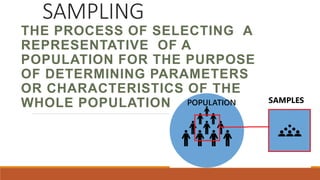
THE PROCESS OF SELECTING A
REPRESENTATIVE OF A
POPULATION FOR THE PURPOSE
OF DETERMINING PARAMETERS
OR CHARACTERISTICS OF THE
WHOLE POPULATION SAMPLESPOPULATION
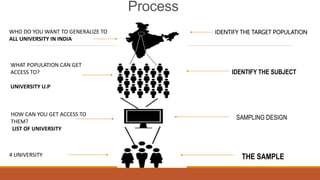
Process
WHO DO YOU WANT TO GENERALIZE TO
ALL UNIVERSITY IN INDIA
WHAT POPULATION CAN GET
ACCESS TO?
UNIVERSITY U.P
HOW CAN YOU GET ACCESS TO
THEM?
LIST OF UNIVERSITY
4 UNIVERSITY
IDENTIFY THE TARGET POPULATION
IDENTIFY THE SUBJECT
SAMPLING DESIGN
THE SAMPLE
Types of
Sampling
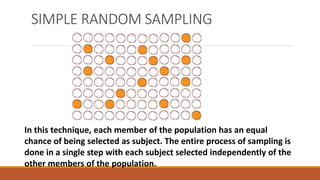
SIMPLE RANDOM SAMPLING
In this technique, each member of the population has an equal
chance of being selected as subject. The entire process of sampling is
done in a single step with each subject selected independently of the
other members of the population.
EXAMPLE:
In a class of 40 students every student gets an equal
opportunity to be selected as a class representative.
In this each and every individual of the population
is given an equal chance of being included in the
sample. It is also known as representative sampling
Advantages of Simple Random Sampling
One of the best things about simple random sampling is the ease of
assembling the sample. It is also considered as a fair way of
selecting a sample from a given population since every member is
given equal opportunities of being selected.
Another key feature of simple random sampling is its
representativeness of the population. Theoretically, the only thing
that can compromise its representativeness is luck. If the sample is
not representative of the population, the random variation is called
sampling error.
Disadvantages of Simple Random
Sampling
One of the most obvious limitations of simple
random sampling method is its need of a complete
list of all the members of the population. Please
keep in mind that the list of the population must be
complete and up-to-date. This list is usually not
available for large populations. In cases as such, it is
wiser to use other sampling techniques.
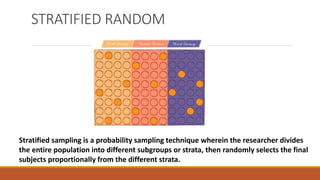
STRATIFIED RANDOM
Stratified sampling is a probability sampling technique wherein the researcher divides
the entire population into different subgroups or strata, then randomly selects the final
subjects proportionally from the different strata.
GPA of college students across the INDIA
For example, suppose a research team wants to determine the GPA of college students across
the INDIA. The research team has difficulty collecting data from all 21 million college students;
it decides to take a random sample of the population by using 4,000 students.
Now assume that the team looks at the different attributes of the sample participants and
wonders if there are any differences in GPAs and students’ majors. Suppose it finds that 560
students are English majors, 1135 are science majors, 800 are computer science majors, 1090
are engineering majors, and 415 are math majors. The team wants to use a proportional
stratified random sample where the stratum of the sample is proportional to the random
sample in the population.
Assume the team researches the demographics of college students in the INDIA and finds the
percentage of what students major in: 12% major in English, 28% major in science, 24% major
in computer science, 21% major in engineering and 15% major in mathematics. Thus, five strata
are created from the stratified random sampling process.
The team then needs to confirm that the stratum of the population is in proportion to the
stratum in the sample; however, they find the proportions are not equal. The team then needs
to resample 4,000 students from the population and randomly select 480 English, 1120 science,
960 computer science, 840 engineering, and 600 mathematics students. With those, it has a
proportionate stratified random sample of college students, which provides a better
representation of students' college majors in the INDIA. The researchers can then highlight
specific stratum, observe the varying studies of INDIA college students and observe the varying
grade point averages.
The same method used above can be used for the polling of elections, income of varying
populations, and income for different jobs across a nation, just to list a few of the applications.
Advantages Of Stratified Random
The biggest advantage of stratified random sampling is
that it reduces selection bias. Stratifying the entire
population before applying random sampling methods
helps ensure a sample that accurately reflects the
population being studied in terms of the criteria used for
stratification.
Stratified random sampling is also advantageous when it
can be used accurately because it ensures each subgroup
within the population receives proper representation
within the sample.
Disadvantages Of Stratified Random
stratified random sampling cannot be used in every study. The method's
disadvantage is that several conditions must be met for it to be used properly.
Researchers must identify every member of a population being studied and
classify each of them into one, and only one, subpopulation.
The other challenge is accurately sorting each member of the population into a
single stratum. The above example makes it easy; undergraduate, graduate,
male and female are clearly defined groups. In other situations, however, it is
far more difficult. Imagine bringing defining characteristics such as race,
ethnicity or religion into play. The sorting process becomes more difficult,
rendering stratified random sampling an ineffective and less than ideal
method.
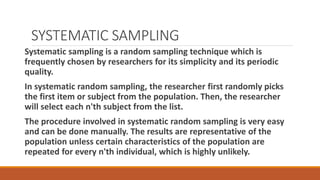
SYSTEMATIC SAMPLING
Systematic sampling is a random sampling technique which is
frequently chosen by researchers for its simplicity and its periodic
quality.
In systematic random sampling, the researcher first randomly picks
the first item or subject from the population. Then, the researcher
will select each n'th subject from the list.
The procedure involved in systematic random sampling is very easy
and can be done manually. The results are representative of the
population unless certain characteristics of the population are
repeated for every n'th individual, which is highly unlikely.
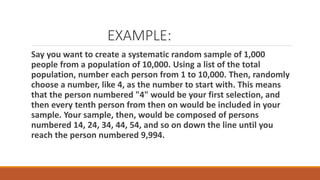
EXAMPLE:
Say you want to create a systematic random sample of 1,000
people from a population of 10,000. Using a list of the total
population, number each person from 1 to 10,000. Then, randomly
choose a number, like 4, as the number to start with. This means
that the person numbered "4" would be your first selection, and
then every tenth person from then on would be included in your
sample. Your sample, then, would be composed of persons
numbered 14, 24, 34, 44, 54, and so on down the line until you
reach the person numbered 9,994.
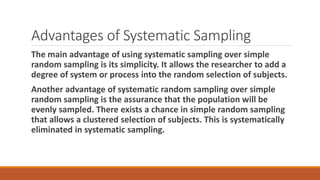
Advantages of Systematic Sampling
The main advantage of using systematic sampling over simple
random sampling is its simplicity. It allows the researcher to add a
degree of system or process into the random selection of subjects.
Another advantage of systematic random sampling over simple
random sampling is the assurance that the population will be
evenly sampled. There exists a chance in simple random sampling
that allows a clustered selection of subjects. This is systematically
eliminated in systematic sampling.
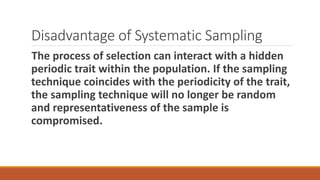
Disadvantage of Systematic Sampling
The process of selection can interact with a hidden
periodic trait within the population. If the sampling
technique coincides with the periodicity of the trait,
the sampling technique will no longer be random
and representativeness of the sample is
compromised.
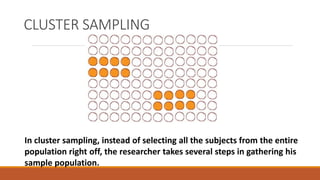
CLUSTER SAMPLING
In cluster sampling, instead of selecting all the subjects from the entire
population right off, the researcher takes several steps in gathering his
sample population.
EXAMPLE:
A researcher wants to survey academic performance of high school students in
India.
1. He can divide the entire population (population of Spain) into different
clusters (cities).
2. Then the researcher selects a number of clusters depending on his research
through simple or systematic random sampling.
3. Then, from the selected clusters (randomly selected cities) the researcher
can either include all the high school students as subjects or he can select a
number of subjects from each cluster through simple or systematic random
sampling.
The important thing to remember about this sampling technique is to give all
the clusters equal chances of being selected.
Advantages of Cluster Sampling
Cluster sampling is less expensive and more quick. It is more economical to
observe clusters of units in a population than randomly selected units
scattered over throughout the state.
Cluster Sample permits each accumulation of large samples.
The loss of precision per individual case is more than compensated for by the
possibility of studying larger samples for the same cost.
Cluster sample may combine the advantages of both random sampling as well
as stratified sampling.
Cluster sampling procedure enables to obtain information from one or more
areas.
Disadvantages of Cluster Sampling
In a cluster sample, each cluster may be composed of units that is
like one another. This may produce large sampling error and reduce
the representativeness of the sample.
In Cluster sampling, when unequal size of some of the subsets is
selected, an element of sample bias will arise.
This type of sampling may not be possible to apply its findings to
another area.
Sometimes, adequate number of cases from the stand point of
increasing the precision of sample is not selected, an overlapping
effect may take place.
Data collection is the process of gathering and measuring information on targeted variables in
an established systematic fashion, which then enables one to answer relevant questions and
evaluate outcomes. Data collection is a component of research in all fields of study
including physical and social sciences, humanities, and business. While methods vary by
discipline, the emphasis on ensuring accurate and honest collection remains the same. The goal
for all data collection is to capture quality evidence that allows analysis to lead to the
formulation of convincing and credible answers to the questions that have been posed.
TYPES OF DATA
A common classification is based upon who collected the data.
Primary data: Data collected by the investigator himself/ herself for a specific purpose.
Examples: Data collected by a student for his/her thesis or research project.
(In movies) The hero is directly told by the heroine that he is her “ideal man”.
Secondary data: Data collected by someone else for some other purpose (but being utilized by
the investigator for another purpose).
Examples: Census data being used to analyze the impact of education on career choice and
earning.
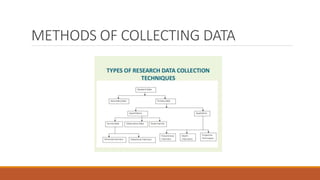
METHODS OF COLLECTING DATA
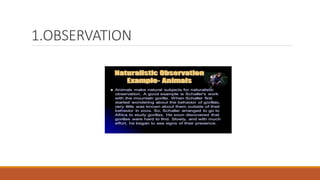
1.OBSERVATION
2.SURVEY
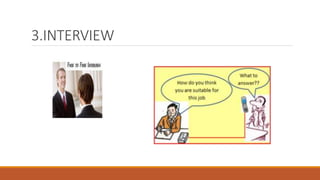
3.INTERVIEW

Research

  • 1.
  • 2.
    SAMPLING THE PROCESS OFSELECTING A REPRESENTATIVE OF A POPULATION FOR THE PURPOSE OF DETERMINING PARAMETERS OR CHARACTERISTICS OF THE WHOLE POPULATION SAMPLESPOPULATION
  • 3.
    Process WHO DO YOUWANT TO GENERALIZE TO ALL UNIVERSITY IN INDIA WHAT POPULATION CAN GET ACCESS TO? UNIVERSITY U.P HOW CAN YOU GET ACCESS TO THEM? LIST OF UNIVERSITY 4 UNIVERSITY IDENTIFY THE TARGET POPULATION IDENTIFY THE SUBJECT SAMPLING DESIGN THE SAMPLE
  • 4.
  • 5.
    SIMPLE RANDOM SAMPLING Inthis technique, each member of the population has an equal chance of being selected as subject. The entire process of sampling is done in a single step with each subject selected independently of the other members of the population.
  • 6.
    EXAMPLE: In a classof 40 students every student gets an equal opportunity to be selected as a class representative. In this each and every individual of the population is given an equal chance of being included in the sample. It is also known as representative sampling
  • 7.
    Advantages of SimpleRandom Sampling One of the best things about simple random sampling is the ease of assembling the sample. It is also considered as a fair way of selecting a sample from a given population since every member is given equal opportunities of being selected. Another key feature of simple random sampling is its representativeness of the population. Theoretically, the only thing that can compromise its representativeness is luck. If the sample is not representative of the population, the random variation is called sampling error.
  • 8.
    Disadvantages of SimpleRandom Sampling One of the most obvious limitations of simple random sampling method is its need of a complete list of all the members of the population. Please keep in mind that the list of the population must be complete and up-to-date. This list is usually not available for large populations. In cases as such, it is wiser to use other sampling techniques.
  • 9.
    STRATIFIED RANDOM Stratified samplingis a probability sampling technique wherein the researcher divides the entire population into different subgroups or strata, then randomly selects the final subjects proportionally from the different strata.
  • 10.
    GPA of collegestudents across the INDIA For example, suppose a research team wants to determine the GPA of college students across the INDIA. The research team has difficulty collecting data from all 21 million college students; it decides to take a random sample of the population by using 4,000 students. Now assume that the team looks at the different attributes of the sample participants and wonders if there are any differences in GPAs and students’ majors. Suppose it finds that 560 students are English majors, 1135 are science majors, 800 are computer science majors, 1090 are engineering majors, and 415 are math majors. The team wants to use a proportional stratified random sample where the stratum of the sample is proportional to the random sample in the population. Assume the team researches the demographics of college students in the INDIA and finds the percentage of what students major in: 12% major in English, 28% major in science, 24% major in computer science, 21% major in engineering and 15% major in mathematics. Thus, five strata are created from the stratified random sampling process.
  • 11.
    The team thenneeds to confirm that the stratum of the population is in proportion to the stratum in the sample; however, they find the proportions are not equal. The team then needs to resample 4,000 students from the population and randomly select 480 English, 1120 science, 960 computer science, 840 engineering, and 600 mathematics students. With those, it has a proportionate stratified random sample of college students, which provides a better representation of students' college majors in the INDIA. The researchers can then highlight specific stratum, observe the varying studies of INDIA college students and observe the varying grade point averages. The same method used above can be used for the polling of elections, income of varying populations, and income for different jobs across a nation, just to list a few of the applications.
  • 12.
    Advantages Of StratifiedRandom The biggest advantage of stratified random sampling is that it reduces selection bias. Stratifying the entire population before applying random sampling methods helps ensure a sample that accurately reflects the population being studied in terms of the criteria used for stratification. Stratified random sampling is also advantageous when it can be used accurately because it ensures each subgroup within the population receives proper representation within the sample.
  • 13.
    Disadvantages Of StratifiedRandom stratified random sampling cannot be used in every study. The method's disadvantage is that several conditions must be met for it to be used properly. Researchers must identify every member of a population being studied and classify each of them into one, and only one, subpopulation. The other challenge is accurately sorting each member of the population into a single stratum. The above example makes it easy; undergraduate, graduate, male and female are clearly defined groups. In other situations, however, it is far more difficult. Imagine bringing defining characteristics such as race, ethnicity or religion into play. The sorting process becomes more difficult, rendering stratified random sampling an ineffective and less than ideal method.
  • 14.
    SYSTEMATIC SAMPLING Systematic samplingis a random sampling technique which is frequently chosen by researchers for its simplicity and its periodic quality. In systematic random sampling, the researcher first randomly picks the first item or subject from the population. Then, the researcher will select each n'th subject from the list. The procedure involved in systematic random sampling is very easy and can be done manually. The results are representative of the population unless certain characteristics of the population are repeated for every n'th individual, which is highly unlikely.
  • 15.
    EXAMPLE: Say you wantto create a systematic random sample of 1,000 people from a population of 10,000. Using a list of the total population, number each person from 1 to 10,000. Then, randomly choose a number, like 4, as the number to start with. This means that the person numbered "4" would be your first selection, and then every tenth person from then on would be included in your sample. Your sample, then, would be composed of persons numbered 14, 24, 34, 44, 54, and so on down the line until you reach the person numbered 9,994.
  • 16.
    Advantages of SystematicSampling The main advantage of using systematic sampling over simple random sampling is its simplicity. It allows the researcher to add a degree of system or process into the random selection of subjects. Another advantage of systematic random sampling over simple random sampling is the assurance that the population will be evenly sampled. There exists a chance in simple random sampling that allows a clustered selection of subjects. This is systematically eliminated in systematic sampling.
  • 17.
    Disadvantage of SystematicSampling The process of selection can interact with a hidden periodic trait within the population. If the sampling technique coincides with the periodicity of the trait, the sampling technique will no longer be random and representativeness of the sample is compromised.
  • 18.
    CLUSTER SAMPLING In clustersampling, instead of selecting all the subjects from the entire population right off, the researcher takes several steps in gathering his sample population.
  • 19.
    EXAMPLE: A researcher wantsto survey academic performance of high school students in India. 1. He can divide the entire population (population of Spain) into different clusters (cities). 2. Then the researcher selects a number of clusters depending on his research through simple or systematic random sampling. 3. Then, from the selected clusters (randomly selected cities) the researcher can either include all the high school students as subjects or he can select a number of subjects from each cluster through simple or systematic random sampling. The important thing to remember about this sampling technique is to give all the clusters equal chances of being selected.
  • 20.
    Advantages of ClusterSampling Cluster sampling is less expensive and more quick. It is more economical to observe clusters of units in a population than randomly selected units scattered over throughout the state. Cluster Sample permits each accumulation of large samples. The loss of precision per individual case is more than compensated for by the possibility of studying larger samples for the same cost. Cluster sample may combine the advantages of both random sampling as well as stratified sampling. Cluster sampling procedure enables to obtain information from one or more areas.
  • 21.
    Disadvantages of ClusterSampling In a cluster sample, each cluster may be composed of units that is like one another. This may produce large sampling error and reduce the representativeness of the sample. In Cluster sampling, when unequal size of some of the subsets is selected, an element of sample bias will arise. This type of sampling may not be possible to apply its findings to another area. Sometimes, adequate number of cases from the stand point of increasing the precision of sample is not selected, an overlapping effect may take place.
  • 23.
    Data collection isthe process of gathering and measuring information on targeted variables in an established systematic fashion, which then enables one to answer relevant questions and evaluate outcomes. Data collection is a component of research in all fields of study including physical and social sciences, humanities, and business. While methods vary by discipline, the emphasis on ensuring accurate and honest collection remains the same. The goal for all data collection is to capture quality evidence that allows analysis to lead to the formulation of convincing and credible answers to the questions that have been posed.
  • 24.
    TYPES OF DATA Acommon classification is based upon who collected the data. Primary data: Data collected by the investigator himself/ herself for a specific purpose. Examples: Data collected by a student for his/her thesis or research project. (In movies) The hero is directly told by the heroine that he is her “ideal man”. Secondary data: Data collected by someone else for some other purpose (but being utilized by the investigator for another purpose). Examples: Census data being used to analyze the impact of education on career choice and earning.
  • 25.
  • 26.
  • 27.
  • 28.