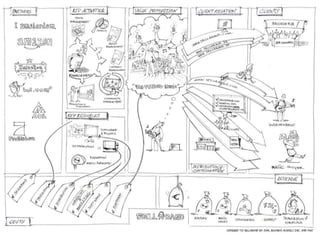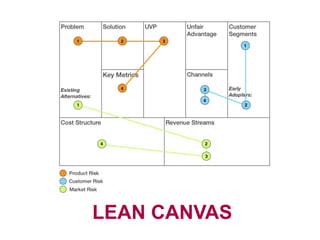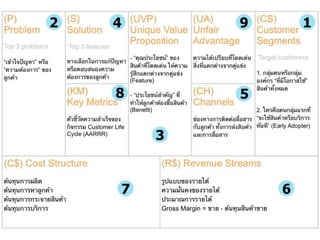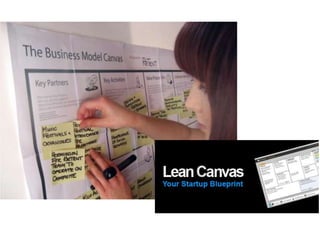
LEAN CANVAS
REQUIREMENT
GATHERING
HUMAN COMPUTER INTERACTION
AND
INDEX
1. Introduction
2. Definition
3. Gathering Requirements
4. Lean canvas
5. Workshops & Assignment
INTRODUCTION
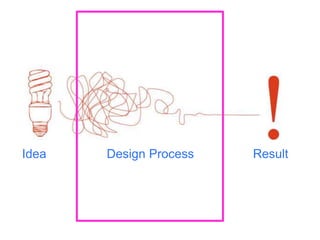
Idea Design Process Result
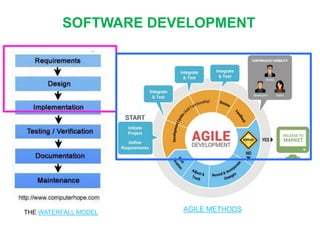
SOFTWARE DEVELOPMENT
THE WATERFALL MODEL AGILE METHODS
DEFINITIONS
requirement
[ri-kwahyuh r-muh nt]
Noun
1.that which is required; a thing demanded or
obligatory:
One of the requirements of the job is accuracy.
2.an act or instance of requiring.
3.a need or necessity:
to meet the requirements of daily life.
re·quire·ment
http://dictionary.reference.com/
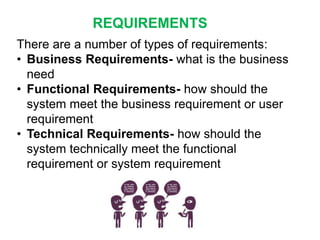
REQUIREMENTS
There are a number of types of requirements:
• Business Requirements- what is the business
need
• Functional Requirements- how should the
system meet the business requirement or user
requirement
• Technical Requirements- how should the
system technically meet the functional
requirement or system requirement
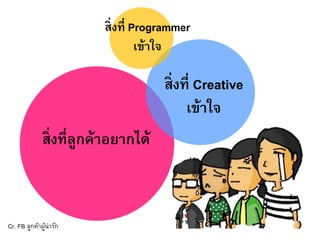
สิ่งที่ลูกค้าอยากได้
สิ่งที่ Creative
เข้าใจ
สิ่งที่ Programmer
เข้าใจ
Cr. FB ลูกค้าผู้น่ารัก
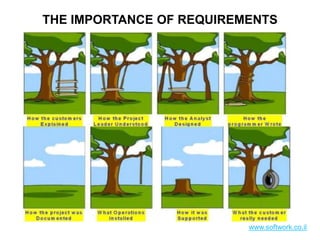
THE IMPORTANCE OF REQUIREMENTS
www.softwork.co.il
• Complete (express a whole idea or statement)
• Correct (technically and legally possible)
• Clear (unambiguous and not confusing)
• Verifiable (it can be determined that the system meets
the requirement)
• Necessary (should support one of the project goals)
• Feasible (can be accomplished within cost and
schedule)
• Prioritized (tracked according to business need levels)
• Consistent (not in conflict with other requirements)
• Traceable (uniquely identified and tracked)
• Modular (can be changed without excessive impact)
• Design-independent (do not pose specific solutions on
design)
A GOOD REQUIREMENT
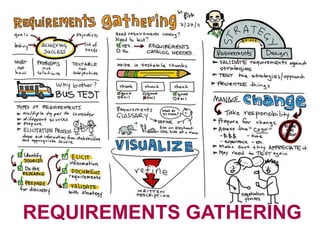
REQUIREMENTS GATHERING
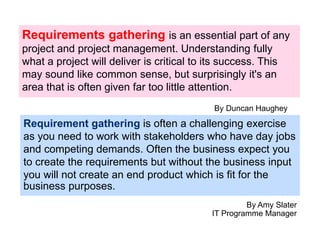
Requirements gathering is an essential part of any
project and project management. Understanding fully
what a project will deliver is critical to its success. This
may sound like common sense, but surprisingly it's an
area that is often given far too little attention.
By Duncan Haughey
Requirement gathering is often a challenging exercise
as you need to work with stakeholders who have day jobs
and competing demands. Often the business expect you
to create the requirements but without the business input
you will not create an end product which is fit for the
business purposes.
By Amy Slater
IT Programme Manager
GATHERING TECHNIQUES
1. One-on-one interviews
2. Group interviews
3. Facilitated sessions
4. Joint application development (JAD)
5. Questionnaires
6. Prototyping
7. Use cases
8. Following people around
9. Request for proposals (RFPs)
10.Brainstorming
LEAN CANVAS
WORKSHOP & ASSIGNMETS
Assignment
1. ทำอย่ำงไรให้แต่งตัวไม่เรียบร้อยมำเรียน แต่งตัวถูกระเบียบ
2. ทำอย่ำงไรให้คนอยำกมำบริจำคเลือด
3. ทำยังไงให้อยำกคนแข่งไตรกีฬำ กำรเตรียมควำมพร้อมสำหรับกำรไปแข่ง
ไตรกีฬำ
4. ทำยังไงให้คนอยำกทำควำมดี
5. ทำยังไงให้คนไม่ฆ่ำตัวตำย
6. ทำยังไงให้คนอยำกเข้ำวัด สวดมนต์ ทำบุญ ( ไม่ได้จำกัดศำสนำ)
7. ทำยังไงให้คนเก่งภำษำอังกฤษ
8. ทำยังไงให้คนไม่ชอบเล่นกีฬำ อยำกจะมำออกกำลังกำย
9. ทำยังไงให้คนหลับยำก นอนหลับง่ำย
10. ทำไงให้คนรู้จักประหยัดไฟประหยัดน้ำ

Requirement gathering-and-lean-canvas

  • 1.
  • 2.
    INDEX 1. Introduction 2. Definition 3.Gathering Requirements 4. Lean canvas 5. Workshops & Assignment
  • 3.
  • 4.
  • 6.
  • 7.
  • 8.
    requirement [ri-kwahyuh r-muh nt] Noun 1.thatwhich is required; a thing demanded or obligatory: One of the requirements of the job is accuracy. 2.an act or instance of requiring. 3.a need or necessity: to meet the requirements of daily life. re·quire·ment http://dictionary.reference.com/
  • 9.
    REQUIREMENTS There are anumber of types of requirements: • Business Requirements- what is the business need • Functional Requirements- how should the system meet the business requirement or user requirement • Technical Requirements- how should the system technically meet the functional requirement or system requirement
  • 10.
  • 11.
    THE IMPORTANCE OFREQUIREMENTS www.softwork.co.il
  • 12.
    • Complete (expressa whole idea or statement) • Correct (technically and legally possible) • Clear (unambiguous and not confusing) • Verifiable (it can be determined that the system meets the requirement) • Necessary (should support one of the project goals) • Feasible (can be accomplished within cost and schedule) • Prioritized (tracked according to business need levels) • Consistent (not in conflict with other requirements) • Traceable (uniquely identified and tracked) • Modular (can be changed without excessive impact) • Design-independent (do not pose specific solutions on design) A GOOD REQUIREMENT
  • 13.
  • 14.
    Requirements gathering isan essential part of any project and project management. Understanding fully what a project will deliver is critical to its success. This may sound like common sense, but surprisingly it's an area that is often given far too little attention. By Duncan Haughey Requirement gathering is often a challenging exercise as you need to work with stakeholders who have day jobs and competing demands. Often the business expect you to create the requirements but without the business input you will not create an end product which is fit for the business purposes. By Amy Slater IT Programme Manager
  • 16.
    GATHERING TECHNIQUES 1. One-on-oneinterviews 2. Group interviews 3. Facilitated sessions 4. Joint application development (JAD) 5. Questionnaires 6. Prototyping 7. Use cases 8. Following people around 9. Request for proposals (RFPs) 10.Brainstorming
  • 18.
  • 21.
  • 22.
    Assignment 1. ทำอย่ำงไรให้แต่งตัวไม่เรียบร้อยมำเรียน แต่งตัวถูกระเบียบ 2.ทำอย่ำงไรให้คนอยำกมำบริจำคเลือด 3. ทำยังไงให้อยำกคนแข่งไตรกีฬำ กำรเตรียมควำมพร้อมสำหรับกำรไปแข่ง ไตรกีฬำ 4. ทำยังไงให้คนอยำกทำควำมดี 5. ทำยังไงให้คนไม่ฆ่ำตัวตำย 6. ทำยังไงให้คนอยำกเข้ำวัด สวดมนต์ ทำบุญ ( ไม่ได้จำกัดศำสนำ) 7. ทำยังไงให้คนเก่งภำษำอังกฤษ 8. ทำยังไงให้คนไม่ชอบเล่นกีฬำ อยำกจะมำออกกำลังกำย 9. ทำยังไงให้คนหลับยำก นอนหลับง่ำย 10. ทำไงให้คนรู้จักประหยัดไฟประหยัดน้ำ

Editor's Notes

  • #5 When Start up project
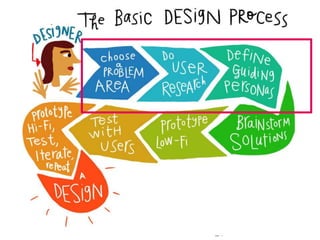
  • #6 A basic design process > problem search > research > designing > persona storyboard prototype
  • #7 sets of requirements are used as inputs into the design stages of product development. Requirements are also an important input into the verification process, since tests should trace back to specific requirements. Requirements show what elements and functions are necessary for the particular project. This is reflected in the waterfall model of the software life-cycle. However, when iterative methods of software development or agile methods are used, the system requirements are incrementally developed in parallel with design and implementation. wiki
  • #9 Obligatory = การบังคับ / เป็นภาระ
  • #10 detailed descriptions of the information, business activities, business rules and interactions needed to accomplish the business mission. Functional requirements describe the view from the user’s perspective of how the system or process will work A technical requirement that describes specifically how the business problem will be solved, and reflects the view from the technical world
  • #12 Organizations need to effectively define and manage requirements to help ensure they the end solution meets the customer/ stakeholder needs, while addressing compliance and staying on schedule and within budget.
  • #13 ที่สมบูรณ์แบบ (แสดงความคิดทั้งหมดหรือคำสั่ง) ที่ถูกต้อง (ในทางเทคนิคและเป็นไปได้ตามกฎหมาย) (แบบใสชัดเจนและไม่ทำให้เกิดความสับสน) ตรวจสอบได้ (มันสามารถกำหนดได้ว่าระบบที่เป็นไปตามความต้องการ) จำเป็น (ควรสนับสนุนหนึ่งในเป้าหมายของโครงการ) ความเป็นไปได้ (สามารถทำได้ภายในค่าใช้จ่ายและตาราง) จัดลำดับความสำคัญ (การติดตามตามธุรกิจต้องระดับ) ที่สอดคล้องกัน (ไม่ได้อยู่ในความขัดแย้งกับข้อกำหนดอื่น ๆ ) ตรวจสอบย้อนกลับ (ระบุเอกลักษณ์และการติดตาม) Modular (สามารถเปลี่ยนแปลงได้โดยไม่ส่งผลกระทบมากเกินไป) การออกแบบที่เป็นอิสระ (ไม่ก่อให้เกิดโซลูชั่นที่เฉพาะเจาะจงในการออกแบบ) accomplished – success
  • #14 การเก็บความต้องการของลูกค้า (Requirement Gathering)
  • #15 เก็บความต้องการของลูกค้า (Requirement Gathering) อย่างไรให้ประสบความสำเร็จ การเก็บความต้องการของลูกค้า (Requirement Gathering) คือการเก็บรวบรวมความต้องการของลูกค้าก่อนเริ่มการพัฒนาระบบ หรือพัฒนาเว็บไซต์ ซึ่งกระบวนการนี้เป็น ขั้นตอนที่ค่อนข้างสำคัญมาก งานจะเสร็จในช่วงเวลาใด หรือควรใช้เทคโนโลยีแบบใด ในการพัฒนาจะสามารถเริ่มวิเคราะห์ได้จากขั้นตอนนี้ ซึ่งถ้าหากคุณรับเขียนเว็บไซต์ให้กับบริษัทต่าง ๆ นั้น เราควรจะวางแผนก่อนการไปเก็บความต้องการของลูกค้าว่า เราจะเก็บอย่างไร และควรคำนึงถึงวิธีป้องกันการเปลี่ยนแปลงความต้องการของลูกค้าด้วยนะครับ โดยผมขอยกตัวอย่างรายละเอียดอย่างย่อของการไปเก็บความต้องการของลูกค้าดังนี้  1. วัตถุประสงค์ หรือ เป้าหมายของการจัดการระบบ หรือเว็บไซต์ ว่าคืออะไรเราจะได้เข้าใจถึงทิศทางนั้น ๆ  2. เก็บหน้าที่การทำงานที่เป็น ส่วนหลักก่อน จับใจความให้ได้ว่ามี เมนูอะไรบ้าง  3. มองส่วนหลักให้ออก และค่อยแตกย่อยลงไปในแต่ละส่วน ของความต้องการหลัก 4. นำทั้งหมดมาเชื่อมต่อกัน พยายามนึกถึงหน้าโปรแกรมว่าจะเป็นเ่ช่นไร เพื่อให้สามารถเข้าใจงานได้มากขึ้น 5. เก็บความต้องการด้านอื่น ๆ เช่น ความปลอดภัย (Security), ความเสถียร (Reliability) และการปรับปรุงต่อยอด (Evolution) 6. แนะนำวิธีป้องกันการเปลี่ยนแปลงความต้องการของลูกค้า โดยรบกวนให้ทางลูกค้าเซ็นต์ชื่อกำกับ ในแต่ละใบเอกสารที่บอกถึงรายละเอียดความต้องการ  
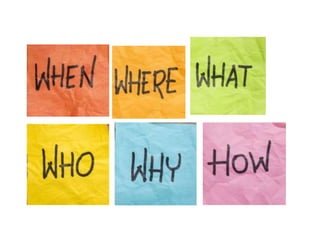
  • #16 Who มีใครเกี่ยวข้องบ้าง? บทบาทของแต่ละคนนั้นคืออะไร? และใครเป็น บุคคลแท้จริงที่ร้องขอเพื่อพัฒนาระบบใหม่? What อะไรคือสิ่งที่ทำให้เกิดปัญหา? มีฟังก์ชันการทำงานอะไรบ้าง? ระบบที่ต้องการหรือระบบที่อยากได้คือระบบอะไร? When ระบบติดตั้งได้เมื่อไร? ผู้สนับสนุนเงินทุน พร้อมสนับสนุนเมื่อไร? ทดสอบระบบใหม่เมื่อไร? Where บริเวณสถานที่ใด ที่ระบบใหม่สามารถดำเนินการได้อย่างเหมาะสม Why ทำไมต้องเสาะแสวงหาระบบใหม่? ทำไมผู้ใช้จึงเชื่อว่าระบบใหม่สามารถ แก้ไขปัญหาให้กับเขาได้ How ระบบใหม่จะทำงานได้อย่างไร? มีข้อจำกัดอย่างไร?