ONLINE SHOPPING PORTAL
Project Plan
Team Members
Piyushree (29036)
Ranjani (29041)
Sivaraj Kumar (29053)
Akankshya Agarwal (29062)
Anandavel S (29122)
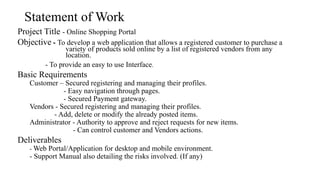
Statement of Work
Project Title - Online Shopping Portal
Objective - To develop a web application that allows a registered customer to purchase a
variety of products sold online by a list of registered vendors from any
location.
- To provide an easy to use Interface.
Basic Requirements
Customer – Secured registering and managing their profiles.
- Easy navigation through pages.
- Secured Payment gateway.
Vendors - Secured registering and managing their profiles.
- Add, delete or modify the already posted items.
Administrator - Authority to approve and reject requests for new items.
- Can control customer and Vendors actions.
Deliverables
- Web Portal/Application for desktop and mobile environment.
- Support Manual also detailing the risks involved. (If any)
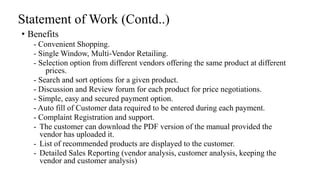
Statement of Work (Contd..)
• Benefits
- Convenient Shopping.
- Single Window, Multi-Vendor Retailing.
- Selection option from different vendors offering the same product at different
prices.
- Search and sort options for a given product.
- Discussion and Review forum for each product for price negotiations.
- Simple, easy and secured payment option.
- Auto fill of Customer data required to be entered during each payment.
- Complaint Registration and support.
- The customer can download the PDF version of the manual provided the
vendor has uploaded it.
- List of recommended products are displayed to the customer.
- Detailed Sales Reporting (vendor analysis, customer analysis, keeping the
vendor and customer analysis)
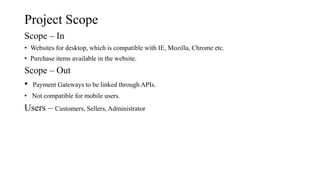
Project Scope
Scope – In
• Websites for desktop, which is compatible with IE, Mozilla, Chrome etc.
• Purchase items available in the website.
Scope – Out
• Payment Gateways to be linked through APIs.
• Not compatible for mobile users.
Users – Customers, Sellers, Administrator
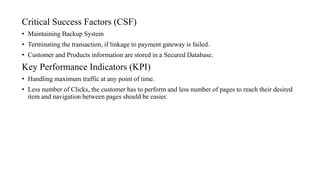
Critical Success Factors (CSF)
• Maintaining Backup System
• Terminating the transaction, if linkage to payment gateway is failed.
• Customer and Products information are stored in a Secured Database.
Key Performance Indicators (KPI)
• Handling maximum traffic at any point of time.
• Less number of Clicks, the customer has to perform and less number of pages to reach their desired
item and navigation between pages should be easier.
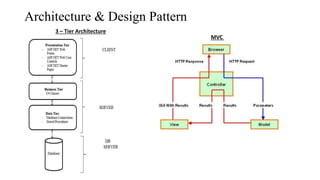
Architecture & Design Pattern
MVC
3 – Tier Architecture
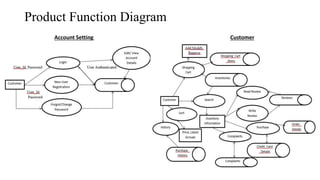
Product Function Diagram
Account Setting Customer
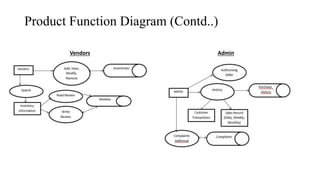
Product Function Diagram (Contd..)
Vendors Admin
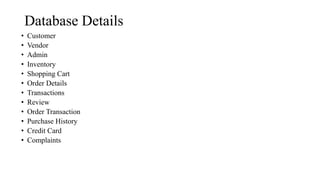
Database Details
• Customer
• Vendor
• Admin
• Inventory
• Shopping Cart
• Order Details
• Transactions
• Review
• Order Transaction
• Purchase History
• Credit Card
• Complaints
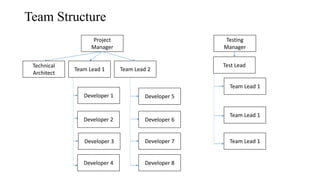
Team Structure
Project
Manager
Technical
Architect
Team Lead 1 Team Lead 2
Developer 4
Developer 1
Developer 2
Developer 3
Developer 5
Developer 6
Developer 8
Developer 7
Testing
Manager
Team Lead 1
Team Lead 1
Team Lead 1
Test Lead
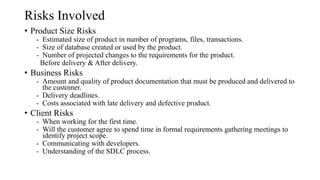
Risks Involved
• Product Size Risks
- Estimated size of product in number of programs, files, transactions.
- Size of database created or used by the product.
- Number of projected changes to the requirements for the product.
Before delivery & After delivery.
• Business Risks
- Amount and quality of product documentation that must be produced and delivered to
the customer.
- Delivery deadlines.
- Costs associated with late delivery and defective product.
• Client Risks
- When working for the first time.
- Will the customer agree to spend time in formal requirements gathering meetings to
identify project scope.
- Communicating with developers.
- Understanding of the SDLC process.
Risks Involved (Contd..)
• Resource Risks
- Number of Resources and skillsets.
- Commitment for entire duration.
• Technology Risks
- Customer demanding new technology
- Requirements put excessive performance constraints on the product.
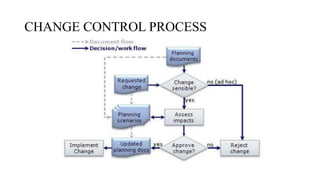
Possible Origins of Change
• New business or market conditions
• Customer demand
• Budgetary or scheduling constraints
CHANGE CONTROL PROCESS
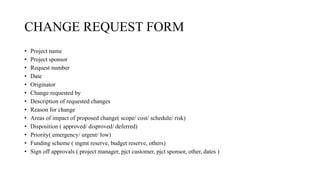
CHANGE REQUEST FORM
• Project name
• Project sponsor
• Request number
• Date
• Originator
• Change requested by
• Description of requested changes
• Reason for change
• Areas of impact of proposed change( scope/ cost/ schedule/ risk)
• Disposition ( approved/ disproved/ deferred)
• Priority( emergency/ urgent/ low)
• Funding scheme ( mgmt reserve, budget reserve, others)
• Sign off approvals ( project manager, pjct customer, pjct sponsor, other, dates )
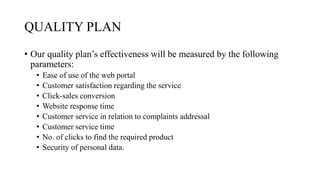
QUALITY PLAN
• Our quality plan’s effectiveness will be measured by the following
parameters:
• Ease of use of the web portal
• Customer satisfaction regarding the service
• Click-sales conversion
• Website response time
• Customer service in relation to complaints addressal
• Customer service time
• No. of clicks to find the required product
• Security of personal data.
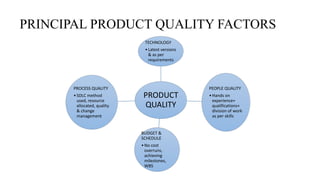
PRINCIPAL PRODUCT QUALITY FACTORS
PRODUCT
QUALITY
TECHNOLOGY
•Latest versions
& as per
requirements
PEOPLE QUALITY
•Hands on
experience+
qualifications+
division of work
as per skills
BUDGET &
SCHEDULE
•No cost
overruns,
achieving
milestones,
WBS
PROCESS QUALITY
•SDLC method
used, resource
allocated, quality
& change
management
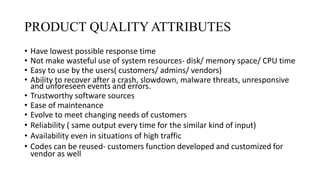
PRODUCT QUALITY ATTRIBUTES
• Have lowest possible response time
• Not make wasteful use of system resources- disk/ memory space/ CPU time
• Easy to use by the users( customers/ admins/ vendors)
• Ability to recover after a crash, slowdown, malware threats, unresponsive
and unforeseen events and errors.
• Trustworthy software sources
• Ease of maintenance
• Evolve to meet changing needs of customers
• Reliability ( same output every time for the similar kind of input)
• Availability even in situations of high traffic
• Codes can be reused- customers function developed and customized for
vendor as well
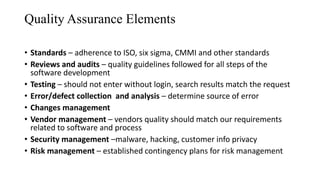
Quality Assurance Elements
• Standards – adherence to ISO, six sigma, CMMI and other standards
• Reviews and audits – quality guidelines followed for all steps of the
software development
• Testing – should not enter without login, search results match the request
• Error/defect collection and analysis – determine source of error
• Changes management
• Vendor management – vendors quality should match our requirements
related to software and process
• Security management –malware, hacking, customer info privacy
• Risk management – established contingency plans for risk management
3rd PARTY ENGAGEMENT
• Payment gateway
• Technology vendors
• Customer service

Online shopping portal: Software Project Plan

  • 1.
    ONLINE SHOPPING PORTAL ProjectPlan Team Members Piyushree (29036) Ranjani (29041) Sivaraj Kumar (29053) Akankshya Agarwal (29062) Anandavel S (29122)
  • 2.
    Statement of Work ProjectTitle - Online Shopping Portal Objective - To develop a web application that allows a registered customer to purchase a variety of products sold online by a list of registered vendors from any location. - To provide an easy to use Interface. Basic Requirements Customer – Secured registering and managing their profiles. - Easy navigation through pages. - Secured Payment gateway. Vendors - Secured registering and managing their profiles. - Add, delete or modify the already posted items. Administrator - Authority to approve and reject requests for new items. - Can control customer and Vendors actions. Deliverables - Web Portal/Application for desktop and mobile environment. - Support Manual also detailing the risks involved. (If any)
  • 3.
    Statement of Work(Contd..) • Benefits - Convenient Shopping. - Single Window, Multi-Vendor Retailing. - Selection option from different vendors offering the same product at different prices. - Search and sort options for a given product. - Discussion and Review forum for each product for price negotiations. - Simple, easy and secured payment option. - Auto fill of Customer data required to be entered during each payment. - Complaint Registration and support. - The customer can download the PDF version of the manual provided the vendor has uploaded it. - List of recommended products are displayed to the customer. - Detailed Sales Reporting (vendor analysis, customer analysis, keeping the vendor and customer analysis)
  • 4.
    Project Scope Scope –In • Websites for desktop, which is compatible with IE, Mozilla, Chrome etc. • Purchase items available in the website. Scope – Out • Payment Gateways to be linked through APIs. • Not compatible for mobile users. Users – Customers, Sellers, Administrator
  • 5.
    Critical Success Factors(CSF) • Maintaining Backup System • Terminating the transaction, if linkage to payment gateway is failed. • Customer and Products information are stored in a Secured Database. Key Performance Indicators (KPI) • Handling maximum traffic at any point of time. • Less number of Clicks, the customer has to perform and less number of pages to reach their desired item and navigation between pages should be easier.
  • 6.
    Architecture & DesignPattern MVC 3 – Tier Architecture
  • 7.
  • 8.
    Product Function Diagram(Contd..) Vendors Admin
  • 9.
    Database Details • Customer •Vendor • Admin • Inventory • Shopping Cart • Order Details • Transactions • Review • Order Transaction • Purchase History • Credit Card • Complaints
  • 10.
    Team Structure Project Manager Technical Architect Team Lead1 Team Lead 2 Developer 4 Developer 1 Developer 2 Developer 3 Developer 5 Developer 6 Developer 8 Developer 7 Testing Manager Team Lead 1 Team Lead 1 Team Lead 1 Test Lead
  • 11.
    Risks Involved • ProductSize Risks - Estimated size of product in number of programs, files, transactions. - Size of database created or used by the product. - Number of projected changes to the requirements for the product. Before delivery & After delivery. • Business Risks - Amount and quality of product documentation that must be produced and delivered to the customer. - Delivery deadlines. - Costs associated with late delivery and defective product. • Client Risks - When working for the first time. - Will the customer agree to spend time in formal requirements gathering meetings to identify project scope. - Communicating with developers. - Understanding of the SDLC process.
  • 12.
    Risks Involved (Contd..) •Resource Risks - Number of Resources and skillsets. - Commitment for entire duration. • Technology Risks - Customer demanding new technology - Requirements put excessive performance constraints on the product.
  • 13.
    Possible Origins ofChange • New business or market conditions • Customer demand • Budgetary or scheduling constraints
  • 14.
  • 15.
    CHANGE REQUEST FORM •Project name • Project sponsor • Request number • Date • Originator • Change requested by • Description of requested changes • Reason for change • Areas of impact of proposed change( scope/ cost/ schedule/ risk) • Disposition ( approved/ disproved/ deferred) • Priority( emergency/ urgent/ low) • Funding scheme ( mgmt reserve, budget reserve, others) • Sign off approvals ( project manager, pjct customer, pjct sponsor, other, dates )
  • 16.
    QUALITY PLAN • Ourquality plan’s effectiveness will be measured by the following parameters: • Ease of use of the web portal • Customer satisfaction regarding the service • Click-sales conversion • Website response time • Customer service in relation to complaints addressal • Customer service time • No. of clicks to find the required product • Security of personal data.
  • 17.
    PRINCIPAL PRODUCT QUALITYFACTORS PRODUCT QUALITY TECHNOLOGY •Latest versions & as per requirements PEOPLE QUALITY •Hands on experience+ qualifications+ division of work as per skills BUDGET & SCHEDULE •No cost overruns, achieving milestones, WBS PROCESS QUALITY •SDLC method used, resource allocated, quality & change management
  • 18.
    PRODUCT QUALITY ATTRIBUTES •Have lowest possible response time • Not make wasteful use of system resources- disk/ memory space/ CPU time • Easy to use by the users( customers/ admins/ vendors) • Ability to recover after a crash, slowdown, malware threats, unresponsive and unforeseen events and errors. • Trustworthy software sources • Ease of maintenance • Evolve to meet changing needs of customers • Reliability ( same output every time for the similar kind of input) • Availability even in situations of high traffic • Codes can be reused- customers function developed and customized for vendor as well
  • 19.
    Quality Assurance Elements •Standards – adherence to ISO, six sigma, CMMI and other standards • Reviews and audits – quality guidelines followed for all steps of the software development • Testing – should not enter without login, search results match the request • Error/defect collection and analysis – determine source of error • Changes management • Vendor management – vendors quality should match our requirements related to software and process • Security management –malware, hacking, customer info privacy • Risk management – established contingency plans for risk management
  • 20.
    3rd PARTY ENGAGEMENT •Payment gateway • Technology vendors • Customer service