CASE Tools
Presented By:
Shruti Shah
Contents
Software Development Tools

2

What Is CASE Tools
Software Development Tools

3

Components Of CASE Tools

4

Layers Of CASE Tools

5

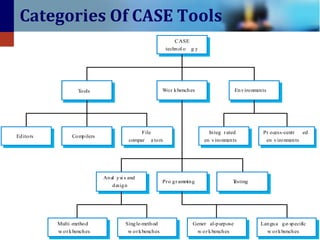
Categories Of CASE Tools

6

Components Of CASE Tools
Perspective Of CASE Tools

7

Benefits Of CASE Tools

8

Problems Of CASE Tools
Software Development Tools

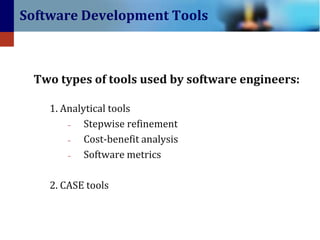
Two types of tools used by software engineers:
1. Analytical tools
–
Stepwise refinement
–
Cost-benefit analysis
–
Software metrics
2. CASE tools
What Is CASE Tools

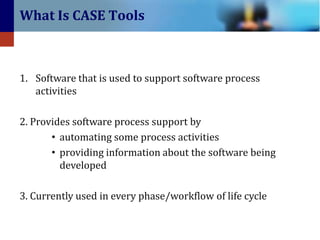
1. Software that is used to support software process
activities
2. Provides software process support by
• automating some process activities
• providing information about the software being
developed
3. Currently used in every phase/workflow of life cycle
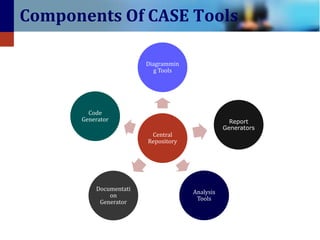
Components Of CASE Tools
Diagrammin
g Tools

Code
Generator

Report
Generators

Central
Repository

Documentati
on
Generator

Analysis
Tools
Components Of CASE Tools

1. Central Repository





Centralized Database.
Used to store Graphical Diagrams & Prototype
Forms and Reports of analysis and diagramming
workflow
Act as



Information Repository
Data Dictionary
Components Of CASE Tools

2. Report Generator


Used to




Create, modify and test prototypes of computer displays and
reports.
Identify which data items to display or collect for each screen
or report
Components Of CASE Tools

3. Diagramming Tool






Allow you to represent a system and its components
visually.
Allows higher level processes to be easily decomposed.
Can examine processes or data models at high or low
level.
Components Of CASE Tools

4. Analysis tools
 Generate reports that help identify possible
inconsistencies, redundancies and omissions.
 Generally focus on
diagram completeness and consistency.
 data structures and usage.

Components Of CASE Tools

5. Documentation Tool






Create standard reports based on contents of
repository.
Need textual descriptions of needs, solutions, trade-offs,
diagrams of data and processes, prototype forms and
reports, program specifications and user
documentation.
High-quality documentation leads to 80% reduction in
system maintenance effort in comparison to average
quality documentation.
Components Of CASE Tools

6. Code Generation Tool



Create code for the custom feature in object model.
Code Generation Tool helps in:
 Connect to the Repository.
 Select the Object Model.
 Select the custom features to generate code for.
 Define properties for each custom feature.
 Specify the output of the project.
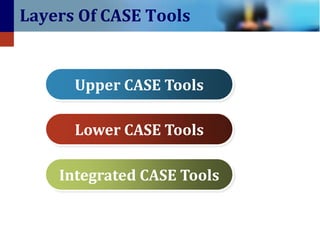
Layers Of CASE Tools

Upper CASE Tools
Lower CASE Tools
Integrated CASE Tools
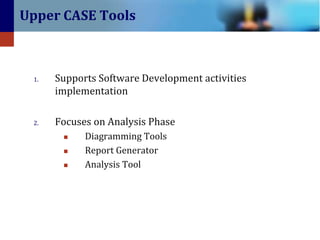
Upper CASE Tools

1.

2.

Supports Software Development activities
implementation
Focuses on Analysis Phase





Diagramming Tools
Report Generator
Analysis Tool
Lower CASE Tools

1.

Supports Programming and Integration tasks.

2.

Focuses on





Central Repository

Code Generator
Configuration Management
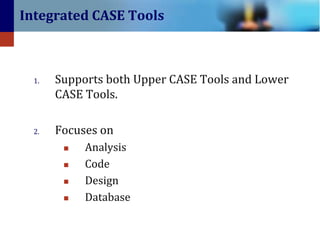
Integrated CASE Tools

1.

2.

Supports both Upper CASE Tools and Lower
CASE Tools.
Focuses on





Analysis
Code
Design
Database
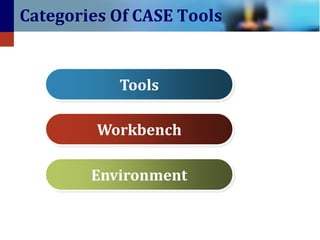
Categories Of CASE Tools

Tools
Workbench
Environment
Categories Of CASE Tools
CASE
techn ol o

Wo r k bench es

To ols

Ed ito rs

File

Co mp ilers

compar

a to rs

d esig n

w o r k bench es

En v iro nmen ts

In teg r ated

An al y si s and

Multi -metho d

gy

Sing le-meth od
w o r k bench es

en v iro nmen ts

Pr o g r ammin g

Pr o cess-centr

ed

en v iro nmen ts

T
esting

Gener al-p urp ose

Lan gu a g e- sp ecific

w o r k bench es

w o r k bench es
Perspective Of CASE Tools

Three Perspective
1. Functional perspective
– Tools are classified according to their specific function.
2. Process perspective
– Tools are classified according to process activities that
are supported.
3. Integration perspective
– Tools are classified according to their organisation into
integrated units.
Benefit Of CASE Tools

Improve software quality
1. Enforce discipline
2. Help communication between development
team members
3. Information is illustrated through diagrams
that are typically easier to understand
4. Development information is centralized
Reduction of time and effort
1. Tasks are much faster to complete and alter
2. Enhance reuse of models or models’
components
3. Can reduce maintenance costs
Problems Of CASE Tools

1. Limitations in flexibility of documentation
2. Major danger: completeness and syntactic
correctness does NOT mean compliance with
requirements
3. Costs associated with the use of the tool
• Purchase price
• Training
Conclusion
Thank You

House Is Open
For Queries

Case tools

  • 1.
  • 2.
    Contents Software Development Tools 2 WhatIs CASE Tools Software Development Tools 3 Components Of CASE Tools 4 Layers Of CASE Tools 5 Categories Of CASE Tools 6 Components Of CASE Tools Perspective Of CASE Tools 7 Benefits Of CASE Tools 8 Problems Of CASE Tools
  • 3.
    Software Development Tools Twotypes of tools used by software engineers: 1. Analytical tools – Stepwise refinement – Cost-benefit analysis – Software metrics 2. CASE tools
  • 4.
    What Is CASETools 1. Software that is used to support software process activities 2. Provides software process support by • automating some process activities • providing information about the software being developed 3. Currently used in every phase/workflow of life cycle
  • 5.
    Components Of CASETools Diagrammin g Tools Code Generator Report Generators Central Repository Documentati on Generator Analysis Tools
  • 6.
    Components Of CASETools 1. Central Repository    Centralized Database. Used to store Graphical Diagrams & Prototype Forms and Reports of analysis and diagramming workflow Act as   Information Repository Data Dictionary
  • 7.
    Components Of CASETools 2. Report Generator  Used to   Create, modify and test prototypes of computer displays and reports. Identify which data items to display or collect for each screen or report
  • 8.
    Components Of CASETools 3. Diagramming Tool    Allow you to represent a system and its components visually. Allows higher level processes to be easily decomposed. Can examine processes or data models at high or low level.
  • 9.
    Components Of CASETools 4. Analysis tools  Generate reports that help identify possible inconsistencies, redundancies and omissions.  Generally focus on diagram completeness and consistency.  data structures and usage. 
  • 10.
    Components Of CASETools 5. Documentation Tool    Create standard reports based on contents of repository. Need textual descriptions of needs, solutions, trade-offs, diagrams of data and processes, prototype forms and reports, program specifications and user documentation. High-quality documentation leads to 80% reduction in system maintenance effort in comparison to average quality documentation.
  • 11.
    Components Of CASETools 6. Code Generation Tool   Create code for the custom feature in object model. Code Generation Tool helps in:  Connect to the Repository.  Select the Object Model.  Select the custom features to generate code for.  Define properties for each custom feature.  Specify the output of the project.
  • 12.
    Layers Of CASETools Upper CASE Tools Lower CASE Tools Integrated CASE Tools
  • 13.
    Upper CASE Tools 1. 2. SupportsSoftware Development activities implementation Focuses on Analysis Phase    Diagramming Tools Report Generator Analysis Tool
  • 14.
    Lower CASE Tools 1. SupportsProgramming and Integration tasks. 2. Focuses on    Central Repository Code Generator Configuration Management
  • 15.
    Integrated CASE Tools 1. 2. Supportsboth Upper CASE Tools and Lower CASE Tools. Focuses on     Analysis Code Design Database
  • 16.
    Categories Of CASETools Tools Workbench Environment
  • 17.
    Categories Of CASETools CASE techn ol o Wo r k bench es To ols Ed ito rs File Co mp ilers compar a to rs d esig n w o r k bench es En v iro nmen ts In teg r ated An al y si s and Multi -metho d gy Sing le-meth od w o r k bench es en v iro nmen ts Pr o g r ammin g Pr o cess-centr ed en v iro nmen ts T esting Gener al-p urp ose Lan gu a g e- sp ecific w o r k bench es w o r k bench es
  • 18.
    Perspective Of CASETools Three Perspective 1. Functional perspective – Tools are classified according to their specific function. 2. Process perspective – Tools are classified according to process activities that are supported. 3. Integration perspective – Tools are classified according to their organisation into integrated units.
  • 19.
    Benefit Of CASETools Improve software quality 1. Enforce discipline 2. Help communication between development team members 3. Information is illustrated through diagrams that are typically easier to understand 4. Development information is centralized
  • 20.
    Reduction of timeand effort 1. Tasks are much faster to complete and alter 2. Enhance reuse of models or models’ components 3. Can reduce maintenance costs
  • 21.
    Problems Of CASETools 1. Limitations in flexibility of documentation 2. Major danger: completeness and syntactic correctness does NOT mean compliance with requirements 3. Costs associated with the use of the tool • Purchase price • Training
  • 22.
  • 23.
    Thank You House IsOpen For Queries

Editor's Notes

  • #4 The Tools of the TradeSoftware engineers need two types of tools1) Analytical tools used in software developmentsuch as stepwise refinement and cost-benefit analysistheoretical tools2) Products that assist the teams of software engineers in developing and maintaining softwareusually termed CASE tools (computer-aided software engineering tools)
  • #5 Computer AIDED Software EngineeringNot automated; still takes human intervention; ASSISTS the humanSoftware that automates all or part of the development processSoftware tool that assists in some aspect of the production of softwareSoftware that helps carry out much of the dredge work associated with software development (e.g., documentation creation and organization)Organizations use CASE tools to:Improve the quality of the systemIncrease speed of design and developmentEase and improve the testing processImprove integration of development activitiesImprove quality and completeness of documentationImprove management of the projectSimplify program maintenancePromote reusability
  • #7 CASE repository acts as:Information repositoryCombines information about organization’s business information and application portfolio Provides automated tools to manage and control accessData dictionaryUsed to manage and control access to information repositoryFacilities for recording, storing and processing resources Useful for cross-referencing
  • #9 Diagramming toolsAllow you to draw DFDs, ERDs, use case diagrams, case diagramsAllows you to use stepwise refinement in building models (work from high level to low level)
  • #10 Analysis toolsTypes of analyses depend on methodology used and features of CASE environment
  • #11 Case documentation generator toolsProvide a method of managing documentationAllow creation of master templates
  • #14 The Tools of the TradeSoftware engineers need two types of tools1) Analytical tools used in software developmentsuch as stepwise refinement and cost-benefit analysistheoretical tools2) Products that assist the teams of software engineers in developing and maintaining softwareusually termed CASE tools (computer-aided software engineering tools)
  • #15 The Tools of the TradeSoftware engineers need two types of tools1) Analytical tools used in software developmentsuch as stepwise refinement and cost-benefit analysistheoretical tools2) Products that assist the teams of software engineers in developing and maintaining softwareusually termed CASE tools (computer-aided software engineering tools)
  • #16 The Tools of the TradeSoftware engineers need two types of tools1) Analytical tools used in software developmentsuch as stepwise refinement and cost-benefit analysistheoretical tools2) Products that assist the teams of software engineers in developing and maintaining softwareusually termed CASE tools (computer-aided software engineering tools)
  • #20 CASE toolsShould not be considered a silver bullet for project developmentAdvanced CASE tools are complex applications that require significant training and experience to achieve real benefitsOften CASE serves only as a glorified diagramming tool that supports the practices of behavioral and structural modelingHas been shown to be a helpful way to support the communication and sharing of project diagrams and technical specifications (as long as it is used by trained developers who have applied CASE on past projects)2) Enforce disciplineBy helping with the standardization of notations and diagrams
  • #21 The Tools of the TradeSoftware engineers need two types of tools1) Analytical tools used in software developmentsuch as stepwise refinement and cost-benefit analysistheoretical tools2) Products that assist the teams of software engineers in developing and maintaining softwareusually termed CASE tools (computer-aided software engineering tools)
  • #22 Limitations in flexibility of documentationDocumentation templates provided may not match organization’s templates3) CostsPurchase price is between $5,000 and $15,000 per year to provide CASE tools to one systems analystTraining => Very complex tools
  • #23 CASE Tools are the fourth generation tools being in an era of technology the things become more easier with the help of these tools we just need to give the right input.