REQUIREMENT GATHERING
FOR CUSTOMIZATION OF HP
EMR
INTRODUCTION
• Requirement Gathering is collection of a set of statements which
define what needs to be provided by a solution to meet the
expectations of the sponsor, stakeholders and users.
• The collection of requirements is obtained by interviews, RAP
sessions and/or workshops.
Requirements gathering is used in:
• Producing the business requirements.
• Producing the functional requirements.
OBJECTIVE
• To obtain suggestions regarding the customization of
EMR(developed by HP),for making it more user
friendly.
METHODOLOGY
• DATA COLLECTION:-
• Review of existing features of HP EMR and OPENEMR
• Feedback from doctors through questionnaire containing open
ended questions.
• Discussion with the doctors regarding the features of HP EMR.
• SAMPLE SIZE
• A target of 100 doctors was predicted, out of which 65 doctors
were approached.
CONTD…
• TOOLS AND TECHNIQUE
• SAMPLING TECHNIQUE:- Convenient and random
• TOOLS:- Questions were included from six concepts which were found
important for any successful EMR implementation
FOFOCUS AREAS
• Work flow management
• Specialist Screen variability
• Diagnosis
• Link with labs
• Connectivity to the IPD
• Offline availability
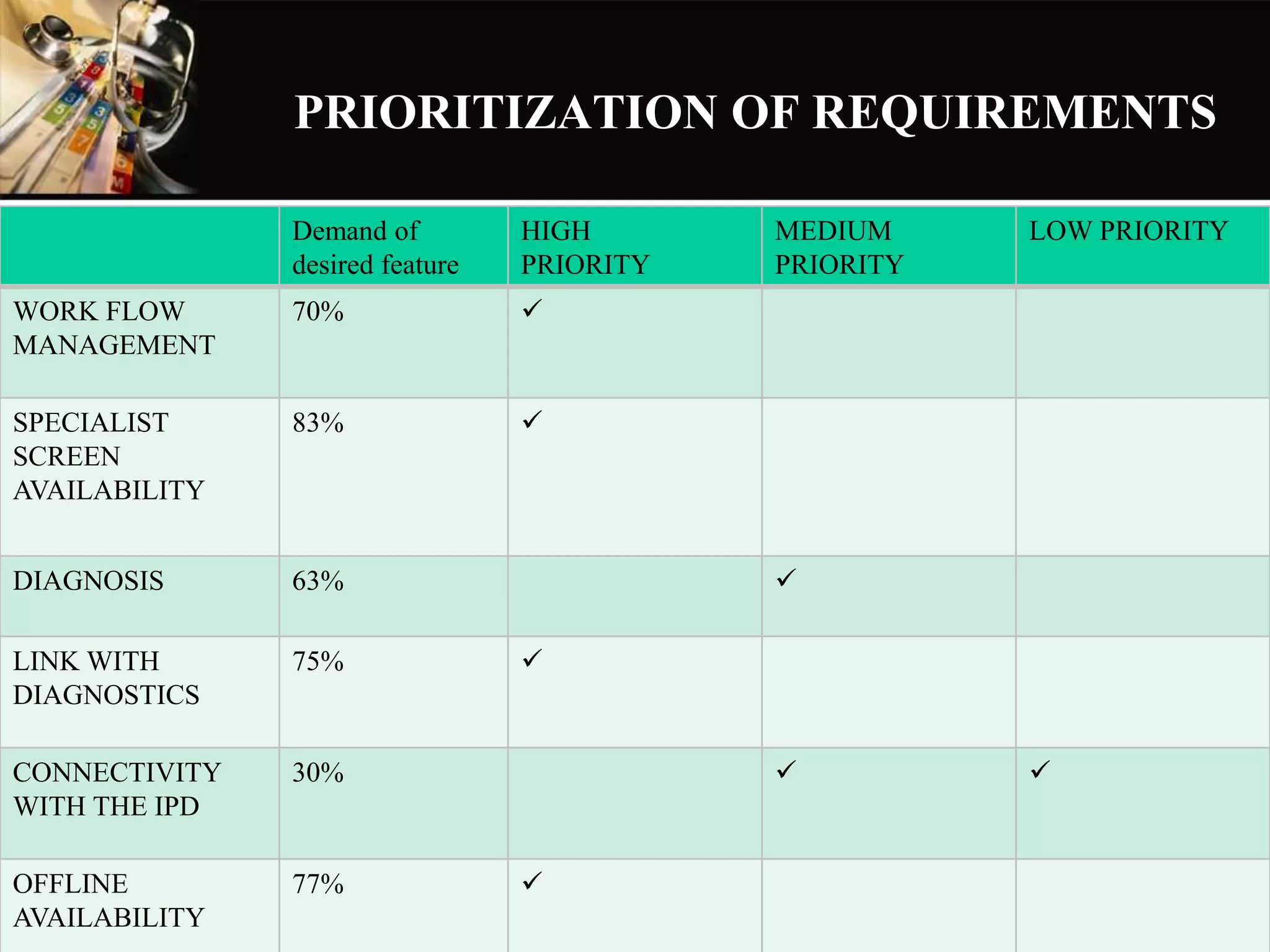
PRIORITIZATION OF REQUIREMENTS
Demand of
desired feature
HIGH
PRIORITY
MEDIUM
PRIORITY
LOW PRIORITY
WORK FLOW
MANAGEMENT
70% 
SPECIALIST
SCREEN
AVAILABILITY
83% 
DIAGNOSIS 63% 
LINK WITH
DIAGNOSTICS
75% 
CONNECTIVITY
WITH THE IPD
30%  
OFFLINE
AVAILABILITY
77% 
WORK FLOW MANAGEMENT
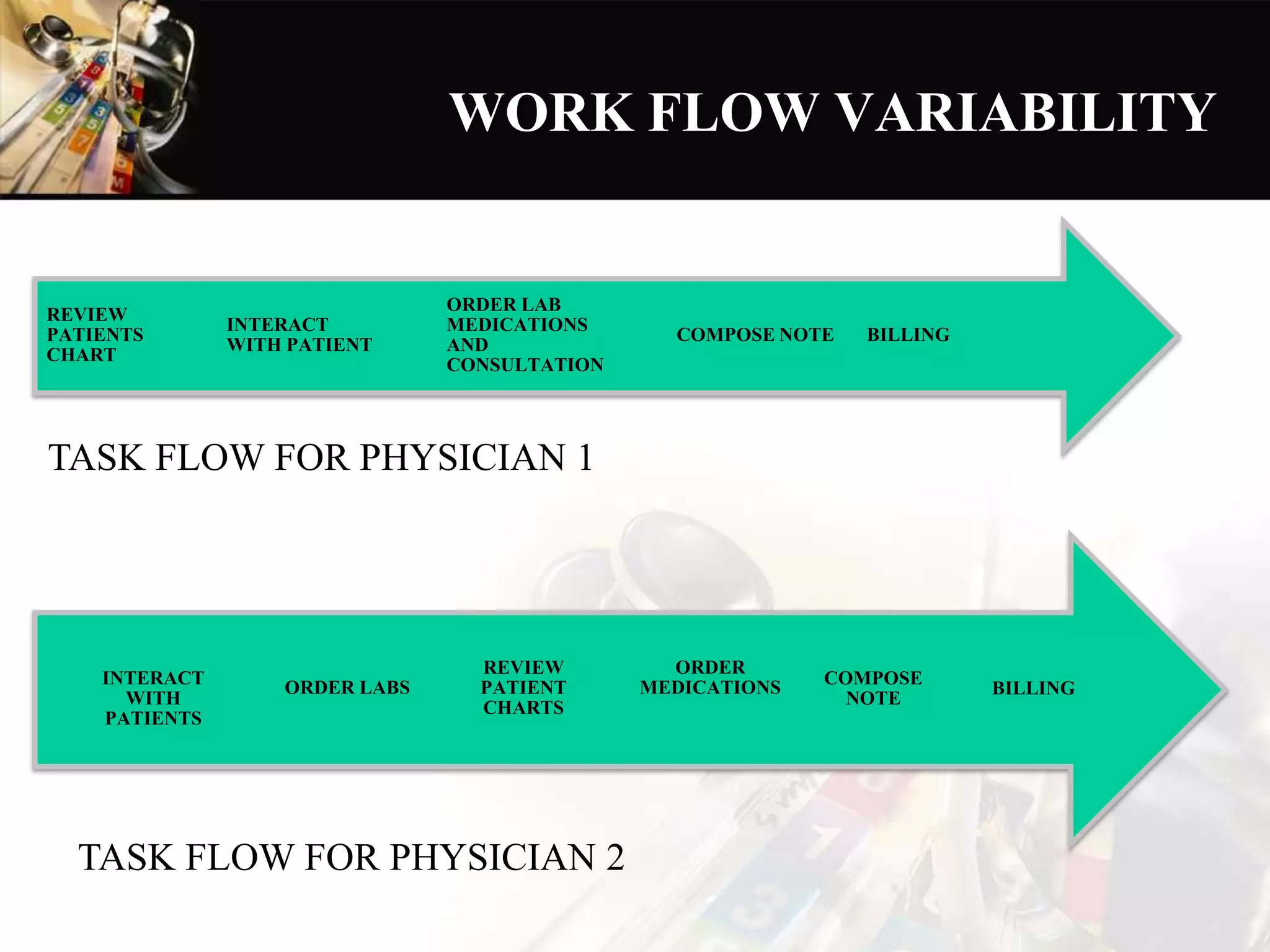
WORK FLOW VARIABILITY
BILLINGCOMPOSE NOTE
ORDER LAB
MEDICATIONS
AND
CONSULTATION
INTERACT
WITH PATIENT
REVIEW
PATIENTS
CHART
TASK FLOW FOR PHYSICIAN 1
TASK FLOW FOR PHYSICIAN 2
BILLING
COMPOSE
NOTE
ORDER
MEDICATIONS
REVIEW
PATIENT
CHARTS
ORDER LABSINTERACT
WITH
PATIENTS
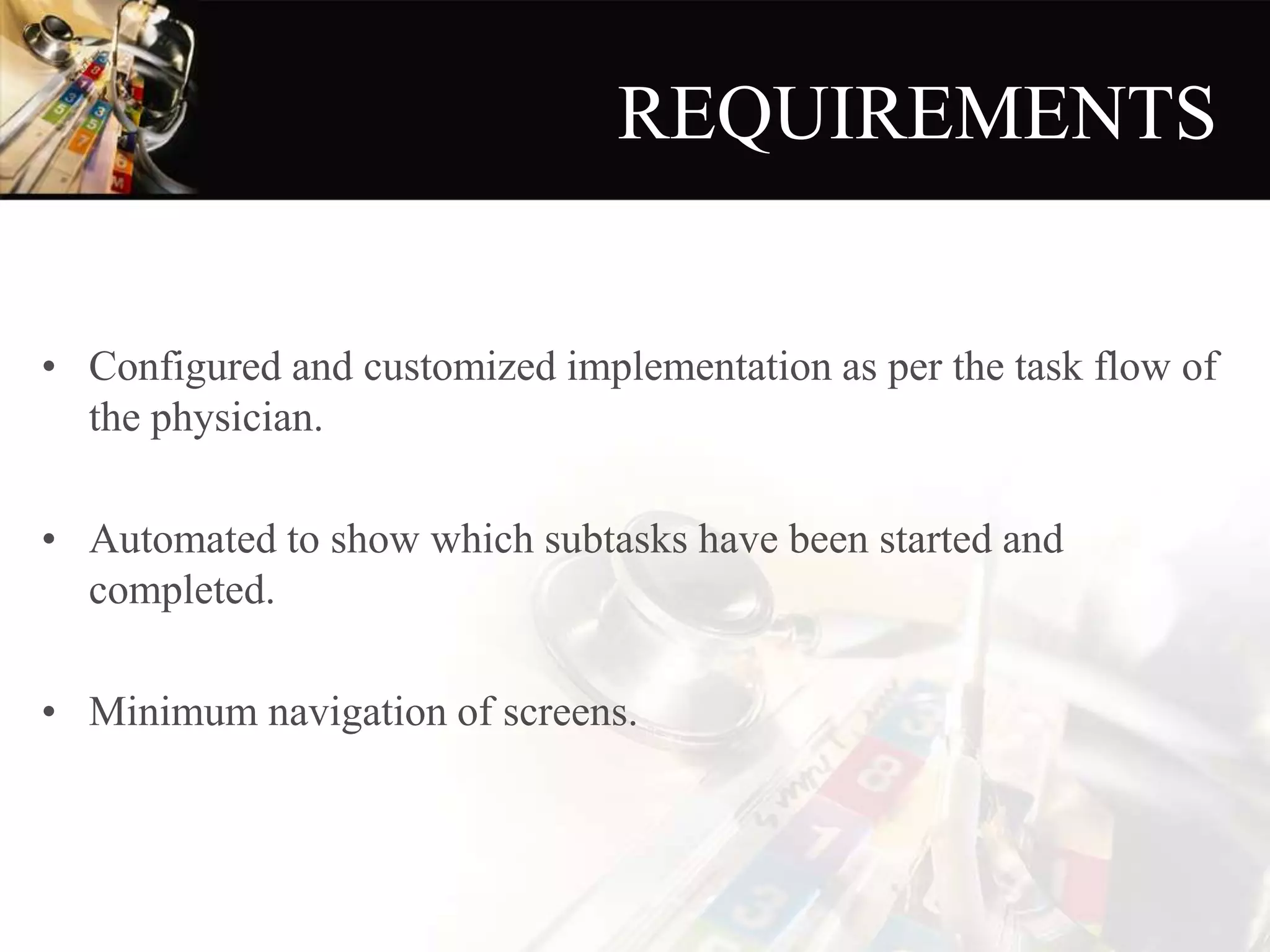
REQUIREMENTS
• Configured and customized implementation as per the task flow of
the physician.
• Automated to show which subtasks have been started and
completed.
• Minimum navigation of screens.
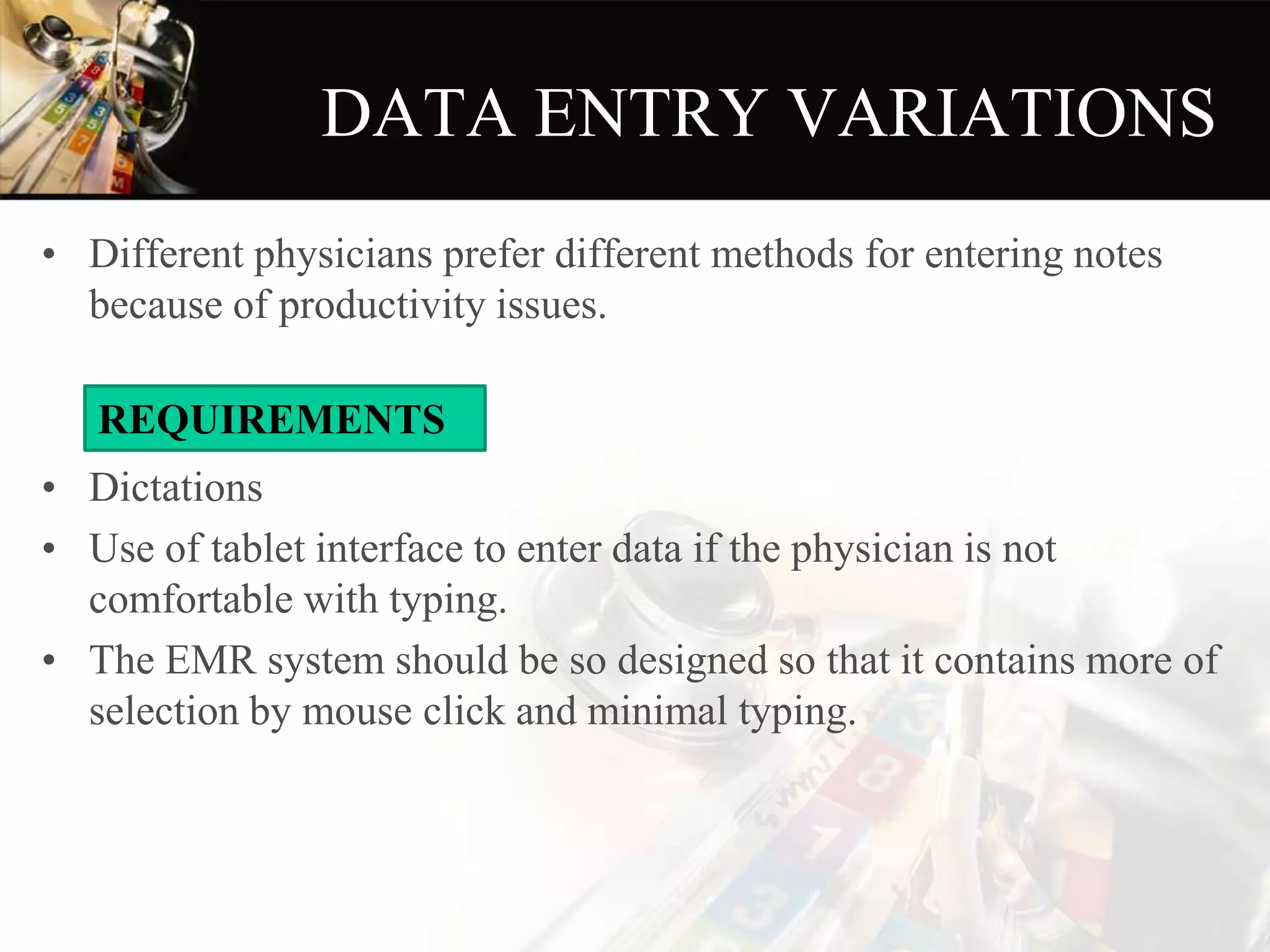
DATA ENTRY VARIATIONS
• Different physicians prefer different methods for entering notes
because of productivity issues.
• Dictations
• Use of tablet interface to enter data if the physician is not
comfortable with typing.
• The EMR system should be so designed so that it contains more of
selection by mouse click and minimal typing.
REQUIREMENTS
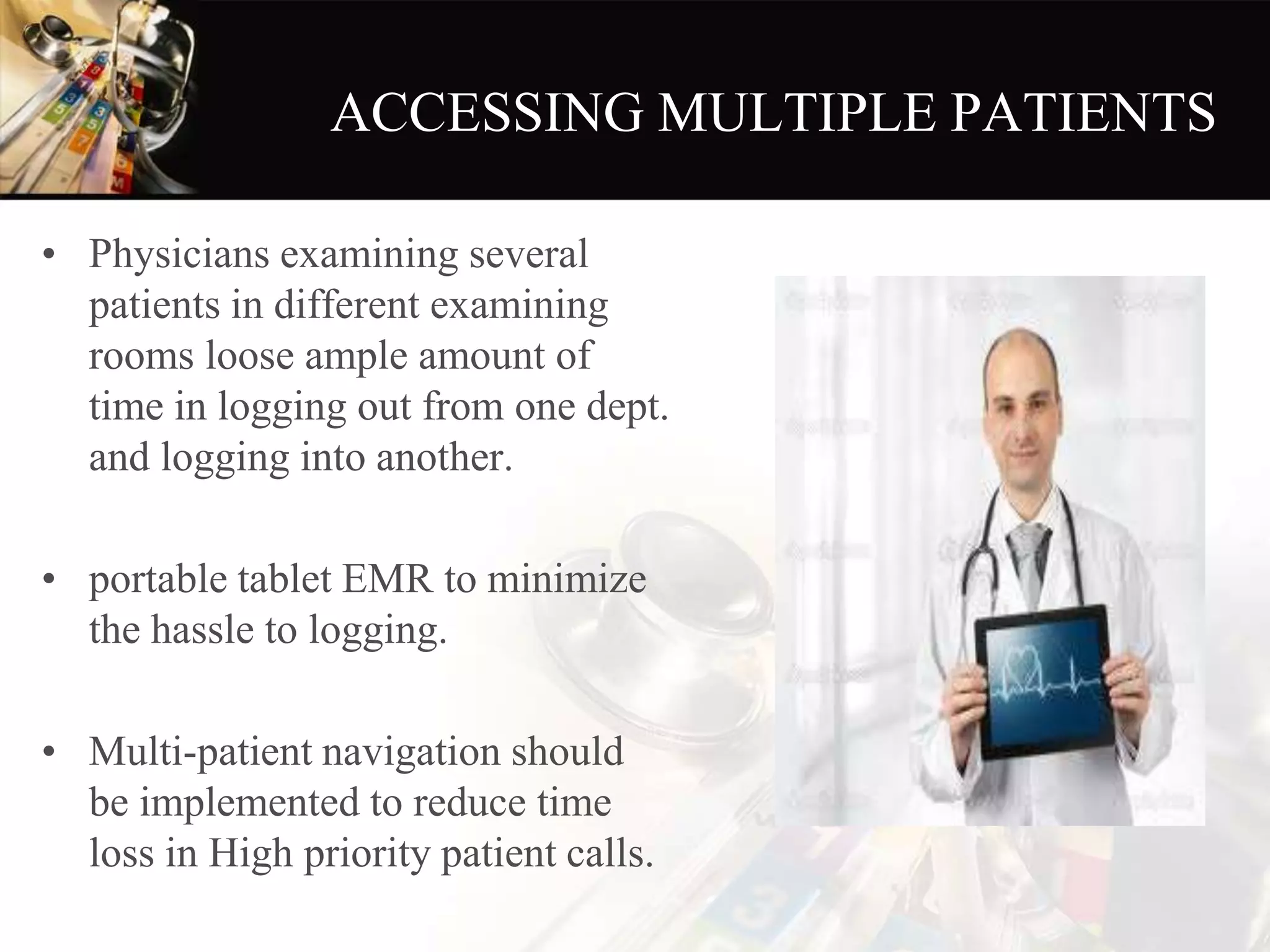
ACCESSING MULTIPLE PATIENTS
• Physicians examining several
patients in different examining
rooms loose ample amount of
time in logging out from one dept.
and logging into another.
• portable tablet EMR to minimize
the hassle to logging.
• Multi-patient navigation should
be implemented to reduce time
loss in High priority patient calls.
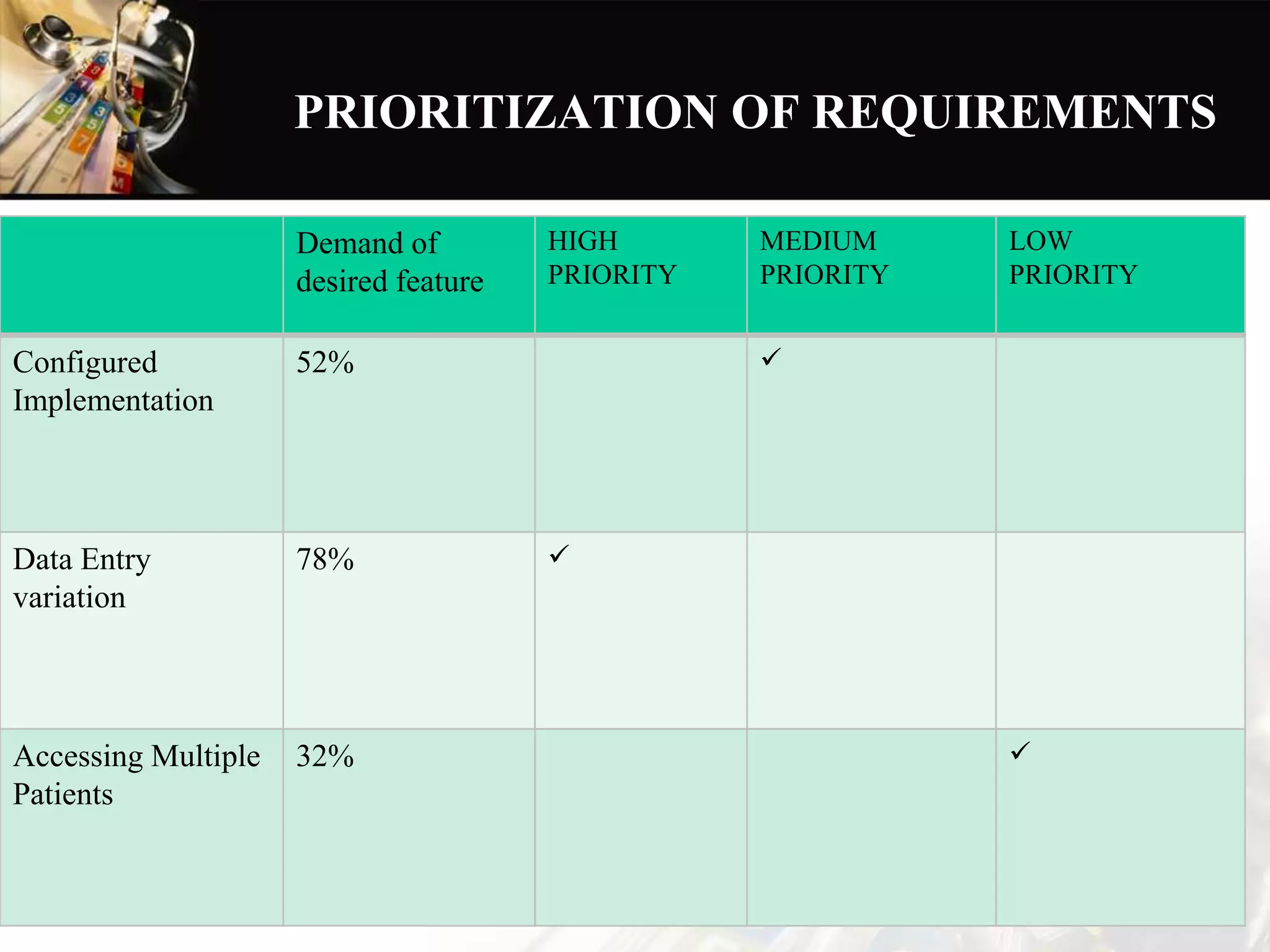
PRIORITIZATION OF REQUIREMENTS
Demand of
desired feature
HIGH
PRIORITY
MEDIUM
PRIORITY
LOW
PRIORITY
Configured
Implementation
52% 
Data Entry
variation
78% 
Accessing Multiple
Patients
32% 
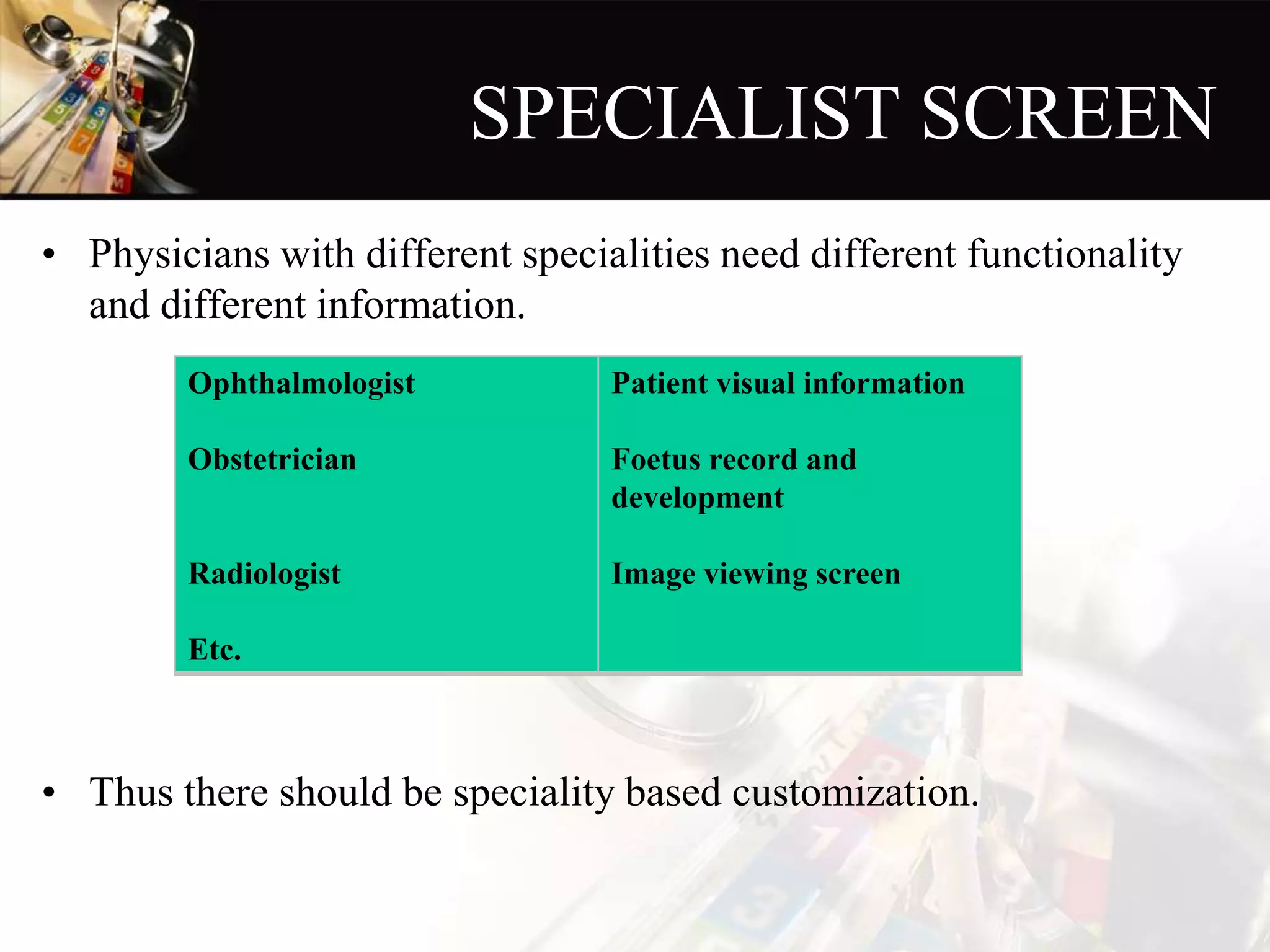
SPECIALIST SCREEN
• Physicians with different specialities need different functionality
and different information.
• Thus there should be speciality based customization.
Ophthalmologist
Obstetrician
Radiologist
Etc.
Patient visual information
Foetus record and
development
Image viewing screen
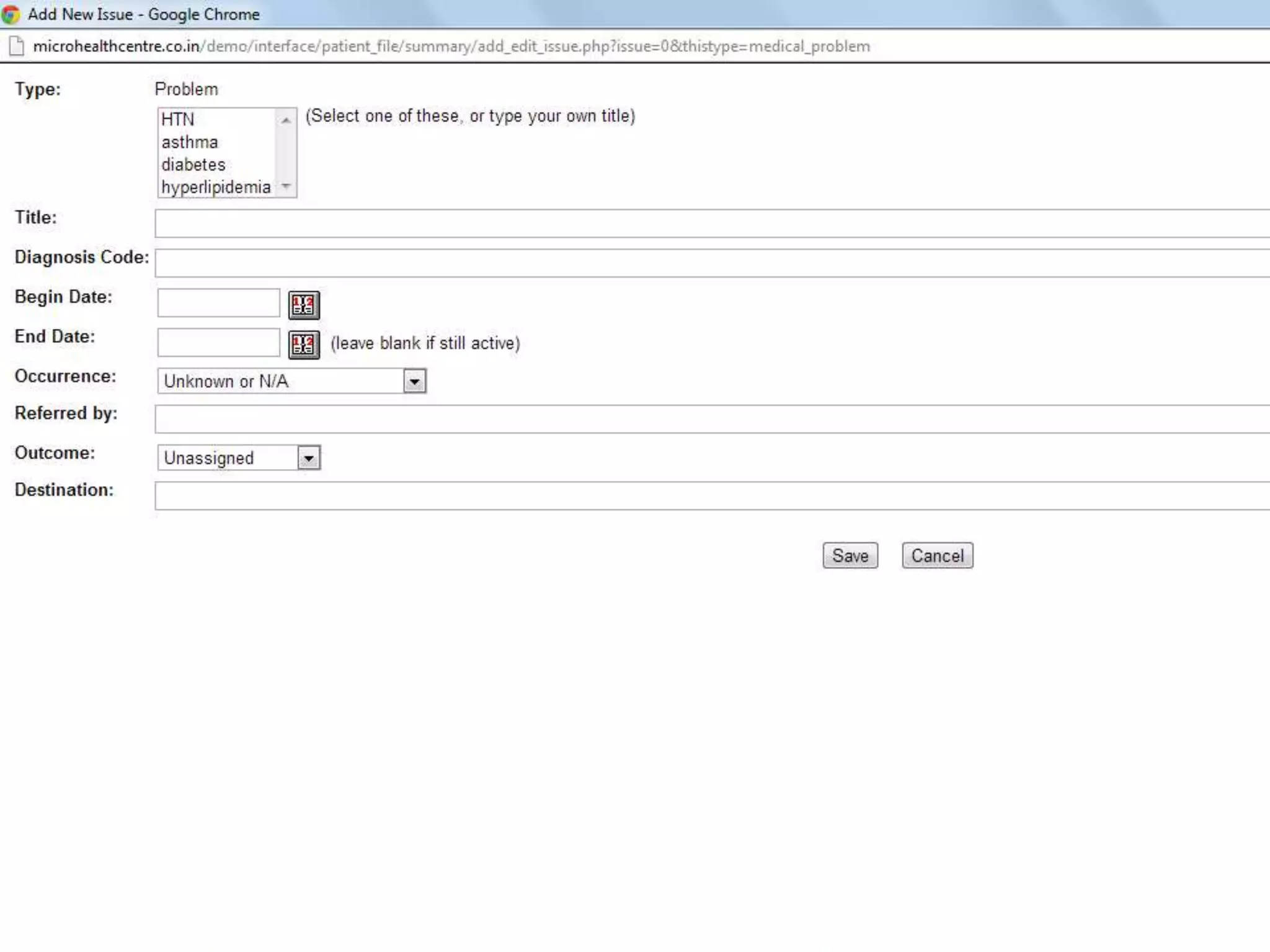
DIAGNOSIS
ENTERING SYMPTOMS
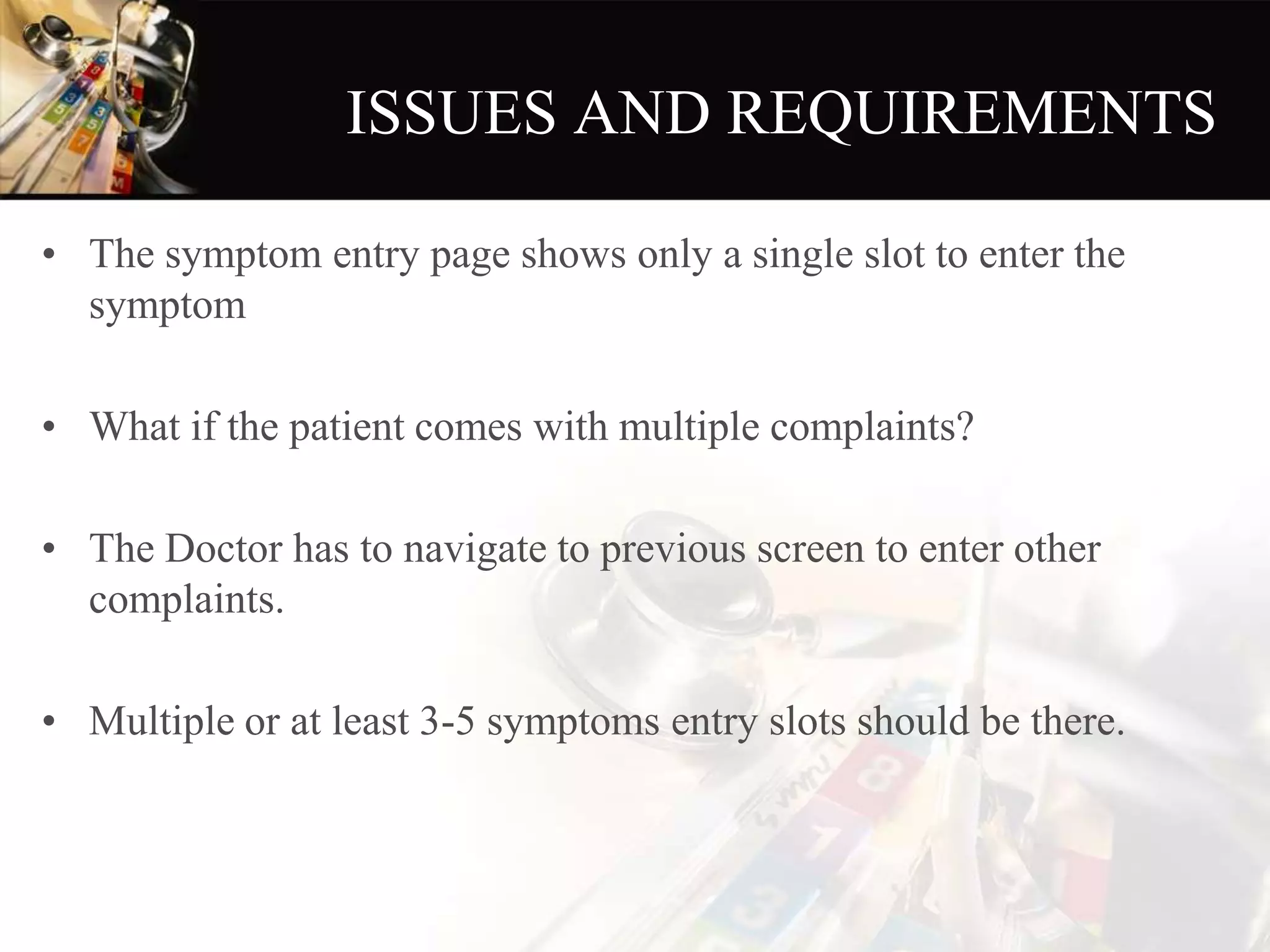
ISSUES AND REQUIREMENTS
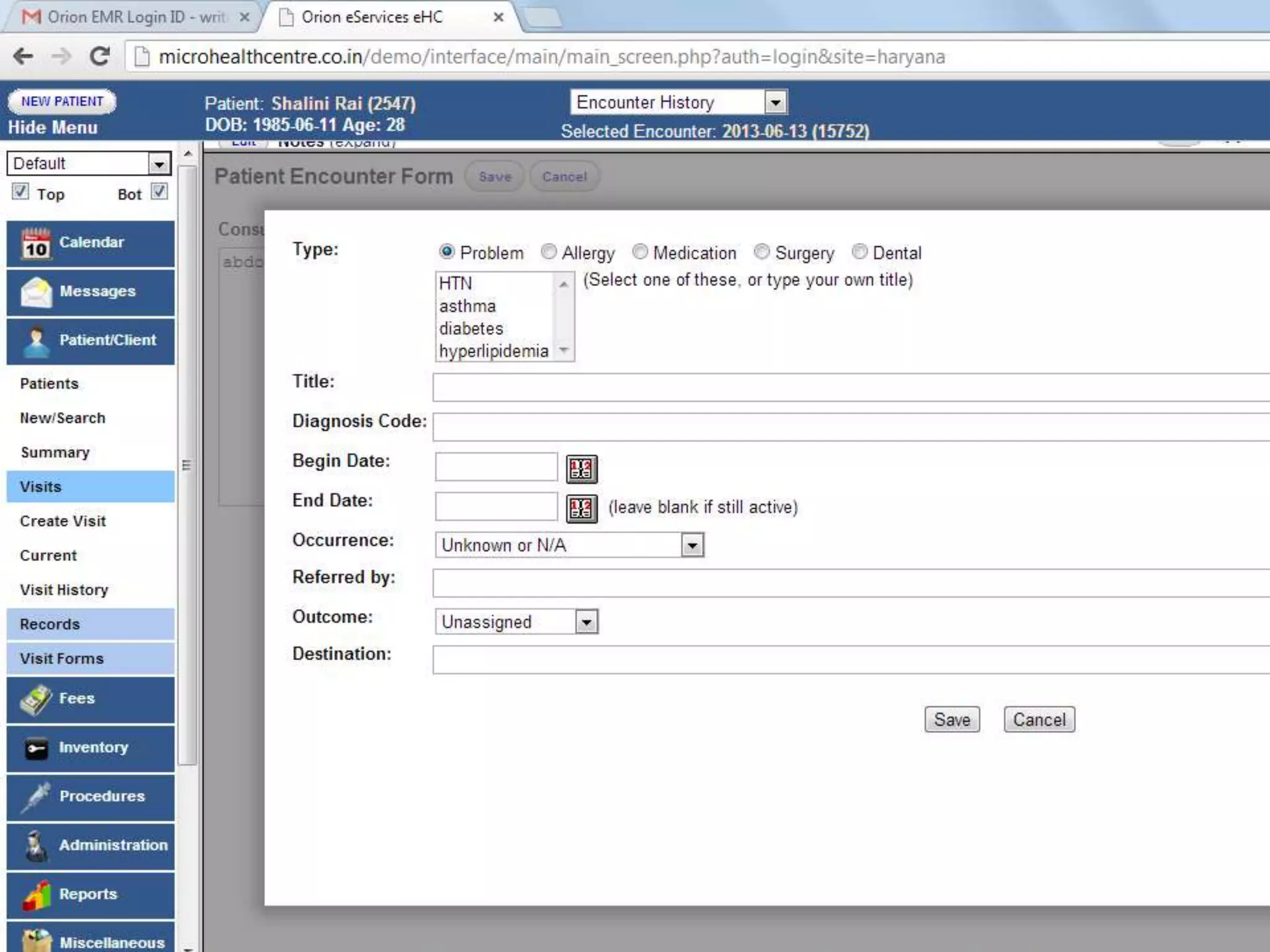
• The symptom entry page shows only a single slot to enter the
symptom
• What if the patient comes with multiple complaints?
• The Doctor has to navigate to previous screen to enter other
complaints.
• Multiple or at least 3-5 symptoms entry slots should be there.
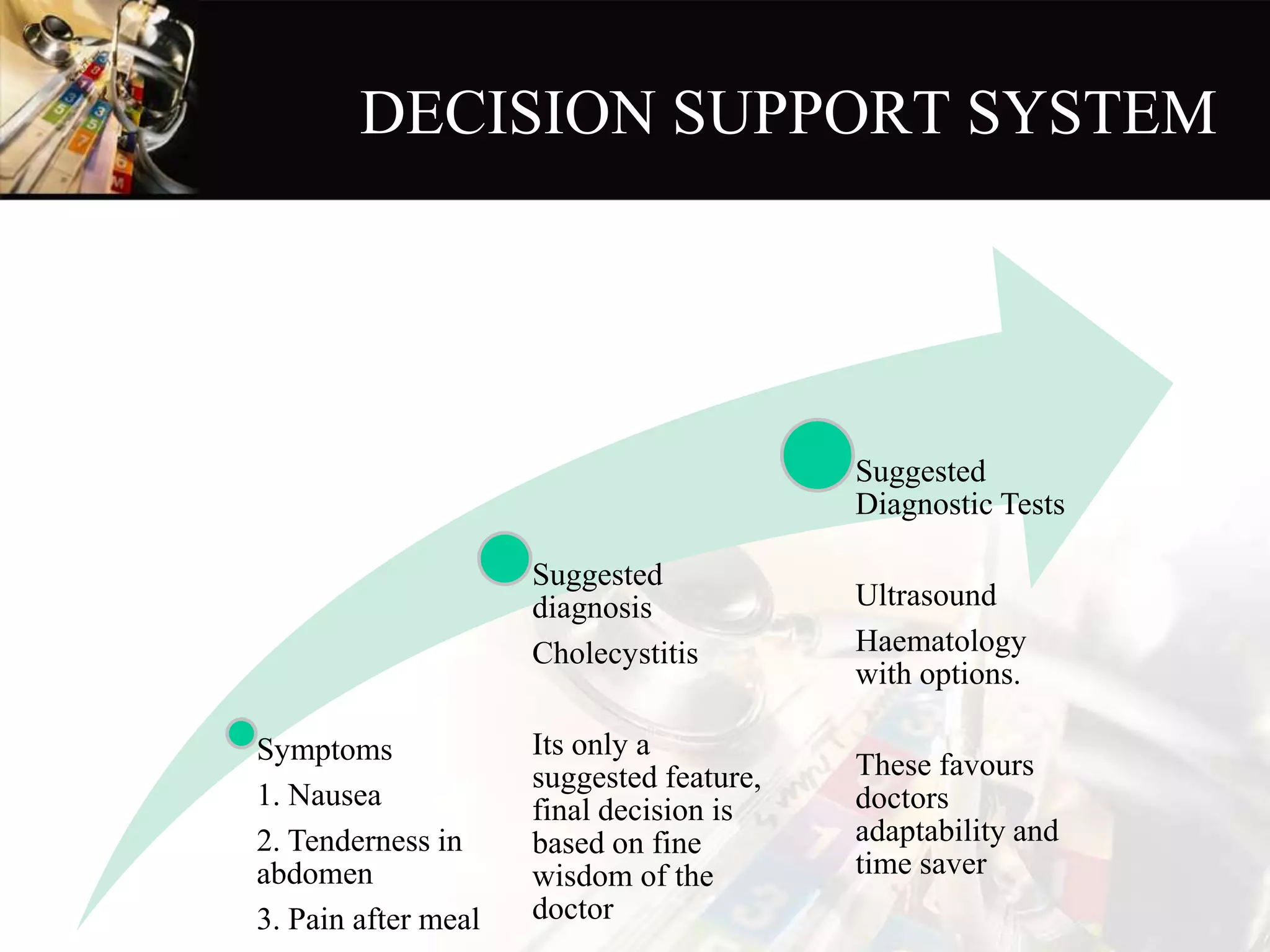
DECISION SUPPORT SYSTEM
Symptoms
1. Nausea
2. Tenderness in
abdomen
3. Pain after meal
Suggested
diagnosis
Cholecystitis
Its only a
suggested feature,
final decision is
based on fine
wisdom of the
doctor
Suggested
Diagnostic Tests
Ultrasound
Haematology
with options.
These favours
doctors
adaptability and
time saver
LINKS WITH DIAGNOSTICS
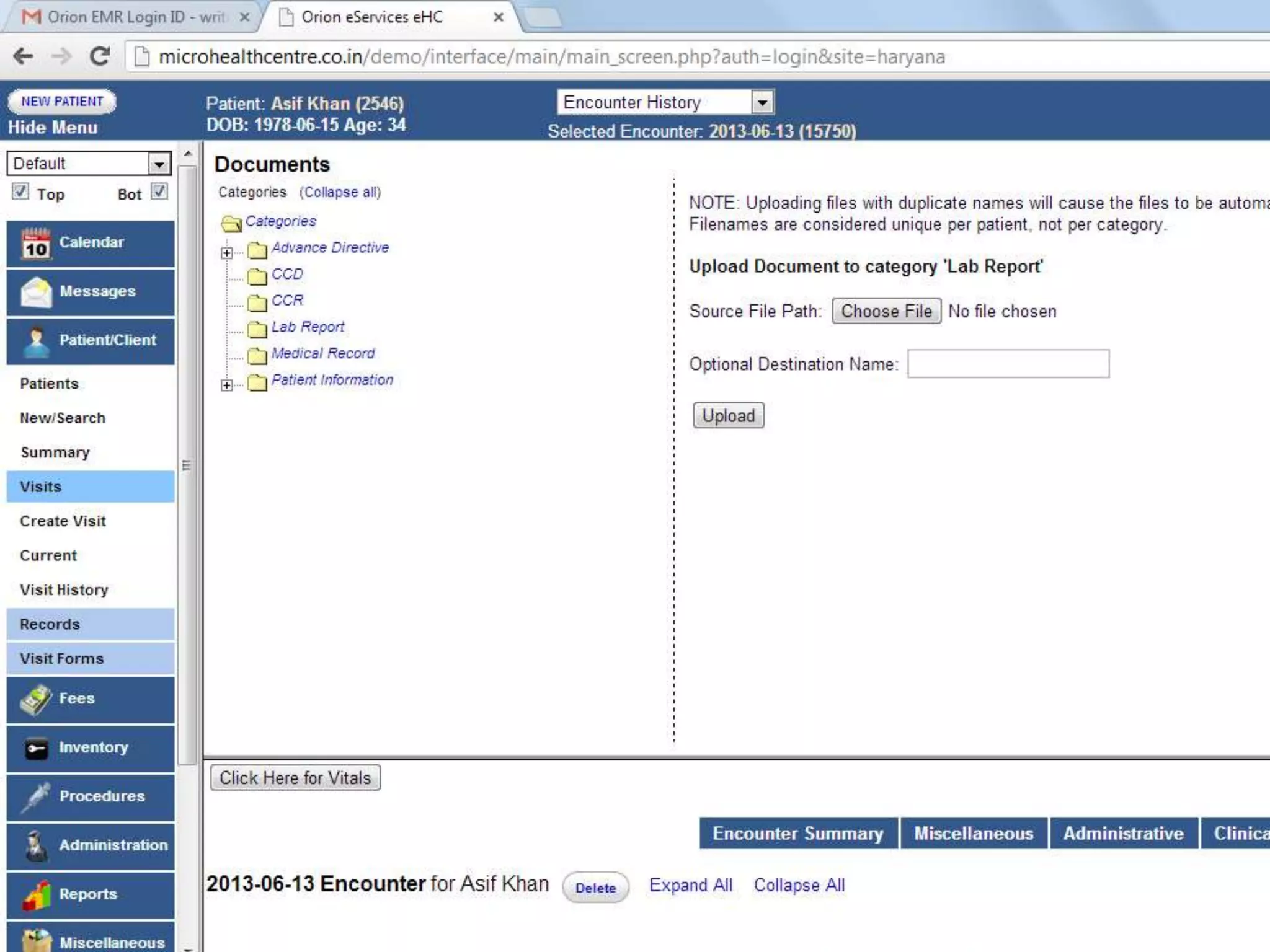
Uploading of laboratory tests and imaging data is
present.
laboratory tests and imaging data are carried in portable
devices.
CURRENT IMPLEMENTATION
Cloud linkage with diagnostics should be obtained.
Uploading should be done by the diagnostics section
based on patient ID number
REQUIREMENT
CONNECTIVITY WITH THE IPD
EMR IN IPD
• Tablet interface can be used for recording notes and vitals of the
in-patients. (data entered using patients ID number)
• Direct linkage between the physician screen and the ICU nursing
station should be there.
Doctor can monitor the vitals of his ICU patient while
sitting in his cabin.
Automated Alert generation, If the vitals range is
disturbed.
MEDICO-LEGAL REQUIREMENTS
MEDICO-LEGAL CUSTOMIZATION
• Separate link for medico-legal cases should be present which can
only be accessed by the physician.
• All entries must be done by the done from the physician log-in
only.
• Highly sensitive decision alert system should be implemented.
E.g. if medical problem entered by the doctor is “damaged spleen
and high blood loss”. And in vital registration b.p. entered id
120/80. system must generate a alert message to confirm the entry.
SECTORAL CUSTOMIZATION
Provision for adding parameters for menstrual
history, conceiving patterns.
Gynecological parameters are completely
avoided in the HP EMR and they should be a
part of it.
GYNAECOLOGIST
SECTORAL CUSTOMIZATION
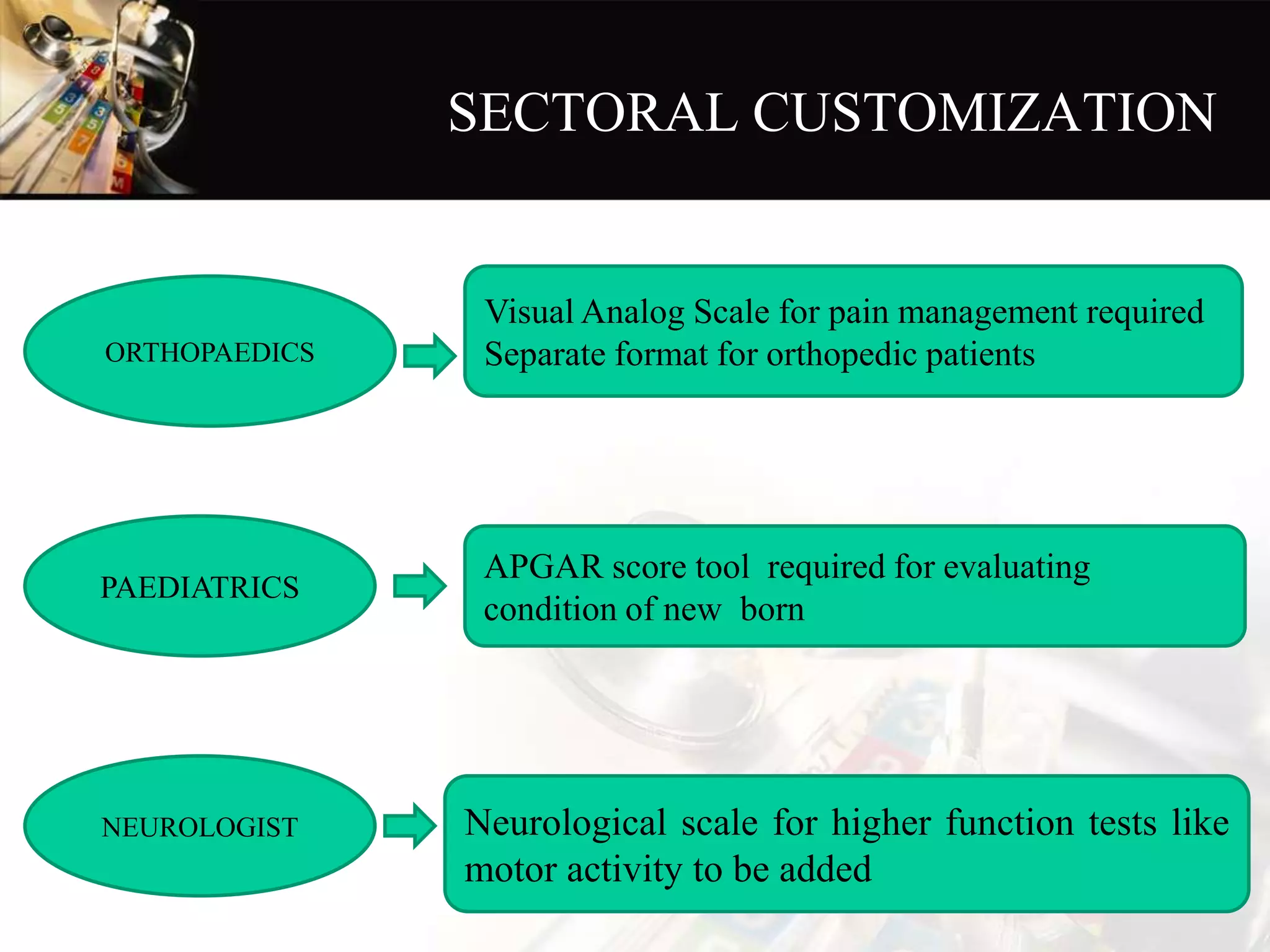
Visual Analog Scale for pain management required
Separate format for orthopedic patientsORTHOPAEDICS
APGAR score tool required for evaluating
condition of new born
PAEDIATRICS
Neurological scale for higher function tests like
motor activity to be added
NEUROLOGIST
SECTORAL CUSTOMIZATION
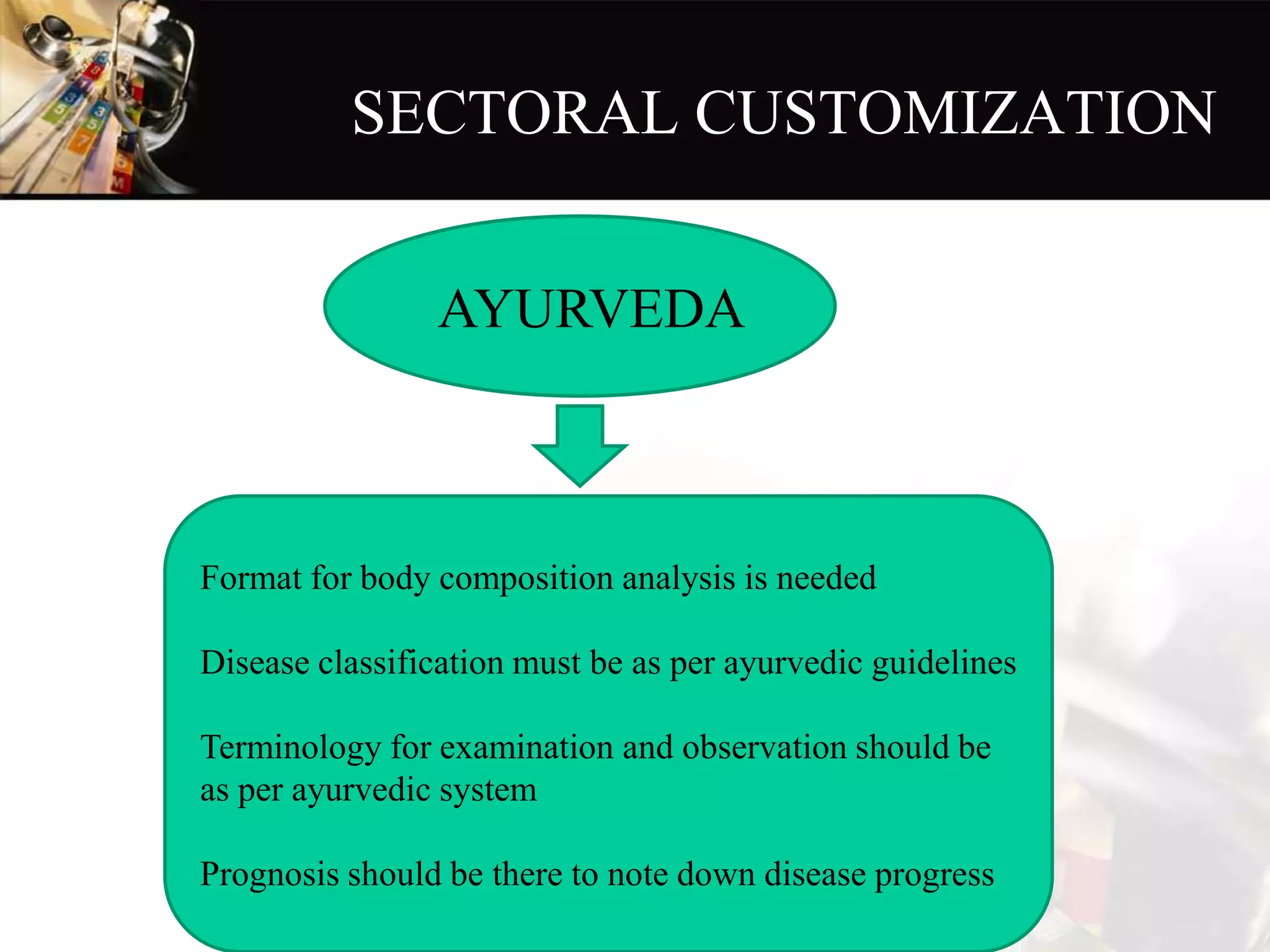
Format for body composition analysis is needed
Disease classification must be as per ayurvedic guidelines
Terminology for examination and observation should be
as per ayurvedic system
Prognosis should be there to note down disease progress
AYURVEDA
OFFLINE AVAILABILITY
• While a purely online EMR sounds wonderful, intelligent offline
availability of these EMRs is critical ,where internet availability is
not reliable, and internet adoption (especially amongst senior
citizens) is not that high.
• Offline availability can be enabled through smarter software
designs, as well as storage devices such as CDs, USB drives, etc.
RECOMMENDATIONS
• Work Flow configurable EMR
• EMR should be linked to every stake holder of the
healthcare system
• Less typing, more clicking (generation of pool drop
boxes)
• Offline backup support
REFERENCES
• www.upassoc.org (JOURNAL OF USABILITY STUDIES)
• www.scoop.it/health-in-india
• www.infoway-inforoute.com
• Experience from the forefront of EMR use(case study)
• www.csu.edu/division/psc/pmguides/requirementgathering
“I keep six honest serving men
(They taught me all I knew);
Their names are What and Why and When
And How and Where and Who.”
...Rudyard Kipling.
THANK YOU

requirement gathering for EMR customization

  • 1.
  • 2.
    INTRODUCTION • Requirement Gatheringis collection of a set of statements which define what needs to be provided by a solution to meet the expectations of the sponsor, stakeholders and users. • The collection of requirements is obtained by interviews, RAP sessions and/or workshops. Requirements gathering is used in: • Producing the business requirements. • Producing the functional requirements.
  • 3.
    OBJECTIVE • To obtainsuggestions regarding the customization of EMR(developed by HP),for making it more user friendly.
  • 4.
    METHODOLOGY • DATA COLLECTION:- •Review of existing features of HP EMR and OPENEMR • Feedback from doctors through questionnaire containing open ended questions. • Discussion with the doctors regarding the features of HP EMR. • SAMPLE SIZE • A target of 100 doctors was predicted, out of which 65 doctors were approached.
  • 5.
    CONTD… • TOOLS ANDTECHNIQUE • SAMPLING TECHNIQUE:- Convenient and random • TOOLS:- Questions were included from six concepts which were found important for any successful EMR implementation
  • 6.
    FOFOCUS AREAS • Workflow management • Specialist Screen variability • Diagnosis • Link with labs • Connectivity to the IPD • Offline availability
  • 7.
    PRIORITIZATION OF REQUIREMENTS Demandof desired feature HIGH PRIORITY MEDIUM PRIORITY LOW PRIORITY WORK FLOW MANAGEMENT 70%  SPECIALIST SCREEN AVAILABILITY 83%  DIAGNOSIS 63%  LINK WITH DIAGNOSTICS 75%  CONNECTIVITY WITH THE IPD 30%   OFFLINE AVAILABILITY 77% 
  • 8.
  • 9.
    WORK FLOW VARIABILITY BILLINGCOMPOSENOTE ORDER LAB MEDICATIONS AND CONSULTATION INTERACT WITH PATIENT REVIEW PATIENTS CHART TASK FLOW FOR PHYSICIAN 1 TASK FLOW FOR PHYSICIAN 2 BILLING COMPOSE NOTE ORDER MEDICATIONS REVIEW PATIENT CHARTS ORDER LABSINTERACT WITH PATIENTS
  • 10.
    REQUIREMENTS • Configured andcustomized implementation as per the task flow of the physician. • Automated to show which subtasks have been started and completed. • Minimum navigation of screens.
  • 11.
    DATA ENTRY VARIATIONS •Different physicians prefer different methods for entering notes because of productivity issues. • Dictations • Use of tablet interface to enter data if the physician is not comfortable with typing. • The EMR system should be so designed so that it contains more of selection by mouse click and minimal typing. REQUIREMENTS
  • 12.
    ACCESSING MULTIPLE PATIENTS •Physicians examining several patients in different examining rooms loose ample amount of time in logging out from one dept. and logging into another. • portable tablet EMR to minimize the hassle to logging. • Multi-patient navigation should be implemented to reduce time loss in High priority patient calls.
  • 13.
    PRIORITIZATION OF REQUIREMENTS Demandof desired feature HIGH PRIORITY MEDIUM PRIORITY LOW PRIORITY Configured Implementation 52%  Data Entry variation 78%  Accessing Multiple Patients 32% 
  • 14.
    SPECIALIST SCREEN • Physicianswith different specialities need different functionality and different information. • Thus there should be speciality based customization. Ophthalmologist Obstetrician Radiologist Etc. Patient visual information Foetus record and development Image viewing screen
  • 15.
  • 16.
  • 17.
    ISSUES AND REQUIREMENTS •The symptom entry page shows only a single slot to enter the symptom • What if the patient comes with multiple complaints? • The Doctor has to navigate to previous screen to enter other complaints. • Multiple or at least 3-5 symptoms entry slots should be there.
  • 18.
    DECISION SUPPORT SYSTEM Symptoms 1.Nausea 2. Tenderness in abdomen 3. Pain after meal Suggested diagnosis Cholecystitis Its only a suggested feature, final decision is based on fine wisdom of the doctor Suggested Diagnostic Tests Ultrasound Haematology with options. These favours doctors adaptability and time saver
  • 19.
  • 21.
    Uploading of laboratorytests and imaging data is present. laboratory tests and imaging data are carried in portable devices. CURRENT IMPLEMENTATION Cloud linkage with diagnostics should be obtained. Uploading should be done by the diagnostics section based on patient ID number REQUIREMENT
  • 22.
  • 23.
    EMR IN IPD •Tablet interface can be used for recording notes and vitals of the in-patients. (data entered using patients ID number) • Direct linkage between the physician screen and the ICU nursing station should be there. Doctor can monitor the vitals of his ICU patient while sitting in his cabin. Automated Alert generation, If the vitals range is disturbed.
  • 24.
  • 25.
    MEDICO-LEGAL CUSTOMIZATION • Separatelink for medico-legal cases should be present which can only be accessed by the physician. • All entries must be done by the done from the physician log-in only. • Highly sensitive decision alert system should be implemented. E.g. if medical problem entered by the doctor is “damaged spleen and high blood loss”. And in vital registration b.p. entered id 120/80. system must generate a alert message to confirm the entry.
  • 26.
    SECTORAL CUSTOMIZATION Provision foradding parameters for menstrual history, conceiving patterns. Gynecological parameters are completely avoided in the HP EMR and they should be a part of it. GYNAECOLOGIST
  • 28.
    SECTORAL CUSTOMIZATION Visual AnalogScale for pain management required Separate format for orthopedic patientsORTHOPAEDICS APGAR score tool required for evaluating condition of new born PAEDIATRICS Neurological scale for higher function tests like motor activity to be added NEUROLOGIST
  • 29.
    SECTORAL CUSTOMIZATION Format forbody composition analysis is needed Disease classification must be as per ayurvedic guidelines Terminology for examination and observation should be as per ayurvedic system Prognosis should be there to note down disease progress AYURVEDA
  • 30.
    OFFLINE AVAILABILITY • Whilea purely online EMR sounds wonderful, intelligent offline availability of these EMRs is critical ,where internet availability is not reliable, and internet adoption (especially amongst senior citizens) is not that high. • Offline availability can be enabled through smarter software designs, as well as storage devices such as CDs, USB drives, etc.
  • 31.
    RECOMMENDATIONS • Work Flowconfigurable EMR • EMR should be linked to every stake holder of the healthcare system • Less typing, more clicking (generation of pool drop boxes) • Offline backup support
  • 32.
    REFERENCES • www.upassoc.org (JOURNALOF USABILITY STUDIES) • www.scoop.it/health-in-india • www.infoway-inforoute.com • Experience from the forefront of EMR use(case study) • www.csu.edu/division/psc/pmguides/requirementgathering
  • 33.
    “I keep sixhonest serving men (They taught me all I knew); Their names are What and Why and When And How and Where and Who.” ...Rudyard Kipling. THANK YOU