A Guide to the Business Analysis Body of Knowledge (BABoK®) – Knowledge Area
Requirements Elicitation
By – Amjad Shaikh
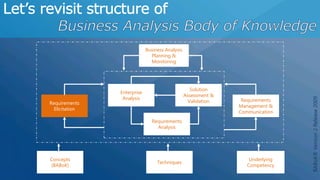
Enterprise
Analysis
Business Analysis
Planning &
Monitoring
Requirements
Elicitation
Requirements
Analysis
Solution
Assessment &
Validation
Underlying
Competency
Requirements
Management &
Communication
Techniques
Concepts
(BABoK)
BABoK®Version2Release2009
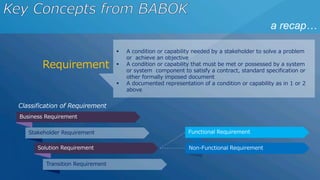
a recap…
 A condition or capability needed by a stakeholder to solve a problem
or achieve an objective
 A condition or capability that must be met or possessed by a system
or system component to satisfy a contract, standard specification or
other formally imposed document
 A documented representation of a condition or capability as in 1 or 2
above
Requirement
Business Requirement
Stakeholder Requirement
Solution Requirement
Transition Requirement
Classification of Requirement
Functional Requirement
Non-Functional Requirement
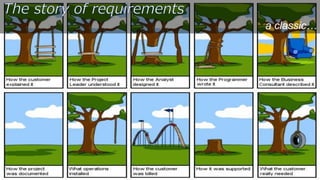
a classic…
Requirements Gathering
Vs.
Requirements Elicitation
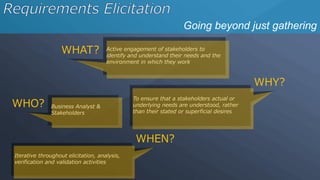
Going beyond just gathering
Active engagement of stakeholders to
identify and understand their needs and the
environment in which they work
WHAT?
Business Analyst &
Stakeholders
WHO?
To ensure that a stakeholders actual or
underlying needs are understood, rather
than their stated or superficial desires
WHY?
Iterative throughout elicitation, analysis,
verification and validation activities
WHEN?
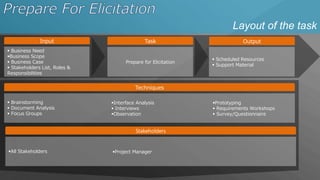
TASKS
Prepare For Elicitation
The Purpose of the task
Ensure all needed resources are
organized and scheduled for
conducting the elicitation activities
Layout of the task
 Business Need
Business Scope
 Business Case
 Stakeholders List, Roles &
Responsibilities
Input
Prepare for Elicitation
Task
 Scheduled Resources
 Support Material
Output
Techniques
 Brainstorming
 Document Analysis
 Focus Groups
Interface Analysis
 Interviews
Observation
Prototyping
 Requirements Workshops
 Survey/Questionnaire
Stakeholders
All Stakeholders Project Manager
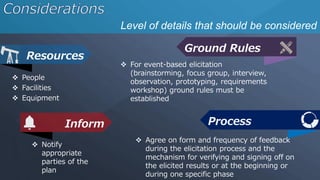
Key Elements
Level of details that should be considered
Resources
Ground Rules
 People
 Facilities
 Equipment
 For event-based elicitation
(brainstorming, focus group, interview,
observation, prototyping, requirements
workshop) ground rules must be
established
Inform
 Notify
appropriate
parties of the
plan
Process
 Agree on form and frequency of feedback
during the elicitation process and the
mechanism for verifying and signing off on
the elicited results or at the beginning or
during one specific phase
Conduct Elicitation
The Purpose of the task
Meet with stakeholder(s) to elicit
information regarding their needs
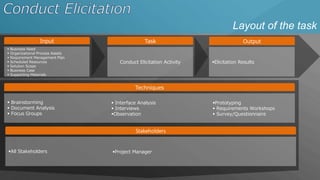
Layout of the task
 Business Need
 Organizational Process Assets
 Requirement Management Plan
 Scheduled Resources
 Solution Scope
 Business Case
 Supporting Materials
Input
Conduct Elicitation Activity
Task
Elicitation Results
Output
Techniques
 Brainstorming
 Document Analysis
 Focus Groups
 Interface Analysis
 Interviews
Observation
Prototyping
 Requirements Workshops
 Survey/Questionnaire
Stakeholders
All Stakeholders Project Manager
Key Elements
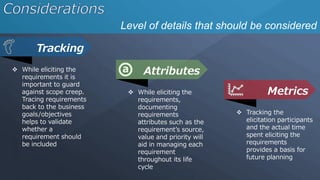
Level of details that should be considered
 While eliciting the
requirements it is
important to guard
against scope creep.
Tracing requirements
back to the business
goals/objectives
helps to validate
whether a
requirement should
be included
Tracking
 While eliciting the
requirements,
documenting
requirements
attributes such as the
requirement’s source,
value and priority will
aid in managing each
requirement
throughout its life
cycle
Attributes
 Tracking the
elicitation participants
and the actual time
spent eliciting the
requirements
provides a basis for
future planning
Metrics
Document Elicitation Results
The Purpose of the task
Record the information provided by
stakeholders for use in analysis
Layout of the task
Elicitation Results
Input
Document Elicitation
Results
Task
 Requirement [Stated]
 Stakeholder Concerns
Output
Techniques
 Brainstorming
 Document Analysis
 Focus Groups
 Interface Analysis
 Interviews
Observation
Prototyping
 Requirements Workshops
 Survey/Questionnaire
Stakeholders
Business Analyst
Key Elements
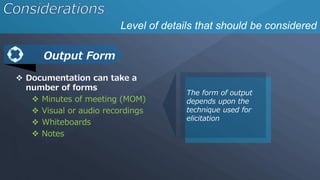
Level of details that should be considered
 Documentation can take a
number of forms
 Minutes of meeting (MOM)
 Visual or audio recordings
 Whiteboards
 Notes
Output Form
The form of output
depends upon the
technique used for
elicitation
Confirm Elicitation Results
The Purpose of the task
Validate that the stated requirements
expressed by the stakeholder match
the stakeholder’s understanding of the
problem and the stakeholder’s needs
Layout of the task
Requirement [Stated,
Unconfirmed]
 Stakeholder Concerns
[Unconfirmed]
Input
Confirm Elicitation
Results
Task
 Requirement [Stated,
Confirmed]
 Stakeholder Concerns
[Confirmed]
Output
Techniques
 Brainstorming
 Document Analysis
 Focus Groups
 Interface Analysis
 Interviews
Observation
Prototyping
 Requirements Workshops
 Survey/Questionnaire
Stakeholders
All Stakeholders
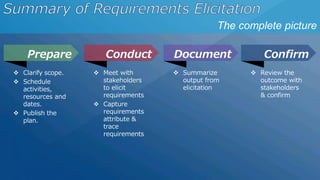
The complete picture
 Clarify scope.
 Schedule
activities,
resources and
dates.
 Publish the
plan.
Prepare
 Meet with
stakeholders
to elicit
requirements
 Capture
requirements
attribute &
trace
requirements
Conduct
 Summarize
output from
elicitation
Document
 Review the
outcome with
stakeholders
& confirm
Confirm
Key Techniques
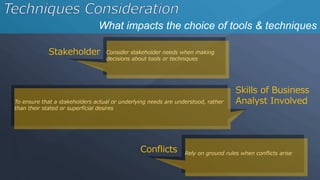
What impacts the choice of tools & techniques
Consider stakeholder needs when making
decisions about tools or techniques
Stakeholder
To ensure that a stakeholders actual or underlying needs are understood, rather
than their stated or superficial desires
Skills of Business
Analyst Involved
Conflicts Rely on ground rules when conflicts arise
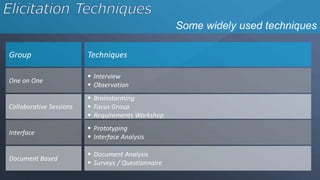
Some widely used techniques
Group Techniques
One on One
 Interview
 Observation
Collaborative Sessions
 Brainstorming
 Focus Group
 Requirements Workshop
Interface
 Prototyping
 Interface Analysis
Document Based
 Document Analysis
 Surveys / Questionnaire
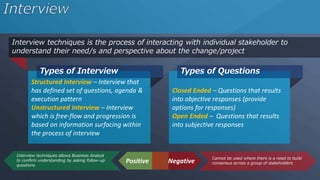
Structured Interview – Interview that
has defined set of questions, agenda &
execution pattern
Unstructured Interview – Interview
which is free-flow and progression is
based on information surfacing within
the process of interview
Types of Interview
Closed Ended – Questions that results
into objective responses (provide
options for responses)
Open Ended – Questions that results
into subjective responses
Types of Questions
Interview techniques is the process of interacting with individual stakeholder to
understand their need/s and perspective about the change/project
Positive Negative Cannot be used where there is a need to build
consensus across a group of stakeholders
Interview techniques allows Business Analyst
to confirm understanding by asking follow-up
questions
Example from Web
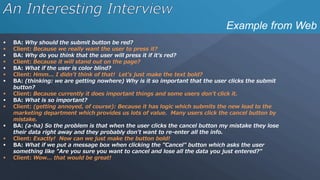
 BA: Why should the submit button be red?
 Client: Because we really want the user to press it?
 BA: Why do you think that the user will press it if it's red?
 Client: Because it will stand out on the page?
 BA: What if the user is color blind?
 Client: Hmm... I didn't think of that! Let's just make the text bold?
 BA: (thinking: we are getting nowhere) Why is it so important that the user clicks the submit
button?
 Client: Because currently it does important things and some users don't click it.
 BA: What is so important?
 Client: (getting annoyed, of course): Because it has logic which submits the new lead to the
marketing department which provides us lots of value. Many users click the cancel button by
mistake.
 BA: (a-ha) So the problem is that when the user clicks the cancel button my mistake they lose
their data right away and they probably don't want to re-enter all the info.
 Client: Exactly! Now can we just make the button bold!
 BA: What if we put a message box when clicking the "Cancel" button which asks the user
something like "Are you sure you want to cancel and lose all the data you just entered?"
 Client: Wow... that would be great!
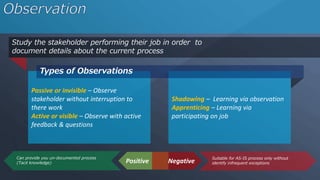
Passive or invisible – Observe
stakeholder without interruption to
there work
Active or visible – Observe with active
feedback & questions
Study the stakeholder performing their job in order to
document details about the current process
Positive Negative Suitable for AS-IS process only without
identify infrequent exceptions
Can provide you un-documented process
(Tacit knowledge)
Shadowing – Learning via observation
Apprenticing – Learning via
participating on job
Types of Observations
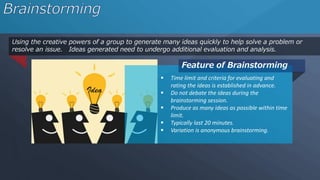
Using the creative powers of a group to generate many ideas quickly to help solve a problem or
resolve an issue. Ideas generated need to undergo additional evaluation and analysis.
Feature of Brainstorming
 Time limit and criteria for evaluating and
rating the ideas is established in advance.
 Do not debate the ideas during the
brainstorming session.
 Produce as many ideas as possible within time
limit.
 Typically last 20 minutes.
 Variation is anonymous brainstorming.
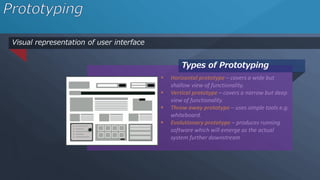
Visual representation of user interface
 Horizontal prototype – covers a wide but
shallow view of functionality.
 Vertical prototype – covers a narrow but deep
view of functionality.
 Throw away prototype – uses simple tools e.g.
whiteboard.
 Evolutionary prototype – produces running
software which will emerge as the actual
system further downstream
Types of Prototyping
Study of the connection between components of a solution, generally system to system
or hardware to hardware interfaces
Fundamentals of Interface Analysis
 Identify system boundaries
 Identify dependencies within system
 Identify the inputs & outputs
transactions
 Identify key data elements
Example
Health Plan Management
System
Consumer Portal Application
Consumer Requests
Plan Information
Provider CRM
Appointment Scheduling
Content Format and Subject Area [Content Format]
Message - ID Description Content format Subject Areas
Message-1 Plan Information Web Services Benefits
Message-2 Appointments Schedule Web Services Scheduling
BABoK®Version2Release2009
BABOK V2 - Business Analysis Knowledge Areas & Tasks Layout
[2] Business Analysis
Planning & Monitoring
[3] Elicitation
[4] Requirements
Management &
Communication
[5] Enterprise Analysis
[6] Requirement
Analysis
[7] Solution
Assessment &
Validation
[2.1] Plan Business
Analysis Approach
[3.1] Prepare for
Elicitation
[4.1] Manage Solution
Scope and Requirements
[5.1] Define Business Need
[6.1] Prioritize
Requirements
[7.1] Assess Proposed
Solution
[2.2] Conduct Stakeholder
Analysis
[3.2] Conduct Elicitation
Activity
[4.2] Manage
Requirement Traceability
[5.2] Assess Capability Gap
[6.2] Organize
Requirements
[7.2] Allocate
Requirements
[2.3] Plan Business
Analysis Activities
[3.3] Document Elicitation
Results
[4.3] Maintain
Requirement for Re
[5.3] Determine Solution
Approach
[6.3] Specify and Model
Requirements
[7.3] Assess Organization
Readiness
[2.4] Plan Business
Analysis Communication
[4.4] Prepare Requirement
Package
[5.4] Define Solution Scope
[6.4] Define Assumptions
& Constraints
[7.4] Define Transition
Requirements
[2.5] Plan Requirement
Management Process
[4.5] Communicate
Requirements
[5.5] Define Business Case [6.5] Verify Requirements [7.5] Validate Solution
[2.6] Manage Business
Analysis Performance
[6.6] Validate
Requirements
[7.6] Evaluate Solution
Performance
[3.4] Confirm Elicitation
Results

BABoK V2 Requirements Elicitation (RE)

  • 1.
    A Guide tothe Business Analysis Body of Knowledge (BABoK®) – Knowledge Area Requirements Elicitation By – Amjad Shaikh
  • 2.
    Enterprise Analysis Business Analysis Planning & Monitoring Requirements Elicitation Requirements Analysis Solution Assessment& Validation Underlying Competency Requirements Management & Communication Techniques Concepts (BABoK) BABoK®Version2Release2009
  • 3.
    a recap…  Acondition or capability needed by a stakeholder to solve a problem or achieve an objective  A condition or capability that must be met or possessed by a system or system component to satisfy a contract, standard specification or other formally imposed document  A documented representation of a condition or capability as in 1 or 2 above Requirement Business Requirement Stakeholder Requirement Solution Requirement Transition Requirement Classification of Requirement Functional Requirement Non-Functional Requirement
  • 4.
  • 6.
  • 7.
    Going beyond justgathering Active engagement of stakeholders to identify and understand their needs and the environment in which they work WHAT? Business Analyst & Stakeholders WHO? To ensure that a stakeholders actual or underlying needs are understood, rather than their stated or superficial desires WHY? Iterative throughout elicitation, analysis, verification and validation activities WHEN?
  • 8.
  • 9.
  • 10.
    The Purpose ofthe task Ensure all needed resources are organized and scheduled for conducting the elicitation activities
  • 11.
    Layout of thetask  Business Need Business Scope  Business Case  Stakeholders List, Roles & Responsibilities Input Prepare for Elicitation Task  Scheduled Resources  Support Material Output Techniques  Brainstorming  Document Analysis  Focus Groups Interface Analysis  Interviews Observation Prototyping  Requirements Workshops  Survey/Questionnaire Stakeholders All Stakeholders Project Manager
  • 12.
  • 13.
    Level of detailsthat should be considered Resources Ground Rules  People  Facilities  Equipment  For event-based elicitation (brainstorming, focus group, interview, observation, prototyping, requirements workshop) ground rules must be established Inform  Notify appropriate parties of the plan Process  Agree on form and frequency of feedback during the elicitation process and the mechanism for verifying and signing off on the elicited results or at the beginning or during one specific phase
  • 14.
  • 15.
    The Purpose ofthe task Meet with stakeholder(s) to elicit information regarding their needs
  • 16.
    Layout of thetask  Business Need  Organizational Process Assets  Requirement Management Plan  Scheduled Resources  Solution Scope  Business Case  Supporting Materials Input Conduct Elicitation Activity Task Elicitation Results Output Techniques  Brainstorming  Document Analysis  Focus Groups  Interface Analysis  Interviews Observation Prototyping  Requirements Workshops  Survey/Questionnaire Stakeholders All Stakeholders Project Manager
  • 17.
  • 18.
    Level of detailsthat should be considered  While eliciting the requirements it is important to guard against scope creep. Tracing requirements back to the business goals/objectives helps to validate whether a requirement should be included Tracking  While eliciting the requirements, documenting requirements attributes such as the requirement’s source, value and priority will aid in managing each requirement throughout its life cycle Attributes  Tracking the elicitation participants and the actual time spent eliciting the requirements provides a basis for future planning Metrics
  • 19.
  • 20.
    The Purpose ofthe task Record the information provided by stakeholders for use in analysis
  • 21.
    Layout of thetask Elicitation Results Input Document Elicitation Results Task  Requirement [Stated]  Stakeholder Concerns Output Techniques  Brainstorming  Document Analysis  Focus Groups  Interface Analysis  Interviews Observation Prototyping  Requirements Workshops  Survey/Questionnaire Stakeholders Business Analyst
  • 22.
  • 23.
    Level of detailsthat should be considered  Documentation can take a number of forms  Minutes of meeting (MOM)  Visual or audio recordings  Whiteboards  Notes Output Form The form of output depends upon the technique used for elicitation
  • 24.
  • 25.
    The Purpose ofthe task Validate that the stated requirements expressed by the stakeholder match the stakeholder’s understanding of the problem and the stakeholder’s needs
  • 26.
    Layout of thetask Requirement [Stated, Unconfirmed]  Stakeholder Concerns [Unconfirmed] Input Confirm Elicitation Results Task  Requirement [Stated, Confirmed]  Stakeholder Concerns [Confirmed] Output Techniques  Brainstorming  Document Analysis  Focus Groups  Interface Analysis  Interviews Observation Prototyping  Requirements Workshops  Survey/Questionnaire Stakeholders All Stakeholders
  • 27.
    The complete picture Clarify scope.  Schedule activities, resources and dates.  Publish the plan. Prepare  Meet with stakeholders to elicit requirements  Capture requirements attribute & trace requirements Conduct  Summarize output from elicitation Document  Review the outcome with stakeholders & confirm Confirm
  • 28.
  • 29.
    What impacts thechoice of tools & techniques Consider stakeholder needs when making decisions about tools or techniques Stakeholder To ensure that a stakeholders actual or underlying needs are understood, rather than their stated or superficial desires Skills of Business Analyst Involved Conflicts Rely on ground rules when conflicts arise
  • 30.
    Some widely usedtechniques Group Techniques One on One  Interview  Observation Collaborative Sessions  Brainstorming  Focus Group  Requirements Workshop Interface  Prototyping  Interface Analysis Document Based  Document Analysis  Surveys / Questionnaire
  • 31.
    Structured Interview –Interview that has defined set of questions, agenda & execution pattern Unstructured Interview – Interview which is free-flow and progression is based on information surfacing within the process of interview Types of Interview Closed Ended – Questions that results into objective responses (provide options for responses) Open Ended – Questions that results into subjective responses Types of Questions Interview techniques is the process of interacting with individual stakeholder to understand their need/s and perspective about the change/project Positive Negative Cannot be used where there is a need to build consensus across a group of stakeholders Interview techniques allows Business Analyst to confirm understanding by asking follow-up questions
  • 32.
    Example from Web BA: Why should the submit button be red?  Client: Because we really want the user to press it?  BA: Why do you think that the user will press it if it's red?  Client: Because it will stand out on the page?  BA: What if the user is color blind?  Client: Hmm... I didn't think of that! Let's just make the text bold?  BA: (thinking: we are getting nowhere) Why is it so important that the user clicks the submit button?  Client: Because currently it does important things and some users don't click it.  BA: What is so important?  Client: (getting annoyed, of course): Because it has logic which submits the new lead to the marketing department which provides us lots of value. Many users click the cancel button by mistake.  BA: (a-ha) So the problem is that when the user clicks the cancel button my mistake they lose their data right away and they probably don't want to re-enter all the info.  Client: Exactly! Now can we just make the button bold!  BA: What if we put a message box when clicking the "Cancel" button which asks the user something like "Are you sure you want to cancel and lose all the data you just entered?"  Client: Wow... that would be great!
  • 33.
    Passive or invisible– Observe stakeholder without interruption to there work Active or visible – Observe with active feedback & questions Study the stakeholder performing their job in order to document details about the current process Positive Negative Suitable for AS-IS process only without identify infrequent exceptions Can provide you un-documented process (Tacit knowledge) Shadowing – Learning via observation Apprenticing – Learning via participating on job Types of Observations
  • 34.
    Using the creativepowers of a group to generate many ideas quickly to help solve a problem or resolve an issue. Ideas generated need to undergo additional evaluation and analysis. Feature of Brainstorming  Time limit and criteria for evaluating and rating the ideas is established in advance.  Do not debate the ideas during the brainstorming session.  Produce as many ideas as possible within time limit.  Typically last 20 minutes.  Variation is anonymous brainstorming.
  • 35.
    Visual representation ofuser interface  Horizontal prototype – covers a wide but shallow view of functionality.  Vertical prototype – covers a narrow but deep view of functionality.  Throw away prototype – uses simple tools e.g. whiteboard.  Evolutionary prototype – produces running software which will emerge as the actual system further downstream Types of Prototyping
  • 36.
    Study of theconnection between components of a solution, generally system to system or hardware to hardware interfaces Fundamentals of Interface Analysis  Identify system boundaries  Identify dependencies within system  Identify the inputs & outputs transactions  Identify key data elements
  • 37.
    Example Health Plan Management System ConsumerPortal Application Consumer Requests Plan Information Provider CRM Appointment Scheduling Content Format and Subject Area [Content Format] Message - ID Description Content format Subject Areas Message-1 Plan Information Web Services Benefits Message-2 Appointments Schedule Web Services Scheduling
  • 40.
    BABoK®Version2Release2009 BABOK V2 -Business Analysis Knowledge Areas & Tasks Layout [2] Business Analysis Planning & Monitoring [3] Elicitation [4] Requirements Management & Communication [5] Enterprise Analysis [6] Requirement Analysis [7] Solution Assessment & Validation [2.1] Plan Business Analysis Approach [3.1] Prepare for Elicitation [4.1] Manage Solution Scope and Requirements [5.1] Define Business Need [6.1] Prioritize Requirements [7.1] Assess Proposed Solution [2.2] Conduct Stakeholder Analysis [3.2] Conduct Elicitation Activity [4.2] Manage Requirement Traceability [5.2] Assess Capability Gap [6.2] Organize Requirements [7.2] Allocate Requirements [2.3] Plan Business Analysis Activities [3.3] Document Elicitation Results [4.3] Maintain Requirement for Re [5.3] Determine Solution Approach [6.3] Specify and Model Requirements [7.3] Assess Organization Readiness [2.4] Plan Business Analysis Communication [4.4] Prepare Requirement Package [5.4] Define Solution Scope [6.4] Define Assumptions & Constraints [7.4] Define Transition Requirements [2.5] Plan Requirement Management Process [4.5] Communicate Requirements [5.5] Define Business Case [6.5] Verify Requirements [7.5] Validate Solution [2.6] Manage Business Analysis Performance [6.6] Validate Requirements [7.6] Evaluate Solution Performance [3.4] Confirm Elicitation Results