Revision activity by Danielle Duffy
Dyer stated that there were four aspects to representation:
1. Re-presentation: the use of media language to portray the subject
in a certain way.
2. Being representative of: types (typically stereotypes) are used
within media to communicate. Mise-en-scène is selected carefully in
order to allow the audience to identify these.
3. The purpose for the creation of media texts is mainly for profit,
and so accuracy and realism shouldn’t be guaranteed. Audiences
are thought to prefer to be entertained rather than have to think,
and so stereotypes are used repeatedly as a sort of comfort for
viewers. Countertypes (where stereotypes are challenged or
subverted) do not go down well with many audiences.
4. Audiences’ responses to representations: audiences can either
make preferred, negotiated or oppositional readings of texts.
* Recognised that stereotypes perform several functions in media
representations
* Argues that the use of stereotypes within the media emphasises that
there are big differences between different types of people
* ‘How we are seen determines how we are treated. How we treat
others is determined by how we see them. How we see them comes
from representation’ The Matter of Images
* His theory was that the use of stereotypes legitimises inequality,
encouraging others to replicate similar, negative behaviour in real
life
* Most representations conform to some form of stereotype and are
exaggerated or hyper real for entertainment values
* The ideological reading of this form of stereotyping is to legitimise
(support) inequality (preferred reading)
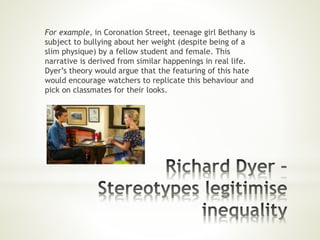
For example, in Coronation Street, teenage girl Bethany is
subject to bullying about her weight (despite being of a
slim physique) by a fellow student and female. This
narrative is derived from similar happenings in real life.
Dyer’s theory would argue that the featuring of this hate
would encourage watchers to replicate this behaviour and
pick on classmates for their looks.
*Suggests that female characters tend to be displayed for
the visual pleasure of male characters and audience
members
*Females are coded as the ‘object’ of gaze within media
texts and are represented in a sexual way
Males = look (Active)
Females = looked at (passive)
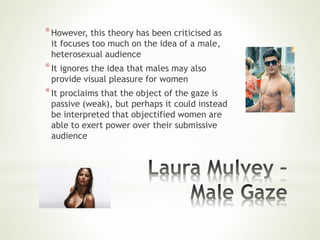
*However, this theory has been criticised as
it focuses too much on the idea of a male,
heterosexual audience
*It ignores the idea that males may also
provide visual pleasure for women
*It proclaims that the object of the gaze is
passive (weak), but perhaps it could instead
be interpreted that objectified women are
able to exert power over their submissive
audience
*Representations no longer refer to real things
*They have surpassed reality to a point where what
we see has become more real to us than reality
itself, and has replaced it
*Therefore images can now be described as
‘hyperreal’ as Baudrillard believes they bare no
relationship to the real
*Audiences often judge a text’s realism against their
own ‘situated culture’
*Suggests that the use of stereotypes can enhance
realism
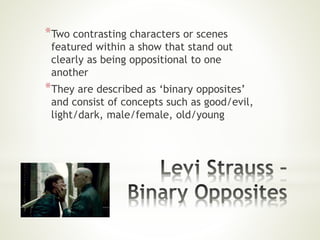
*Two contrasting characters or scenes
featured within a show that stand out
clearly as being oppositional to one
another
*They are described as ‘binary opposites’
and consist of concepts such as good/evil,
light/dark, male/female, old/young
Dominant vs. subordinate types:
*Male / female
*White / other ethnic groups
*Middle-upper class / working class
*Middle aged / the young-old
*Heterosexual / homosexual
*Able-bodied / disabled
*Regional identity / North/Midlands/Irish
*(London/south east) / West/Scotland/Wales
*Suggested there were 3 main types of reading
(interpreting) a text and its representations:
dominant, oppositional and negotiated
*A set of beliefs that are widely accepted as
being the most normal, or the most accurate
*For example, the dominant ideology of men is
that they are strong, brave and work to provide
money for their families
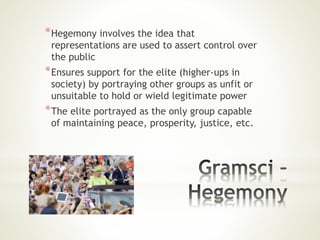
*Hegemony involves the idea that
representations are used to assert control over
the public
*Ensures support for the elite (higher-ups in
society) by portraying other groups as unfit or
unsuitable to hold or wield legitimate power
*The elite portrayed as the only group capable
of maintaining peace, prosperity, justice, etc.
*Roles in media with negative portrayals are
most commonly depicted as being of a lower
class e.g. ‘hoodies’, paedophiles, criminals,
‘chavs’, foreigners, immigrants
*Front page newspapers exhibit these types and
others will associate crimes with these types of
people
*Therefore others will turn to the elite for help
and protection against these degenerate types
*Cultural hegemony is the philosophic and
sociological concept that a culturally-diverse
society can be ruled or dominated by one of its
social classe
*It is the dominance of one social group over another
*The theory claims that the ideas of the ruling class
come to be seen as the norm; they are seen as
universal ideologies, perceived to benefit everyone
whilst only really benefiting the ruling class

Representation theories

  • 1.
    Revision activity byDanielle Duffy
  • 2.
    Dyer stated thatthere were four aspects to representation: 1. Re-presentation: the use of media language to portray the subject in a certain way. 2. Being representative of: types (typically stereotypes) are used within media to communicate. Mise-en-scène is selected carefully in order to allow the audience to identify these. 3. The purpose for the creation of media texts is mainly for profit, and so accuracy and realism shouldn’t be guaranteed. Audiences are thought to prefer to be entertained rather than have to think, and so stereotypes are used repeatedly as a sort of comfort for viewers. Countertypes (where stereotypes are challenged or subverted) do not go down well with many audiences. 4. Audiences’ responses to representations: audiences can either make preferred, negotiated or oppositional readings of texts.
  • 3.
    * Recognised thatstereotypes perform several functions in media representations * Argues that the use of stereotypes within the media emphasises that there are big differences between different types of people * ‘How we are seen determines how we are treated. How we treat others is determined by how we see them. How we see them comes from representation’ The Matter of Images * His theory was that the use of stereotypes legitimises inequality, encouraging others to replicate similar, negative behaviour in real life * Most representations conform to some form of stereotype and are exaggerated or hyper real for entertainment values * The ideological reading of this form of stereotyping is to legitimise (support) inequality (preferred reading)
  • 4.
    For example, inCoronation Street, teenage girl Bethany is subject to bullying about her weight (despite being of a slim physique) by a fellow student and female. This narrative is derived from similar happenings in real life. Dyer’s theory would argue that the featuring of this hate would encourage watchers to replicate this behaviour and pick on classmates for their looks.
  • 5.
    *Suggests that femalecharacters tend to be displayed for the visual pleasure of male characters and audience members *Females are coded as the ‘object’ of gaze within media texts and are represented in a sexual way Males = look (Active) Females = looked at (passive)
  • 6.
    *However, this theoryhas been criticised as it focuses too much on the idea of a male, heterosexual audience *It ignores the idea that males may also provide visual pleasure for women *It proclaims that the object of the gaze is passive (weak), but perhaps it could instead be interpreted that objectified women are able to exert power over their submissive audience
  • 7.
    *Representations no longerrefer to real things *They have surpassed reality to a point where what we see has become more real to us than reality itself, and has replaced it *Therefore images can now be described as ‘hyperreal’ as Baudrillard believes they bare no relationship to the real *Audiences often judge a text’s realism against their own ‘situated culture’ *Suggests that the use of stereotypes can enhance realism
  • 8.
    *Two contrasting charactersor scenes featured within a show that stand out clearly as being oppositional to one another *They are described as ‘binary opposites’ and consist of concepts such as good/evil, light/dark, male/female, old/young
  • 9.
    Dominant vs. subordinatetypes: *Male / female *White / other ethnic groups *Middle-upper class / working class *Middle aged / the young-old *Heterosexual / homosexual *Able-bodied / disabled *Regional identity / North/Midlands/Irish *(London/south east) / West/Scotland/Wales
  • 10.
    *Suggested there were3 main types of reading (interpreting) a text and its representations: dominant, oppositional and negotiated *A set of beliefs that are widely accepted as being the most normal, or the most accurate *For example, the dominant ideology of men is that they are strong, brave and work to provide money for their families
  • 11.
    *Hegemony involves theidea that representations are used to assert control over the public *Ensures support for the elite (higher-ups in society) by portraying other groups as unfit or unsuitable to hold or wield legitimate power *The elite portrayed as the only group capable of maintaining peace, prosperity, justice, etc.
  • 12.
    *Roles in mediawith negative portrayals are most commonly depicted as being of a lower class e.g. ‘hoodies’, paedophiles, criminals, ‘chavs’, foreigners, immigrants *Front page newspapers exhibit these types and others will associate crimes with these types of people *Therefore others will turn to the elite for help and protection against these degenerate types
  • 13.
    *Cultural hegemony isthe philosophic and sociological concept that a culturally-diverse society can be ruled or dominated by one of its social classe *It is the dominance of one social group over another *The theory claims that the ideas of the ruling class come to be seen as the norm; they are seen as universal ideologies, perceived to benefit everyone whilst only really benefiting the ruling class