Deep Learning World | Munich 2019
Machine Learning at WeWork:
Creating Community Through Graph Embeddings
PHYSICAL + DIGITAL DATA
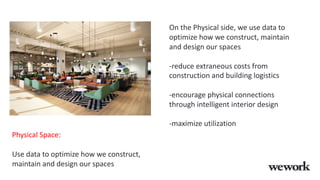
Physical Space:
Use data to optimize how we construct,
maintain and design our spaces
On the Physical side, we use data to
optimize how we construct, maintain
and design our spaces
-reduce extraneous costs from
construction and building logistics
-encourage physical connections
through intelligent interior design
-maximize utilization
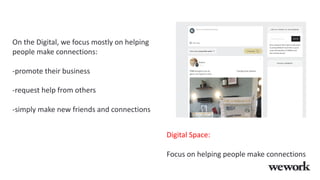
Digital Space:
Focus on helping people make connections
On the Digital, we focus mostly on helping
people make connections:
-promote their business
-request help from others
-simply make new friends and connections
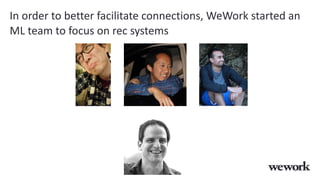
In order to better facilitate connections, WeWork started an
ML team to focus on rec systems
In order to better facilitate connections, WeWork started an
ML team to focus on rec systems
In order to better facilitate connections, WeWork started an
ML team to focus on rec systems
-personalized newsfeed
-text classifiers
-entity extraction
-onboarding skills suggestion
-conference rooms recommender
-experiment platform
Graph Embeddings with node2vec
Or: How to recommend members for fun and profit
Graph Embeddings with node2vec
1) Business Use Case
2) Data
3) Model
Use Case: Member Needs
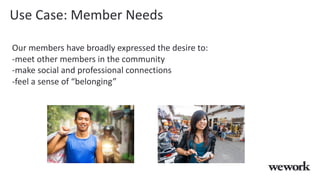
Our members have broadly expressed the desire to:
-meet other members in the community
-make social and professional connections
-feel a sense of “belonging”
Use Case: Member Needs
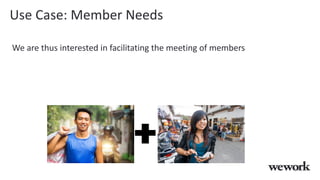
We are thus interested in facilitating the meeting of members
Use Case: Member Needs
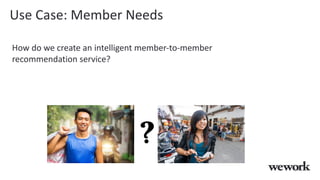
How do we create an intelligent member-to-member
recommendation service?
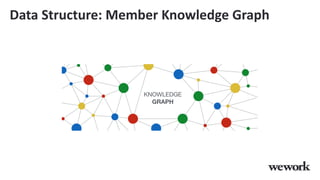
Data Structure: Member Knowledge Graph
Member Knowledge Graph
A central repository of information about our members
Member Knowledge Graph
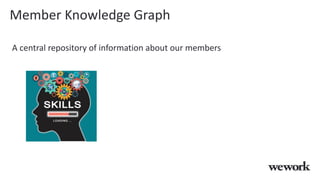
A central repository of information about our members
Member Knowledge Graph
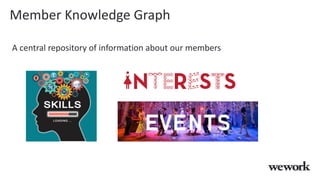
A central repository of information about our members
Member Knowledge Graph
A central repository of information about our members
Member Knowledge Graph
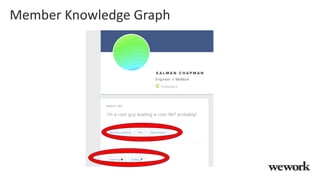
We collect data from:
-member profiles
-member interactions on the app
-posts you’ve liked
-events you’ve bookmarked
-community team notes
-external data sources that we match to our internal data
Member Knowledge Graph
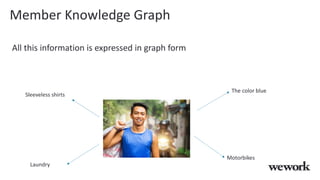
All this information is expressed in graph form
Member Knowledge Graph
All this information is expressed in graph form
Sleeveless shirts
Laundry
The color blue
Motorbikes
Member Knowledge Graph
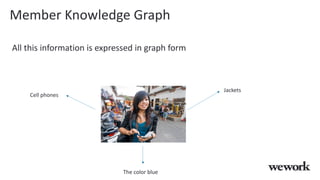
All this information is expressed in graph form
Cell phones
Jackets
The color blue
Member Knowledge Graph
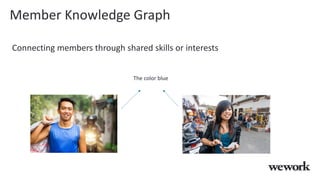
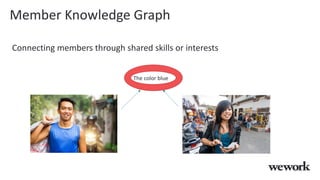
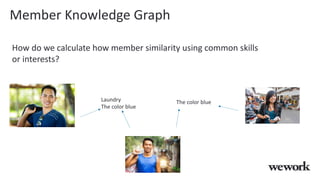
Connecting members through shared skills or interests
The color blue
Member Knowledge Graph
Connecting members through shared skills or interests
The color blue
Member Knowledge Graph
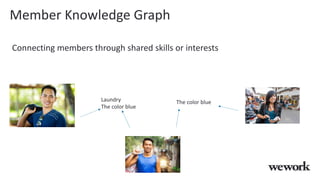
Connecting members through shared skills or interests
Laundry
The color blue
The color blue
Member Knowledge Graph
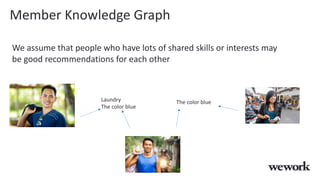
We assume that people who have lots of shared skills or interests may
be good recommendations for each other
Laundry
The color blue
The color blue
Member Knowledge Graph
How do we calculate how member similarity using common skills
or interests?
Laundry
The color blue
The color blue
Embeddings
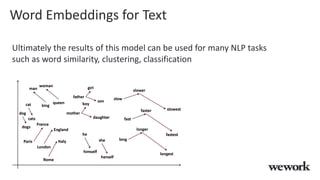
Word Embeddings for Text
Learn vector representations of words that capture semantic meanings
Word Embeddings for Text
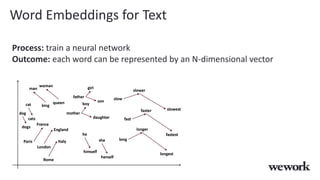
Process: train a neural network
Outcome: each word can be represented by an N-dimensional vector
Word Embeddings for Text
Ultimately the results of this model can be used for many NLP tasks
such as word similarity, clustering, classification
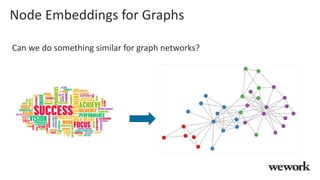
Node Embeddings for Graphs
Can we do something similar for graph networks?
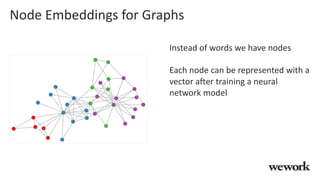
Node Embeddings for Graphs
Instead of words we have nodes
Each node can be represented with a
vector after training a neural
network model
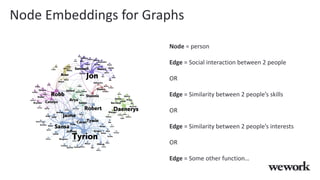
Node Embeddings for Graphs
Node = person
Edge = Social interaction between 2 people
OR
Edge = Similarity between 2 people’s skills
OR
Edge = Similarity between 2 people’s interests
OR
Edge = Some other function…
Node Embeddings for Graphs
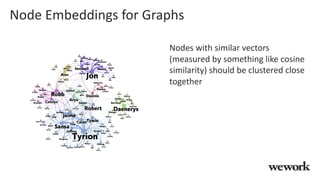
Nodes with similar vectors
(measured by something like cosine
similarity) should be clustered close
together
Node Embeddings for Graphs
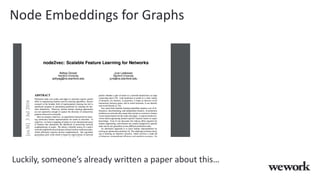
Luckily, someone’s already written a paper about this…
word2vec vs Node2vec
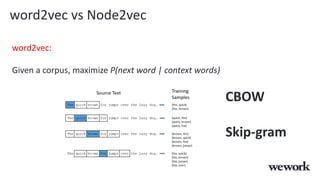
word2vec:
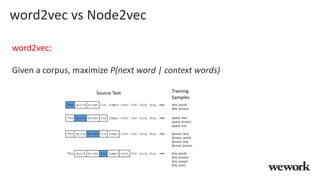
Given a corpus, maximize P(next word | context words)
word2vec vs Node2vec
word2vec:
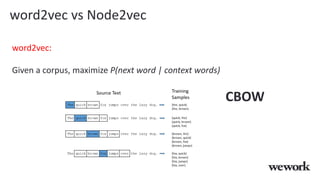
Given a corpus, maximize P(next word | context words)
CBOW
word2vec vs Node2vec
word2vec:
Given a corpus, maximize P(next word | context words)
CBOW
Skip-gram
word2vec vs Node2vec
node2vec:
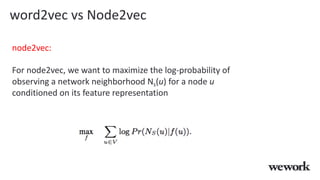
For node2vec, we want to maximize the log-probability of
observing a network neighborhood Ns(u) for a node u
conditioned on its feature representation
word2vec vs Node2vec
node2vec:
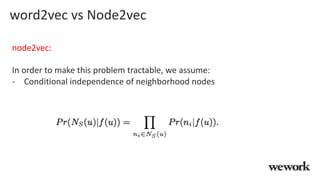
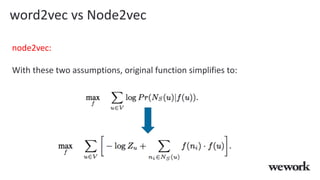
In order to make this problem tractable, we assume:
- Conditional independence of neighborhood nodes
word2vec vs Node2vec
node2vec:
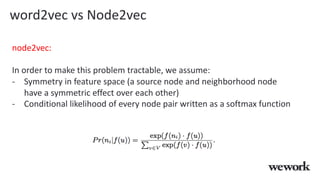
In order to make this problem tractable, we assume:
- Symmetry in feature space (a source node and neighborhood node
have a symmetric effect over each other)
- Conditional likelihood of every node pair written as a softmax function
word2vec vs Node2vec
node2vec:
With these two assumptions, original function simplifies to:
word2vec vs Node2vec
node2vec:
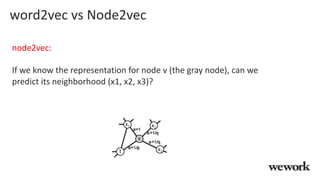
If we know the representation for node v (the gray node), can we
predict its neighborhood (x1, x2, x3)?
node2vec Algorithm
Problem:
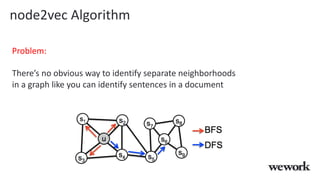
There’s no obvious way to identify separate neighborhoods
in a graph like you can identify sentences in a document
node2vec Algorithm
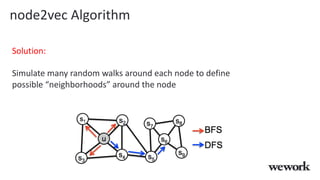
Solution:
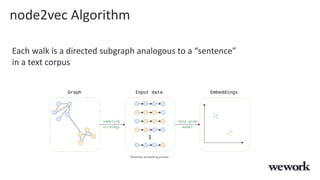
Simulate many random walks around each node to define
possible “neighborhoods” around the node
node2vec Algorithm
Each walk is a directed subgraph analogous to a “sentence”
in a text corpus
node2vec Algorithm
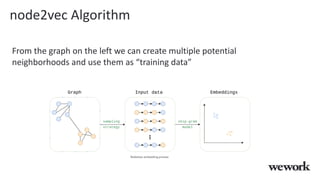
From the graph on the left we can create multiple potential
neighborhoods and use them as “training data”
node2vec Algorithm
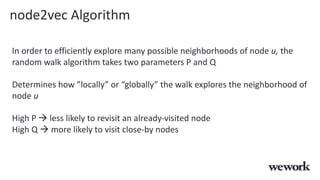
In order to efficiently explore many possible neighborhoods of node u, the
random walk algorithm takes two parameters P and Q
Determines how ”locally” or “globally” the walk explores the neighborhood of
node u
High P à less likely to revisit an already-visited node
High Q à more likely to visit close-by nodes
node2vec Algorithm
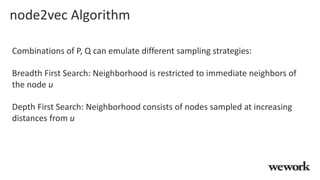
Combinations of P, Q can emulate different sampling strategies:
Breadth First Search: Neighborhood is restricted to immediate neighbors of
the node u
Depth First Search: Neighborhood consists of nodes sampled at increasing
distances from u
node2vec
The node2vec algorithm can be decomposed into 3 steps:
a) Precompute transition probabilities for the random walk simulation
b) For every node, simulate r random walks of fixed length l
c) Feed random walks into a word2vec model and solve with SGD
node2vec
Once we train a model and find embeddings for each node we can do:
- Clustering using node embeddings
- Node classification
- Link prediction
- Community Detection
Clustering off node2vec
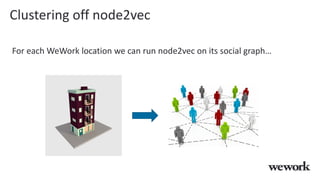
For each WeWork location we can run node2vec on its social graph…
Clustering off node2vec
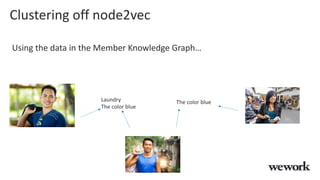
Using the data in the Member Knowledge Graph…
Laundry
The color blue
The color blue
Clustering off node2vec
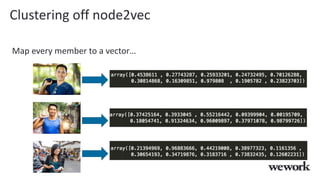
Map every member to a vector…
Clustering off node2vec
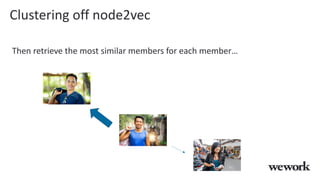
Then retrieve the most similar members for each member…
Clustering off node2vec
And use this to power different kinds of member recommendations
Clustering off node2vec
And use this to power different kinds of member recommendations
-General member recommendations during onboarding
Clustering off node2vec
And use this to power different kinds of member recommendations
-General member recommendations during onboarding
-Facilitated introductions between WeWork Labs members
Thanks for Listening!

Creating Community at WeWork through Graph Embeddings with node2vec - Karry Lu

  • 1.
    Deep Learning World| Munich 2019 Machine Learning at WeWork: Creating Community Through Graph Embeddings
  • 2.
  • 3.
    Physical Space: Use datato optimize how we construct, maintain and design our spaces On the Physical side, we use data to optimize how we construct, maintain and design our spaces -reduce extraneous costs from construction and building logistics -encourage physical connections through intelligent interior design -maximize utilization
  • 4.
    Digital Space: Focus onhelping people make connections On the Digital, we focus mostly on helping people make connections: -promote their business -request help from others -simply make new friends and connections
  • 5.
    In order tobetter facilitate connections, WeWork started an ML team to focus on rec systems
  • 6.
    In order tobetter facilitate connections, WeWork started an ML team to focus on rec systems
  • 7.
    In order tobetter facilitate connections, WeWork started an ML team to focus on rec systems -personalized newsfeed -text classifiers -entity extraction -onboarding skills suggestion -conference rooms recommender -experiment platform
  • 8.
    Graph Embeddings withnode2vec Or: How to recommend members for fun and profit
  • 9.
    Graph Embeddings withnode2vec 1) Business Use Case 2) Data 3) Model
  • 10.
    Use Case: MemberNeeds Our members have broadly expressed the desire to: -meet other members in the community -make social and professional connections -feel a sense of “belonging”
  • 11.
    Use Case: MemberNeeds We are thus interested in facilitating the meeting of members
  • 12.
    Use Case: MemberNeeds How do we create an intelligent member-to-member recommendation service?
  • 13.
    Data Structure: MemberKnowledge Graph
  • 14.
    Member Knowledge Graph Acentral repository of information about our members
  • 15.
    Member Knowledge Graph Acentral repository of information about our members
  • 16.
    Member Knowledge Graph Acentral repository of information about our members
  • 17.
    Member Knowledge Graph Acentral repository of information about our members
  • 18.
    Member Knowledge Graph Wecollect data from: -member profiles -member interactions on the app -posts you’ve liked -events you’ve bookmarked -community team notes -external data sources that we match to our internal data
  • 19.
  • 20.
    Member Knowledge Graph Allthis information is expressed in graph form
  • 21.
    Member Knowledge Graph Allthis information is expressed in graph form Sleeveless shirts Laundry The color blue Motorbikes
  • 22.
    Member Knowledge Graph Allthis information is expressed in graph form Cell phones Jackets The color blue
  • 23.
    Member Knowledge Graph Connectingmembers through shared skills or interests The color blue
  • 24.
    Member Knowledge Graph Connectingmembers through shared skills or interests The color blue
  • 25.
    Member Knowledge Graph Connectingmembers through shared skills or interests Laundry The color blue The color blue
  • 26.
    Member Knowledge Graph Weassume that people who have lots of shared skills or interests may be good recommendations for each other Laundry The color blue The color blue
  • 27.
    Member Knowledge Graph Howdo we calculate how member similarity using common skills or interests? Laundry The color blue The color blue
  • 28.
  • 29.
    Word Embeddings forText Learn vector representations of words that capture semantic meanings
  • 30.
    Word Embeddings forText Process: train a neural network Outcome: each word can be represented by an N-dimensional vector
  • 31.
    Word Embeddings forText Ultimately the results of this model can be used for many NLP tasks such as word similarity, clustering, classification
  • 32.
    Node Embeddings forGraphs Can we do something similar for graph networks?
  • 33.
    Node Embeddings forGraphs Instead of words we have nodes Each node can be represented with a vector after training a neural network model
  • 34.
    Node Embeddings forGraphs Node = person Edge = Social interaction between 2 people OR Edge = Similarity between 2 people’s skills OR Edge = Similarity between 2 people’s interests OR Edge = Some other function…
  • 35.
    Node Embeddings forGraphs Nodes with similar vectors (measured by something like cosine similarity) should be clustered close together
  • 36.
    Node Embeddings forGraphs Luckily, someone’s already written a paper about this…
  • 37.
    word2vec vs Node2vec word2vec: Givena corpus, maximize P(next word | context words)
  • 38.
    word2vec vs Node2vec word2vec: Givena corpus, maximize P(next word | context words) CBOW
  • 39.
    word2vec vs Node2vec word2vec: Givena corpus, maximize P(next word | context words) CBOW Skip-gram
  • 40.
    word2vec vs Node2vec node2vec: Fornode2vec, we want to maximize the log-probability of observing a network neighborhood Ns(u) for a node u conditioned on its feature representation
  • 41.
    word2vec vs Node2vec node2vec: Inorder to make this problem tractable, we assume: - Conditional independence of neighborhood nodes
  • 42.
    word2vec vs Node2vec node2vec: Inorder to make this problem tractable, we assume: - Symmetry in feature space (a source node and neighborhood node have a symmetric effect over each other) - Conditional likelihood of every node pair written as a softmax function
  • 43.
    word2vec vs Node2vec node2vec: Withthese two assumptions, original function simplifies to:
  • 44.
    word2vec vs Node2vec node2vec: Ifwe know the representation for node v (the gray node), can we predict its neighborhood (x1, x2, x3)?
  • 45.
    node2vec Algorithm Problem: There’s noobvious way to identify separate neighborhoods in a graph like you can identify sentences in a document
  • 46.
    node2vec Algorithm Solution: Simulate manyrandom walks around each node to define possible “neighborhoods” around the node
  • 47.
    node2vec Algorithm Each walkis a directed subgraph analogous to a “sentence” in a text corpus
  • 48.
    node2vec Algorithm From thegraph on the left we can create multiple potential neighborhoods and use them as “training data”
  • 49.
    node2vec Algorithm In orderto efficiently explore many possible neighborhoods of node u, the random walk algorithm takes two parameters P and Q Determines how ”locally” or “globally” the walk explores the neighborhood of node u High P à less likely to revisit an already-visited node High Q à more likely to visit close-by nodes
  • 50.
    node2vec Algorithm Combinations ofP, Q can emulate different sampling strategies: Breadth First Search: Neighborhood is restricted to immediate neighbors of the node u Depth First Search: Neighborhood consists of nodes sampled at increasing distances from u
  • 51.
    node2vec The node2vec algorithmcan be decomposed into 3 steps: a) Precompute transition probabilities for the random walk simulation b) For every node, simulate r random walks of fixed length l c) Feed random walks into a word2vec model and solve with SGD
  • 52.
    node2vec Once we traina model and find embeddings for each node we can do: - Clustering using node embeddings - Node classification - Link prediction - Community Detection
  • 53.
    Clustering off node2vec Foreach WeWork location we can run node2vec on its social graph…
  • 54.
    Clustering off node2vec Usingthe data in the Member Knowledge Graph… Laundry The color blue The color blue
  • 55.
    Clustering off node2vec Mapevery member to a vector…
  • 56.
    Clustering off node2vec Thenretrieve the most similar members for each member…
  • 57.
    Clustering off node2vec Anduse this to power different kinds of member recommendations
  • 58.
    Clustering off node2vec Anduse this to power different kinds of member recommendations -General member recommendations during onboarding
  • 59.
    Clustering off node2vec Anduse this to power different kinds of member recommendations -General member recommendations during onboarding -Facilitated introductions between WeWork Labs members
  • 60.