node2vec: Scalable Feature
Learning for Networks
Tien-Bach-Thanh Do
Network Science Lab
Dept. of Artificial Intelligence
The Catholic University of Korea
E-mail: xxx@catholic.ac.kr
2023 / 12 / 26
Aditya Grover, Jure Leskovec
InProceedings of the 22nd ACM SIGKDD international conference on
Knowledge discovery and data mining
2
Introduction
● Unveiling Node2Vec: navigating graphs with embeddings
● Node2Vec is a powerful algorithm for generating embeddings of nodes in a graph, enabling efficient
representation learning.
3
Background
• Node2Vec is an algorithm for scalable feature learning in graphs. It was introduced by Aditya Grover and
Jure Leskovec in 2016.
• Motivation: traditional graph analysis often relies on node-based metrics, but Node2Vec aims to capture
the structural information of graphs in a more meaningful way.
• Key idea: the algorithm learn continuous feature representations, or embeddings, for nodes in a graph,
facilitating downstream tasks such as node classification, link prediction, and graph visualization.
4
Methodology
Breadth-first search (BFS)
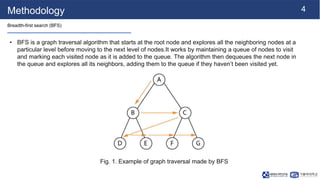
• BFS is a graph traversal algorithm that starts at the root node and explores all the neighboring nodes at a
particular level before moving to the next level of nodes.It works by maintaining a queue of nodes to visit
and marking each visited node as it is added to the queue. The algorithm then dequeues the next node in
the queue and explores all its neighbors, adding them to the queue if they haven’t been visited yet.
Fig. 1. Example of graph traversal made by BFS
5
Methodology
Depth-first search (DFS)
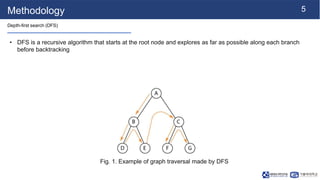
• DFS is a recursive algorithm that starts at the root node and explores as far as possible along each branch
before backtracking
Fig. 1. Example of graph traversal made by DFS
6
Methodology
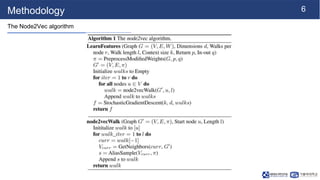
The Node2Vec algorithm
7
Graph Embeddings
• Explanation: graph embeddings are vector representations of nodes that preserve structural relationships
in the graph.
• Purpose: embeddings help transform discrete graph data into a continuous vector space, making it easier
to apply machine learning techniques.
• Node2Vec’s approach: it leverages random walks to capture the local and global neighborhood of nodes,
enabling the generation of informative embeddings.
8
Transition matrix
• Explanation: Node2Vec constructs a transition matrix that characterizes the probabilities of transitions
between nodes.
• Math behind it: the transition matrix is constructed based on the probabilities associated with each edge in
the graph.
• Influence of parameters: the parameters p and q influence the weights assigned to different types of
transitions, balancing local and global exploration.
9
Learning Embeddings
• Objective: Node2Vec aims to learn embeddings that maximize the likelihood of preserving neighborhood
relationships observed in random walks.
• Skip-gram model: the learning objective is formulated as a skip-gram model, where the goal is to predict
the context (neighbor) nodes given the current node.
• Optimization: the embeddings are learned by optimizing the objective function using techniques like
stochastic gradient descent.
10
Applications
• Node classification: use Node2Vec embeddings for classifying nodes in a graph based on their structural
properties.
• Link prediction: predict missing or future links between nodes in a graph.
• Graph visualization: visualize high-dimensional graph data in a lower-dimensional space for better
interpretability.
• Recommendation systems: enhance the performance of recommendation algorithms by incorporating node
embeddings.
11
Challenges and considerations
• Scalability: Node2Vec may face challenges with large-scale graphs due to the need for extensive random
walks.
• Parameter tuning: proper selection of parameters (p and q) is crucial for achieving meaningful embeddings.
• Interpretability: while embeddings capture structural information, interpreting the learned features can be
challenging.
12
Conclusions
• Recap: Node2Vec is a valuable tool for graph representation learning, offering versatile applications in
various domains.
• Future directions: Ongoing research continues to explore enhancements and extensions to Node2Vec for
addressing challenges and expanding its capabilities.
• Takeaway: Understanding and leveraging Node2Vec opens up new avenues for analyzing and extracting
insights from complex graph-structured data.

node2vec: Scalable Feature Learning for Networks.pptx

  • 1.
    node2vec: Scalable Feature Learningfor Networks Tien-Bach-Thanh Do Network Science Lab Dept. of Artificial Intelligence The Catholic University of Korea E-mail: xxx@catholic.ac.kr 2023 / 12 / 26 Aditya Grover, Jure Leskovec InProceedings of the 22nd ACM SIGKDD international conference on Knowledge discovery and data mining
  • 2.
    2 Introduction ● Unveiling Node2Vec:navigating graphs with embeddings ● Node2Vec is a powerful algorithm for generating embeddings of nodes in a graph, enabling efficient representation learning.
  • 3.
    3 Background • Node2Vec isan algorithm for scalable feature learning in graphs. It was introduced by Aditya Grover and Jure Leskovec in 2016. • Motivation: traditional graph analysis often relies on node-based metrics, but Node2Vec aims to capture the structural information of graphs in a more meaningful way. • Key idea: the algorithm learn continuous feature representations, or embeddings, for nodes in a graph, facilitating downstream tasks such as node classification, link prediction, and graph visualization.
  • 4.
    4 Methodology Breadth-first search (BFS) •BFS is a graph traversal algorithm that starts at the root node and explores all the neighboring nodes at a particular level before moving to the next level of nodes.It works by maintaining a queue of nodes to visit and marking each visited node as it is added to the queue. The algorithm then dequeues the next node in the queue and explores all its neighbors, adding them to the queue if they haven’t been visited yet. Fig. 1. Example of graph traversal made by BFS
  • 5.
    5 Methodology Depth-first search (DFS) •DFS is a recursive algorithm that starts at the root node and explores as far as possible along each branch before backtracking Fig. 1. Example of graph traversal made by DFS
  • 6.
  • 7.
    7 Graph Embeddings • Explanation:graph embeddings are vector representations of nodes that preserve structural relationships in the graph. • Purpose: embeddings help transform discrete graph data into a continuous vector space, making it easier to apply machine learning techniques. • Node2Vec’s approach: it leverages random walks to capture the local and global neighborhood of nodes, enabling the generation of informative embeddings.
  • 8.
    8 Transition matrix • Explanation:Node2Vec constructs a transition matrix that characterizes the probabilities of transitions between nodes. • Math behind it: the transition matrix is constructed based on the probabilities associated with each edge in the graph. • Influence of parameters: the parameters p and q influence the weights assigned to different types of transitions, balancing local and global exploration.
  • 9.
    9 Learning Embeddings • Objective:Node2Vec aims to learn embeddings that maximize the likelihood of preserving neighborhood relationships observed in random walks. • Skip-gram model: the learning objective is formulated as a skip-gram model, where the goal is to predict the context (neighbor) nodes given the current node. • Optimization: the embeddings are learned by optimizing the objective function using techniques like stochastic gradient descent.
  • 10.
    10 Applications • Node classification:use Node2Vec embeddings for classifying nodes in a graph based on their structural properties. • Link prediction: predict missing or future links between nodes in a graph. • Graph visualization: visualize high-dimensional graph data in a lower-dimensional space for better interpretability. • Recommendation systems: enhance the performance of recommendation algorithms by incorporating node embeddings.
  • 11.
    11 Challenges and considerations •Scalability: Node2Vec may face challenges with large-scale graphs due to the need for extensive random walks. • Parameter tuning: proper selection of parameters (p and q) is crucial for achieving meaningful embeddings. • Interpretability: while embeddings capture structural information, interpreting the learned features can be challenging.
  • 12.
    12 Conclusions • Recap: Node2Vecis a valuable tool for graph representation learning, offering versatile applications in various domains. • Future directions: Ongoing research continues to explore enhancements and extensions to Node2Vec for addressing challenges and expanding its capabilities. • Takeaway: Understanding and leveraging Node2Vec opens up new avenues for analyzing and extracting insights from complex graph-structured data.