Working Definitions:
Learning outcomes are statements of what a student
should know, understand and/or be able to demonstrate after
completion of a process of learning.
• must not simply be a “wish list” of what a student is capable
of doing on completion of the learning activity.
• must be simply and clearly described.
• must be capable of being validly assessed.
Learning Activity- the process of appropriation of scientific knowledge
occurs through the solution, by the students, of the learning tasks.
Assessment- making informed and consistent judgments to improve student
learning.
Assessment for learning- occurs when teachers use inferences about
student progress to inform their teaching (formative assessment)
Assessment as learning- occurs when students reflect on and monitor
their progress to inform their future learning goals (formative assessment)
Assessment of learning- occurs when teachers use evidence of student
learning to make judgments on students’ achievement against goals and
standards (summative assessment)
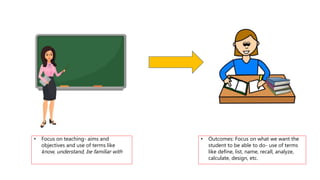
• Focus on teaching- aims and
objectives and use of terms like
know, understand, be familiar with
• Outcomes: Focus on what we want the
student to be able to do- use of terms
like define, list, name, recall, analyze,
calculate, design, etc.
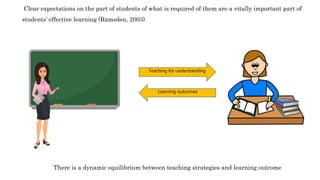
Clear expectations on the part of students of what is required of them are a vitally important part of
students’ effective learning (Ramsden, 2003)
Teaching for understanding
Learning outcomes
There is a dynamic equilibrium between teaching strategies and learning outcome
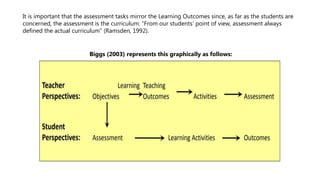
It is important that the assessment tasks mirror the Learning Outcomes since, as far as the students are
concerned, the assessment is the curriculum: “From our students’ point of view, assessment always
defined the actual curriculum” (Ramsden, 1992).
Biggs (2003) represents this graphically as follows:
“Constructive Alignment” (Biggs, 2005)
Constructive
The students construct understanding for themselves
learning activities. “Teaching is simply a catalyst for learning”
(Biggs).
Alignment
Alignment refers to what the teacher does in helping to
support the learning activities to achieve the learning
outcomes.
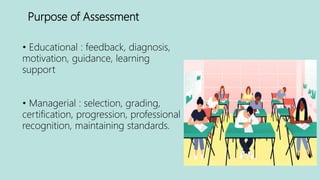
Purpose of Assessment
• Educational : feedback, diagnosis,
motivation, guidance, learning
support
• Managerial : selection, grading,
certification, progression, professional
recognition, maintaining standards.
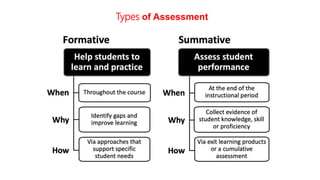
Types of Assessment
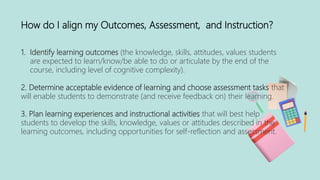
How do I align my Outcomes, Assessment, and Instruction?
1. Identify learning outcomes (the knowledge, skills, attitudes, values students
are expected to learn/know/be able to do or articulate by the end of the
course, including level of cognitive complexity).
2. Determine acceptable evidence of learning and choose assessment tasks that
will enable students to demonstrate (and receive feedback on) their learning.
3. Plan learning experiences and instructional activities that will best help
students to develop the skills, knowledge, values or attitudes described in the
learning outcomes, including opportunities for self-reflection and assessment.
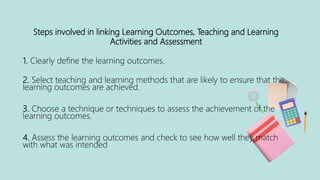
Steps involved in linking Learning Outcomes, Teaching and Learning
Activities and Assessment
1. Clearly define the learning outcomes.
2. Select teaching and learning methods that are likely to ensure that the
learning outcomes are achieved.
3. Choose a technique or techniques to assess the achievement of the
learning outcomes.
4. Assess the learning outcomes and check to see how well they match
with what was intended
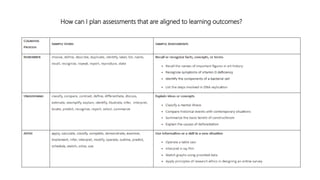
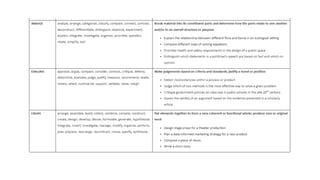
How can I plan assessments that are aligned to learning outcomes?
REPORT-Aligning Learning Outcomes, Learning Activities and Assessment.pptx

REPORT-Aligning Learning Outcomes, Learning Activities and Assessment.pptx

  • 2.
    Working Definitions: Learning outcomesare statements of what a student should know, understand and/or be able to demonstrate after completion of a process of learning. • must not simply be a “wish list” of what a student is capable of doing on completion of the learning activity. • must be simply and clearly described. • must be capable of being validly assessed.
  • 3.
    Learning Activity- theprocess of appropriation of scientific knowledge occurs through the solution, by the students, of the learning tasks. Assessment- making informed and consistent judgments to improve student learning. Assessment for learning- occurs when teachers use inferences about student progress to inform their teaching (formative assessment) Assessment as learning- occurs when students reflect on and monitor their progress to inform their future learning goals (formative assessment) Assessment of learning- occurs when teachers use evidence of student learning to make judgments on students’ achievement against goals and standards (summative assessment)
  • 5.
    • Focus onteaching- aims and objectives and use of terms like know, understand, be familiar with • Outcomes: Focus on what we want the student to be able to do- use of terms like define, list, name, recall, analyze, calculate, design, etc.
  • 6.
    Clear expectations onthe part of students of what is required of them are a vitally important part of students’ effective learning (Ramsden, 2003) Teaching for understanding Learning outcomes There is a dynamic equilibrium between teaching strategies and learning outcome
  • 7.
    It is importantthat the assessment tasks mirror the Learning Outcomes since, as far as the students are concerned, the assessment is the curriculum: “From our students’ point of view, assessment always defined the actual curriculum” (Ramsden, 1992). Biggs (2003) represents this graphically as follows:
  • 8.
    “Constructive Alignment” (Biggs,2005) Constructive The students construct understanding for themselves learning activities. “Teaching is simply a catalyst for learning” (Biggs). Alignment Alignment refers to what the teacher does in helping to support the learning activities to achieve the learning outcomes.
  • 9.
    Purpose of Assessment •Educational : feedback, diagnosis, motivation, guidance, learning support • Managerial : selection, grading, certification, progression, professional recognition, maintaining standards.
  • 10.
  • 12.
    How do Ialign my Outcomes, Assessment, and Instruction? 1. Identify learning outcomes (the knowledge, skills, attitudes, values students are expected to learn/know/be able to do or articulate by the end of the course, including level of cognitive complexity). 2. Determine acceptable evidence of learning and choose assessment tasks that will enable students to demonstrate (and receive feedback on) their learning. 3. Plan learning experiences and instructional activities that will best help students to develop the skills, knowledge, values or attitudes described in the learning outcomes, including opportunities for self-reflection and assessment.
  • 13.
    Steps involved inlinking Learning Outcomes, Teaching and Learning Activities and Assessment 1. Clearly define the learning outcomes. 2. Select teaching and learning methods that are likely to ensure that the learning outcomes are achieved. 3. Choose a technique or techniques to assess the achievement of the learning outcomes. 4. Assess the learning outcomes and check to see how well they match with what was intended
  • 14.
    How can Iplan assessments that are aligned to learning outcomes?