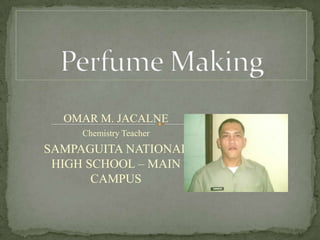
OMAR M. JACALNE
Chemistry Teacher
SAMPAGUITA NATIONAL
HIGH SCHOOL – MAIN
CAMPUS
Laboratory Activity
Formulating A
Homogeneous
Chemical System
Introduction
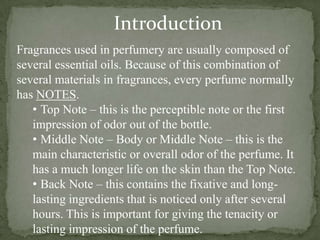
Fragrances used in perfumery are usually composed of
several essential oils. Because of this combination of
several materials in fragrances, every perfume normally
has NOTES.
• Top Note – this is the perceptible note or the first
impression of odor out of the bottle.
• Middle Note – Body or Middle Note – this is the
main characteristic or overall odor of the perfume. It
has a much longer life on the skin than the Top Note.
• Back Note – this contains the fixative and long-
lasting ingredients that is noticed only after several
hours. This is important for giving the tenacity or
lasting impression of the perfume.
Materials
Percentage
10% Fragrance Oil
1-2% Fixative (Muscol)
1% Dipropylene Glycol (DPG)
78 % Triple Distilled Alcohol
9-10 % Distilled Water
For 300 mL 10 % by vol. (Eu De
Toilette)
30 mL Fragrance Oil
6mL Fixative (Muscol)
3mL Dipropylene Glycol (DPG)
234 mL Triple Distilled Alcohol
27 mL Distilled Water
Pipette/Medicine Dropper Erlenmeyer Flask
Stirring rod (glass) 100 mL Graduated Cylinder
Syringe 500 mL Beaker
10-30mL Perfume Bottle Funnel
Amber bottle(for perfume aging)
Eu De Toilette 8 to 15%
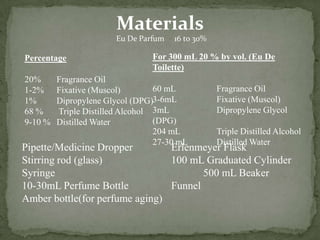
Materials
Percentage
20% Fragrance Oil
1-2% Fixative (Muscol)
1% Dipropylene Glycol (DPG)
68 % Triple Distilled Alcohol
9-10 % Distilled Water
For 300 mL 20 % by vol. (Eu De
Toilette)
60 mL Fragrance Oil
3-6mL Fixative (Muscol)
3mL Dipropylene Glycol
(DPG)
204 mL Triple Distilled Alcohol
27-30 mL Distilled Water
Pipette/Medicine Dropper Erlenmeyer Flask
Stirring rod (glass) 100 mL Graduated Cylinder
Syringe 500 mL Beaker
10-30mL Perfume Bottle Funnel
Amber bottle(for perfume aging)
Eu De Parfum 16 to 30%
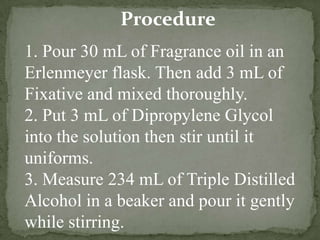
Procedure
1. Pour 30 mL of Fragrance oil in an
Erlenmeyer flask. Then add 3 mL of
Fixative and mixed thoroughly.
2. Put 3 mL of Dipropylene Glycol
into the solution then stir until it
uniforms.
3. Measure 234 mL of Triple Distilled
Alcohol in a beaker and pour it gently
while stirring.
Procedure
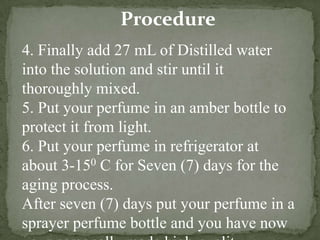
4. Finally add 27 mL of Distilled water
into the solution and stir until it
thoroughly mixed.
5. Put your perfume in an amber bottle to
protect it from light.
6. Put your perfume in refrigerator at
about 3-150 C for Seven (7) days for the
aging process.
After seven (7) days put your perfume in a
sprayer perfume bottle and you have now
Definitions
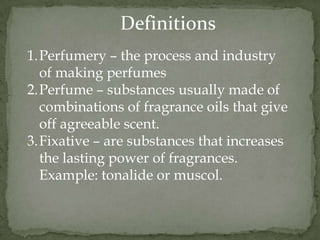
1.Perfumery – the process and industry
of making perfumes
2.Perfume – substances usually made of
combinations of fragrance oils that give
off agreeable scent.
3.Fixative – are substances that increases
the lasting power of fragrances.
Example: tonalide or muscol.
Definitions
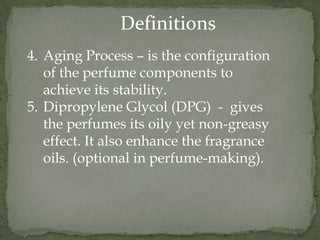
4. Aging Process – is the configuration
of the perfume components to
achieve its stability.
5. Dipropylene Glycol (DPG) - gives
the perfumes its oily yet non-greasy
effect. It also enhance the fragrance
oils. (optional in perfume-making).
Notes
1. Do not put too much Dipropylene Glycol
(DPG), a fragrance enhancer can destroy the
quality of your perfume if it is greater than the
required amount.
2. Too much fixative may also destroy your
fragrance oil the way DPG can. Do not put
higher than 2% by volume.
3. Perfume shall be put in an amber bottle for
aging process to protect it from light. Hydro-
Alcohol Perfumes turns cloudy when expose
to direct heat or sunlight; they are photo-
active and should not exceed 350C.
4. Follow the instructions carefully.
OMAR M. JACALNE
Chemistry Teacher
SAMPAGUITA NATIONAL
HIGH SCHOOL – MAIN
CAMPUS
LABORATORY ACTIVITY
FORMULATING A
COLLOIDAL
DI-POLAR CHEMICAL
SYSTEM
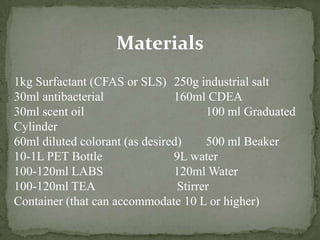
Materials
1kg Surfactant (CFAS or SLS) 250g industrial salt
30ml antibacterial 160ml CDEA
30ml scent oil 100 ml Graduated
Cylinder
60ml diluted colorant (as desired) 500 ml Beaker
10-1L PET Bottle 9L water
100-120ml LABS 120ml Water
100-120ml TEA Stirrer
Container (that can accommodate 10 L or higher)
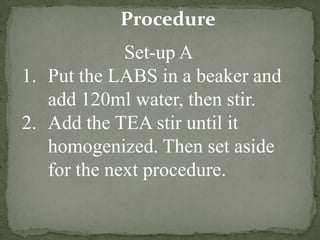
Procedure
Set-up A
1. Put the LABS in a beaker and
add 120ml water, then stir.
2. Add the TEA stir until it
homogenized. Then set aside
for the next procedure.
Procedure
Set-up B
1. Put the 9 L of water in a
container then dissolve the
surfactant until homogenized.
2. Add the CDEA stir until it
homogenized. Then set aside
for the next procedure.
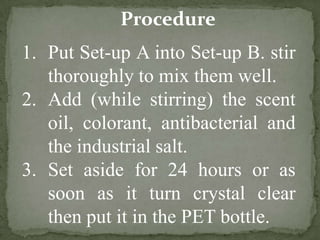
Procedure
1. Put Set-up A into Set-up B. stir
thoroughly to mix them well.
2. Add (while stirring) the scent
oil, colorant, antibacterial and
the industrial salt.
3. Set aside for 24 hours or as
soon as it turn crystal clear
then put it in the PET bottle.
Notes
1. LABS (Linear Alkyl-Benzene Sulphonate) is an
active substance and needed to be
neutralized.
2. Make sure that the industrial salt are mixed
thoroughly to form a crystal clear colloidal
system.
3. Do not put too much industrial salt in order to
have an ideal water-soluble di-polar chemical
system.
4. Do not use tubig-poso because in contains
dissolved metals and other minerals that might
affect your chemical system.
5. Follow the instructions carefully.

Omj perfume makingetc

  • 1.
    OMAR M. JACALNE ChemistryTeacher SAMPAGUITA NATIONAL HIGH SCHOOL – MAIN CAMPUS
  • 2.
  • 3.
    Introduction Fragrances used inperfumery are usually composed of several essential oils. Because of this combination of several materials in fragrances, every perfume normally has NOTES. • Top Note – this is the perceptible note or the first impression of odor out of the bottle. • Middle Note – Body or Middle Note – this is the main characteristic or overall odor of the perfume. It has a much longer life on the skin than the Top Note. • Back Note – this contains the fixative and long- lasting ingredients that is noticed only after several hours. This is important for giving the tenacity or lasting impression of the perfume.
  • 4.
    Materials Percentage 10% Fragrance Oil 1-2%Fixative (Muscol) 1% Dipropylene Glycol (DPG) 78 % Triple Distilled Alcohol 9-10 % Distilled Water For 300 mL 10 % by vol. (Eu De Toilette) 30 mL Fragrance Oil 6mL Fixative (Muscol) 3mL Dipropylene Glycol (DPG) 234 mL Triple Distilled Alcohol 27 mL Distilled Water Pipette/Medicine Dropper Erlenmeyer Flask Stirring rod (glass) 100 mL Graduated Cylinder Syringe 500 mL Beaker 10-30mL Perfume Bottle Funnel Amber bottle(for perfume aging) Eu De Toilette 8 to 15%
  • 5.
    Materials Percentage 20% Fragrance Oil 1-2%Fixative (Muscol) 1% Dipropylene Glycol (DPG) 68 % Triple Distilled Alcohol 9-10 % Distilled Water For 300 mL 20 % by vol. (Eu De Toilette) 60 mL Fragrance Oil 3-6mL Fixative (Muscol) 3mL Dipropylene Glycol (DPG) 204 mL Triple Distilled Alcohol 27-30 mL Distilled Water Pipette/Medicine Dropper Erlenmeyer Flask Stirring rod (glass) 100 mL Graduated Cylinder Syringe 500 mL Beaker 10-30mL Perfume Bottle Funnel Amber bottle(for perfume aging) Eu De Parfum 16 to 30%
  • 6.
    Procedure 1. Pour 30mL of Fragrance oil in an Erlenmeyer flask. Then add 3 mL of Fixative and mixed thoroughly. 2. Put 3 mL of Dipropylene Glycol into the solution then stir until it uniforms. 3. Measure 234 mL of Triple Distilled Alcohol in a beaker and pour it gently while stirring.
  • 7.
    Procedure 4. Finally add27 mL of Distilled water into the solution and stir until it thoroughly mixed. 5. Put your perfume in an amber bottle to protect it from light. 6. Put your perfume in refrigerator at about 3-150 C for Seven (7) days for the aging process. After seven (7) days put your perfume in a sprayer perfume bottle and you have now
  • 8.
    Definitions 1.Perfumery – theprocess and industry of making perfumes 2.Perfume – substances usually made of combinations of fragrance oils that give off agreeable scent. 3.Fixative – are substances that increases the lasting power of fragrances. Example: tonalide or muscol.
  • 9.
    Definitions 4. Aging Process– is the configuration of the perfume components to achieve its stability. 5. Dipropylene Glycol (DPG) - gives the perfumes its oily yet non-greasy effect. It also enhance the fragrance oils. (optional in perfume-making).
  • 10.
    Notes 1. Do notput too much Dipropylene Glycol (DPG), a fragrance enhancer can destroy the quality of your perfume if it is greater than the required amount. 2. Too much fixative may also destroy your fragrance oil the way DPG can. Do not put higher than 2% by volume. 3. Perfume shall be put in an amber bottle for aging process to protect it from light. Hydro- Alcohol Perfumes turns cloudy when expose to direct heat or sunlight; they are photo- active and should not exceed 350C. 4. Follow the instructions carefully.
  • 11.
    OMAR M. JACALNE ChemistryTeacher SAMPAGUITA NATIONAL HIGH SCHOOL – MAIN CAMPUS
  • 12.
  • 13.
    Materials 1kg Surfactant (CFASor SLS) 250g industrial salt 30ml antibacterial 160ml CDEA 30ml scent oil 100 ml Graduated Cylinder 60ml diluted colorant (as desired) 500 ml Beaker 10-1L PET Bottle 9L water 100-120ml LABS 120ml Water 100-120ml TEA Stirrer Container (that can accommodate 10 L or higher)
  • 14.
    Procedure Set-up A 1. Putthe LABS in a beaker and add 120ml water, then stir. 2. Add the TEA stir until it homogenized. Then set aside for the next procedure.
  • 15.
    Procedure Set-up B 1. Putthe 9 L of water in a container then dissolve the surfactant until homogenized. 2. Add the CDEA stir until it homogenized. Then set aside for the next procedure.
  • 16.
    Procedure 1. Put Set-upA into Set-up B. stir thoroughly to mix them well. 2. Add (while stirring) the scent oil, colorant, antibacterial and the industrial salt. 3. Set aside for 24 hours or as soon as it turn crystal clear then put it in the PET bottle.
  • 17.
    Notes 1. LABS (LinearAlkyl-Benzene Sulphonate) is an active substance and needed to be neutralized. 2. Make sure that the industrial salt are mixed thoroughly to form a crystal clear colloidal system. 3. Do not put too much industrial salt in order to have an ideal water-soluble di-polar chemical system. 4. Do not use tubig-poso because in contains dissolved metals and other minerals that might affect your chemical system. 5. Follow the instructions carefully.