FACTORS OF PRODUCTION
+Prices of factors of production :
+ Land – rent
+ Labour – wages / salaries
+ Capital – interest
+ Entrepreneur - Profit
3.
Theories of factorprice determination
+ 1) Marginal Productivity theory
+ Marginal productivity theory is the idea that a company would be
willing to pay a worker only what they can contribute to the
company’s value.
+ The income made from each additional unit of work is called the
value of its marginal product.(VMP)
+ This idea is part of a larger concept called distribution theory. The
overall idea of marginal productivity is that every type of input
should be paid based on its marginal product value.
4.
+ The theorystates that every factor should be paid as
per their marginal contribution to the output.
+ For eg, for labour payment
+ wages = VMP
5.
Modern theory offactor pricing
+ According to the modern theory, price of any factor is
determined by its demand & supply.
+ Ricardo definedrent as, “that portion of the produce
of the earth which is paid to the landlord for the
use of the original and indestructible powers of
the soil.” In his theory, rent is nothing but the producer’s
surplus or differential gain, and it is found in land only.
8.
Assumptions of theTheory:
+ The Ricardian theory of rent is based on the following
assumptions:
+ 1. Rent of land arises due to the differences in the fertility or situation of the
different plots of land. It arises owing to the original and indestructible
powers of the soil.
+ 2. Ricardo assumes the operation of the law of diminishing marginal
returns in the case of cultivation of land. As the different plots of land differ
in fertility, the produce from the inferior plots of land diminishes though
the total cost of production in each plot of land is the same.
+ 3. Ricardo looks at the supply of land from the standpoint of the society as
a whole.
+ 4. In the Ricardian theory it is assumed that land, being a gift of nature, has
no supply price and no cost of production.
9.
Reasons for Existenceof Rent:
+ According to Ricardo rent arises for two main
reasons:
+ (1) Scarcity of land as a factor and
+ (2) Differences in the fertility of the soil.
10.
Modern theory ofrent
+ J.S. Mill first discussed the modern theory of rent.
+ According to modern version rent is a surplus which
arises due to difference between actual earning and
transfer earning.
+ That is: Rent = Actual Earning-Transfer Earning.
11.
What is TransferEarning?
+ In this universe, each factor of production has varied uses. When we
transfer one factor from one use to another, we have to sacrifice the
income earned by it from its earlier use. Sacrifice of earning is called
transfer earning.
+ Basically, the concept of transfer earning in economics is introduced
by Prof. Benham. According to him, “The amount of money which any
particular unit could earn in its best paid alternative use is sometimes
called its transfer earnings.”
12.
Demand & Supplyof land
+ Demand for Land:
+ Land has derived demand. It means that demand for land depends on
the demand for agricultural products. If demand for food grains
increases, demands for land will also increase and vice-versa.
Moreover, demand for land is influenced by its marginal productivity.
It means as more and more land is used its MP1 goes on diminishing.
+ Supply of land
+ Supply of land is fixed. Its supply is perfectly inelastic. It means,
increase in the price of land will not evoke any increase in its supply.
14.
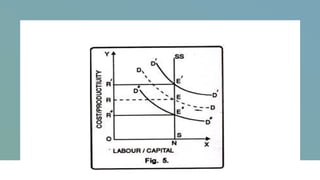
+ In Fig.5 units of land have been measured on X-axis and rent on Y-axis. SS is
the supply curve of land which is parallel to Y-axis indicating that the supply
of land remains fixed. Rent will be determined at a point where the demand
and supply of land are equal to each other.
+ Initially DD is the demand curve which intersects the supply curve at point E.
At this point, equilibrium rent OR is determined. Now, if the population rises
which gives boost to the demand for food, the demand curve shifts to D’D’ and
the equilibrium will be at point E’ and the rent will rise to the extent of OR’.
Marginal productivity theoryof
wage
+ The marginal productivity theory of wage states that the price of
labour, i.e., wage rate, is determined according to the marginal
product of labour. This was stated by the neo
classical economists,
especially J. B. Clark.
+ When marginal product of labour is expressed in money terms we
obtain VMPL. MRPL is the change in total revenue following a change
in the employment of labour. Marginal productivity theory of wage
states that wage of labour equals VMPL (= MRPL). Employer will
employ labour up to the point until market wage equals labour’s value
of the marginal product (VMP) and marginal revenue product (MRP).
17.
Modern theory ofwage
determination
+ The most acceptable theory of wages is the modern
theory of wages. It is also known as Demand and Supply
theory of wages. According to this theory wages are
determined by demand and supply of labour.
+ Demand for labour : Producers demand labour because
labour is productive. When a labourer is employed he
produces goods. The capacity of labourer can be measured in
terms of goods. At higher level of wages the demand for
labour will be low, and at lower level of wages the demand for
labourers will be high.
+ So, the demand curve for labour slopes downward from left
to right.
18.
+ Supply oflabour : By the supply of labour, we mean the number of workers of a
given type of labour which would offer themselves for employment at various
wage rates. The supply of labour depends on the following factors:
+ 1) Population, 2) Age composition of population, 3) Working age, 4) Expenses of
education, 5) Preference between leisure and work, 6) Attitude of women towards
work, 7) Birth control 8) Wages.
+ If other things are constant, generally as wages increases the supply of labour
will increase, and vice versa. So the supply curve for labour slopes upward from
left to right.
+ Determination of wages : According to this theory, wage rate is determined by
the interaction of demand for supply of labour. This can be shown with the help
of the following diagram:
19.
Nominal wage andreal wage
+ A nominal wage is the amount of money an employee is
paid, while a real wage is the same amount adjusted for
inflation:
• Nominal wage
• The amount of money an employee is paid, also known as a
money wage. It is the quoted price on a job offer or the
reported salary.
• Real wage
• The nominal wage adjusted for inflation. It measures the
purchasing power of the employee's earnings.
+ Real wages are used to compare wages across periods with
rising prices. If a nominal wage increases more slowly than
inflation, the employee's purchasing power will decline.
+ The rateof interest measures the percentage reward a
lender receives for deferring the consumption of
resources until a future date. Correspondingly, it
measures the price a borrower pays to have resources
now.
22.
+ Interest ratesare determined in a FREE
MARKET where SUPPLY and DEMAND interact. The
supply of funds is influenced by the willingness of
consumers, businesses, and governments to save. The
demand for funds reflects the desires of businesses,
households, and governments to spend more than
they take in as revenues.
23.
Determinants of interestrate
+ The strength of the economy and the willingness to save.
+ The rate of inflation.
+ The riskiness of the borrower.
+ The time period of the loan.
24.
Gross interest &Net interest
+ Gross interest is the total interest earned on an
investment or loan before taxes or fees are applied,
while net interest is the amount received after these
deductions are accounted for:
• Gross interest
• The interest rate earned on an investment or loan
before taxes or fees are applied. It's the headline
interest rate that's often quoted for a loan or
investment.
• Net interest
• The amount received after taxes and deductions have
been accounted for. It's calculated by deducting the
impact of taxes, fees, and other costs from the gross
interest.
25.
Zero interest rate
•A zero interest rate policy (ZIRP) occurs when a central
bank sets its target short-term interest rate at or close
to 0%.
• The goal of ZIRP is to spur economic activity by
encouraging low-cost borrowing and greater access to
cheap credit by firms and individuals.
. Risk-Bearing Theoryof Profit
+ The main proponent of this theory is Prof. Hawley.
According to Hawley, one of the major functions of an
entrepreneur is to bear risk that is associated first with the
setting up of the business and then with the management
of the business.
+ Risks are some unforeseen conditions against which some
insurance coverage can be taken.
28.
Uncertainty Theory ofProfit
+ In addition to the Risk-bearing Theory, F. H. Knight also
outlined the Uncertainty Theory of Profit. According to
this theory, there is a difference between risk, which is
quantifiable, and uncertainty, which is immeasurable.
Uncertainty arises from the unpredictable nature of the
business environment. Thus, when entrepreneurs
make decisions without having complete knowledge or
certainty about the outcome, they are faced with
uncertainty. Knight believed that entrepreneurs who
successfully manage uncertainty should be rewarded
with profit.
29.
Dynamic Theory ofProfit
+ The Dynamic Theory of Profit was proposed by Joseph
Schumpeter. According to this theory, profit arises due
to dynamic changes in the economy. These changes
could be caused by changes in technology, consumer
preferences, and population size. In this theory,
entrepreneurs take advantage of these changes to
make a profit. They are seen as innovators who
constantly look for opportunities to outshine their
competitors.
30.
Innovation Theory ofProfit
+ The Innovation Theory, proposed by Joseph
Schumpeter as well, places emphasis on the role of
innovations in the process of profit generation.
Innovations like the introduction of new products,
techniques of production, or the opening of new
markets lead to an increase in the earning capacity of
the organization. This, in turn, leads to profits.
Schumpeter emphasized that the entrepreneur is the
driving force behind these innovations and responsible
for creating profits.
31.
Gross & Netprofit
+ The main difference between gross profit and net profit is that gross
profit is the amount of money left after deducting the cost of producing
and selling a product or service, while net profit is the amount of money
left after deducting all expenses and taxes:
+ Gross profit
+ Also known as sales profit or gross income, gross profit is calculated by
subtracting the cost of goods sold (COGS) from a company's total
revenue.
+ Net profit
+ Also known as the bottom line, net profit is calculated by subtracting all
expenses and taxes from a company's operating profit.
32.
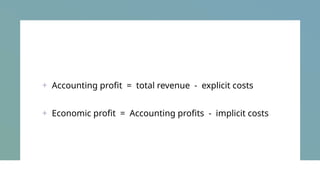
Accounting & economicprofit
+ Accounting profit is a company's net income, while economic profit is the
value of cash flow after accounting for all costs, including opportunity costs:
+ Accounting profit
+ A company's net income, calculated by subtracting all expenses from total
revenue. This is the figure that appears on a company's income statement
and is used for tax purposes.
+ Economic profit
+ A company's cash flow after subtracting all costs, including opportunity
costs. Economic profit is a theoretical calculation that considers what could
have happened instead. It's used by management to evaluate the
effectiveness of business decisions and to help determine the best strategy
33.
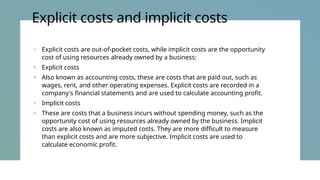
Explicit costs andimplicit costs
+ Explicit costs are out-of-pocket costs, while implicit costs are the opportunity
cost of using resources already owned by a business:
+ Explicit costs
+ Also known as accounting costs, these are costs that are paid out, such as
wages, rent, and other operating expenses. Explicit costs are recorded in a
company's financial statements and are used to calculate accounting profit.
+ Implicit costs
+ These are costs that a business incurs without spending money, such as the
opportunity cost of using resources already owned by the business. Implicit
costs are also known as imputed costs. They are more difficult to measure
than explicit costs and are more subjective. Implicit costs are used to
calculate economic profit.
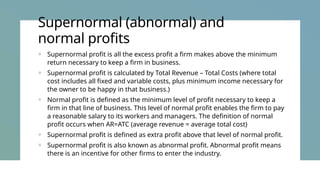
Supernormal (abnormal) and
normalprofits
+ Supernormal profit is all the excess profit a firm makes above the minimum
return necessary to keep a firm in business.
+ Supernormal profit is calculated by Total Revenue – Total Costs (where total
cost includes all fixed and variable costs, plus minimum income necessary for
the owner to be happy in that business.)
+ Normal profit is defined as the minimum level of profit necessary to keep a
firm in that line of business. This level of normal profit enables the firm to pay
a reasonable salary to its workers and managers. The definition of normal
profit occurs when AR=ATC (average revenue = average total cost)
+ Supernormal profit is defined as extra profit above that level of normal profit.
+ Supernormal profit is also known as abnormal profit. Abnormal profit means
there is an incentive for other firms to enter the industry.