Electronic Ballast
Fundamentals
                 Submitted by
                 Balvant Singh
                 EC-A (final yr.)

                 0922231025
Contents

 1.   Types of Ballast
 2.   Basics of Electronic Ballast
 3.   Starting Methods
 4.   Fluorescent tube
 5.   Lamp Structure
 6.   Working of lamp
 7.   Startup Circuit
 8.   Advantages of EB
Types of Ballast

 1. Electromagnetic
 2. Hybrid
 3. Electronics
  Purpose of EB

 a. Provide a start−up voltage,
 b. Maintain a constant current,
 c. Assure that the circuit will remain stable.
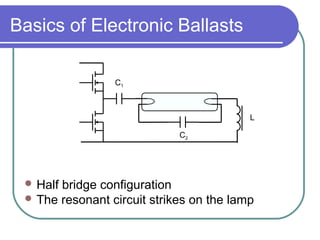
Basics of Electronic Ballasts

                 C1


                                          L

                             C2


  Halfbridge configuration
  The resonant circuit strikes on the lamp
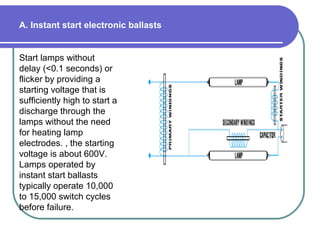
A. Instant start electronic ballasts


Start lamps without
delay (<0.1 seconds) or
flicker by providing a
starting voltage that is
sufficiently high to start a
discharge through the
lamps without the need
for heating lamp
electrodes. , the starting
voltage is about 600V.
Lamps operated by
instant start ballasts
typically operate 10,000
to 15,000 switch cycles
before failure.
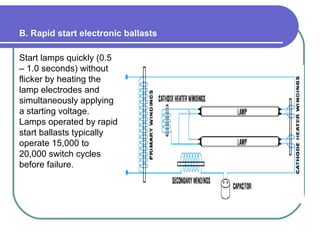
B. Rapid start electronic ballasts

Start lamps quickly (0.5
– 1.0 seconds) without
flicker by heating the
lamp electrodes and
simultaneously applying
a starting voltage.
Lamps operated by rapid
start ballasts typically
operate 15,000 to
20,000 switch cycles
before failure.
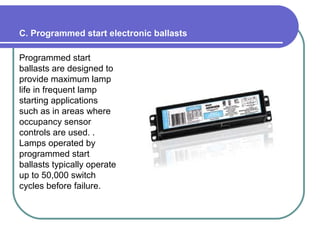
C. Programmed start electronic ballasts

Programmed start
ballasts are designed to
provide maximum lamp
life in frequent lamp
starting applications
such as in areas where
occupancy sensor
controls are used. .
Lamps operated by
programmed start
ballasts typically operate
up to 50,000 switch
cycles before failure.
Fluorescent tubes

  Much  more efficient than incandescent
   lamps : 2 to 4 times more efficient.
  Less energy required to operate.
  Eco-friendly for environment.
  The lamps are much cooler than
   incandescent lamps.
Lamp Structure

   The lamp is a sealed tube
    containing mercury vapor
    and some inert gases
    such as argon at very
    high pressure
   The inside of the tube is
    coated with phosphor
   At the ends of the tube
    there are filaments or
    electrodes
How does it work?
    When the tube is off it does
     not conduct
    It is turned on by a high
     voltage which excites the gas
     inside the tube
    Once the tube conducts on a
     lower voltage is sufficient to
     maintain conduction
    The electric current passes
     through the gas and emits
     UV, the internal phosphor
     coating converters the UV to
     visible light
    The color of the light cab be
     varied by different
     combinations of phosphors
Lamp starting

  When   the lamps is off the tube is non
   -conductive
  The tube must be excited or started by a
   high voltage
  After the lamps is started the lamp
   voltage drops
  A current limiting “ballast” is needed in
   between the power source and the lamp
Start up circuit
Starter switch
Advantages:

 1) Dimmable (only applicable for
  expensive products that are not
  commercially competitive in public
  lighting systems);
 2) Energy saving;
 3) No flickering effect.

Electronic ballast fundamentals

  • 1.
    Electronic Ballast Fundamentals Submitted by Balvant Singh EC-A (final yr.) 0922231025
  • 2.
    Contents 1. Types of Ballast 2. Basics of Electronic Ballast 3. Starting Methods 4. Fluorescent tube 5. Lamp Structure 6. Working of lamp 7. Startup Circuit 8. Advantages of EB
  • 3.
    Types of Ballast 1. Electromagnetic 2. Hybrid 3. Electronics  Purpose of EB a. Provide a start−up voltage, b. Maintain a constant current, c. Assure that the circuit will remain stable.
  • 4.
    Basics of ElectronicBallasts C1 L C2  Halfbridge configuration  The resonant circuit strikes on the lamp
  • 5.
    A. Instant startelectronic ballasts Start lamps without delay (<0.1 seconds) or flicker by providing a starting voltage that is sufficiently high to start a discharge through the lamps without the need for heating lamp electrodes. , the starting voltage is about 600V. Lamps operated by instant start ballasts typically operate 10,000 to 15,000 switch cycles before failure.
  • 6.
    B. Rapid startelectronic ballasts Start lamps quickly (0.5 – 1.0 seconds) without flicker by heating the lamp electrodes and simultaneously applying a starting voltage. Lamps operated by rapid start ballasts typically operate 15,000 to 20,000 switch cycles before failure.
  • 7.
    C. Programmed startelectronic ballasts Programmed start ballasts are designed to provide maximum lamp life in frequent lamp starting applications such as in areas where occupancy sensor controls are used. . Lamps operated by programmed start ballasts typically operate up to 50,000 switch cycles before failure.
  • 8.
    Fluorescent tubes Much more efficient than incandescent lamps : 2 to 4 times more efficient.  Less energy required to operate.  Eco-friendly for environment.  The lamps are much cooler than incandescent lamps.
  • 9.
    Lamp Structure  The lamp is a sealed tube containing mercury vapor and some inert gases such as argon at very high pressure  The inside of the tube is coated with phosphor  At the ends of the tube there are filaments or electrodes
  • 10.
    How does itwork?  When the tube is off it does not conduct  It is turned on by a high voltage which excites the gas inside the tube  Once the tube conducts on a lower voltage is sufficient to maintain conduction  The electric current passes through the gas and emits UV, the internal phosphor coating converters the UV to visible light  The color of the light cab be varied by different combinations of phosphors
  • 11.
    Lamp starting When the lamps is off the tube is non -conductive  The tube must be excited or started by a high voltage  After the lamps is started the lamp voltage drops  A current limiting “ballast” is needed in between the power source and the lamp
  • 12.
  • 13.
  • 14.
    Advantages:  1) Dimmable(only applicable for expensive products that are not commercially competitive in public lighting systems);  2) Energy saving;  3) No flickering effect.