Renal Function Tests
Rajarshi Kar
Assistant Professor
Dept of Biochemistry
Objectives
• Enumerate the functions of kidney
• Discuss the biochemical test which are done to assess the function of
kidney
• Discuss the abnormalities in biochemical tests associated with renal
impairment
Kidney Functions
• Excretory
• Homeostatic
• Endocrine
• Metabolic
Renal Function
• Excretory Functions
• Formation and excretion of urine
• Glomerular filtration
• Tubular reabsorption
• Tubular secretion
• Excreting toxic substances in synergy with liver
• Homeostatic function
• Regulation of blood volume
• Regulation of blood pH
• Regulation of serum electrolytes; Na, K, Cl and Ca
• Reabsorption of essential nutrients
Renal Function
• Endocrine function
• Erythropoietin
• Renin Angiotensin system
• Vitamin D activation
• Degradation of hormones like insulin and aldosterone
• Metabolic function
• Along with liver site for gluconeogenesis
Renal function tests; Why needed?
• To assess functional capacity of kidneys
• To diagnose renal impairment
• To assess the severity and progression of renal impairment
• To assess the effectiveness of treatment
Causes of renal disease
• Pre-renal
• Any condition that results in reduced blood flow to kidneys
• Severe blood loss
• Hemolysis
• Renal
• Damage to renal tissue, glomerular basement membrane or tubules
• Glomerulonephritis
• Diabetic or hypertensive nephropathy
• Tubular damage due to toxic substances
• Post Renal
• Obstruction to urine outflow
• Ureteric or urethral stone
• Prostatic cancer
This list not exhaustive, these are only few common causes of renal disease
Renal function test
• Can be divided into two categories
• Test for glomerular function
• Serum Urea
• Serum Creatinine
• Clearance tests
• Tests for tubular function
• Urine concentration test
• Dilution test
• Para amino hippuric acid clearance test
• Acidification test
• Urine examination
• Important for assessing both glomerular and tubular function
Renal function test
• The following parameters are commonly included in assessing renal
function (the normal values/reference range is mentioned)
• Serum Urea ( 15-45 mg/dl)
• Serum Creatinine (0.6 – 1.2 mg/dl)
• Serum Uric acid (males 3.5-7.2 mg/dl, females 2.6-6 mg/dl)
• Total protein (6.4-8.1 g/dl)
• Serum albumin (3.2-4.6 g/dl)
• Serum electrolytes
• Na (136-146 mEq/L)
• K (3.5-5.1 mEq/L)
• Cl (101-109 mEq/L)
• Phosphate (2.8-4 mg/dl)
• Calcium (8.8-10.2 mg/dl)
Renal Function Tests
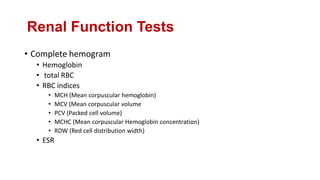
• Complete hemogram
• Hemoglobin
• total RBC
• RBC indices
• MCH (Mean corpuscular hemoglobin)
• MCV (Mean corpuscular volume
• PCV (Packed cell volume)
• MCHC (Mean corpuscular Hemoglobin concentration)
• RDW (Red cell distribution width)
• ESR
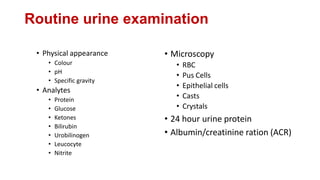
Routine urine examination
• Physical appearance
• Colour
• pH
• Specific gravity
• Analytes
• Protein
• Glucose
• Ketones
• Bilirubin
• Urobilinogen
• Leucocyte
• Nitrite
• Microscopy
• RBC
• Pus Cells
• Epithelial cells
• Casts
• Crystals
• 24 hour urine protein
• Albumin/creatinine ration (ACR)
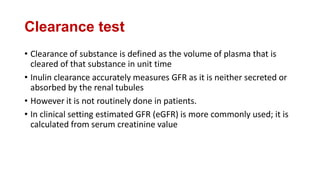
Clearance test
• Clearance of substance is defined as the volume of plasma that is
cleared of that substance in unit time
• Inulin clearance accurately measures GFR as it is neither secreted or
absorbed by the renal tubules
• However it is not routinely done in patients.
• In clinical setting estimated GFR (eGFR) is more commonly used; it is
calculated from serum creatinine value
Estimated GFR
• The Cockcroft-Gault formula for estimating creatinine clearance (CrCl)
is routinely as a simple means to provide a reliable approximation of
residual renal function in all patients with CKD. The formulas are as
follows:
• CrCl (male) = ([140-age] × weight in kg)/(serum creatinine × 72)
• However this has been extensively modified and there are online
calculators of eGFR from serum creatinine and body weight of
patients
• The eGFR is used to determine the stage of chronic kidney disease
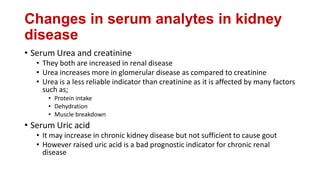
Changes in serum analytes in kidney
disease
• Serum Urea and creatinine
• They both are increased in renal disease
• Urea increases more in glomerular disease as compared to creatinine
• Urea is a less reliable indicator than creatinine as it is affected by many factors
such as;
• Protein intake
• Dehydration
• Muscle breakdown
• Serum Uric acid
• It may increase in chronic kidney disease but not sufficient to cause gout
• However raised uric acid is a bad prognostic indicator for chronic renal
disease
Changes in serum analytes in kidney
disease
• Total protein and albumin
• Both serum total protein and albumin is decreased in chronic kidney disease
(CKD) due to increased proteinuria
• Even though proteinuria may also be seen in acute kidney disease but it
usually does not alter the total protein and albumin
• Serum electrolytes
• Sodium is decreased (hyponatremia) and potassium is increased
(hyperkalemia) in chronic kidney disease (CKD) as kidney reabsorb sodium in
exchange of potassium
• Chloride and phosphate is increased in CKD
• Calcium is decreased as vitamin D is deficient
Changes in hemogram and urine
analysis in kidney disease
• RBC count and hemoglobin is decreased in advanced stages of kidney
disease due to deficiency of erythropoietin
• Urine examination reveals
• Proteinuria is seen in both acute and chronic kidney disease as well as kidney
infection
• Proteinuria can be of two types
• In the initial stages very less amount of albumin escapes into urine; microalbuminuria (30 to
300 mg/day)
• Frank proteinuria ( when it is greater than 300 mg/day)
• Best evaluated in 24 hour urine sample
• In spot urine albumin/ creatinine ratio is used to evaluate proteinuria
• Presence of RBC may indicate glomerulonephritis , acute nephritis, kidney infection
• Presence of pus cells, esterase positivity, nitrites may indicate bacterial infection
Tests for tubular function
• Urine concentration test
• In CKD kidneys loses the ability to concentrate urine
• Specific gravity is measured in urine
• Low fixed specific gravity is indicative of chronic kidney disease
• Dilution test
• After overnight water deprivation patient is asked to take 1200ml of water in
half hour, urine specific gravity is measured in samples collected over next 4
hours. At least one sample should show sp gr of 1.003 or below
Tests for tubular function
• Para amino hippuric acid clearance test
• PAH is unique in that it is completely excreted in one passage through kidney
as it is both filtered and secreted.
• Therefore clearance of PAH is a measure of renal plasma flow
• Acidification test
• In this the ability to acidify urine is tested after administering 0.1g/kg
ammonium chloride gelatin coated samples
Thank you

Renal function Tests - PPT.pdf

  • 1.
    Renal Function Tests RajarshiKar Assistant Professor Dept of Biochemistry
  • 2.
    Objectives • Enumerate thefunctions of kidney • Discuss the biochemical test which are done to assess the function of kidney • Discuss the abnormalities in biochemical tests associated with renal impairment
  • 3.
    Kidney Functions • Excretory •Homeostatic • Endocrine • Metabolic
  • 4.
    Renal Function • ExcretoryFunctions • Formation and excretion of urine • Glomerular filtration • Tubular reabsorption • Tubular secretion • Excreting toxic substances in synergy with liver • Homeostatic function • Regulation of blood volume • Regulation of blood pH • Regulation of serum electrolytes; Na, K, Cl and Ca • Reabsorption of essential nutrients
  • 5.
    Renal Function • Endocrinefunction • Erythropoietin • Renin Angiotensin system • Vitamin D activation • Degradation of hormones like insulin and aldosterone • Metabolic function • Along with liver site for gluconeogenesis
  • 6.
    Renal function tests;Why needed? • To assess functional capacity of kidneys • To diagnose renal impairment • To assess the severity and progression of renal impairment • To assess the effectiveness of treatment
  • 7.
    Causes of renaldisease • Pre-renal • Any condition that results in reduced blood flow to kidneys • Severe blood loss • Hemolysis • Renal • Damage to renal tissue, glomerular basement membrane or tubules • Glomerulonephritis • Diabetic or hypertensive nephropathy • Tubular damage due to toxic substances • Post Renal • Obstruction to urine outflow • Ureteric or urethral stone • Prostatic cancer This list not exhaustive, these are only few common causes of renal disease
  • 8.
    Renal function test •Can be divided into two categories • Test for glomerular function • Serum Urea • Serum Creatinine • Clearance tests • Tests for tubular function • Urine concentration test • Dilution test • Para amino hippuric acid clearance test • Acidification test • Urine examination • Important for assessing both glomerular and tubular function
  • 9.
    Renal function test •The following parameters are commonly included in assessing renal function (the normal values/reference range is mentioned) • Serum Urea ( 15-45 mg/dl) • Serum Creatinine (0.6 – 1.2 mg/dl) • Serum Uric acid (males 3.5-7.2 mg/dl, females 2.6-6 mg/dl) • Total protein (6.4-8.1 g/dl) • Serum albumin (3.2-4.6 g/dl) • Serum electrolytes • Na (136-146 mEq/L) • K (3.5-5.1 mEq/L) • Cl (101-109 mEq/L) • Phosphate (2.8-4 mg/dl) • Calcium (8.8-10.2 mg/dl)
  • 10.
    Renal Function Tests •Complete hemogram • Hemoglobin • total RBC • RBC indices • MCH (Mean corpuscular hemoglobin) • MCV (Mean corpuscular volume • PCV (Packed cell volume) • MCHC (Mean corpuscular Hemoglobin concentration) • RDW (Red cell distribution width) • ESR
  • 11.
    Routine urine examination •Physical appearance • Colour • pH • Specific gravity • Analytes • Protein • Glucose • Ketones • Bilirubin • Urobilinogen • Leucocyte • Nitrite • Microscopy • RBC • Pus Cells • Epithelial cells • Casts • Crystals • 24 hour urine protein • Albumin/creatinine ration (ACR)
  • 12.
    Clearance test • Clearanceof substance is defined as the volume of plasma that is cleared of that substance in unit time • Inulin clearance accurately measures GFR as it is neither secreted or absorbed by the renal tubules • However it is not routinely done in patients. • In clinical setting estimated GFR (eGFR) is more commonly used; it is calculated from serum creatinine value
  • 13.
    Estimated GFR • TheCockcroft-Gault formula for estimating creatinine clearance (CrCl) is routinely as a simple means to provide a reliable approximation of residual renal function in all patients with CKD. The formulas are as follows: • CrCl (male) = ([140-age] × weight in kg)/(serum creatinine × 72) • However this has been extensively modified and there are online calculators of eGFR from serum creatinine and body weight of patients • The eGFR is used to determine the stage of chronic kidney disease
  • 14.
    Changes in serumanalytes in kidney disease • Serum Urea and creatinine • They both are increased in renal disease • Urea increases more in glomerular disease as compared to creatinine • Urea is a less reliable indicator than creatinine as it is affected by many factors such as; • Protein intake • Dehydration • Muscle breakdown • Serum Uric acid • It may increase in chronic kidney disease but not sufficient to cause gout • However raised uric acid is a bad prognostic indicator for chronic renal disease
  • 15.
    Changes in serumanalytes in kidney disease • Total protein and albumin • Both serum total protein and albumin is decreased in chronic kidney disease (CKD) due to increased proteinuria • Even though proteinuria may also be seen in acute kidney disease but it usually does not alter the total protein and albumin • Serum electrolytes • Sodium is decreased (hyponatremia) and potassium is increased (hyperkalemia) in chronic kidney disease (CKD) as kidney reabsorb sodium in exchange of potassium • Chloride and phosphate is increased in CKD • Calcium is decreased as vitamin D is deficient
  • 16.
    Changes in hemogramand urine analysis in kidney disease • RBC count and hemoglobin is decreased in advanced stages of kidney disease due to deficiency of erythropoietin • Urine examination reveals • Proteinuria is seen in both acute and chronic kidney disease as well as kidney infection • Proteinuria can be of two types • In the initial stages very less amount of albumin escapes into urine; microalbuminuria (30 to 300 mg/day) • Frank proteinuria ( when it is greater than 300 mg/day) • Best evaluated in 24 hour urine sample • In spot urine albumin/ creatinine ratio is used to evaluate proteinuria • Presence of RBC may indicate glomerulonephritis , acute nephritis, kidney infection • Presence of pus cells, esterase positivity, nitrites may indicate bacterial infection
  • 17.
    Tests for tubularfunction • Urine concentration test • In CKD kidneys loses the ability to concentrate urine • Specific gravity is measured in urine • Low fixed specific gravity is indicative of chronic kidney disease • Dilution test • After overnight water deprivation patient is asked to take 1200ml of water in half hour, urine specific gravity is measured in samples collected over next 4 hours. At least one sample should show sp gr of 1.003 or below
  • 18.
    Tests for tubularfunction • Para amino hippuric acid clearance test • PAH is unique in that it is completely excreted in one passage through kidney as it is both filtered and secreted. • Therefore clearance of PAH is a measure of renal plasma flow • Acidification test • In this the ability to acidify urine is tested after administering 0.1g/kg ammonium chloride gelatin coated samples
  • 19.