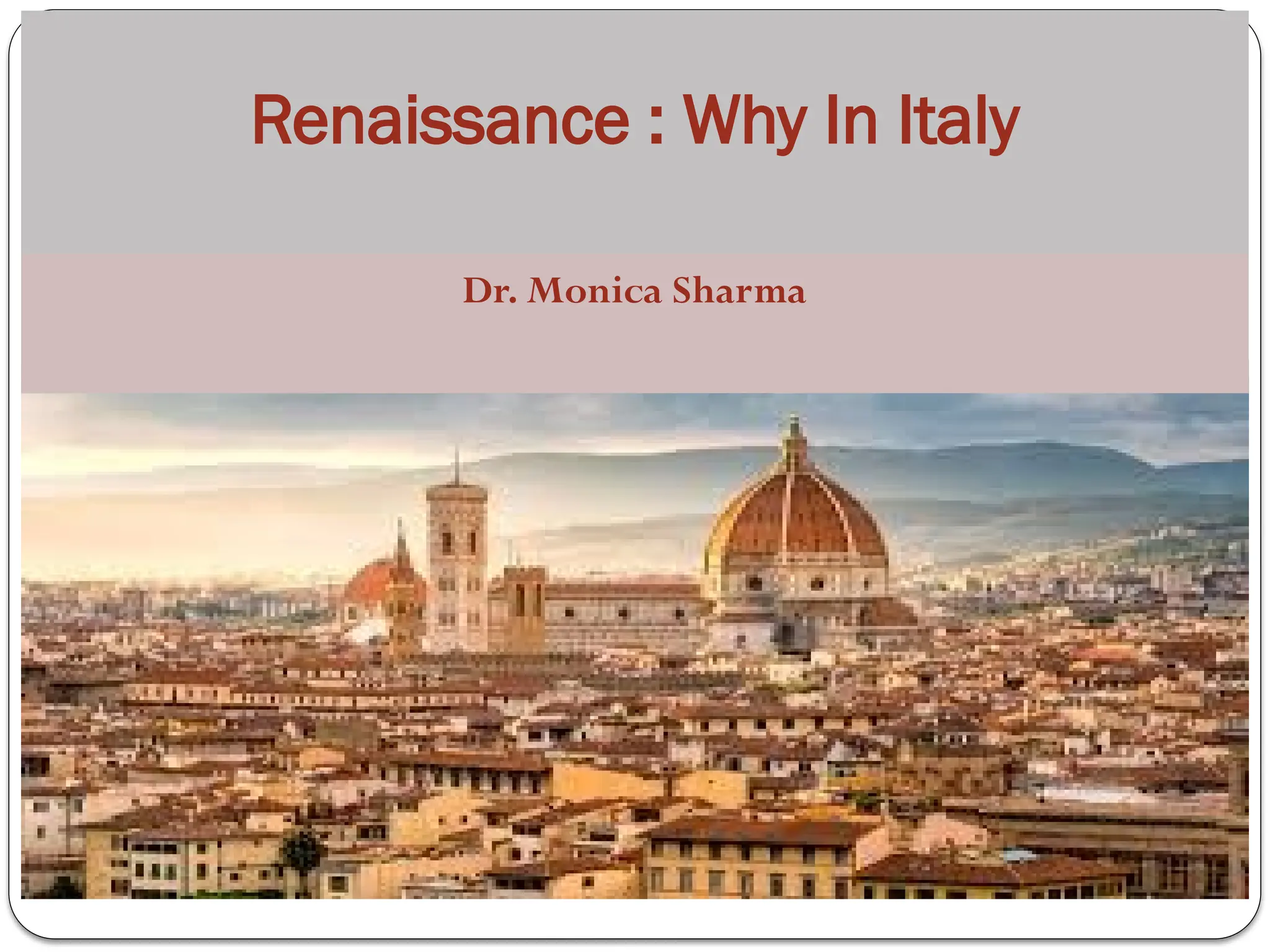
Renaissance : Why In Italy
Dr. Monica Sharma
Why the Renaissance Began in Italy
The Italian Renaissance emerged due to a confluence of factors. Economically,
thriving trade networks generated wealth, fueling artistic and intellectual
patronage .
Culturally, Italy's Roman heritage provided a rich foundation for a classical revival.
Politically, the independent city-states fostered competition and innovation
Finally, powerful merchant families, such as the Medici, invested significantly in the
arts and sciences, catalyzing the Renaissance movement.
.
Patronage: The Fuel of the Renaissance
Wealthy individuals, families, and the Church acted as patrons, supporting artists, writers, and scholars. This
support was crucial in several ways:
Financial Support: Patrons provided artists and intellectuals with the necessary funds to create their
works.This enabled them to focus on their craft without worrying about financial constraints.
Commissioned Works: Patrons often commissioned specific works, providing artists with a steady income
and creative challenges.This led to the creation of masterpieces that adorned churches, palaces, and public
spaces
Social Status: Being associated with renowned artists and intellectuals enhanced the patron's social status
and prestige. It was a way to demonstrate wealth, power, and cultural sophistication.
Intellectual Exchange: Patrons often created intellectual circles, bringing together artists, scholars, and
thinkers. This fostered the exchange of ideas and contributed to the intellectual ferment of the Renaissance.
Preservation of Art and Literature: By commissioning works and creating collections, patrons helped
preserve the artistic and literary heritage of the Renaissance for future generations.
Wealthy Italian Families: Patrons of Art
Medici Family (Florence): Undoubtedly the most famous patrons, the
Medici amassed immense wealth through banking.Their support of artists
like Michelangelo, Leonardo daVinci, and Botticelli transformed Florence
into a cultural epicenter.
Sforza Family (Milan): Rulers of Milan, the Sforza family commissioned
works from renowned artists like Leonardo daVinci, who worked on
projects like the Last Supper.
Borgia Family (Rome): Powerful and controversial, the Borgias,
particularly PopeAlexanderVI, were significant patrons of the arts.
Gonzaga Family (Mantua):This family created a magnificent court at
Mantua, supporting artists likeAndrea Mantegna.
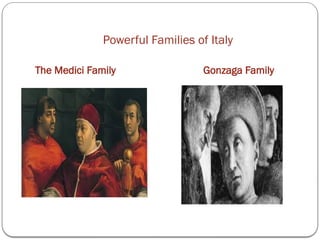
Powerful Families of Italy
The Medici Family Gonzaga Family
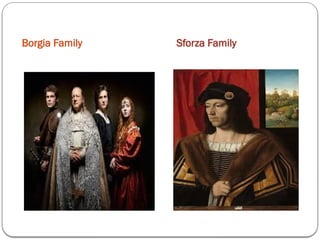
Borgia Family Sforza Family
Economic Prosperity
 Trade and Commerce: Italy's strategic location on the Mediterranean
Sea made it a hub for trade with the East. Cities likeVenice and Florence
flourished economically, creating a wealthy merchant class with the
means to patronize the arts
 Banking: Italian city-states developed sophisticated banking systems,
providing financial stability and capital for artistic and intellectual
pursuits.
Classical Heritage
 Roman Legacy: Italy was the heart of the Roman Empire, and
remnants of its grandeur and culture were still evident. This
provided inspiration and a foundation for the Renaissance's
emphasis on humanism and classical ideals.
 Byzantine Influence:The fall of Constantinople in 1453
brought Greek scholars and their knowledge of classical texts to
Italy, fueling the Renaissance's intellectual revival.
City-States and Competition
 Independent Centers: Italy was divided into independent city-states like
Florence, Milan, and Venice, fostering competition and innovation. These
city-states became patrons of the arts, encouraging artistic and intellectual
development.
 Humanism: The focus on human potential and achievements, a core
Renaissance ideal, thrived in the competitive environment of city-states.
.
The Catholic Church
 Patronage: The Catholic Church, headquartered in Rome, was a
major patron of the arts, commissioning works from renowned
artists and architects.
 Intellectual Center: Rome was a center of learning and
theology, attracting scholars and thinkers who contributed to the
Renaissance's intellectual ferment
The Vatican : A rich and powerful patron
 With the Vatican City situated in Rome, the centre of the Roman Catholic Church
brought with it massive wealth and influence.
 It collected the greatest minds of the day in its religious colleges who, plied with funds
and texts, worked to further understand the relationship between man and God.
 The Popes commissioned talented artists to design and decorate their churches and
palaces with some of the Renaissance’s most sublime works emulating Catholic
iconography and the stories of the Bible.
Vast trading links :Leading to cultural and material
exchange
 As many of Italy’s powerful city-states were located on a peninsular of the Mediterranean sea, it became a hotbed for
trading goods and ideas. Different cultures came through Italy’s ports every day as merchants from around the world
interacted with those in the marketplace and inns they stayed in.
 Not only did this create a melting pot of cultures, it also made the city-states and their merchant class very wealthy,
with access to a vast array of commodities.
 One of the most important of these were the sale of pigments, used in the paints of Renaissance artists.Venice was
the main point of entry for pigmented goods, from verdigris (green from Greece) to the rare lapis lazuli of Central
Asia.
 The vast range of colours at artists’ disposal allowed them to play with new and striking shades, achieving the vibrant
artwork so iconic to the Italian Renaissance today.
The legacy of Ancient Rome
 The Italian Peninsula had been the center of the Roman Empire, and the
remnants of this once-great civilization were all around.
 The rediscovery of classical texts and the admiration for Roman art and
architecture played a vital role in inspiring the Renaissance’s humanist ideals.
 In fact, the term “Renaissance” itself means “rebirth,” signifying the revival of
interest in the knowledge and achievements of antiquity.
The fall of Constantinople
 The fall of Constantinople in 1453 to the Ottoman Empire had a significant
impact on the Renaissance.With the city’s collapse, many Greek scholars and
their precious manuscripts fled to Italy, bringing with them a wealth of
knowledge.
 This influx of intellectual capital helped to fuel the Renaissance’s spirit of
inquiry and innovation.
The invention of the printing press
 The invention of the printing press by Johannes Gutenberg in the mid-15th
century revolutionized the dissemination of knowledge.
 The availability of books increased dramatically, allowing for a wider
distribution of classical texts and humanist ideas.
 Italy, with its strong tradition of scholarship, was uniquely positioned to benefit
from this technological advancement.
 During the Renaissance, the establishment of art academies, such as the
Accademia di Belle Arti in Florence (L’Accademia di Belle Arti di Firenze),
played a crucial role in nurturing and disseminating artistic knowledge.
 These institutions provided formal training for artists, fostering an
environment that emphasized learning, experimentation, and the
development of new techniques.
 The academies contributed to the professionalization of the arts, laying the
groundwork for the artistic achievements of the Renaissance.
The emergence of art academies
Conclusion
 The Renaissance’s emergence in Italy can be attributed to a
multitude of factors, including the Church’s influence, political
stability, cultural exchange with Islamic and Byzantine
civilizations, and the growth of art academies.
 Together, these conditions created an environment ripe for the
blossoming of a remarkable period of human achievement, forever
altering the trajectory ofWestern history.

Renaissance Why it Started in Italy.pptx

  • 1.
    Renaissance : WhyIn Italy Dr. Monica Sharma
  • 2.
    Why the RenaissanceBegan in Italy The Italian Renaissance emerged due to a confluence of factors. Economically, thriving trade networks generated wealth, fueling artistic and intellectual patronage . Culturally, Italy's Roman heritage provided a rich foundation for a classical revival. Politically, the independent city-states fostered competition and innovation Finally, powerful merchant families, such as the Medici, invested significantly in the arts and sciences, catalyzing the Renaissance movement. .
  • 3.
    Patronage: The Fuelof the Renaissance Wealthy individuals, families, and the Church acted as patrons, supporting artists, writers, and scholars. This support was crucial in several ways: Financial Support: Patrons provided artists and intellectuals with the necessary funds to create their works.This enabled them to focus on their craft without worrying about financial constraints. Commissioned Works: Patrons often commissioned specific works, providing artists with a steady income and creative challenges.This led to the creation of masterpieces that adorned churches, palaces, and public spaces Social Status: Being associated with renowned artists and intellectuals enhanced the patron's social status and prestige. It was a way to demonstrate wealth, power, and cultural sophistication. Intellectual Exchange: Patrons often created intellectual circles, bringing together artists, scholars, and thinkers. This fostered the exchange of ideas and contributed to the intellectual ferment of the Renaissance. Preservation of Art and Literature: By commissioning works and creating collections, patrons helped preserve the artistic and literary heritage of the Renaissance for future generations.
  • 4.
    Wealthy Italian Families:Patrons of Art Medici Family (Florence): Undoubtedly the most famous patrons, the Medici amassed immense wealth through banking.Their support of artists like Michelangelo, Leonardo daVinci, and Botticelli transformed Florence into a cultural epicenter. Sforza Family (Milan): Rulers of Milan, the Sforza family commissioned works from renowned artists like Leonardo daVinci, who worked on projects like the Last Supper. Borgia Family (Rome): Powerful and controversial, the Borgias, particularly PopeAlexanderVI, were significant patrons of the arts. Gonzaga Family (Mantua):This family created a magnificent court at Mantua, supporting artists likeAndrea Mantegna.
  • 5.
    Powerful Families ofItaly The Medici Family Gonzaga Family
  • 6.
  • 7.
    Economic Prosperity  Tradeand Commerce: Italy's strategic location on the Mediterranean Sea made it a hub for trade with the East. Cities likeVenice and Florence flourished economically, creating a wealthy merchant class with the means to patronize the arts  Banking: Italian city-states developed sophisticated banking systems, providing financial stability and capital for artistic and intellectual pursuits.
  • 8.
    Classical Heritage  RomanLegacy: Italy was the heart of the Roman Empire, and remnants of its grandeur and culture were still evident. This provided inspiration and a foundation for the Renaissance's emphasis on humanism and classical ideals.  Byzantine Influence:The fall of Constantinople in 1453 brought Greek scholars and their knowledge of classical texts to Italy, fueling the Renaissance's intellectual revival.
  • 9.
    City-States and Competition Independent Centers: Italy was divided into independent city-states like Florence, Milan, and Venice, fostering competition and innovation. These city-states became patrons of the arts, encouraging artistic and intellectual development.  Humanism: The focus on human potential and achievements, a core Renaissance ideal, thrived in the competitive environment of city-states. .
  • 10.
    The Catholic Church Patronage: The Catholic Church, headquartered in Rome, was a major patron of the arts, commissioning works from renowned artists and architects.  Intellectual Center: Rome was a center of learning and theology, attracting scholars and thinkers who contributed to the Renaissance's intellectual ferment
  • 11.
    The Vatican :A rich and powerful patron  With the Vatican City situated in Rome, the centre of the Roman Catholic Church brought with it massive wealth and influence.  It collected the greatest minds of the day in its religious colleges who, plied with funds and texts, worked to further understand the relationship between man and God.  The Popes commissioned talented artists to design and decorate their churches and palaces with some of the Renaissance’s most sublime works emulating Catholic iconography and the stories of the Bible.
  • 12.
    Vast trading links:Leading to cultural and material exchange  As many of Italy’s powerful city-states were located on a peninsular of the Mediterranean sea, it became a hotbed for trading goods and ideas. Different cultures came through Italy’s ports every day as merchants from around the world interacted with those in the marketplace and inns they stayed in.  Not only did this create a melting pot of cultures, it also made the city-states and their merchant class very wealthy, with access to a vast array of commodities.  One of the most important of these were the sale of pigments, used in the paints of Renaissance artists.Venice was the main point of entry for pigmented goods, from verdigris (green from Greece) to the rare lapis lazuli of Central Asia.  The vast range of colours at artists’ disposal allowed them to play with new and striking shades, achieving the vibrant artwork so iconic to the Italian Renaissance today.
  • 13.
    The legacy ofAncient Rome  The Italian Peninsula had been the center of the Roman Empire, and the remnants of this once-great civilization were all around.  The rediscovery of classical texts and the admiration for Roman art and architecture played a vital role in inspiring the Renaissance’s humanist ideals.  In fact, the term “Renaissance” itself means “rebirth,” signifying the revival of interest in the knowledge and achievements of antiquity.
  • 14.
    The fall ofConstantinople  The fall of Constantinople in 1453 to the Ottoman Empire had a significant impact on the Renaissance.With the city’s collapse, many Greek scholars and their precious manuscripts fled to Italy, bringing with them a wealth of knowledge.  This influx of intellectual capital helped to fuel the Renaissance’s spirit of inquiry and innovation.
  • 15.
    The invention ofthe printing press  The invention of the printing press by Johannes Gutenberg in the mid-15th century revolutionized the dissemination of knowledge.  The availability of books increased dramatically, allowing for a wider distribution of classical texts and humanist ideas.  Italy, with its strong tradition of scholarship, was uniquely positioned to benefit from this technological advancement.
  • 16.
     During theRenaissance, the establishment of art academies, such as the Accademia di Belle Arti in Florence (L’Accademia di Belle Arti di Firenze), played a crucial role in nurturing and disseminating artistic knowledge.  These institutions provided formal training for artists, fostering an environment that emphasized learning, experimentation, and the development of new techniques.  The academies contributed to the professionalization of the arts, laying the groundwork for the artistic achievements of the Renaissance. The emergence of art academies
  • 17.
    Conclusion  The Renaissance’semergence in Italy can be attributed to a multitude of factors, including the Church’s influence, political stability, cultural exchange with Islamic and Byzantine civilizations, and the growth of art academies.  Together, these conditions created an environment ripe for the blossoming of a remarkable period of human achievement, forever altering the trajectory ofWestern history.