BY ENG. KAFATA
1
DISTANCE RELAY
The impedance relays also called distance relays are
employed to provide protection to transmission lines
connected in a network
A distance relay, as its name implies, has the ability to
detect a fault within a pre-set distance along a
transmission line or power cable from its location.
The impedance relay is made to respond to the
impedance between the relay location and the point
where fault is incident.
2
DISTANCE RELAY
The impedance is proportional to the distance to the
fault, and is therefore independent of the fault current
levels.
Power line has a resistance and reactive per kilometer
related to its design and construction so its total
impedance will be a function of its length or distance.
A distance relay, looks at current and voltage and
compares these two quantities on the basis of Ohm’s
law.
3
Principle of operation of distance relay
 A distance relay compares the currents and voltages at the
relaying point with Current providing the operating torque and
the voltage provides the restraining torque.
 In other words an impedance relay is a voltage restrained
overcurrent relay.
 Since the operating characteristics of the relay depend upon
the ratio of voltage and current and the phase angle between
them, their characteristics can be best represented on an R-X
diagram where both V/I ratio and the phase angle can be
plotted in terms of an impedance R+jX.
4
Principle of operation of distance relay
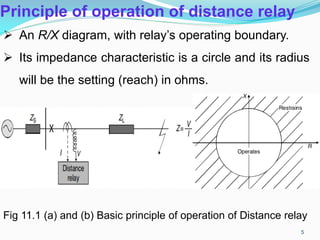
 An R/X diagram, with relay’s operating boundary.
 Its impedance characteristic is a circle and its radius
will be the setting (reach) in ohms.
Fig 11.1 (a) and (b) Basic principle of operation of Distance relay
5
Principle of operation of distance relay
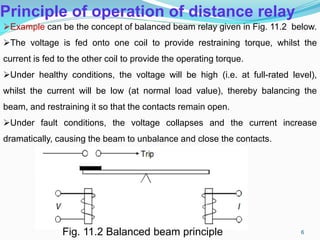
Example can be the concept of balanced beam relay given in Fig. 11.2 below.
The voltage is fed onto one coil to provide restraining torque, whilst the
current is fed to the other coil to provide the operating torque.
Under healthy conditions, the voltage will be high (i.e. at full-rated level),
whilst the current will be low (at normal load value), thereby balancing the
beam, and restraining it so that the contacts remain open.
Under fault conditions, the voltage collapses and the current increase
dramatically, causing the beam to unbalance and close the contacts.
Fig. 11.2 Balanced beam principle 6
Principle of operation of distance relay
The distance relays achieve selectivity on the basis of
impedance rather than current and hence can always
be set for instantaneous operation in the first zone.
Settings for distance relays are relatively easier to
carry out.
The distance relays, thus, basically compare local
voltage (voltage at relaying point) and local current to
measure the impedance from the relaying point to the
fault point.
7
Principle of operation of distance relay
Distance protection involves the division of the voltage at the
relaying point by the measured current.
The impedance so calculated is compared with the reach point
impedance.
If the measured impedance is less than the reach point
impedance, it is assumed that a fault exists on the line between
the relay and the reach point.
The reach point of a relay is the point along the line impedance
locus that is intersected by the boundary characteristic of the
relay.
8
RELAY PERFORMANCE
Distance relay performance is defined in terms of
reach accuracy and operating time.
Reach accuracy is a comparison of the actual ohmic
reach of the relay under practical conditions with the
relay setting value in ohms.
Reach accuracy particularly depends on the level of
voltage presented to the relay under fault conditions.
9
RELAY PERFORMANCE
Depending on the measuring techniques employed,
measuring signal transient errors, such as those
produced by Capacitor Voltage Transformers (CVT) or
saturating CT’s, can also adversely delay relay
operation for faults close to the reach point.
It is usual for electromechanical and static distance
relays to claim both maximum and minimum
operating times.
10
STEPPED DISTANCE CHARACTERISTICS OF A DISTANCE
RELAY
The distance measurement can be done either by an
amplitude comparator or by a phase comparator.
The basic constructional unit representing an
amplitude comparator is a balanced beam relay.
Similarly, an induction cup relay is a phase comparator.
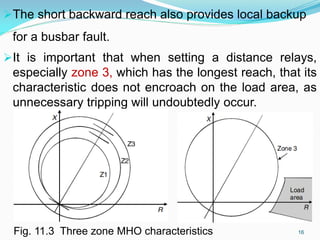
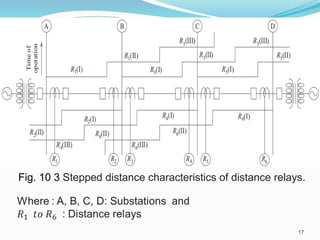
 A distance relay has three zones of protection as
shown in Fig. 11.3(a).
The first zone (zone 1) covers about 80% to 85% of
the section to be protected. 11
STEPPED DISTANCE CHARACTERISTICS OF A DISTANCE
RELAY
The resulting 15% - 20% safety margin ensures that
there is no risk of the Zone 1 protection over-reaching
the protected line due to errors in the current and
voltage transformers, inaccuracies in line impedance
data provided for setting purposes and errors of relay
setting and measurement.
Otherwise, it may lead to a loss of discrimination with
fast operating protection on the Zone 2 of the distance
protection covering the remaining 15% - 20% of the
12
STEPPED DISTANCE CHARACTERISTICS OF A DISTANCE
RELAY
A distance relay operates instantaneously if the fault occurs in
the first zone (zone 1).
The second zone (zone 2) covers at least 120% of the
protected line impedance.
In many applications it is common practice to set the Zone 2
reach to be equal to the protected line section +50% of the
shortest adjacent line.
The same distance relay operates after a pre-set time delay if
the fault occurs in the second zone of protection of the relay.
13
STEPPED DISTANCE CHARACTERISTICS OF A DISTANCE
RELAY
Where possible, this ensures that the resulting
maximum effective Zone 2 reach does not extend
beyond the minimum effective Zone 1 reach of the
adjacent line protection.
This avoids the need to grade the Zone 2 time
settings between upstream and downstream relays.
Remote back-up protection for all faults on adjacent
lines can be provided by a third zone (Zone 3) of
protection. 14
STEPPED DISTANCE CHARACTERISTICS OF A DISTANCE
RELAY
This is a time delayed to discriminate with Zone 2
protection plus circuit breaker trip time for the adjacent
line.
Zone 3 reach should be set to at least 1.2 times the
impedance presented to the relay for a fault at the
remote end of second line section.
This zone is invariably added as a starter element and
this takes the form of an offset mho characteristic.
15
The short backward reach also provides local backup
for a busbar fault.
It is important that when setting a distance relays,
especially zone 3, which has the longest reach, that its
characteristic does not encroach on the load area, as
unnecessary tripping will undoubtedly occur.
16
Fig. 11.3 Three zone MHO characteristics
Fig. 10 3 Stepped distance characteristics of distance relays.
17
Effect of arc resistance
 Resistance of the fault arc can also have an impact
on the performance of a distance relay.
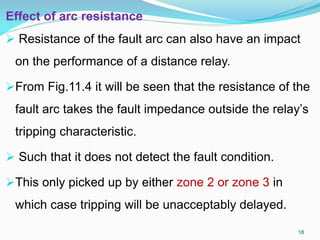
From Fig.11.4 it will be seen that the resistance of the
fault arc takes the fault impedance outside the relay’s
tripping characteristic.
 Such that it does not detect the fault condition.
This only picked up by either zone 2 or zone 3 in
which case tripping will be unacceptably delayed.
18
Effect of arc resistance
The effect of arc resistance is most significant on short lines
where the reach of the relay setting is small.
It can be a problem if the fault occurs near the end of the reach.
High fault-arc resistances tend to occur during midspan
flashovers to ground during a veldt fire or on transmission lines
carried on wood poles without earth wires.
These problems can usually be overcome by using relays
having different shaped characteristics.
19
Transmission Lines
Classification of line length depends on:
 Source-to-line Impedance Ratio (SIR),
and
 Nominal voltage
Length considerations:
 Short Lines: SIR > 4
 Medium Lines: 0.5 < SIR < 4
 Long Lines: SIR < 0.5
20
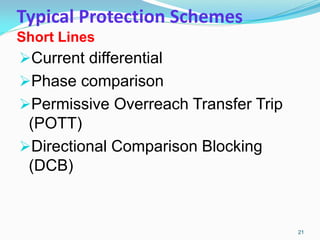
Typical Protection Schemes
Short Lines
Current differential
Phase comparison
Permissive Overreach Transfer Trip
(POTT)
Directional Comparison Blocking
(DCB)
21
Typical Protection Schemes
Medium Lines
Phase comparison
Directional Comparison Blocking (DCB)
Permissive Underreach Transfer Trip (PUTT)
Permissive Overreach Transfer Trip (POTT)
Unblocking
Step Distance
Step or coordinated overcurrent
Inverse time overcurrent
Current Differential
22
Typical Protection Schemes
Long Lines
• Phase comparison
• Directional Comparison Blocking (DCB)
• Permissive Underreach Transfer Trip (PUTT)
• Permissive Overreach Transfer Trip (POTT)
• Unblocking
• Step Distance
• Step or coordinated overcurrent
• Current Differential 23
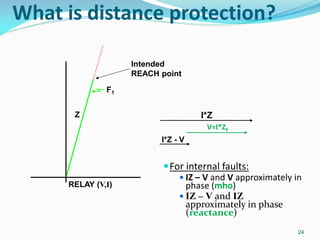
What is distance protection?
For internal faults:
 IZ – V and V approximately in
phase (mho)
 IZ – V and IZ
approximately in phase
(reactance)
RELAY (V,I)
Intended
REACH point
Z
F1
I*Z
V=I*ZF
I*Z - V
24
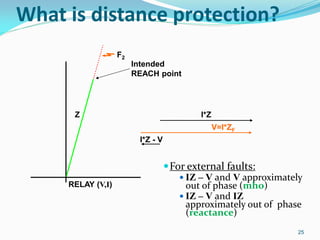
What is distance protection?
For external faults:
 IZ – V and V approximately
out of phase (mho)
 IZ – V and IZ
approximately out of phase
(reactance)
RELAY (V,I)
Intended
REACH point
Z I*Z
V=I*ZF
I*Z - V
F2
25
Types of Distance Relays
There are mainly for types of Distance Relays:
(1) Impedance relay
(2) Reactance relay
(3) Mho relay
(4) Modified impedance relay
26
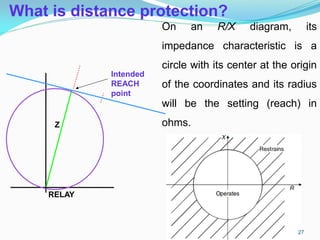
What is distance protection?
RELAY
Intended
REACH
point
Z
On an R/X diagram, its
impedance characteristic is a
circle with its center at the origin
of the coordinates and its radius
will be the setting (reach) in
ohms.
27
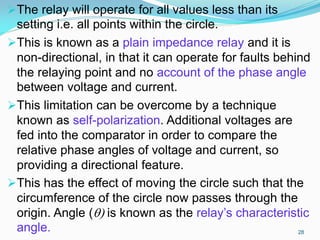
The relay will operate for all values less than its
setting i.e. all points within the circle.
This is known as a plain impedance relay and it is
non-directional, in that it can operate for faults behind
the relaying point and no account of the phase angle
between voltage and current.
This limitation can be overcome by a technique
known as self-polarization. Additional voltages are
fed into the comparator in order to compare the
relative phase angles of voltage and current, so
providing a directional feature.
This has the effect of moving the circle such that the
circumference of the circle now passes through the
origin. Angle () is known as the relay’s characteristic
angle. 28
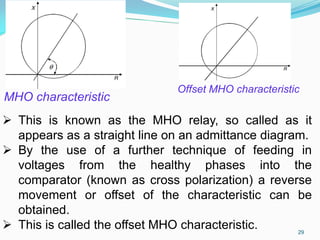
 This is known as the MHO relay, so called as it
appears as a straight line on an admittance diagram.
 By the use of a further technique of feeding in
voltages from the healthy phases into the
comparator (known as cross polarization) a reverse
movement or offset of the characteristic can be
obtained.
 This is called the offset MHO characteristic.
Offset MHO characteristic
MHO characteristic
29
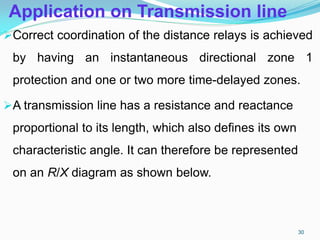
Application on Transmission line
Correct coordination of the distance relays is achieved
by having an instantaneous directional zone 1
protection and one or two more time-delayed zones.
A transmission line has a resistance and reactance
proportional to its length, which also defines its own
characteristic angle. It can therefore be represented
on an R/X diagram as shown below.
30
Zone 1
The relay characteristic has also been added, and
noted that the reach of the measuring element has
been set at approximately 80% of the line length.
This ‘under-reach’ setting has been purposely chosen
to avoid over-reaching into the next line section to
ensure sound selectivity, for the following reasons:
It is not practical to accurately measure the
impedance of a transmission line, which could be
very long (say 100 km). Survey lengths are normally
used and these could have errors up to 10%. 31
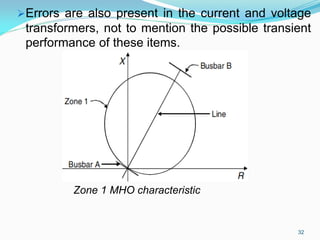
Errors are also present in the current and voltage
transformers, not to mention the possible transient
performance of these items.
Zone 1 MHO characteristic
32
Zone 2
To cover the remaining 20% of the line length, a
second measuring element can be fitted, set to over-
reach the line, but it must be time delayed by 0.5 s to
provide the necessary coordination with the
downstream relay.
It does not only covers the remaining 20% of the line,
but also provides backup for the next line section
should this fail to trip for whatever reason.
33
Zone 3
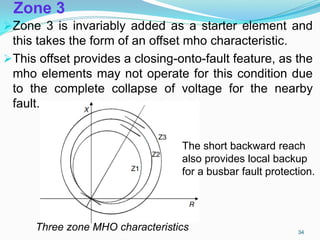
Zone 3 is invariably added as a starter element and
this takes the form of an offset mho characteristic.
This offset provides a closing-onto-fault feature, as the
mho elements may not operate for this condition due
to the complete collapse of voltage for the nearby
fault.
Three zone MHO characteristics
The short backward reach
also provides local backup
for a busbar fault protection.
34
Effect of load current
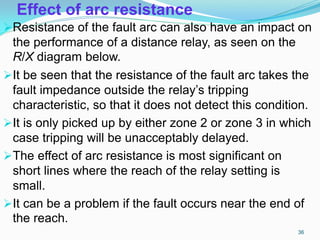
 Load current can be expressed as impedance, by Ohm’s law.
 As shown on the R/X diagram by the shaded area, the
angular limits being governed by the power factor of the load.
 It is important that when setting a distance relays, especially
zone 3, which has the longest reach, that its characteristic
does not encroach on the load area, as unnecessary tripping
will undoubtedly occur.
Load current characteristics 35
Effect of arc resistance
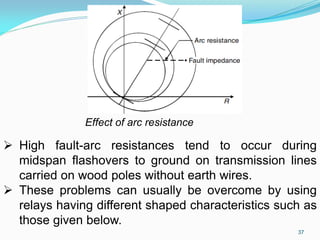
Resistance of the fault arc can also have an impact on
the performance of a distance relay, as seen on the
R/X diagram below.
It be seen that the resistance of the fault arc takes the
fault impedance outside the relay’s tripping
characteristic, so that it does not detect this condition.
It is only picked up by either zone 2 or zone 3 in which
case tripping will be unacceptably delayed.
The effect of arc resistance is most significant on
short lines where the reach of the relay setting is
small.
It can be a problem if the fault occurs near the end of
the reach.
36
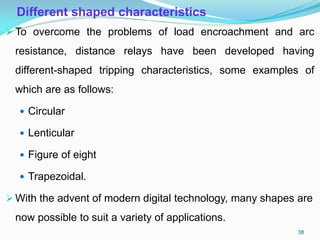
Effect of arc resistance
 High fault-arc resistances tend to occur during
midspan flashovers to ground on transmission lines
carried on wood poles without earth wires.
 These problems can usually be overcome by using
relays having different shaped characteristics such as
those given below.
37
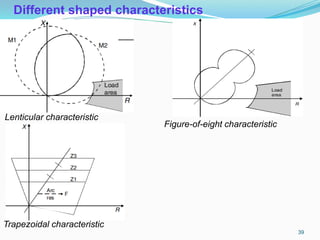
Different shaped characteristics
To overcome the problems of load encroachment and arc
resistance, distance relays have been developed having
different-shaped tripping characteristics, some examples of
which are as follows:
 Circular
 Lenticular
 Figure of eight
 Trapezoidal.
With the advent of modern digital technology, many shapes are
now possible to suit a variety of applications.
38
Different shaped characteristics
Lenticular characteristic
Figure-of-eight characteristic
Trapezoidal characteristic
39
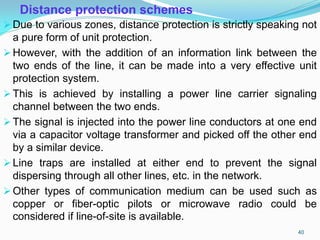
Distance protection schemes
Due to various zones, distance protection is strictly speaking not
a pure form of unit protection.
However, with the addition of an information link between the
two ends of the line, it can be made into a very effective unit
protection system.
This is achieved by installing a power line carrier signaling
channel between the two ends.
The signal is injected into the power line conductors at one end
via a capacitor voltage transformer and picked off the other end
by a similar device.
Line traps are installed at either end to prevent the signal
dispersing through all other lines, etc. in the network.
Other types of communication medium can be used such as
copper or fiber-optic pilots or microwave radio could be
considered if line-of-site is available.
40
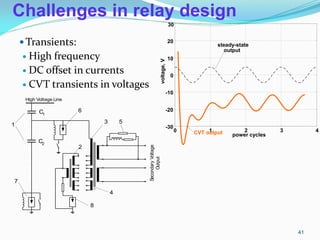
Challenges in relay design
 Transients:
 High frequency
 DC offset in currents
 CVT transients in voltages
CVT output
0 1 2 3 4
steady-state
output
power cycles
-30
-20
-10
0
10
20
30
voltage,
V
C1
C2
2
3 5
6
1
4
7
High Voltage Line
Secondary
Voltage
Output
8
41
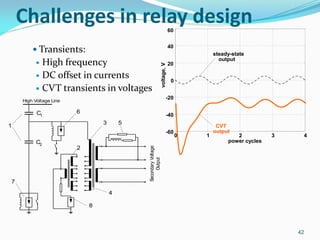
Challenges in relay design
 Transients:
 High frequency
 DC offset in currents
 CVT transients in voltages
C1
C2
2
3 5
6
1
4
7
High Voltage Line
Secondary
Voltage
Output
8
CVT
output
0 1 2 3 4
steady-state
output
-60
-40
-20
0
20
40
power cycles
voltage,
V
60
42
Challenges in relay design
-0.5 0 0.5 1 1.5
-100
-80
-60
-40
-20
0
20
40
60
80
100
Voltage
[V]
-0.5 0 0.5 1 1.5
-3
-2
-1
0
1
2
3
4
5
Current
[A]
vA
vB vC
iA
iB
,iC
-0.5 0 0.5 1 1.5
-100
-50
0
50
100
Reactance
comparator
[V]
power cycles
SPOL
SOP
> In-phase = internal fault
> Out-of-phase = external
fault
43
Transient Overreach
 Fault current generally contains dc offset in
addition to ac power frequency component.
Ratio of dc to ac component of current
depends on instant in the cycle at which
fault occurred.
Rate of decay of dc offset depends on
system X/R.
44
Zone 1 and CVT Transients
Capacitive Voltage Transformers (CVTs) create
certain problems for fast distance relays applied to
systems with high Source Impedance Ratios
(SIRs):
 CVT-induced transient voltage components may
assume large magnitudes (up to 30-40%) and
last for a comparatively long time (up to about 2
cycles)
 60Hz voltage for faults at the relay reach point
may be as low as 3% for a SIR of 30
 the signal may be buried under noise
45
Zone 1 and CVT Transients
CVT transients can cause distance relays to overreach.
Generally, transient overreach may be caused by:
overestimation of the current (the magnitude of the
current as measured is larger than its actual value,
and consequently, the fault appears closer than it is
actually located),
underestimation of the voltage (the magnitude of the
voltage as measured is lower than its actual value)
combination of the above 46
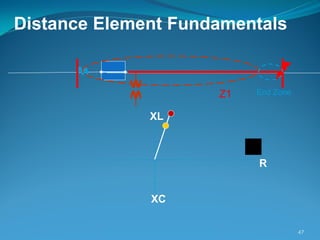
Distance Element Fundamentals
XL
XC
R
Z1 End Zone
47
-10 -5 0 5 10
-5
0
5
10
15
Reactance
[ohm]
Resistance [ohm]
18
22
26
30
34
42
44 Actual Fault
Location
Line
Impedance
Trajectory
(msec)
dynamic mho
zone extended
for high SIRs
Impedance locus may pass
below the origin of the Z-plane -
this would call for a time delay
to obtain stability 48
CVT Transient Overreach Solutions
Apply delay (fixed or adaptable)
Reduce the reach
Adaptive techniques and better filtering
algorithms
49
CVT Transients – Adaptive Solution
Optimize signal filtering:
 currents - max 3% error due to the dc
component
 voltages - max 0.6% error due to CVT
transients
Adaptive double-reach approach
 filtering alone ensures maximum transient
overreach at the level of 1% (for SIRs up to 5)
and 20% (for SIRs up to 30)
 to reduce the transient overreach even further
an adaptive double-reach zone 1 has been
implemented. 50
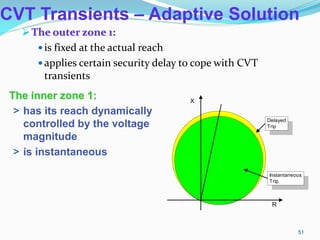
CVT Transients – Adaptive Solution
The outer zone 1:
 is fixed at the actual reach
 applies certain security delay to cope with CVT
transients
Delayed
Trip
Instantaneous
Trip
R
X
The inner zone 1:
> has its reach dynamically
controlled by the voltage
magnitude
> is instantaneous
51
Desirable Distance Relay Attributes
Filters:
Prefiltering of currents to remove dc decaying transients
 Limit maximum transient overshoot (below 2%)
Prefiltering of voltages to remove low frequency
transients caused by CVTs
 Limit transient overreach to less than 5% for an SIR of
30
Accurate and fast frequency tracking algorithm
Adaptive reach control for faults at reach points 52
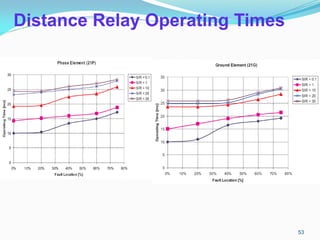
Distance Relay Operating Times
53
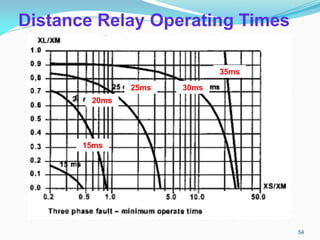
Distance Relay Operating Times
20ms
15ms
25ms 30ms
35ms
54
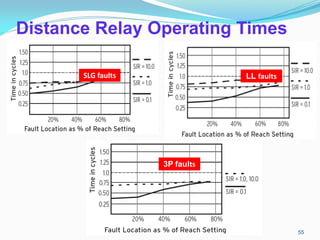
Distance Relay Operating Times
SLG faults LL faults
3P faults
55
0 5 10 15 20 25 30
0
10
20
30
40
50
60
70
80
90
100
Maximum
Rach
[%]
SIR
Actual maximum reach curves
Relay 1
Relay 3
Relay 2
Relay 4
56
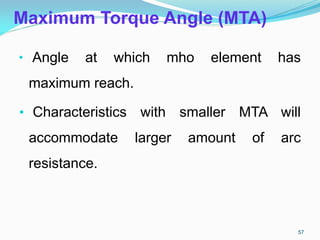
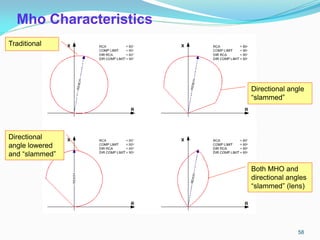
Maximum Torque Angle (MTA)
• Angle at which mho element has
maximum reach.
• Characteristics with smaller MTA will
accommodate larger amount of arc
resistance.
57
Traditional
Directional
angle lowered
and “slammed”
Directional angle
“slammed”
Both MHO and
directional angles
“slammed” (lens)
Mho Characteristics
58
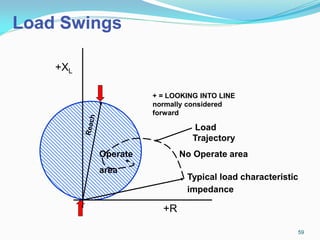
Typical load characteristic
impedance
+R
Operate
area
No Operate area
+XL
+ = LOOKING INTO LINE
normally considered
forward
Load
Trajectory
Load Swings
59
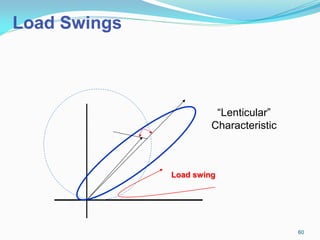
Load swing
“Lenticular”
Characteristic
Load Swings
60
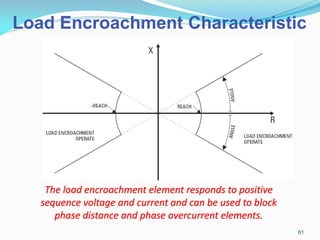
Load Encroachment Characteristic
The load encroachment element responds to positive
sequence voltage and current and can be used to block
phase distance and phase overcurrent elements.
61
Blinders
 Blinders limit the operation of distance relays
(quad or mho) to a narrow region that parallels
and encompasses the protected line
 Applied to long transmission lines, where mho
settings are large enough to pick up on
maximum load or minor system swings
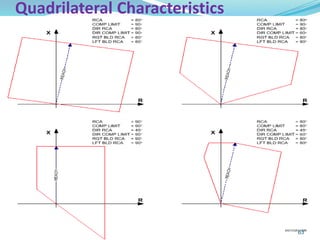
62
Quadrilateral Characteristics
63
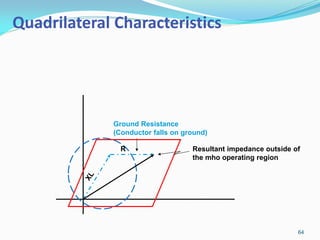
Ground Resistance
(Conductor falls on ground)
R Resultant impedance outside of
the mho operating region
Quadrilateral Characteristics
64
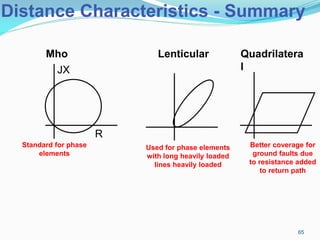
Mho Quadrilatera
l
Better coverage for
ground faults due
to resistance added
to return path
Lenticular
Used for phase elements
with long heavily loaded
lines heavily loaded
Standard for phase
elements
JX
R
Distance Characteristics - Summary
65
Distance Element Polarization
 Distance Element Polarization is a method used to polarize (or bias) the
operation of impedance elements within distance relays.
 Distance element polarization refers to a setting adjustment in distance
protection relays used in power systems.
 Polarization quantities commonly used in distance relays for determining
directionality:
• Self-polarized
• Memory voltage
• Positive sequence voltage
• Quadrature voltage
• Leading phase voltage
66
Self-polarized
A self-polarized relay is a type of protective relay that
determines the direction of a fault based on the phase
relationship between voltage and current signals
measured at its terminals.
Self-polarization in protective relays is to ensure that the relay
can accurately determine whether a fault is within its protected
zone (forward fault) or outside (reverse fault).
67
Memory Polarization
 Positive-sequence memorized voltage is used for
polarizing:
 Mho comparator (dynamic, expanding Mho).
 Negative-sequence directional comparator
(Ground Distance Mho and Quad).
 Zero-sequence directional comparator (Ground
Distance MHO and QUAD).
 Directional comparator (Phase Distance MHO
and QUAD).
 Memory duration is a common distance settings
(all zones, phase and ground, MHO and QUAD).
68
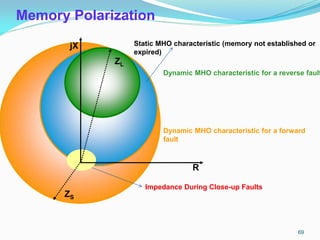
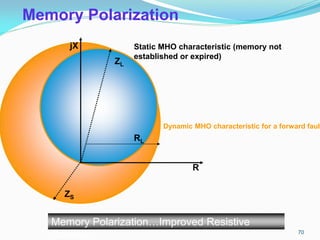
Memory Polarization
jX
R
Dynamic MHO characteristic for a reverse fault
Dynamic MHO characteristic for a forward
fault
Impedance During Close-up Faults
Static MHO characteristic (memory not established or
expired)
ZL
ZS
69
Memory Polarization
Memory Polarization…Improved Resistive
Coverage
Dynamic MHO characteristic for a forward fault
Static MHO characteristic (memory not
established or expired)
jX
R
ZL
ZS
RL
70
Choice of Polarization
In order to provide flexibility modern
distance relays offer a choice with respect
to polarization of ground overcurrent
direction functions:
 Voltage polarization
 Current polarization
 Dual polarization
71
Ground Directional Elements
 Pilot-aided schemes using ground mho distance relays have
inherently limited fault resistance coverage
 Ground directional over current protection using either negative or
zero sequence can be a useful supplement to give more coverage
for high resistance faults
 Directional discrimination based on the ground quantities is fast:
– Accurate angular relations between the zero and negative
sequence quantities establish very quickly because:
During faults zero and negative-sequence currents and
voltages build up from very low values (practically from zero)
The pre-fault values do not bias the developing fault
components in any direction
72
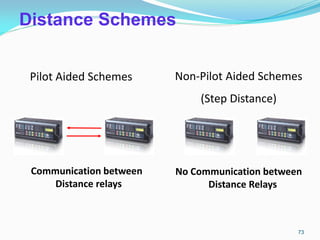
Distance Schemes
Pilot Aided Schemes
No Communication between
Distance Relays
Communication between
Distance relays
Non-Pilot Aided Schemes
(Step Distance)
73
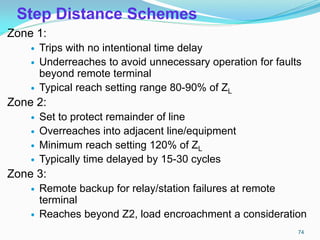
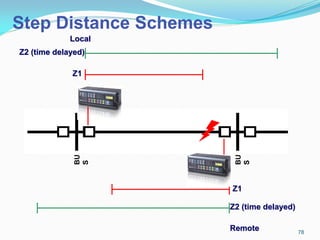
Step Distance Schemes
Zone 1:
 Trips with no intentional time delay
 Underreaches to avoid unnecessary operation for faults
beyond remote terminal
 Typical reach setting range 80-90% of ZL
Zone 2:
 Set to protect remainder of line
 Overreaches into adjacent line/equipment
 Minimum reach setting 120% of ZL
 Typically time delayed by 15-30 cycles
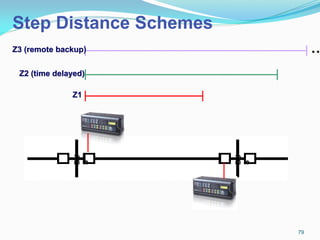
Zone 3:
 Remote backup for relay/station failures at remote
terminal
 Reaches beyond Z2, load encroachment a consideration
74
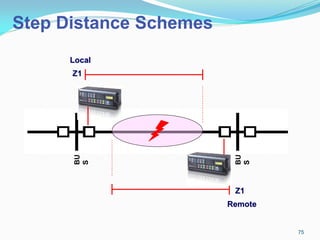
Z1
Z1
Local
Remote
Step Distance Schemes
75
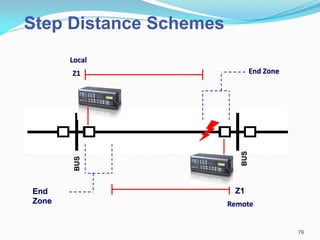
Z1
Z1
End
Zone
End Zone
Local
Remote
Step Distance Schemes
76
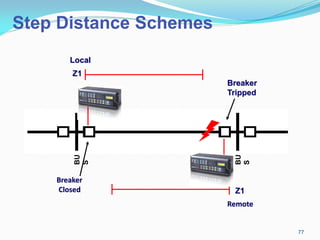
Z1
Z1
Breaker
Tripped
Breaker
Closed
Local
Remote
Step Distance Schemes
77
Z1
Z1
Z2 (time delayed)
Remote
Local
Step Distance Schemes
Z2 (time delayed)
78
Z1
Z2 (time delayed)
Step Distance Schemes
Z3 (remote backup) …
79
Step Distance Protection
80
Local Relay – Z2
Zone 2 PKP
Local Relay Remote Relay
Remote Relay – Z4
Zone 4 PKP
Over Lap
Distance Relay Coordination
81
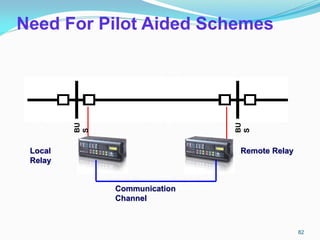
Communication
Channel
Local
Relay
Remote Relay
Need For Pilot Aided Schemes
82
Pilot Communications Channels
Distance-based pilot schemes traditionally
utilize simple on/off communications between
relays, but can also utilize peer-to-peer
communications and GOOSE messaging over
digital channels
 Typical communications media include:
Pilot-wire (50Hz, 60Hz, AT)
Power line carrier
Microwave
Radio
Optic fiber (directly connected or
multiplexed channels)
83
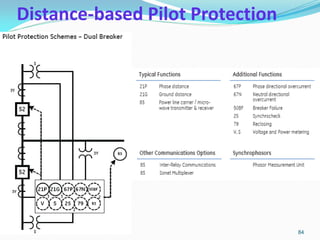
Distance-based Pilot Protection
84
Pilot-Aided Distance-Based Schemes
 DUTT – Direct Under-reaching Transfer Trip
 PUTT – Permissive Under-reaching Transfer Trip
 POTT – Permissive Over-reaching Transfer Trip
 Hybrid POTT – Hybrid Permissive Over-reaching
Transfer Trip
 DCB – Directional Comparison Blocking Scheme
 DCUB – Directional Comparison Unblocking Scheme
85
Direct Underreaching Transfer Trip (DUTT)
 A DUTT is a protective relay scheme used in power systems to
facilitate fast and coordinated tripping of circuit breakers to
isolate faults.
 This scheme is typically employed in interconnected power
systems where transmission lines span across different utility
companies or regions.
 In a DUTT scheme, each end of a transmission line is
protected by distance relays (or other types of relays capable
of measuring fault impedance).
 These relays are set to trip the circuit breaker at their
respective ends if a fault occurs within their reach zone.
86
Direct Under reaching Transfer Trip (DUTT)
When a relay detects a fault within its reach zone, it sends a trip
signal directly to the remote relay at the opposite end of the line
via a communication channel.
Under-reaching Logic: The "under-reaching" part of DUTT
refers to the fact that the relay at one end of the line (let's call it
Relay A) will initiate a trip signal even if the fault is beyond its
own reach, relying on the coordination and confirmation from
the remote relay (Relay B) at the other end of the line.
87
Direct Under reaching Transfer Trip (DUTT)
Trip Signal Transmission: Upon detecting a fault, Relay A sends
a trip signal to Relay B through the communication channel.
Relay B then verifies the fault within its own reach zone and
initiates tripping of the circuit breaker at its end if necessary.
Advantages: DUTT improves the speed and reliability of fault
clearing by allowing the remote end of the transmission line to
initiate breaker tripping based on the confirmation received from
the local end.
This coordination ensures that faults are isolated swiftly,
minimizing disruption to the power system and reducing the
likelihood of cascading failures. 88
Direct Under reaching Transfer Trip (DUTT)
 only under reaching (RU) functions which overlap in reach (Zone 1).
 Applied with Frequency Shift Keying (FSK): is a modulation technique used
to transmit digital signals over communication channels.
 GUARD frequency transmitted during normal conditions
 TRIP frequency when one RU function operates
 Scheme does not provide tripping for faults beyond RU reach if remote
breaker is open or channel is inoperative.
 Dual pilot channels improve security
 Modern digital relays facilitate DUTT through various communication
methods such as fiber optics, microwave links, or digital pilot wires.
 These communication channels ensure rapid and reliable transmission of trip
signals between the relays.
89
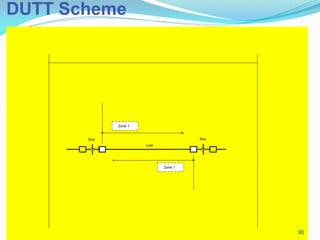
Bus
Line
Bus
Zone 1
Zone 1
DUTT Scheme
90
Permissive Under reaching Transfer Trip (PUTT)
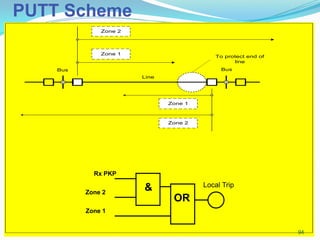
 Permissive Under-reach scheme is a type of protective relay scheme used to
coordinate the operation of distance relays.
Primary Distance Protection:
 Each end of the transmission line is protected by a distance relay.
 These relays measure the impedance to the fault and are set to operate
when the fault impedance falls within their respective reach zones.
 Permissive Under-reach Logic:
 In a Permissive Under-reach scheme, the relay at one end of the line (for
example, Relay A) is configured to only operate if the relay at the other end
(Relay B) has already operated.
 This means Relay A "under-reaches" its normal reach zone (i.e., it will not
operate based on its own reach alone) unless it receives a permissive signal
from Relay B.
91
Permissive Underreaching Transfer Trip (PUTT)
Coordination and Selectivity
The purpose of this scheme is to provide additional coordination
and selectivity in fault detection and isolation.
By requiring confirmation from the relay at the opposite end of
the line before operating, the scheme helps ensure that Relay A
only trips for faults that are severe enough to cause both relays
to operate.
Requires both under reaching (RU) and overreaching (RO)
functions
Identical to DUTT, with pilot tripping signal supervised by RO
(Zone 2)
92
Permissive Underreaching Transfer Trip (PUTT)
This scheme enhances the reliability of protection coordination
by reducing the possibility of unnecessary tripping due to
transient faults or faults outside the protected zone.
It also helps in minimizing the impact of faults on the power
system by isolating only the affected section of the line.
Implementation
Permissive Under-reach logic is typically implemented using
communication between the relays at either end of the protected line.
Modern digital relays can communicate directly through
communication channels such as fiber optics or digital pilot wires. 93
Bus
Line
Bus
Zone 1
Zone 2
Zone 2
Zone 1
To protect end of
line
& Local Trip
Zone 2
Rx PKP
OR
Zone 1
PUTT Scheme
94
Permissive Overreaching Transfer Trip (POTT)
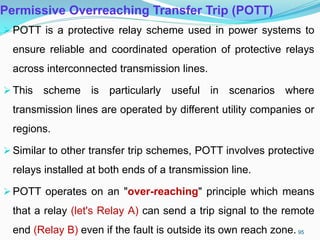
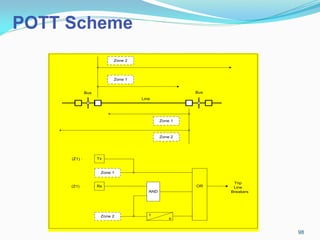
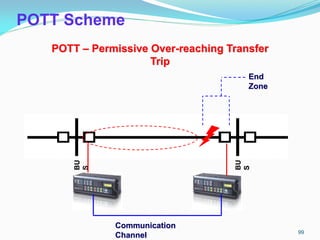
POTT is a protective relay scheme used in power systems to
ensure reliable and coordinated operation of protective relays
across interconnected transmission lines.
This scheme is particularly useful in scenarios where
transmission lines are operated by different utility companies or
regions.
Similar to other transfer trip schemes, POTT involves protective
relays installed at both ends of a transmission line.
POTT operates on an "over-reaching" principle which means
that a relay (let's Relay A) can send a trip signal to the remote
end (Relay B) even if the fault is outside its own reach zone. 95
Permissive Overreaching Transfer Trip (POTT)
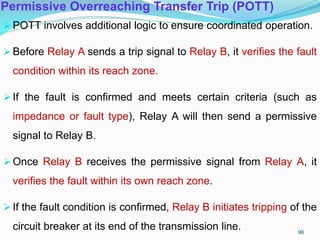
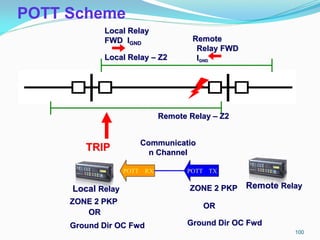
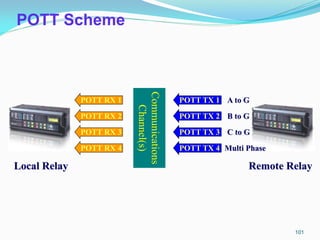
POTT involves additional logic to ensure coordinated operation.
Before Relay A sends a trip signal to Relay B, it verifies the fault
condition within its reach zone.
If the fault is confirmed and meets certain criteria (such as
impedance or fault type), Relay A will then send a permissive
signal to Relay B.
Once Relay B receives the permissive signal from Relay A, it
verifies the fault within its own reach zone.
If the fault condition is confirmed, Relay B initiates tripping of the
circuit breaker at its end of the transmission line. 96
Permissive Overreaching Transfer Trip (POTT)
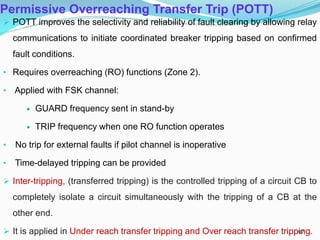
 POTT improves the selectivity and reliability of fault clearing by allowing relay
communications to initiate coordinated breaker tripping based on confirmed
fault conditions.
• Requires overreaching (RO) functions (Zone 2).
• Applied with FSK channel:
 GUARD frequency sent in stand-by
 TRIP frequency when one RO function operates
• No trip for external faults if pilot channel is inoperative
• Time-delayed tripping can be provided
 Inter-tripping, (transferred tripping) is the controlled tripping of a circuit CB to
completely isolate a circuit simultaneously with the tripping of a CB at the
other end.
 It is applied in Under reach transfer tripping and Over reach transfer tripping.
97
Bus
Line
Bus
Zone 1
Zone 2
Trip
Line
Breakers
OR
t
Rx
Tx
AND
(Z1)
(Z1)
o
Zone 1
Zone 2
Zone 2
Zone 1
POTT Scheme
98
POTT Scheme
POTT – Permissive Over-reaching Transfer
Trip
End
Zone
Communication
Channel 99
Local Relay Remote Relay
Remote
Relay FWD
IGND
Ground Dir OC Fwd
OR
Local Relay – Z2
ZONE 2 PKP
Local Relay
FWD IGND
Ground Dir OC Fwd
OR
TRIP
Remote Relay – Z2
POTT TX
ZONE 2 PKP
POTT RX
Communicatio
n Channel
POTT Scheme
100
POTT TX 4
POTT TX 3
POTT TX 2
POTT TX 1 A to G
B to G
C to G
Multi Phase
Local Relay Remote Relay
POTT RX 4
POTT RX 3
POTT RX 2
POTT RX 1
Communications
Channel(s)
POTT Scheme
101
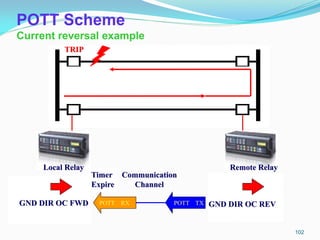
Local Relay Remote Relay
POTT TX ZONE 2 OR
GND DIR OC FWD
Communication
Channel
TRIP
GND DIR OC REV
GND DIR OC REV POTT RX
Start
Timer
Timer
Expire
GND DIR OC FWD
POTT Scheme
Current reversal example
102
Local Relay
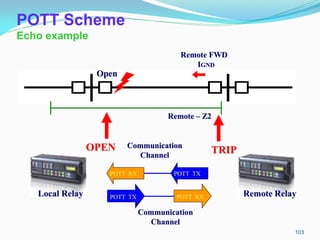
Open
Remote Relay
Remote FWD
IGND
POTT TX
Remote – Z2
Communication
Channel
POTT RX
OPEN
POTT TX
Communication
Channel
POTT RX
TRIP
POTT Scheme
Echo example
103
Hybrid POTT
 A Hybrid Permissive Over-reaching Transfer Trip (HPOTT) is an
advanced protective relay scheme used in power systems to
enhance the reliability and selectivity of fault detection and
isolation across interconnected transmission lines.
HPOTT combines elements of both Permissive Over-reaching
Transfer Trip (POTT) and Direct Transfer Trip (DTT) schemes to
optimize fault clearing operations.
HPOTT involves protective relays installed at both ends of a
transmission line, similar to other transfer trip schemes.
Intended for three-terminal lines and weak infeed conditions.
 Echo feature adds security during weak infeed conditions. 104
Hybrid POTT
 Reverse-looking distance and oc elements used to identify
external faults.
Similar to POTT, HPOTT includes permissive logic where a relay
(let's say Relay A) verifies the fault condition within its reach
zone and then sends a permissive signal to the remote end
(Relay B).
HPOTT incorporates over-reaching logic which means that
Relay A can send a trip signal to Relay B even if the fault is
outside its own reach zone, but within the overall protected zone
covered by the relays.
105
Hybrid POTT
Before Relay A sends a permissive signal to Relay B, it verifies
the fault condition within its reach zone.
If the fault meets certain criteria (impedance or fault type), Relay
A initiates the permissive signal to Relay B.
Upon receiving the permissive signal, Relay B verifies the fault
within its own reach zone and proceeds with tripping the circuit
breaker at its end if necessary.
HPOTT requires robust communication channels between the
protective relays, such as fiber optics, microwave links, or digital
pilot wires. 106
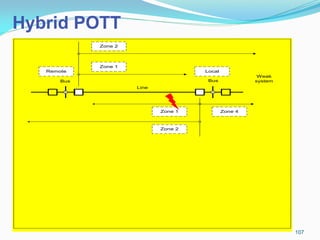
Bus
Line
Bus
Zone 1
Zone 2
Zone 2
Zone 1 Zone 4
Local
Remote
Weak
system
Hybrid POTT
107
Directional Comparison Blocking (DCB)
 Phase comparison is a differential scheme that compares the phase angle between
the currents at the ends of the line.
 If the currents are essentially in phase, there is no fault in the protected section.
 A Directional Comparison Blocking Scheme (DCB Scheme) is a protective relay
scheme used in power systems to provide selective fault detection and isolation,
particularly where transmission lines are interconnected and overlapping protection
zones need careful coordination.
 This scheme ensures that relays only operate for faults occurring in the specified
direction they are intended to protect.
 The DCB Scheme compares the directional information from both ends of the
protected line.
 It verifies whether the fault direction indicated by both relays matches and meets
predetermined conditions before initiating a trip signal. 108
Directional Comparison Blocking (DCB)
 Under normal conditions, the relays monitor the line for faults based on their
directional settings.
 If a fault occurs, each relay detects the fault current direction and verifies it
against its predetermined settings.
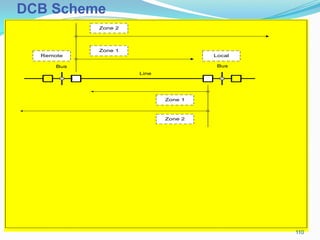
 Requires overreaching (RO) tripping and blocking (B) functions
 ON/OFF pilot channel typically used (i.e., PLC)
 Transmitter is keyed to ON state when blocking function(s) operate
 Receipt of signal from remote end blocks tripping relays
 Tripping function set with Zone 2 reach or greater
 Blocking functions include Zone 3 reverse and low-set ground overcurrent
elements
109
Bus
Line
Bus
Zone 1
Zone 2
Zone 2
Zone 1
Local
Remote
DCB Scheme
110
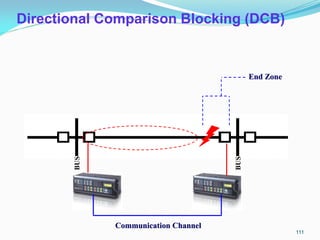
End Zone
Communication Channel
Directional Comparison Blocking (DCB)
111
Directional Comparison Blocking (DCB)
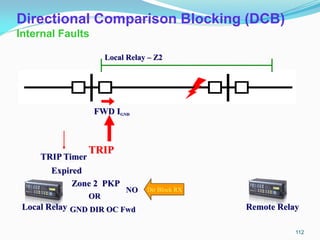
Internal Faults
Local Relay Remote Relay
Local Relay – Z2
Zone 2 PKP
TRIP Timer
Start
FWD IGND
GND DIR OC Fwd
OR
Dir Block RX
NO
TRIP
Expired
112
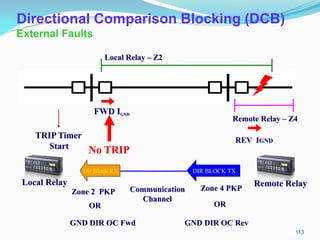
Local Relay Remote Relay
Remote Relay – Z4
Zone 4 PKP
REV IGND
GND DIR OC Rev
OR
DIR BLOCK TX
Local Relay – Z2
Zone 2 PKP
Dir Block RX
Communication
Channel
FWD IGND
GND DIR OC Fwd
OR
TRIP Timer
Start No TRIP
Directional Comparison Blocking (DCB)
External Faults
113
Directional Comparison Unblocking (DCUB)
 Directional Comparison Unblocking (DCUB) is the mechanism or logic
employed to override the blocking condition imposed by DCB schemes
under certain circumstances.
DCUB typically activates when the system detects persistent
or severe fault conditions that require immediate action, even
if there is a directional mismatch between the relays.
When DCUB is triggered, it temporarily bypasses the
directional comparison blocking logic.
This allows the protective relay to initiate a trip signal and
thereby isolate the fault, despite the initial blocking condition.
114
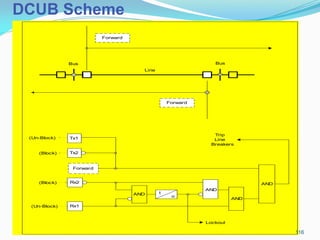
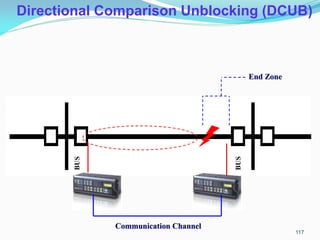
Directional Comparison Unblocking (DCUB)
Applied to Permissive Overreaching (POR) schemes to
overcome the possibility of carrier signal attenuation or loss as a
result of the fault
 Unblocking provided in the receiver when signal is lost:
 If signal is lost due to fault, at least one permissive RO
functions will be picked up
 Unblocking logic produces short-duration TRIP signal (150-
300 ms). If RO function not picked up, channel lockout
occurs until GUARD signal returns
115
Bus
Line
Bus
Trip
Line
Breakers
Tx1
(Un-Block)
Forward
Forward
Tx2
(Block)
Forward
Rx2
Rx1
t
o
AND t
o
AND
AND
AND
Lockout
(Block)
(Un-Block)
DCUB Scheme
116
End Zone
Communication Channel
Directional Comparison Unblocking (DCUB)
117
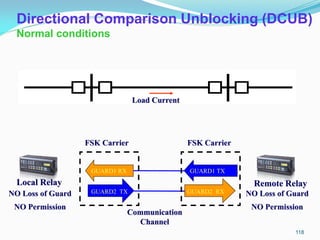
Directional Comparison Unblocking (DCUB)
Normal conditions
Local Relay Remote Relay
GUARD1 TX
GUARD1 RX
Communication
Channel
GUARD2 TX GUARD2 RX
NO Loss of Guard
FSK Carrier FSK Carrier
NO Permission
NO Loss of Guard
NO Permission
Load Current
118
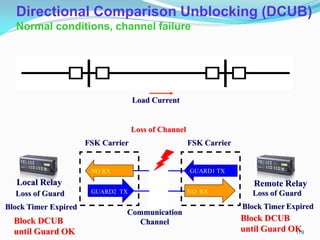
Directional Comparison Unblocking (DCUB)
Normal conditions, channel failure
Local Relay Remote Relay
GUARD1 TX
GUARD1 RX
Communication
Channel
GUARD2 TX GUARD2 RX
FSK Carrier FSK Carrier
Loss of Guard
Block Timer Started
Loss of Guard
Block Timer Started
Load Current
NO RX
NO RX
Block DCUB
until Guard OK
Expired
Block DCUB
until Guard OK
Expired
Loss of Channel
119
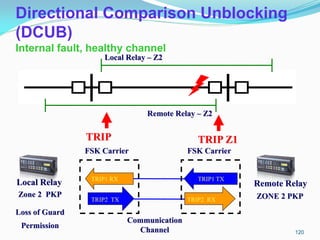
Directional Comparison Unblocking
(DCUB)
Internal fault, healthy channel
Local Relay Remote Relay
GUARD1 TX
GUARD1 RX
Communication
Channel
GUARD2 TX GUARD2 RX
FSK Carrier FSK Carrier
Loss of Guard
Permission
TRIP1 TX
Local Relay – Z2
Zone 2 PKP
TRIP1 RX
TRIP2 TX
TRIP
Remote Relay – Z2
ZONE 2 PKP
TRIP Z1
TRIP2 RX
120
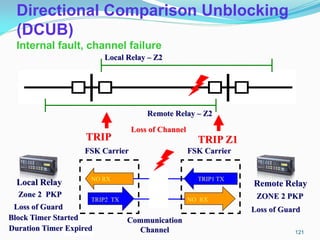
Directional Comparison Unblocking
(DCUB)
Internal fault, channel failure
Local Relay Remote Relay
GUARD1 TX
GUARD1 RX
Communication
Channel
GUARD2 TX GUARD2 RX
FSK Carrier FSK Carrier
TRIP1 TX
Local Relay – Z2
Zone 2 PKP
NO RX
TRIP2 TX
TRIP
Remote Relay – Z2
ZONE 2 PKP
TRIP Z1
NO RX
Loss of Guard
Loss of Channel
Loss of Guard
Block Timer Started
Duration Timer Started
Expired 121
Redundancy Considerations
Redundant protection systems increase dependability
of the system:
Multiple sets of protection using same protection
principle and multiple pilot channels overcome
individual element failure, or
Multiple sets of protection using different
protection principles and multiple channels
protects against failure of one of the protection
methods.
Security can be improved using “voting” schemes (i.e.,
2-out-of-3), potentially at expense of dependability.
Redundancy of instrument transformers, battery
systems, trip coil circuits, etc. also need to be
considered.
122
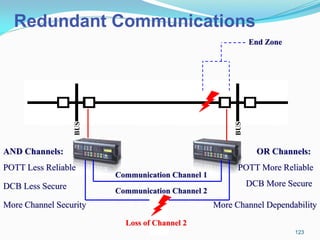
End Zone
Communication Channel 1
Communication Channel 2
Loss of Channel 2
AND Channels:
POTT Less Reliable
DCB Less Secure
OR Channels:
POTT More Reliable
DCB More Secure
More Channel Security More Channel Dependability
Redundant Communications
123
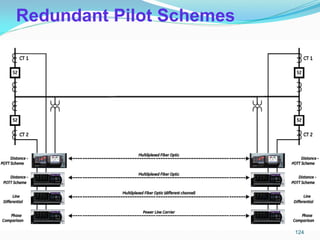
Redundant Pilot Schemes
124
Pilot Relay Desirable Attributes
 Integrated functions:
weak infeed
echo
line pick-up (SOTF)
 Basic protection elements used to key the
communication:
distance elements
fast and sensitive ground (zero and
negative sequence) directional IOCs with
current, voltage, and/or dual polarization
125
Pilot Relay Desirable Attributes
Pre-programmed distance-based pilot schemes:
Direct Under-reaching Transfer Trip (DUTT)
Permissive Under-reaching Transfer Trip (PUTT)
Permissive Overreaching Transfer Trip (POTT)
Hybrid Permissive Overreaching Transfer Trip
(HYB POTT)
Blocking scheme (DCB)
Unblocking scheme (DCUB)
126
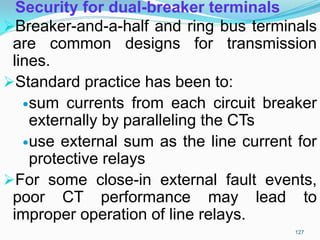
Security for dual-breaker terminals
Breaker-and-a-half and ring bus terminals
are common designs for transmission
lines.
Standard practice has been to:
sum currents from each circuit breaker
externally by paralleling the CTs
use external sum as the line current for
protective relays
For some close-in external fault events,
poor CT performance may lead to
improper operation of line relays.
127
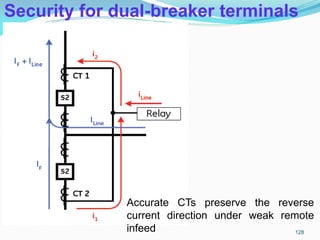
Security for dual-breaker terminals
Accurate CTs preserve the reverse
current direction under weak remote
infeed 128
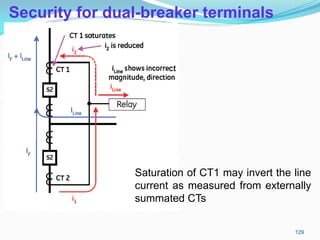
Security for dual-breaker terminals
Saturation of CT1 may invert the line
current as measured from externally
summated CTs
129
Security for dual-breaker terminals
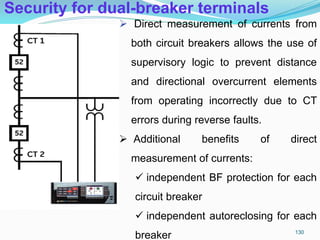
 Direct measurement of currents from
both circuit breakers allows the use of
supervisory logic to prevent distance
and directional overcurrent elements
from operating incorrectly due to CT
errors during reverse faults.
 Additional benefits of direct
measurement of currents:
 independent BF protection for each
circuit breaker
 independent autoreclosing for each
breaker 130
Security for dual-breaker terminals
Supervisory logic should:
 Not affect speed or sensitivity of protection
elements
 Correctly allow tripping during evolving external-to-
internal fault conditions
 Determine direction of current flow through each
breaker independently:
 Both currents in FWD direction  internal fault
 One current FWD, one current REV  external
fault
 Allow tripping during all forward/internal faults
 Block tripping during all reverse/external faults
 Initially block tripping during evolving external-to-
internal faults until second fault appears in forward
direction. Block is then lifted to permit tripping. 131
Single-pole Tripping
Distance relay must correctly identify a SLG
fault and trip only the circuit breaker pole for
the faulted phase.
Autoreclosing and breaker failure functions
must be initiated correctly on the fault event
Security must be maintained on the healthy
phases during the open pole condition and
any reclosing attempt. 132
Out-of-Step Condition
For certain operating conditions, a severe
system disturbance can cause system
instability and result in loss of synchronism
between different generating units on an
interconnected system.
133
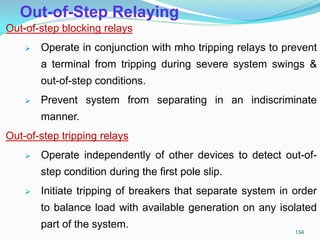
Out-of-Step Relaying
Out-of-step blocking relays
 Operate in conjunction with mho tripping relays to prevent
a terminal from tripping during severe system swings &
out-of-step conditions.
 Prevent system from separating in an indiscriminate
manner.
Out-of-step tripping relays
 Operate independently of other devices to detect out-of-
step condition during the first pole slip.
 Initiate tripping of breakers that separate system in order
to balance load with available generation on any isolated
part of the system.
134
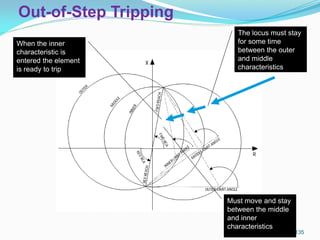
Out-of-Step Tripping
The locus must stay
for some time
between the outer
and middle
characteristics
Must move and stay
between the middle
and inner
characteristics
When the inner
characteristic is
entered the element
is ready to trip
135
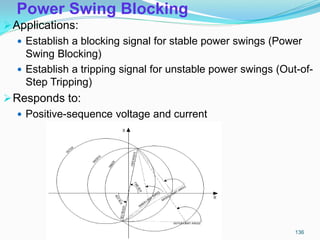
Power Swing Blocking
Applications:
 Establish a blocking signal for stable power swings (Power
Swing Blocking)
 Establish a tripping signal for unstable power swings (Out-of-
Step Tripping)
Responds to:
 Positive-sequence voltage and current
136
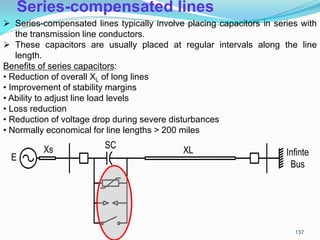
Series-compensated lines
E
Xs SC XL Infinte
Bus
 Series-compensated lines typically involve placing capacitors in series with
the transmission line conductors.
 These capacitors are usually placed at regular intervals along the line
length.
Benefits of series capacitors:
• Reduction of overall XL of long lines
• Improvement of stability margins
• Ability to adjust line load levels
• Loss reduction
• Reduction of voltage drop during severe disturbances
• Normally economical for line lengths > 200 miles
137
Series-compensated lines
E
Xs SC XL Infinte
Bus
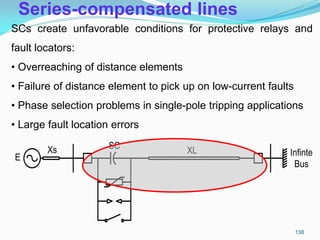
SCs create unfavorable conditions for protective relays and
fault locators:
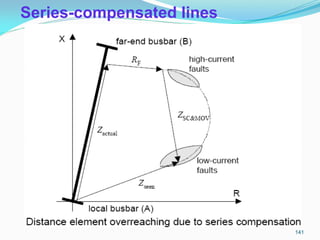
• Overreaching of distance elements
• Failure of distance element to pick up on low-current faults
• Phase selection problems in single-pole tripping applications
• Large fault location errors
138
Series-compensated lines
Series Capacitor with MOV
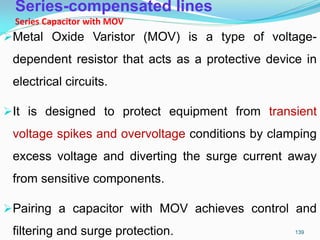
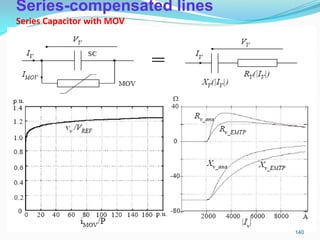
Metal Oxide Varistor (MOV) is a type of voltage-
dependent resistor that acts as a protective device in
electrical circuits.
It is designed to protect equipment from transient
voltage spikes and overvoltage conditions by clamping
excess voltage and diverting the surge current away
from sensitive components.
Pairing a capacitor with MOV achieves control and
filtering and surge protection. 139
Series-compensated lines
Series Capacitor with MOV
140
Series-compensated lines
141
Series-compensated lines
Dynamic Reach Control
The impedance seen by the relay can vary due to
factors like line loading, system topology changes, and
the presence of series compensation.
Dynamic Reach Control addresses the challenge of
accurately detecting faults under varying system
conditions.
It continuously monitors the operating parameters of
the transmission line and adjusts the reach (operating
distance) of the relay dynamically. 142
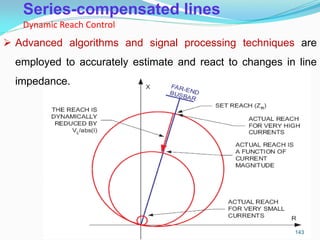
Series-compensated lines
Dynamic Reach Control
143
 Advanced algorithms and signal processing techniques are
employed to accurately estimate and react to changes in line
impedance.
Series-compensated lines
Dynamic Reach Control for External Faults
144
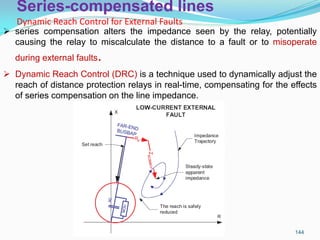
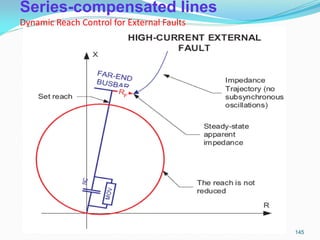
 series compensation alters the impedance seen by the relay, potentially
causing the relay to miscalculate the distance to a fault or to misoperate
during external faults.
 Dynamic Reach Control (DRC) is a technique used to dynamically adjust the
reach of distance protection relays in real-time, compensating for the effects
of series compensation on the line impedance.
Series-compensated lines
Dynamic Reach Control for External Faults
145
Series-compensated lines
Dynamic Reach Control for Internal Faults
146
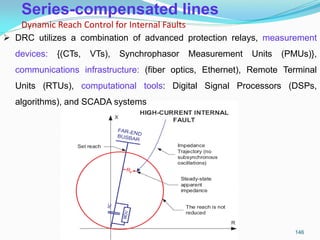
 DRC utilizes a combination of advanced protection relays, measurement
devices: {(CTs, VTs), Synchrophasor Measurement Units (PMUs)},
communications infrastructure: (fiber optics, Ethernet), Remote Terminal
Units (RTUs), computational tools: Digital Signal Processors (DSPs,
algorithms), and SCADA systems
Distance Protection Looking Through a
Transformer
Phase distance elements can be set to see beyond
any 3-phase power transformer.
CTs & VTs may be located independently on different
sides of the transformer.
Given distance zone is defined by VT location (not
CTs).
Reach setting is in sec, and must take into account
location & ratios of VTs, CTs and voltage ratio of the
involved power transformer.
147
Transformer Group Compensation
The location of voltage transformers (VTs) and current
transformers (CTs) relative to power transformers can introduce
phase shift and magnitude changes in the signals they
measure.
These changes can affect the accuracy of distance relays,
which are critical for detecting and isolating faults in
transmission lines.
Power transformers inherently cause phase shifts between the
primary and secondary sides due to the winding configuration
and transformer design.
148
Transformer Group Compensation
Phase shift can distort the measurement of voltage and current
phasors at the secondary side of the transformer compared to
the primary side.
Distance relays, rely on accurate phase angle information to
determine the distance to a fault.
Transformers also cause a change in the magnitude of the
voltage and current signals due to transformation ratios and
impedance characteristics.
This change in magnitude can affect the sensitivity and
accuracy of distance relays in detecting fault conditions.
149
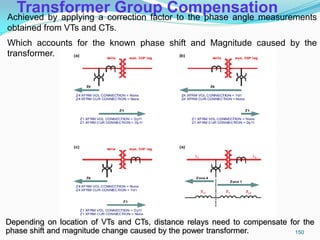
Transformer Group Compensation
Depending on location of VTs and CTs, distance relays need to compensate for the
phase shift and magnitude change caused by the power transformer. 150
Achieved by applying a correction factor to the phase angle measurements
obtained from VTs and CTs.
Which accounts for the known phase shift and Magnitude caused by the
transformer.
Setting Rules
Transformer positive sequence impedance must be
included in reach setting only if transformer lies
between VTs and intended reach point.
Currents require compensation only if transformer
located between CTs and intended reach point.
Voltages require compensation only if transformer
located between VTs and intended reach point.
Compensation set based on transformer connection &
vector group as seen from CTs/VTs toward reach point.
151
Distance Relay Desirable Attributes
 Multiple reversible distance zones
 Individual per-zone, per-element characteristic:
 Dynamic voltage memory polarization
 Various characteristics, including mho, quad, lenticular
 Individual per-zone, per-element current supervision
 Multi-input phase comparator:
 additional ground directional supervision
 dynamic reactance supervision
 Transient overreach filtering/control
 Phase shift & magnitude compensation for distance applications
with power transformers
152
Distance Relay Desirable Attributes
For improved flexibility, it is desirable to have the
following parameters settable on a per zone basis:
 Zero-sequence compensation
 Mutual zero-sequence compensation
 Maximum torque angle
 Blinders
 Directional angle
 Comparator limit angles (for lenticular characteristic)
 Overcurrent supervision
153
Distance Relay Desirable Attributes
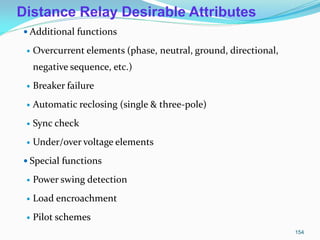
 Additional functions
 Overcurrent elements (phase, neutral, ground, directional,
negative sequence, etc.)
 Breaker failure
 Automatic reclosing (single & three-pole)
 Sync check
 Under/over voltage elements
 Special functions
 Power swing detection
 Load encroachment
 Pilot schemes
154
155

Distance Protection in power system .pdf

  • 1.
  • 2.
    DISTANCE RELAY The impedancerelays also called distance relays are employed to provide protection to transmission lines connected in a network A distance relay, as its name implies, has the ability to detect a fault within a pre-set distance along a transmission line or power cable from its location. The impedance relay is made to respond to the impedance between the relay location and the point where fault is incident. 2
  • 3.
    DISTANCE RELAY The impedanceis proportional to the distance to the fault, and is therefore independent of the fault current levels. Power line has a resistance and reactive per kilometer related to its design and construction so its total impedance will be a function of its length or distance. A distance relay, looks at current and voltage and compares these two quantities on the basis of Ohm’s law. 3
  • 4.
    Principle of operationof distance relay  A distance relay compares the currents and voltages at the relaying point with Current providing the operating torque and the voltage provides the restraining torque.  In other words an impedance relay is a voltage restrained overcurrent relay.  Since the operating characteristics of the relay depend upon the ratio of voltage and current and the phase angle between them, their characteristics can be best represented on an R-X diagram where both V/I ratio and the phase angle can be plotted in terms of an impedance R+jX. 4
  • 5.
    Principle of operationof distance relay  An R/X diagram, with relay’s operating boundary.  Its impedance characteristic is a circle and its radius will be the setting (reach) in ohms. Fig 11.1 (a) and (b) Basic principle of operation of Distance relay 5
  • 6.
    Principle of operationof distance relay Example can be the concept of balanced beam relay given in Fig. 11.2 below. The voltage is fed onto one coil to provide restraining torque, whilst the current is fed to the other coil to provide the operating torque. Under healthy conditions, the voltage will be high (i.e. at full-rated level), whilst the current will be low (at normal load value), thereby balancing the beam, and restraining it so that the contacts remain open. Under fault conditions, the voltage collapses and the current increase dramatically, causing the beam to unbalance and close the contacts. Fig. 11.2 Balanced beam principle 6
  • 7.
    Principle of operationof distance relay The distance relays achieve selectivity on the basis of impedance rather than current and hence can always be set for instantaneous operation in the first zone. Settings for distance relays are relatively easier to carry out. The distance relays, thus, basically compare local voltage (voltage at relaying point) and local current to measure the impedance from the relaying point to the fault point. 7
  • 8.
    Principle of operationof distance relay Distance protection involves the division of the voltage at the relaying point by the measured current. The impedance so calculated is compared with the reach point impedance. If the measured impedance is less than the reach point impedance, it is assumed that a fault exists on the line between the relay and the reach point. The reach point of a relay is the point along the line impedance locus that is intersected by the boundary characteristic of the relay. 8
  • 9.
    RELAY PERFORMANCE Distance relayperformance is defined in terms of reach accuracy and operating time. Reach accuracy is a comparison of the actual ohmic reach of the relay under practical conditions with the relay setting value in ohms. Reach accuracy particularly depends on the level of voltage presented to the relay under fault conditions. 9
  • 10.
    RELAY PERFORMANCE Depending onthe measuring techniques employed, measuring signal transient errors, such as those produced by Capacitor Voltage Transformers (CVT) or saturating CT’s, can also adversely delay relay operation for faults close to the reach point. It is usual for electromechanical and static distance relays to claim both maximum and minimum operating times. 10
  • 11.
    STEPPED DISTANCE CHARACTERISTICSOF A DISTANCE RELAY The distance measurement can be done either by an amplitude comparator or by a phase comparator. The basic constructional unit representing an amplitude comparator is a balanced beam relay. Similarly, an induction cup relay is a phase comparator.  A distance relay has three zones of protection as shown in Fig. 11.3(a). The first zone (zone 1) covers about 80% to 85% of the section to be protected. 11
  • 12.
    STEPPED DISTANCE CHARACTERISTICSOF A DISTANCE RELAY The resulting 15% - 20% safety margin ensures that there is no risk of the Zone 1 protection over-reaching the protected line due to errors in the current and voltage transformers, inaccuracies in line impedance data provided for setting purposes and errors of relay setting and measurement. Otherwise, it may lead to a loss of discrimination with fast operating protection on the Zone 2 of the distance protection covering the remaining 15% - 20% of the 12
  • 13.
    STEPPED DISTANCE CHARACTERISTICSOF A DISTANCE RELAY A distance relay operates instantaneously if the fault occurs in the first zone (zone 1). The second zone (zone 2) covers at least 120% of the protected line impedance. In many applications it is common practice to set the Zone 2 reach to be equal to the protected line section +50% of the shortest adjacent line. The same distance relay operates after a pre-set time delay if the fault occurs in the second zone of protection of the relay. 13
  • 14.
    STEPPED DISTANCE CHARACTERISTICSOF A DISTANCE RELAY Where possible, this ensures that the resulting maximum effective Zone 2 reach does not extend beyond the minimum effective Zone 1 reach of the adjacent line protection. This avoids the need to grade the Zone 2 time settings between upstream and downstream relays. Remote back-up protection for all faults on adjacent lines can be provided by a third zone (Zone 3) of protection. 14
  • 15.
    STEPPED DISTANCE CHARACTERISTICSOF A DISTANCE RELAY This is a time delayed to discriminate with Zone 2 protection plus circuit breaker trip time for the adjacent line. Zone 3 reach should be set to at least 1.2 times the impedance presented to the relay for a fault at the remote end of second line section. This zone is invariably added as a starter element and this takes the form of an offset mho characteristic. 15
  • 16.
    The short backwardreach also provides local backup for a busbar fault. It is important that when setting a distance relays, especially zone 3, which has the longest reach, that its characteristic does not encroach on the load area, as unnecessary tripping will undoubtedly occur. 16 Fig. 11.3 Three zone MHO characteristics
  • 17.
    Fig. 10 3Stepped distance characteristics of distance relays. 17
  • 18.
    Effect of arcresistance  Resistance of the fault arc can also have an impact on the performance of a distance relay. From Fig.11.4 it will be seen that the resistance of the fault arc takes the fault impedance outside the relay’s tripping characteristic.  Such that it does not detect the fault condition. This only picked up by either zone 2 or zone 3 in which case tripping will be unacceptably delayed. 18
  • 19.
    Effect of arcresistance The effect of arc resistance is most significant on short lines where the reach of the relay setting is small. It can be a problem if the fault occurs near the end of the reach. High fault-arc resistances tend to occur during midspan flashovers to ground during a veldt fire or on transmission lines carried on wood poles without earth wires. These problems can usually be overcome by using relays having different shaped characteristics. 19
  • 20.
    Transmission Lines Classification ofline length depends on:  Source-to-line Impedance Ratio (SIR), and  Nominal voltage Length considerations:  Short Lines: SIR > 4  Medium Lines: 0.5 < SIR < 4  Long Lines: SIR < 0.5 20
  • 21.
    Typical Protection Schemes ShortLines Current differential Phase comparison Permissive Overreach Transfer Trip (POTT) Directional Comparison Blocking (DCB) 21
  • 22.
    Typical Protection Schemes MediumLines Phase comparison Directional Comparison Blocking (DCB) Permissive Underreach Transfer Trip (PUTT) Permissive Overreach Transfer Trip (POTT) Unblocking Step Distance Step or coordinated overcurrent Inverse time overcurrent Current Differential 22
  • 23.
    Typical Protection Schemes LongLines • Phase comparison • Directional Comparison Blocking (DCB) • Permissive Underreach Transfer Trip (PUTT) • Permissive Overreach Transfer Trip (POTT) • Unblocking • Step Distance • Step or coordinated overcurrent • Current Differential 23
  • 24.
    What is distanceprotection? For internal faults:  IZ – V and V approximately in phase (mho)  IZ – V and IZ approximately in phase (reactance) RELAY (V,I) Intended REACH point Z F1 I*Z V=I*ZF I*Z - V 24
  • 25.
    What is distanceprotection? For external faults:  IZ – V and V approximately out of phase (mho)  IZ – V and IZ approximately out of phase (reactance) RELAY (V,I) Intended REACH point Z I*Z V=I*ZF I*Z - V F2 25
  • 26.
    Types of DistanceRelays There are mainly for types of Distance Relays: (1) Impedance relay (2) Reactance relay (3) Mho relay (4) Modified impedance relay 26
  • 27.
    What is distanceprotection? RELAY Intended REACH point Z On an R/X diagram, its impedance characteristic is a circle with its center at the origin of the coordinates and its radius will be the setting (reach) in ohms. 27
  • 28.
    The relay willoperate for all values less than its setting i.e. all points within the circle. This is known as a plain impedance relay and it is non-directional, in that it can operate for faults behind the relaying point and no account of the phase angle between voltage and current. This limitation can be overcome by a technique known as self-polarization. Additional voltages are fed into the comparator in order to compare the relative phase angles of voltage and current, so providing a directional feature. This has the effect of moving the circle such that the circumference of the circle now passes through the origin. Angle () is known as the relay’s characteristic angle. 28
  • 29.
     This isknown as the MHO relay, so called as it appears as a straight line on an admittance diagram.  By the use of a further technique of feeding in voltages from the healthy phases into the comparator (known as cross polarization) a reverse movement or offset of the characteristic can be obtained.  This is called the offset MHO characteristic. Offset MHO characteristic MHO characteristic 29
  • 30.
    Application on Transmissionline Correct coordination of the distance relays is achieved by having an instantaneous directional zone 1 protection and one or two more time-delayed zones. A transmission line has a resistance and reactance proportional to its length, which also defines its own characteristic angle. It can therefore be represented on an R/X diagram as shown below. 30
  • 31.
    Zone 1 The relaycharacteristic has also been added, and noted that the reach of the measuring element has been set at approximately 80% of the line length. This ‘under-reach’ setting has been purposely chosen to avoid over-reaching into the next line section to ensure sound selectivity, for the following reasons: It is not practical to accurately measure the impedance of a transmission line, which could be very long (say 100 km). Survey lengths are normally used and these could have errors up to 10%. 31
  • 32.
    Errors are alsopresent in the current and voltage transformers, not to mention the possible transient performance of these items. Zone 1 MHO characteristic 32
  • 33.
    Zone 2 To coverthe remaining 20% of the line length, a second measuring element can be fitted, set to over- reach the line, but it must be time delayed by 0.5 s to provide the necessary coordination with the downstream relay. It does not only covers the remaining 20% of the line, but also provides backup for the next line section should this fail to trip for whatever reason. 33
  • 34.
    Zone 3 Zone 3is invariably added as a starter element and this takes the form of an offset mho characteristic. This offset provides a closing-onto-fault feature, as the mho elements may not operate for this condition due to the complete collapse of voltage for the nearby fault. Three zone MHO characteristics The short backward reach also provides local backup for a busbar fault protection. 34
  • 35.
    Effect of loadcurrent  Load current can be expressed as impedance, by Ohm’s law.  As shown on the R/X diagram by the shaded area, the angular limits being governed by the power factor of the load.  It is important that when setting a distance relays, especially zone 3, which has the longest reach, that its characteristic does not encroach on the load area, as unnecessary tripping will undoubtedly occur. Load current characteristics 35
  • 36.
    Effect of arcresistance Resistance of the fault arc can also have an impact on the performance of a distance relay, as seen on the R/X diagram below. It be seen that the resistance of the fault arc takes the fault impedance outside the relay’s tripping characteristic, so that it does not detect this condition. It is only picked up by either zone 2 or zone 3 in which case tripping will be unacceptably delayed. The effect of arc resistance is most significant on short lines where the reach of the relay setting is small. It can be a problem if the fault occurs near the end of the reach. 36
  • 37.
    Effect of arcresistance  High fault-arc resistances tend to occur during midspan flashovers to ground on transmission lines carried on wood poles without earth wires.  These problems can usually be overcome by using relays having different shaped characteristics such as those given below. 37
  • 38.
    Different shaped characteristics Toovercome the problems of load encroachment and arc resistance, distance relays have been developed having different-shaped tripping characteristics, some examples of which are as follows:  Circular  Lenticular  Figure of eight  Trapezoidal. With the advent of modern digital technology, many shapes are now possible to suit a variety of applications. 38
  • 39.
    Different shaped characteristics Lenticularcharacteristic Figure-of-eight characteristic Trapezoidal characteristic 39
  • 40.
    Distance protection schemes Dueto various zones, distance protection is strictly speaking not a pure form of unit protection. However, with the addition of an information link between the two ends of the line, it can be made into a very effective unit protection system. This is achieved by installing a power line carrier signaling channel between the two ends. The signal is injected into the power line conductors at one end via a capacitor voltage transformer and picked off the other end by a similar device. Line traps are installed at either end to prevent the signal dispersing through all other lines, etc. in the network. Other types of communication medium can be used such as copper or fiber-optic pilots or microwave radio could be considered if line-of-site is available. 40
  • 41.
    Challenges in relaydesign  Transients:  High frequency  DC offset in currents  CVT transients in voltages CVT output 0 1 2 3 4 steady-state output power cycles -30 -20 -10 0 10 20 30 voltage, V C1 C2 2 3 5 6 1 4 7 High Voltage Line Secondary Voltage Output 8 41
  • 42.
    Challenges in relaydesign  Transients:  High frequency  DC offset in currents  CVT transients in voltages C1 C2 2 3 5 6 1 4 7 High Voltage Line Secondary Voltage Output 8 CVT output 0 1 2 3 4 steady-state output -60 -40 -20 0 20 40 power cycles voltage, V 60 42
  • 43.
    Challenges in relaydesign -0.5 0 0.5 1 1.5 -100 -80 -60 -40 -20 0 20 40 60 80 100 Voltage [V] -0.5 0 0.5 1 1.5 -3 -2 -1 0 1 2 3 4 5 Current [A] vA vB vC iA iB ,iC -0.5 0 0.5 1 1.5 -100 -50 0 50 100 Reactance comparator [V] power cycles SPOL SOP > In-phase = internal fault > Out-of-phase = external fault 43
  • 44.
    Transient Overreach  Faultcurrent generally contains dc offset in addition to ac power frequency component. Ratio of dc to ac component of current depends on instant in the cycle at which fault occurred. Rate of decay of dc offset depends on system X/R. 44
  • 45.
    Zone 1 andCVT Transients Capacitive Voltage Transformers (CVTs) create certain problems for fast distance relays applied to systems with high Source Impedance Ratios (SIRs):  CVT-induced transient voltage components may assume large magnitudes (up to 30-40%) and last for a comparatively long time (up to about 2 cycles)  60Hz voltage for faults at the relay reach point may be as low as 3% for a SIR of 30  the signal may be buried under noise 45
  • 46.
    Zone 1 andCVT Transients CVT transients can cause distance relays to overreach. Generally, transient overreach may be caused by: overestimation of the current (the magnitude of the current as measured is larger than its actual value, and consequently, the fault appears closer than it is actually located), underestimation of the voltage (the magnitude of the voltage as measured is lower than its actual value) combination of the above 46
  • 47.
  • 48.
    -10 -5 05 10 -5 0 5 10 15 Reactance [ohm] Resistance [ohm] 18 22 26 30 34 42 44 Actual Fault Location Line Impedance Trajectory (msec) dynamic mho zone extended for high SIRs Impedance locus may pass below the origin of the Z-plane - this would call for a time delay to obtain stability 48
  • 49.
    CVT Transient OverreachSolutions Apply delay (fixed or adaptable) Reduce the reach Adaptive techniques and better filtering algorithms 49
  • 50.
    CVT Transients –Adaptive Solution Optimize signal filtering:  currents - max 3% error due to the dc component  voltages - max 0.6% error due to CVT transients Adaptive double-reach approach  filtering alone ensures maximum transient overreach at the level of 1% (for SIRs up to 5) and 20% (for SIRs up to 30)  to reduce the transient overreach even further an adaptive double-reach zone 1 has been implemented. 50
  • 51.
    CVT Transients –Adaptive Solution The outer zone 1:  is fixed at the actual reach  applies certain security delay to cope with CVT transients Delayed Trip Instantaneous Trip R X The inner zone 1: > has its reach dynamically controlled by the voltage magnitude > is instantaneous 51
  • 52.
    Desirable Distance RelayAttributes Filters: Prefiltering of currents to remove dc decaying transients  Limit maximum transient overshoot (below 2%) Prefiltering of voltages to remove low frequency transients caused by CVTs  Limit transient overreach to less than 5% for an SIR of 30 Accurate and fast frequency tracking algorithm Adaptive reach control for faults at reach points 52
  • 53.
  • 54.
    Distance Relay OperatingTimes 20ms 15ms 25ms 30ms 35ms 54
  • 55.
    Distance Relay OperatingTimes SLG faults LL faults 3P faults 55
  • 56.
    0 5 1015 20 25 30 0 10 20 30 40 50 60 70 80 90 100 Maximum Rach [%] SIR Actual maximum reach curves Relay 1 Relay 3 Relay 2 Relay 4 56
  • 57.
    Maximum Torque Angle(MTA) • Angle at which mho element has maximum reach. • Characteristics with smaller MTA will accommodate larger amount of arc resistance. 57
  • 58.
    Traditional Directional angle lowered and “slammed” Directionalangle “slammed” Both MHO and directional angles “slammed” (lens) Mho Characteristics 58
  • 59.
    Typical load characteristic impedance +R Operate area NoOperate area +XL + = LOOKING INTO LINE normally considered forward Load Trajectory Load Swings 59
  • 60.
  • 61.
    Load Encroachment Characteristic Theload encroachment element responds to positive sequence voltage and current and can be used to block phase distance and phase overcurrent elements. 61
  • 62.
    Blinders  Blinders limitthe operation of distance relays (quad or mho) to a narrow region that parallels and encompasses the protected line  Applied to long transmission lines, where mho settings are large enough to pick up on maximum load or minor system swings 62
  • 63.
  • 64.
    Ground Resistance (Conductor fallson ground) R Resultant impedance outside of the mho operating region Quadrilateral Characteristics 64
  • 65.
    Mho Quadrilatera l Better coveragefor ground faults due to resistance added to return path Lenticular Used for phase elements with long heavily loaded lines heavily loaded Standard for phase elements JX R Distance Characteristics - Summary 65
  • 66.
    Distance Element Polarization Distance Element Polarization is a method used to polarize (or bias) the operation of impedance elements within distance relays.  Distance element polarization refers to a setting adjustment in distance protection relays used in power systems.  Polarization quantities commonly used in distance relays for determining directionality: • Self-polarized • Memory voltage • Positive sequence voltage • Quadrature voltage • Leading phase voltage 66
  • 67.
    Self-polarized A self-polarized relayis a type of protective relay that determines the direction of a fault based on the phase relationship between voltage and current signals measured at its terminals. Self-polarization in protective relays is to ensure that the relay can accurately determine whether a fault is within its protected zone (forward fault) or outside (reverse fault). 67
  • 68.
    Memory Polarization  Positive-sequencememorized voltage is used for polarizing:  Mho comparator (dynamic, expanding Mho).  Negative-sequence directional comparator (Ground Distance Mho and Quad).  Zero-sequence directional comparator (Ground Distance MHO and QUAD).  Directional comparator (Phase Distance MHO and QUAD).  Memory duration is a common distance settings (all zones, phase and ground, MHO and QUAD). 68
  • 69.
    Memory Polarization jX R Dynamic MHOcharacteristic for a reverse fault Dynamic MHO characteristic for a forward fault Impedance During Close-up Faults Static MHO characteristic (memory not established or expired) ZL ZS 69
  • 70.
    Memory Polarization Memory Polarization…ImprovedResistive Coverage Dynamic MHO characteristic for a forward fault Static MHO characteristic (memory not established or expired) jX R ZL ZS RL 70
  • 71.
    Choice of Polarization Inorder to provide flexibility modern distance relays offer a choice with respect to polarization of ground overcurrent direction functions:  Voltage polarization  Current polarization  Dual polarization 71
  • 72.
    Ground Directional Elements Pilot-aided schemes using ground mho distance relays have inherently limited fault resistance coverage  Ground directional over current protection using either negative or zero sequence can be a useful supplement to give more coverage for high resistance faults  Directional discrimination based on the ground quantities is fast: – Accurate angular relations between the zero and negative sequence quantities establish very quickly because: During faults zero and negative-sequence currents and voltages build up from very low values (practically from zero) The pre-fault values do not bias the developing fault components in any direction 72
  • 73.
    Distance Schemes Pilot AidedSchemes No Communication between Distance Relays Communication between Distance relays Non-Pilot Aided Schemes (Step Distance) 73
  • 74.
    Step Distance Schemes Zone1:  Trips with no intentional time delay  Underreaches to avoid unnecessary operation for faults beyond remote terminal  Typical reach setting range 80-90% of ZL Zone 2:  Set to protect remainder of line  Overreaches into adjacent line/equipment  Minimum reach setting 120% of ZL  Typically time delayed by 15-30 cycles Zone 3:  Remote backup for relay/station failures at remote terminal  Reaches beyond Z2, load encroachment a consideration 74
  • 75.
  • 76.
  • 77.
  • 78.
    Z1 Z1 Z2 (time delayed) Remote Local StepDistance Schemes Z2 (time delayed) 78
  • 79.
    Z1 Z2 (time delayed) StepDistance Schemes Z3 (remote backup) … 79
  • 80.
  • 81.
    Local Relay –Z2 Zone 2 PKP Local Relay Remote Relay Remote Relay – Z4 Zone 4 PKP Over Lap Distance Relay Coordination 81
  • 82.
  • 83.
    Pilot Communications Channels Distance-basedpilot schemes traditionally utilize simple on/off communications between relays, but can also utilize peer-to-peer communications and GOOSE messaging over digital channels  Typical communications media include: Pilot-wire (50Hz, 60Hz, AT) Power line carrier Microwave Radio Optic fiber (directly connected or multiplexed channels) 83
  • 84.
  • 85.
    Pilot-Aided Distance-Based Schemes DUTT – Direct Under-reaching Transfer Trip  PUTT – Permissive Under-reaching Transfer Trip  POTT – Permissive Over-reaching Transfer Trip  Hybrid POTT – Hybrid Permissive Over-reaching Transfer Trip  DCB – Directional Comparison Blocking Scheme  DCUB – Directional Comparison Unblocking Scheme 85
  • 86.
    Direct Underreaching TransferTrip (DUTT)  A DUTT is a protective relay scheme used in power systems to facilitate fast and coordinated tripping of circuit breakers to isolate faults.  This scheme is typically employed in interconnected power systems where transmission lines span across different utility companies or regions.  In a DUTT scheme, each end of a transmission line is protected by distance relays (or other types of relays capable of measuring fault impedance).  These relays are set to trip the circuit breaker at their respective ends if a fault occurs within their reach zone. 86
  • 87.
    Direct Under reachingTransfer Trip (DUTT) When a relay detects a fault within its reach zone, it sends a trip signal directly to the remote relay at the opposite end of the line via a communication channel. Under-reaching Logic: The "under-reaching" part of DUTT refers to the fact that the relay at one end of the line (let's call it Relay A) will initiate a trip signal even if the fault is beyond its own reach, relying on the coordination and confirmation from the remote relay (Relay B) at the other end of the line. 87
  • 88.
    Direct Under reachingTransfer Trip (DUTT) Trip Signal Transmission: Upon detecting a fault, Relay A sends a trip signal to Relay B through the communication channel. Relay B then verifies the fault within its own reach zone and initiates tripping of the circuit breaker at its end if necessary. Advantages: DUTT improves the speed and reliability of fault clearing by allowing the remote end of the transmission line to initiate breaker tripping based on the confirmation received from the local end. This coordination ensures that faults are isolated swiftly, minimizing disruption to the power system and reducing the likelihood of cascading failures. 88
  • 89.
    Direct Under reachingTransfer Trip (DUTT)  only under reaching (RU) functions which overlap in reach (Zone 1).  Applied with Frequency Shift Keying (FSK): is a modulation technique used to transmit digital signals over communication channels.  GUARD frequency transmitted during normal conditions  TRIP frequency when one RU function operates  Scheme does not provide tripping for faults beyond RU reach if remote breaker is open or channel is inoperative.  Dual pilot channels improve security  Modern digital relays facilitate DUTT through various communication methods such as fiber optics, microwave links, or digital pilot wires.  These communication channels ensure rapid and reliable transmission of trip signals between the relays. 89
  • 90.
  • 91.
    Permissive Under reachingTransfer Trip (PUTT)  Permissive Under-reach scheme is a type of protective relay scheme used to coordinate the operation of distance relays. Primary Distance Protection:  Each end of the transmission line is protected by a distance relay.  These relays measure the impedance to the fault and are set to operate when the fault impedance falls within their respective reach zones.  Permissive Under-reach Logic:  In a Permissive Under-reach scheme, the relay at one end of the line (for example, Relay A) is configured to only operate if the relay at the other end (Relay B) has already operated.  This means Relay A "under-reaches" its normal reach zone (i.e., it will not operate based on its own reach alone) unless it receives a permissive signal from Relay B. 91
  • 92.
    Permissive Underreaching TransferTrip (PUTT) Coordination and Selectivity The purpose of this scheme is to provide additional coordination and selectivity in fault detection and isolation. By requiring confirmation from the relay at the opposite end of the line before operating, the scheme helps ensure that Relay A only trips for faults that are severe enough to cause both relays to operate. Requires both under reaching (RU) and overreaching (RO) functions Identical to DUTT, with pilot tripping signal supervised by RO (Zone 2) 92
  • 93.
    Permissive Underreaching TransferTrip (PUTT) This scheme enhances the reliability of protection coordination by reducing the possibility of unnecessary tripping due to transient faults or faults outside the protected zone. It also helps in minimizing the impact of faults on the power system by isolating only the affected section of the line. Implementation Permissive Under-reach logic is typically implemented using communication between the relays at either end of the protected line. Modern digital relays can communicate directly through communication channels such as fiber optics or digital pilot wires. 93
  • 94.
    Bus Line Bus Zone 1 Zone 2 Zone2 Zone 1 To protect end of line & Local Trip Zone 2 Rx PKP OR Zone 1 PUTT Scheme 94
  • 95.
    Permissive Overreaching TransferTrip (POTT) POTT is a protective relay scheme used in power systems to ensure reliable and coordinated operation of protective relays across interconnected transmission lines. This scheme is particularly useful in scenarios where transmission lines are operated by different utility companies or regions. Similar to other transfer trip schemes, POTT involves protective relays installed at both ends of a transmission line. POTT operates on an "over-reaching" principle which means that a relay (let's Relay A) can send a trip signal to the remote end (Relay B) even if the fault is outside its own reach zone. 95
  • 96.
    Permissive Overreaching TransferTrip (POTT) POTT involves additional logic to ensure coordinated operation. Before Relay A sends a trip signal to Relay B, it verifies the fault condition within its reach zone. If the fault is confirmed and meets certain criteria (such as impedance or fault type), Relay A will then send a permissive signal to Relay B. Once Relay B receives the permissive signal from Relay A, it verifies the fault within its own reach zone. If the fault condition is confirmed, Relay B initiates tripping of the circuit breaker at its end of the transmission line. 96
  • 97.
    Permissive Overreaching TransferTrip (POTT)  POTT improves the selectivity and reliability of fault clearing by allowing relay communications to initiate coordinated breaker tripping based on confirmed fault conditions. • Requires overreaching (RO) functions (Zone 2). • Applied with FSK channel:  GUARD frequency sent in stand-by  TRIP frequency when one RO function operates • No trip for external faults if pilot channel is inoperative • Time-delayed tripping can be provided  Inter-tripping, (transferred tripping) is the controlled tripping of a circuit CB to completely isolate a circuit simultaneously with the tripping of a CB at the other end.  It is applied in Under reach transfer tripping and Over reach transfer tripping. 97
  • 98.
  • 99.
    POTT Scheme POTT –Permissive Over-reaching Transfer Trip End Zone Communication Channel 99
  • 100.
    Local Relay RemoteRelay Remote Relay FWD IGND Ground Dir OC Fwd OR Local Relay – Z2 ZONE 2 PKP Local Relay FWD IGND Ground Dir OC Fwd OR TRIP Remote Relay – Z2 POTT TX ZONE 2 PKP POTT RX Communicatio n Channel POTT Scheme 100
  • 101.
    POTT TX 4 POTTTX 3 POTT TX 2 POTT TX 1 A to G B to G C to G Multi Phase Local Relay Remote Relay POTT RX 4 POTT RX 3 POTT RX 2 POTT RX 1 Communications Channel(s) POTT Scheme 101
  • 102.
    Local Relay RemoteRelay POTT TX ZONE 2 OR GND DIR OC FWD Communication Channel TRIP GND DIR OC REV GND DIR OC REV POTT RX Start Timer Timer Expire GND DIR OC FWD POTT Scheme Current reversal example 102
  • 103.
    Local Relay Open Remote Relay RemoteFWD IGND POTT TX Remote – Z2 Communication Channel POTT RX OPEN POTT TX Communication Channel POTT RX TRIP POTT Scheme Echo example 103
  • 104.
    Hybrid POTT  AHybrid Permissive Over-reaching Transfer Trip (HPOTT) is an advanced protective relay scheme used in power systems to enhance the reliability and selectivity of fault detection and isolation across interconnected transmission lines. HPOTT combines elements of both Permissive Over-reaching Transfer Trip (POTT) and Direct Transfer Trip (DTT) schemes to optimize fault clearing operations. HPOTT involves protective relays installed at both ends of a transmission line, similar to other transfer trip schemes. Intended for three-terminal lines and weak infeed conditions.  Echo feature adds security during weak infeed conditions. 104
  • 105.
    Hybrid POTT  Reverse-lookingdistance and oc elements used to identify external faults. Similar to POTT, HPOTT includes permissive logic where a relay (let's say Relay A) verifies the fault condition within its reach zone and then sends a permissive signal to the remote end (Relay B). HPOTT incorporates over-reaching logic which means that Relay A can send a trip signal to Relay B even if the fault is outside its own reach zone, but within the overall protected zone covered by the relays. 105
  • 106.
    Hybrid POTT Before RelayA sends a permissive signal to Relay B, it verifies the fault condition within its reach zone. If the fault meets certain criteria (impedance or fault type), Relay A initiates the permissive signal to Relay B. Upon receiving the permissive signal, Relay B verifies the fault within its own reach zone and proceeds with tripping the circuit breaker at its end if necessary. HPOTT requires robust communication channels between the protective relays, such as fiber optics, microwave links, or digital pilot wires. 106
  • 107.
    Bus Line Bus Zone 1 Zone 2 Zone2 Zone 1 Zone 4 Local Remote Weak system Hybrid POTT 107
  • 108.
    Directional Comparison Blocking(DCB)  Phase comparison is a differential scheme that compares the phase angle between the currents at the ends of the line.  If the currents are essentially in phase, there is no fault in the protected section.  A Directional Comparison Blocking Scheme (DCB Scheme) is a protective relay scheme used in power systems to provide selective fault detection and isolation, particularly where transmission lines are interconnected and overlapping protection zones need careful coordination.  This scheme ensures that relays only operate for faults occurring in the specified direction they are intended to protect.  The DCB Scheme compares the directional information from both ends of the protected line.  It verifies whether the fault direction indicated by both relays matches and meets predetermined conditions before initiating a trip signal. 108
  • 109.
    Directional Comparison Blocking(DCB)  Under normal conditions, the relays monitor the line for faults based on their directional settings.  If a fault occurs, each relay detects the fault current direction and verifies it against its predetermined settings.  Requires overreaching (RO) tripping and blocking (B) functions  ON/OFF pilot channel typically used (i.e., PLC)  Transmitter is keyed to ON state when blocking function(s) operate  Receipt of signal from remote end blocks tripping relays  Tripping function set with Zone 2 reach or greater  Blocking functions include Zone 3 reverse and low-set ground overcurrent elements 109
  • 110.
    Bus Line Bus Zone 1 Zone 2 Zone2 Zone 1 Local Remote DCB Scheme 110
  • 111.
    End Zone Communication Channel DirectionalComparison Blocking (DCB) 111
  • 112.
    Directional Comparison Blocking(DCB) Internal Faults Local Relay Remote Relay Local Relay – Z2 Zone 2 PKP TRIP Timer Start FWD IGND GND DIR OC Fwd OR Dir Block RX NO TRIP Expired 112
  • 113.
    Local Relay RemoteRelay Remote Relay – Z4 Zone 4 PKP REV IGND GND DIR OC Rev OR DIR BLOCK TX Local Relay – Z2 Zone 2 PKP Dir Block RX Communication Channel FWD IGND GND DIR OC Fwd OR TRIP Timer Start No TRIP Directional Comparison Blocking (DCB) External Faults 113
  • 114.
    Directional Comparison Unblocking(DCUB)  Directional Comparison Unblocking (DCUB) is the mechanism or logic employed to override the blocking condition imposed by DCB schemes under certain circumstances. DCUB typically activates when the system detects persistent or severe fault conditions that require immediate action, even if there is a directional mismatch between the relays. When DCUB is triggered, it temporarily bypasses the directional comparison blocking logic. This allows the protective relay to initiate a trip signal and thereby isolate the fault, despite the initial blocking condition. 114
  • 115.
    Directional Comparison Unblocking(DCUB) Applied to Permissive Overreaching (POR) schemes to overcome the possibility of carrier signal attenuation or loss as a result of the fault  Unblocking provided in the receiver when signal is lost:  If signal is lost due to fault, at least one permissive RO functions will be picked up  Unblocking logic produces short-duration TRIP signal (150- 300 ms). If RO function not picked up, channel lockout occurs until GUARD signal returns 115
  • 116.
  • 117.
    End Zone Communication Channel DirectionalComparison Unblocking (DCUB) 117
  • 118.
    Directional Comparison Unblocking(DCUB) Normal conditions Local Relay Remote Relay GUARD1 TX GUARD1 RX Communication Channel GUARD2 TX GUARD2 RX NO Loss of Guard FSK Carrier FSK Carrier NO Permission NO Loss of Guard NO Permission Load Current 118
  • 119.
    Directional Comparison Unblocking(DCUB) Normal conditions, channel failure Local Relay Remote Relay GUARD1 TX GUARD1 RX Communication Channel GUARD2 TX GUARD2 RX FSK Carrier FSK Carrier Loss of Guard Block Timer Started Loss of Guard Block Timer Started Load Current NO RX NO RX Block DCUB until Guard OK Expired Block DCUB until Guard OK Expired Loss of Channel 119
  • 120.
    Directional Comparison Unblocking (DCUB) Internalfault, healthy channel Local Relay Remote Relay GUARD1 TX GUARD1 RX Communication Channel GUARD2 TX GUARD2 RX FSK Carrier FSK Carrier Loss of Guard Permission TRIP1 TX Local Relay – Z2 Zone 2 PKP TRIP1 RX TRIP2 TX TRIP Remote Relay – Z2 ZONE 2 PKP TRIP Z1 TRIP2 RX 120
  • 121.
    Directional Comparison Unblocking (DCUB) Internalfault, channel failure Local Relay Remote Relay GUARD1 TX GUARD1 RX Communication Channel GUARD2 TX GUARD2 RX FSK Carrier FSK Carrier TRIP1 TX Local Relay – Z2 Zone 2 PKP NO RX TRIP2 TX TRIP Remote Relay – Z2 ZONE 2 PKP TRIP Z1 NO RX Loss of Guard Loss of Channel Loss of Guard Block Timer Started Duration Timer Started Expired 121
  • 122.
    Redundancy Considerations Redundant protectionsystems increase dependability of the system: Multiple sets of protection using same protection principle and multiple pilot channels overcome individual element failure, or Multiple sets of protection using different protection principles and multiple channels protects against failure of one of the protection methods. Security can be improved using “voting” schemes (i.e., 2-out-of-3), potentially at expense of dependability. Redundancy of instrument transformers, battery systems, trip coil circuits, etc. also need to be considered. 122
  • 123.
    End Zone Communication Channel1 Communication Channel 2 Loss of Channel 2 AND Channels: POTT Less Reliable DCB Less Secure OR Channels: POTT More Reliable DCB More Secure More Channel Security More Channel Dependability Redundant Communications 123
  • 124.
  • 125.
    Pilot Relay DesirableAttributes  Integrated functions: weak infeed echo line pick-up (SOTF)  Basic protection elements used to key the communication: distance elements fast and sensitive ground (zero and negative sequence) directional IOCs with current, voltage, and/or dual polarization 125
  • 126.
    Pilot Relay DesirableAttributes Pre-programmed distance-based pilot schemes: Direct Under-reaching Transfer Trip (DUTT) Permissive Under-reaching Transfer Trip (PUTT) Permissive Overreaching Transfer Trip (POTT) Hybrid Permissive Overreaching Transfer Trip (HYB POTT) Blocking scheme (DCB) Unblocking scheme (DCUB) 126
  • 127.
    Security for dual-breakerterminals Breaker-and-a-half and ring bus terminals are common designs for transmission lines. Standard practice has been to: sum currents from each circuit breaker externally by paralleling the CTs use external sum as the line current for protective relays For some close-in external fault events, poor CT performance may lead to improper operation of line relays. 127
  • 128.
    Security for dual-breakerterminals Accurate CTs preserve the reverse current direction under weak remote infeed 128
  • 129.
    Security for dual-breakerterminals Saturation of CT1 may invert the line current as measured from externally summated CTs 129
  • 130.
    Security for dual-breakerterminals  Direct measurement of currents from both circuit breakers allows the use of supervisory logic to prevent distance and directional overcurrent elements from operating incorrectly due to CT errors during reverse faults.  Additional benefits of direct measurement of currents:  independent BF protection for each circuit breaker  independent autoreclosing for each breaker 130
  • 131.
    Security for dual-breakerterminals Supervisory logic should:  Not affect speed or sensitivity of protection elements  Correctly allow tripping during evolving external-to- internal fault conditions  Determine direction of current flow through each breaker independently:  Both currents in FWD direction  internal fault  One current FWD, one current REV  external fault  Allow tripping during all forward/internal faults  Block tripping during all reverse/external faults  Initially block tripping during evolving external-to- internal faults until second fault appears in forward direction. Block is then lifted to permit tripping. 131
  • 132.
    Single-pole Tripping Distance relaymust correctly identify a SLG fault and trip only the circuit breaker pole for the faulted phase. Autoreclosing and breaker failure functions must be initiated correctly on the fault event Security must be maintained on the healthy phases during the open pole condition and any reclosing attempt. 132
  • 133.
    Out-of-Step Condition For certainoperating conditions, a severe system disturbance can cause system instability and result in loss of synchronism between different generating units on an interconnected system. 133
  • 134.
    Out-of-Step Relaying Out-of-step blockingrelays  Operate in conjunction with mho tripping relays to prevent a terminal from tripping during severe system swings & out-of-step conditions.  Prevent system from separating in an indiscriminate manner. Out-of-step tripping relays  Operate independently of other devices to detect out-of- step condition during the first pole slip.  Initiate tripping of breakers that separate system in order to balance load with available generation on any isolated part of the system. 134
  • 135.
    Out-of-Step Tripping The locusmust stay for some time between the outer and middle characteristics Must move and stay between the middle and inner characteristics When the inner characteristic is entered the element is ready to trip 135
  • 136.
    Power Swing Blocking Applications: Establish a blocking signal for stable power swings (Power Swing Blocking)  Establish a tripping signal for unstable power swings (Out-of- Step Tripping) Responds to:  Positive-sequence voltage and current 136
  • 137.
    Series-compensated lines E Xs SCXL Infinte Bus  Series-compensated lines typically involve placing capacitors in series with the transmission line conductors.  These capacitors are usually placed at regular intervals along the line length. Benefits of series capacitors: • Reduction of overall XL of long lines • Improvement of stability margins • Ability to adjust line load levels • Loss reduction • Reduction of voltage drop during severe disturbances • Normally economical for line lengths > 200 miles 137
  • 138.
    Series-compensated lines E Xs SCXL Infinte Bus SCs create unfavorable conditions for protective relays and fault locators: • Overreaching of distance elements • Failure of distance element to pick up on low-current faults • Phase selection problems in single-pole tripping applications • Large fault location errors 138
  • 139.
    Series-compensated lines Series Capacitorwith MOV Metal Oxide Varistor (MOV) is a type of voltage- dependent resistor that acts as a protective device in electrical circuits. It is designed to protect equipment from transient voltage spikes and overvoltage conditions by clamping excess voltage and diverting the surge current away from sensitive components. Pairing a capacitor with MOV achieves control and filtering and surge protection. 139
  • 140.
  • 141.
  • 142.
    Series-compensated lines Dynamic ReachControl The impedance seen by the relay can vary due to factors like line loading, system topology changes, and the presence of series compensation. Dynamic Reach Control addresses the challenge of accurately detecting faults under varying system conditions. It continuously monitors the operating parameters of the transmission line and adjusts the reach (operating distance) of the relay dynamically. 142
  • 143.
    Series-compensated lines Dynamic ReachControl 143  Advanced algorithms and signal processing techniques are employed to accurately estimate and react to changes in line impedance.
  • 144.
    Series-compensated lines Dynamic ReachControl for External Faults 144  series compensation alters the impedance seen by the relay, potentially causing the relay to miscalculate the distance to a fault or to misoperate during external faults.  Dynamic Reach Control (DRC) is a technique used to dynamically adjust the reach of distance protection relays in real-time, compensating for the effects of series compensation on the line impedance.
  • 145.
    Series-compensated lines Dynamic ReachControl for External Faults 145
  • 146.
    Series-compensated lines Dynamic ReachControl for Internal Faults 146  DRC utilizes a combination of advanced protection relays, measurement devices: {(CTs, VTs), Synchrophasor Measurement Units (PMUs)}, communications infrastructure: (fiber optics, Ethernet), Remote Terminal Units (RTUs), computational tools: Digital Signal Processors (DSPs, algorithms), and SCADA systems
  • 147.
    Distance Protection LookingThrough a Transformer Phase distance elements can be set to see beyond any 3-phase power transformer. CTs & VTs may be located independently on different sides of the transformer. Given distance zone is defined by VT location (not CTs). Reach setting is in sec, and must take into account location & ratios of VTs, CTs and voltage ratio of the involved power transformer. 147
  • 148.
    Transformer Group Compensation Thelocation of voltage transformers (VTs) and current transformers (CTs) relative to power transformers can introduce phase shift and magnitude changes in the signals they measure. These changes can affect the accuracy of distance relays, which are critical for detecting and isolating faults in transmission lines. Power transformers inherently cause phase shifts between the primary and secondary sides due to the winding configuration and transformer design. 148
  • 149.
    Transformer Group Compensation Phaseshift can distort the measurement of voltage and current phasors at the secondary side of the transformer compared to the primary side. Distance relays, rely on accurate phase angle information to determine the distance to a fault. Transformers also cause a change in the magnitude of the voltage and current signals due to transformation ratios and impedance characteristics. This change in magnitude can affect the sensitivity and accuracy of distance relays in detecting fault conditions. 149
  • 150.
    Transformer Group Compensation Dependingon location of VTs and CTs, distance relays need to compensate for the phase shift and magnitude change caused by the power transformer. 150 Achieved by applying a correction factor to the phase angle measurements obtained from VTs and CTs. Which accounts for the known phase shift and Magnitude caused by the transformer.
  • 151.
    Setting Rules Transformer positivesequence impedance must be included in reach setting only if transformer lies between VTs and intended reach point. Currents require compensation only if transformer located between CTs and intended reach point. Voltages require compensation only if transformer located between VTs and intended reach point. Compensation set based on transformer connection & vector group as seen from CTs/VTs toward reach point. 151
  • 152.
    Distance Relay DesirableAttributes  Multiple reversible distance zones  Individual per-zone, per-element characteristic:  Dynamic voltage memory polarization  Various characteristics, including mho, quad, lenticular  Individual per-zone, per-element current supervision  Multi-input phase comparator:  additional ground directional supervision  dynamic reactance supervision  Transient overreach filtering/control  Phase shift & magnitude compensation for distance applications with power transformers 152
  • 153.
    Distance Relay DesirableAttributes For improved flexibility, it is desirable to have the following parameters settable on a per zone basis:  Zero-sequence compensation  Mutual zero-sequence compensation  Maximum torque angle  Blinders  Directional angle  Comparator limit angles (for lenticular characteristic)  Overcurrent supervision 153
  • 154.
    Distance Relay DesirableAttributes  Additional functions  Overcurrent elements (phase, neutral, ground, directional, negative sequence, etc.)  Breaker failure  Automatic reclosing (single & three-pole)  Sync check  Under/over voltage elements  Special functions  Power swing detection  Load encroachment  Pilot schemes 154
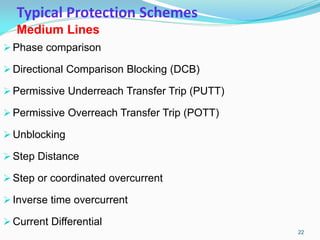
  • 155.