Relative Clauses
1. Relative pronouns and adverbs
2. Omission of relative pronouns
3. Defining and Non-defining clauses
1. Relative pronouns and
adverbs
Sometimes, when talking about
people or things it could be
necessary to add more
information. It is when we use a
RELATIVE CLAUSE:
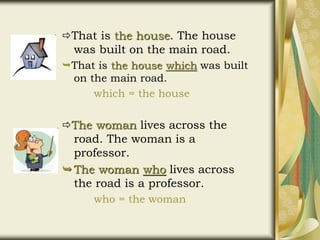
That is the house. The house
was built on the main road.
That is the house which was built
on the main road.
which = the house
The woman lives across the
road. The woman is a
professor.
The woman who lives across
the road is a professor.
who = the woman
Relative clauses always follow the
name they refer to (its antecedent).
The most frequent relative pronouns
are:
 who / whom  people
 which  objects
 where  places and spatial references
 when  temporal references
 that  people / objects
 whom is used in formal speech and it is
only used when it refers to the direct object of
the main clause:
- This is the boy about whom you were asking me.
 whose  expresses possession and cannot
be omitted:
- Whose book is this? (NEVER “Of who…?”)
- The children whose books you are using are
my pupils.
 whom and which are used after
prepositions but in colloquial English we
can omit the relative pronoun and place
the preposition in a final position:
- This is the boy about whom you were
asking me.
- This is the boy (who) you were asking
me about.
- I like the car about which you were
asking me about.
- I like the car (which) you were talking
about.
There are other relative connectors
that are not pronouns but adverbs,
such as:
 where  The house where I was born.
 when  I remember the time when we lived there.
 why  The reason why he is so sad is a mystery to us.
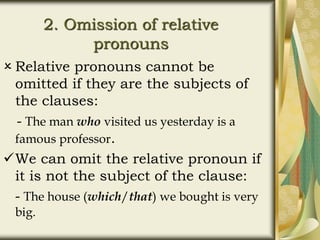
2. Omission of relative
pronouns
 Relative pronouns cannot be
omitted if they are the subjects of
the clauses:
- The man who visited us yesterday is a
famous professor.
We can omit the relative pronoun if
it is not the subject of the clause:
- The house (which/that) we bought is very
big.
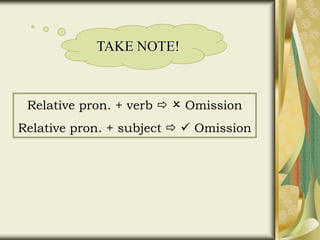
TAKE NOTE!
Relative pron. + verb   Omission
Relative pron. + subject   Omission
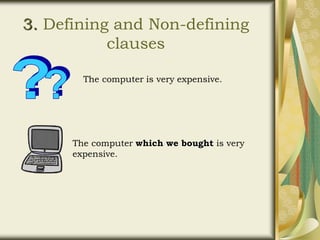
3. Defining and Non-defining
clauses
The computer is very expensive.
The computer which we bought is very
expensive.
Those relative clauses that are
NECESSARY to understand the
meaning of a sentence are called
DEFINING CLAUSES (especificativas)
That’s the actor.
That’s the actor who
plays Hamlet.
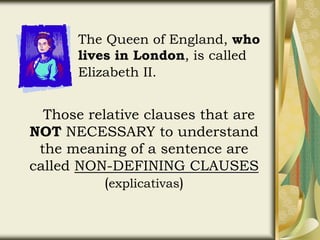
The Queen of England, who
lives in London, is called
Elizabeth II.
Those relative clauses that are
NOT NECESSARY to understand
the meaning of a sentence are
called NON-DEFINING CLAUSES
(explicativas)
Non-defining clauses:
1. are separated by commas
2. never use “that”
3. never omit the relative
pronoun
4. are used in writing or
formal speech (so are less
common)
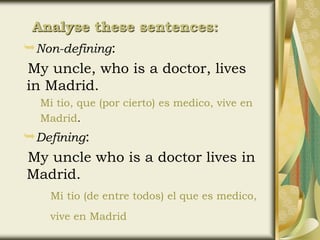
Non-defining:
My uncle, who is a doctor, lives
in Madrid.
Mi tio, que (por cierto) es medico, vive en
Madrid.
Defining:
My uncle who is a doctor lives in
Madrid.
Mi tio (de entre todos) el que es medico,
vive en Madrid
Analyse these sentences:

relativeclauses-120517151436-phpapp01.ppt

  • 1.
    Relative Clauses 1. Relativepronouns and adverbs 2. Omission of relative pronouns 3. Defining and Non-defining clauses
  • 2.
    1. Relative pronounsand adverbs Sometimes, when talking about people or things it could be necessary to add more information. It is when we use a RELATIVE CLAUSE:
  • 3.
    That is thehouse. The house was built on the main road. That is the house which was built on the main road. which = the house The woman lives across the road. The woman is a professor. The woman who lives across the road is a professor. who = the woman
  • 4.
    Relative clauses alwaysfollow the name they refer to (its antecedent). The most frequent relative pronouns are:  who / whom  people  which  objects  where  places and spatial references  when  temporal references  that  people / objects
  • 5.
     whom isused in formal speech and it is only used when it refers to the direct object of the main clause: - This is the boy about whom you were asking me.  whose  expresses possession and cannot be omitted: - Whose book is this? (NEVER “Of who…?”) - The children whose books you are using are my pupils.
  • 6.
     whom andwhich are used after prepositions but in colloquial English we can omit the relative pronoun and place the preposition in a final position: - This is the boy about whom you were asking me. - This is the boy (who) you were asking me about. - I like the car about which you were asking me about. - I like the car (which) you were talking about.
  • 7.
    There are otherrelative connectors that are not pronouns but adverbs, such as:  where  The house where I was born.  when  I remember the time when we lived there.  why  The reason why he is so sad is a mystery to us.
  • 8.
    2. Omission ofrelative pronouns  Relative pronouns cannot be omitted if they are the subjects of the clauses: - The man who visited us yesterday is a famous professor. We can omit the relative pronoun if it is not the subject of the clause: - The house (which/that) we bought is very big.
  • 9.
    TAKE NOTE! Relative pron.+ verb   Omission Relative pron. + subject   Omission
  • 10.
    3. Defining andNon-defining clauses The computer is very expensive. The computer which we bought is very expensive.
  • 11.
    Those relative clausesthat are NECESSARY to understand the meaning of a sentence are called DEFINING CLAUSES (especificativas) That’s the actor. That’s the actor who plays Hamlet.
  • 12.
    The Queen ofEngland, who lives in London, is called Elizabeth II. Those relative clauses that are NOT NECESSARY to understand the meaning of a sentence are called NON-DEFINING CLAUSES (explicativas)
  • 13.
    Non-defining clauses: 1. areseparated by commas 2. never use “that” 3. never omit the relative pronoun 4. are used in writing or formal speech (so are less common)
  • 14.
    Non-defining: My uncle, whois a doctor, lives in Madrid. Mi tio, que (por cierto) es medico, vive en Madrid. Defining: My uncle who is a doctor lives in Madrid. Mi tio (de entre todos) el que es medico, vive en Madrid Analyse these sentences: