Relative Clauses
Definition
• Relative clauses are a type of
subordinate clause
• They are descriptive clauses that
modify nouns
Example
Cornelia est puella Romana quae in
Italia habitat.
• The underlined clause gives
information about the noun “puella”
• This relative clause describes
Cornelia as living in Italy
Relative Pronouns
• Relative Clauses are introduced by
Relative Pronouns.
• Relative Pronouns connect the statement in
the subordinate clause (the relative clause)
to the noun in the main clause
• From our example:
Cornelia est puella Romana quae in Italia
habitat.
Relative Pronoun
Antecedent
• The noun in the main clause which
connects to the relative clause is
called the antecedent.
• Cornelia est puella Romana quae in
Italia habitat.
• In this example “puella” is the
antecedent.
Forms of the Relative
Pronoun
See Handout
Choosing the correct relative
pronoun
The form of the relative pronoun that
introduces a relative clause depends
on two things:
1. The gender and number of its
antecedent
2. The case required by the function of
the relative pronoun in its own clause
Example:
• Cornelia est puella Romana quae in Italia
habitat.
• From the chart, “quae” could be 4 choices
– Can you find which ones?
• “quae” is the correct relative pronoun because it
matches its antecedent (“puella”) in gender and
number (fem., and sing.)
• The case is nominative because in the relative
clause “quae” is the subject
Example #1
• Crines eius curabant duae ancillae, quarumquarum
altera speculum tenebat.
• Here, “quarum” is the relative pronoun
that introduces the relative clause
• If the antecedent is “ancillae”, what
gender and number must “quarum” be?
• What case is “quarum”? Why?
Example #1 cont.
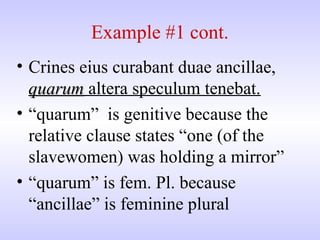
• Crines eius curabant duae ancillae,
quarumquarum altera speculum tenebat.
• “quarum” is genitive because the
relative clause states “one (of the
slavewomen) was holding a mirror”
• “quarum” is fem. Pl. because
“ancillae” is feminine plural
Example #2
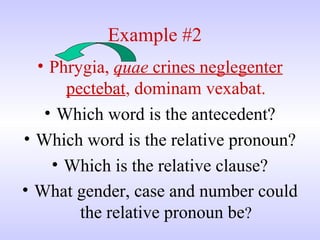
• Phrygia, quae crines neglegenter
pectebat, dominam vexabat.
• Which word is the antecedent?
• Which word is the relative pronoun?
• Which is the relative clause?
• What gender, case and number could
the relative pronoun be?
Example #2 cont.
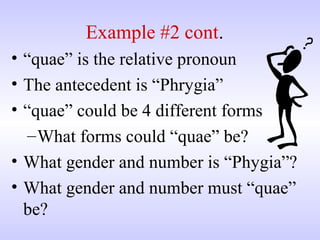
• “quae” is the relative pronoun
• The antecedent is “Phrygia”
• “quae” could be 4 different forms
–What forms could “quae” be?
• What gender and number is “Phygia”?
• What gender and number must “quae”
be?
Example #2 cont.
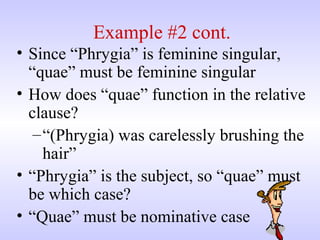
• Since “Phrygia” is feminine singular,
“quae” must be feminine singular
• How does “quae” function in the relative
clause?
–“(Phrygia) was carelessly brushing the
hair”
• “Phrygia” is the subject, so “quae” must
be which case?
• “Quae” must be nominative case
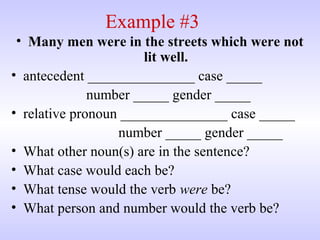
Example #3
• Many men were in the streets which were not
lit well.
• antecedent _______________ case _____
number _____ gender _____
• relative pronoun _______________ case _____
number _____ gender _____
• What other noun(s) are in the sentence?
• What case would each be?
• What tense would the verb were be?
• What person and number would the verb be?
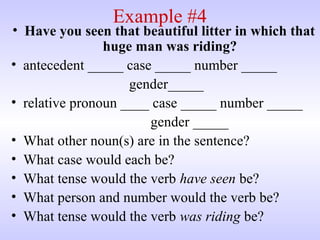
Example #4
• Have you seen that beautiful litter in which that
huge man was riding?
• antecedent _____ case _____ number _____
gender_____
• relative pronoun ____ case _____ number _____
gender _____
• What other noun(s) are in the sentence?
• What case would each be?
• What tense would the verb have seen be?
• What person and number would the verb be?
• What tense would the verb was riding be?

Relative clauses

  • 1.
  • 2.
    Definition • Relative clausesare a type of subordinate clause • They are descriptive clauses that modify nouns
  • 3.
    Example Cornelia est puellaRomana quae in Italia habitat. • The underlined clause gives information about the noun “puella” • This relative clause describes Cornelia as living in Italy
  • 4.
    Relative Pronouns • RelativeClauses are introduced by Relative Pronouns. • Relative Pronouns connect the statement in the subordinate clause (the relative clause) to the noun in the main clause • From our example: Cornelia est puella Romana quae in Italia habitat. Relative Pronoun
  • 5.
    Antecedent • The nounin the main clause which connects to the relative clause is called the antecedent. • Cornelia est puella Romana quae in Italia habitat. • In this example “puella” is the antecedent.
  • 6.
    Forms of theRelative Pronoun See Handout
  • 7.
    Choosing the correctrelative pronoun The form of the relative pronoun that introduces a relative clause depends on two things: 1. The gender and number of its antecedent 2. The case required by the function of the relative pronoun in its own clause
  • 8.
    Example: • Cornelia estpuella Romana quae in Italia habitat. • From the chart, “quae” could be 4 choices – Can you find which ones? • “quae” is the correct relative pronoun because it matches its antecedent (“puella”) in gender and number (fem., and sing.) • The case is nominative because in the relative clause “quae” is the subject
  • 9.
    Example #1 • Crineseius curabant duae ancillae, quarumquarum altera speculum tenebat. • Here, “quarum” is the relative pronoun that introduces the relative clause • If the antecedent is “ancillae”, what gender and number must “quarum” be? • What case is “quarum”? Why?
  • 10.
    Example #1 cont. •Crines eius curabant duae ancillae, quarumquarum altera speculum tenebat. • “quarum” is genitive because the relative clause states “one (of the slavewomen) was holding a mirror” • “quarum” is fem. Pl. because “ancillae” is feminine plural
  • 11.
    Example #2 • Phrygia,quae crines neglegenter pectebat, dominam vexabat. • Which word is the antecedent? • Which word is the relative pronoun? • Which is the relative clause? • What gender, case and number could the relative pronoun be?
  • 12.
    Example #2 cont. •“quae” is the relative pronoun • The antecedent is “Phrygia” • “quae” could be 4 different forms –What forms could “quae” be? • What gender and number is “Phygia”? • What gender and number must “quae” be?
  • 13.
    Example #2 cont. •Since “Phrygia” is feminine singular, “quae” must be feminine singular • How does “quae” function in the relative clause? –“(Phrygia) was carelessly brushing the hair” • “Phrygia” is the subject, so “quae” must be which case? • “Quae” must be nominative case
  • 14.
    Example #3 • Manymen were in the streets which were not lit well. • antecedent _______________ case _____ number _____ gender _____ • relative pronoun _______________ case _____ number _____ gender _____ • What other noun(s) are in the sentence? • What case would each be? • What tense would the verb were be? • What person and number would the verb be?
  • 15.
    Example #4 • Haveyou seen that beautiful litter in which that huge man was riding? • antecedent _____ case _____ number _____ gender_____ • relative pronoun ____ case _____ number _____ gender _____ • What other noun(s) are in the sentence? • What case would each be? • What tense would the verb have seen be? • What person and number would the verb be? • What tense would the verb was riding be?