Regulatory Reforms at the Therapeutic
Goods Administration (TGA)
Dr Mark McDonald
Assistant Secretary, Regulatory Reforms, TGA
CMA Complementary Medicines Regulatory Obligations Seminar
11 April 2017
About the TGA (briefly)
• Part of the Commonwealth Department of
Health, but separately located and with its own strong external
brand
• HQ in Canberra with 5 satellite offices
• Approx. 700 staff plus 80 contractors: scientists, engineers,
toxicologists, technicians, medical officers, pharmacists, lawyers
and administrative staff
• Budget of $150m pa
• Virtually all of TGA’s operations are cost recovered from industry
fees and charges - unique globally among medicines and device
regulatory bodies
Regulatory Reforms at the Therapeutic Goods Administration 1
Locations
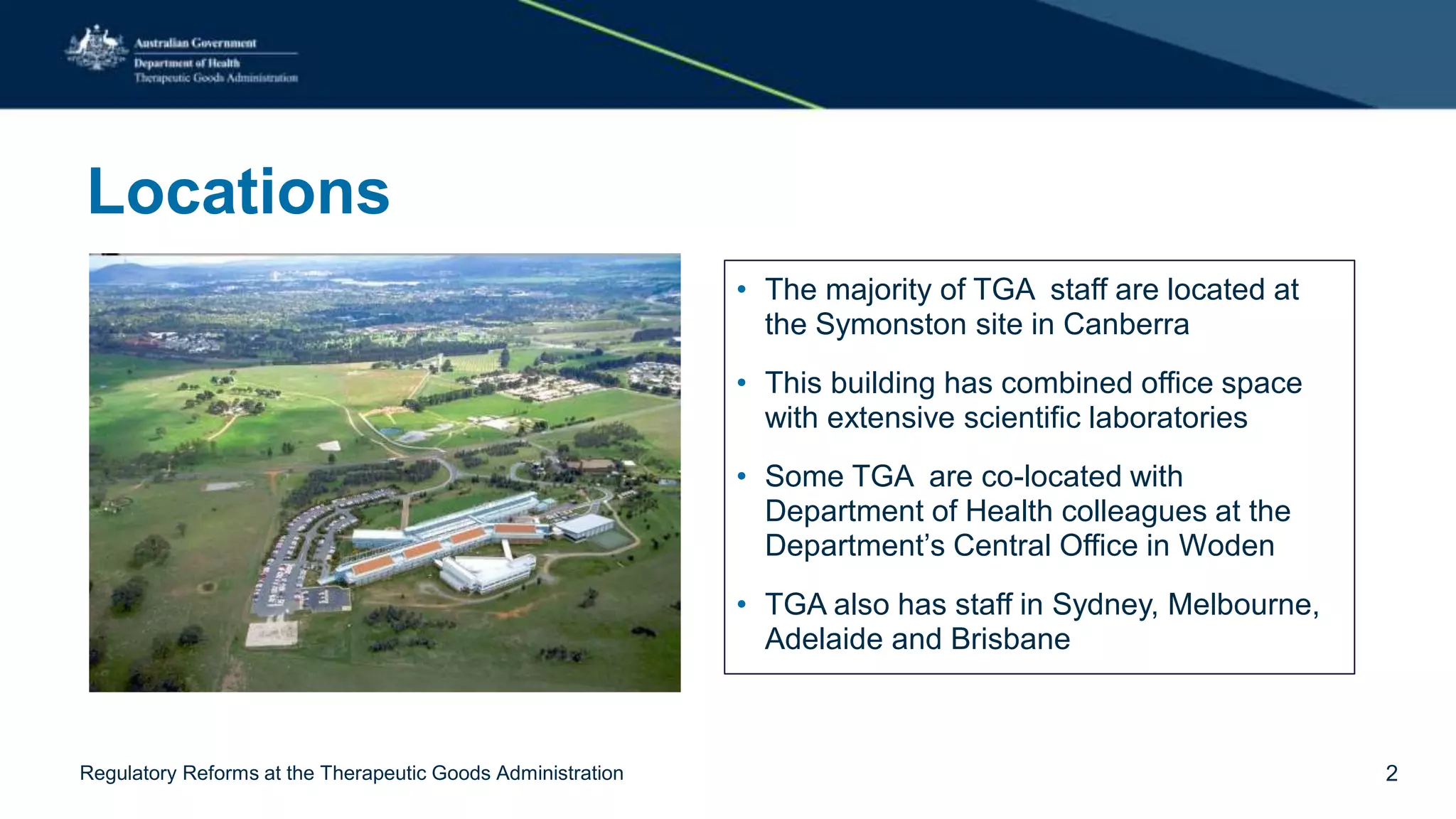
• The majority of TGA staff are located at
the Symonston site in Canberra
• This building has combined office space
with extensive scientific laboratories
• Some TGA are co-located with
Department of Health colleagues at the
Department’s Central Office in Woden
• TGA also has staff in Sydney, Melbourne,
Adelaide and Brisbane
2Regulatory Reforms at the Therapeutic Goods Administration
TGA’s role
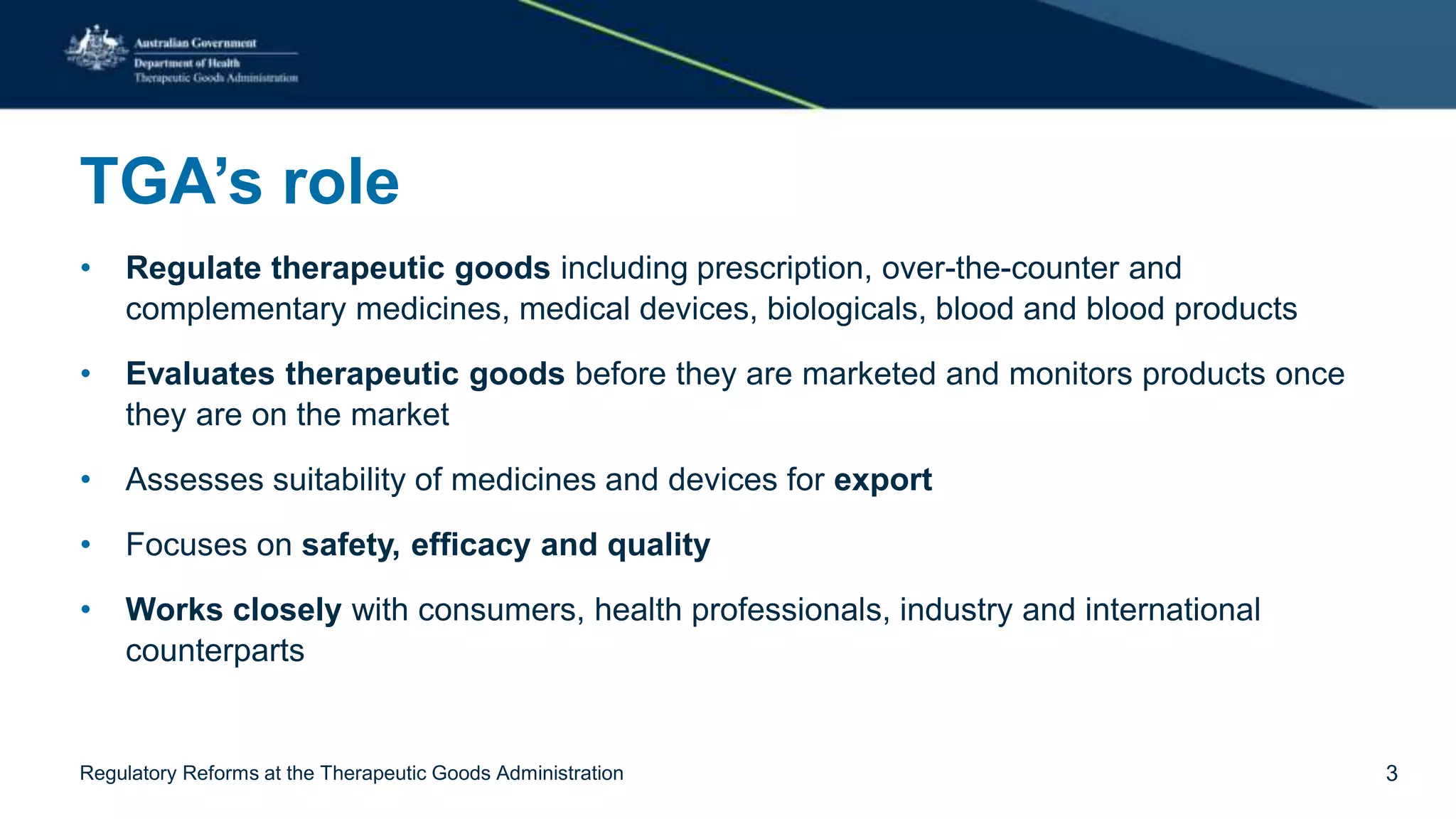
• Regulate therapeutic goods including prescription, over-the-counter and
complementary medicines, medical devices, biologicals, blood and blood products
• Evaluates therapeutic goods before they are marketed and monitors products once
they are on the market
• Assesses suitability of medicines and devices for export
• Focuses on safety, efficacy and quality
• Works closely with consumers, health professionals, industry and international
counterparts
Regulatory Reforms at the Therapeutic Goods Administration 3
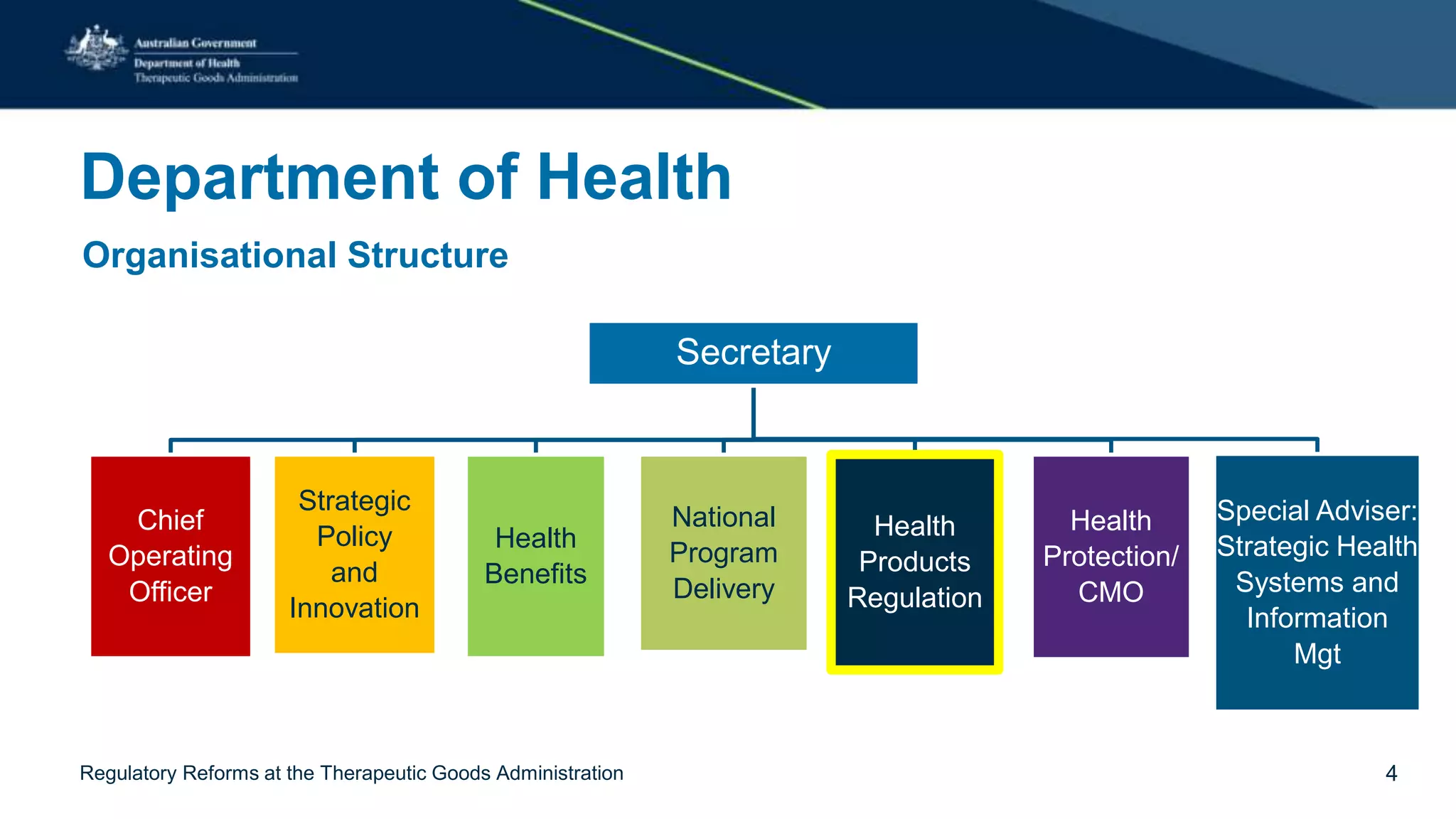
Department of Health
Organisational Structure
Secretary
Chief
Operating
Officer
Strategic
Policy
and
Innovation
Health
Benefits
National
Program
Delivery
Health
Products
Regulation
Health
Protection/
CMO
Special Adviser:
Strategic Health
Systems and
Information
Mgt
Regulatory Reforms at the Therapeutic Goods Administration 4
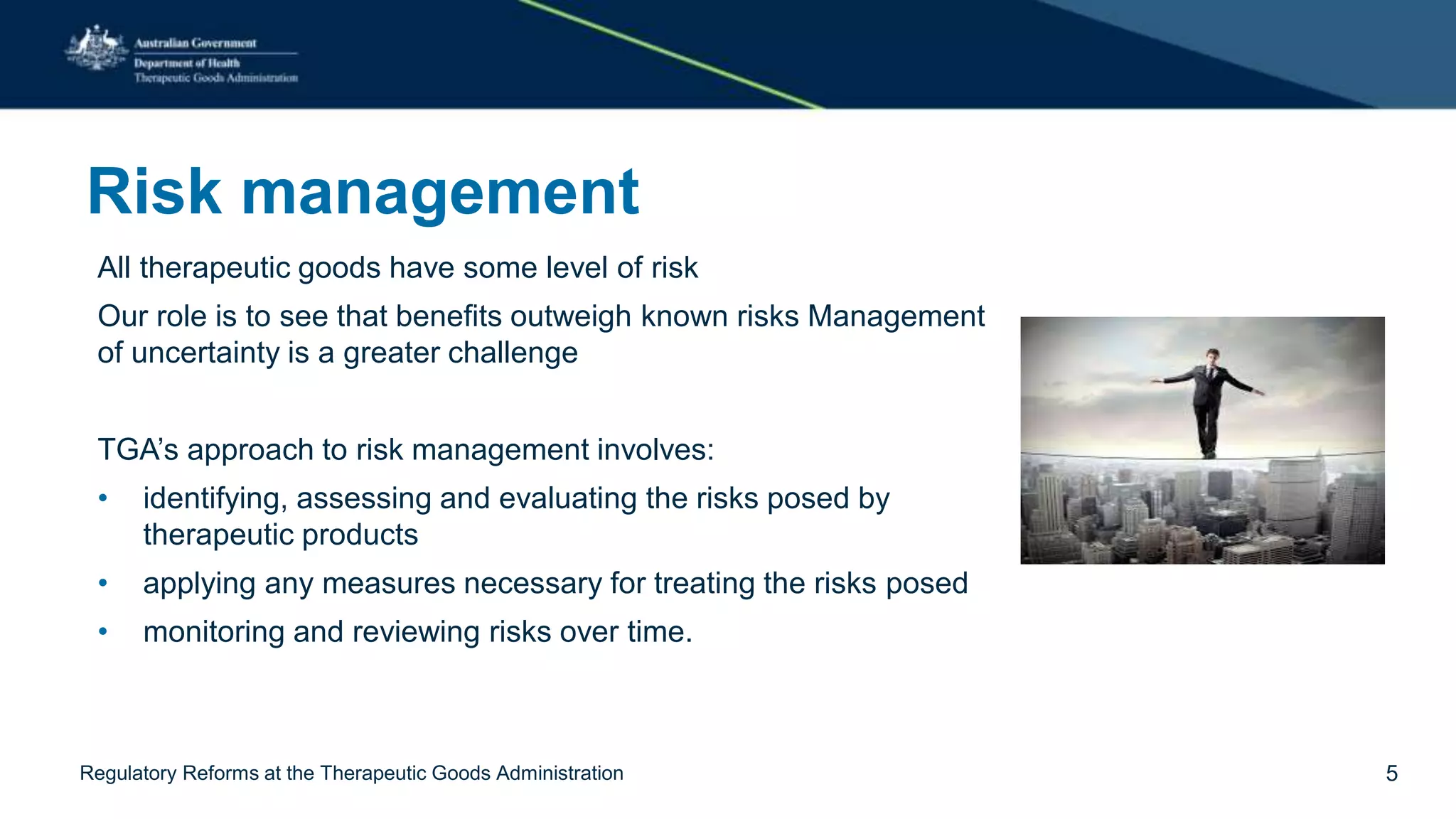
Risk management
All therapeutic goods have some level of risk
Our role is to see that benefits outweigh known risks Management
of uncertainty is a greater challenge
TGA’s approach to risk management involves:
• identifying, assessing and evaluating the risks posed by
therapeutic products
• applying any measures necessary for treating the risks posed
• monitoring and reviewing risks over time.
Regulatory Reforms at the Therapeutic Goods Administration 5
Can regulators manage uncertainty well enough?
• Regulators have frameworks for assessing benefits and harms (risk) but
less with uncertainty
• Uncertainty and harms can be confused, with negative consequences
for decision making
• A balance between the two is needed, combining the science with an
appropriately designed regulatory framework
Regulatory Reforms at the Therapeutic Goods Administration 6
Review of Medicines & Medical Devices Regulation
• Expert Panel commenced late 2014 after most of 2014 in pre-work
• Review process included discussion papers, submissions and interviews by the panel
• Two reports on medicines and devices and complementary medicines and advertising
released during 2015 with 58 recommendations
• Following release of the reports, workshops held with key stakeholders by the Department
to get feedback on recommendations
• Health Minister took preferred position to Cabinet
• Government response was publicly released on 15 September 2016
Regulatory Reforms at the Therapeutic Goods Administration 7
Key principles endorsed by Government
• The Australian Government retain responsibility for approval of
therapeutic goods rather than automatically accepting international approvals,
but TGA needs to:
− make greater use of overseas evaluations
− introduce greater flexibility in approval pathways for both medicines and
medical devices
− more appropriately align level regulation with the actual risk posed by
certain types of products
Regulatory Reforms at the Therapeutic Goods Administration 8
Further reviews to be undertaken
In scope
• Medicines (and chemicals) Scheduling Policy Framework
• Schedule 3 medicine advertising guidelines
• Review regulation of lower-risk medicines
Proposed process
• Document the basis of current approaches, approach of other
regulators, and alternative frameworks
• Conduct stakeholder workshops
• Consultation papers and formal feedback on options
• Provide advice to Minister on options
• Ministerial decision, change to regulations ?
Regulatory Reforms at the Therapeutic Goods Administration 9
To Regulate or Not to Regulate
• TGA regulatory frameworks
– Exempt goods
– Excluded goods
• Consumer goods (ACCC)
Regulatory Reforms at the Therapeutic Goods Administration 10
Guiding principles of the review
• Not our intention to fundamentally change the definition of a medicine or medical device
• What is the purpose of our regulation
• Considered the concept of ‘regulatory familiarity’ of particular products
• Recognised that moving some product types to regulation by Food Standards Australian
New Zealand (FSANZ) or under the National Industrial Chemicals Notification and
Assessment Scheme (NICNAS) are not necessarily options that provide for decreasing
regulation.
• Australian Consumer Law provides for default Australian Competition and Consumer
Commission (ACCC) oversight of all consumer goods in Australia under Australian
Consumer Law, including therapeutic goods used by consumers.
Regulatory Reforms at the Therapeutic Goods Administration 11
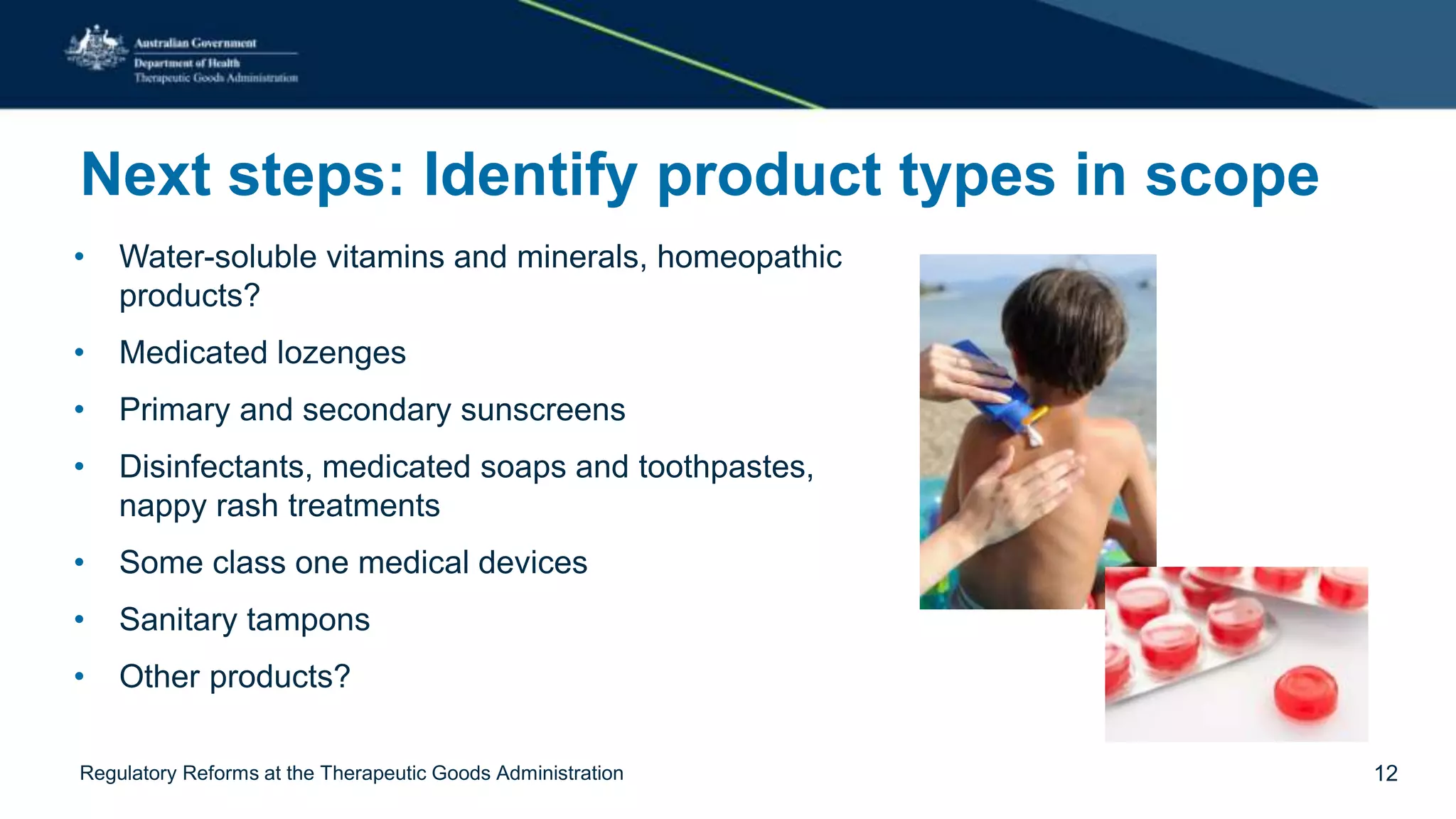
Next steps: Identify product types in scope
• Water-soluble vitamins and minerals, homeopathic
products?
• Medicated lozenges
• Primary and secondary sunscreens
• Disinfectants, medicated soaps and toothpastes,
nappy rash treatments
• Some class one medical devices
• Sanitary tampons
• Other products?
Regulatory Reforms at the Therapeutic Goods Administration 12
Next steps: Develop a risk framework
• How to define “low risk”?
• For medicinal products, this could include parameters such as:
– safety of the ingredients
– route of administration
– risk associated with the claims including labelled use
– nature of the condition being treated/ prevented
– nature and number of the population using the product
– impact of poor manufacturing quality on safety/ efficacy
• Regulatory “familiarity” does this reduce uncertainty or actual risks?
• What is the ability of sponsors to objectively self-assess the product ?
• Look at international experience / alternative regulatory approaches
Regulatory Reforms at the Therapeutic Goods Administration 13
Low Risk Classification System
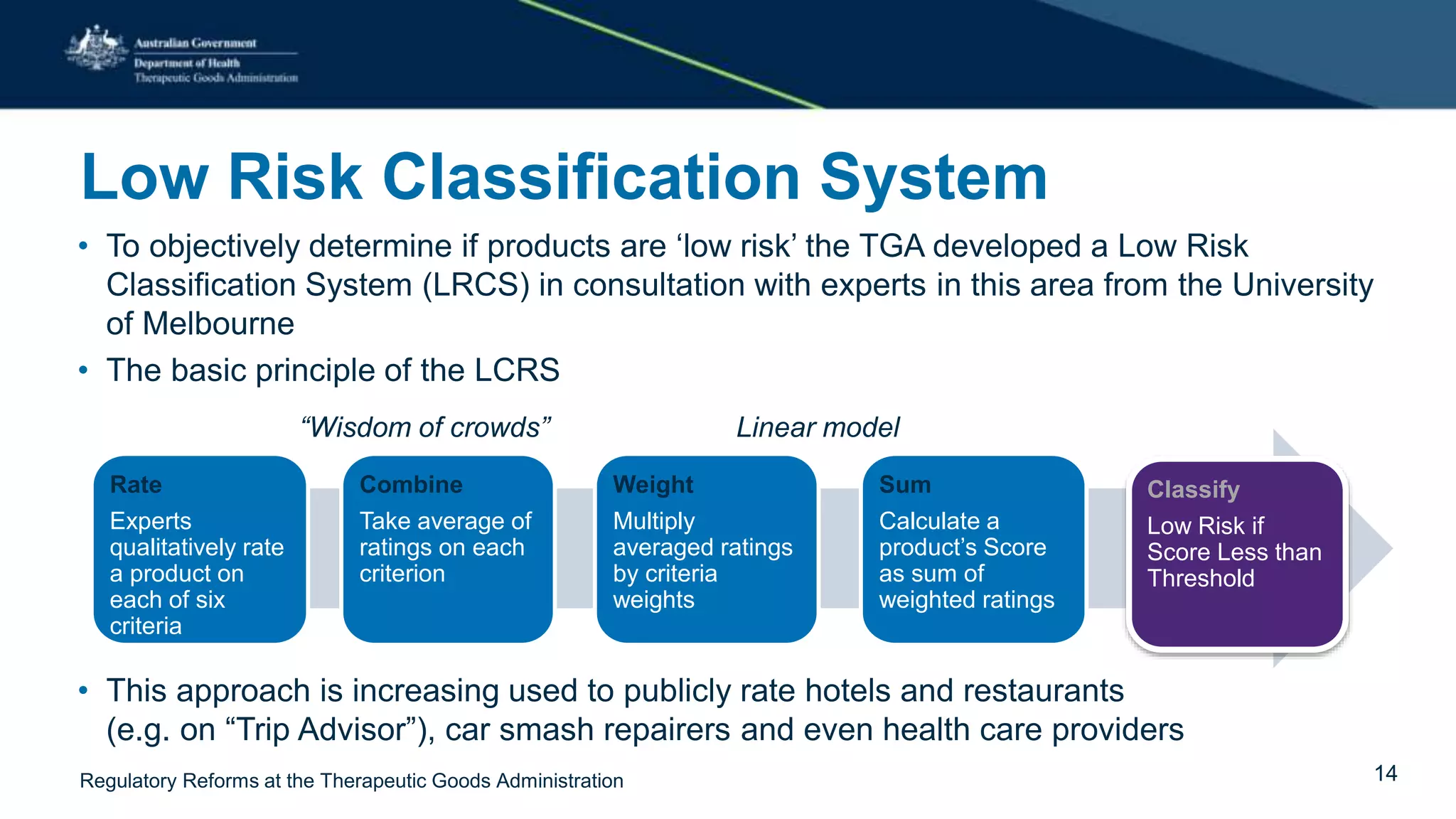
• To objectively determine if products are ‘low risk’ the TGA developed a Low Risk
Classification System (LRCS) in consultation with experts in this area from the University
of Melbourne
• The basic principle of the LCRS
• This approach is increasing used to publicly rate hotels and restaurants
(e.g. on “Trip Advisor”), car smash repairers and even health care providers
“Wisdom of crowds” Linear model
Rate
Experts
qualitatively rate
a product on
each of six
criteria
Combine
Take average of
ratings on each
criterion
Weight
Multiply
averaged ratings
by criteria
weights
Sum
Calculate a
product’s Score
as sum of
weighted ratings
Classify
Low Risk if
Score Less than
Threshold
Regulatory Reforms at the Therapeutic Goods Administration 14
So what was considered ‘low risk’
In the context of Recommendation 14 of this review the following was considered ‘low risk’:
• Ear candles
• Nappy rash creams
• Antiperspirants
• ‘Low risk’ OTC medicines
• Hard surface disinfectants
• Sunscreens
• Tampons and menstrual cups
TGA developed a range of possible options that represent potential future regulatory
approaches.
Regulatory Reforms at the Therapeutic Goods Administration 15
‘Low risk’ OTC medicines
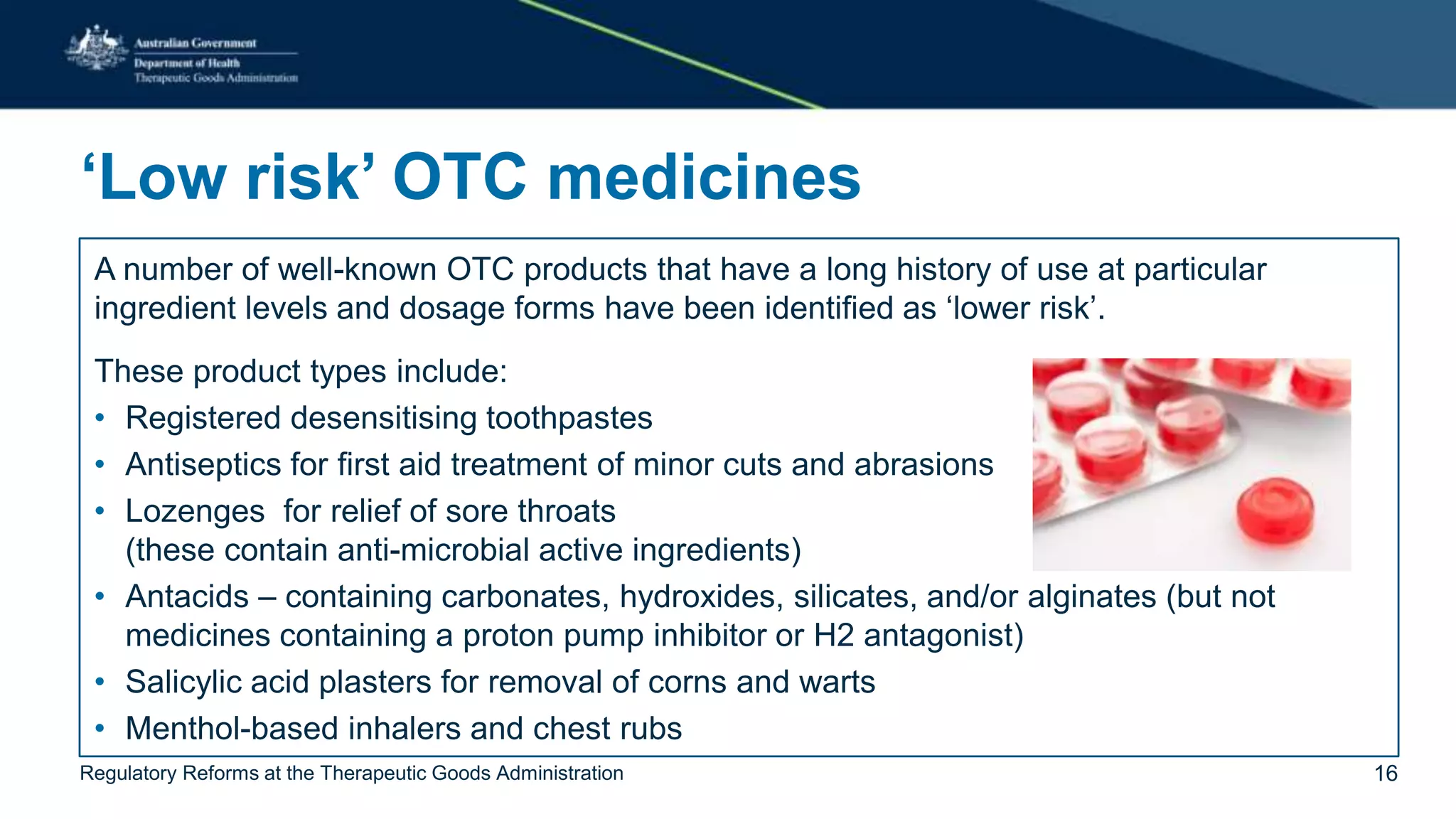
A number of well-known OTC products that have a long history of use at particular
ingredient levels and dosage forms have been identified as ‘lower risk’.
These product types include:
• Registered desensitising toothpastes
• Antiseptics for first aid treatment of minor cuts and abrasions
• Lozenges for relief of sore throats
(these contain anti-microbial active ingredients)
• Antacids – containing carbonates, hydroxides, silicates, and/or alginates (but not
medicines containing a proton pump inhibitor or H2 antagonist)
• Salicylic acid plasters for removal of corns and warts
• Menthol-based inhalers and chest rubs
Regulatory Reforms at the Therapeutic Goods Administration 16
‘Low risk’ OTC medicines
Product types continued:
• Antiseptic mouth washes
• Acne treatments containing benzoyl peroxide
• Rubefacient preparations for minor aches and pains of muscles (e.g. methyl salicylate,
menthol, capsicum) but not creams or ointments containing a non-steroidal anti-
inflammatory medicine
• Certain laxatives
Options
• Maintain the status quo regulation
• Review the eligibility of active ingredients to become Listable
Regulatory Reforms at the Therapeutic Goods Administration 17
Hard surface disinfectants
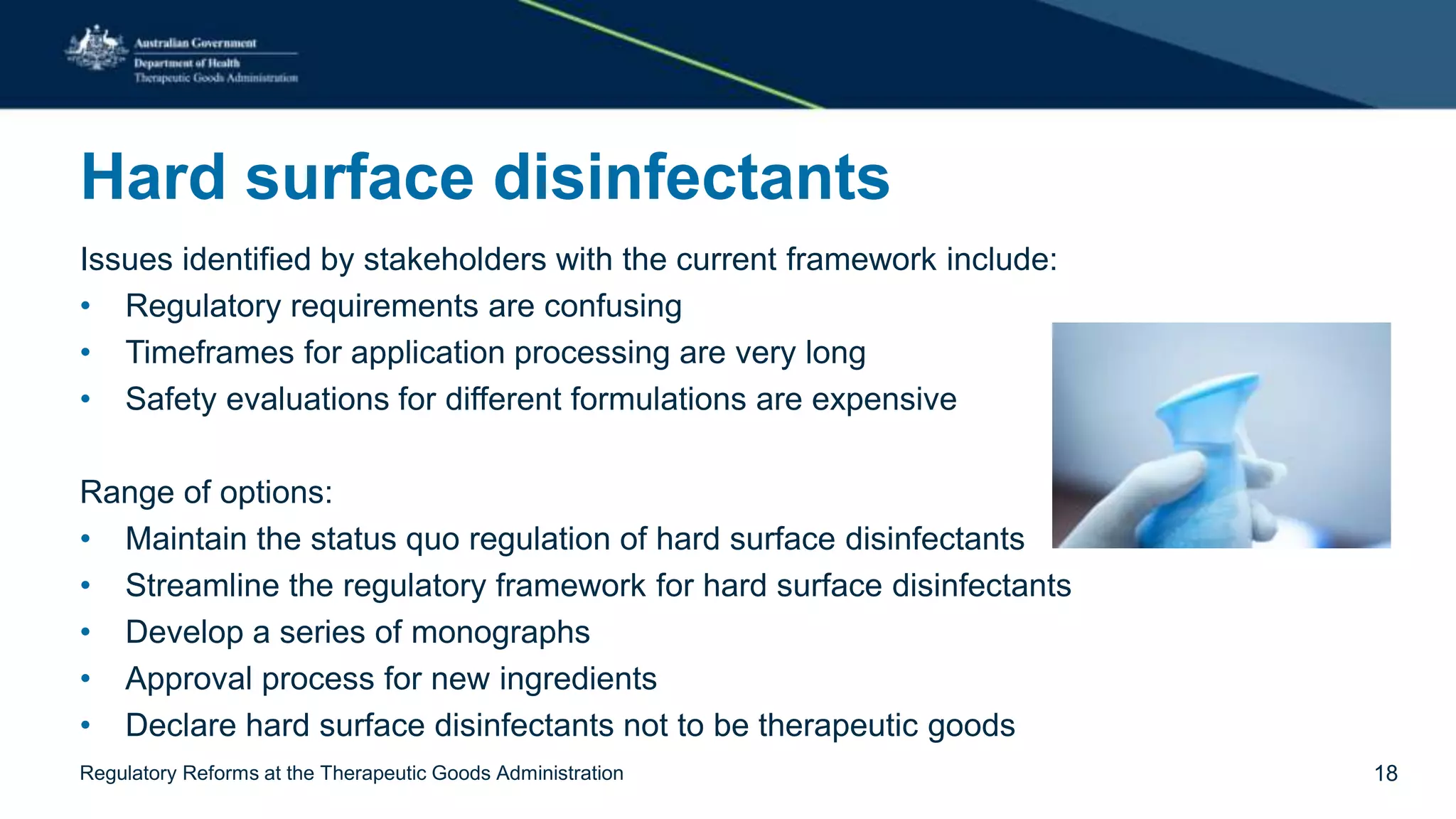
Issues identified by stakeholders with the current framework include:
• Regulatory requirements are confusing
• Timeframes for application processing are very long
• Safety evaluations for different formulations are expensive
Range of options:
• Maintain the status quo regulation of hard surface disinfectants
• Streamline the regulatory framework for hard surface disinfectants
• Develop a series of monographs
• Approval process for new ingredients
• Declare hard surface disinfectants not to be therapeutic goods
Regulatory Reforms at the Therapeutic Goods Administration 18
Sunscreens
Issues identified by stakeholders with the current
framework include:
• Medicine level GMP
• Process for review of new ingredients slow
and expensive
• Application of pharmacopeial standards for
all ingredients
• Different levels of regulation confusing
Range of options:
• Maintain the status quo regulation of sunscreens.
• Streamline the regulatory pathways for sunscreen
regulation.
• Prevent all secondary sunscreens from making
SPF claims.
• Creation of a GMP standard for primary
sunscreens.
• New ingredient approval process.
• Alternative ingredient standards for excipients.
• Exclude all sunscreens from the regulatory
framework.
Regulatory Reforms at the Therapeutic Goods Administration 19
So what was considered ‘low risk’
Recommendation 23 was the review of Class I medical devices.
• To maintain international harmonisation we did not want to fundamentally change the
classification system for medical devices.
• Whilst trying to identify candidates for consideration it was recognised that there is a
significant number of potentially non therapeutic goods in the ARTG
• Proposal is to clean up the ARTG to remove the ‘white noise’ before taking a look at
those remaining Class I medical devices, and consider any further regulatory changes.
Regulatory Reforms at the Therapeutic Goods Administration 20
Proposed next steps for Class I medical devices
• Systematic review of ARTG to identify non therapeutic goods
• Engage with States and Territories Health department procurement branches
• Update the Excluded Goods Order
• Review the Class I medical device ARTG entry process
Regulatory Reforms at the Therapeutic Goods Administration 21
So what was considered ‘low risk’
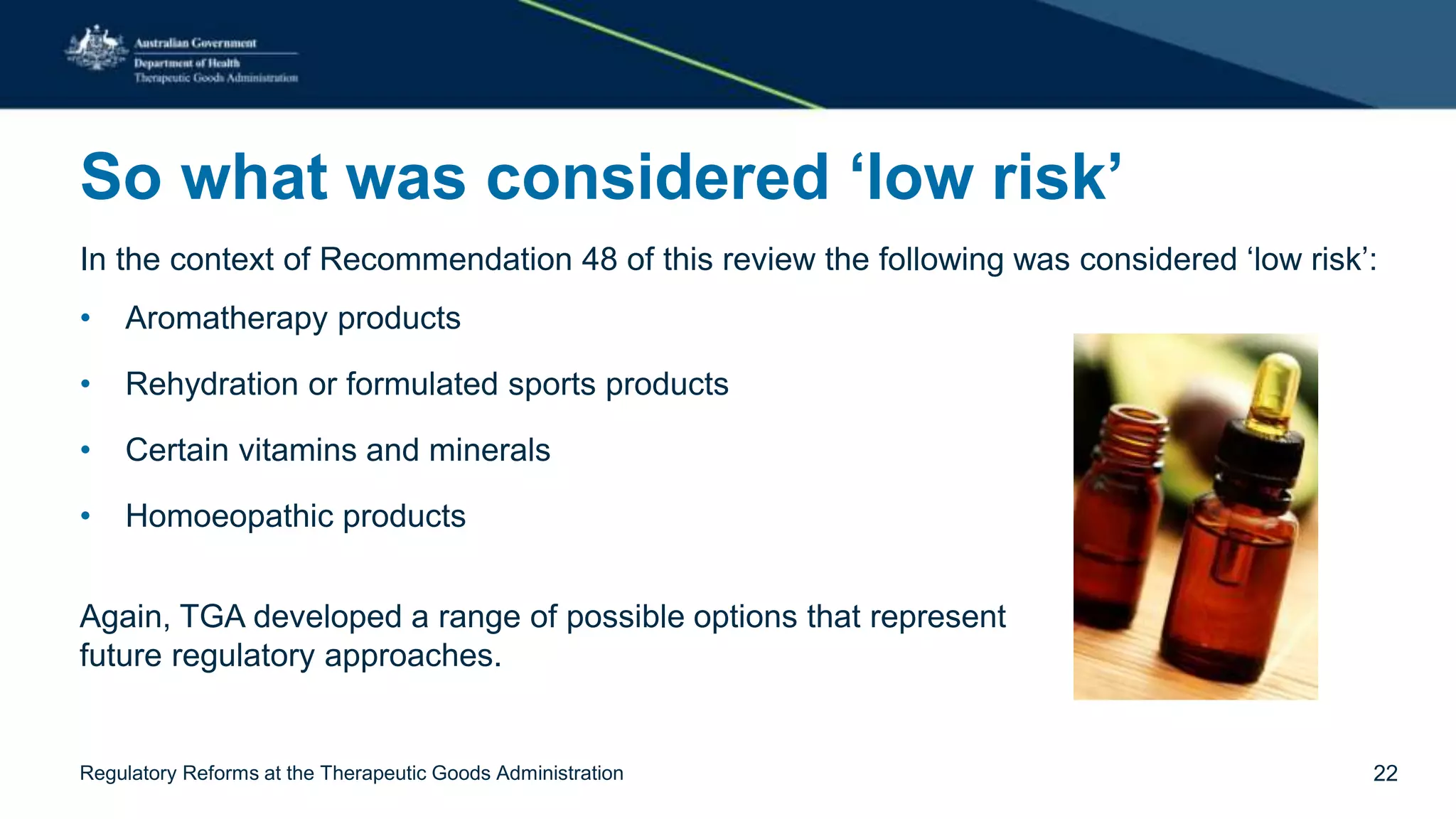
In the context of Recommendation 48 of this review the following was considered ‘low risk’:
• Aromatherapy products
• Rehydration or formulated sports products
• Certain vitamins and minerals
• Homoeopathic products
Again, TGA developed a range of possible options that represent
future regulatory approaches.
Regulatory Reforms at the Therapeutic Goods Administration 22
Aromatherapy products
Aromatherapy uses essential oils for the purpose of altering one's mood, cognitive,
psychological or physical wellbeing.
Issues with the current approach include:
• the purpose of a product containing an essential oil determines which part of government
regulates it.
• The difference between therapeutic and cosmetic products can be confusing.
Range of options:
• Maintain the status quo regulation of aromatherapy products
• Exemption from listing in the ARTG and/or GMP
• Declare essential oils not to be therapeutic goods
Regulatory Reforms at the Therapeutic Goods Administration 23
Rehydration or formulated sports products
Issue with the current approach include:
• confusion at the food-medicine interface
• the dosage forms for these products range from sachets of oral powders and
effervescent tablets to ice blocks and ready to drink solutions.
• rehydration products are similar in composition and presentation to electrolyte drinks,
also known as sports drinks, which are beverages designed specifically for the rapid
replacement of fluid, carbohydrates, and electrolytes.
Proposed further action:
• Review of rehydration products on the ARTG to remove food claims to ensure clear
demarcation between sports drinks and therapeutic rehydration products.
Regulatory Reforms at the Therapeutic Goods Administration 24
Certain vitamins and minerals
Not all of these supplements represent equal risk.
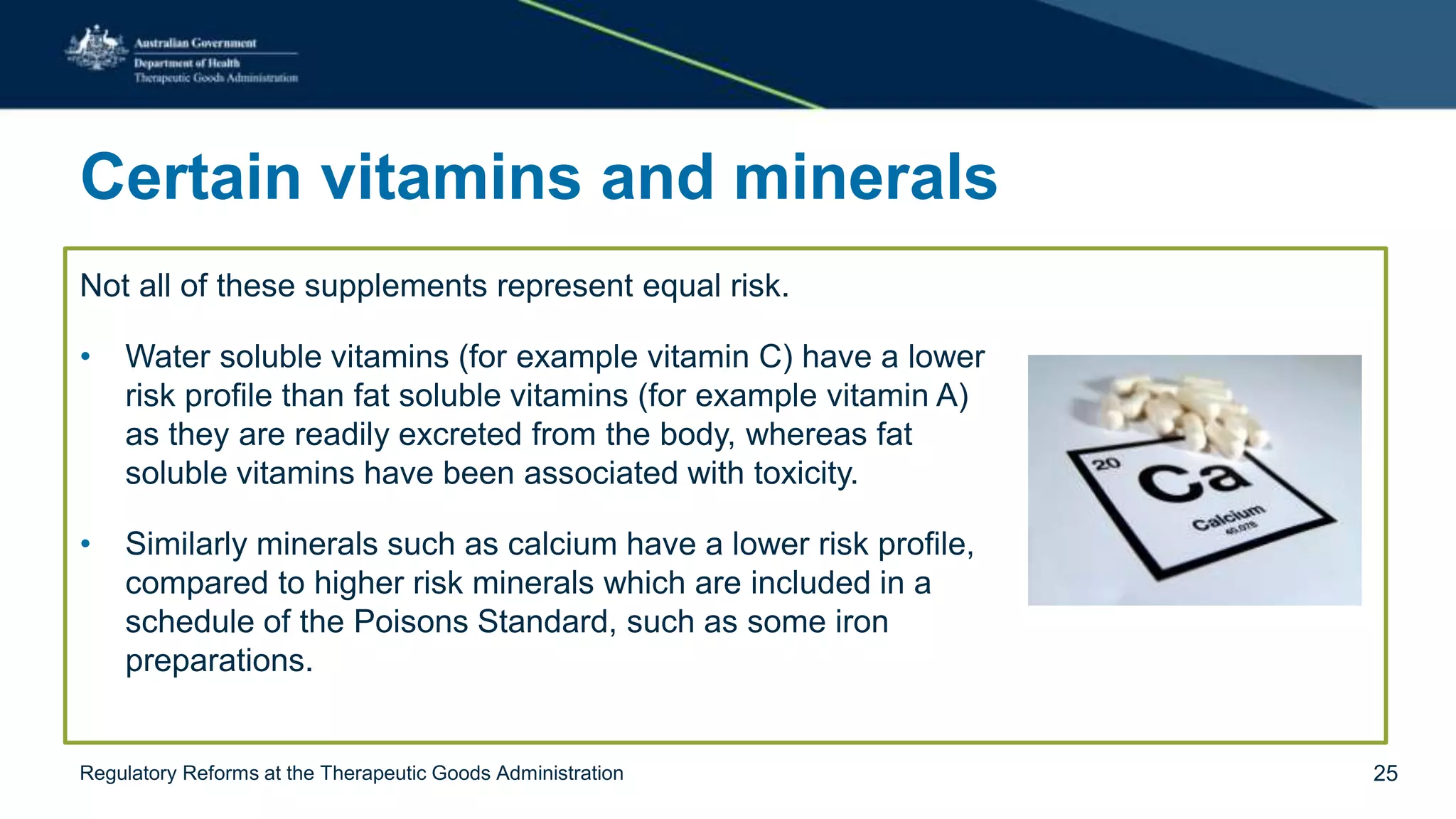
• Water soluble vitamins (for example vitamin C) have a lower
risk profile than fat soluble vitamins (for example vitamin A)
as they are readily excreted from the body, whereas fat
soluble vitamins have been associated with toxicity.
• Similarly minerals such as calcium have a lower risk profile,
compared to higher risk minerals which are included in a
schedule of the Poisons Standard, such as some iron
preparations.
Regulatory Reforms at the Therapeutic Goods Administration 25
Certain vitamins and minerals
Issues with the current approach include:
• the introduction of Standard 1.2.7 – Nutrition, Health and Related Claims in 2013 by
Food Standards Australia New Zealand (FSANZ) has caused a significant change to the
food/medicine interface
• Some vitamin and mineral products are more akin to food or dietary supplements than
medicines
Range of options:
• Maintain the status quo regulation of vitamins and minerals
• Exemption from listing in the ARTG and/or GMP
• Declare vitamins and mineral not to be therapeutic goods
Regulatory Reforms at the Therapeutic Goods Administration 26
Homoeopathic products
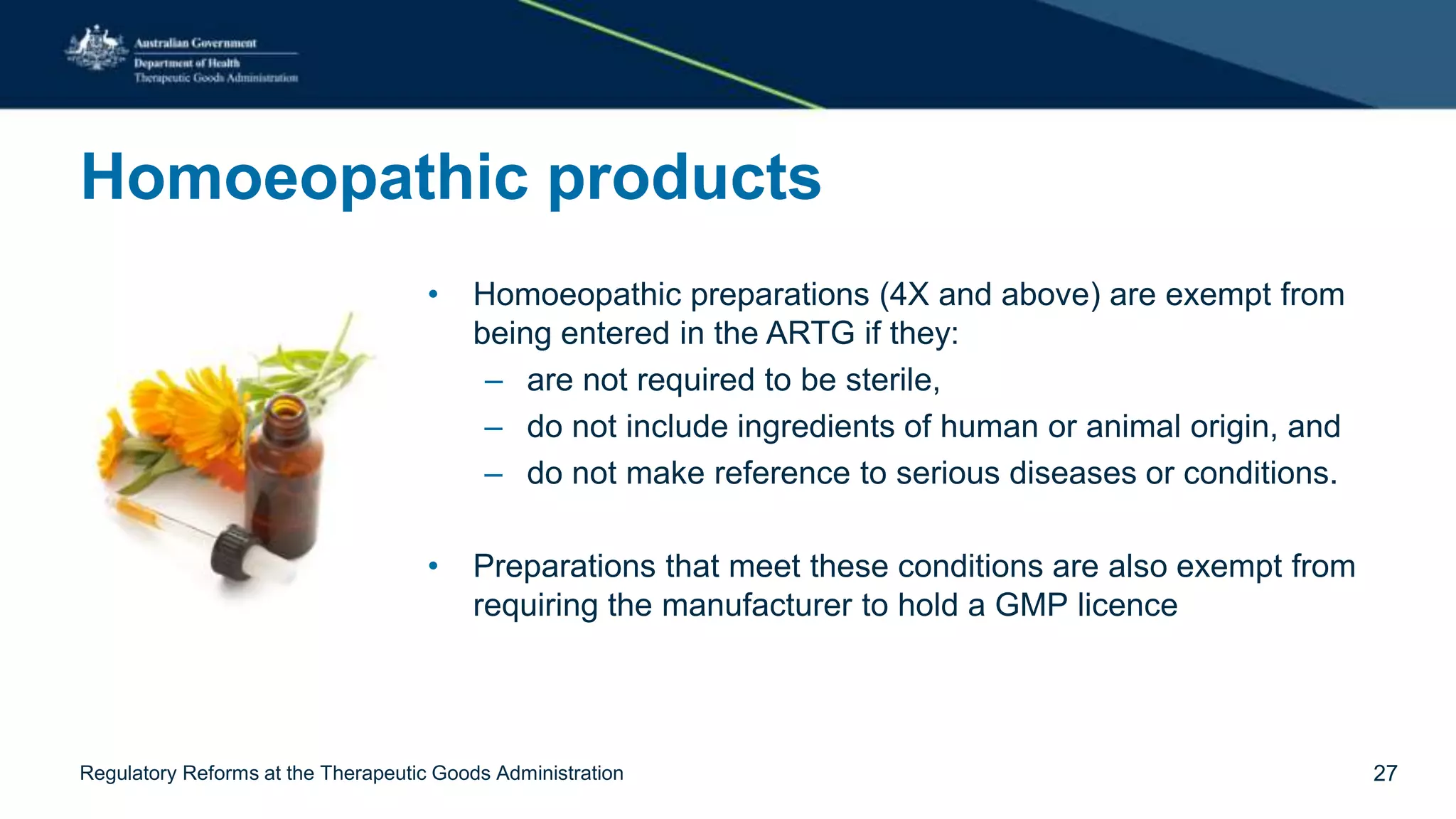
• Homoeopathic preparations (4X and above) are exempt from
being entered in the ARTG if they:
– are not required to be sterile,
– do not include ingredients of human or animal origin, and
– do not make reference to serious diseases or conditions.
• Preparations that meet these conditions are also exempt from
requiring the manufacturer to hold a GMP licence
Regulatory Reforms at the Therapeutic Goods Administration 27
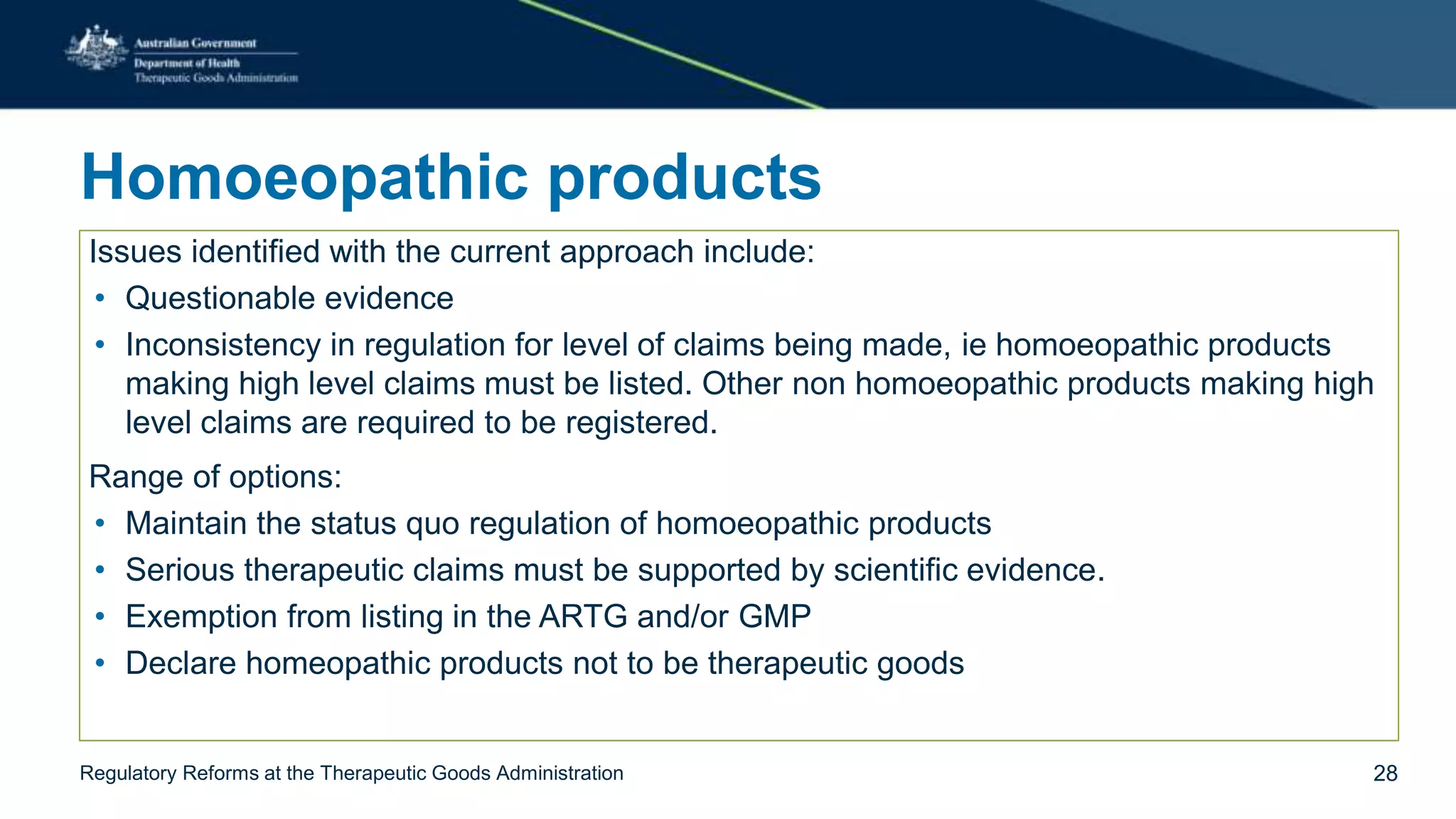
Homoeopathic products
Issues identified with the current approach include:
• Questionable evidence
• Inconsistency in regulation for level of claims being made, ie homoeopathic products
making high level claims must be listed. Other non homoeopathic products making high
level claims are required to be registered.
Range of options:
• Maintain the status quo regulation of homoeopathic products
• Serious therapeutic claims must be supported by scientific evidence.
• Exemption from listing in the ARTG and/or GMP
• Declare homeopathic products not to be therapeutic goods
Regulatory Reforms at the Therapeutic Goods Administration 28
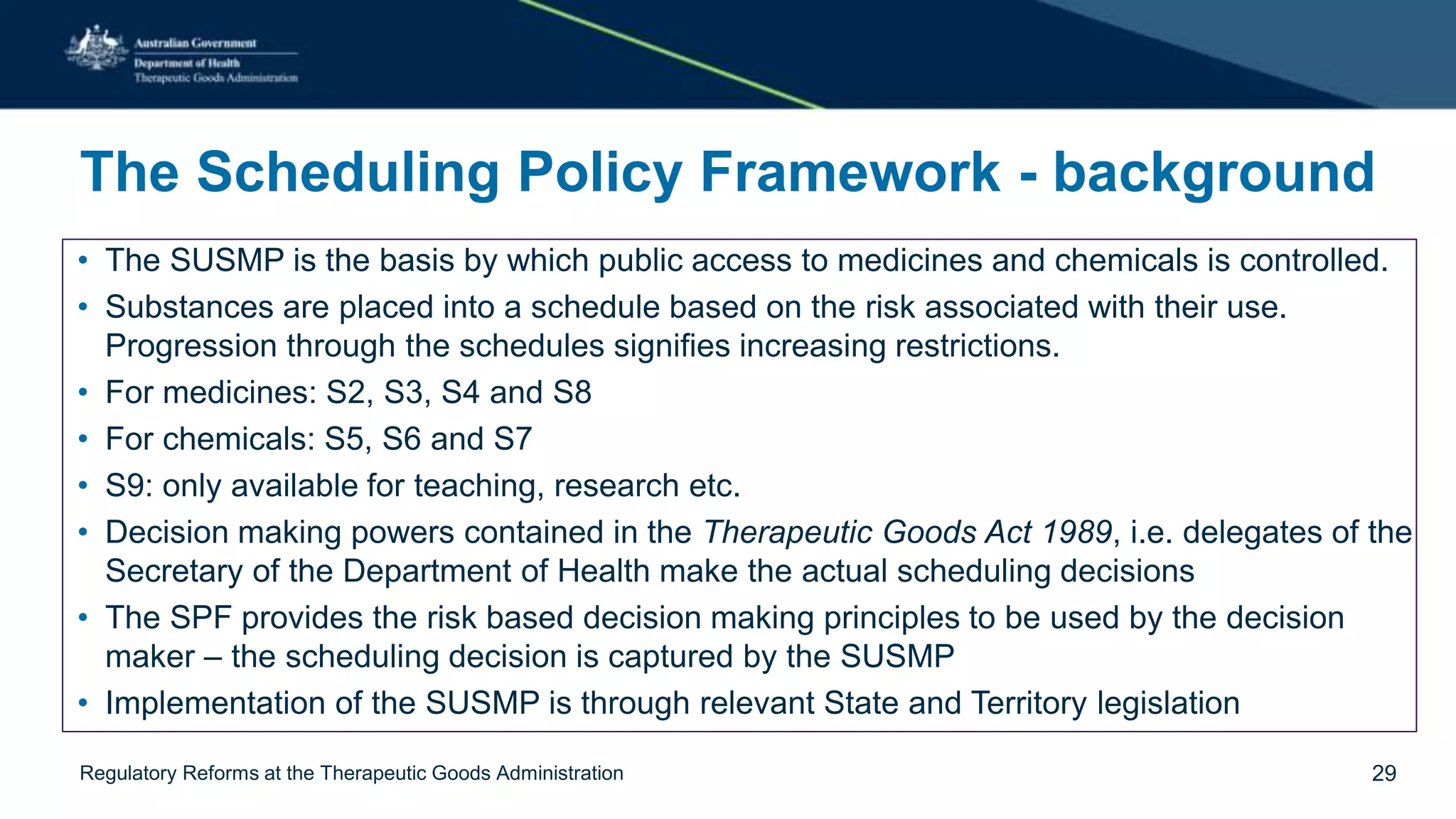
The Scheduling Policy Framework - background
• The SUSMP is the basis by which public access to medicines and chemicals is controlled.
• Substances are placed into a schedule based on the risk associated with their use.
Progression through the schedules signifies increasing restrictions.
• For medicines: S2, S3, S4 and S8
• For chemicals: S5, S6 and S7
• S9: only available for teaching, research etc.
• Decision making powers contained in the Therapeutic Goods Act 1989, i.e. delegates of the
Secretary of the Department of Health make the actual scheduling decisions
• The SPF provides the risk based decision making principles to be used by the decision
maker – the scheduling decision is captured by the SUSMP
• Implementation of the SUSMP is through relevant State and Territory legislation
Regulatory Reforms at the Therapeutic Goods Administration 29
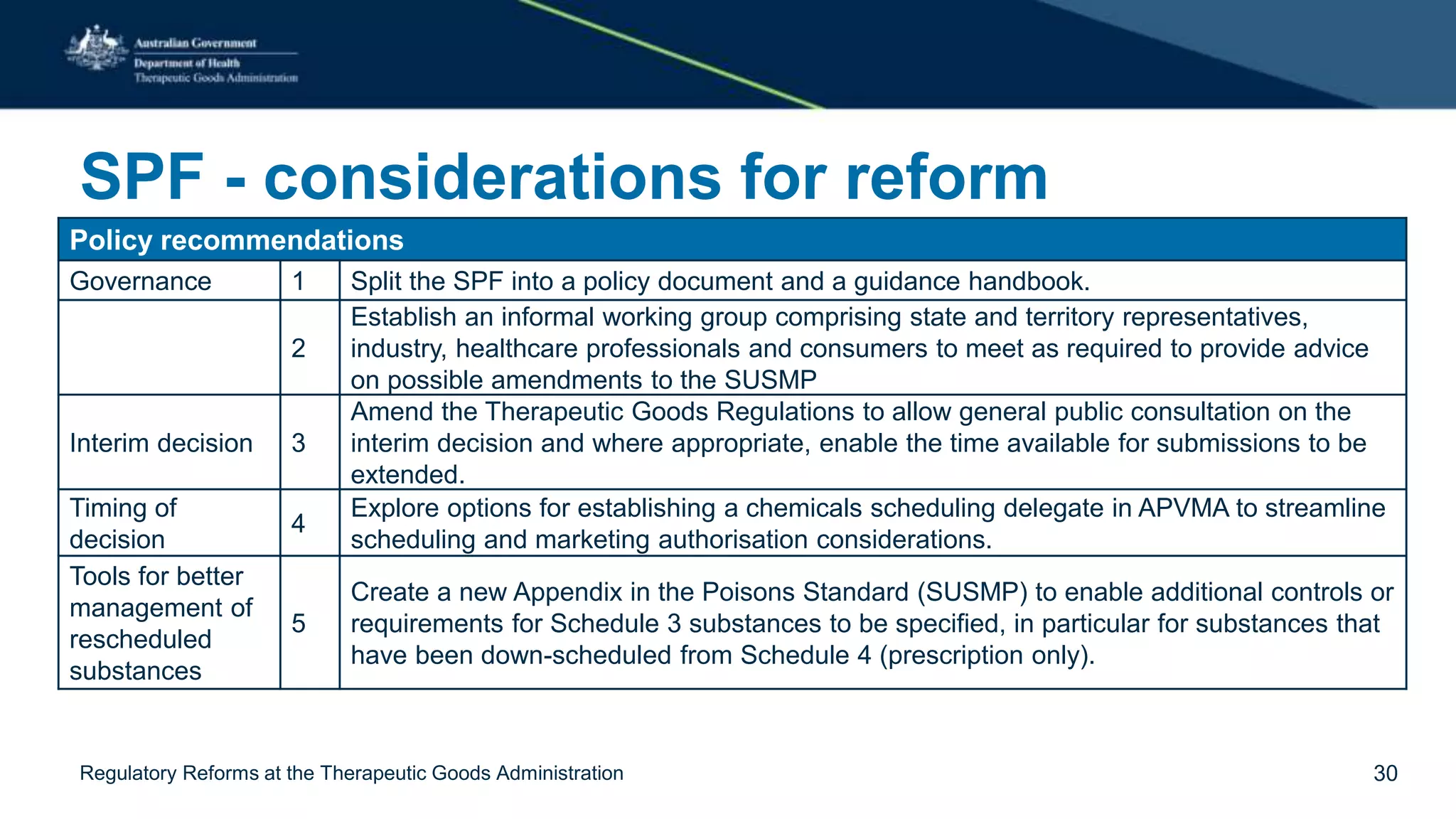
SPF - considerations for reform
Policy recommendations
Governance 1 Split the SPF into a policy document and a guidance handbook.
2
Establish an informal working group comprising state and territory representatives,
industry, healthcare professionals and consumers to meet as required to provide advice
on possible amendments to the SUSMP
Interim decision 3
Amend the Therapeutic Goods Regulations to allow general public consultation on the
interim decision and where appropriate, enable the time available for submissions to be
extended.
Timing of
decision
4
Explore options for establishing a chemicals scheduling delegate in APVMA to streamline
scheduling and marketing authorisation considerations.
Tools for better
management of
rescheduled
substances
5
Create a new Appendix in the Poisons Standard (SUSMP) to enable additional controls or
requirements for Schedule 3 substances to be specified, in particular for substances that
have been down-scheduled from Schedule 4 (prescription only).
Regulatory Reforms at the Therapeutic Goods Administration 30
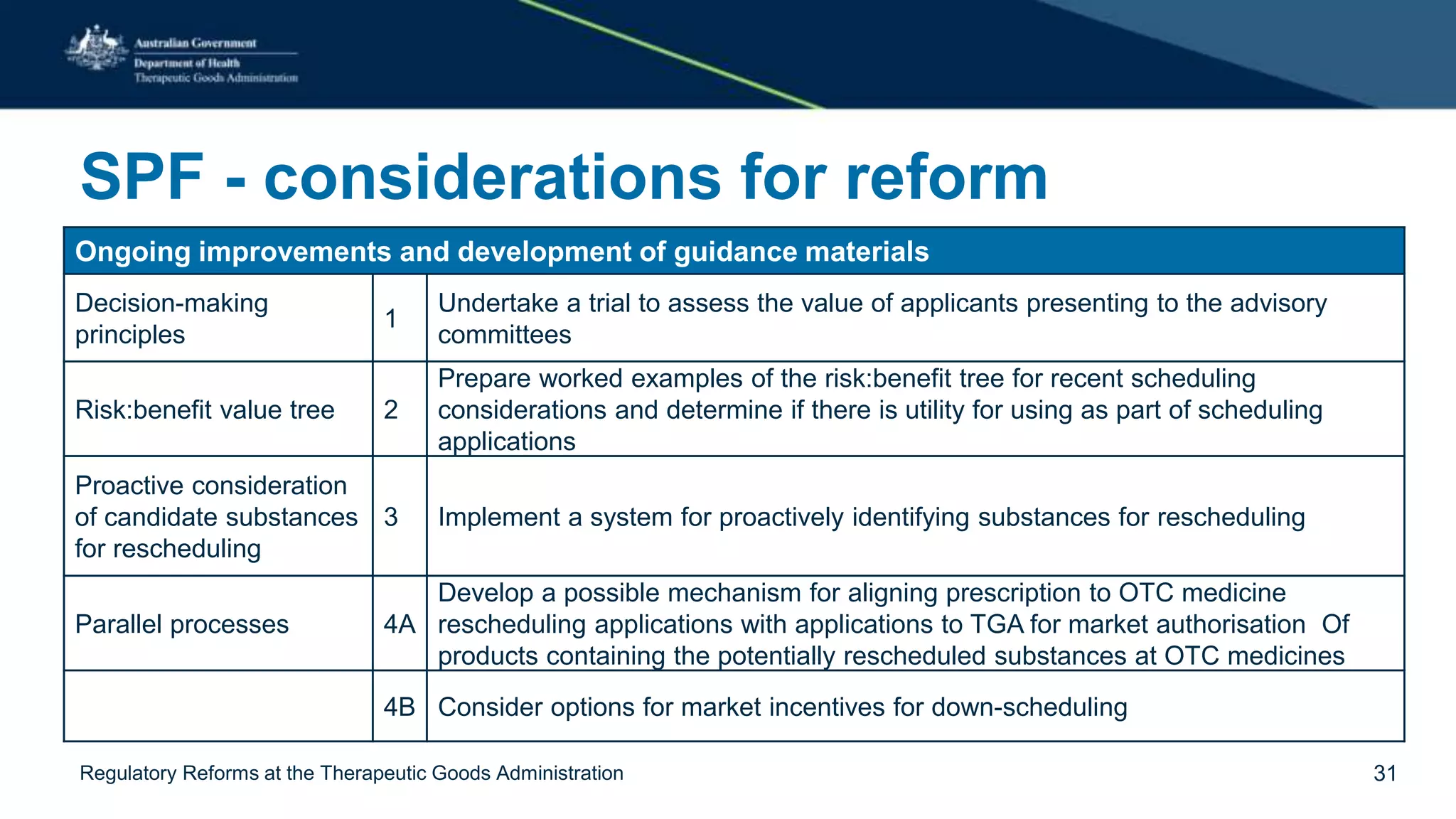
SPF - considerations for reform
Ongoing improvements and development of guidance materials
Decision-making
principles
1
Undertake a trial to assess the value of applicants presenting to the advisory
committees
Risk:benefit value tree 2
Prepare worked examples of the risk:benefit tree for recent scheduling
considerations and determine if there is utility for using as part of scheduling
applications
Proactive consideration
of candidate substances
for rescheduling
3 Implement a system for proactively identifying substances for rescheduling
Parallel processes 4A
Develop a possible mechanism for aligning prescription to OTC medicine
rescheduling applications with applications to TGA for market authorisation Of
products containing the potentially rescheduled substances at OTC medicines
4B Consider options for market incentives for down-scheduling
Regulatory Reforms at the Therapeutic Goods Administration 31
S3 (pharmacist only) medicines advertising
• Currently only a limited number of S3 medicines can be advertised – managed
through an appendix to the SUSMP
• The Expert Panel found very diverse views on possible change
– And whether the current situation led to unnecessary GP visits
• Government has asked for more specific consultation to be conducted
• Options canvassed by stakeholders in 2015 workshops, included:
– Make no change to the current system
– Move instead to having a small list of substances forbidden from advertising
– Move to a self-regulatory approach
– Allow “information provision” by industry but not advertising
• Current consultation is asking stakeholders for their feedback on these possible options in order to
develop a new framework for the advertising of these substances
Regulatory Reforms at the Therapeutic Goods Administration 32
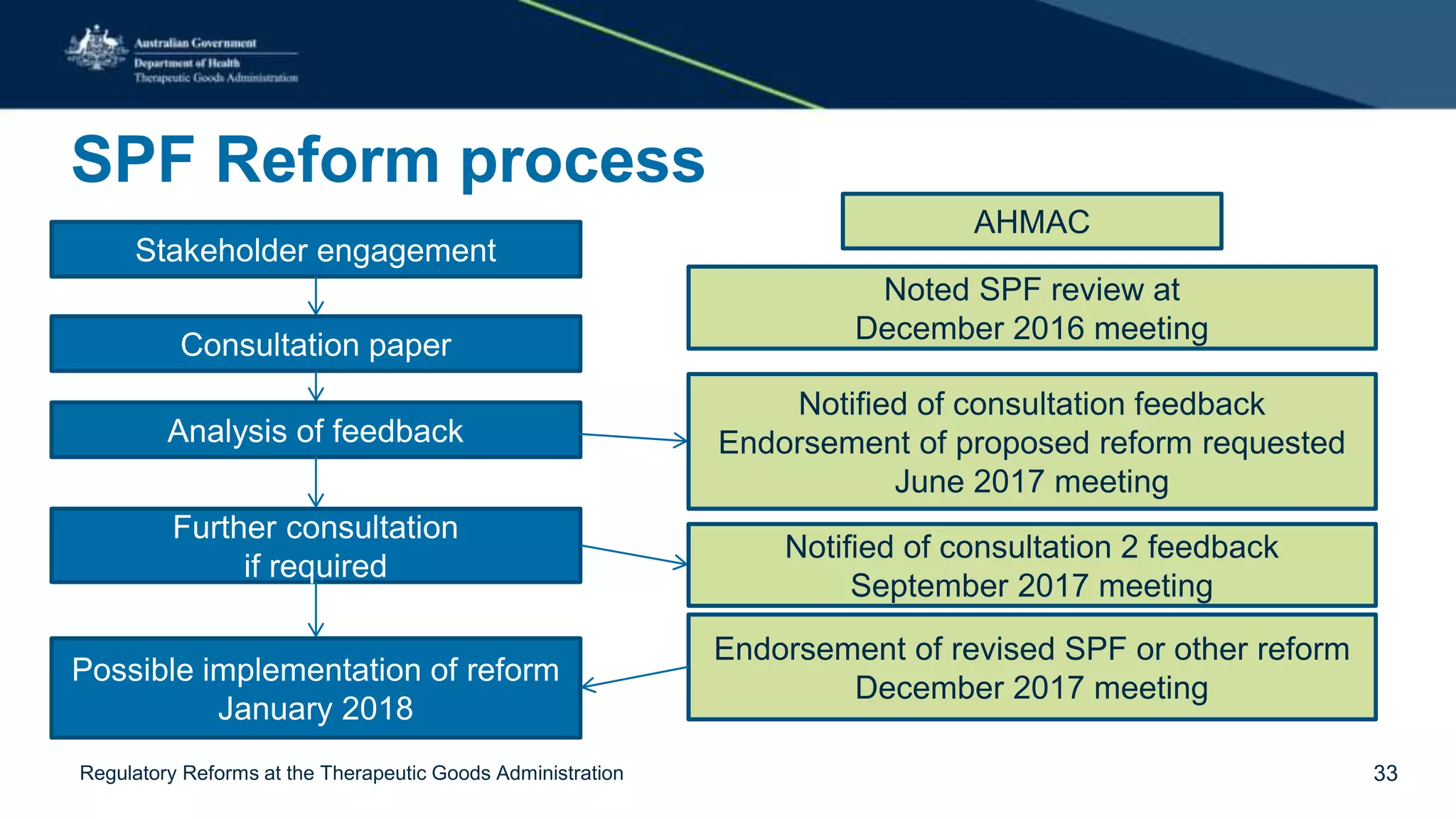
SPF Reform process
AHMAC
Stakeholder engagement
Consultation paper
Noted SPF review at
December 2016 meeting
Analysis of feedback
Notified of consultation feedback
Endorsement of proposed reform requested
June 2017 meeting
Further consultation
if required
Notified of consultation 2 feedback
September 2017 meeting
Possible implementation of reform
January 2018
Endorsement of revised SPF or other reform
December 2017 meeting
Regulatory Reforms at the Therapeutic Goods Administration 33
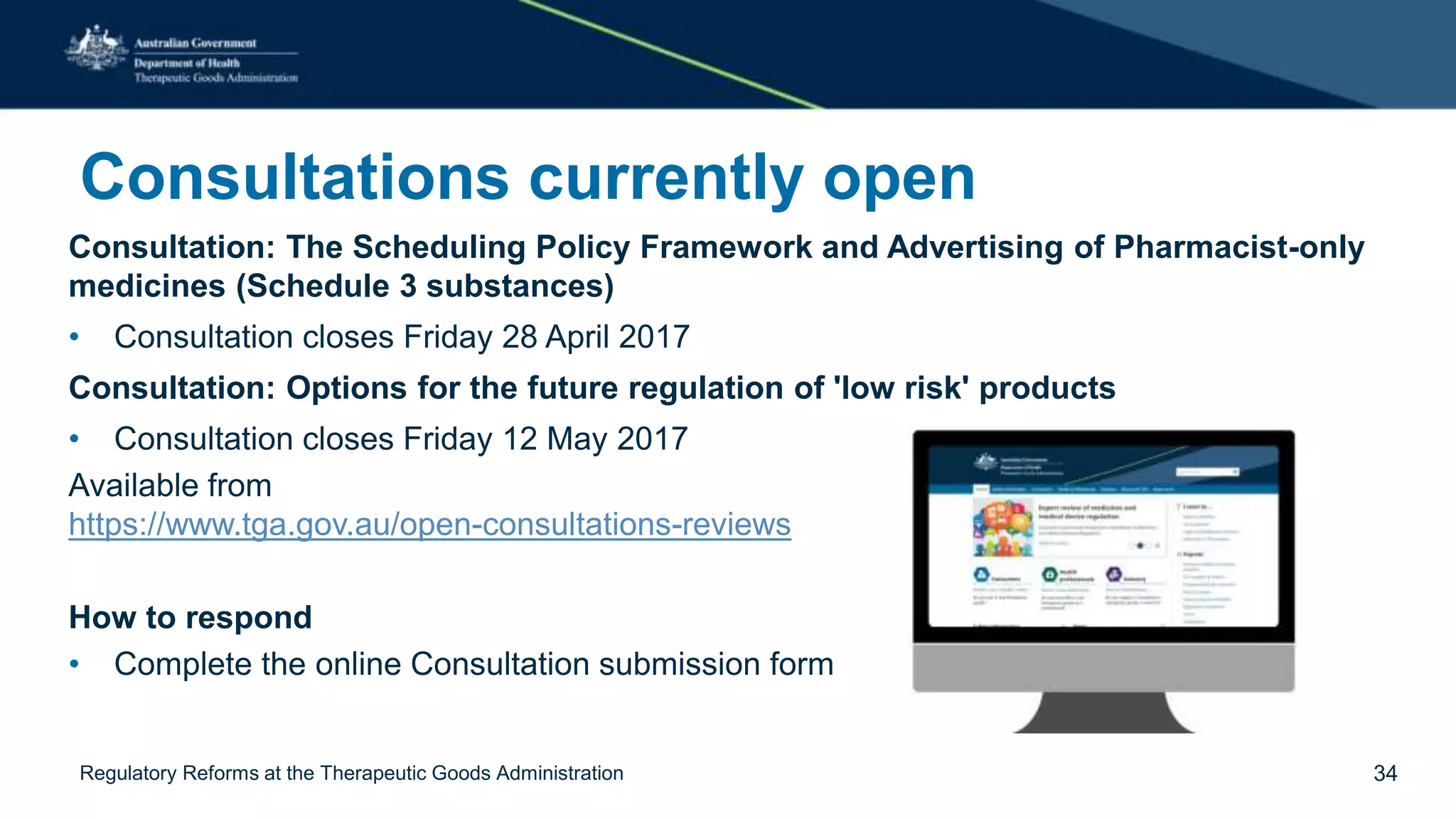
Consultations currently open
Consultation: The Scheduling Policy Framework and Advertising of Pharmacist-only
medicines (Schedule 3 substances)
• Consultation closes Friday 28 April 2017
Consultation: Options for the future regulation of 'low risk' products
• Consultation closes Friday 12 May 2017
Available from
https://www.tga.gov.au/open-consultations-reviews
How to respond
• Complete the online Consultation submission form
Regulatory Reforms at the Therapeutic Goods Administration 34
Consultations currently open
The Scheduling Policy Framework and Advertising of
Pharmacist-only medicines (Schedule 3 substances)
• Consultation closes Friday 28 April 2017
Options for the future regulation of 'low risk' products
• Consultation closes Friday 12 May 2017
Regulatory Reforms at the Therapeutic Goods Administration 35
Questions?
Any questions relating to consultation submissions can be directed to the
Regulatory Reforms Team by email to tgaregreforms@health.gov.au
36
Find out more:
www.tga.gov.au/mmdr
MMDRconsultation@health.gov.au
tgaregreforms@health.gov.au
Presentation: Regulatory reforms at the Therapeutic Goods Administration

Presentation: Regulatory reforms at the Therapeutic Goods Administration

  • 1.
    Regulatory Reforms atthe Therapeutic Goods Administration (TGA) Dr Mark McDonald Assistant Secretary, Regulatory Reforms, TGA CMA Complementary Medicines Regulatory Obligations Seminar 11 April 2017
  • 2.
    About the TGA(briefly) • Part of the Commonwealth Department of Health, but separately located and with its own strong external brand • HQ in Canberra with 5 satellite offices • Approx. 700 staff plus 80 contractors: scientists, engineers, toxicologists, technicians, medical officers, pharmacists, lawyers and administrative staff • Budget of $150m pa • Virtually all of TGA’s operations are cost recovered from industry fees and charges - unique globally among medicines and device regulatory bodies Regulatory Reforms at the Therapeutic Goods Administration 1
  • 3.
    Locations • The majorityof TGA staff are located at the Symonston site in Canberra • This building has combined office space with extensive scientific laboratories • Some TGA are co-located with Department of Health colleagues at the Department’s Central Office in Woden • TGA also has staff in Sydney, Melbourne, Adelaide and Brisbane 2Regulatory Reforms at the Therapeutic Goods Administration
  • 4.
    TGA’s role • Regulatetherapeutic goods including prescription, over-the-counter and complementary medicines, medical devices, biologicals, blood and blood products • Evaluates therapeutic goods before they are marketed and monitors products once they are on the market • Assesses suitability of medicines and devices for export • Focuses on safety, efficacy and quality • Works closely with consumers, health professionals, industry and international counterparts Regulatory Reforms at the Therapeutic Goods Administration 3
  • 5.
    Department of Health OrganisationalStructure Secretary Chief Operating Officer Strategic Policy and Innovation Health Benefits National Program Delivery Health Products Regulation Health Protection/ CMO Special Adviser: Strategic Health Systems and Information Mgt Regulatory Reforms at the Therapeutic Goods Administration 4
  • 6.
    Risk management All therapeuticgoods have some level of risk Our role is to see that benefits outweigh known risks Management of uncertainty is a greater challenge TGA’s approach to risk management involves: • identifying, assessing and evaluating the risks posed by therapeutic products • applying any measures necessary for treating the risks posed • monitoring and reviewing risks over time. Regulatory Reforms at the Therapeutic Goods Administration 5
  • 7.
    Can regulators manageuncertainty well enough? • Regulators have frameworks for assessing benefits and harms (risk) but less with uncertainty • Uncertainty and harms can be confused, with negative consequences for decision making • A balance between the two is needed, combining the science with an appropriately designed regulatory framework Regulatory Reforms at the Therapeutic Goods Administration 6
  • 8.
    Review of Medicines& Medical Devices Regulation • Expert Panel commenced late 2014 after most of 2014 in pre-work • Review process included discussion papers, submissions and interviews by the panel • Two reports on medicines and devices and complementary medicines and advertising released during 2015 with 58 recommendations • Following release of the reports, workshops held with key stakeholders by the Department to get feedback on recommendations • Health Minister took preferred position to Cabinet • Government response was publicly released on 15 September 2016 Regulatory Reforms at the Therapeutic Goods Administration 7
  • 9.
    Key principles endorsedby Government • The Australian Government retain responsibility for approval of therapeutic goods rather than automatically accepting international approvals, but TGA needs to: − make greater use of overseas evaluations − introduce greater flexibility in approval pathways for both medicines and medical devices − more appropriately align level regulation with the actual risk posed by certain types of products Regulatory Reforms at the Therapeutic Goods Administration 8
  • 10.
    Further reviews tobe undertaken In scope • Medicines (and chemicals) Scheduling Policy Framework • Schedule 3 medicine advertising guidelines • Review regulation of lower-risk medicines Proposed process • Document the basis of current approaches, approach of other regulators, and alternative frameworks • Conduct stakeholder workshops • Consultation papers and formal feedback on options • Provide advice to Minister on options • Ministerial decision, change to regulations ? Regulatory Reforms at the Therapeutic Goods Administration 9
  • 11.
    To Regulate orNot to Regulate • TGA regulatory frameworks – Exempt goods – Excluded goods • Consumer goods (ACCC) Regulatory Reforms at the Therapeutic Goods Administration 10
  • 12.
    Guiding principles ofthe review • Not our intention to fundamentally change the definition of a medicine or medical device • What is the purpose of our regulation • Considered the concept of ‘regulatory familiarity’ of particular products • Recognised that moving some product types to regulation by Food Standards Australian New Zealand (FSANZ) or under the National Industrial Chemicals Notification and Assessment Scheme (NICNAS) are not necessarily options that provide for decreasing regulation. • Australian Consumer Law provides for default Australian Competition and Consumer Commission (ACCC) oversight of all consumer goods in Australia under Australian Consumer Law, including therapeutic goods used by consumers. Regulatory Reforms at the Therapeutic Goods Administration 11
  • 13.
    Next steps: Identifyproduct types in scope • Water-soluble vitamins and minerals, homeopathic products? • Medicated lozenges • Primary and secondary sunscreens • Disinfectants, medicated soaps and toothpastes, nappy rash treatments • Some class one medical devices • Sanitary tampons • Other products? Regulatory Reforms at the Therapeutic Goods Administration 12
  • 14.
    Next steps: Developa risk framework • How to define “low risk”? • For medicinal products, this could include parameters such as: – safety of the ingredients – route of administration – risk associated with the claims including labelled use – nature of the condition being treated/ prevented – nature and number of the population using the product – impact of poor manufacturing quality on safety/ efficacy • Regulatory “familiarity” does this reduce uncertainty or actual risks? • What is the ability of sponsors to objectively self-assess the product ? • Look at international experience / alternative regulatory approaches Regulatory Reforms at the Therapeutic Goods Administration 13
  • 15.
    Low Risk ClassificationSystem • To objectively determine if products are ‘low risk’ the TGA developed a Low Risk Classification System (LRCS) in consultation with experts in this area from the University of Melbourne • The basic principle of the LCRS • This approach is increasing used to publicly rate hotels and restaurants (e.g. on “Trip Advisor”), car smash repairers and even health care providers “Wisdom of crowds” Linear model Rate Experts qualitatively rate a product on each of six criteria Combine Take average of ratings on each criterion Weight Multiply averaged ratings by criteria weights Sum Calculate a product’s Score as sum of weighted ratings Classify Low Risk if Score Less than Threshold Regulatory Reforms at the Therapeutic Goods Administration 14
  • 16.
    So what wasconsidered ‘low risk’ In the context of Recommendation 14 of this review the following was considered ‘low risk’: • Ear candles • Nappy rash creams • Antiperspirants • ‘Low risk’ OTC medicines • Hard surface disinfectants • Sunscreens • Tampons and menstrual cups TGA developed a range of possible options that represent potential future regulatory approaches. Regulatory Reforms at the Therapeutic Goods Administration 15
  • 17.
    ‘Low risk’ OTCmedicines A number of well-known OTC products that have a long history of use at particular ingredient levels and dosage forms have been identified as ‘lower risk’. These product types include: • Registered desensitising toothpastes • Antiseptics for first aid treatment of minor cuts and abrasions • Lozenges for relief of sore throats (these contain anti-microbial active ingredients) • Antacids – containing carbonates, hydroxides, silicates, and/or alginates (but not medicines containing a proton pump inhibitor or H2 antagonist) • Salicylic acid plasters for removal of corns and warts • Menthol-based inhalers and chest rubs Regulatory Reforms at the Therapeutic Goods Administration 16
  • 18.
    ‘Low risk’ OTCmedicines Product types continued: • Antiseptic mouth washes • Acne treatments containing benzoyl peroxide • Rubefacient preparations for minor aches and pains of muscles (e.g. methyl salicylate, menthol, capsicum) but not creams or ointments containing a non-steroidal anti- inflammatory medicine • Certain laxatives Options • Maintain the status quo regulation • Review the eligibility of active ingredients to become Listable Regulatory Reforms at the Therapeutic Goods Administration 17
  • 19.
    Hard surface disinfectants Issuesidentified by stakeholders with the current framework include: • Regulatory requirements are confusing • Timeframes for application processing are very long • Safety evaluations for different formulations are expensive Range of options: • Maintain the status quo regulation of hard surface disinfectants • Streamline the regulatory framework for hard surface disinfectants • Develop a series of monographs • Approval process for new ingredients • Declare hard surface disinfectants not to be therapeutic goods Regulatory Reforms at the Therapeutic Goods Administration 18
  • 20.
    Sunscreens Issues identified bystakeholders with the current framework include: • Medicine level GMP • Process for review of new ingredients slow and expensive • Application of pharmacopeial standards for all ingredients • Different levels of regulation confusing Range of options: • Maintain the status quo regulation of sunscreens. • Streamline the regulatory pathways for sunscreen regulation. • Prevent all secondary sunscreens from making SPF claims. • Creation of a GMP standard for primary sunscreens. • New ingredient approval process. • Alternative ingredient standards for excipients. • Exclude all sunscreens from the regulatory framework. Regulatory Reforms at the Therapeutic Goods Administration 19
  • 21.
    So what wasconsidered ‘low risk’ Recommendation 23 was the review of Class I medical devices. • To maintain international harmonisation we did not want to fundamentally change the classification system for medical devices. • Whilst trying to identify candidates for consideration it was recognised that there is a significant number of potentially non therapeutic goods in the ARTG • Proposal is to clean up the ARTG to remove the ‘white noise’ before taking a look at those remaining Class I medical devices, and consider any further regulatory changes. Regulatory Reforms at the Therapeutic Goods Administration 20
  • 22.
    Proposed next stepsfor Class I medical devices • Systematic review of ARTG to identify non therapeutic goods • Engage with States and Territories Health department procurement branches • Update the Excluded Goods Order • Review the Class I medical device ARTG entry process Regulatory Reforms at the Therapeutic Goods Administration 21
  • 23.
    So what wasconsidered ‘low risk’ In the context of Recommendation 48 of this review the following was considered ‘low risk’: • Aromatherapy products • Rehydration or formulated sports products • Certain vitamins and minerals • Homoeopathic products Again, TGA developed a range of possible options that represent future regulatory approaches. Regulatory Reforms at the Therapeutic Goods Administration 22
  • 24.
    Aromatherapy products Aromatherapy usesessential oils for the purpose of altering one's mood, cognitive, psychological or physical wellbeing. Issues with the current approach include: • the purpose of a product containing an essential oil determines which part of government regulates it. • The difference between therapeutic and cosmetic products can be confusing. Range of options: • Maintain the status quo regulation of aromatherapy products • Exemption from listing in the ARTG and/or GMP • Declare essential oils not to be therapeutic goods Regulatory Reforms at the Therapeutic Goods Administration 23
  • 25.
    Rehydration or formulatedsports products Issue with the current approach include: • confusion at the food-medicine interface • the dosage forms for these products range from sachets of oral powders and effervescent tablets to ice blocks and ready to drink solutions. • rehydration products are similar in composition and presentation to electrolyte drinks, also known as sports drinks, which are beverages designed specifically for the rapid replacement of fluid, carbohydrates, and electrolytes. Proposed further action: • Review of rehydration products on the ARTG to remove food claims to ensure clear demarcation between sports drinks and therapeutic rehydration products. Regulatory Reforms at the Therapeutic Goods Administration 24
  • 26.
    Certain vitamins andminerals Not all of these supplements represent equal risk. • Water soluble vitamins (for example vitamin C) have a lower risk profile than fat soluble vitamins (for example vitamin A) as they are readily excreted from the body, whereas fat soluble vitamins have been associated with toxicity. • Similarly minerals such as calcium have a lower risk profile, compared to higher risk minerals which are included in a schedule of the Poisons Standard, such as some iron preparations. Regulatory Reforms at the Therapeutic Goods Administration 25
  • 27.
    Certain vitamins andminerals Issues with the current approach include: • the introduction of Standard 1.2.7 – Nutrition, Health and Related Claims in 2013 by Food Standards Australia New Zealand (FSANZ) has caused a significant change to the food/medicine interface • Some vitamin and mineral products are more akin to food or dietary supplements than medicines Range of options: • Maintain the status quo regulation of vitamins and minerals • Exemption from listing in the ARTG and/or GMP • Declare vitamins and mineral not to be therapeutic goods Regulatory Reforms at the Therapeutic Goods Administration 26
  • 28.
    Homoeopathic products • Homoeopathicpreparations (4X and above) are exempt from being entered in the ARTG if they: – are not required to be sterile, – do not include ingredients of human or animal origin, and – do not make reference to serious diseases or conditions. • Preparations that meet these conditions are also exempt from requiring the manufacturer to hold a GMP licence Regulatory Reforms at the Therapeutic Goods Administration 27
  • 29.
    Homoeopathic products Issues identifiedwith the current approach include: • Questionable evidence • Inconsistency in regulation for level of claims being made, ie homoeopathic products making high level claims must be listed. Other non homoeopathic products making high level claims are required to be registered. Range of options: • Maintain the status quo regulation of homoeopathic products • Serious therapeutic claims must be supported by scientific evidence. • Exemption from listing in the ARTG and/or GMP • Declare homeopathic products not to be therapeutic goods Regulatory Reforms at the Therapeutic Goods Administration 28
  • 30.
    The Scheduling PolicyFramework - background • The SUSMP is the basis by which public access to medicines and chemicals is controlled. • Substances are placed into a schedule based on the risk associated with their use. Progression through the schedules signifies increasing restrictions. • For medicines: S2, S3, S4 and S8 • For chemicals: S5, S6 and S7 • S9: only available for teaching, research etc. • Decision making powers contained in the Therapeutic Goods Act 1989, i.e. delegates of the Secretary of the Department of Health make the actual scheduling decisions • The SPF provides the risk based decision making principles to be used by the decision maker – the scheduling decision is captured by the SUSMP • Implementation of the SUSMP is through relevant State and Territory legislation Regulatory Reforms at the Therapeutic Goods Administration 29
  • 31.
    SPF - considerationsfor reform Policy recommendations Governance 1 Split the SPF into a policy document and a guidance handbook. 2 Establish an informal working group comprising state and territory representatives, industry, healthcare professionals and consumers to meet as required to provide advice on possible amendments to the SUSMP Interim decision 3 Amend the Therapeutic Goods Regulations to allow general public consultation on the interim decision and where appropriate, enable the time available for submissions to be extended. Timing of decision 4 Explore options for establishing a chemicals scheduling delegate in APVMA to streamline scheduling and marketing authorisation considerations. Tools for better management of rescheduled substances 5 Create a new Appendix in the Poisons Standard (SUSMP) to enable additional controls or requirements for Schedule 3 substances to be specified, in particular for substances that have been down-scheduled from Schedule 4 (prescription only). Regulatory Reforms at the Therapeutic Goods Administration 30
  • 32.
    SPF - considerationsfor reform Ongoing improvements and development of guidance materials Decision-making principles 1 Undertake a trial to assess the value of applicants presenting to the advisory committees Risk:benefit value tree 2 Prepare worked examples of the risk:benefit tree for recent scheduling considerations and determine if there is utility for using as part of scheduling applications Proactive consideration of candidate substances for rescheduling 3 Implement a system for proactively identifying substances for rescheduling Parallel processes 4A Develop a possible mechanism for aligning prescription to OTC medicine rescheduling applications with applications to TGA for market authorisation Of products containing the potentially rescheduled substances at OTC medicines 4B Consider options for market incentives for down-scheduling Regulatory Reforms at the Therapeutic Goods Administration 31
  • 33.
    S3 (pharmacist only)medicines advertising • Currently only a limited number of S3 medicines can be advertised – managed through an appendix to the SUSMP • The Expert Panel found very diverse views on possible change – And whether the current situation led to unnecessary GP visits • Government has asked for more specific consultation to be conducted • Options canvassed by stakeholders in 2015 workshops, included: – Make no change to the current system – Move instead to having a small list of substances forbidden from advertising – Move to a self-regulatory approach – Allow “information provision” by industry but not advertising • Current consultation is asking stakeholders for their feedback on these possible options in order to develop a new framework for the advertising of these substances Regulatory Reforms at the Therapeutic Goods Administration 32
  • 34.
    SPF Reform process AHMAC Stakeholderengagement Consultation paper Noted SPF review at December 2016 meeting Analysis of feedback Notified of consultation feedback Endorsement of proposed reform requested June 2017 meeting Further consultation if required Notified of consultation 2 feedback September 2017 meeting Possible implementation of reform January 2018 Endorsement of revised SPF or other reform December 2017 meeting Regulatory Reforms at the Therapeutic Goods Administration 33
  • 35.
    Consultations currently open Consultation:The Scheduling Policy Framework and Advertising of Pharmacist-only medicines (Schedule 3 substances) • Consultation closes Friday 28 April 2017 Consultation: Options for the future regulation of 'low risk' products • Consultation closes Friday 12 May 2017 Available from https://www.tga.gov.au/open-consultations-reviews How to respond • Complete the online Consultation submission form Regulatory Reforms at the Therapeutic Goods Administration 34
  • 36.
    Consultations currently open TheScheduling Policy Framework and Advertising of Pharmacist-only medicines (Schedule 3 substances) • Consultation closes Friday 28 April 2017 Options for the future regulation of 'low risk' products • Consultation closes Friday 12 May 2017 Regulatory Reforms at the Therapeutic Goods Administration 35
  • 37.
    Questions? Any questions relatingto consultation submissions can be directed to the Regulatory Reforms Team by email to tgaregreforms@health.gov.au 36
  • 38.