THERAPEUTIC
GOODS
ORGANIZATION(TGA)
PRESENTED BY: KEERTHANA N
PHARMACEUTICAL REGULATORY AFFAIRS
M PHARM
DEPARTMENT OF PHARMACEUTICS
T JOHN COLLEGE OF PHARMACY
THERAPEUTIC GOODS
ADMISTRATION IS A UNIT OF
AUSTRALIAN GOVERNMENT
DEPARTMENT OF HEALTH AND
AGING , IS RESPONSIBLE FOR
ADMINISTERING THE ACT .
THIS CAME INTO EFFECT ON 15TH FEBRUARY 1991
OBJECTIVES
• To provide national framework for the regulation of
therapeutic goods in Australia
• To safeguard and enhance the health of the Australian
community through the effective and timely regulation of
therapeutic goods .
• Ensure the quality, safety and efficacy of medicine and
ensure the quality , safety and performance of medical
devices
• Essentially therapeutic goods must be entered on the
Australian register of therapeutic goods (ARTG) before
they can be supplied in Australia .
3
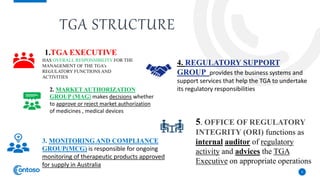
TGA STRUCTURE
4
1.TGA EXECUTIVE
HAS OVERALL RESPONSIBILITY FOR THE
MANAGEMENT OF THE TGA’s
REGULATORY FUNCTIONS AND
ACTIVITIES
2. MARKET AUTHORIZATION
GROUP (MAG) makes decisions whether
to approve or reject market authorization
of medicines , medical devices
3. MONITORING AND COMPLIANCE
GROUP(MCG) is responsible for ongoing
monitoring of therapeutic products approved
for supply in Australia
4. REGULATORY SUPPORT
GROUP provides the business systems and
support services that help the TGA to undertake
its regulatory responsibilities
5. OFFICE OF REGULATORY
INTEGRITY (ORI) functions as
internal auditor of regulatory
activity and advices the TGA
Executive on appropriate operations
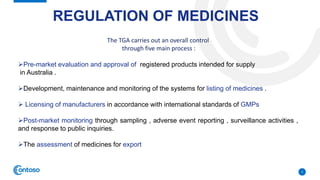
REGULATION OF MEDICINES
5
The TGA carries out an overall control
through five main process :
Pre-market evaluation and approval of registered products intended for supply
in Australia .
Development, maintenance and monitoring of the systems for listing of medicines .
 Licensing of manufacturers in accordance with international standards of GMPs
Post-market monitoring through sampling , adverse event reporting , surveillance activities ,
and response to public inquiries.
The assessment of medicines for export
6
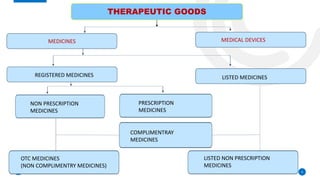
THERAPEUTIC GOODS
MEDICINES MEDICAL DEVICES
LISTED MEDICINES
REGISTERED MEDICINES
NON PRESCRIPTION
MEDICINES
PRESCRIPTION
MEDICINES
COMPLIMENTRAY
MEDICINES
OTC MEDICINES
(NON COMPLIMENTRY MEDICINES)
LISTED NON PRESCRIPTION
MEDICINES
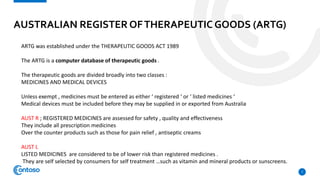
AUSTRALIAN REGISTER OFTHERAPEUTIC GOODS (ARTG)
7
ARTG was established under the THERAPEUTIC GOODS ACT 1989
The ARTG is a computer database of therapeutic goods .
The therapeutic goods are divided broadly into two classes :
MEDICINES AND MEDICAL DEVICES
Unless exempt , medicines must be entered as either ‘ registered ‘ or ‘ listed medicines ‘
Medical devices must be included before they may be supplied in or exported from Australia
AUST R ; REGISTERED MEDICINES are assessed for safety , quality and effectiveness
They include all prescription medicines
Over the counter products such as those for pain relief , antiseptic creams
AUST L
LISTED MEDICINES are considered to be of lower risk than registered medicines .
They are self selected by consumers for self treatment …such as vitamin and mineral products or sunscreens.
LISTED MEDICINES
8
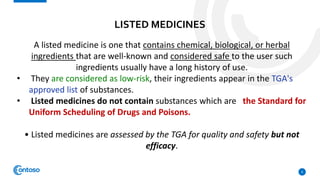
A listed medicine is one that contains chemical, biological, or herbal
ingredients that are well-known and considered safe to the user such
ingredients usually have a long history of use.
• They are considered as low-risk, their ingredients appear in the TGA's
approved list of substances.
• Listed medicines do not contain substances which are the Standard for
Uniform Scheduling of Drugs and Poisons.
• Listed medicines are assessed by the TGA for quality and safety but not
efficacy.
9
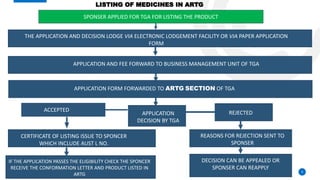
SPONSER APPLIED FOR TGA FOR LISTING THE PRODUCT
THE APPLICATION AND DECISION LODGE VIA ELECTRONIC LODGEMENT FACILITY OR VIA PAPER APPLICATION
FORM
APPLICATION AND FEE FORWARD TO BUSINESS MANAGEMENT UNIT OF TGA
APPLICATION FORM FORWARDED TO ARTG SECTION OF TGA
ACCEPTED
APPLICATION
DECISION BY TGA
REJECTED
REASONS FOR REJECTION SENT TO
SPONSER
DECISION CAN BE APPEALED OR
SPONSER CAN REAPPLY
CERTIFICATE OF LISTING ISSUE TO SPONCER
WHICH INCLUDE AUST L NO.
IF THE APPLICATION PASSES THE ELIGIBILITY CHECK THE SPONCER
RECEIVE THE CONFORMATION LETTER AND PRODUCT LISTED IN
ARTG
LISTING OF MEDICINES IN ARTG
REGISTERED MEDICINES
10
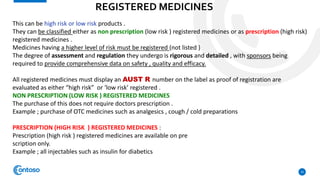
This can be high risk or low risk products .
They can be classified either as non prescription (low risk ) registered medicines or as prescription (high risk)
registered medicines .
Medicines having a higher level of risk must be registered (not listed )
The degree of assessment and regulation they undergo is rigorous and detailed , with sponsors being
required to provide comprehensive data on safety , quality and efficacy.
All registered medicines must display an AUST R number on the label as proof of registration are
evaluated as either “high risk” or ‘low risk’ registered .
NON PRESCRIPTION (LOW RISK ) REGISTERED MEDICINES
The purchase of this does not require doctors prescription .
Example ; purchase of OTC medicines such as analgesics , cough / cold preparations
PRESCRIPTION (HIGH RISK ) REGISTERED MEDICINES :
Prescription (high risk ) registered medicines are available on pre
scription only.
Example ; all injectables such as insulin for diabetics
11
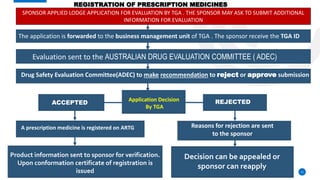
SPONSOR APPLIED LODGE APPLICATION FOR EVALUATION BY TGA . THE SPONSOR MAY ASK TO SUBMIT ADDITIONAL
INFORMATION FOR EVALUATION
REGISTRATION OF PRESCRIPTION MEDICINES
The application is forwarded to the business management unit of TGA . The sponsor receive the TGA ID
no.
Evaluation sent to the AUSTRALIAN DRUG EVALUATION COMMITTEE ( ADEC)
Drug Safety Evaluation Committee(ADEC) to make recommendation to reject or approve submission
ACCEPTED REJECTED
Application Decision
By TGA
A prescription medicine is registered on ARTG Reasons for rejection are sent
to the sponsor
Product information sent to sponsor for verification.
Upon conformation certificate of registration is
issued
Decision can be appealed or
sponsor can reapply
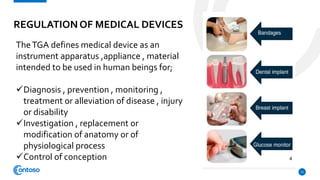
REGULATION OF MEDICAL DEVICES
12
TheTGA defines medical device as an
instrument apparatus ,appliance , material
intended to be used in human beings for;
Diagnosis , prevention , monitoring ,
treatment or alleviation of disease , injury
or disability
Investigation , replacement or
modification of anatomy or of
physiological process
Control of conception
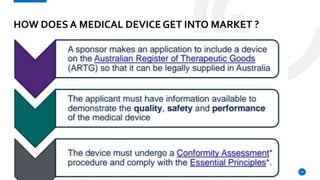
HOW DOES A MEDICAL DEVICE GET INTO MARKET ?
13
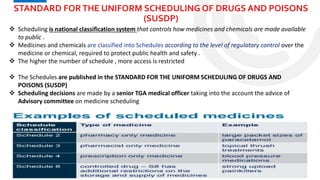
STANDARD FORTHE UNIFORM SCHEDULING OF DRUGS AND POISONS
(SUSDP)
14
 Scheduling is national classification system that controls how medicines and chemicals are made available
to public .
 Medicines and chemicals are classified into Schedules according to the level of regulatory control over the
medicine or chemical, required to protect public health and safety .
 The higher the number of schedule , more access is restricted
 The Schedules are published in the STANDARD FOR THE UNIFORM SCHEDULING OF DRUGS AND
POISONS (SUSDP)
 Scheduling decisions are made by a senior TGA medical officer taking into the account the advice of
Advisory committee on medicine scheduling
TGA AS WORLD CLASS REGULATOR
15
TheTGA has invested significant effort into establishing itself as a leading regulator
of therapeutic goods.This has involved;
attracting staff with the right balance of technical and regulatory skills
supplementing this world-class expertise with external experts
(TGA advisory committees)
working closely with international regulators
Developing appropriate regulatory processes
Developing timely and appropriate internal and external communication
processes.
THANKYOU!

TGA REGULATORY AFFAIRS.pptx

  • 1.
    THERAPEUTIC GOODS ORGANIZATION(TGA) PRESENTED BY: KEERTHANAN PHARMACEUTICAL REGULATORY AFFAIRS M PHARM DEPARTMENT OF PHARMACEUTICS T JOHN COLLEGE OF PHARMACY
  • 2.
    THERAPEUTIC GOODS ADMISTRATION ISA UNIT OF AUSTRALIAN GOVERNMENT DEPARTMENT OF HEALTH AND AGING , IS RESPONSIBLE FOR ADMINISTERING THE ACT . THIS CAME INTO EFFECT ON 15TH FEBRUARY 1991
  • 3.
    OBJECTIVES • To providenational framework for the regulation of therapeutic goods in Australia • To safeguard and enhance the health of the Australian community through the effective and timely regulation of therapeutic goods . • Ensure the quality, safety and efficacy of medicine and ensure the quality , safety and performance of medical devices • Essentially therapeutic goods must be entered on the Australian register of therapeutic goods (ARTG) before they can be supplied in Australia . 3
  • 4.
    TGA STRUCTURE 4 1.TGA EXECUTIVE HASOVERALL RESPONSIBILITY FOR THE MANAGEMENT OF THE TGA’s REGULATORY FUNCTIONS AND ACTIVITIES 2. MARKET AUTHORIZATION GROUP (MAG) makes decisions whether to approve or reject market authorization of medicines , medical devices 3. MONITORING AND COMPLIANCE GROUP(MCG) is responsible for ongoing monitoring of therapeutic products approved for supply in Australia 4. REGULATORY SUPPORT GROUP provides the business systems and support services that help the TGA to undertake its regulatory responsibilities 5. OFFICE OF REGULATORY INTEGRITY (ORI) functions as internal auditor of regulatory activity and advices the TGA Executive on appropriate operations
  • 5.
    REGULATION OF MEDICINES 5 TheTGA carries out an overall control through five main process : Pre-market evaluation and approval of registered products intended for supply in Australia . Development, maintenance and monitoring of the systems for listing of medicines .  Licensing of manufacturers in accordance with international standards of GMPs Post-market monitoring through sampling , adverse event reporting , surveillance activities , and response to public inquiries. The assessment of medicines for export
  • 6.
    6 THERAPEUTIC GOODS MEDICINES MEDICALDEVICES LISTED MEDICINES REGISTERED MEDICINES NON PRESCRIPTION MEDICINES PRESCRIPTION MEDICINES COMPLIMENTRAY MEDICINES OTC MEDICINES (NON COMPLIMENTRY MEDICINES) LISTED NON PRESCRIPTION MEDICINES
  • 7.
    AUSTRALIAN REGISTER OFTHERAPEUTICGOODS (ARTG) 7 ARTG was established under the THERAPEUTIC GOODS ACT 1989 The ARTG is a computer database of therapeutic goods . The therapeutic goods are divided broadly into two classes : MEDICINES AND MEDICAL DEVICES Unless exempt , medicines must be entered as either ‘ registered ‘ or ‘ listed medicines ‘ Medical devices must be included before they may be supplied in or exported from Australia AUST R ; REGISTERED MEDICINES are assessed for safety , quality and effectiveness They include all prescription medicines Over the counter products such as those for pain relief , antiseptic creams AUST L LISTED MEDICINES are considered to be of lower risk than registered medicines . They are self selected by consumers for self treatment …such as vitamin and mineral products or sunscreens.
  • 8.
    LISTED MEDICINES 8 A listedmedicine is one that contains chemical, biological, or herbal ingredients that are well-known and considered safe to the user such ingredients usually have a long history of use. • They are considered as low-risk, their ingredients appear in the TGA's approved list of substances. • Listed medicines do not contain substances which are the Standard for Uniform Scheduling of Drugs and Poisons. • Listed medicines are assessed by the TGA for quality and safety but not efficacy.
  • 9.
    9 SPONSER APPLIED FORTGA FOR LISTING THE PRODUCT THE APPLICATION AND DECISION LODGE VIA ELECTRONIC LODGEMENT FACILITY OR VIA PAPER APPLICATION FORM APPLICATION AND FEE FORWARD TO BUSINESS MANAGEMENT UNIT OF TGA APPLICATION FORM FORWARDED TO ARTG SECTION OF TGA ACCEPTED APPLICATION DECISION BY TGA REJECTED REASONS FOR REJECTION SENT TO SPONSER DECISION CAN BE APPEALED OR SPONSER CAN REAPPLY CERTIFICATE OF LISTING ISSUE TO SPONCER WHICH INCLUDE AUST L NO. IF THE APPLICATION PASSES THE ELIGIBILITY CHECK THE SPONCER RECEIVE THE CONFORMATION LETTER AND PRODUCT LISTED IN ARTG LISTING OF MEDICINES IN ARTG
  • 10.
    REGISTERED MEDICINES 10 This canbe high risk or low risk products . They can be classified either as non prescription (low risk ) registered medicines or as prescription (high risk) registered medicines . Medicines having a higher level of risk must be registered (not listed ) The degree of assessment and regulation they undergo is rigorous and detailed , with sponsors being required to provide comprehensive data on safety , quality and efficacy. All registered medicines must display an AUST R number on the label as proof of registration are evaluated as either “high risk” or ‘low risk’ registered . NON PRESCRIPTION (LOW RISK ) REGISTERED MEDICINES The purchase of this does not require doctors prescription . Example ; purchase of OTC medicines such as analgesics , cough / cold preparations PRESCRIPTION (HIGH RISK ) REGISTERED MEDICINES : Prescription (high risk ) registered medicines are available on pre scription only. Example ; all injectables such as insulin for diabetics
  • 11.
    11 SPONSOR APPLIED LODGEAPPLICATION FOR EVALUATION BY TGA . THE SPONSOR MAY ASK TO SUBMIT ADDITIONAL INFORMATION FOR EVALUATION REGISTRATION OF PRESCRIPTION MEDICINES The application is forwarded to the business management unit of TGA . The sponsor receive the TGA ID no. Evaluation sent to the AUSTRALIAN DRUG EVALUATION COMMITTEE ( ADEC) Drug Safety Evaluation Committee(ADEC) to make recommendation to reject or approve submission ACCEPTED REJECTED Application Decision By TGA A prescription medicine is registered on ARTG Reasons for rejection are sent to the sponsor Product information sent to sponsor for verification. Upon conformation certificate of registration is issued Decision can be appealed or sponsor can reapply
  • 12.
    REGULATION OF MEDICALDEVICES 12 TheTGA defines medical device as an instrument apparatus ,appliance , material intended to be used in human beings for; Diagnosis , prevention , monitoring , treatment or alleviation of disease , injury or disability Investigation , replacement or modification of anatomy or of physiological process Control of conception
  • 13.
    HOW DOES AMEDICAL DEVICE GET INTO MARKET ? 13
  • 14.
    STANDARD FORTHE UNIFORMSCHEDULING OF DRUGS AND POISONS (SUSDP) 14  Scheduling is national classification system that controls how medicines and chemicals are made available to public .  Medicines and chemicals are classified into Schedules according to the level of regulatory control over the medicine or chemical, required to protect public health and safety .  The higher the number of schedule , more access is restricted  The Schedules are published in the STANDARD FOR THE UNIFORM SCHEDULING OF DRUGS AND POISONS (SUSDP)  Scheduling decisions are made by a senior TGA medical officer taking into the account the advice of Advisory committee on medicine scheduling
  • 15.
    TGA AS WORLDCLASS REGULATOR 15 TheTGA has invested significant effort into establishing itself as a leading regulator of therapeutic goods.This has involved; attracting staff with the right balance of technical and regulatory skills supplementing this world-class expertise with external experts (TGA advisory committees) working closely with international regulators Developing appropriate regulatory processes Developing timely and appropriate internal and external communication processes.
  • 16.