REGULATORY REQUIREMENT FOR PRODUCT APPROVAL-API.pptx
2.
Medicinal products, pharmaceuticals,veterinary medicines, medical
devices, and food supplements – all these products are subject to
regulations designed by governments to protect public health. For
producing drug product of high quality, safety and efficacy every
industry need to follow regulations. The Regulatory Affairs
department is an important part of the organizational structure of
pharmaceutical companies. At the late stage of product
development regulatory professionals are responsible for the
submission of the dossier for registration, e.g. Marketing
Authorization Applications (MAA) in the EU or NDA(new drug
application) in US.
4.
●
●
●
Filing a DMF/ASMFwith regulatory agencies in support
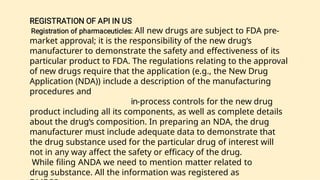
of the NDA / ANDA/ INDA /MAA filed by a Formulator
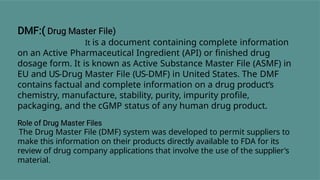
(Drug Product manufacturer who uses API of that
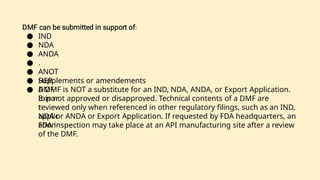
particular API manufacturing company).
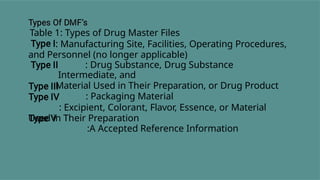
Filing dossier of API with EDQM for obtaining CEP.
Assessing and filing amendments/variations to the
information (which may be related to manufacture,
control, stability studies etc) in DMF/ASMF/Dossier of
particular API with the Regulatory agencies. Major
amendments are to be reported prior to their
implementation while minor amendments may be
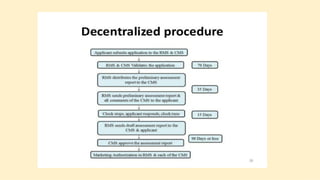
5.
● Taking approvalof customers of API before implementing any major
changes
regarding the information mentioned in DMF/ASMF/Dossier. The updated
DMF ASMF may be submitted to the customer simultaneously along with
amendments/variations filed with the agency.
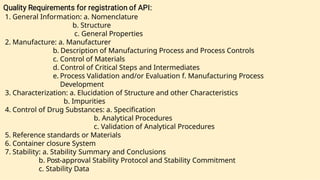
7.
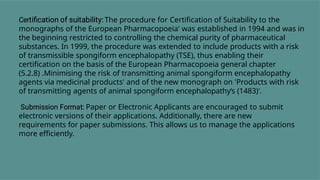
The U S.Food and Drug
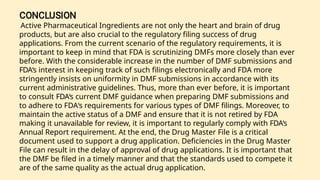
Administration is a scientific, regulatory, and public health
agency that oversees items accounting for 25 cents of every
dollar spent by consumers. The agency grew from a single
chemist in the U.
S. Department of Agriculture in 1862
to a staff of approximately 9,100 employees and a budget of
$1.294 billion in 2001, comprising chemists,
pharmacologists, physicians, microbiologists, veterinarians,
pharmacists, lawyers, and many others. About one-third of
the agency's employees are stationed outside of the
Washington, D. C. area, staffing over 150 field offices and
laboratories, including five regional offices and 20 district
8.
Organization of FDA
TheFDA's organization consists of the Office of the
Commissioner and four directorates overseeing
the core functions of the agency: Medical Products
and Tobacco, Foods, Global Regulatory Operations
and Policy, and Operations.
9.
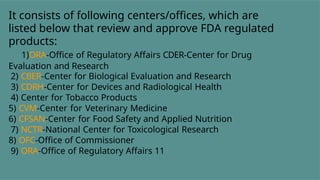
It consists offollowing centers/offices, which are
listed below that review and approve FDA regulated
products:
1)ORA-Office of Regulatory Affairs CDER-Center for Drug
Evaluation and Research
2) CBER-Center for Biological Evaluation and Research
3) CDRH-Center for Devices and Radiological Health
4) Center for Tobacco Products
5) CVM-Center for Veterinary Medicine
6) CFSAN-Center for Food Safety and Applied Nutrition
7) NCTR-National Center for Toxicological Research
8) OFC-Office of Commissioner
9) ORA-Office of Regulatory Affairs 11
10.
●
●
European Medicines Agency–EMEA:
The European Medicines Agency (EMEA) is a
decentralised body of the European Union with
headquarters in London.
● Its main responsibility is the protection and promotion
of public and animal health, through the evaluation
and supervision of medicines for human and
veterinary use. The EMEA is responsible for the
scientific evaluation of applications for European
marketing authorisation for medicinal products
(centralised procedure). Under the centralised
procedure, companies submit one single marketing
authorisation application to the EMEA.
The EMEA takes appropriate actions if adverse
drug reaction reports suggest changes to the
11.
In 2001, theCommittee for Orphan Medicinal Products
(COMP) was established, charged with reviewing
designation applications from persons or companies who
intend to
develop medicines for rare diseases (so-called ‗orphan
drugs‘).
•The Agency is also involved in referral procedures
relating to medicinal products that are approved or under
consideration by Member States.
:
a. Committee for orphan medicinal products (COMP)
b. Pediatric committee (PDCO)
c. Committee for veterinary medicinal products (CVMP)
d. Committee on advanced therapies (CAT)
e. Committee for medicinal products for human use (CHMP)
f. Committee for herbal products (HMPC)
g. Pharmacovigilance Risk Assessment Committee (PRAC)
12.
For most countries,whether or not they had initiated product
registration controls earlier, the 1960s and 1970s saw a rapid increase
in laws, ISSN 2395-3411 Available online at www.ijpacr.com 314
International Journal of Pharma And Chemical Research I Volume 3 I
Issue 2 I Apr – Jun I 2017 regulations and guidelines for reporting and
evaluating the data on safety, quality and efficacy of new medicinal
products.
Harmonisation of regulatory requirements was pioneered by the
European Community (EC), in the 1980s, as the EC (now the European
Union) moved towards the development of a single market for
pharmaceuticals. The birth of ICH took place at a meeting in April 1990,
hosted by EFPIA in Brussels.
Representatives of the regulatory agencies and industry associations of
Europe, Japan and the US met, primarily, to plan an International
Conference but the meeting also discussed the wider implications and
13.
The CTD isorganised into five modules. Module 1 is region specific and
Modules 2, 3, 4 and 5 are intended to be common for all regions. In July
2003, the CTD became the mandatory format for new drug applications
in the EU and Japan, and the strongly recommended format of choice for
NDAs submitted to the FDA.
●
●
●
●
:
The objective of this
study was :
To know about the Regulatory agencies present in the US and EU
and registration procedures for pharmaceuticals.
Study and analyse on the Requirements for registration of API in
US
(FDA) and EU(EMEA)
Comparison of regulatory requirements of API in US and EU on
what basis the registration requirements are varying
Simplifying the registration procedure for API in US and
European
14.
Each and everystudy has some patterns and follows certain
pathways in order to reach the Destination.
The study was analysed by dividing the whole study into 4 steps:
1. Type of study
2. Source of data
3. Registration of API in US and EU
4. Study process
1.
The study was conducted with an objective to chalk out
the regulatory requirements for the registration of API and difference
of those regulatory requirements and registration process in US and
EU.
15.
:
Major part ofsecondary data collection was done by means of following sources:
1. Literature review
2. Regulatory agencies and related websites of particular country i.e US and
EU. 3.Guidelines framed by government authorities
: Academic journals, online journals, Market research reports, news paper
articles, and other resources. And direct communication with Regulatory authorities. Online
books also served as a good source of information.
Typically covered
the regulatory guidelines published officially by agencies and websites related to the registration
requirements for different countries.
: Guidelines must give the most useful information
and the information mentioned in the guideline was standard, every one try to follow these
guidelines.
16.
In India mostof the drugs are exported to US and EU. These study
parameters are selected to understand the
●
●
●
Basic requirements for the registration of API in US and EU
Registration procedures for API in US and EU. In US registration
is carried out through drug master file process (type-2), while in
EU, the registration is done by filing of active substance master
file (ASMF). By knowing the requirements it may allow us to
make easy for registration of single API in both US and EU
countries.
18.
: All newdrugs are subject to FDA pre-
market approval; it is the responsibility of the new drug‘s
manufacturer to demonstrate the safety and effectiveness of its
particular product to FDA. The regulations relating to the approval
of new drugs require that the application (e.g., the New Drug
Application (NDA)) include a description of the manufacturing
procedures and
in-process controls for the new drug
product including all its components, as well as complete details
about the drug‘s composition. In preparing an NDA, the drug
manufacturer must include adequate data to demonstrate that
the drug substance used for the particular drug of interest will
not in any way affect the safety or efficacy of the drug.
While filing ANDA we need to mention matter related to
drug substance. All the information was registered as
19.
It is adocument containing complete information
on an Active Pharmaceutical Ingredient (API) or finished drug
dosage form. It is known as Active Substance Master File (ASMF) in
EU and US-Drug Master File (US-DMF) in United States. The DMF
contains factual and complete information on a drug product‘s
chemistry, manufacture, stability, purity, impurity profile,
packaging, and the cGMP status of any human drug product.
The Drug Master File (DMF) system was developed to permit suppliers to
make this information on their products directly available to FDA for its
review of drug company applications that involve the use of the supplier's
material.
20.
●
●
●
●
●
●
●
:
IND
NDA
ANDA
.
ANOT
HER
DMF
Expor
t
applic
ation
Supplements or amendements
ADMF is NOT a substitute for an IND, NDA, ANDA, or Export Application.
It is not approved or disapproved. Technical contents of a DMF are
reviewed only when referenced in other regulatory filings, such as an IND,
NDA or ANDA or Export Application. If requested by FDA headquarters, an
FDA inspection may take place at an API manufacturing site after a review
of the DMF.
21.
Table 1: Typesof Drug Master Files
: Manufacturing Site, Facilities, Operating Procedures,
and Personnel (no longer applicable)
: Drug Substance, Drug Substance
Intermediate, and
Material Used in Their Preparation, or Drug Product
: Packaging Material
: Excipient, Colorant, Flavor, Essence, or Material
Used in Their Preparation
:A Accepted Reference Information
22.
In US activepharmaceutical ingredient is referred as drug
substance. Registration of active substance takes palace along with
pre marketing approvals like NDA & ANDA. That means there is no
separate registration process for API .The manufacturer of API need
to submit the information in the form of DMF. The FDA reviews the
information and gives the DMF number. When the drug product
manufacturer wants to get approval for the product, they mention
the DMF of drug substance as supporting document for the
applications like NDA & ANDA.
As mentioned above the requirements
include Module 1 - includes administrative
information Module 3 - include quality
information
23.
●
●
An original andduplicate copy is to be submitted for all DMF
submissions. The original and duplicate copy must be collated,
fully assembled and individually jacketed
Standard paper size is preferred (e.g., 8-1/2 by 11 inches for US
DMF). Paper length should not be less than 10 inches nor more
than 12 inches. However, it may occasionally be necessary to use
individual pages larger than standard paper size to present a
floor plan, synthesis diagram, batch formula, or manufacturing
instructions.
● Those pages should be folded and mounted to allow the pages
to be opened for review without disassembling the jacket and
refolded without damage when the volume is shelved. The
Agency‘s system for filing DMFs provided for assembly on the
left side of the page.
● The left margin should be at least three fourths of an inch to
assure that text is not obscured in the fastened area
24.
Drug Master Filewith one signed original of the covering letter and
other necessary documents are send to the FDA‘s Central Drug
Evaluation and Research (CDER). • The Drug Master File staff will
audit the nontechnical information for completeness and adequacy
for submission. If the key elements are missing, the staff will contact
the proposed holder to try to obtain the necessary documents in
order to file the DMF.
•Once the DMFs are determined to be acceptable for filing, the
document room staffs assigns a DMF number and a letter is sent to the
contact person listed in the DMF.
DMF submissions and Correspondence should be addressed as follows:
Drug Master File Staff Center for Drug Evaluation and Research Central
Document Room Food and Drug Administration
25.
●
●
●
●
●
Most of thehealth authorities require paper copies of the documents. The
size of DMFs easily approaches or exceeds 1000 pages. Each master file is
made up of several volumes as well as duplicate copies.
ALL electronic applications must follow the Electronic Common Technical
Document. eCTD is a structured format that permits life cycle management,
which is important for DMFs.
US marketing applications are submitted in electronic CTD format.
There is no requirement to submit any type of application in electronic format
but encouraged to submit in electronic format. Submitting the information in
the eCTD backbone files will result in greater efficiency.
The absence of electronic datasets in an acceptable format to permit review
and analysis may be considered as inadequate and resulting in refuse-to-file
an application.
26.
●
●
●
●
●
●
●
The following fileformats should be
used :
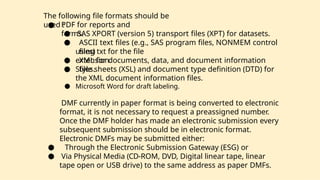
● PDF for reports and
forms.
SAS XPORT (version 5) transport files (XPT) for datasets.
ASCII text files (e.g., SAS program files, NONMEM control
files)
using txt for the file
extension.
XML for documents, data, and document information
files.
Style sheets (XSL) and document type definition (DTD) for
the XML document information files.
Microsoft Word for draft labeling.
DMF currently in paper format is being converted to electronic
format, it is not necessary to request a preassigned number.
Once the DMF holder has made an electronic submission every
subsequent submission should be in electronic format.
Electronic DMFs may be submitted either:
Through the Electronic Submission Gateway (ESG) or
Via Physical Media (CD-ROM, DVD, Digital linear tape, linear
tape open or USB drive) to the same address as paper DMFs.
27.
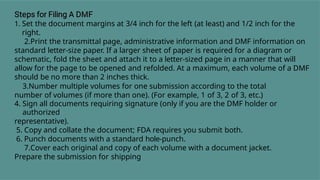
1. Set thedocument margins at 3/4 inch for the left (at least) and 1/2 inch for the
right.
2.Print the transmittal page, administrative information and DMF information on
standard letter-size paper. If a larger sheet of paper is required for a diagram or
schematic, fold the sheet and attach it to a letter-sized page in a manner that will
allow for the page to be opened and refolded. At a maximum, each volume of a DMF
should be no more than 2 inches thick.
3.Number multiple volumes for one submission according to the total
number of volumes (if more than one). (For example, 1 of 3, 2 of 3, etc.)
4. Sign all documents requiring signature (only if you are the DMF holder or
authorized
representative).
5. Copy and collate the document; FDA requires you submit both.
6. Punch documents with a standard hole-punch.
7.Cover each original and copy of each volume with a document jacket.
Prepare the submission for shipping
28.
●
●
●
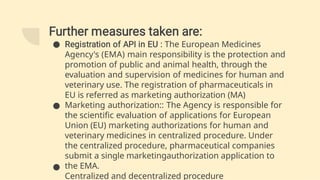
: The EuropeanMedicines
Agency's (EMA) main responsibility is the protection and
promotion of public and animal health, through the
evaluation and supervision of medicines for human and
veterinary use. The registration of pharmaceuticals in
EU is referred as marketing authorization (MA)
Marketing authorization:: The Agency is responsible for
the scientific evaluation of applications for European
Union (EU) marketing authorizations for human and
veterinary medicines in centralized procedure. Under
the centralized procedure, pharmaceutical companies
submit a single marketingauthorization application to
the EMA.
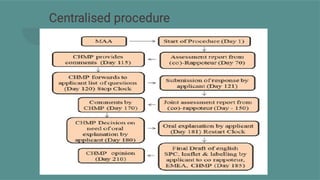
Centralized and decentralized procedure
31.
●
●
●
:
Definition: Any componentthat is intended to furnish
pharmacological activity or other direct effect in the
diagnosis, cure, mitigation, treatment, or prevention of
disease, or to effect the structure or any function of the body
of man or other animals.
New active substance used for the first time
Existing active substances not included in the
European Pharmacopoeia (Ph.Eur.) or the
pharmacopoeia of an EU Member State
Active substances included in the Ph.Eur. or in
the pharmacopoeia of an EU Member State.
32.
●
●
It should beemphasized that the concept of the ASMF shall only apply to a
well- defined active substance and cannot be used for excipients, finished
products and biological active substances. The scientific information in the
ASMF should be physically divided into two separate parts, namely
The Applicant‘s Part (AP)
and The Restricted Part (RP).
The AP contains the information that the ASMF holder regards as non-
confidential to the Applicant/MA holder, whereas the RP contains the information
that the ASMF holder regards as confidential. It is emphasized that the AP is still
a confidential document that cannot be submitted by anyone to third parties
without the written consent of the ASMF holder. The RP may contain the
remaining information, such as detailed information on the individual steps of
the manufacturing method (reaction conditions, temperature, validation and
evaluation data of critical steps) and the quality control during the manufacture
of the active substance
33.
requires the qualitydata of active substance. Nowadays
EU also follows CTD format which is referred as EU-CTD. CTD contains five
modules. The present work aims to discuss about registration of active substance
and it includes
Administrative,
regional or national information Quality
information of drug substance
The overall content of the
ASMF should contain detailed scientific information as
indicated under the various headings of the
relevant Notice to Applicants for Marketing Authorizations for Medicinal
Products in the Member States of the European Union (NtA)
In the first submission of an ASMF with an allocated EMEA ASMF reference
number, the ASMF holder is required to submit:
i) MAA application form stating the correct EMEA ASMF reference number
ii) Letter of Access
34.
1. General Information:a. Nomenclature
b. Structure
c. General Properties
2. Manufacture: a. Manufacturer
b. Description of Manufacturing Process and Process Controls
c. Control of Materials
d. Control of Critical Steps and Intermediates
e. Process Validation and/or Evaluation f. Manufacturing Process
Development
3. Characterization: a. Elucidation of Structure and other Characteristics
b. Impurities
4. Control of Drug Substances: a. Specification
b. Analytical Procedures
c. Validation of Analytical Procedures
5. Reference standards or Materials
6. Container closure System
7. Stability: a. Stability Summary and Conclusions
b. Post-approval Stability Protocol and Stability Commitment
c. Stability Data
35.
The procedure forCertification of Suitability to the
monographs of the European Pharmacopoeia' was established in 1994 and was in
the beginning restricted to controlling the chemical purity of pharmaceutical
substances. In 1999, the procedure was extended to include products with a risk
of transmissible spongiform encephalopathy (TSE), thus enabling their
certification on the basis of the European Pharmacopoeia general chapter
(5.2.8) .Minimising the risk of transmitting animal spongiform encephalopathy
agents via medicinal products' and of the new monograph on 'Products with risk
of transmitting agents of animal spongiform encephalopathy‘s (1483)'.
Paper or Electronic Applicants are encouraged to submit
electronic versions of their applications. Additionally, there are new
requirements for paper submissions. This allows us to manage the applications
more efficiently.
36.
Active Pharmaceutical Ingredientsare not only the heart and brain of drug
products, but are also crucial to the regulatory filing success of drug
applications. From the current scenario of the regulatory requirements, it is
important to keep in mind that FDA is scrutinizing DMFs more closely than ever
before. With the considerable increase in the number of DMF submissions and
FDA‘s interest in keeping track of such filings electronically and FDA more
stringently insists on uniformity in DMF submissions in accordance with its
current administrative guidelines. Thus, more than ever before, it is important
to consult FDA‘s current DMF guidance when preparing DMF submissions and
to adhere to FDA‘s requirements for various types of DMF filings. Moreover, to
maintain the active status of a DMF and ensure that it is not retired by FDA
making it unavailable for review, it is important to regularly comply with FDA‘s
Annual Report requirement. At the end, the Drug Master File is a critical
document used to support a drug application. Deficiencies in the Drug Master
File can result in the delay of approval of drug applications. It is important that
the DMF be filed in a timely manner and that the standards used to compete it
are of the same quality as the actual drug application.