Cyclin and Cyclin-Dependent Kinases Mr. Hunter AP / IB Biology  Hyde Park Academy 12/07/2009
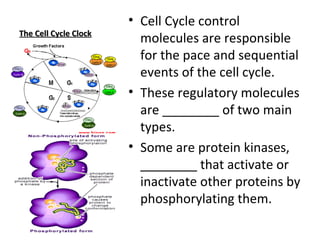
The Cell Cycle Clock Cell Cycle control molecules are responsible for the pace and sequential events of the cell cycle. These regulatory molecules are ________ of two main types. Some are protein kinases, ________ that activate or inactivate other proteins by phosphorylating them.
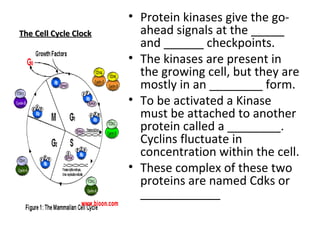
The Cell Cycle Clock Protein kinases give the go-ahead signals at the _____ and ______ checkpoints. The kinases are present in the growing cell, but they are mostly in an ________ form. To be activated a Kinase must be attached to another protein called a ________. Cyclins fluctuate in concentration within the cell. These complex of these two proteins are named Cdks or ____________
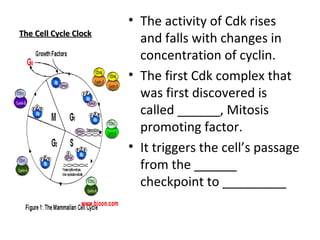
The Cell Cycle Clock The activity of Cdk rises and falls with changes in concentration of cyclin. The first Cdk complex that was first discovered is called ______, Mitosis promoting factor. It triggers the cell’s passage from the ______ checkpoint to _________
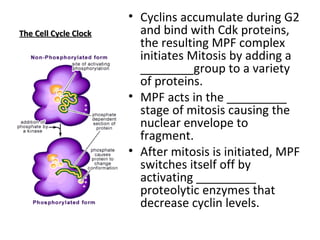
The Cell Cycle Clock Cyclins accumulate during G2 and bind with Cdk proteins, the resulting MPF complex initiates Mitosis by adding a ________group to a variety of proteins. MPF acts in the _________ stage of mitosis causing the nuclear envelope to fragment. After mitosis is initiated, MPF switches itself off by activating _________ proteolytic enzymes that decrease cyclin levels.
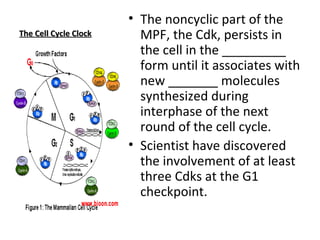
The Cell Cycle Clock The noncyclic part of the MPF, the Cdk, persists in the cell in the _________ form until it associates with new _______ molecules synthesized during interphase of the next round of the cell cycle. Scientist have discovered the involvement of at least three Cdks at the G1 checkpoint.

Cyclin And Cyclin Dependent Kinases

  • 1.
    Cyclin and Cyclin-DependentKinases Mr. Hunter AP / IB Biology Hyde Park Academy 12/07/2009
  • 2.
    The Cell CycleClock Cell Cycle control molecules are responsible for the pace and sequential events of the cell cycle. These regulatory molecules are ________ of two main types. Some are protein kinases, ________ that activate or inactivate other proteins by phosphorylating them.
  • 3.
    The Cell CycleClock Protein kinases give the go-ahead signals at the _____ and ______ checkpoints. The kinases are present in the growing cell, but they are mostly in an ________ form. To be activated a Kinase must be attached to another protein called a ________. Cyclins fluctuate in concentration within the cell. These complex of these two proteins are named Cdks or ____________
  • 4.
    The Cell CycleClock The activity of Cdk rises and falls with changes in concentration of cyclin. The first Cdk complex that was first discovered is called ______, Mitosis promoting factor. It triggers the cell’s passage from the ______ checkpoint to _________
  • 5.
    The Cell CycleClock Cyclins accumulate during G2 and bind with Cdk proteins, the resulting MPF complex initiates Mitosis by adding a ________group to a variety of proteins. MPF acts in the _________ stage of mitosis causing the nuclear envelope to fragment. After mitosis is initiated, MPF switches itself off by activating _________ proteolytic enzymes that decrease cyclin levels.
  • 6.
    The Cell CycleClock The noncyclic part of the MPF, the Cdk, persists in the cell in the _________ form until it associates with new _______ molecules synthesized during interphase of the next round of the cell cycle. Scientist have discovered the involvement of at least three Cdks at the G1 checkpoint.