1
Slide
© 2005 Thomson/South-Western
Chapter 14
Chapter 14
Simple Linear Regression
 Simple Linear Regression Model
Simple Linear Regression Model
 Least Squares Method
Least Squares Method
 Coefficient of Determination
Coefficient of Determination
 Model Assumptions
Model Assumptions
 Testing for Significance
Testing for Significance
 Using the Estimated Regression Equation
Using the Estimated Regression Equation
for Estimation and Prediction
 Computer Solution
Computer Solution
 Residual Analysis: Validating Model Assumptions
Residual Analysis: Validating Model Assumptions
2
Slide
© 2005 Thomson/South-Western
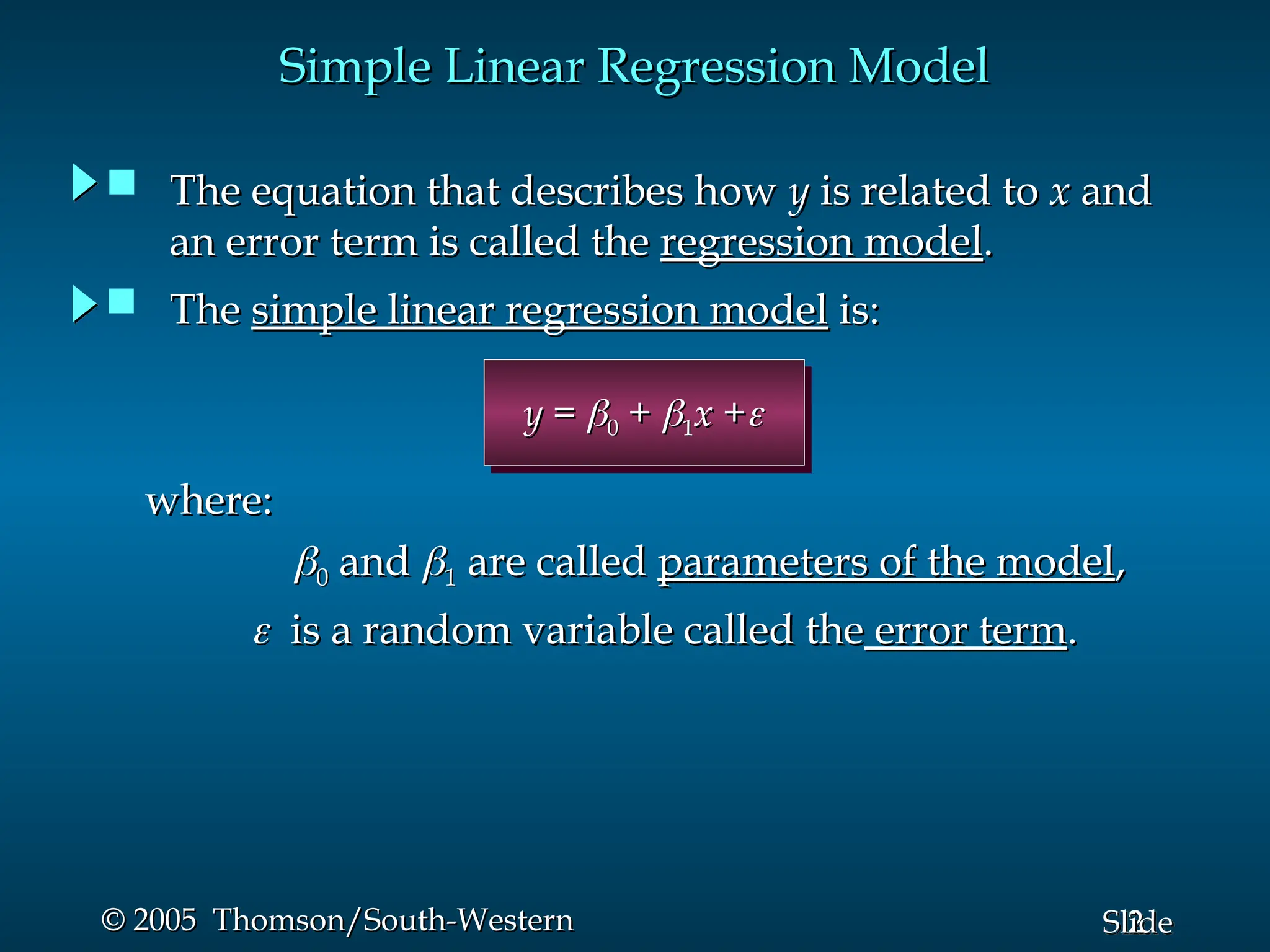
Simple Linear Regression Model
y
y =
= 
0
0 +
+ 
1
1x
x +
+

where:
where:

0
0 and
and 
1
1 are called
are called parameters of the model
parameters of the model,
,

 is a random variable called the
is a random variable called the error term
error term.
.
 The
The simple linear regression model
simple linear regression model is:
is:
 The equation that describes how
The equation that describes how y
y is related to
is related to x
x and
and
an error term is called the
an error term is called the regression model
regression model.
.
3
Slide
© 2005 Thomson/South-Western
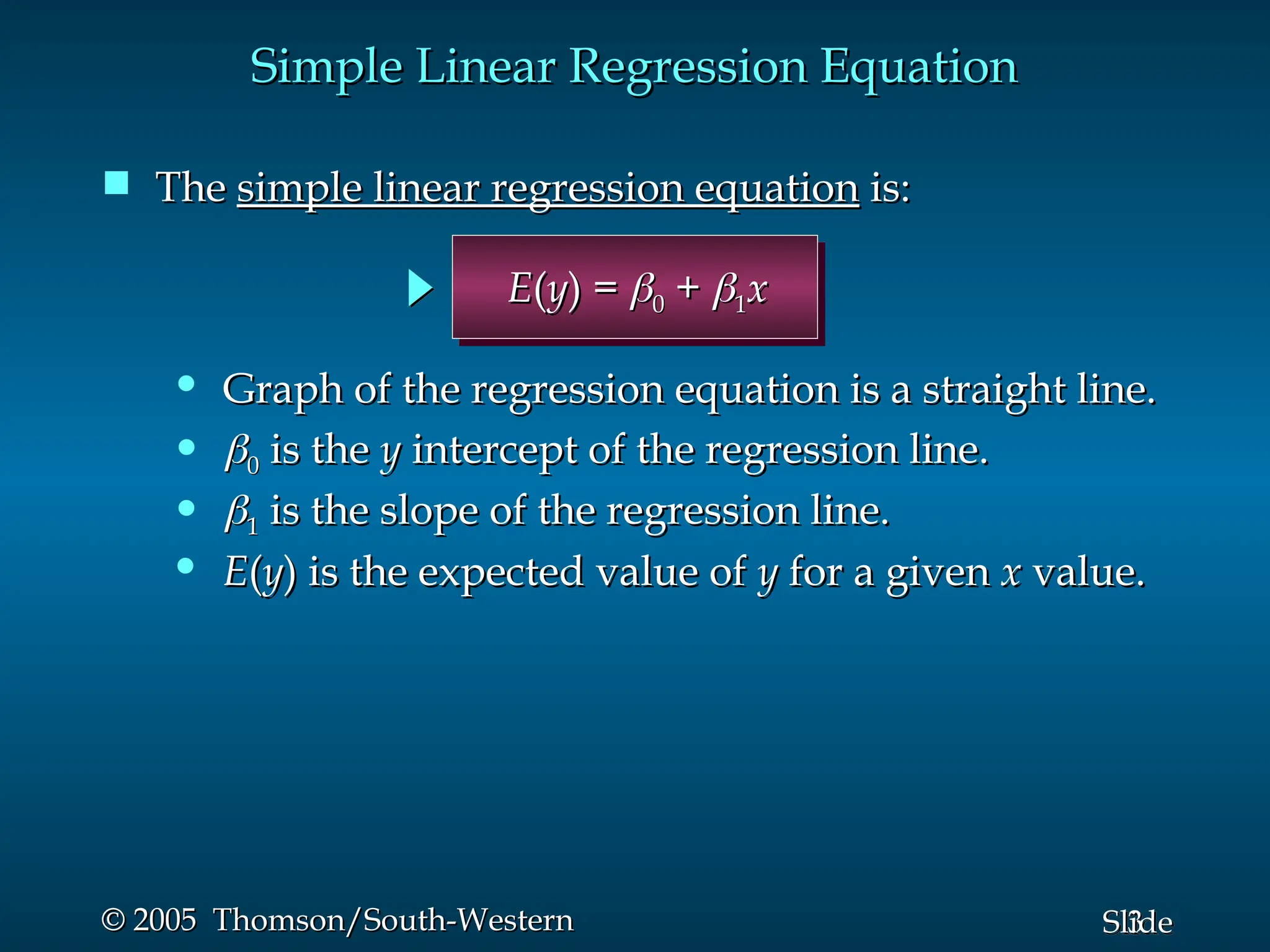
Simple Linear Regression Equation
 The
The simple linear regression equation
simple linear regression equation is:
is:
• E
E(
(y
y) is the expected value of
) is the expected value of y
y for a given
for a given x
x value.
value.
• 
1
1 is the slope of the regression line.
is the slope of the regression line.
• 
0
0 is the
is the y
y intercept of the regression line.
intercept of the regression line.
• Graph of the regression equation is a straight line.
Graph of the regression equation is a straight line.
E
E(
(y
y) =
) = 
0
0 +
+ 
1
1x
x
4
Slide
© 2005 Thomson/South-Western
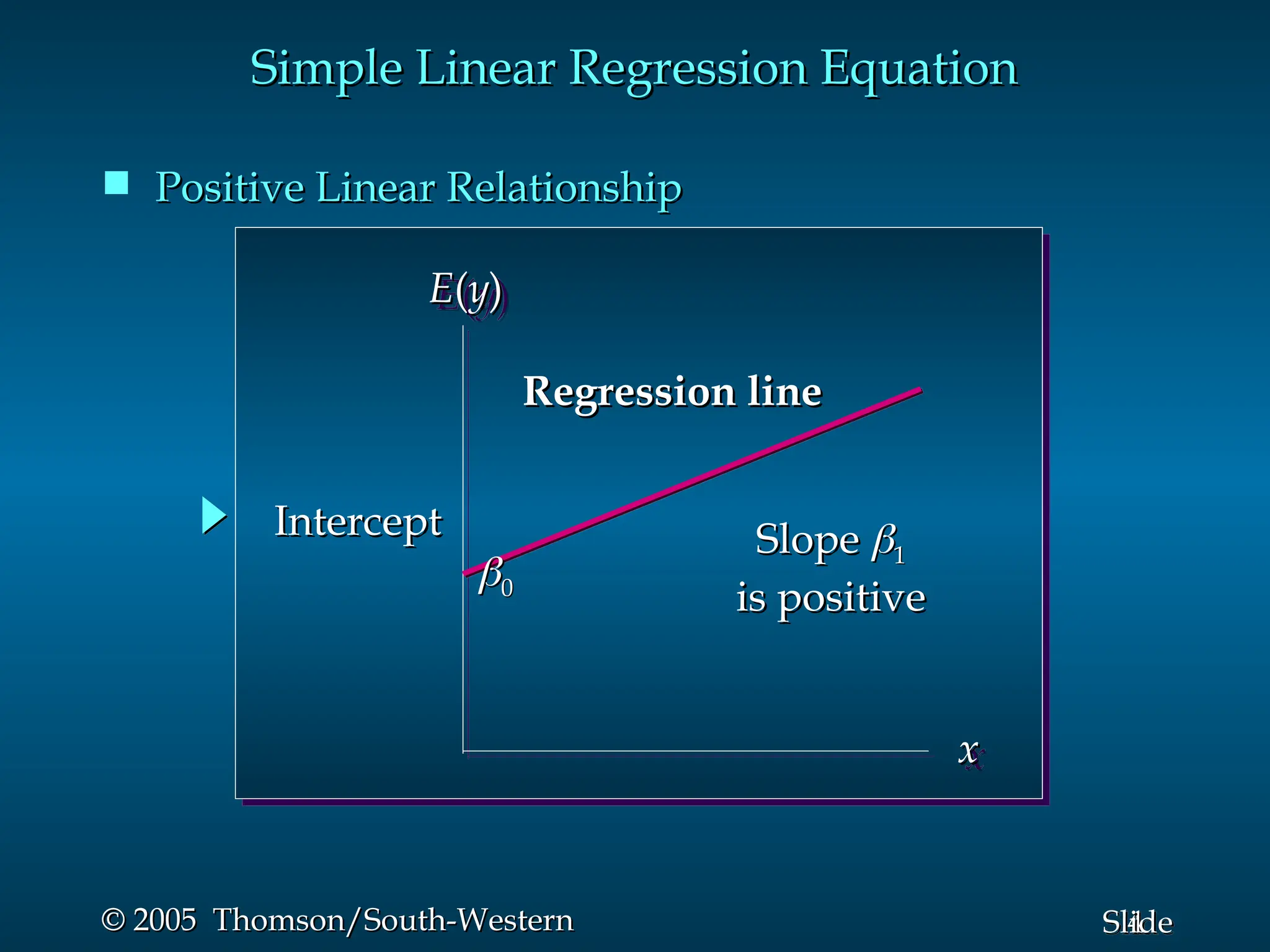
Simple Linear Regression Equation
 Positive Linear Relationship
Positive Linear Relationship
E
E(
(y
y)
)
x
x
Slope
Slope 
1
1
is positive
is positive
Regression line
Regression line
Intercept
Intercept

0
0
5
Slide
© 2005 Thomson/South-Western
Simple Linear Regression Equation
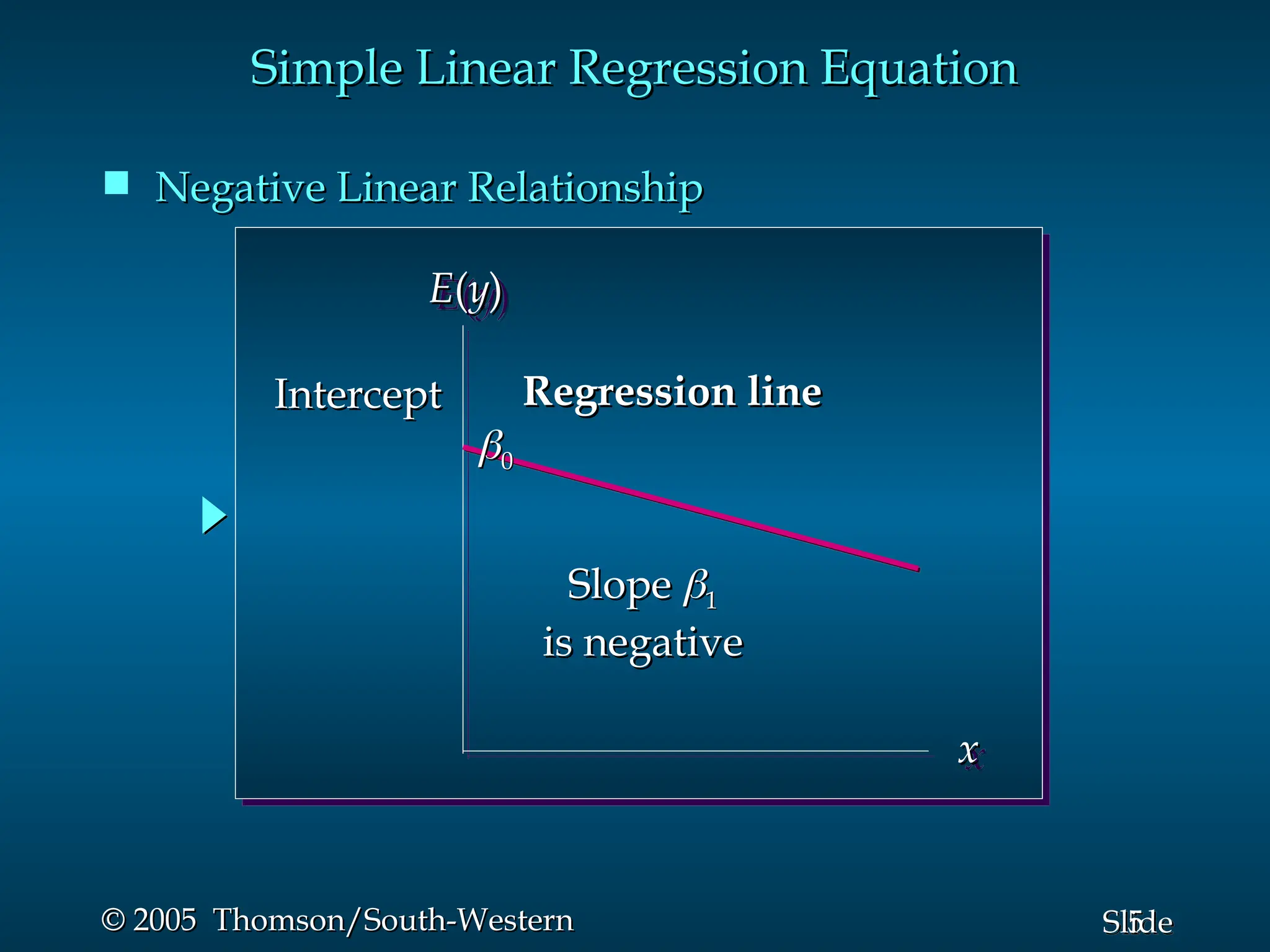
 Negative Linear Relationship
Negative Linear Relationship
E
E(
(y
y)
)
x
x
Slope
Slope 
1
1
is negative
is negative
Regression line
Regression line
Intercept
Intercept

0
0
6
Slide
© 2005 Thomson/South-Western
Simple Linear Regression Equation
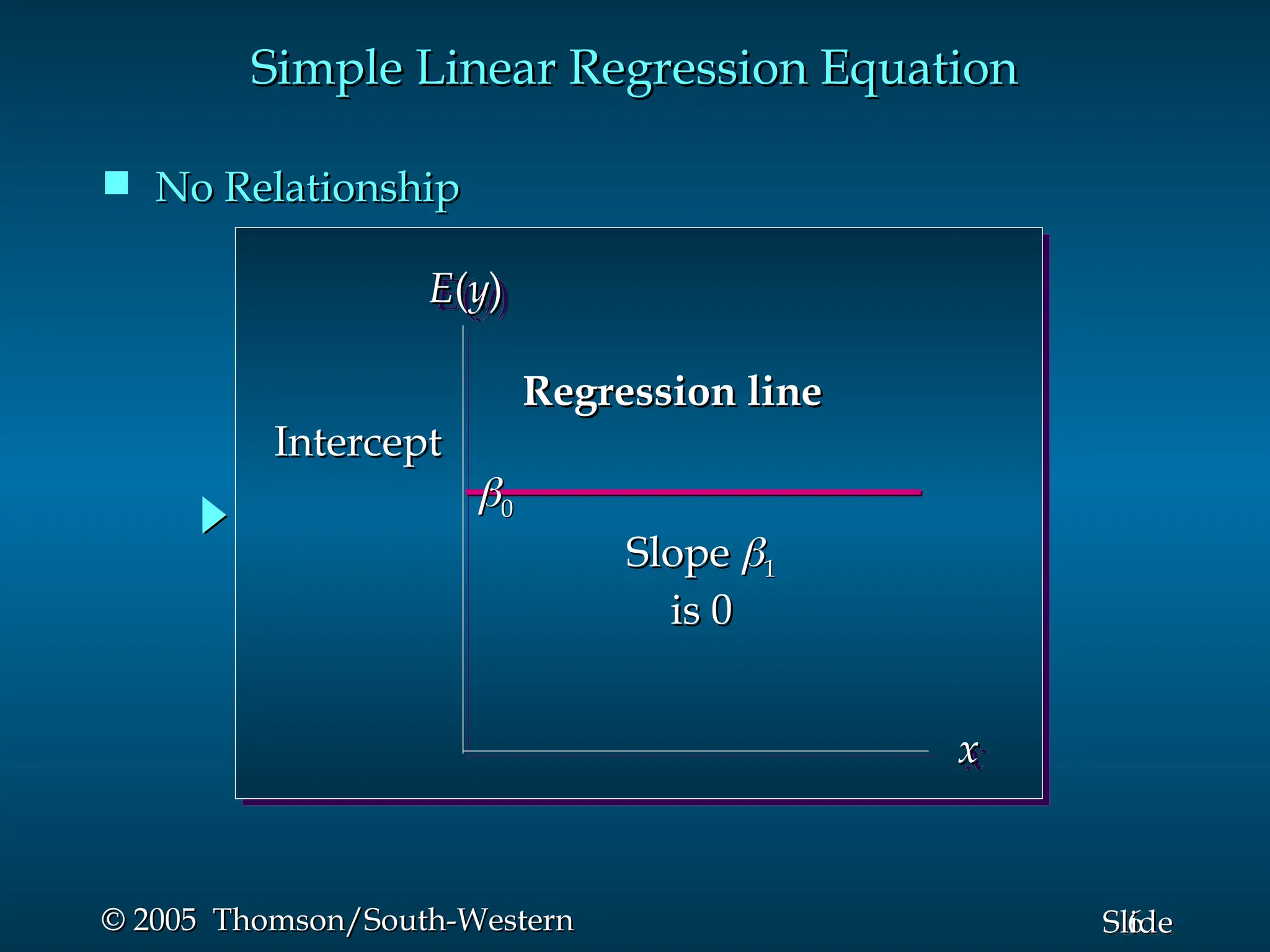
 No Relationship
No Relationship
E
E(
(y
y)
)
x
x
Slope
Slope 
1
1
is 0
is 0
Regression line
Regression line
Intercept
Intercept

0
0
7
Slide
© 2005 Thomson/South-Western
Estimated Simple Linear Regression Equation
 The
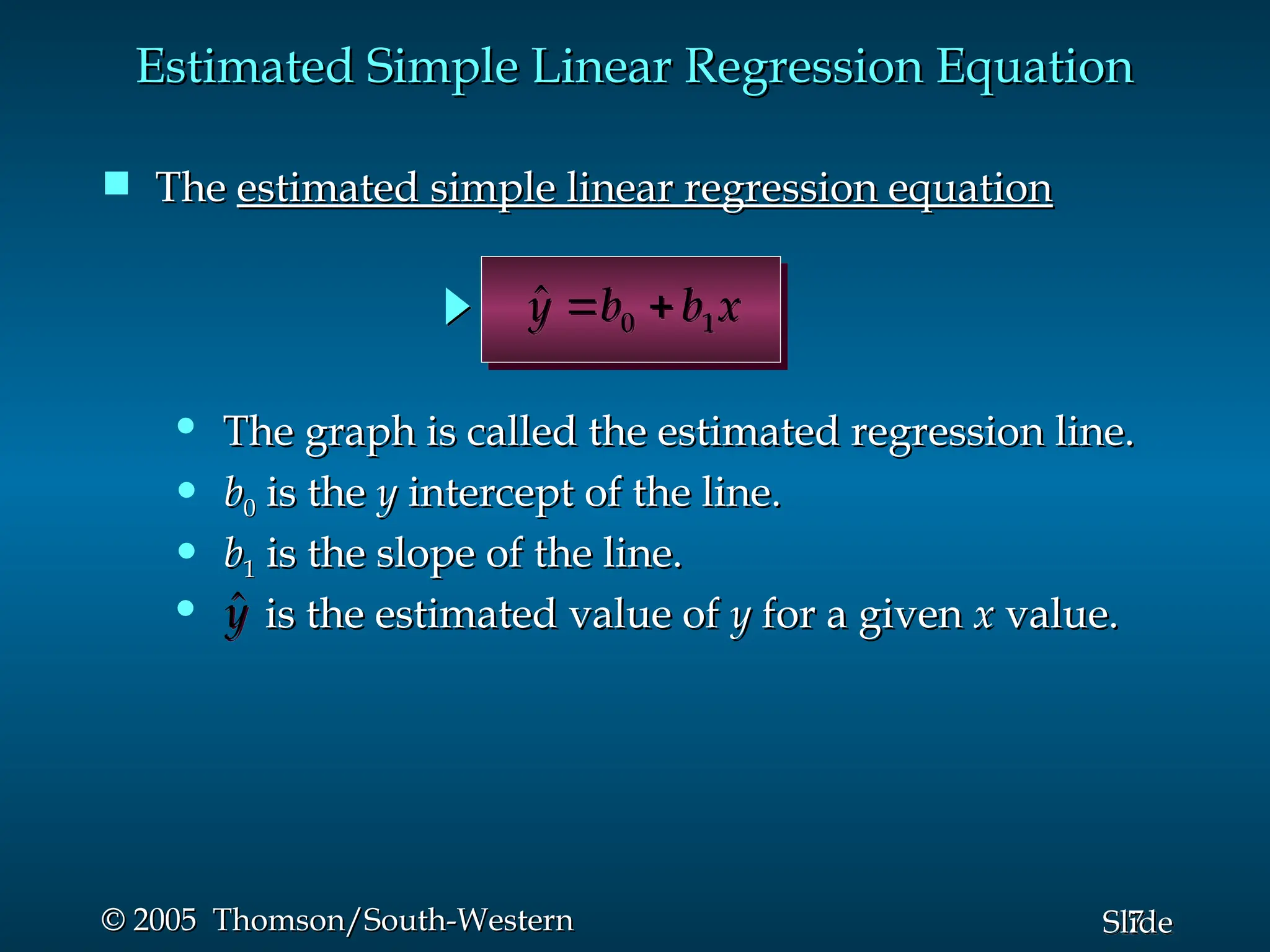
The estimated simple linear regression equation
estimated simple linear regression equation
0 1
ŷ b b x
 
• is the estimated value of
is the estimated value of y
y for a given
for a given x
x value.
value.
ŷ
• b
b1
1 is the slope of the line.
is the slope of the line.
• b
b0
0 is the
is the y
y intercept of the line.
intercept of the line.
• The graph is called the estimated regression line.
The graph is called the estimated regression line.
8
Slide
© 2005 Thomson/South-Western
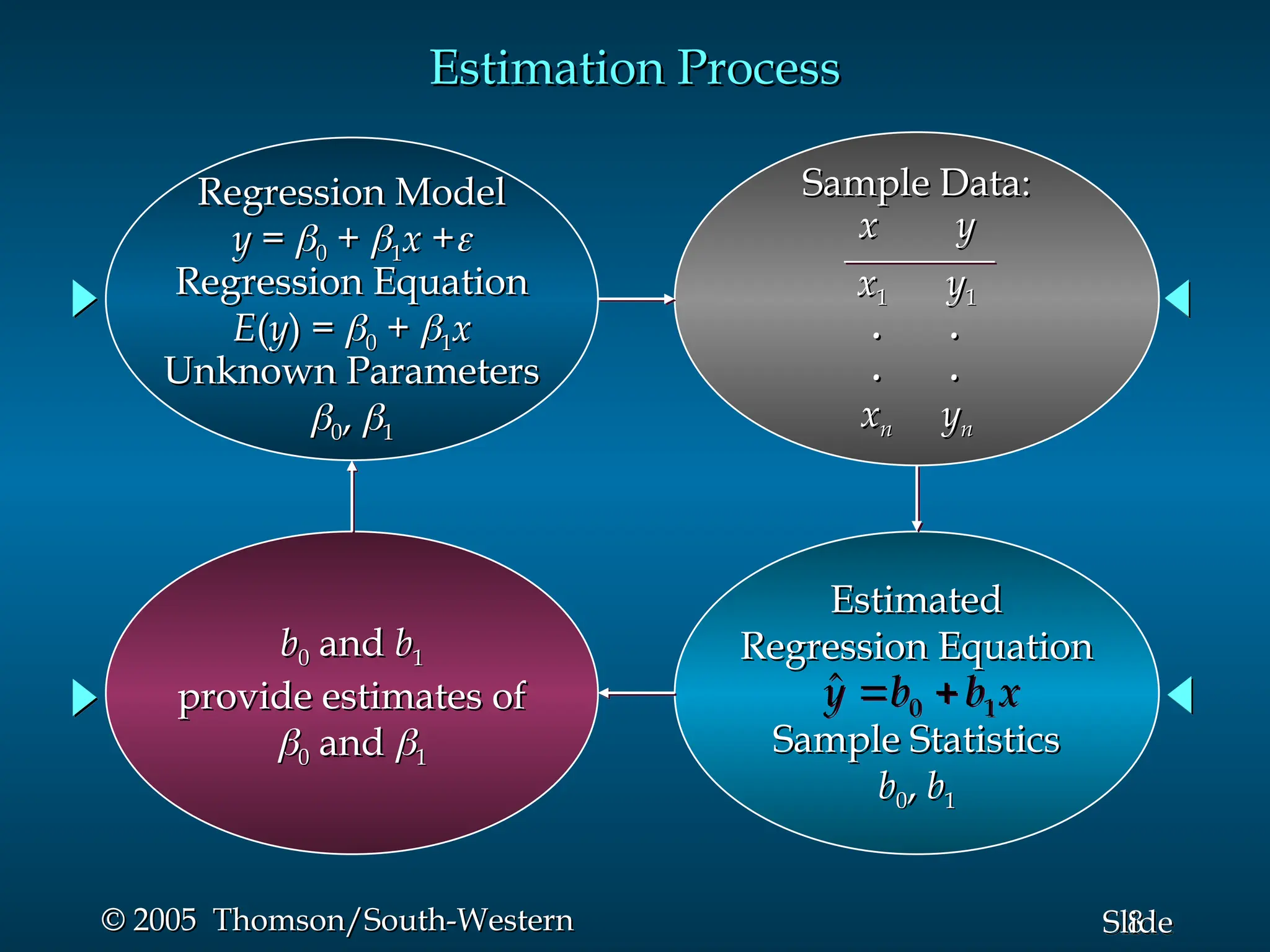
Estimation Process
Estimation Process
Regression Model
Regression Model
y
y =
= 
0
0 +
+ 
1
1x
x +
+

Regression Equation
Regression Equation
E
E(
(y
y) =
) = 
0
0 +
+ 
1
1x
x
Unknown Parameters
Unknown Parameters

0
0,
, 
1
1
Sample Data:
Sample Data:
x y
x y
x
x1
1 y
y1
1
. .
. .
. .
. .
x
xn
n y
yn
n
b
b0
0 and
and b
b1
1
provide estimates of

0
0 and
and 
1
1
Estimated
Estimated
Regression Equation
Regression Equation
Sample Statistics
Sample Statistics
b
b0
0,
, b
b1
1
0 1
ŷ b b x
 
9
Slide
© 2005 Thomson/South-Western
Least Squares Method
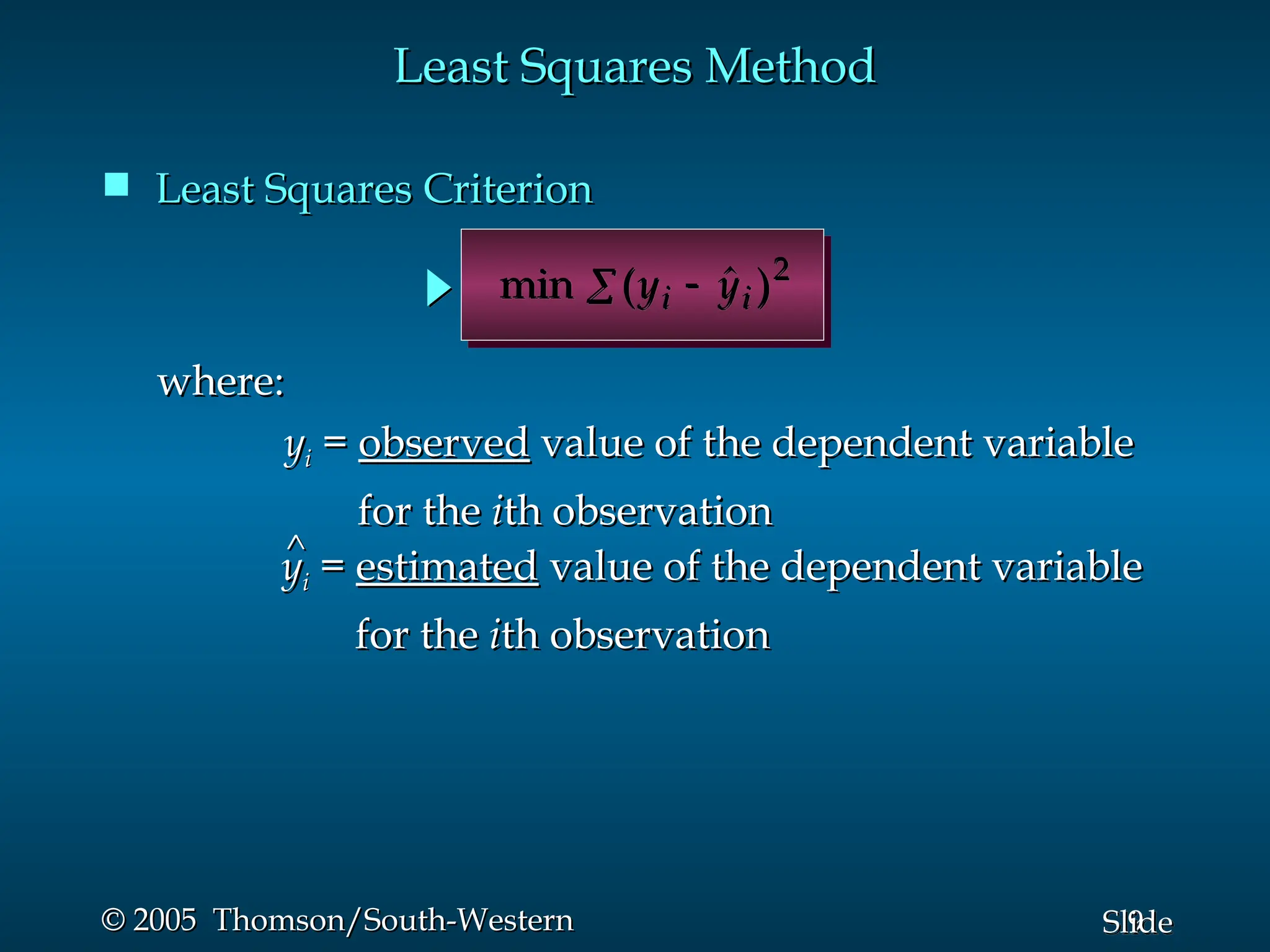
 Least Squares Criterion
Least Squares Criterion
min (y y
i i

  )2
where:
where:
y
yi
i =
= observed
observed value of the dependent variable
value of the dependent variable
for the
for the i
ith observation
th observation
^
^
y
yi
i =
= estimated
estimated value of the dependent variable
value of the dependent variable
for the
for the i
ith observation
th observation
10
Slide
© 2005 Thomson/South-Western
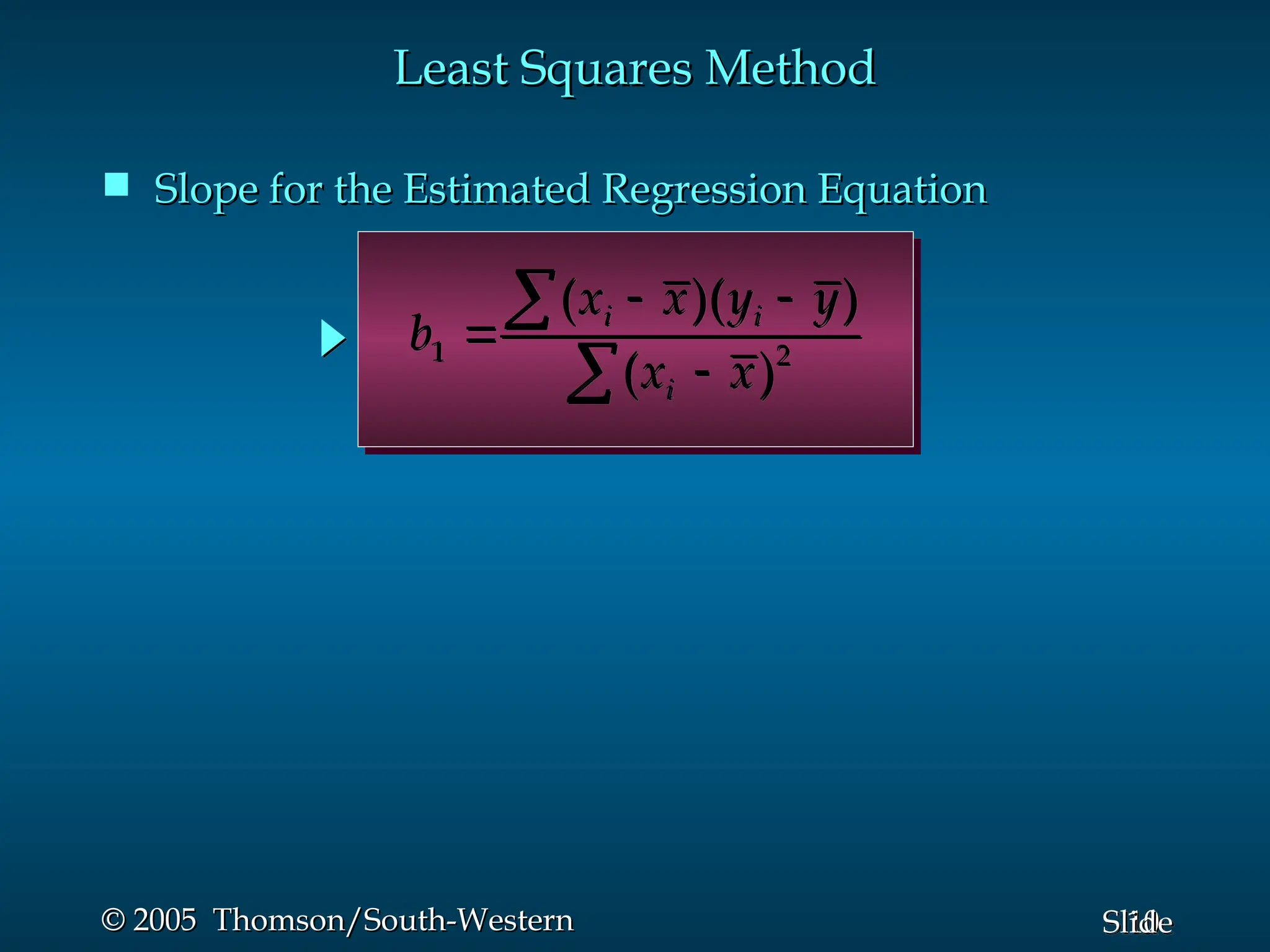
 Slope for the Estimated Regression Equation
Slope for the Estimated Regression Equation
1 2
( )( )
( )
i i
i
x x y y
b
x x
 




Least Squares Method
11
Slide
© 2005 Thomson/South-Western
 y
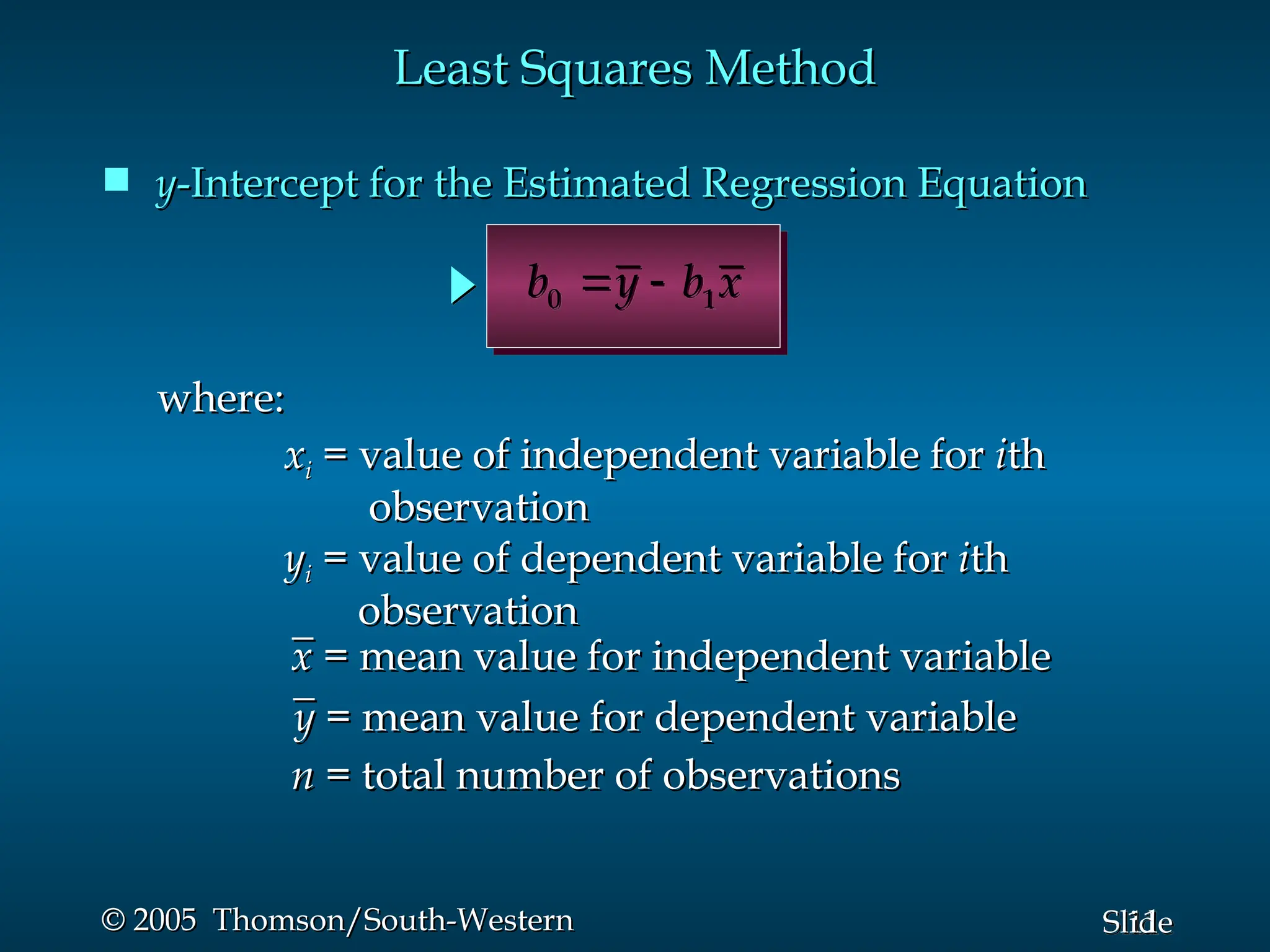
y-Intercept for the Estimated Regression Equation
-Intercept for the Estimated Regression Equation
Least Squares Method
0 1
b y b x
 
where:
where:
x
xi
i = value of independent variable for
= value of independent variable for i
ith
th
observation
observation
n
n = total number of observations
= total number of observations
_
_
y
y = mean value for dependent variable
= mean value for dependent variable
_
_
x
x = mean value for independent variable
= mean value for independent variable
y
yi
i = value of dependent variable for
= value of dependent variable for i
ith
th
observation
observation
12
Slide
© 2005 Thomson/South-Western
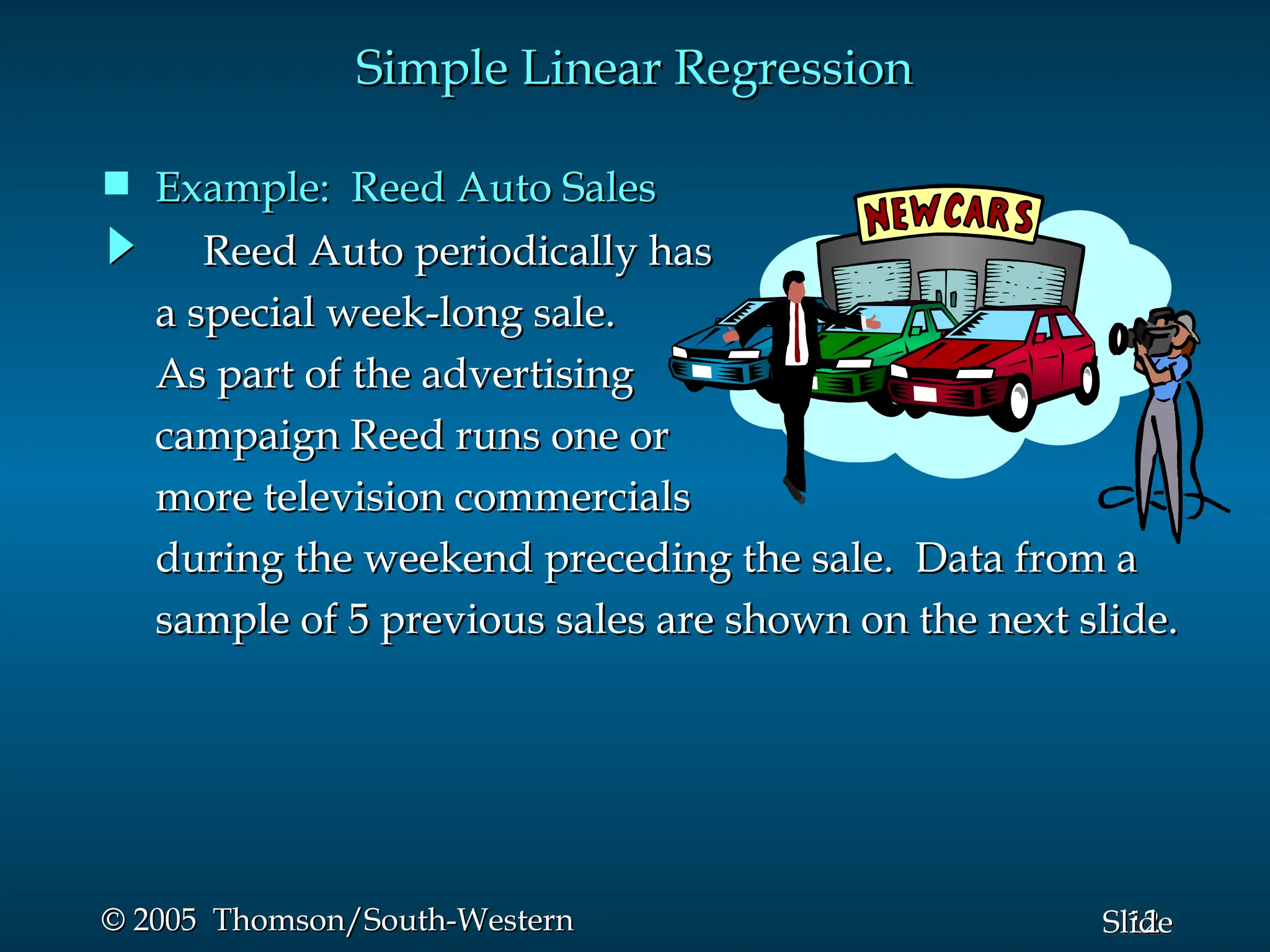
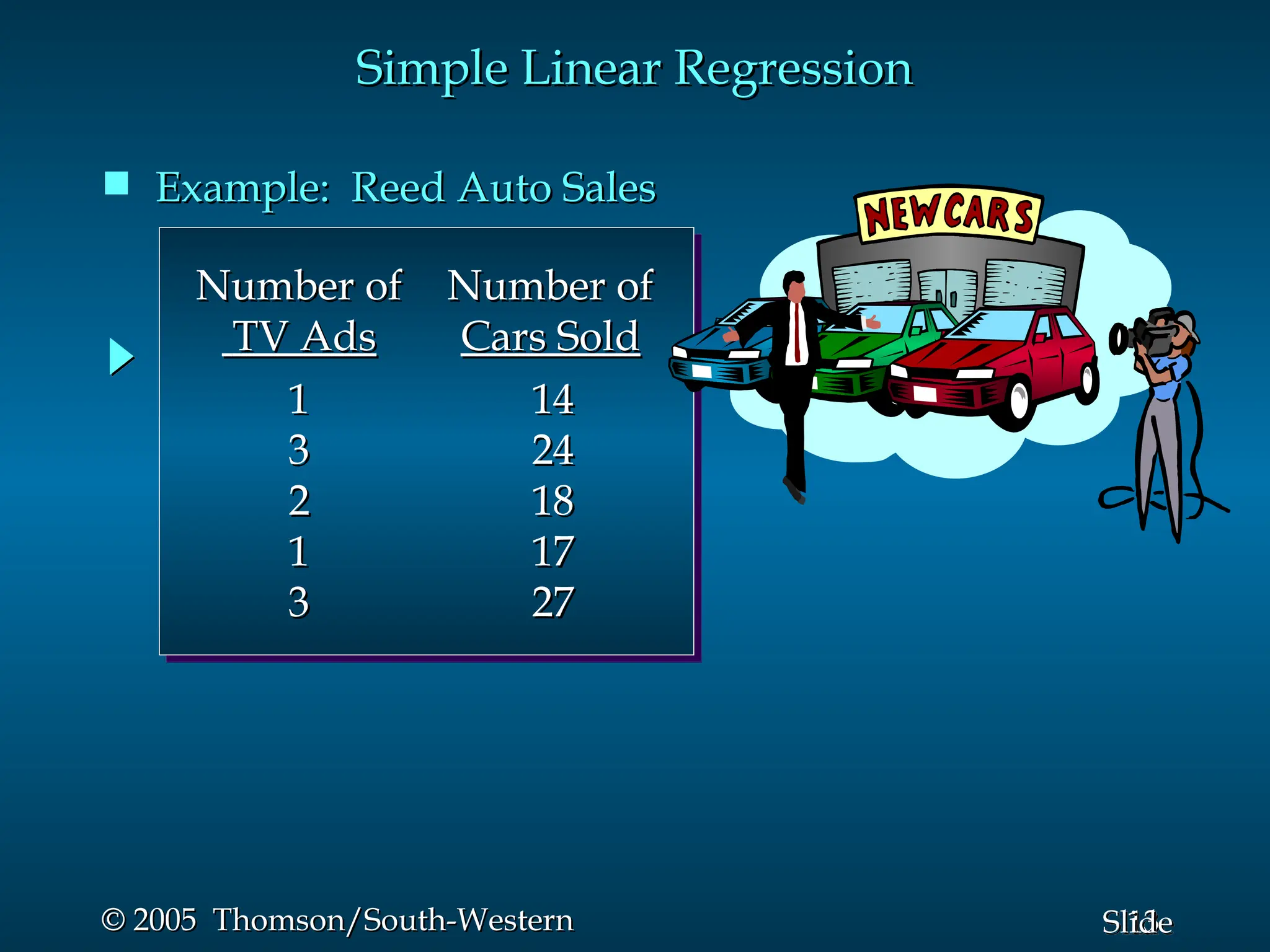
Reed Auto periodically has
a special week-long sale.
As part of the advertising
campaign Reed runs one or
more television commercials
during the weekend preceding the sale. Data from a
sample of 5 previous sales are shown on the next slide.
Simple Linear Regression
 Example: Reed Auto Sales
Example: Reed Auto Sales
13
Slide
© 2005 Thomson/South-Western
Simple Linear Regression
 Example: Reed Auto Sales
Example: Reed Auto Sales
Number of
Number of
TV Ads
TV Ads
Number of
Number of
Cars Sold
Cars Sold
1
1
3
3
2
2
1
1
3
3
14
14
24
24
18
18
17
17
27
27
14
Slide
© 2005 Thomson/South-Western
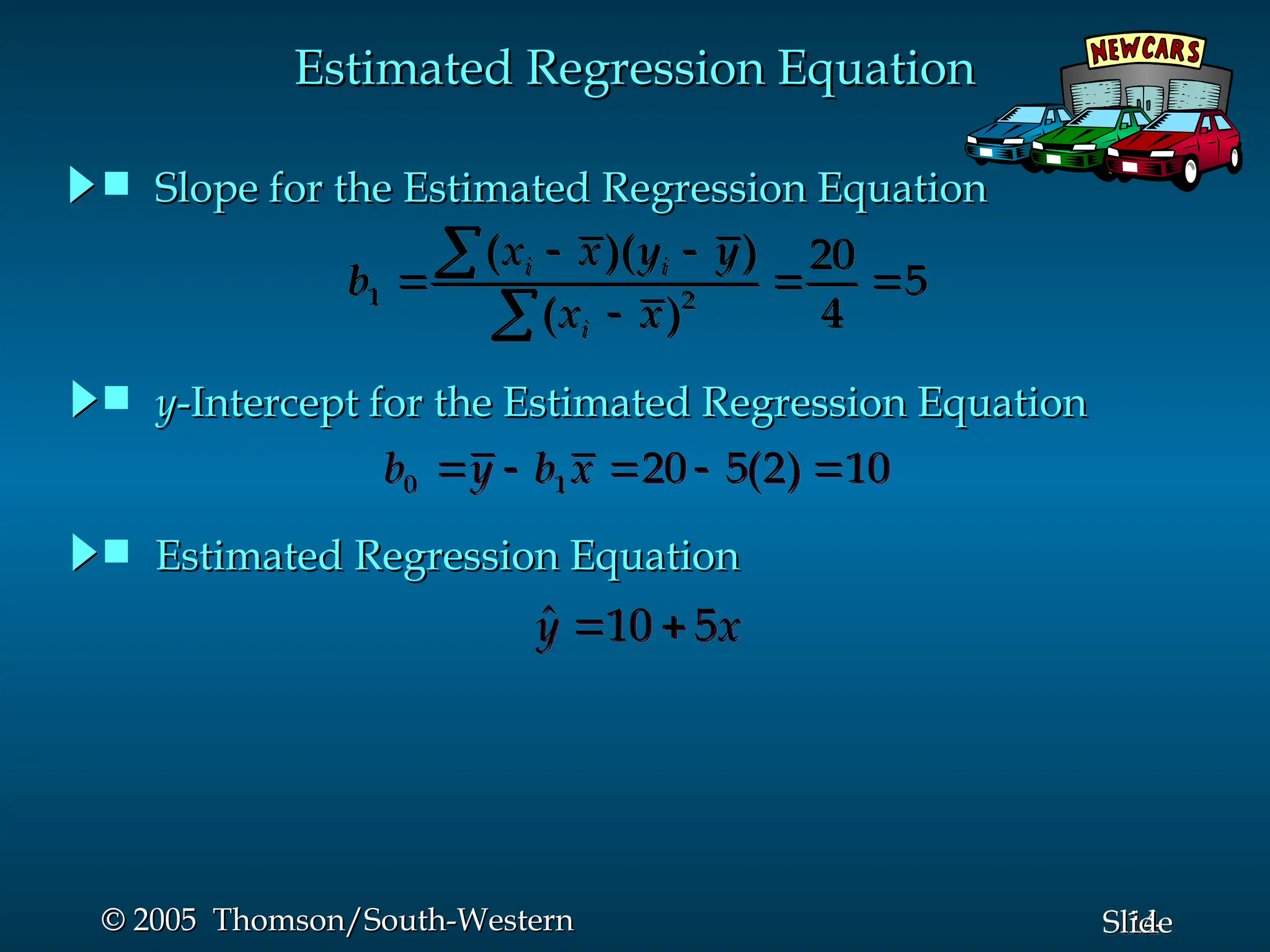
Estimated Regression Equation
ˆ 10 5
y x
 
1 2
( )( ) 20
5
( ) 4
i i
i
x x y y
b
x x
 
  



0 1 20 5(2) 10
b y b x
    
 Slope for the Estimated Regression Equation
Slope for the Estimated Regression Equation
 y
y-Intercept for the Estimated Regression Equation
-Intercept for the Estimated Regression Equation
 Estimated Regression Equation
Estimated Regression Equation
15
Slide
© 2005 Thomson/South-Western
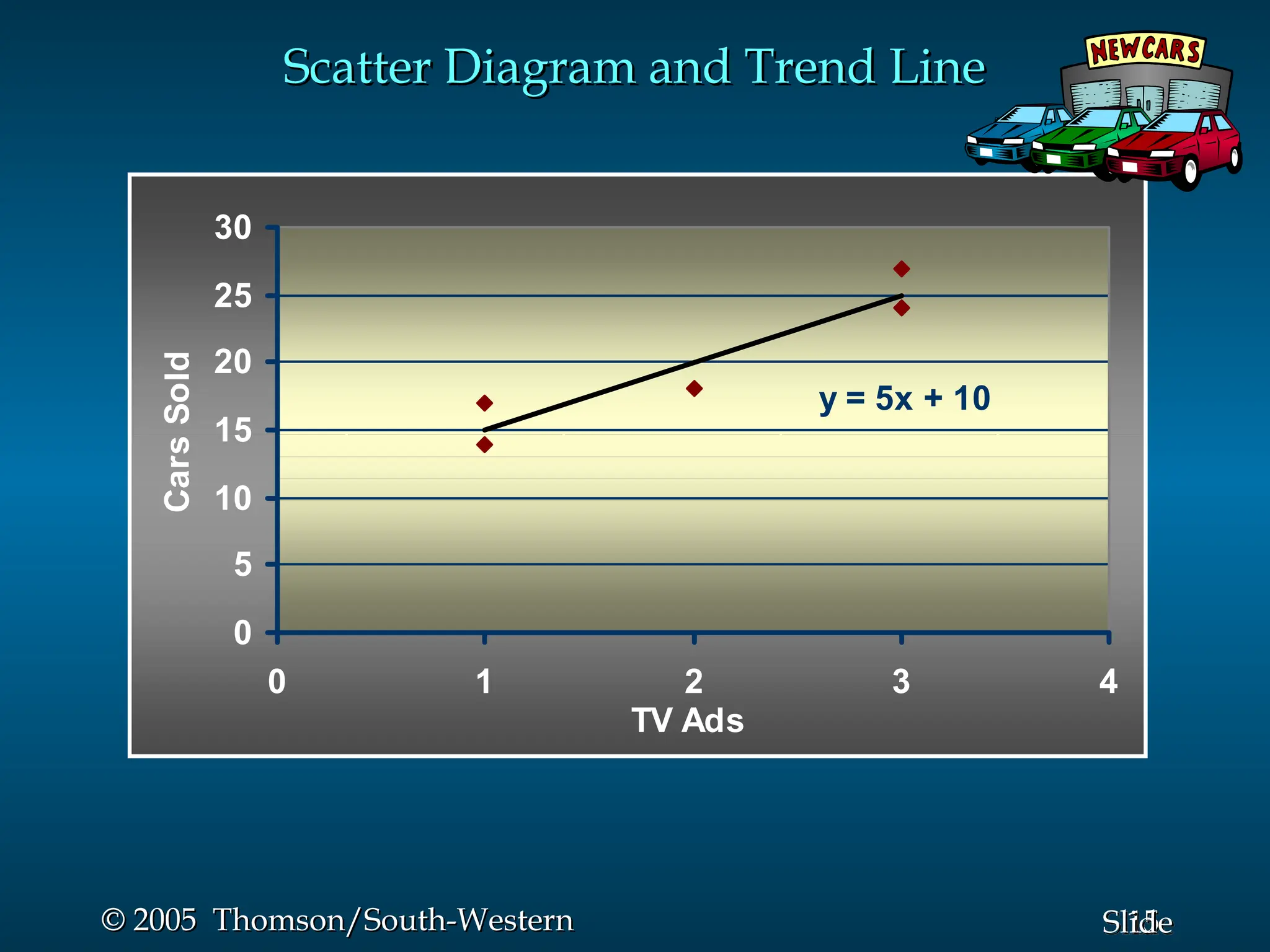
Scatter Diagram and Trend Line
y = 5x + 10
0
5
10
15
20
25
30
0 1 2 3 4
TV Ads
Cars
Sold
16
Slide
© 2005 Thomson/South-Western
Coefficient of Determination
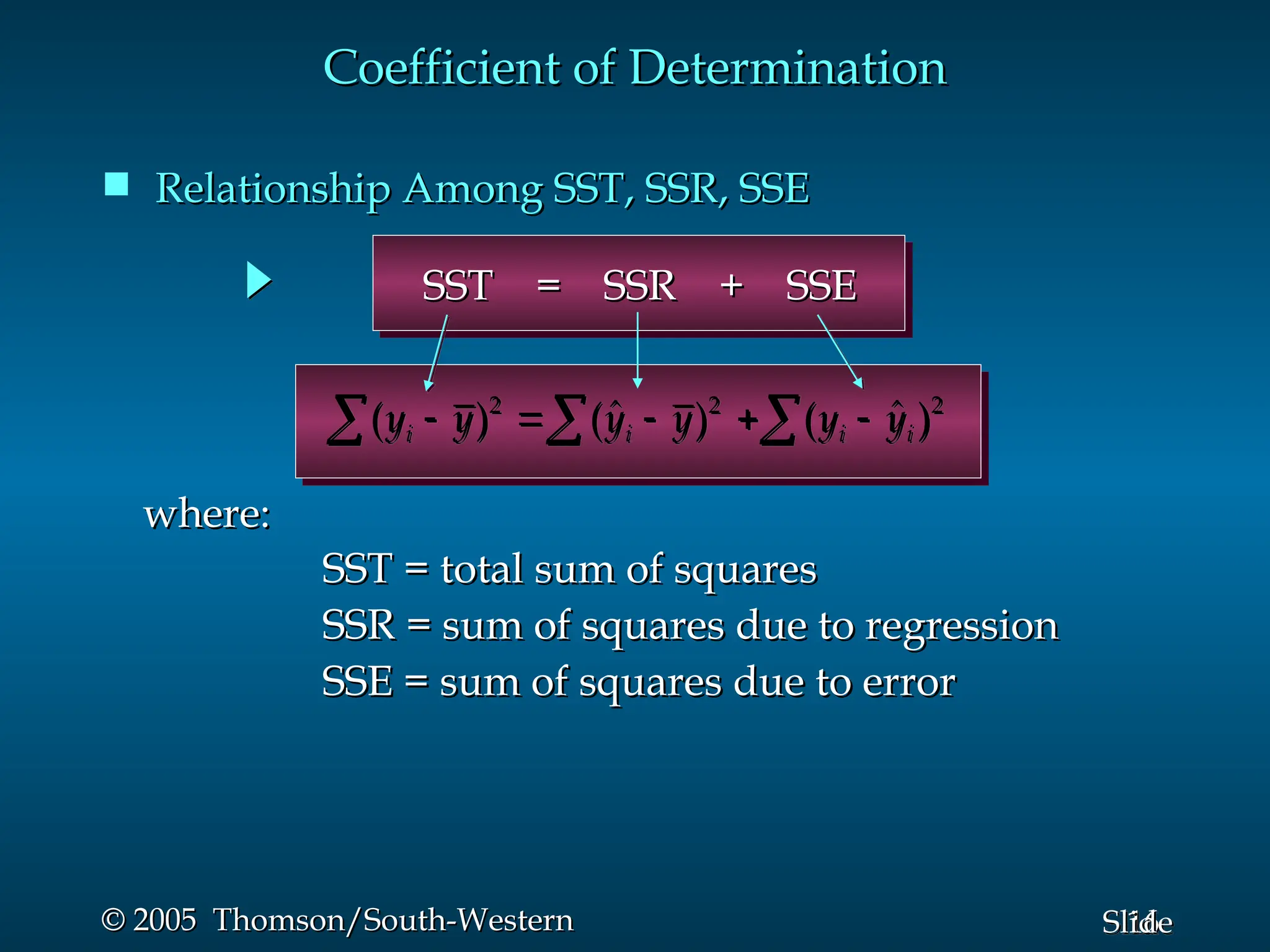
 Relationship Among SST, SSR, SSE
Relationship Among SST, SSR, SSE
where:
where:
SST = total sum of squares
SSR = sum of squares due to regression
SSE = sum of squares due to error
SST = SSR + SSE
SST = SSR + SSE
2
( )
i
y y

 2
ˆ
( )
i
y y
 
 2
ˆ
( )
i i
y y
 

17
Slide
© 2005 Thomson/South-Western
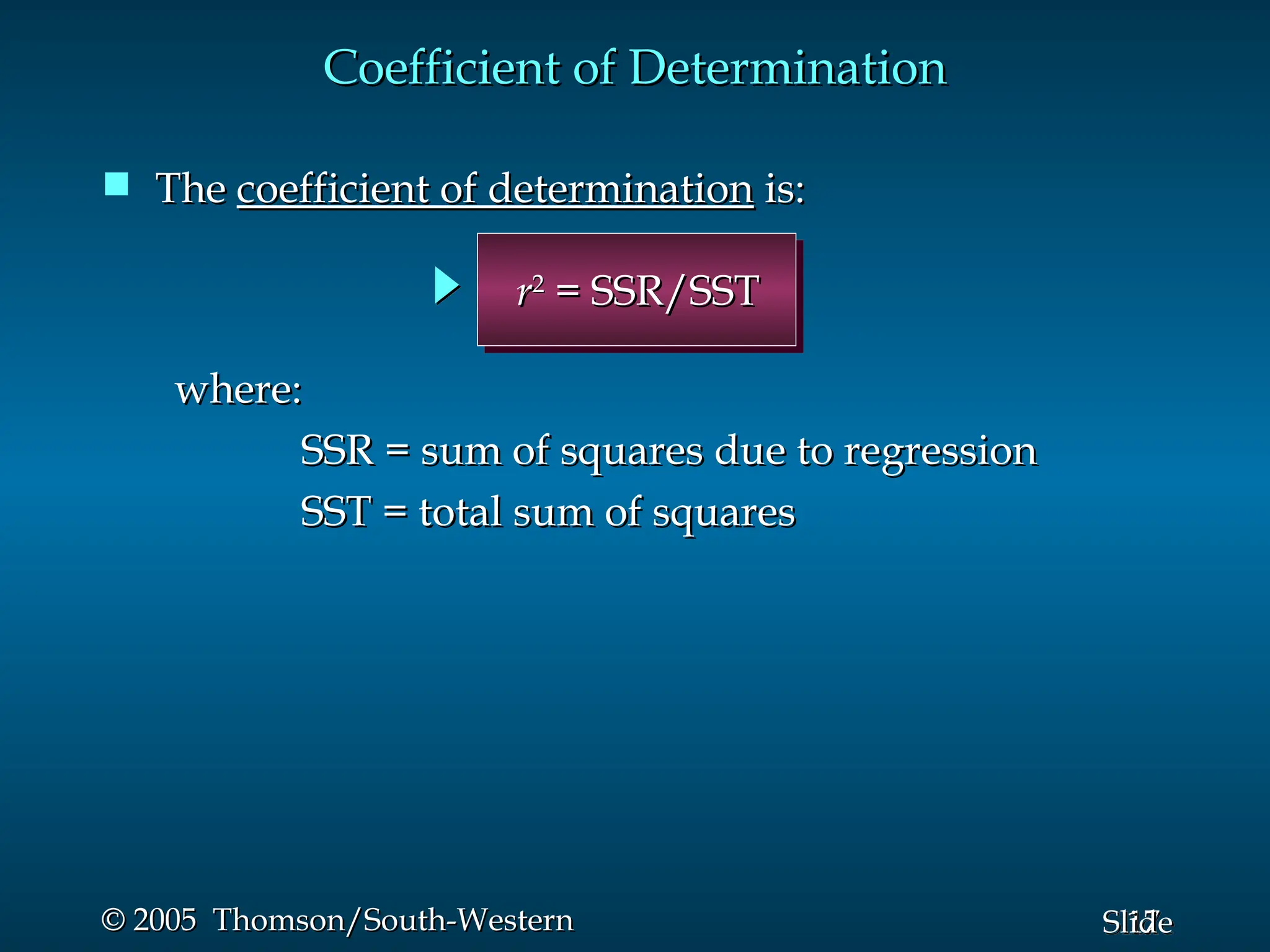
 The
The coefficient of determination
coefficient of determination is:
is:
Coefficient of Determination
where:
where:
SSR = sum of squares due to regression
SST = total sum of squares
r
r2
2
= SSR/SST
= SSR/SST
18
Slide
© 2005 Thomson/South-Western
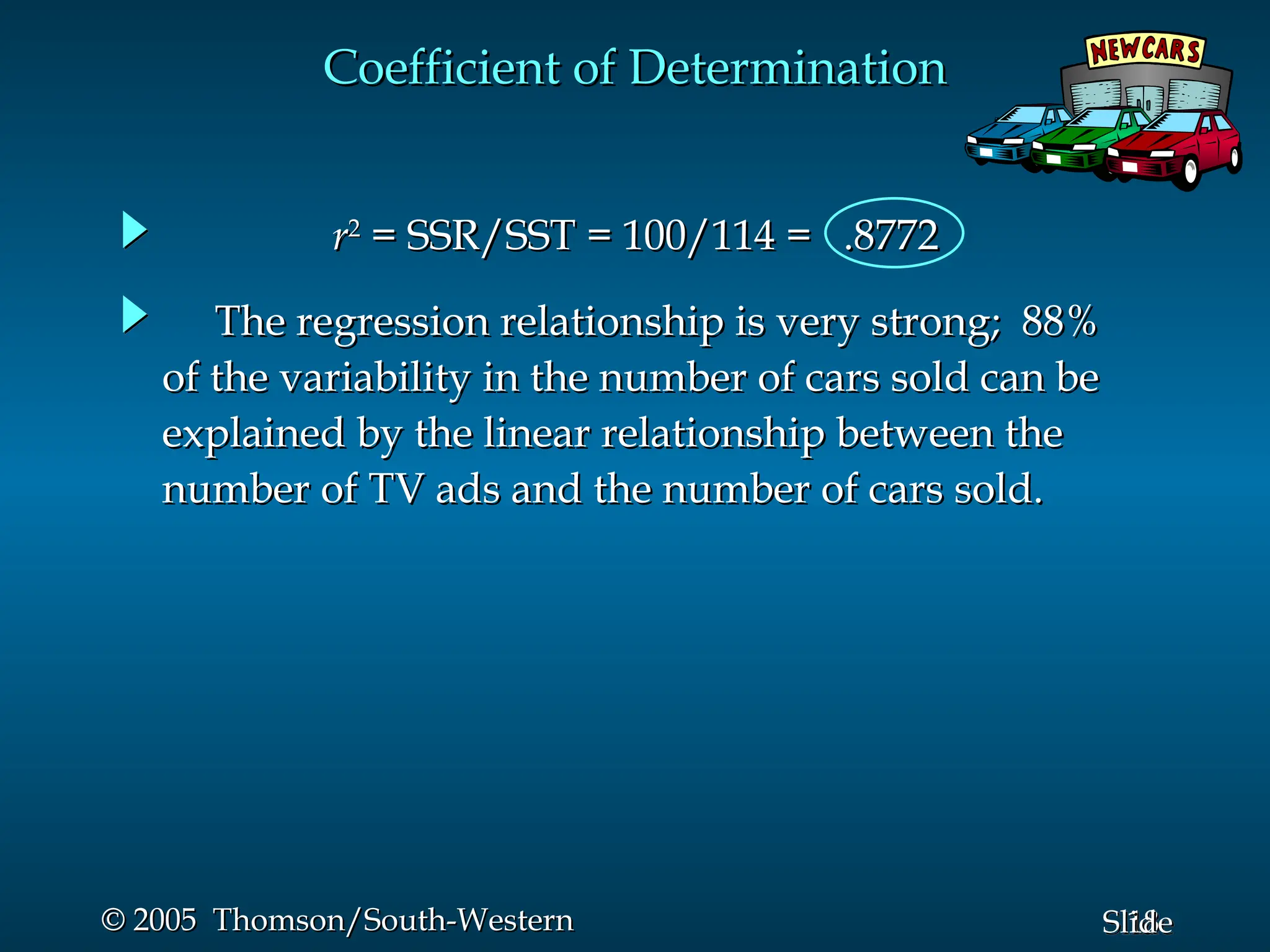
Coefficient of Determination
r
r2
2
= SSR/SST = 100/114 = .8772
The regression relationship is very strong; 88%
of the variability in the number of cars sold can be
explained by the linear relationship between the
number of TV ads and the number of cars sold.
19
Slide
© 2005 Thomson/South-Western
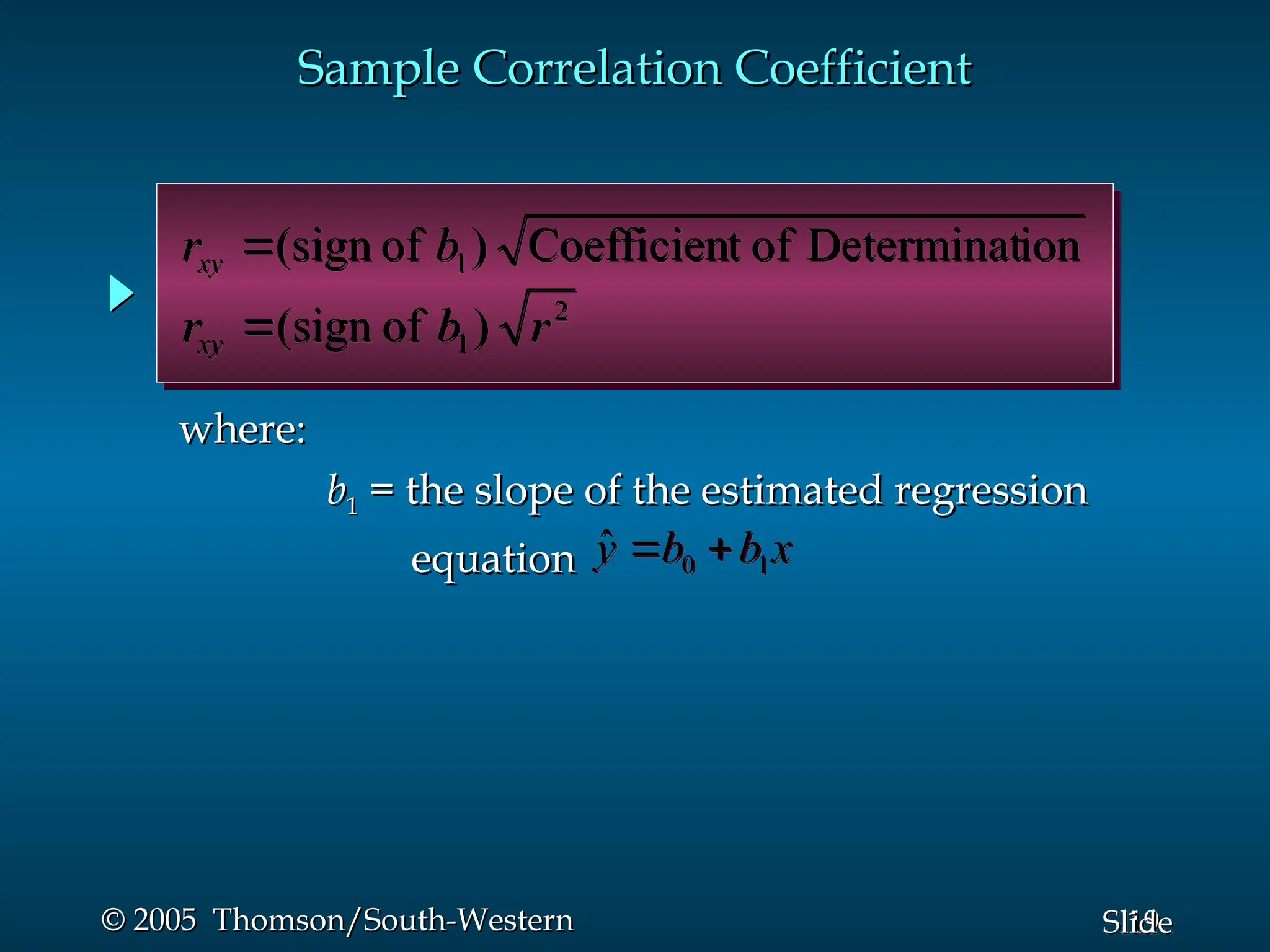
Sample Correlation Coefficient
2
1)
of
(sign r
b
rxy 
ion
Determinat
of
t
Coefficien
)
of
(sign 1
b
rxy 
where:
where:
b
b1
1 = the slope of the estimated regression
= the slope of the estimated regression
equation
equation x
b
b
y 1
0
ˆ 

20
Slide
© 2005 Thomson/South-Western
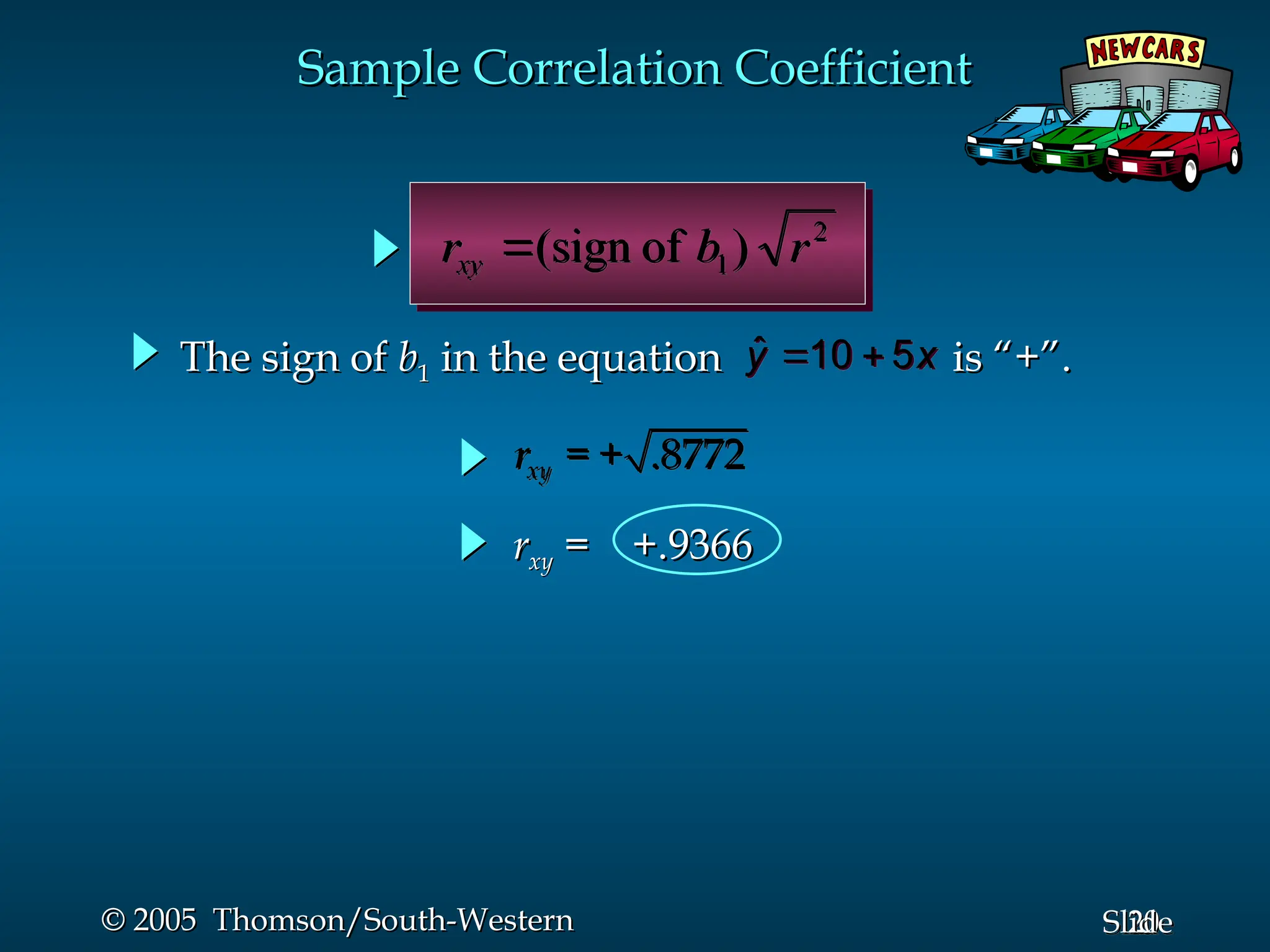
2
1)
of
(sign r
b
rxy 
The sign of
The sign of b
b1
1 in the equation
in the equation is “+”.
is “+”.
ˆ 10 5
y x
 
= + .8772
xy
r
Sample Correlation Coefficient
r
rxy
xy = +.9366
= +.9366
21
Slide
© 2005 Thomson/South-Western
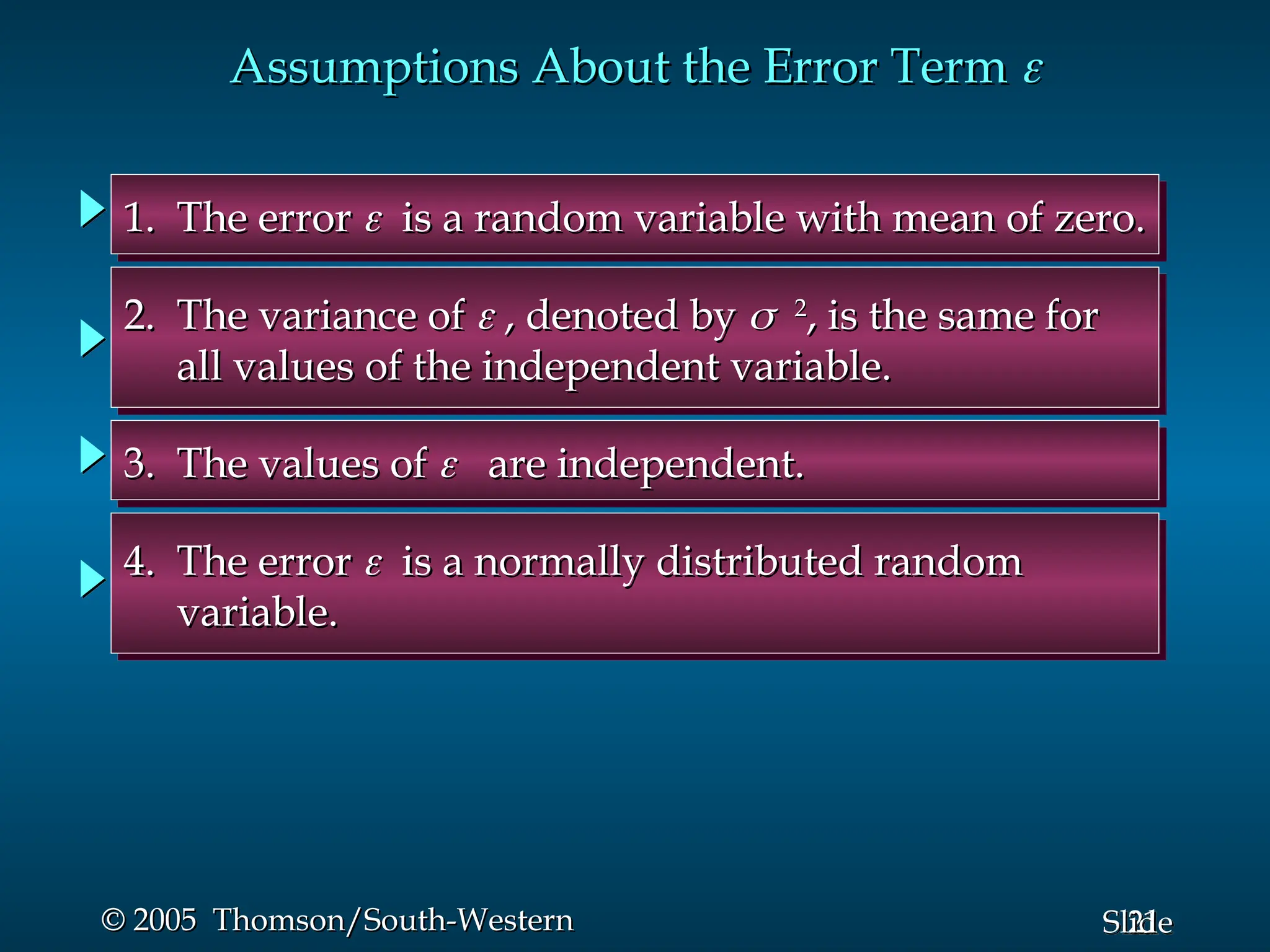
Assumptions About the Error Term
Assumptions About the Error Term 

1. The error
1. The error 
 is a random variable with mean of zero.
is a random variable with mean of zero.
2. The variance of
2. The variance of 
 , denoted by
, denoted by 
2
2
, is the same for
, is the same for
all values of the independent variable.
3. The values of
3. The values of 
 are independent.
are independent.
4. The error
4. The error 
 is a normally distributed random
is a normally distributed random
variable.
variable.
22
Slide
© 2005 Thomson/South-Western
Testing for Significance
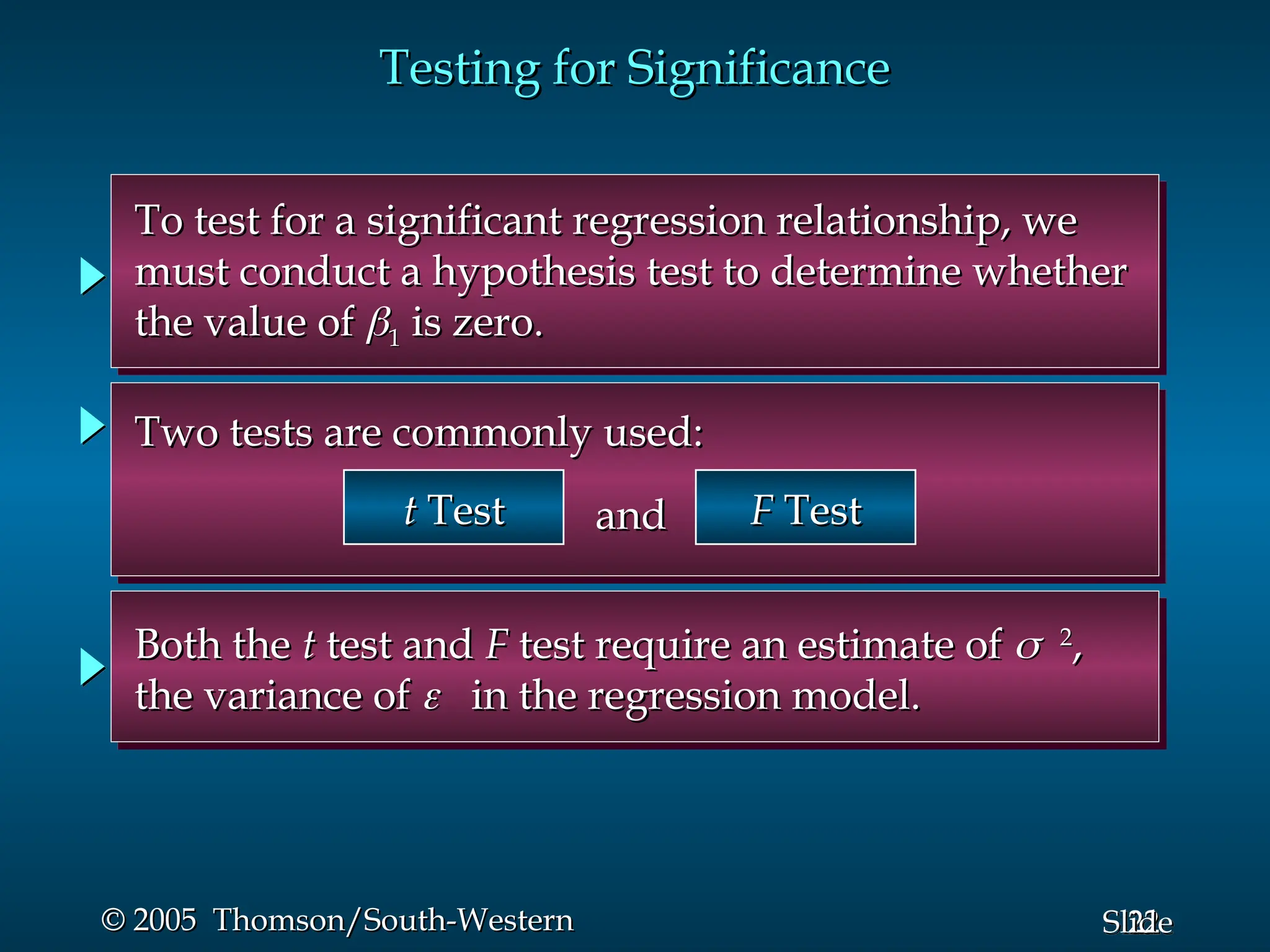
To test for a significant regression relationship, we
must conduct a hypothesis test to determine whether
the value of
the value of 
1
1 is zero.
is zero.
Two tests are commonly used:
t
t Test
Test and
and F
F Test
Test
Both the
Both the t
t test and
test and F
F test require an estimate of
test require an estimate of 

2
2
,
,
the variance of
the variance of 

 in the regression model.
in the regression model.
23
Slide
© 2005 Thomson/South-Western
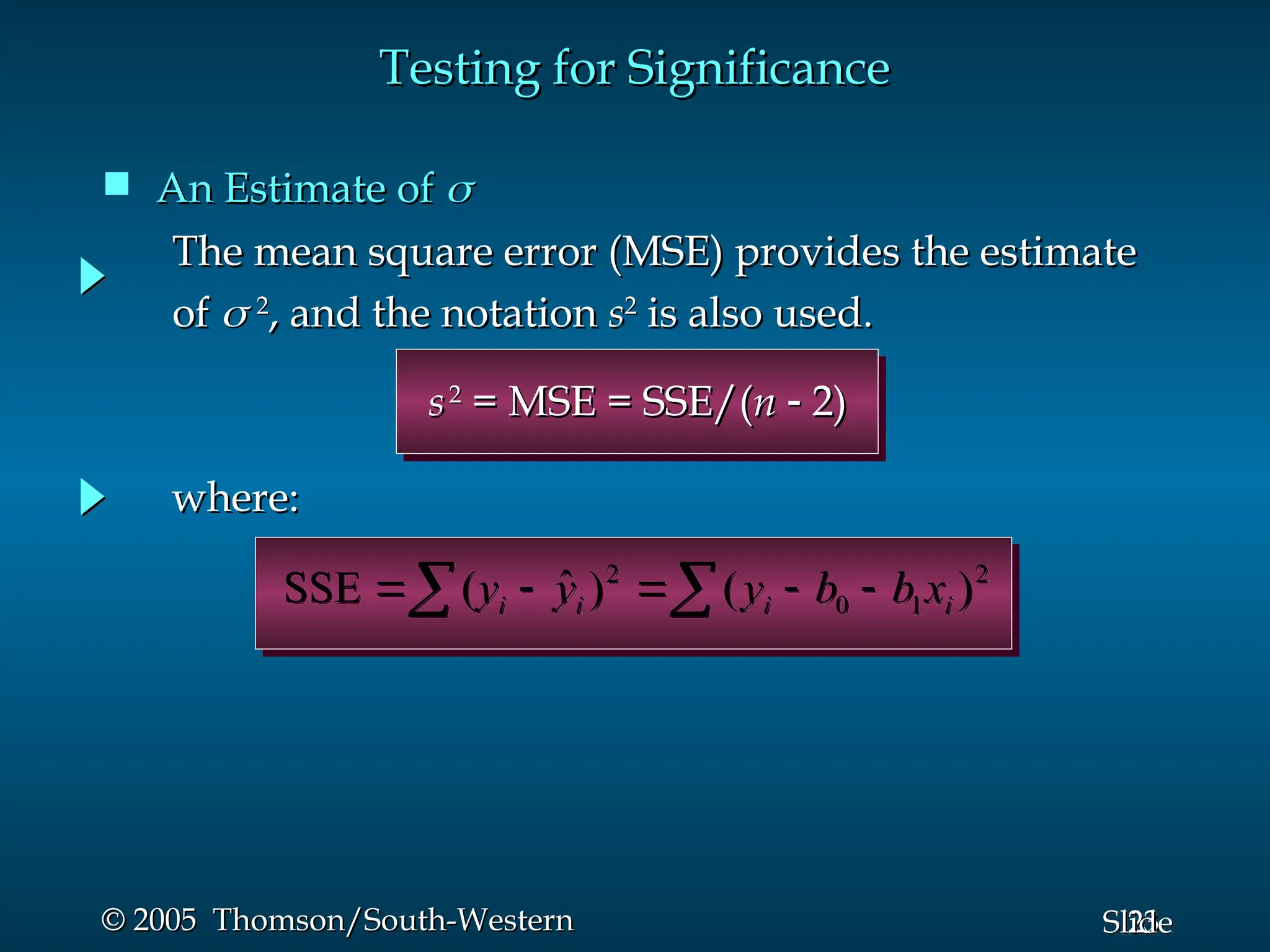
 An Estimate of
An Estimate of 

Testing for Significance

 



 2
1
0
2
)
(
)
ˆ
(
SSE i
i
i
i x
b
b
y
y
y
where:
where:
s
s2
2
= MSE = SSE/(
= MSE = SSE/(n
n 
 2)
2)
The mean square error (MSE) provides the estimate
of
of 
 2
2
, and the notation
, and the notation s
s2
2
is also used.
is also used.
24
Slide
© 2005 Thomson/South-Western
Testing for Significance
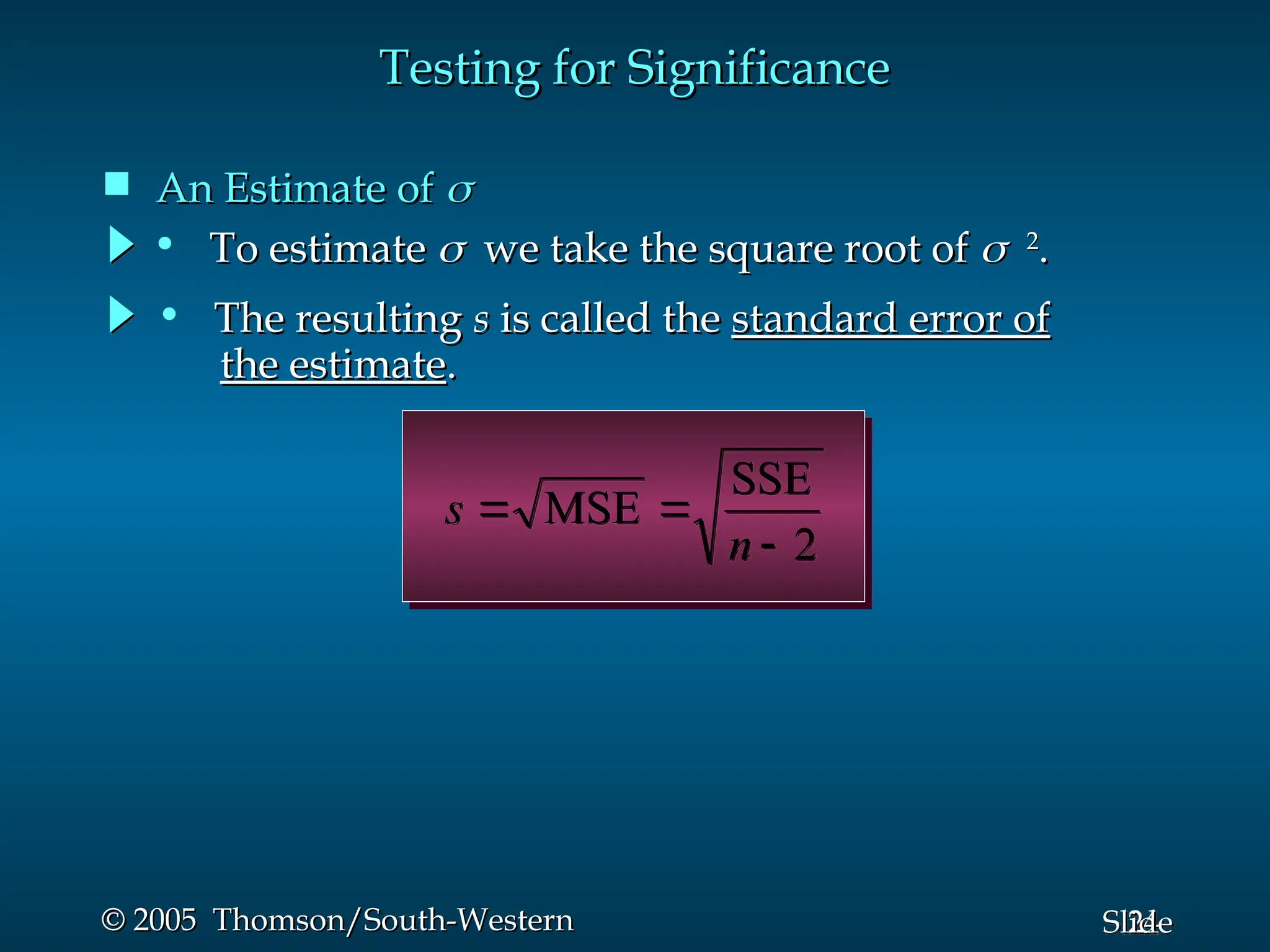
 An Estimate of
An Estimate of 

2
SSE
MSE



n
s
• To estimate
To estimate 
 we take the square root of
we take the square root of 
2
2
.
.
• The resulting
The resulting s
s is called the
is called the standard error of
standard error of
the estimate
the estimate.
.
25
Slide
© 2005 Thomson/South-Western
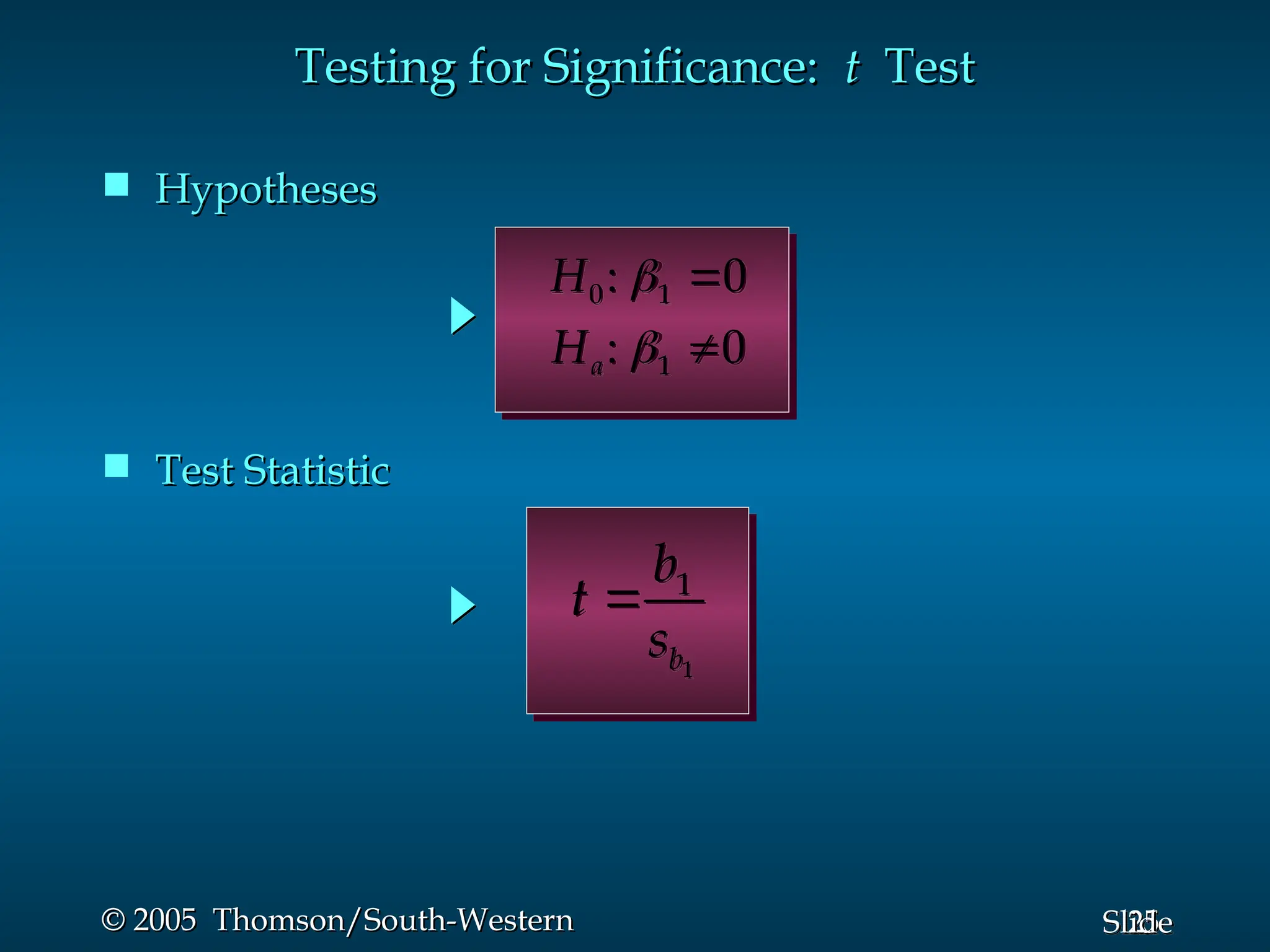
 Hypotheses
Hypotheses
 Test Statistic
Test Statistic
Testing for Significance:
Testing for Significance: t
t Test
Test
0 1
: 0
H  
1
: 0
a
H  
1
1
b
b
t
s

26
Slide
© 2005 Thomson/South-Western
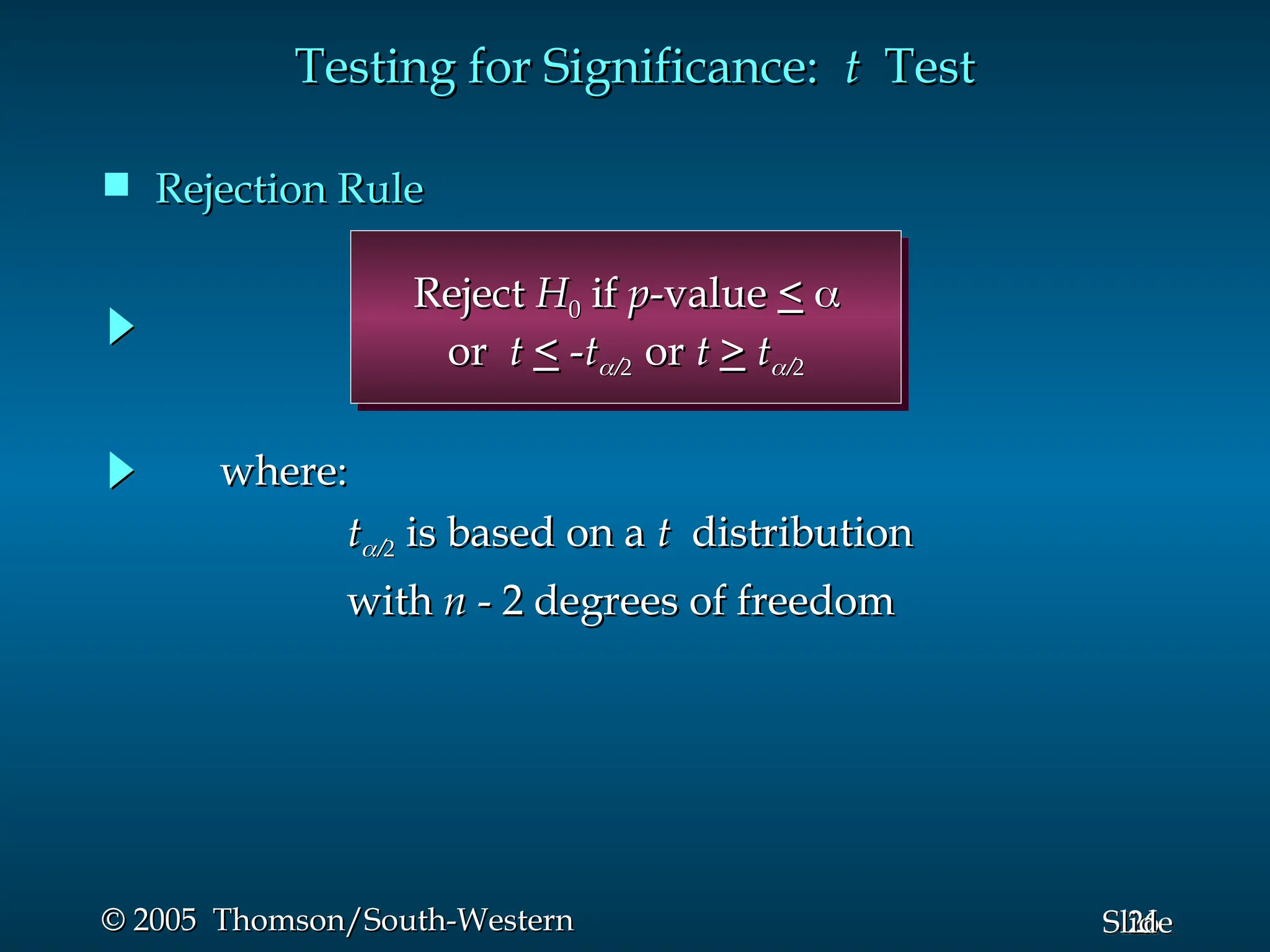
 Rejection Rule
Rejection Rule
Testing for Significance:
Testing for Significance: t
t Test
Test
where:
where:
t
t

 is based on a
is based on a t
t distribution
distribution
with
with n
n - 2 degrees of freedom
- 2 degrees of freedom
Reject
Reject H
H0
0 if
if p
p-value
-value <
< 

or
or t
t <
< -
-t
t

or
or t
t >
> t
t


27
Slide
© 2005 Thomson/South-Western
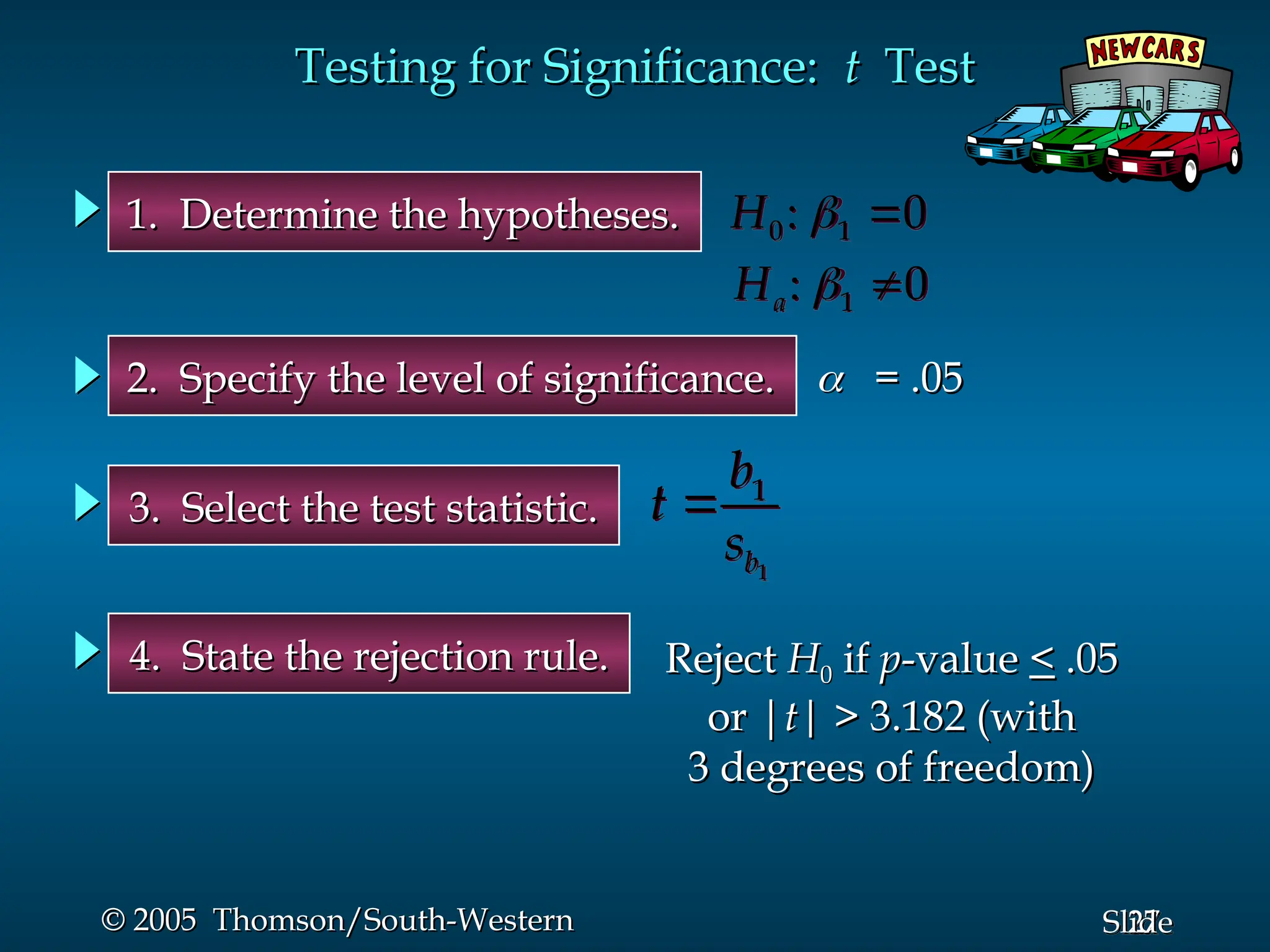
1. Determine the hypotheses.
2. Specify the level of significance.
3. Select the test statistic.

 = .05
= .05
4. State the rejection rule.
4. State the rejection rule. Reject
Reject H
H0
0 if
if p
p-value
-value <
< .05
.05
or |
or |t|
t| > 3.182 (with
> 3.182 (with
3 degrees of freedom)
Testing for Significance:
Testing for Significance: t
t Test
Test
0 1
: 0
H  
1
: 0
a
H  
1
1
b
b
t
s

28
Slide
© 2005 Thomson/South-Western
Testing for Significance:
Testing for Significance: t
t Test
Test
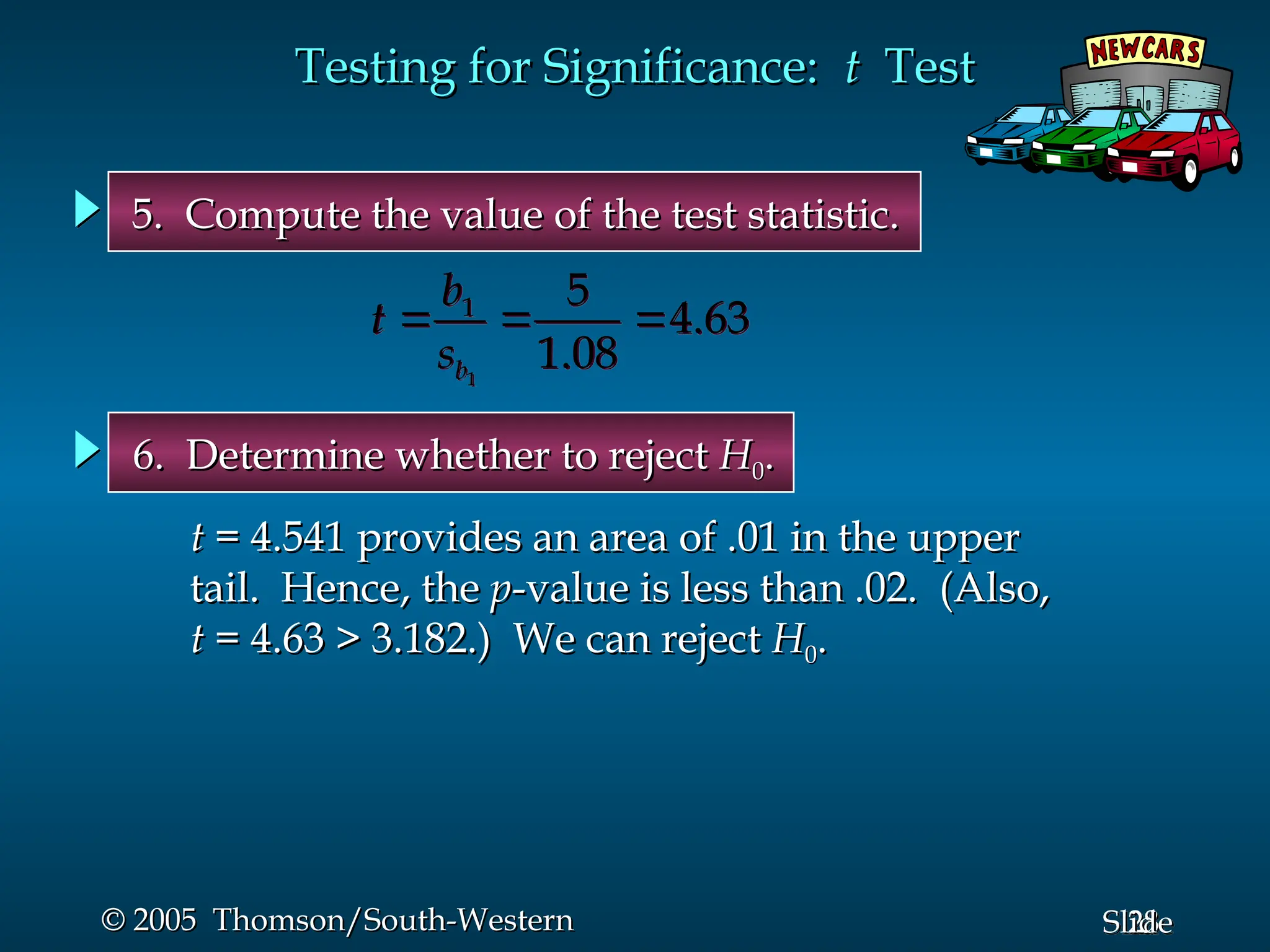
5. Compute the value of the test statistic.
6. Determine whether to reject
6. Determine whether to reject H
H0
0.
.
t
t = 4.541 provides an area of .01 in the upper
= 4.541 provides an area of .01 in the upper
tail. Hence, the
tail. Hence, the p
p-value is less than .02. (Also,
-value is less than .02. (Also,
t
t = 4.63 > 3.182.) We can reject
= 4.63 > 3.182.) We can reject H
H0
0.
.
1
1 5
4.63
1.08
b
b
t
s
  
29
Slide
© 2005 Thomson/South-Western
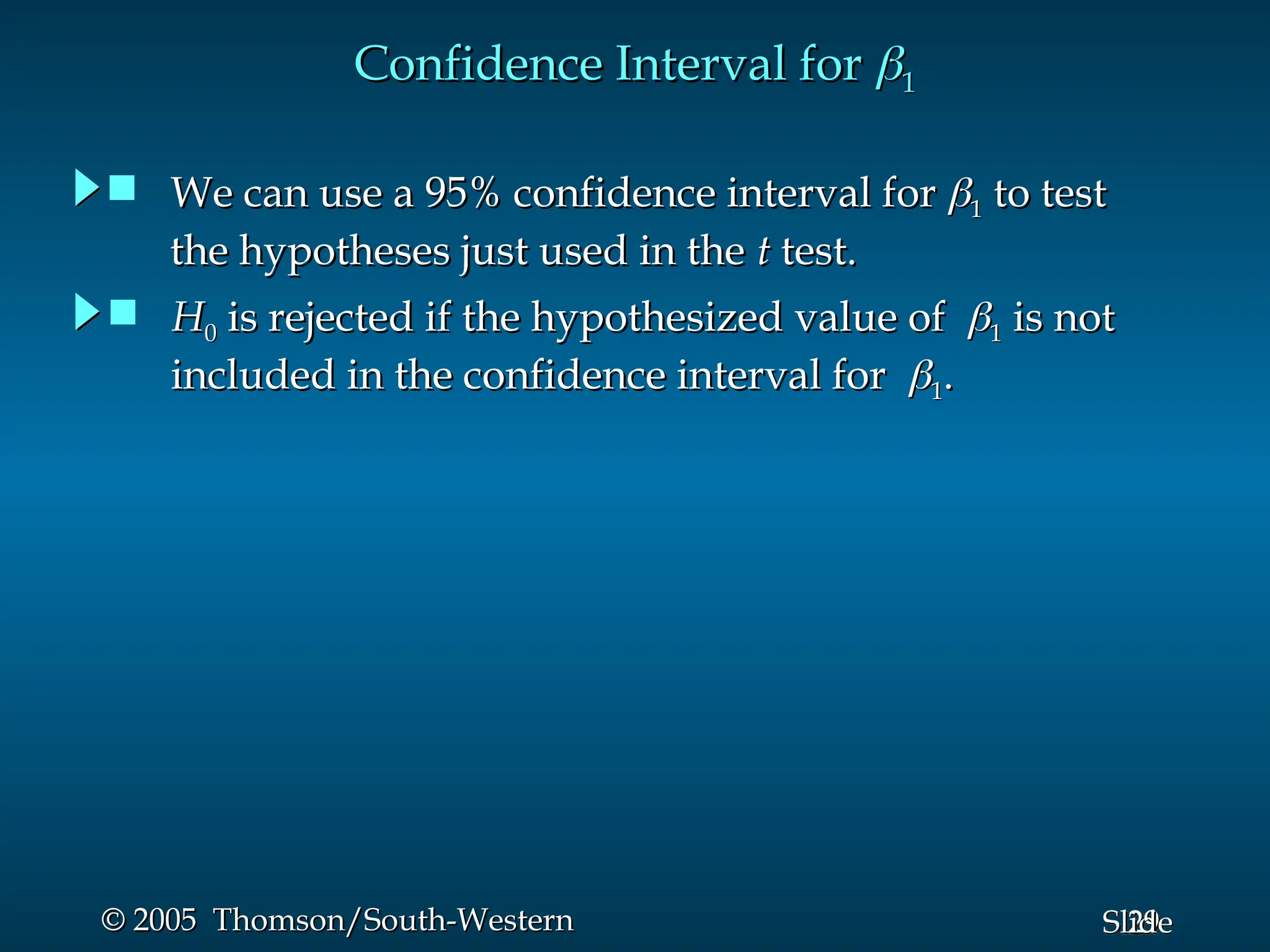
Confidence Interval for
Confidence Interval for 
1
1
 H
H0
0 is rejected if the hypothesized value of
is rejected if the hypothesized value of 
1
1 is not
is not
included in the confidence interval for
included in the confidence interval for 
1
1.
.
 We can use a 95% confidence interval for
We can use a 95% confidence interval for 
1
1 to test
to test
the hypotheses just used in the
the hypotheses just used in the t
t test.
test.
30
Slide
© 2005 Thomson/South-Western
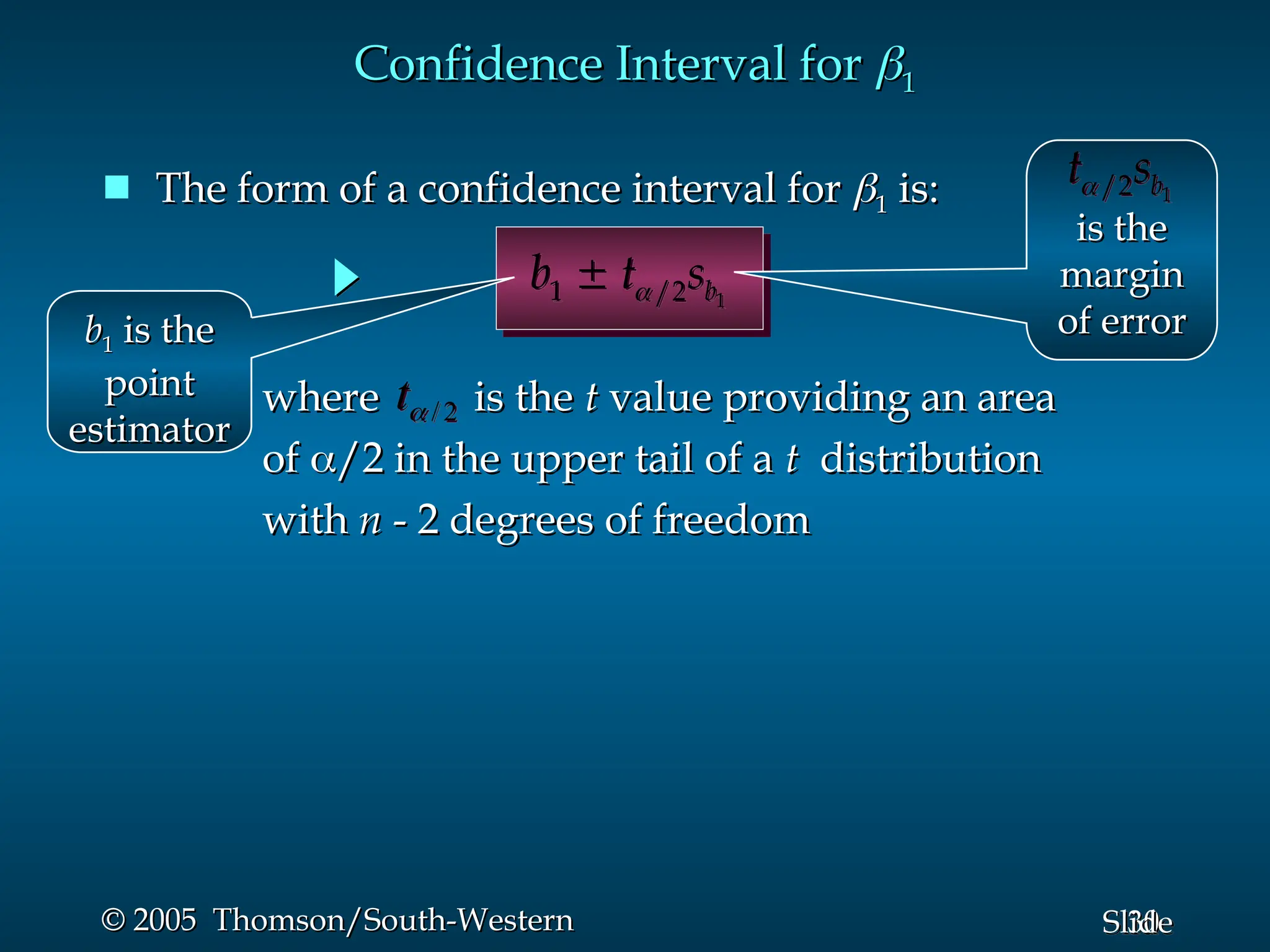
 The form of a confidence interval for
The form of a confidence interval for 
1
1 is:
is:
Confidence Interval for
Confidence Interval for 
1
1
1
1 /2 b
b t s


where
where is the
is the t
t value providing an area
value providing an area
of
of 
/2 in the upper tail of a
/2 in the upper tail of a t
t distribution
distribution
with
with n
n - 2 degrees of freedom
- 2 degrees of freedom
2
/

t
b
b1
1 is the
is the
point
point
estimator
estimator
is the
is the
margin
margin
of error
of error
1
/2 b
t s

31
Slide
© 2005 Thomson/South-Western
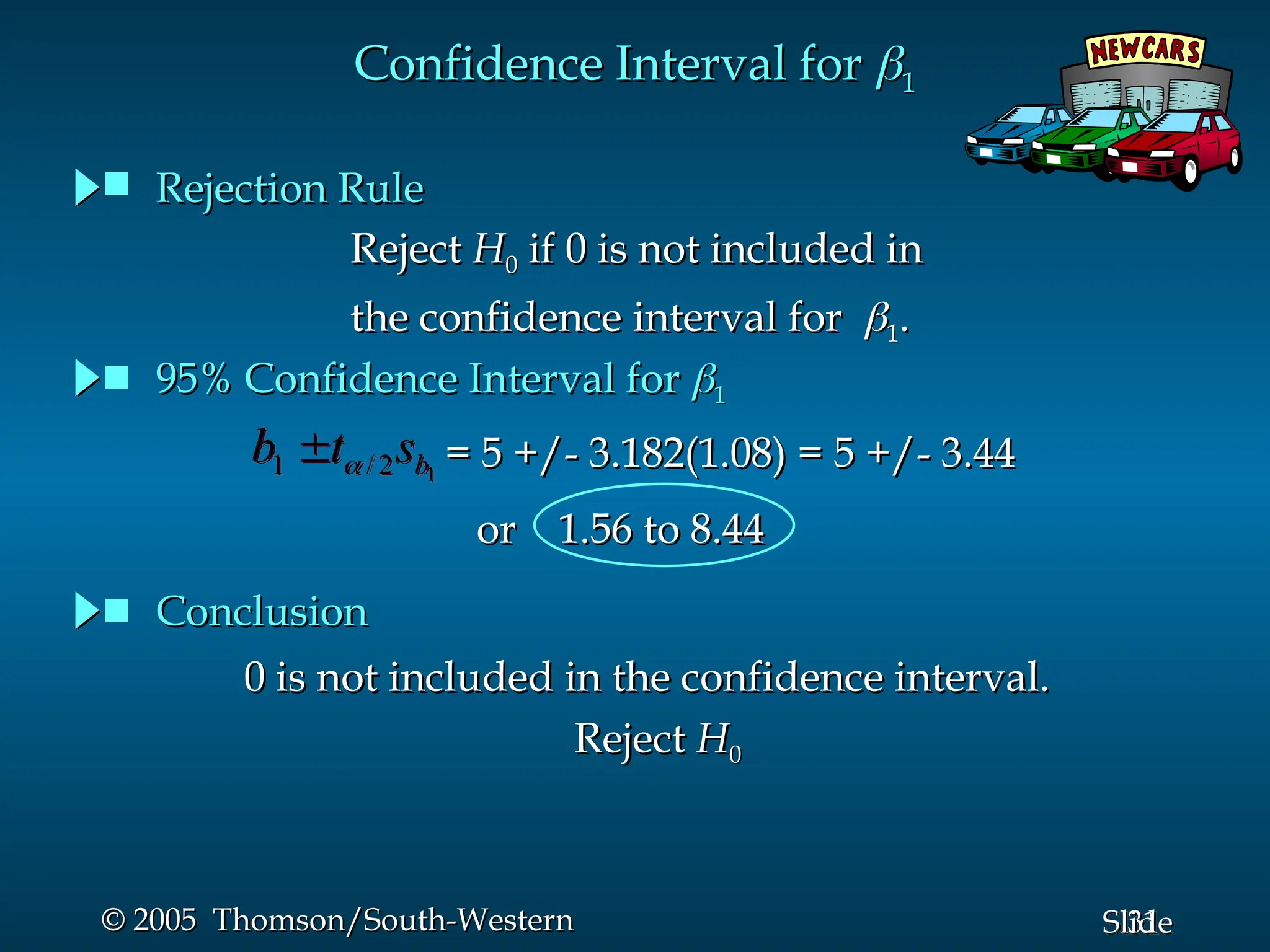
Confidence Interval for
Confidence Interval for 
1
1
Reject
Reject H
H0
0 if 0 is not included in
if 0 is not included in
the confidence interval for
the confidence interval for 
1
1.
.
0 is not included in the confidence interval.
Reject
Reject H
H0
0
= 5 +/- 3.182(1.08) = 5 +/- 3.44
= 5 +/- 3.182(1.08) = 5 +/- 3.44
1
2
/
1 b
s
t
b 

or 1.56 to 8.44
or 1.56 to 8.44
 Rejection Rule
Rejection Rule
 95% Confidence Interval for
95% Confidence Interval for 
1
1
 Conclusion
Conclusion
32
Slide
© 2005 Thomson/South-Western
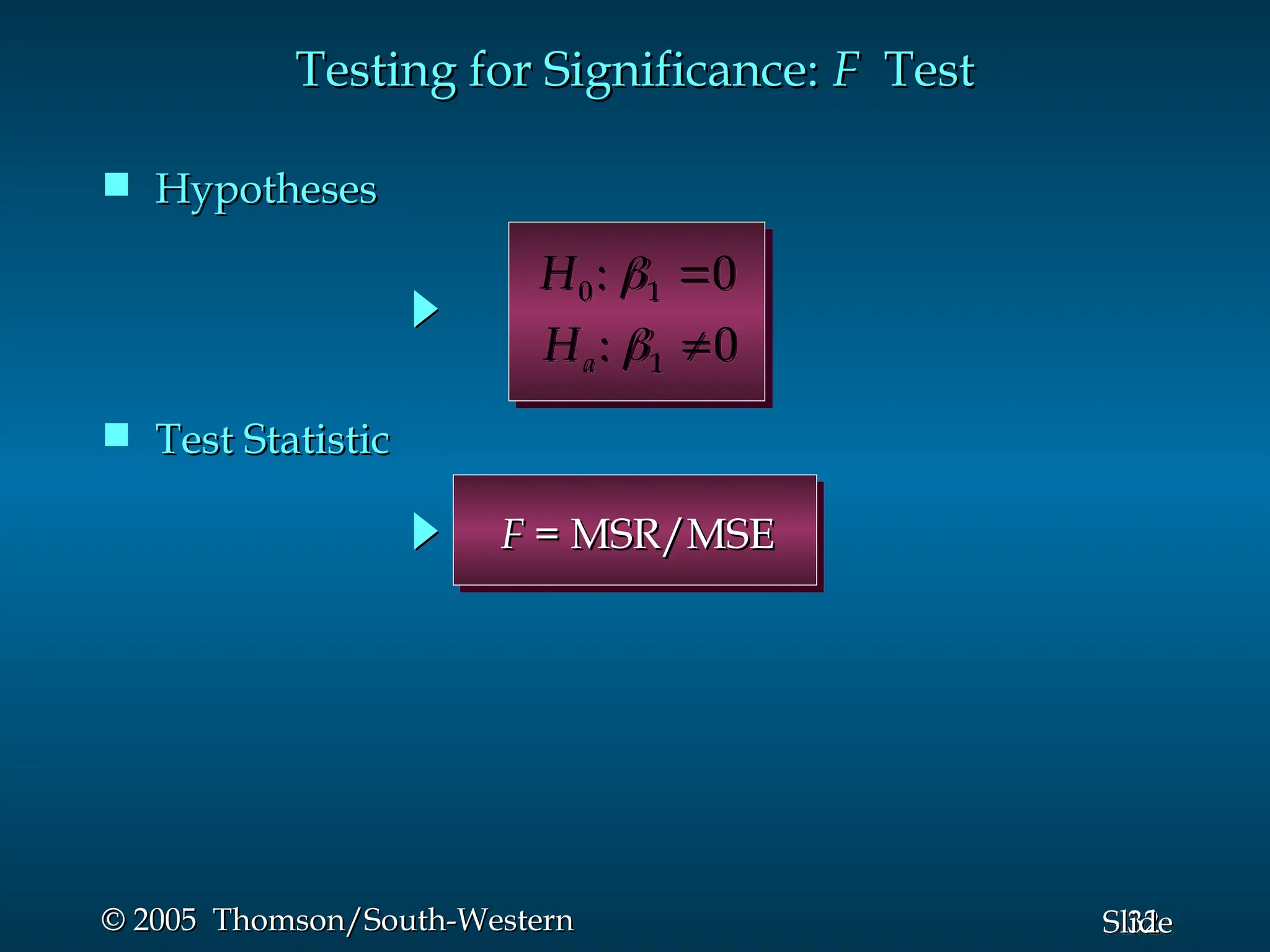
 Hypotheses
Hypotheses
 Test Statistic
Test Statistic
Testing for Significance:
Testing for Significance: F
F Test
Test
F
F = MSR/MSE
= MSR/MSE
0 1
: 0
H  
1
: 0
a
H  
33
Slide
© 2005 Thomson/South-Western
 Rejection Rule
Rejection Rule
Testing for Significance:
Testing for Significance: F
F Test
Test
where:
where:
F
F
 is based on an
is based on an F
F distribution with
distribution with
1 degree of freedom in the numerator and
n
n - 2 degrees of freedom in the denominator
- 2 degrees of freedom in the denominator
Reject
Reject H
H0
0 if
if
p
p-value
-value <
< 

or
or F
F >
> F
F

34
Slide
© 2005 Thomson/South-Western
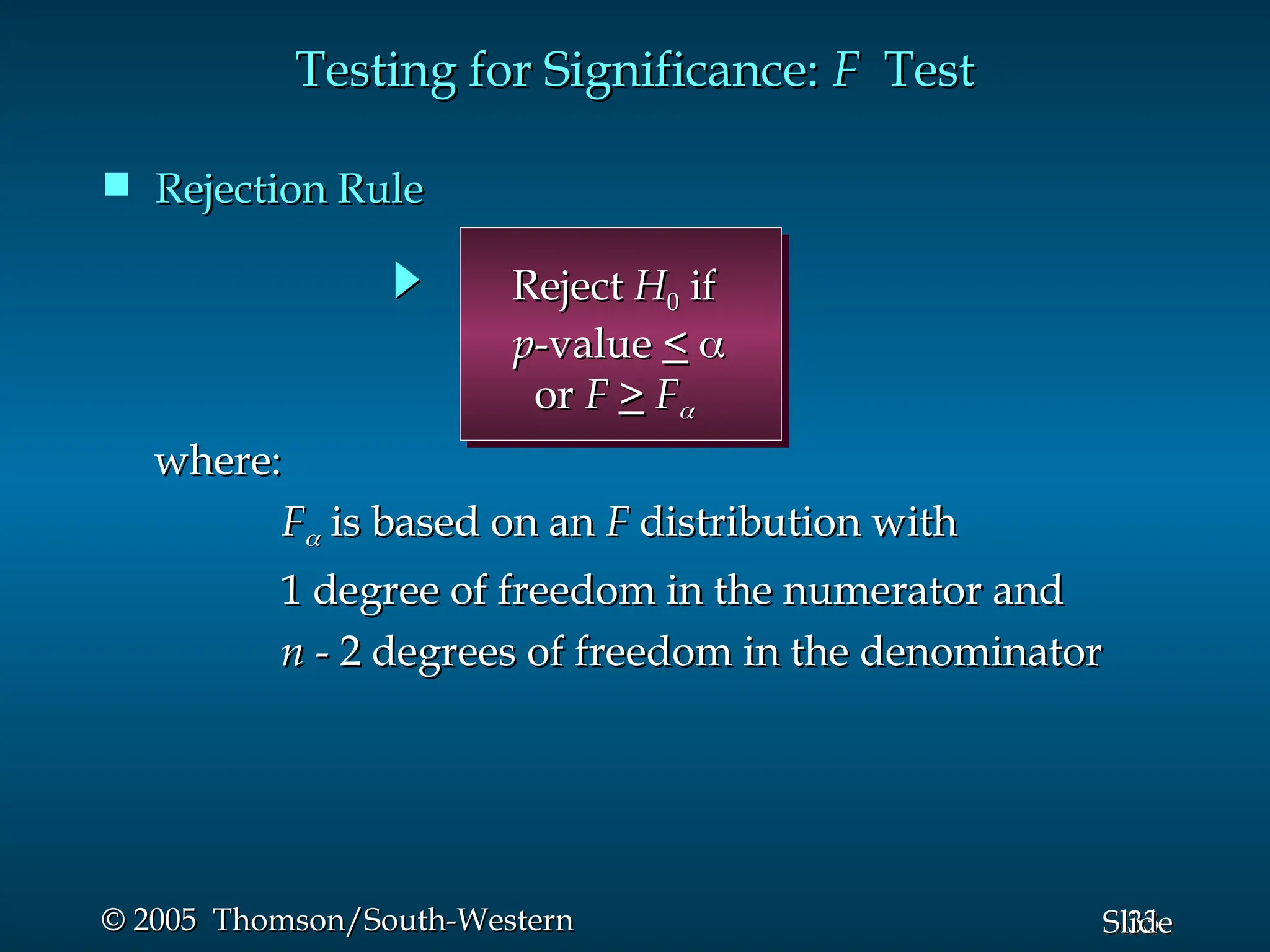
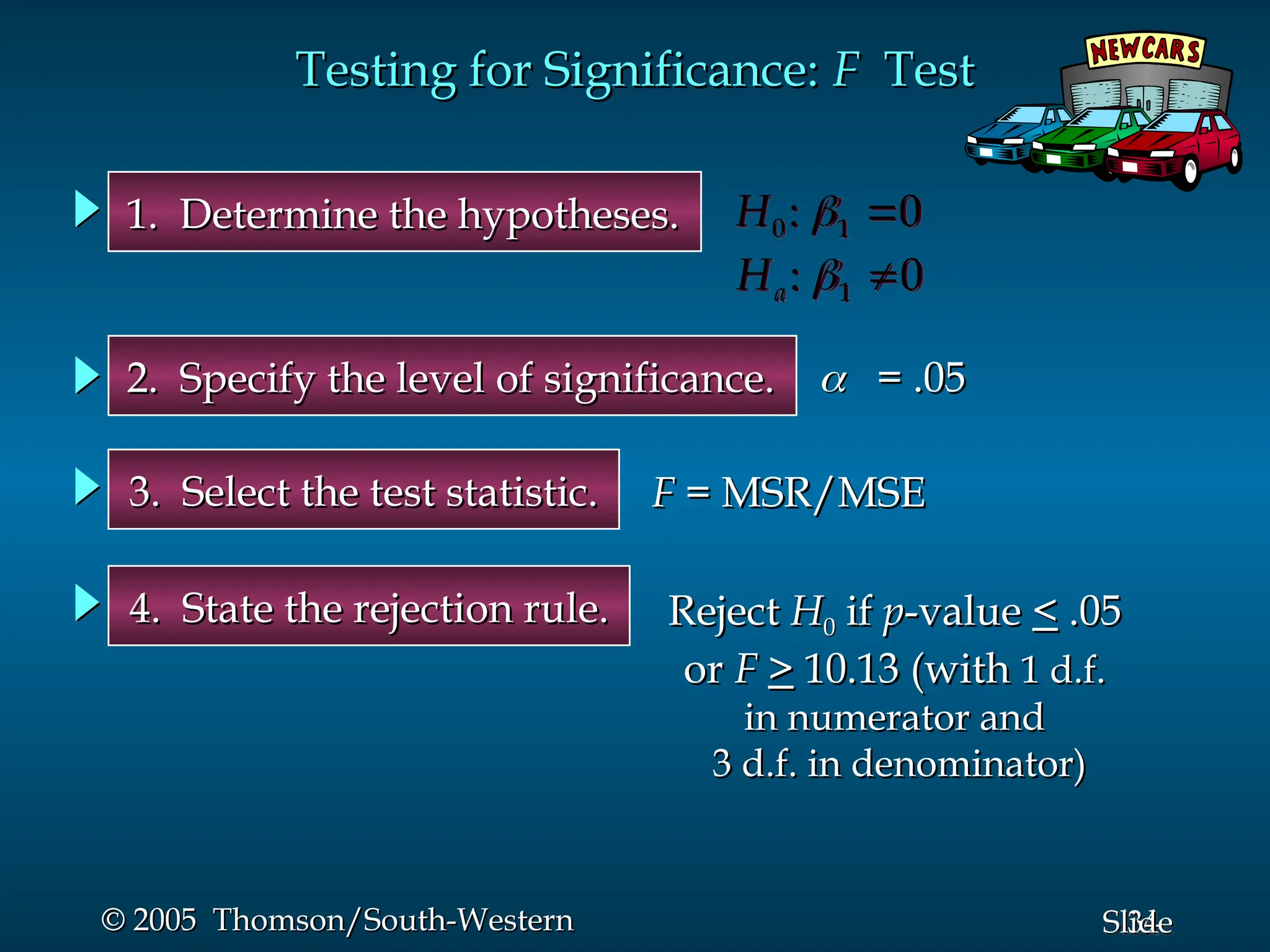
1. Determine the hypotheses.
2. Specify the level of significance.
3. Select the test statistic.

 = .05
= .05
4. State the rejection rule.
4. State the rejection rule. Reject
Reject H
H0
0 if
if p
p-value
-value <
< .05
.05
or
or F
F >
> 10.13 (with
10.13 (with 1 d.f.
1 d.f.
in numerator and
in numerator and
3 d.f. in denominator)
Testing for Significance:
Testing for Significance: F
F Test
Test
0 1
: 0
H  
1
: 0
a
H  
F
F = MSR/MSE
= MSR/MSE
35
Slide
© 2005 Thomson/South-Western
Testing for Significance:
Testing for Significance: F
F Test
Test
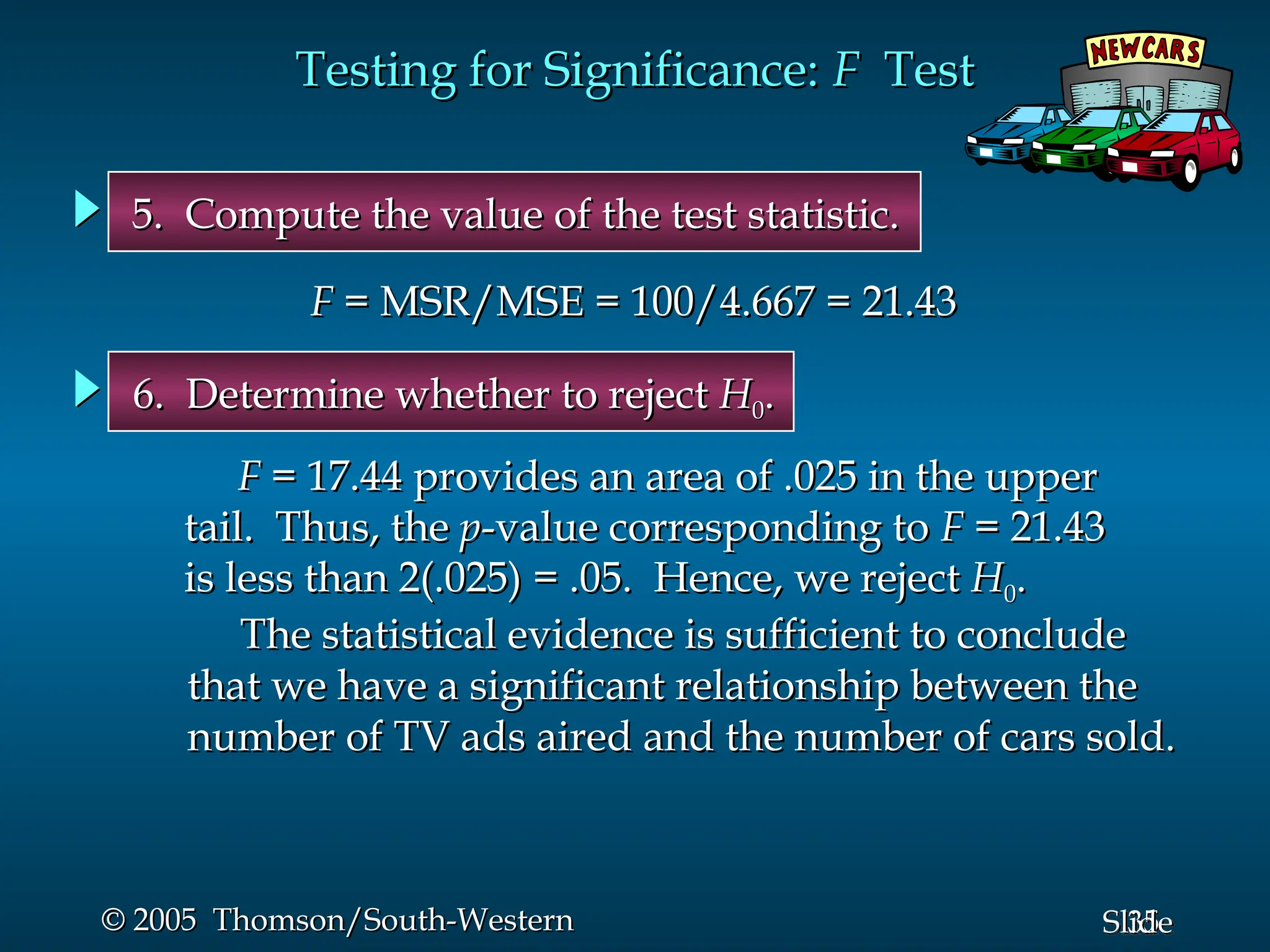
5. Compute the value of the test statistic.
6. Determine whether to reject
6. Determine whether to reject H
H0
0.
.
F
F = 17.44 provides an area of .025 in the upper
= 17.44 provides an area of .025 in the upper
tail. Thus, the
tail. Thus, the p
p-value corresponding to
-value corresponding to F
F = 21.43
= 21.43
is less than 2(.025) = .05. Hence, we reject
is less than 2(.025) = .05. Hence, we reject H
H0
0.
.
F
F = MSR/MSE = 100/4.667 = 21.43
= MSR/MSE = 100/4.667 = 21.43
The statistical evidence is sufficient to conclude
that we have a significant relationship between the
number of TV ads aired and the number of cars sold.
36
Slide
© 2005 Thomson/South-Western
Some Cautions about the
Interpretation of Significance Tests
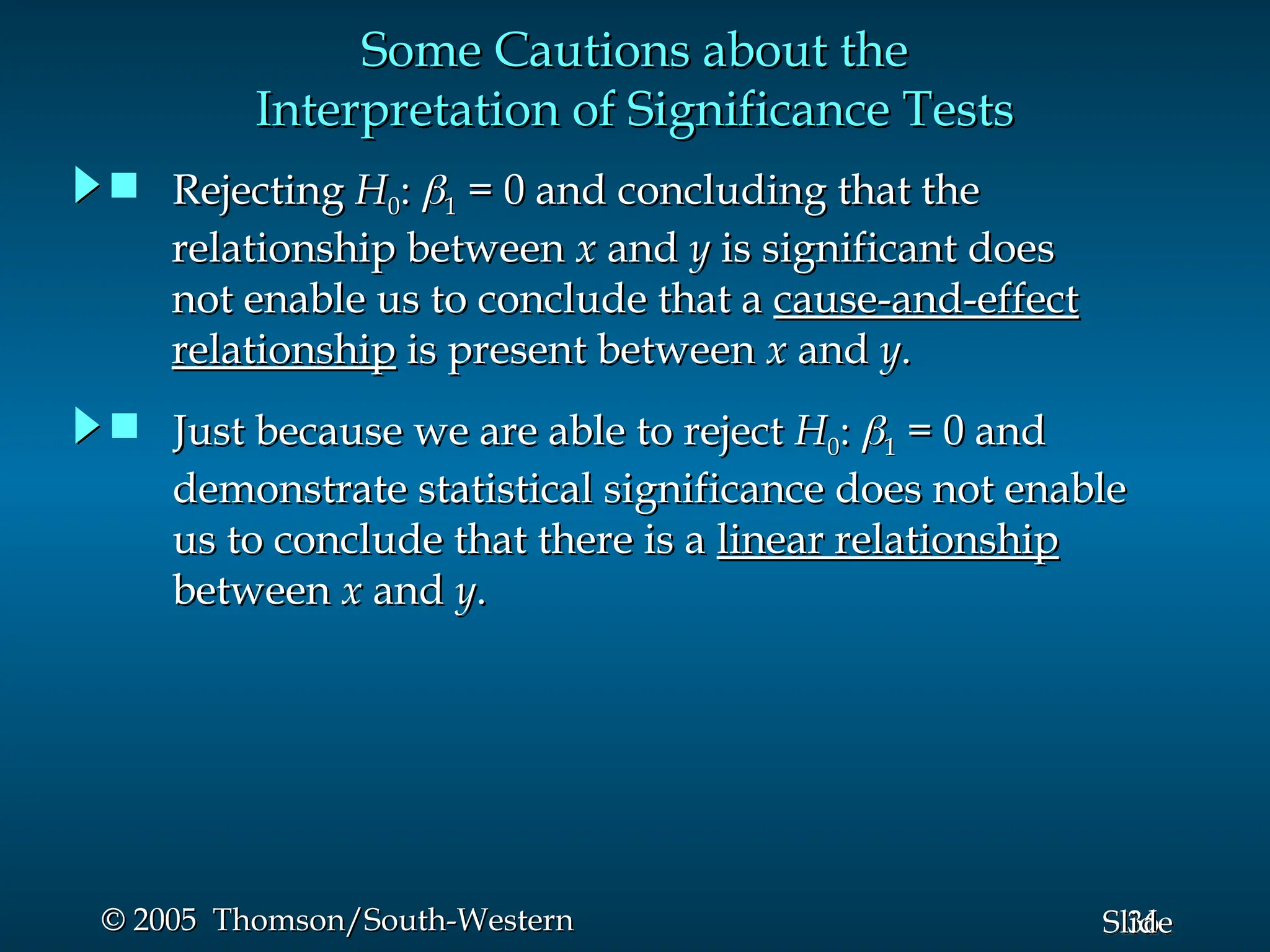
 Just because we are able to reject
Just because we are able to reject H
H0
0:
: 
1
1 = 0 and
= 0 and
demonstrate statistical significance does not enable
us to conclude that there is a
us to conclude that there is a linear relationship
linear relationship
between
between x
x and
and y
y.
.
 Rejecting
Rejecting H
H0
0:
: 
1
1 = 0 and concluding that the
= 0 and concluding that the
relationship between
relationship between x
x and
and y
y is significant does
is significant does
not enable us to conclude that a
not enable us to conclude that a cause-and-effect
cause-and-effect
relationship
relationship is present between
is present between x
x and
and y
y.
.
37
Slide
© 2005 Thomson/South-Western
End of Chapter 14
End of Chapter 14

wwwwwwwwwwwwwwwwwwwwW7_Simple_linear_regression_PPT.ppt

  • 1.
    1 Slide © 2005 Thomson/South-Western ©2005 Thomson/South-Western Chapter 14 Chapter 14 Simple Linear Regression Simple Linear Regression  Simple Linear Regression Model Simple Linear Regression Model  Least Squares Method Least Squares Method  Coefficient of Determination Coefficient of Determination  Model Assumptions Model Assumptions  Testing for Significance Testing for Significance  Using the Estimated Regression Equation Using the Estimated Regression Equation for Estimation and Prediction for Estimation and Prediction  Computer Solution Computer Solution  Residual Analysis: Validating Model Assumptions Residual Analysis: Validating Model Assumptions
  • 2.
    2 Slide © 2005 Thomson/South-Western ©2005 Thomson/South-Western Simple Linear Regression Model Simple Linear Regression Model y y = =  0 0 + +  1 1x x + +  where: where:  0 0 and and  1 1 are called are called parameters of the model parameters of the model, ,   is a random variable called the is a random variable called the error term error term. .  The The simple linear regression model simple linear regression model is: is:  The equation that describes how The equation that describes how y y is related to is related to x x and and an error term is called the an error term is called the regression model regression model. .
  • 3.
    3 Slide © 2005 Thomson/South-Western ©2005 Thomson/South-Western Simple Linear Regression Equation Simple Linear Regression Equation  The The simple linear regression equation simple linear regression equation is: is: • E E( (y y) is the expected value of ) is the expected value of y y for a given for a given x x value. value. •  1 1 is the slope of the regression line. is the slope of the regression line. •  0 0 is the is the y y intercept of the regression line. intercept of the regression line. • Graph of the regression equation is a straight line. Graph of the regression equation is a straight line. E E( (y y) = ) =  0 0 + +  1 1x x
  • 4.
    4 Slide © 2005 Thomson/South-Western ©2005 Thomson/South-Western Simple Linear Regression Equation Simple Linear Regression Equation  Positive Linear Relationship Positive Linear Relationship E E( (y y) ) x x Slope Slope  1 1 is positive is positive Regression line Regression line Intercept Intercept  0 0
  • 5.
    5 Slide © 2005 Thomson/South-Western ©2005 Thomson/South-Western Simple Linear Regression Equation Simple Linear Regression Equation  Negative Linear Relationship Negative Linear Relationship E E( (y y) ) x x Slope Slope  1 1 is negative is negative Regression line Regression line Intercept Intercept  0 0
  • 6.
    6 Slide © 2005 Thomson/South-Western ©2005 Thomson/South-Western Simple Linear Regression Equation Simple Linear Regression Equation  No Relationship No Relationship E E( (y y) ) x x Slope Slope  1 1 is 0 is 0 Regression line Regression line Intercept Intercept  0 0
  • 7.
    7 Slide © 2005 Thomson/South-Western ©2005 Thomson/South-Western Estimated Simple Linear Regression Equation Estimated Simple Linear Regression Equation  The The estimated simple linear regression equation estimated simple linear regression equation 0 1 ŷ b b x   • is the estimated value of is the estimated value of y y for a given for a given x x value. value. ŷ • b b1 1 is the slope of the line. is the slope of the line. • b b0 0 is the is the y y intercept of the line. intercept of the line. • The graph is called the estimated regression line. The graph is called the estimated regression line.
  • 8.
    8 Slide © 2005 Thomson/South-Western ©2005 Thomson/South-Western Estimation Process Estimation Process Regression Model Regression Model y y = =  0 0 + +  1 1x x + +  Regression Equation Regression Equation E E( (y y) = ) =  0 0 + +  1 1x x Unknown Parameters Unknown Parameters  0 0, ,  1 1 Sample Data: Sample Data: x y x y x x1 1 y y1 1 . . . . . . . . x xn n y yn n b b0 0 and and b b1 1 provide estimates of provide estimates of  0 0 and and  1 1 Estimated Estimated Regression Equation Regression Equation Sample Statistics Sample Statistics b b0 0, , b b1 1 0 1 ŷ b b x  
  • 9.
    9 Slide © 2005 Thomson/South-Western ©2005 Thomson/South-Western Least Squares Method Least Squares Method  Least Squares Criterion Least Squares Criterion min (y y i i    )2 where: where: y yi i = = observed observed value of the dependent variable value of the dependent variable for the for the i ith observation th observation ^ ^ y yi i = = estimated estimated value of the dependent variable value of the dependent variable for the for the i ith observation th observation
  • 10.
    10 Slide © 2005 Thomson/South-Western ©2005 Thomson/South-Western  Slope for the Estimated Regression Equation Slope for the Estimated Regression Equation 1 2 ( )( ) ( ) i i i x x y y b x x       Least Squares Method Least Squares Method
  • 11.
    11 Slide © 2005 Thomson/South-Western ©2005 Thomson/South-Western  y y-Intercept for the Estimated Regression Equation -Intercept for the Estimated Regression Equation Least Squares Method Least Squares Method 0 1 b y b x   where: where: x xi i = value of independent variable for = value of independent variable for i ith th observation observation n n = total number of observations = total number of observations _ _ y y = mean value for dependent variable = mean value for dependent variable _ _ x x = mean value for independent variable = mean value for independent variable y yi i = value of dependent variable for = value of dependent variable for i ith th observation observation
  • 12.
    12 Slide © 2005 Thomson/South-Western ©2005 Thomson/South-Western Reed Auto periodically has Reed Auto periodically has a special week-long sale. a special week-long sale. As part of the advertising As part of the advertising campaign Reed runs one or campaign Reed runs one or more television commercials more television commercials during the weekend preceding the sale. Data from a during the weekend preceding the sale. Data from a sample of 5 previous sales are shown on the next slide. sample of 5 previous sales are shown on the next slide. Simple Linear Regression Simple Linear Regression  Example: Reed Auto Sales Example: Reed Auto Sales
  • 13.
    13 Slide © 2005 Thomson/South-Western ©2005 Thomson/South-Western Simple Linear Regression Simple Linear Regression  Example: Reed Auto Sales Example: Reed Auto Sales Number of Number of TV Ads TV Ads Number of Number of Cars Sold Cars Sold 1 1 3 3 2 2 1 1 3 3 14 14 24 24 18 18 17 17 27 27
  • 14.
    14 Slide © 2005 Thomson/South-Western ©2005 Thomson/South-Western Estimated Regression Equation Estimated Regression Equation ˆ 10 5 y x   1 2 ( )( ) 20 5 ( ) 4 i i i x x y y b x x         0 1 20 5(2) 10 b y b x       Slope for the Estimated Regression Equation Slope for the Estimated Regression Equation  y y-Intercept for the Estimated Regression Equation -Intercept for the Estimated Regression Equation  Estimated Regression Equation Estimated Regression Equation
  • 15.
    15 Slide © 2005 Thomson/South-Western ©2005 Thomson/South-Western Scatter Diagram and Trend Line Scatter Diagram and Trend Line y = 5x + 10 0 5 10 15 20 25 30 0 1 2 3 4 TV Ads Cars Sold
  • 16.
    16 Slide © 2005 Thomson/South-Western ©2005 Thomson/South-Western Coefficient of Determination Coefficient of Determination  Relationship Among SST, SSR, SSE Relationship Among SST, SSR, SSE where: where: SST = total sum of squares SST = total sum of squares SSR = sum of squares due to regression SSR = sum of squares due to regression SSE = sum of squares due to error SSE = sum of squares due to error SST = SSR + SSE SST = SSR + SSE 2 ( ) i y y   2 ˆ ( ) i y y    2 ˆ ( ) i i y y   
  • 17.
    17 Slide © 2005 Thomson/South-Western ©2005 Thomson/South-Western  The The coefficient of determination coefficient of determination is: is: Coefficient of Determination Coefficient of Determination where: where: SSR = sum of squares due to regression SSR = sum of squares due to regression SST = total sum of squares SST = total sum of squares r r2 2 = SSR/SST = SSR/SST
  • 18.
    18 Slide © 2005 Thomson/South-Western ©2005 Thomson/South-Western Coefficient of Determination Coefficient of Determination r r2 2 = SSR/SST = 100/114 = .8772 = SSR/SST = 100/114 = .8772 The regression relationship is very strong; 88% The regression relationship is very strong; 88% of the variability in the number of cars sold can be of the variability in the number of cars sold can be explained by the linear relationship between the explained by the linear relationship between the number of TV ads and the number of cars sold. number of TV ads and the number of cars sold.
  • 19.
    19 Slide © 2005 Thomson/South-Western ©2005 Thomson/South-Western Sample Correlation Coefficient Sample Correlation Coefficient 2 1) of (sign r b rxy  ion Determinat of t Coefficien ) of (sign 1 b rxy  where: where: b b1 1 = the slope of the estimated regression = the slope of the estimated regression equation equation x b b y 1 0 ˆ  
  • 20.
    20 Slide © 2005 Thomson/South-Western ©2005 Thomson/South-Western 2 1) of (sign r b rxy  The sign of The sign of b b1 1 in the equation in the equation is “+”. is “+”. ˆ 10 5 y x   = + .8772 xy r Sample Correlation Coefficient Sample Correlation Coefficient r rxy xy = +.9366 = +.9366
  • 21.
    21 Slide © 2005 Thomson/South-Western ©2005 Thomson/South-Western Assumptions About the Error Term Assumptions About the Error Term   1. The error 1. The error   is a random variable with mean of zero. is a random variable with mean of zero. 2. The variance of 2. The variance of   , denoted by , denoted by  2 2 , is the same for , is the same for all values of the independent variable. all values of the independent variable. 3. The values of 3. The values of   are independent. are independent. 4. The error 4. The error   is a normally distributed random is a normally distributed random variable. variable.
  • 22.
    22 Slide © 2005 Thomson/South-Western ©2005 Thomson/South-Western Testing for Significance Testing for Significance To test for a significant regression relationship, we To test for a significant regression relationship, we must conduct a hypothesis test to determine whether must conduct a hypothesis test to determine whether the value of the value of  1 1 is zero. is zero. Two tests are commonly used: Two tests are commonly used: t t Test Test and and F F Test Test Both the Both the t t test and test and F F test require an estimate of test require an estimate of   2 2 , , the variance of the variance of    in the regression model. in the regression model.
  • 23.
    23 Slide © 2005 Thomson/South-Western ©2005 Thomson/South-Western  An Estimate of An Estimate of   Testing for Significance Testing for Significance        2 1 0 2 ) ( ) ˆ ( SSE i i i i x b b y y y where: where: s s2 2 = MSE = SSE/( = MSE = SSE/(n n   2) 2) The mean square error (MSE) provides the estimate The mean square error (MSE) provides the estimate of of   2 2 , and the notation , and the notation s s2 2 is also used. is also used.
  • 24.
    24 Slide © 2005 Thomson/South-Western ©2005 Thomson/South-Western Testing for Significance Testing for Significance  An Estimate of An Estimate of   2 SSE MSE    n s • To estimate To estimate   we take the square root of we take the square root of  2 2 . . • The resulting The resulting s s is called the is called the standard error of standard error of the estimate the estimate. .
  • 25.
    25 Slide © 2005 Thomson/South-Western ©2005 Thomson/South-Western  Hypotheses Hypotheses  Test Statistic Test Statistic Testing for Significance: Testing for Significance: t t Test Test 0 1 : 0 H   1 : 0 a H   1 1 b b t s 
  • 26.
    26 Slide © 2005 Thomson/South-Western ©2005 Thomson/South-Western  Rejection Rule Rejection Rule Testing for Significance: Testing for Significance: t t Test Test where: where: t t   is based on a is based on a t t distribution distribution with with n n - 2 degrees of freedom - 2 degrees of freedom Reject Reject H H0 0 if if p p-value -value < <   or or t t < < - -t t  or or t t > > t t  
  • 27.
    27 Slide © 2005 Thomson/South-Western ©2005 Thomson/South-Western 1. Determine the hypotheses. 1. Determine the hypotheses. 2. Specify the level of significance. 2. Specify the level of significance. 3. Select the test statistic. 3. Select the test statistic.   = .05 = .05 4. State the rejection rule. 4. State the rejection rule. Reject Reject H H0 0 if if p p-value -value < < .05 .05 or | or |t| t| > 3.182 (with > 3.182 (with 3 degrees of freedom) 3 degrees of freedom) Testing for Significance: Testing for Significance: t t Test Test 0 1 : 0 H   1 : 0 a H   1 1 b b t s 
  • 28.
    28 Slide © 2005 Thomson/South-Western ©2005 Thomson/South-Western Testing for Significance: Testing for Significance: t t Test Test 5. Compute the value of the test statistic. 5. Compute the value of the test statistic. 6. Determine whether to reject 6. Determine whether to reject H H0 0. . t t = 4.541 provides an area of .01 in the upper = 4.541 provides an area of .01 in the upper tail. Hence, the tail. Hence, the p p-value is less than .02. (Also, -value is less than .02. (Also, t t = 4.63 > 3.182.) We can reject = 4.63 > 3.182.) We can reject H H0 0. . 1 1 5 4.63 1.08 b b t s   
  • 29.
    29 Slide © 2005 Thomson/South-Western ©2005 Thomson/South-Western Confidence Interval for Confidence Interval for  1 1  H H0 0 is rejected if the hypothesized value of is rejected if the hypothesized value of  1 1 is not is not included in the confidence interval for included in the confidence interval for  1 1. .  We can use a 95% confidence interval for We can use a 95% confidence interval for  1 1 to test to test the hypotheses just used in the the hypotheses just used in the t t test. test.
  • 30.
    30 Slide © 2005 Thomson/South-Western ©2005 Thomson/South-Western  The form of a confidence interval for The form of a confidence interval for  1 1 is: is: Confidence Interval for Confidence Interval for  1 1 1 1 /2 b b t s   where where is the is the t t value providing an area value providing an area of of  /2 in the upper tail of a /2 in the upper tail of a t t distribution distribution with with n n - 2 degrees of freedom - 2 degrees of freedom 2 /  t b b1 1 is the is the point point estimator estimator is the is the margin margin of error of error 1 /2 b t s 
  • 31.
    31 Slide © 2005 Thomson/South-Western ©2005 Thomson/South-Western Confidence Interval for Confidence Interval for  1 1 Reject Reject H H0 0 if 0 is not included in if 0 is not included in the confidence interval for the confidence interval for  1 1. . 0 is not included in the confidence interval. 0 is not included in the confidence interval. Reject Reject H H0 0 = 5 +/- 3.182(1.08) = 5 +/- 3.44 = 5 +/- 3.182(1.08) = 5 +/- 3.44 1 2 / 1 b s t b   or 1.56 to 8.44 or 1.56 to 8.44  Rejection Rule Rejection Rule  95% Confidence Interval for 95% Confidence Interval for  1 1  Conclusion Conclusion
  • 32.
    32 Slide © 2005 Thomson/South-Western ©2005 Thomson/South-Western  Hypotheses Hypotheses  Test Statistic Test Statistic Testing for Significance: Testing for Significance: F F Test Test F F = MSR/MSE = MSR/MSE 0 1 : 0 H   1 : 0 a H  
  • 33.
    33 Slide © 2005 Thomson/South-Western ©2005 Thomson/South-Western  Rejection Rule Rejection Rule Testing for Significance: Testing for Significance: F F Test Test where: where: F F  is based on an is based on an F F distribution with distribution with 1 degree of freedom in the numerator and 1 degree of freedom in the numerator and n n - 2 degrees of freedom in the denominator - 2 degrees of freedom in the denominator Reject Reject H H0 0 if if p p-value -value < <   or or F F > > F F 
  • 34.
    34 Slide © 2005 Thomson/South-Western ©2005 Thomson/South-Western 1. Determine the hypotheses. 1. Determine the hypotheses. 2. Specify the level of significance. 2. Specify the level of significance. 3. Select the test statistic. 3. Select the test statistic.   = .05 = .05 4. State the rejection rule. 4. State the rejection rule. Reject Reject H H0 0 if if p p-value -value < < .05 .05 or or F F > > 10.13 (with 10.13 (with 1 d.f. 1 d.f. in numerator and in numerator and 3 d.f. in denominator) 3 d.f. in denominator) Testing for Significance: Testing for Significance: F F Test Test 0 1 : 0 H   1 : 0 a H   F F = MSR/MSE = MSR/MSE
  • 35.
    35 Slide © 2005 Thomson/South-Western ©2005 Thomson/South-Western Testing for Significance: Testing for Significance: F F Test Test 5. Compute the value of the test statistic. 5. Compute the value of the test statistic. 6. Determine whether to reject 6. Determine whether to reject H H0 0. . F F = 17.44 provides an area of .025 in the upper = 17.44 provides an area of .025 in the upper tail. Thus, the tail. Thus, the p p-value corresponding to -value corresponding to F F = 21.43 = 21.43 is less than 2(.025) = .05. Hence, we reject is less than 2(.025) = .05. Hence, we reject H H0 0. . F F = MSR/MSE = 100/4.667 = 21.43 = MSR/MSE = 100/4.667 = 21.43 The statistical evidence is sufficient to conclude The statistical evidence is sufficient to conclude that we have a significant relationship between the that we have a significant relationship between the number of TV ads aired and the number of cars sold. number of TV ads aired and the number of cars sold.
  • 36.
    36 Slide © 2005 Thomson/South-Western ©2005 Thomson/South-Western Some Cautions about the Some Cautions about the Interpretation of Significance Tests Interpretation of Significance Tests  Just because we are able to reject Just because we are able to reject H H0 0: :  1 1 = 0 and = 0 and demonstrate statistical significance does not enable demonstrate statistical significance does not enable us to conclude that there is a us to conclude that there is a linear relationship linear relationship between between x x and and y y. .  Rejecting Rejecting H H0 0: :  1 1 = 0 and concluding that the = 0 and concluding that the relationship between relationship between x x and and y y is significant does is significant does not enable us to conclude that a not enable us to conclude that a cause-and-effect cause-and-effect relationship relationship is present between is present between x x and and y y. .
  • 37.
    37 Slide © 2005 Thomson/South-Western ©2005 Thomson/South-Western End of Chapter 14 End of Chapter 14