ANALYSIS OF
REGENERATIVE
SUSPENSION
SYSTEM
DEPARTMENT OF AUTOMOBILE ENGINEERING
Sri Venkateswara College Of Engineering BATCH 13
Raghuviir Narendran
Rohan Shankar
A. Rukesh Babu
Project Guide: Mr. V. Ganesh
Project Review
IDEA DEVELOPMENT
 Energy losses
 Evolved from regenerative braking system
 Conserve energy
 Increase overall efficiency
PROJECT OBJECTIVES
 Analyse the maximum voltage recovered due to:
 Road irregularities
 Braking
 Vehicle hits a large bump
 Determine the best conditions for energy recovery
SYSTEM CONCEPT
 Recover energy from vibrations due to road bumps
and irregularities
 Energy Recovery is achieved by the principle of
Electromagnetic Induction.
 Wasted energy is recovered, utilized in a productive
way.
WORKING PRINCIPLE
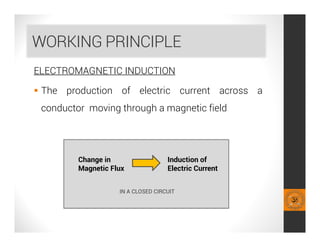
ELECTROMAGNETIC INDUCTION
 The production of electric current across a
conductor moving through a magnetic field
IN A CLOSED CIRCUIT
Change in
Magnetic Flux
Induction of
Electric Current
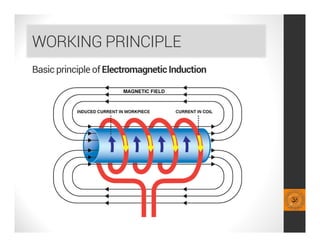
WORKING PRINCIPLE
Basic principle of ElectromagneticInduction
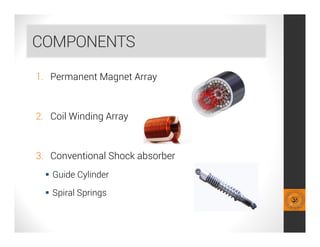
COMPONENTS
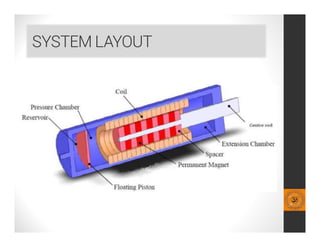
1. Permanent Magnet Array
2. Coil Winding Array
3. Conventional Shock absorber
 Guide Cylinder
 Spiral Springs
SYSTEM LAYOUT
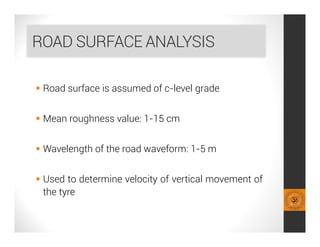
ROAD SURFACE ANALYSIS
 Road surface is assumed of c-level grade
 Mean roughness value: 1-15 cm
 Wavelength of the road waveform: 1-5 m
 Used to determine velocity of vertical movement of
the tyre
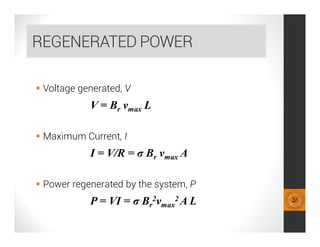
REGENERATED POWER
 Voltage generated, V
V = Br vmax L
 Maximum Current, I
I = V/R = σ Br vmax A
 Power regenerated by the system, P
P = VI = σ Br
2vmax
2 A L
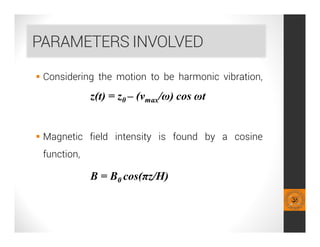
PARAMETERS INVOLVED
 Considering the motion to be harmonic vibration,
z(t) = z0 – (vmax/ω) cos ωt
 Magnetic field intensity is found by a cosine
function,
B = B0 cos(πz/H)
VELOCITY OF TYRE MOVEMENT
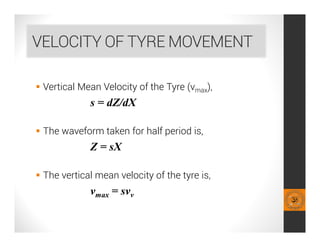
 Vertical Mean Velocity of the Tyre (vmax),
s = dZ/dX
 The waveform taken for half period is,
Z = sX
 The vertical mean velocity of the tyre is,
vmax = svv
INSTANTANEOUS VOLTAGE (V)
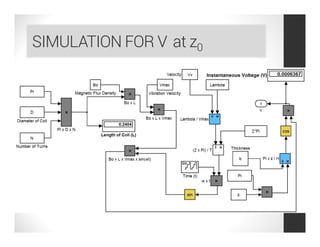
 instantaneous voltage of one coil centred at z0 is
V = B0 L cos { π [z0 – (vmax/ω) cos ωt]/H} vmax sinωt
SIMULATION FOR V at z0
INSTANTANEOUS VOLTAGE
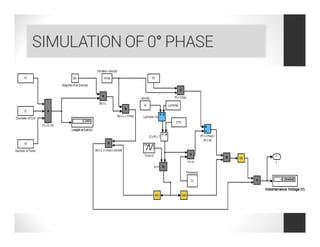
In order to account for practicality, we consider,
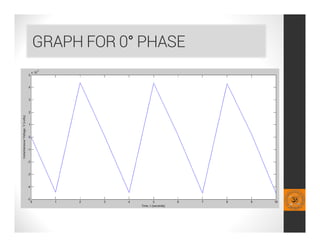
 0° phase of the coil,
V = B0 L cos {π [(vmax/ω) cosωt]/b} vmax sinωt
90° phase
V = B0 L sin {π [(vmax/ω) cosωt]/b} vmax sinωt
SIMULATION OF 0° PHASE
GRAPH FOR 0° PHASE
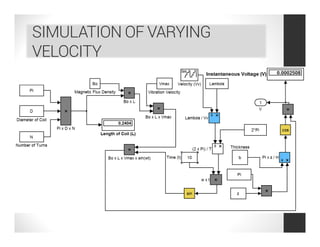
SIMULATION OF VARYING
VELOCITY
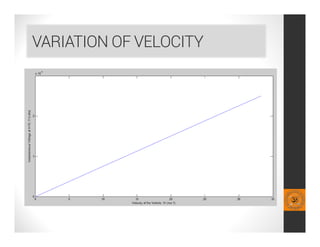
VARIATION OF VELOCITY
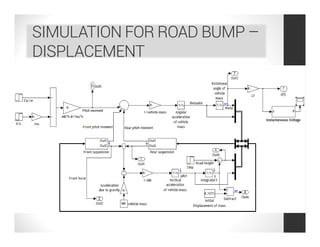
SIMULATION FOR ROAD BUMP –
DISPLACEMENT
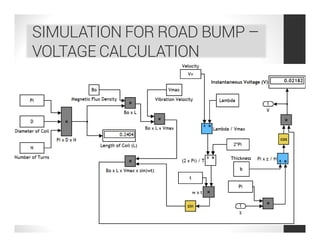
SIMULATION FOR ROAD BUMP –
VOLTAGE CALCULATION
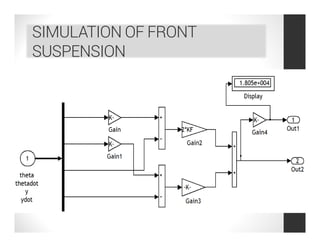
SIMULATION OF FRONT
SUSPENSION
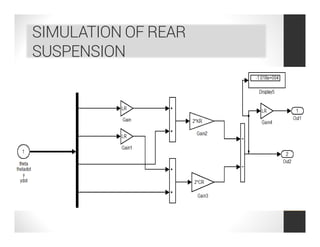
SIMULATION OF REAR
SUSPENSION
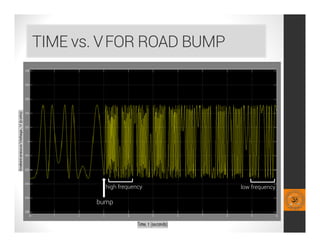
TIME vs. VFOR ROAD BUMP
bump
high frequency low frequency
PROS & CONS
 Reduced load on alternator
 Improved overall efficiency
 Extra energy can be utilized
 Added weight
 Complex design
THANK YOU

Regenerative Suspension System-Project Review [Compatibility Mode]