Reflex arc & Babinski sign
Sangita Sarma
M.Optometry
Reflex
• Reflex activity is the response to a peripheral nervous stimulation that
occurs without our consciousness.
• It is a type of protective mechanism and it protects the body from
irreparable damages.
• For example, when hand is placed on a hot object, it is withdrawn
immediately.
Reflex arc
• Reflex arc is the anatomical nervous pathway for a reflex action. A
simple reflex arc includes five components.
• 1. Receptor- Receptor is the end organ, which receives the stimulus.
When receptor is stimulated, impulses are generated in afferent
nerve.
• 2. Afferent Nerve Afferent or sensory nerve transmits sensory
impulses from the receptor to center.
• 3. Center Center receives the sensory impulses via afferent nerve
fibers and in turn, it generates appropriate motor impulses. Center is
located in the brain or spinal cord.
• 4. Efferent Nerve Efferent or motor nerve transmits motor impulses
from the center to the effector organ
• 5. Effector Organ Effector organ is the structure such as muscle or
gland where the activity occurs in response to stimulus.
Classification------SELF STUDY (Satyanarayan
book)
• 1. Depending upon whether inborn or acquired
• 2. Depending upon situation – anatomical classification
• 3. Depending upon purpose – physiological classification
• 4. Depending upon number of synapse
• 5. Depending upon whether visceral or somatic
• 6. Depending upon clinical basis
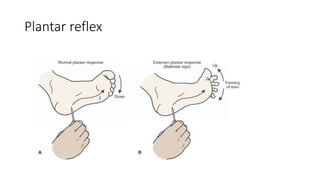
Plantar reflex
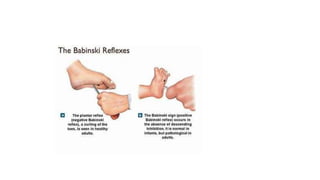
Babinski sign (Babinski +ve)
• Babinski sign is a reflex in the foot that is tested by stimulating the sole. It is
when the big toe moves up and the other toes spread out. It is normal in
newborn babies, but may indicate brain or spinal cord problems in older children
or adults.
• This reflex was first discovered and named by the French neurologist Joseph
Babinski. He describes it in a report published in 1896.
• It’s presence is normal upto 2 years of life.
Other reflexes to be checked in infants-
• Root reflex, in which the doctor rubs a finger on the corner of the baby’s mouth
to see if the baby reflexively moves their head toward the direction of stroking to
look for a nipple or bottle to feed on
• Suck reflex, in which the doctor touches the roof of the baby’s mouth to see if
the baby begins to suck the finger as if feeding on a nipple or bottle
• Grasp reflex, in which the doctor rubs a finger on the palm of the baby’s hand to
see if the baby reflexively wraps their fingers tightly around the doctor’s finger
Positive Babinski sign in adults indicates
• upper motor neuron lesion
• cerebral palsy
• strokes
• brain injury or brain tumors
• spinal cord tumor or injury
• multiple sclerosis (MS)
• meningitis
Some Neural Diseases
Motor Neuron disease
• Motor neuron diseases or motor neurone diseases (MNDs) are a group of
rare neurodegenerative disorders that selectively affect motor neurons, the cells
which control voluntary muscles of the body.
• They include amyotrophic lateral sclerosis (ALS), progressive bulbar
palsy (PBP), pseudobulbar palsy, progressive muscular atrophy (PMA), primary
lateral sclerosis (PLS), spinal muscular atrophy (SMA) and monomelic
amyotrophy (MMA).
• Symptoms of motor neuron diseases can be first seen at birth or can come on
slowly later in life. Most of these diseases worsen over time; while some, such as
ALS, shorten one's life expectancy, others do not.
ALS_Stephen Hawking’s motor neuron
disease
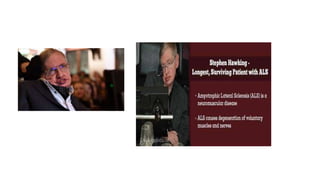
• Stephen Hawking had a rare form of motor neuron disease
called amyotrophic lateral sclerosis (ALS) or Lou Gehrig
Disease. The disease attacks the nerves controlling voluntary
movement, leading to paralysis.
• He was diagnosed at age 21 and lived for five decades with the
condition, which was an extraordinary exception15. He
communicated through a speech-generating device using a
single cheek muscle5. He died on the 18th of March, 2018
SMA
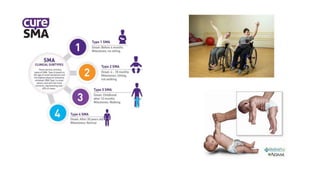
• Spinal muscular atrophy (SMA) is a rare neuromuscular disorder that
results in the loss of motor neurons and progressive muscle wasting.
• It is usually diagnosed in infancy or early childhood and if left untreated it
is the most common genetic cause of infant death.
• It may also appear later in life and then have a milder course of the
disease. The common feature is progressive weakness of voluntary
muscles, with arm, leg and respiratory muscles being affected first.
• Spinal muscular atrophy is caused by a genetic mutation in
the SMN1 gene
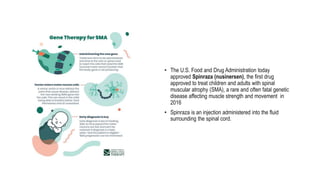
• The U.S. Food and Drug Administration today
approved Spinraza (nusinersen), the first drug
approved to treat children and adults with spinal
muscular atrophy (SMA), a rare and often fatal genetic
disease affecting muscle strength and movement in
2016
• Spinraza is an injection administered into the fluid
surrounding the spinal cord.
• Zolgensma is developed by Novartis Gene Therapies and has
been approved by Britain. The drug costs Rs.18 crore per dose,
according to the official statement NHS England. (the costliest
drug)
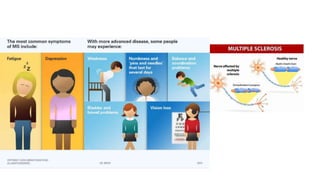
Multiple Sclerosis
In MS, the immune system attacks the protective sheath (myelin) that covers
nerve fibers and causes communication problems between brain
and the rest of your body.
Eventually, the disease can cause permanent damage or deterioration
of the nerve fibers.
• Girls are predisposed to get than man. (Usually develops by 2nd decade of life)
• Numbness or weakness in one or more limbs that typically occurs on one side of your body at a tim
• Tingling
• Electric-shock sensations that occur with certain neck movements,
especially bending the neck forward (Lhermitte sign)
• Lack of coordination
• Unsteady gait or inability to walk
• Optic neuritis in 1 out of 4 patients
References
• 1. Guyton and Hall’s textbook of Medical Physiology
• 2. K Simbulingum, Prema Simbulingam, Essentials of medical
Physiology

Reflex arc & Babinski sign.pptx

  • 1.
    Reflex arc &Babinski sign Sangita Sarma M.Optometry
  • 2.
    Reflex • Reflex activityis the response to a peripheral nervous stimulation that occurs without our consciousness. • It is a type of protective mechanism and it protects the body from irreparable damages. • For example, when hand is placed on a hot object, it is withdrawn immediately.
  • 3.
    Reflex arc • Reflexarc is the anatomical nervous pathway for a reflex action. A simple reflex arc includes five components. • 1. Receptor- Receptor is the end organ, which receives the stimulus. When receptor is stimulated, impulses are generated in afferent nerve. • 2. Afferent Nerve Afferent or sensory nerve transmits sensory impulses from the receptor to center.
  • 4.
    • 3. CenterCenter receives the sensory impulses via afferent nerve fibers and in turn, it generates appropriate motor impulses. Center is located in the brain or spinal cord. • 4. Efferent Nerve Efferent or motor nerve transmits motor impulses from the center to the effector organ • 5. Effector Organ Effector organ is the structure such as muscle or gland where the activity occurs in response to stimulus.
  • 5.
    Classification------SELF STUDY (Satyanarayan book) •1. Depending upon whether inborn or acquired • 2. Depending upon situation – anatomical classification • 3. Depending upon purpose – physiological classification • 4. Depending upon number of synapse • 5. Depending upon whether visceral or somatic • 6. Depending upon clinical basis
  • 6.
  • 7.
    Babinski sign (Babinski+ve) • Babinski sign is a reflex in the foot that is tested by stimulating the sole. It is when the big toe moves up and the other toes spread out. It is normal in newborn babies, but may indicate brain or spinal cord problems in older children or adults. • This reflex was first discovered and named by the French neurologist Joseph Babinski. He describes it in a report published in 1896. • It’s presence is normal upto 2 years of life.
  • 9.
    Other reflexes tobe checked in infants- • Root reflex, in which the doctor rubs a finger on the corner of the baby’s mouth to see if the baby reflexively moves their head toward the direction of stroking to look for a nipple or bottle to feed on • Suck reflex, in which the doctor touches the roof of the baby’s mouth to see if the baby begins to suck the finger as if feeding on a nipple or bottle • Grasp reflex, in which the doctor rubs a finger on the palm of the baby’s hand to see if the baby reflexively wraps their fingers tightly around the doctor’s finger
  • 10.
    Positive Babinski signin adults indicates • upper motor neuron lesion • cerebral palsy • strokes • brain injury or brain tumors • spinal cord tumor or injury • multiple sclerosis (MS) • meningitis
  • 11.
  • 12.
    Motor Neuron disease •Motor neuron diseases or motor neurone diseases (MNDs) are a group of rare neurodegenerative disorders that selectively affect motor neurons, the cells which control voluntary muscles of the body. • They include amyotrophic lateral sclerosis (ALS), progressive bulbar palsy (PBP), pseudobulbar palsy, progressive muscular atrophy (PMA), primary lateral sclerosis (PLS), spinal muscular atrophy (SMA) and monomelic amyotrophy (MMA). • Symptoms of motor neuron diseases can be first seen at birth or can come on slowly later in life. Most of these diseases worsen over time; while some, such as ALS, shorten one's life expectancy, others do not.
  • 13.
    ALS_Stephen Hawking’s motorneuron disease • Stephen Hawking had a rare form of motor neuron disease called amyotrophic lateral sclerosis (ALS) or Lou Gehrig Disease. The disease attacks the nerves controlling voluntary movement, leading to paralysis. • He was diagnosed at age 21 and lived for five decades with the condition, which was an extraordinary exception15. He communicated through a speech-generating device using a single cheek muscle5. He died on the 18th of March, 2018
  • 15.
    SMA • Spinal muscularatrophy (SMA) is a rare neuromuscular disorder that results in the loss of motor neurons and progressive muscle wasting. • It is usually diagnosed in infancy or early childhood and if left untreated it is the most common genetic cause of infant death. • It may also appear later in life and then have a milder course of the disease. The common feature is progressive weakness of voluntary muscles, with arm, leg and respiratory muscles being affected first. • Spinal muscular atrophy is caused by a genetic mutation in the SMN1 gene
  • 17.
    • The U.S.Food and Drug Administration today approved Spinraza (nusinersen), the first drug approved to treat children and adults with spinal muscular atrophy (SMA), a rare and often fatal genetic disease affecting muscle strength and movement in 2016 • Spinraza is an injection administered into the fluid surrounding the spinal cord.
  • 18.
    • Zolgensma isdeveloped by Novartis Gene Therapies and has been approved by Britain. The drug costs Rs.18 crore per dose, according to the official statement NHS England. (the costliest drug)
  • 19.
    Multiple Sclerosis In MS,the immune system attacks the protective sheath (myelin) that covers nerve fibers and causes communication problems between brain and the rest of your body. Eventually, the disease can cause permanent damage or deterioration of the nerve fibers. • Girls are predisposed to get than man. (Usually develops by 2nd decade of life) • Numbness or weakness in one or more limbs that typically occurs on one side of your body at a tim • Tingling • Electric-shock sensations that occur with certain neck movements, especially bending the neck forward (Lhermitte sign) • Lack of coordination • Unsteady gait or inability to walk • Optic neuritis in 1 out of 4 patients
  • 24.
    References • 1. Guytonand Hall’s textbook of Medical Physiology • 2. K Simbulingum, Prema Simbulingam, Essentials of medical Physiology