By- Shubhra Agarwal
Reflection of Light
Reflection
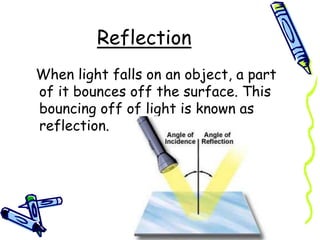
When light falls on an object, a part
of it bounces off the surface. This
bouncing off of light is known as
reflection.
Incident ray of light
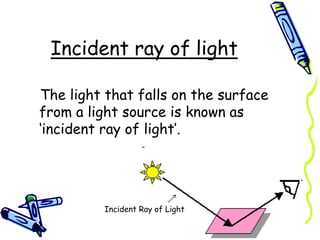
The light that falls on the surface
from a light source is known as
‘incident ray of light’.
Incident Ray of Light
Reflected Ray of Light
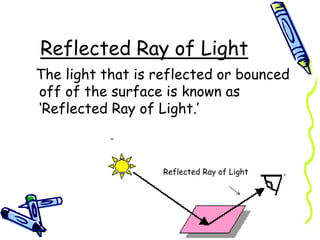
The light that is reflected or bounced
off of the surface is known as
‘Reflected Ray of Light.’
Reflected Ray of Light
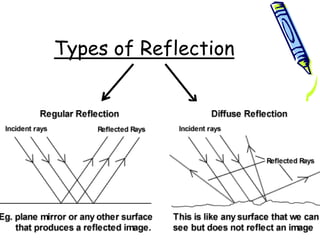
Types of Reflection
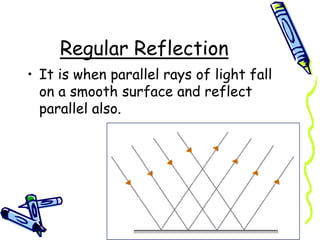
Regular Reflection
• It is when parallel rays of light fall
on a smooth surface and reflect
parallel also.
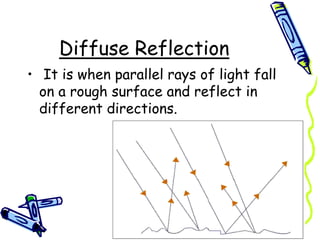
Diffuse Reflection
• It is when parallel rays of light fall
on a rough surface and reflect in
different directions.
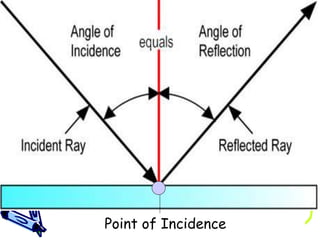
As you saw, when we draw the normal
and then place the incident and
reflected rays of light of its sides,
the angle between the incident light
and normal line and the angle
between reflected light and normal
line should be the same.
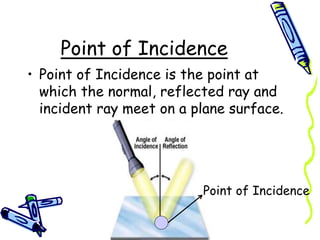
Point of Incidence
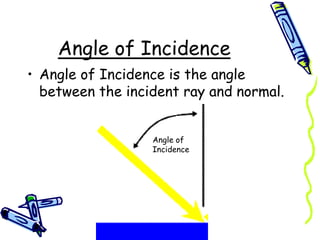
Angle of Incidence
• Angle of Incidence is the angle
between the incident ray and normal.
Angle of
Incidence
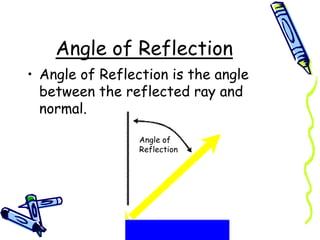
Angle of Reflection
• Angle of Reflection is the angle
between the reflected ray and
normal.
Angle of
Reflection
Point of Incidence
• Point of Incidence is the point at
which the normal, reflected ray and
incident ray meet on a plane surface.
Point of Incidence
Laws of Reflection
1. The incident ray, reflected ray and
normal at the point of incidence lie on the
same plane.
2. The angle of incidence and the angle of
reflection is the same when measured.
Max Agarwal

Reflections

  • 1.
  • 2.
    Reflection When light fallson an object, a part of it bounces off the surface. This bouncing off of light is known as reflection.
  • 3.
    Incident ray oflight The light that falls on the surface from a light source is known as ‘incident ray of light’. Incident Ray of Light
  • 4.
    Reflected Ray ofLight The light that is reflected or bounced off of the surface is known as ‘Reflected Ray of Light.’ Reflected Ray of Light
  • 5.
  • 6.
    Regular Reflection • Itis when parallel rays of light fall on a smooth surface and reflect parallel also.
  • 7.
    Diffuse Reflection • Itis when parallel rays of light fall on a rough surface and reflect in different directions.
  • 8.
    As you saw,when we draw the normal and then place the incident and reflected rays of light of its sides, the angle between the incident light and normal line and the angle between reflected light and normal line should be the same.
  • 9.
  • 10.
    Angle of Incidence •Angle of Incidence is the angle between the incident ray and normal. Angle of Incidence
  • 11.
    Angle of Reflection •Angle of Reflection is the angle between the reflected ray and normal. Angle of Reflection
  • 12.
    Point of Incidence •Point of Incidence is the point at which the normal, reflected ray and incident ray meet on a plane surface. Point of Incidence
  • 13.
    Laws of Reflection 1.The incident ray, reflected ray and normal at the point of incidence lie on the same plane. 2. The angle of incidence and the angle of reflection is the same when measured.
  • 14.