1.Introduction about light:-
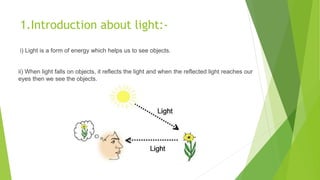
i) Light is a form of energy which helps us to see objects.
ii) When light falls on objects, it reflects the light and when the reflected light reaches our
eyes then we see the objects.
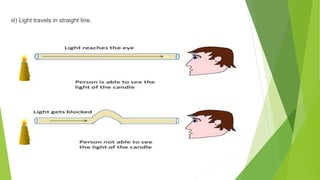
iii) Light travels in straight line.
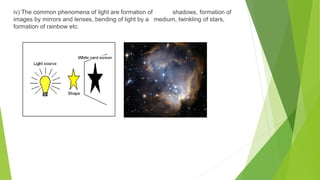
iv) The common phenomena of light are formation of shadows, formation of
images by mirrors and lenses, bending of light by a medium, twinkling of stars,
formation of rainbow etc.
2.Reflection of light:-
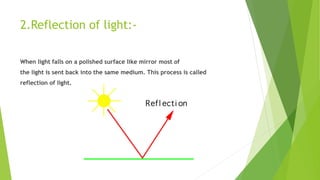
When light falls on a polished surface like mirror most of
the light is sent back into the same medium. This process is called
reflection of light.
Laws of reflection of light:-
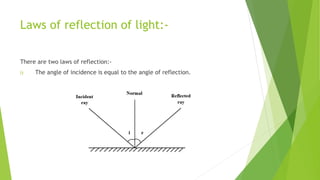
There are two laws of reflection:-
i) The angle of incidence is equal to the angle of reflection.
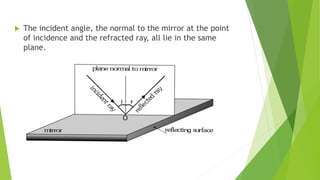
 The incident angle, the normal to the mirror at the point
of incidence and the refracted ray, all lie in the same
plane.
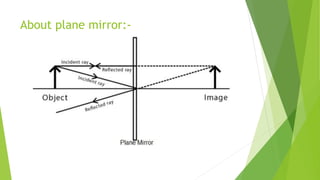
About plane mirror:-
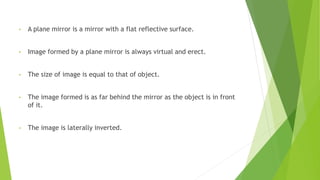
• A plane mirror is a mirror with a flat reflective surface.
• Image formed by a plane mirror is always virtual and erect.
• The size of image is equal to that of object.
• The image formed is as far behind the mirror as the object is in front
of it.
• The image is laterally inverted.
Spherical mirror:-
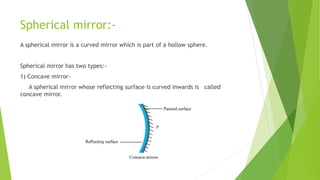
A spherical mirror is a curved mirror which is part of a hollow sphere.
Spherical mirror has two types:-
1) Concave mirror-
A spherical mirror whose reflecting surface is curved inwards is called
concave mirror.
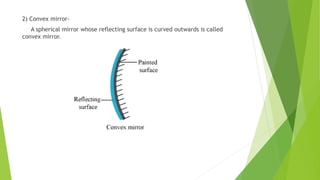
2) Convex mirror-
A spherical mirror whose reflecting surface is curved outwards is called
convex mirror.
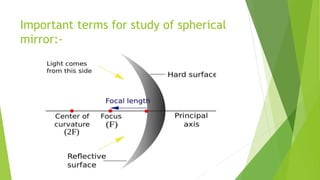
Important terms for study of spherical
mirror:-
 Pole (P)- the centre of reflecting surface of a spherical mirror is a point
called pole.
 Centre of curvature (C)- the reflecting surface of a spherical mirror forms a
part of a sphere. Centre of this sphere is called centre of curvature.
centre of curvature is not a part of mirror. The centre of curvature of
a concave mirror lies in front of it and it lies behind the mirror in convex mirror.
 Radius of curvature (R)- the radius of the sphere of which reflecting surface
of a spherical mirror forms a part is called radius of curvature of mirror.
 Principal axis- straight line passing through the pole and centre of curvature
of spherical mirror is called principal axis.
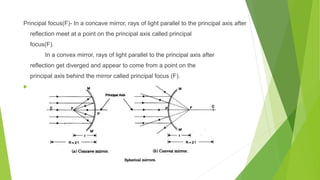
Principal focus(F)- In a concave mirror, rays of light parallel to the principal axis after
reflection meet at a point on the principal axis called principal
focus(F).
In a convex mirror, rays of light parallel to the principal axis after
reflection get diverged and appear to come from a point on the
principal axis behind the mirror called principal focus (F).

Focal length(f)- It is the distance between the pole and
principal focus.
In a spherical mirror the radius of curvature is twice the
focal length.
R = 2f or f = R/2

Class 10 light refraction and reflection

  • 2.
    1.Introduction about light:- i)Light is a form of energy which helps us to see objects. ii) When light falls on objects, it reflects the light and when the reflected light reaches our eyes then we see the objects.
  • 3.
    iii) Light travelsin straight line.
  • 4.
    iv) The commonphenomena of light are formation of shadows, formation of images by mirrors and lenses, bending of light by a medium, twinkling of stars, formation of rainbow etc.
  • 5.
    2.Reflection of light:- Whenlight falls on a polished surface like mirror most of the light is sent back into the same medium. This process is called reflection of light.
  • 6.
    Laws of reflectionof light:- There are two laws of reflection:- i) The angle of incidence is equal to the angle of reflection.
  • 7.
     The incidentangle, the normal to the mirror at the point of incidence and the refracted ray, all lie in the same plane.
  • 8.
  • 9.
    • A planemirror is a mirror with a flat reflective surface. • Image formed by a plane mirror is always virtual and erect. • The size of image is equal to that of object. • The image formed is as far behind the mirror as the object is in front of it. • The image is laterally inverted.
  • 10.
    Spherical mirror:- A sphericalmirror is a curved mirror which is part of a hollow sphere. Spherical mirror has two types:- 1) Concave mirror- A spherical mirror whose reflecting surface is curved inwards is called concave mirror.
  • 11.
    2) Convex mirror- Aspherical mirror whose reflecting surface is curved outwards is called convex mirror.
  • 12.
    Important terms forstudy of spherical mirror:-
  • 13.
     Pole (P)-the centre of reflecting surface of a spherical mirror is a point called pole.  Centre of curvature (C)- the reflecting surface of a spherical mirror forms a part of a sphere. Centre of this sphere is called centre of curvature. centre of curvature is not a part of mirror. The centre of curvature of a concave mirror lies in front of it and it lies behind the mirror in convex mirror.  Radius of curvature (R)- the radius of the sphere of which reflecting surface of a spherical mirror forms a part is called radius of curvature of mirror.  Principal axis- straight line passing through the pole and centre of curvature of spherical mirror is called principal axis.
  • 14.
    Principal focus(F)- Ina concave mirror, rays of light parallel to the principal axis after reflection meet at a point on the principal axis called principal focus(F). In a convex mirror, rays of light parallel to the principal axis after reflection get diverged and appear to come from a point on the principal axis behind the mirror called principal focus (F). 
  • 15.
    Focal length(f)- Itis the distance between the pole and principal focus. In a spherical mirror the radius of curvature is twice the focal length. R = 2f or f = R/2