Class – 10 Physics
Reflection of Light
• Reflection or Reflection of light is the process of
bouncing back light rays when it strikes the smooth
and shiny reflecting surface.
• It is due to the reflection of light we are able to see
ourselves in the Plane mirror.
• Light from our incident on the plane mirror gets
reflected and so we are able to see our virtual image
on the mirror.
• Reflection is produced by all the waves namely, Light
waves, Electromagnetic waves, Sound waves, and
waves that form on the water’s surface.
Class – 10 Physics
• The reflection of a light wave follows some set of rules known as
the Laws of Reflection.
 There are two essential laws of reflection, according to which the
angle of incidence and the angle of reflection made by the light
wave on the smooth reflecting surface are equal.
 Also, the incident ray, normal, reflected ray, incident angle, and
reflected angle, all lie on the same plane.
Class – 10 Physics
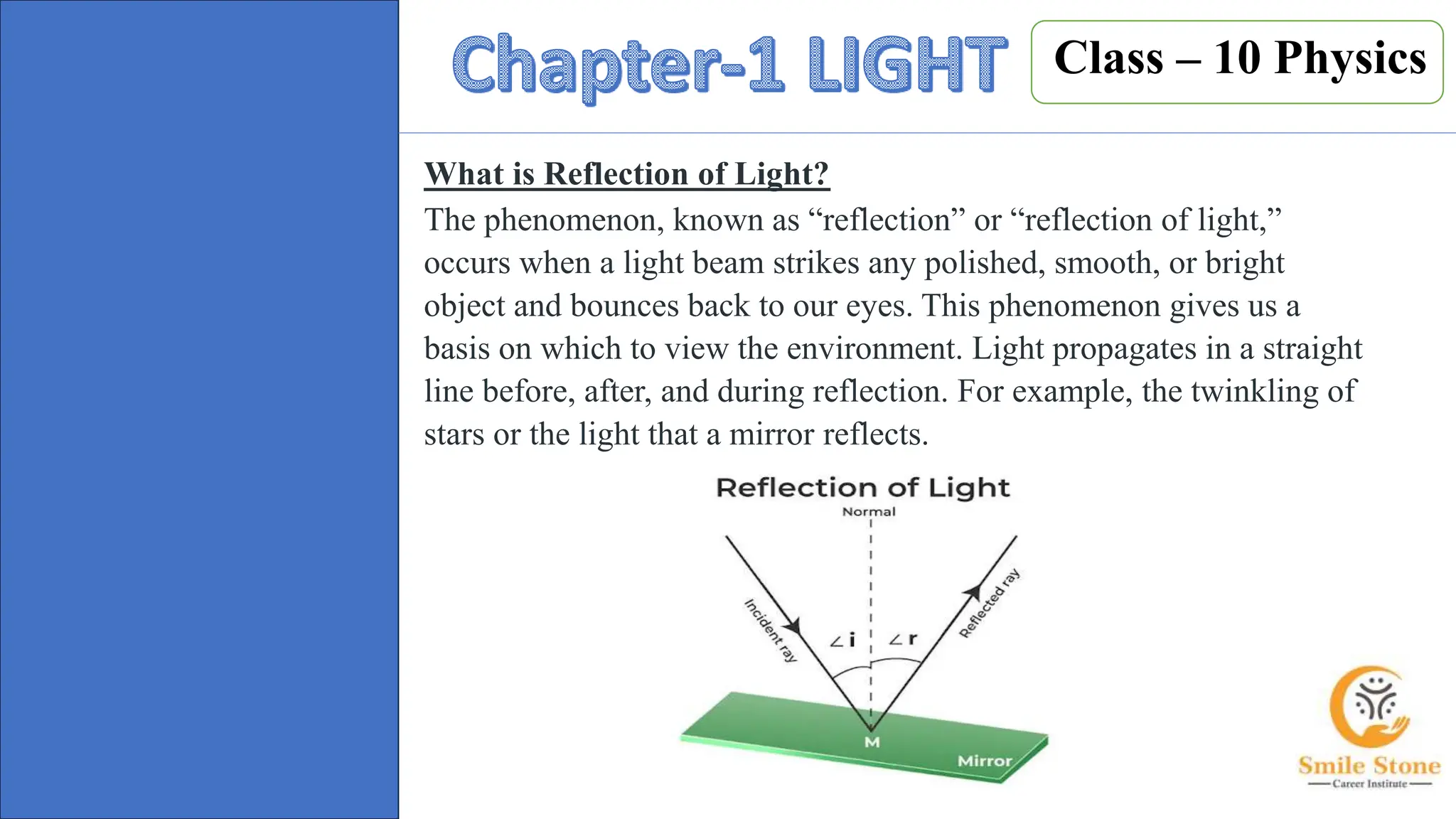
What is Reflection of Light?
The phenomenon, known as “reflection” or “reflection of light,”
occurs when a light beam strikes any polished, smooth, or bright
object and bounces back to our eyes. This phenomenon gives us a
basis on which to view the environment. Light propagates in a straight
line before, after, and during reflection. For example, the twinkling of
stars or the light that a mirror reflects.
Class – 10 Physics
Here is the list of important terminologies used in Reflection of Light as
shown in the figure above:
•Normal: A perpendicular drawn to the reflecting surface at point M
(known as the point of incidence) is called the normal to the reflecting
surface.
•Incident Ray: A ray of light that falls on the reflecting surface from a
light source or an object is called the incident ray.
•Reflected Ray: A ray of light that arises from the reflecting surface after
reflection from it is called a reflected ray.
•Angle of Incidence: The angle between the incident ray and normal to the
point of incidence on the reflecting surface is known as the incident angle
or Bugle of incidence. It is denoted by ∠i.
Class – 10 Physics
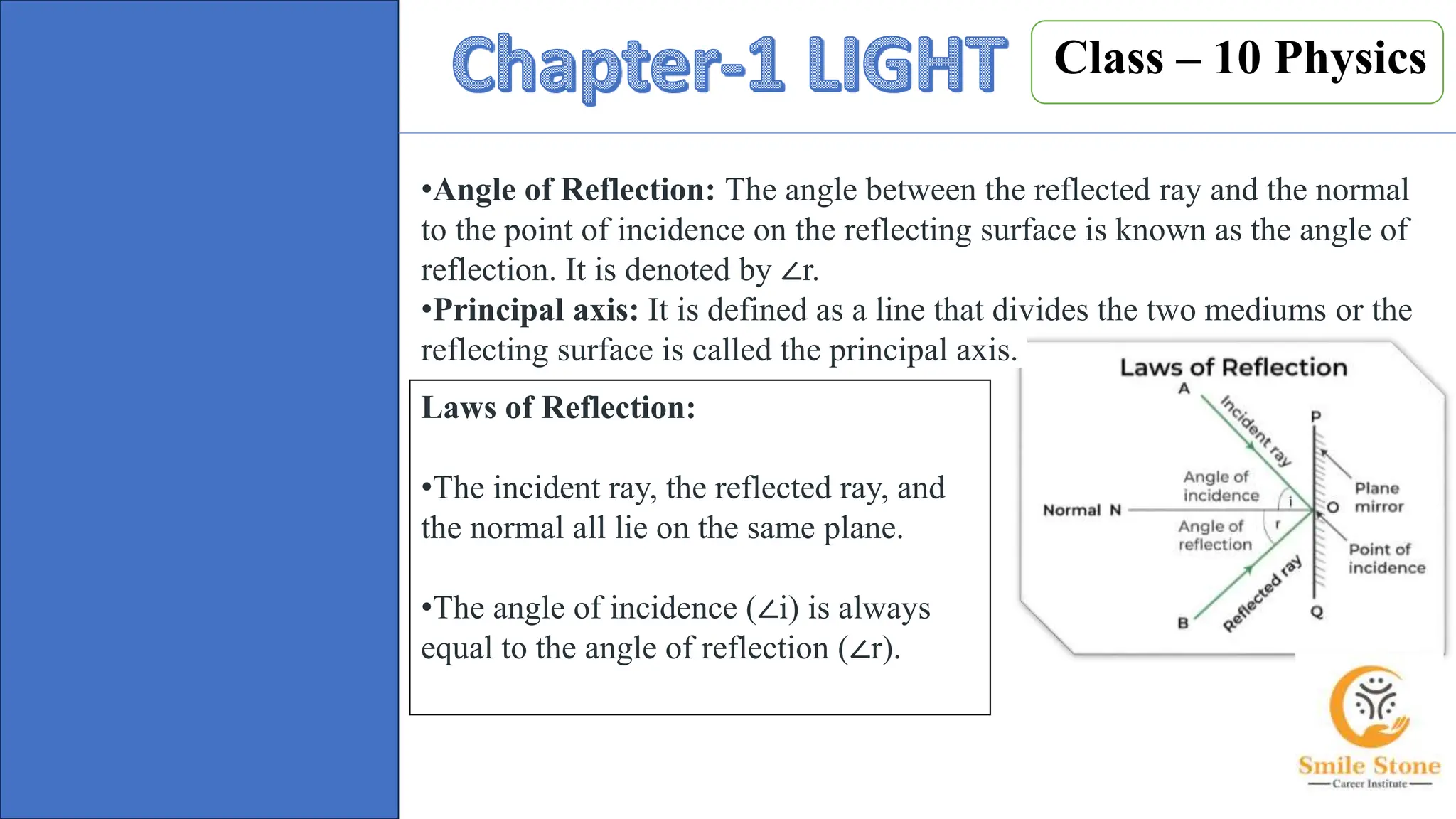
•Angle of Reflection: The angle between the reflected ray and the normal
to the point of incidence on the reflecting surface is known as the angle of
reflection. It is denoted by ∠r.
•Principal axis: It is defined as a line that divides the two mediums or the
reflecting surface is called the principal axis.
Laws of Reflection:
•The incident ray, the reflected ray, and
the normal all lie on the same plane.
•The angle of incidence (∠i) is always
equal to the angle of reflection (∠r).
Class – 10 Physics
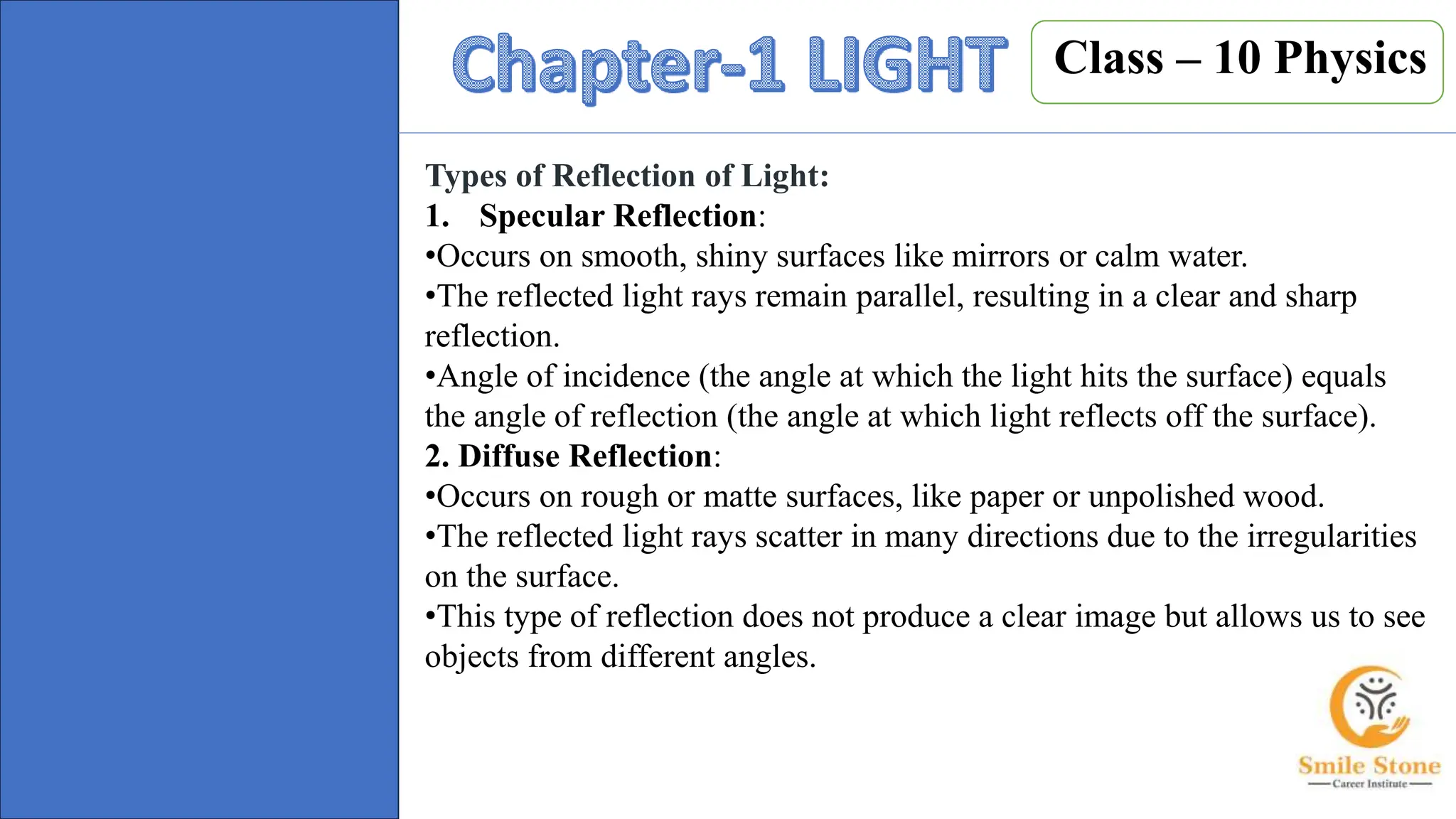
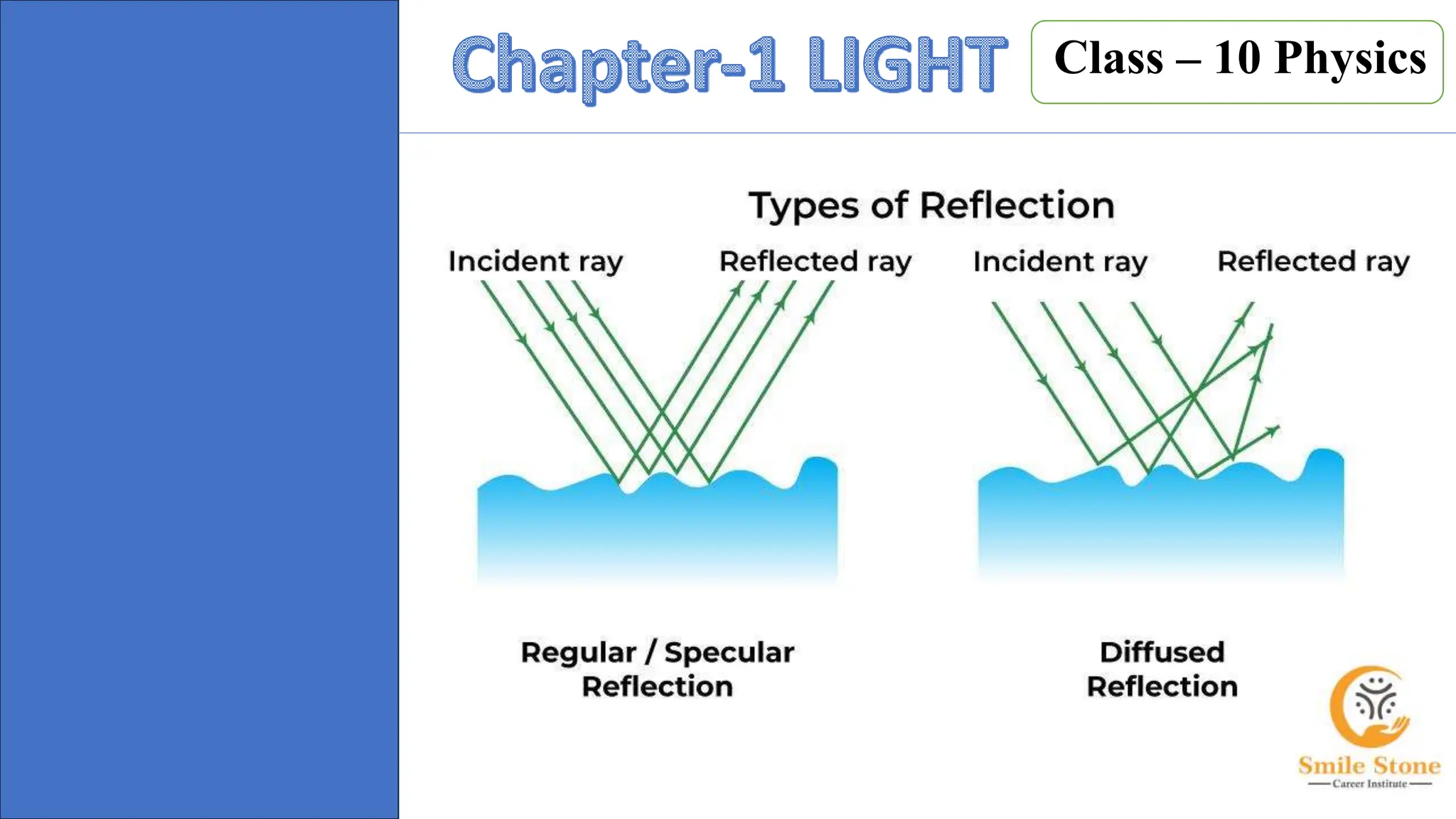
Types of Reflection of Light:
1. Specular Reflection:
•Occurs on smooth, shiny surfaces like mirrors or calm water.
•The reflected light rays remain parallel, resulting in a clear and sharp
reflection.
•Angle of incidence (the angle at which the light hits the surface) equals
the angle of reflection (the angle at which light reflects off the surface).
2. Diffuse Reflection:
•Occurs on rough or matte surfaces, like paper or unpolished wood.
•The reflected light rays scatter in many directions due to the irregularities
on the surface.
•This type of reflection does not produce a clear image but allows us to see
objects from different angles.
Class – 10 Physics
Class – 10 Physics
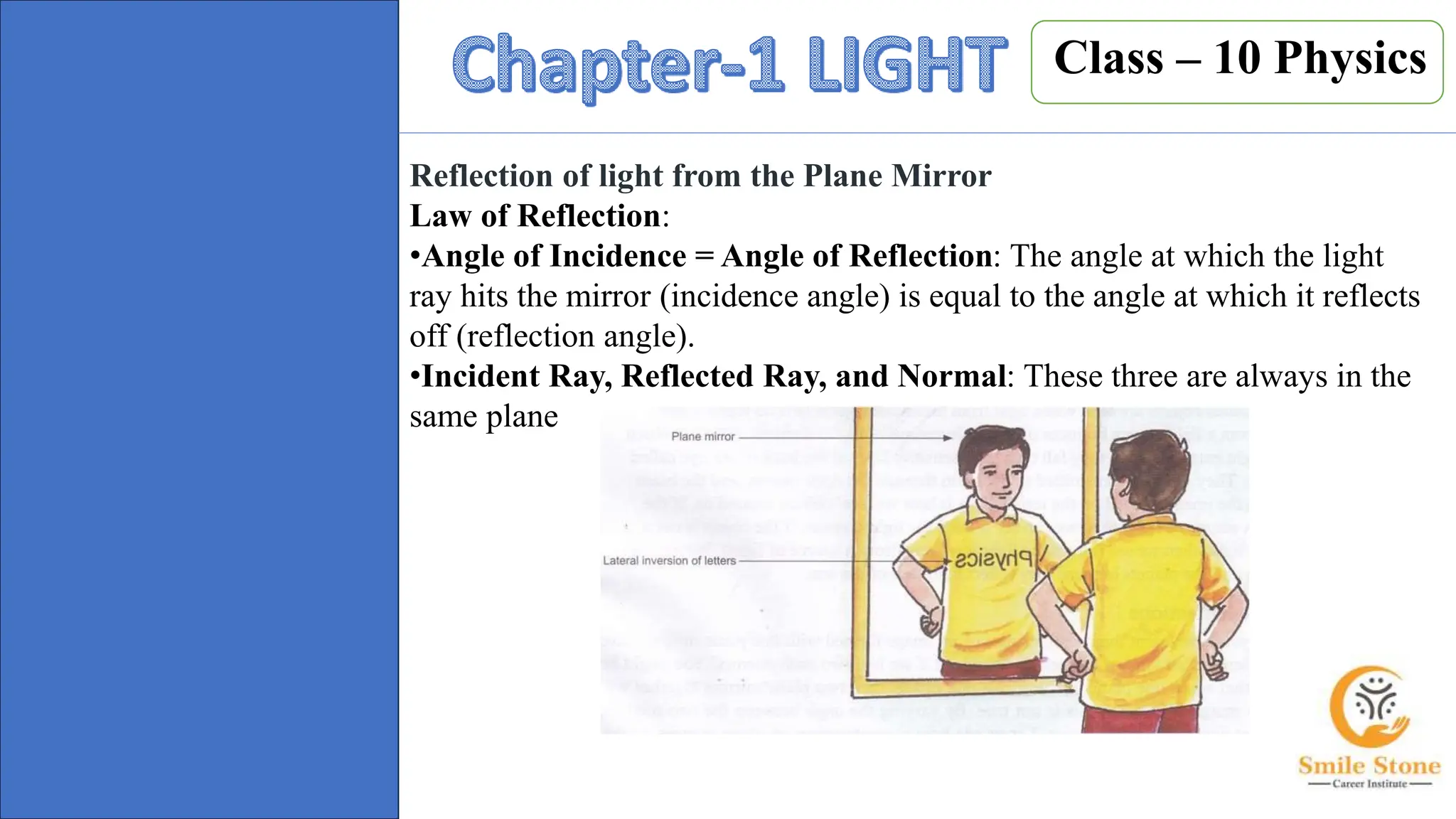
Reflection of light from the Plane Mirror
Law of Reflection:
•Angle of Incidence = Angle of Reflection: The angle at which the light
ray hits the mirror (incidence angle) is equal to the angle at which it reflects
off (reflection angle).
•Incident Ray, Reflected Ray, and Normal: These three are always in the
same plane
Class – 10 Physics
Characteristics of the Image Formed:
•Virtual Image: The image appears to be behind the mirror; it cannot be
projected onto a screen.
•Upright: The image is the same orientation as the object.
•Same Size: The image is the same size as the object.
•Laterally Inverted: The left and right sides of the image are reversed.
•Same Distance: The image appears to be the same distance behind the
mirror as the object is in front.
Mirror Equation and Magnification:
•Plane mirrors do not alter the size or shape of the image, so magnification is
1.
•The mirror equation is not typically used for plane mirrors since the focal
length (f) is infinite.
Class – 10 Physics
Applications:
•Used in everyday objects like bathroom mirrors, dressing mirrors, and
rear-view mirrors in vehicles.
•Utilized in optical instruments to redirect light and provide a clear view.
Differences between Regular and Irregular Reflection
Class – 10 Physics
Regular Reflection Irregular Reflection
Regular Reflection occurs at smooth
surfaces such as plane mirrors etc.
Irregular Reflection occurs on rough
surfaces such as wood etc.
The reflected rays and the incident
rays are parallel to each other after
reflection, in this case.
However, in irregular reflection, both
incident and reflected rays are not
parallel to each other, after
reflection.
An image is formed and visible after
regular reflection.
But in this case, a distorted image is
formed which is not clearly
observed.
Class – 10 Physics
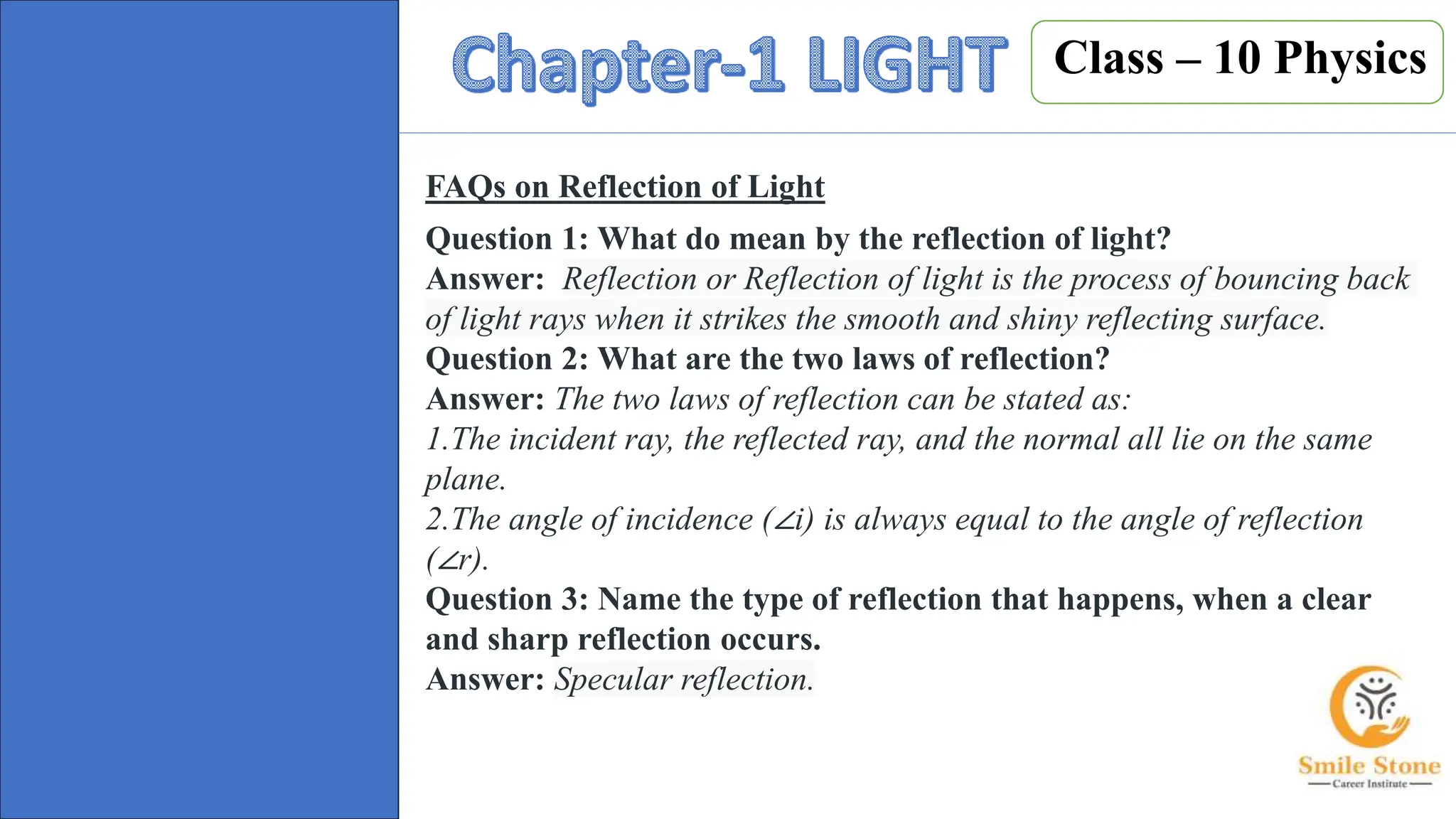
FAQs on Reflection of Light
Question 1: What do mean by the reflection of light?
Answer: Reflection or Reflection of light is the process of bouncing back
of light rays when it strikes the smooth and shiny reflecting surface.
Question 2: What are the two laws of reflection?
Answer: The two laws of reflection can be stated as:
1.The incident ray, the reflected ray, and the normal all lie on the same
plane.
2.The angle of incidence (∠i) is always equal to the angle of reflection
(∠r).
Question 3: Name the type of reflection that happens, when a clear
and sharp reflection occurs.
Answer: Specular reflection.
Class – 10 Physics
Question 4: What type of image is formed by the plane mirror?
Answer: A virtual and erect image is formed by the Plane mirror.
Question 5: What are the two types of images?
Answer: The two types of images formed by the reflection of light are
Real and Virtual images.
Class – 10 Physics
Refraction of Light
• Refraction is an important term used in the Ray Optics branch of Physics.
• Refraction of light is defined as the change in direction or the bending of
a wave passing from one medium to another due to the change in speed of
the wave.
• Some natural phenomena occurring in nature where refraction of light
takes place are the twinkling of stars, the formation of mirages and
Rainbows, Optical illusions, and many more.
• The major cause of refraction to occur is the change in the speed of waves
in different mediums, which is different due to the difference between the
densities of the mediums. e.g. the speed of light in a vacuum is maximum.
• Snell’s Law provides a quantitative description of the amount of bending
of a wave, that depends on the refractive index of the two mediums.
Class – 10 Physics
What is Refraction of Light?
The bending of a light wave when it passes from one medium to another
due to the change in the speed of the light traveling the two different media
is called the Refraction of light.
Class – 10 Physics
Class – 10 Physics
Class – 10 Physics
Class – 10 Physics
Class – 10 Physics
Class – 10 Physics
Class – 10 Physics
Class – 10 Physics
Class – 10 Physics
Class – 10 Physics
Class – 10 Physics
Class – 10 Physics
Class – 10 Physics
Class – 10 Physics
Class – 10 Physics
Class – 10 Physics
Class – 10 Physics
Class – 10 Physics
Class – 10 Physics
Class – 10 Physics
Class – 10 Physics
Class – 10 Physics
Class – 10 Physics
Class – 10 Physics
Class – 10 Physics
Class – 10 Physics
Class – 10 Physics
Class – 10 Physics
Class – 10 Physics
Class – 10 Physics
Class – 10 Physics
Class – 10 Physics
Class – 10 Physics

chapter 1 LIGHT: reflection and refraction class 10 physics.pptx

  • 1.
    Class – 10Physics Reflection of Light • Reflection or Reflection of light is the process of bouncing back light rays when it strikes the smooth and shiny reflecting surface. • It is due to the reflection of light we are able to see ourselves in the Plane mirror. • Light from our incident on the plane mirror gets reflected and so we are able to see our virtual image on the mirror. • Reflection is produced by all the waves namely, Light waves, Electromagnetic waves, Sound waves, and waves that form on the water’s surface.
  • 2.
    Class – 10Physics • The reflection of a light wave follows some set of rules known as the Laws of Reflection.  There are two essential laws of reflection, according to which the angle of incidence and the angle of reflection made by the light wave on the smooth reflecting surface are equal.  Also, the incident ray, normal, reflected ray, incident angle, and reflected angle, all lie on the same plane.
  • 3.
    Class – 10Physics What is Reflection of Light? The phenomenon, known as “reflection” or “reflection of light,” occurs when a light beam strikes any polished, smooth, or bright object and bounces back to our eyes. This phenomenon gives us a basis on which to view the environment. Light propagates in a straight line before, after, and during reflection. For example, the twinkling of stars or the light that a mirror reflects.
  • 4.
    Class – 10Physics Here is the list of important terminologies used in Reflection of Light as shown in the figure above: •Normal: A perpendicular drawn to the reflecting surface at point M (known as the point of incidence) is called the normal to the reflecting surface. •Incident Ray: A ray of light that falls on the reflecting surface from a light source or an object is called the incident ray. •Reflected Ray: A ray of light that arises from the reflecting surface after reflection from it is called a reflected ray. •Angle of Incidence: The angle between the incident ray and normal to the point of incidence on the reflecting surface is known as the incident angle or Bugle of incidence. It is denoted by ∠i.
  • 5.
    Class – 10Physics •Angle of Reflection: The angle between the reflected ray and the normal to the point of incidence on the reflecting surface is known as the angle of reflection. It is denoted by ∠r. •Principal axis: It is defined as a line that divides the two mediums or the reflecting surface is called the principal axis. Laws of Reflection: •The incident ray, the reflected ray, and the normal all lie on the same plane. •The angle of incidence (∠i) is always equal to the angle of reflection (∠r).
  • 6.
    Class – 10Physics Types of Reflection of Light: 1. Specular Reflection: •Occurs on smooth, shiny surfaces like mirrors or calm water. •The reflected light rays remain parallel, resulting in a clear and sharp reflection. •Angle of incidence (the angle at which the light hits the surface) equals the angle of reflection (the angle at which light reflects off the surface). 2. Diffuse Reflection: •Occurs on rough or matte surfaces, like paper or unpolished wood. •The reflected light rays scatter in many directions due to the irregularities on the surface. •This type of reflection does not produce a clear image but allows us to see objects from different angles.
  • 7.
    Class – 10Physics
  • 8.
    Class – 10Physics Reflection of light from the Plane Mirror Law of Reflection: •Angle of Incidence = Angle of Reflection: The angle at which the light ray hits the mirror (incidence angle) is equal to the angle at which it reflects off (reflection angle). •Incident Ray, Reflected Ray, and Normal: These three are always in the same plane
  • 9.
    Class – 10Physics Characteristics of the Image Formed: •Virtual Image: The image appears to be behind the mirror; it cannot be projected onto a screen. •Upright: The image is the same orientation as the object. •Same Size: The image is the same size as the object. •Laterally Inverted: The left and right sides of the image are reversed. •Same Distance: The image appears to be the same distance behind the mirror as the object is in front. Mirror Equation and Magnification: •Plane mirrors do not alter the size or shape of the image, so magnification is 1. •The mirror equation is not typically used for plane mirrors since the focal length (f) is infinite.
  • 10.
    Class – 10Physics Applications: •Used in everyday objects like bathroom mirrors, dressing mirrors, and rear-view mirrors in vehicles. •Utilized in optical instruments to redirect light and provide a clear view.
  • 11.
    Differences between Regularand Irregular Reflection Class – 10 Physics Regular Reflection Irregular Reflection Regular Reflection occurs at smooth surfaces such as plane mirrors etc. Irregular Reflection occurs on rough surfaces such as wood etc. The reflected rays and the incident rays are parallel to each other after reflection, in this case. However, in irregular reflection, both incident and reflected rays are not parallel to each other, after reflection. An image is formed and visible after regular reflection. But in this case, a distorted image is formed which is not clearly observed.
  • 12.
    Class – 10Physics FAQs on Reflection of Light Question 1: What do mean by the reflection of light? Answer: Reflection or Reflection of light is the process of bouncing back of light rays when it strikes the smooth and shiny reflecting surface. Question 2: What are the two laws of reflection? Answer: The two laws of reflection can be stated as: 1.The incident ray, the reflected ray, and the normal all lie on the same plane. 2.The angle of incidence (∠i) is always equal to the angle of reflection (∠r). Question 3: Name the type of reflection that happens, when a clear and sharp reflection occurs. Answer: Specular reflection.
  • 13.
    Class – 10Physics Question 4: What type of image is formed by the plane mirror? Answer: A virtual and erect image is formed by the Plane mirror. Question 5: What are the two types of images? Answer: The two types of images formed by the reflection of light are Real and Virtual images.
  • 14.
    Class – 10Physics Refraction of Light • Refraction is an important term used in the Ray Optics branch of Physics. • Refraction of light is defined as the change in direction or the bending of a wave passing from one medium to another due to the change in speed of the wave. • Some natural phenomena occurring in nature where refraction of light takes place are the twinkling of stars, the formation of mirages and Rainbows, Optical illusions, and many more. • The major cause of refraction to occur is the change in the speed of waves in different mediums, which is different due to the difference between the densities of the mediums. e.g. the speed of light in a vacuum is maximum. • Snell’s Law provides a quantitative description of the amount of bending of a wave, that depends on the refractive index of the two mediums.
  • 15.
    Class – 10Physics What is Refraction of Light? The bending of a light wave when it passes from one medium to another due to the change in the speed of the light traveling the two different media is called the Refraction of light.
  • 16.
    Class – 10Physics
  • 17.
    Class – 10Physics
  • 18.
    Class – 10Physics
  • 19.
    Class – 10Physics
  • 20.
    Class – 10Physics
  • 21.
    Class – 10Physics
  • 22.
    Class – 10Physics
  • 23.
    Class – 10Physics
  • 24.
    Class – 10Physics
  • 25.
    Class – 10Physics
  • 26.
    Class – 10Physics
  • 27.
    Class – 10Physics
  • 28.
    Class – 10Physics
  • 29.
    Class – 10Physics
  • 30.
    Class – 10Physics
  • 31.
    Class – 10Physics
  • 32.
    Class – 10Physics
  • 33.
    Class – 10Physics
  • 34.
    Class – 10Physics
  • 35.
    Class – 10Physics
  • 36.
    Class – 10Physics
  • 37.
    Class – 10Physics
  • 38.
    Class – 10Physics
  • 39.
    Class – 10Physics
  • 40.
    Class – 10Physics
  • 41.
    Class – 10Physics
  • 42.
    Class – 10Physics
  • 43.
    Class – 10Physics
  • 44.
    Class – 10Physics
  • 45.
    Class – 10Physics
  • 46.
    Class – 10Physics
  • 47.
    Class – 10Physics
  • 48.
    Class – 10Physics