LIGHT ENERGY
We all have seen and used mirrors, when
you get ready to go to your school, you stand
in front of a looking mirrors to see yourself.
What you see in the looking mirror is actually
your image, which is formed due to reflection
of light from the looking mirrors. However,
mirrors can be curved also.
Have you ever seen different funny
images of yourself formed by different mirrors
placed in a room or in a shop?
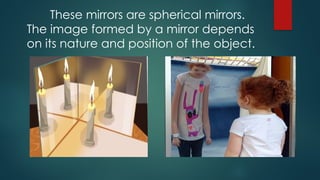
These mirrors are spherical mirrors.
The image formed by a mirror depends
on its nature and position of the object.
A mirror, whether plane or spherical forms
images of objects due to the phenomenon of
reflection of light. In this chapter, We well study the
phenomenon of REFLECTION OF LIGHT.
REFLECTION OF LIGHT
When a light beam traveling in a
medium falls on a boundary leading into
another medium, a part of the incident light
bounces back into the original medium.
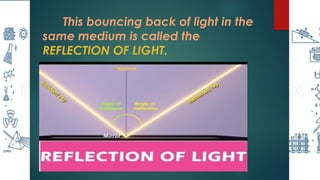
This bouncing back of light in the
same medium is called the
REFLECTION OF LIGHT.
There are two types of reflection
depending upon the nature of the
reflection surface.
These are as follows.
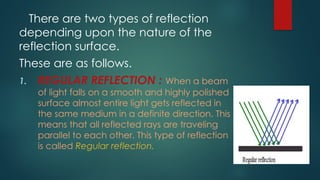
1. REGULAR REFLECTION : When a beam
of light falls on a smooth and highly polished
surface almost entire light gets reflected in
the same medium in a definite direction. This
means that all reflected rays are traveling
parallel to each other. This type of reflection
is called Regular reflection.
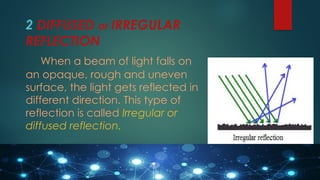
2 DIFFUSED or IRREGULAR
REFLECTION
When a beam of light falls on
an opaque, rough and uneven
surface, the light gets reflected in
different direction. This type of
reflection is called Irregular or
diffused reflection.
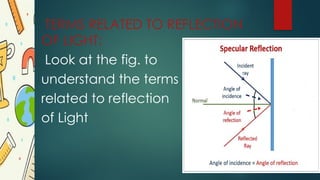
TERMS RELATED TO REFLECTION
OF LIGHT:
Look at the fig. to
understand the terms
related to reflection
of Light
 Incident ray: It is the light ray which strikes.
the reflecting surface.
 Reflected ray: It is the light ray which.
bounces back after reflection from the
reflecting surface
 Point of incident : It is the point on the
reflecting surface where the incident ray
strikes.
 Normal : It is a perpendicular line drown on
the reflecting surface at the point of incident.
 Angle of incidence: It is the angle which
the incident ray makes with the normal
drown at the point of incidence .
 Angle of Reflection: It is the angle which
the reflected ray makes with the normal.

Physical science [ Light energy ]

  • 1.
  • 2.
    We all haveseen and used mirrors, when you get ready to go to your school, you stand in front of a looking mirrors to see yourself. What you see in the looking mirror is actually your image, which is formed due to reflection of light from the looking mirrors. However, mirrors can be curved also. Have you ever seen different funny images of yourself formed by different mirrors placed in a room or in a shop?
  • 3.
    These mirrors arespherical mirrors. The image formed by a mirror depends on its nature and position of the object.
  • 4.
    A mirror, whetherplane or spherical forms images of objects due to the phenomenon of reflection of light. In this chapter, We well study the phenomenon of REFLECTION OF LIGHT. REFLECTION OF LIGHT When a light beam traveling in a medium falls on a boundary leading into another medium, a part of the incident light bounces back into the original medium.
  • 5.
    This bouncing backof light in the same medium is called the REFLECTION OF LIGHT.
  • 6.
    There are twotypes of reflection depending upon the nature of the reflection surface. These are as follows. 1. REGULAR REFLECTION : When a beam of light falls on a smooth and highly polished surface almost entire light gets reflected in the same medium in a definite direction. This means that all reflected rays are traveling parallel to each other. This type of reflection is called Regular reflection.
  • 7.
    2 DIFFUSED orIRREGULAR REFLECTION When a beam of light falls on an opaque, rough and uneven surface, the light gets reflected in different direction. This type of reflection is called Irregular or diffused reflection.
  • 8.
    TERMS RELATED TOREFLECTION OF LIGHT: Look at the fig. to understand the terms related to reflection of Light
  • 9.
     Incident ray:It is the light ray which strikes. the reflecting surface.  Reflected ray: It is the light ray which. bounces back after reflection from the reflecting surface  Point of incident : It is the point on the reflecting surface where the incident ray strikes.  Normal : It is a perpendicular line drown on the reflecting surface at the point of incident.
  • 10.
     Angle ofincidence: It is the angle which the incident ray makes with the normal drown at the point of incidence .  Angle of Reflection: It is the angle which the reflected ray makes with the normal.